UNIVERSITY OF KWAZULU-NATAL
TITLE
Towards improved financial services and treatment of investors in retirements funds By
Michael Lindelani Gcwabaza
Student Number
205524682
A dissertation submitted in partial fulfillment of the requirements for the degree of Master of Business Administration
Graduate School of Business Faculty of Management Studies
Supervisor:
Mr. Leo Deodutt
Year of submission 2013
DECLARATION
I Michael Lindelani Gcwabaza declare that
(i) The research reported in this dissertation/thesis, except where otherwise indicated, is my original research.
(ii) This dissertation/thesis has not been submitted for any degree or examination at any other university.
(iii) This dissertation/thesis does not contain other persons' data, pictures, graphs or other information, unless specifically acknowledged as being sourced from other persons.
(iv) This dissertation/thesis does not contain other persons' writing, unless specifically acknowledged as being sourced from other researchers. Where other written sources have been quoted, then:
a) their words have been re-written but the general information attributed to them has been referenced:
b) where their exact words have been used, their writing has been placed inside quotation marks, and referenced.
(v) This dissertation/thesis does not contain text, graphics or tables copied and pasted from the Internet, unless specifically acknowledged, and the source being detailed in the dissertation/thesis and in the References sections.
Signature:
Acknowledgements
I wish to express my sincere appreciation and gratitude to the following individuals, without whose assistance, this study would not have been possible:
Mr. Leo Deodutt for supervising me during this project, Professor Walter Geach for his assistance during this project,
My wife Thelisile Gcotshiwe and my children for allowing me the time and space to complete this project,
My mother Mama Mbusi for always being there as a life mentor, and
All those who took the time to participate in the survey and for the valuable feedback they provided which formed the basis of this project.
iv
Abstract
It is a common practice that people earn income during their period of active employment and they save part thereof to sustain their livelihoods when they retire. A variety of investment vehicles is available to use as means of saving for retirement. Unfortunately not all persons who save for retirement do retire in a position of financial independence due to a number of reasons including insufficient funds available at retirement to cover the retiree’s cost of living.
This research project aims establishing the most common reasons as to why investors’ savings yield less than what was anticipated or projected at the time of putting the investment plan in place. Data was collected via a questionnaire that was distributed to a random sample of 150 users of financial services using a snow ball sampling approach.
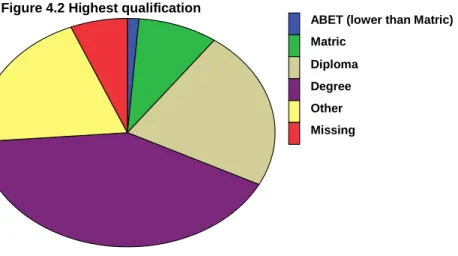
Statistical analysis revealed that 50% of the participants were males and 50% were females. The majority of them (99%) were employed thus had less time to manage their investment portfolios, and that 68% have a tertiary qualification. Only 1.3% have ABET level of education. Of the participants 42% based their investment decisions on the advice given by the financial advisors and placed 85% of their combined investments with the banks and insurance houses. Only 2.5% of the participants had expert knowledge of the investment vehicles they opted for. Of the rest, 35%
indicated that the adviser’s motive was commission driven and a further 17% indicated that the adviser failed to conduct a proper financial needs analysis. Of those who suffered losses 59% lost between R1 and R5,000, 25% lost between R5,001 and R10,000, 13% lost between R10,000 and R50,000 and 3% lost more than R100,000 due to improper advice. It was observed that 53% of the participants did not know or were not sure of where to go for recourse regarding complaints relating to improper rendering of financial services. Only 47% knew how and where to lodge their complaints whilst more than 49% was of the view that literacy and awareness campaigns were not prevalent.
The study could be used by institutions like the Financial Services Board and the Office of the Ombud for Financial Services Providers to strongly consider investing in raising consumer awareness and educating consumers about remedies available to them should a need arise. It could also be used by financial institutions to improve the way they conduct business in order to build a positive reputation and restore investors’ confidence in them – all which are pivotal to entrench a mutually beneficial relationship that is necessary to ensure sustainability of the industry in a longer term.
Table of Contents
Description Page
Title page i
Declaration ii
Acknowledgements iii
Abstract iv
Table of Contents v
List of Figures vi
List of Tables viii
CHAPTER ONE Introduction
1.1 Introduction 1
1.2 Motivation of the Study 1
1.3 Focus of the Study 4
1.4 Problem Statement 4
1.5 Research Questions 4
1.6 Objectives 5
1.7 Limitations of the Study 5
1.8 Summary 6
CHAPTER TWO
2.1 Introduction 8
2.2 Theoretical framework 8
2.3 The regulation of the financial services industry 30
2.4 Previous Researches 33
2.5 Reformulated Problem 38
2.6 Summary 39
CHAPTER THREE
3.1 Introduction 41
3.2 Aim and Objectives of the Study 41
3.3 Data Collection Strategies 41
3.4 Research Design and Methods 42
3.5 Analysis of Data 45
3.6 Summary 46
vi
CHAPTER FOUR
4.1 Introduction 47
4.2 Headings 47
4.3 Summary 62
CHAPTER FIVE
5.1 Introduction 63
5.2 Demographic data analysis and discussion 63
5.3 Research data analysis and discussion 64
5.4 Summary 68
CHAPTER SIX
6.1 Introduction 69
6.2 Solving the research problem statement 69
6.3 Implications of this Research 72
6.4 Recommendation for Future Studies 74
6.5 Summary 75
BIBLIOGRAPHY 76
LIST OF CURRENT AND COMPLETED DISSERTATION 79
(From NEXUS DATABASES – National Research Foundation)
Appendix 1 Letter of introduction Appendix 2 Letter of informed consent Appendix 3 Research questionnaire Appendix 4 Approval for ethical clearance
List of Figures
No. Description Page
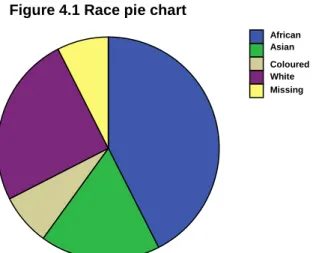
4.1 Race distribution pie chart 48
4.2 Highest qualification 49
4.3 Age group 50
4.4 Investment horizon 51
4.5 Savings are placed with 52
4.6 My level of understanding of investment vehicle option 53 4.7 Were you treated fairly and professionally by the financial advisor 54 4.8 What appeared to be my financial advisor’s motive? 55
How can the financial services industry encourage investors to place more investments with it?
4.9 Treat me fairly and not prey on my lack of knowledge 56 4.10 Educate investors, simplify their investment products... 57
4.11 Become transparent on their cost structure 58
Are investors happy with the way the regulatory bodies discharge their mandate to project them:
4.12 Are investors satisfied with the manner in which the financial services
industry is regulated? 59
4.13 Are literacy and awareness campaigns prevalent and helpful? 60 4.14 Do investors know how and where to lodge complaints? 61
viii
List of Tables
No. Description Page
4.1 Gender distribution 47
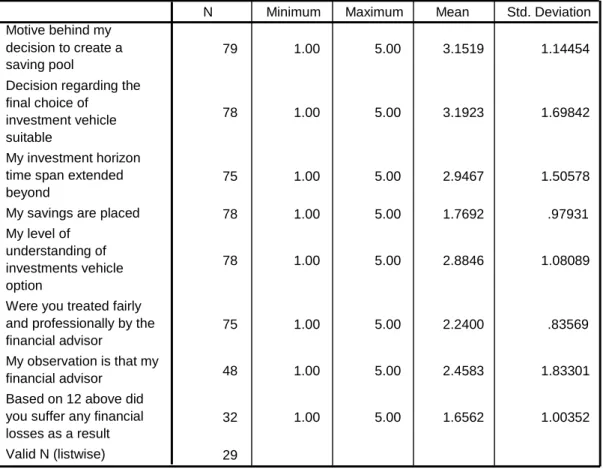
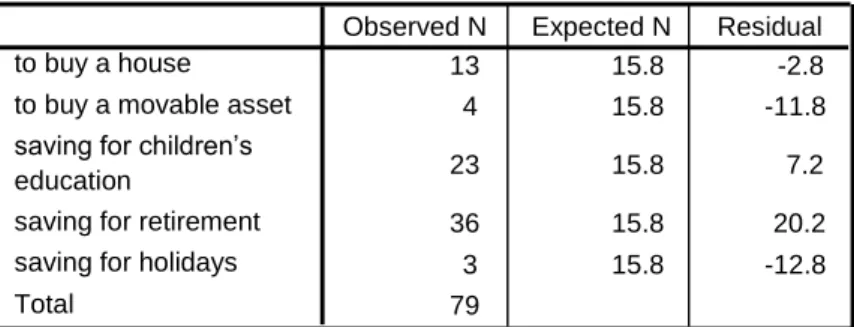
4.2 Motive behind the decision to create savings 47
4.3 Race distribution 47
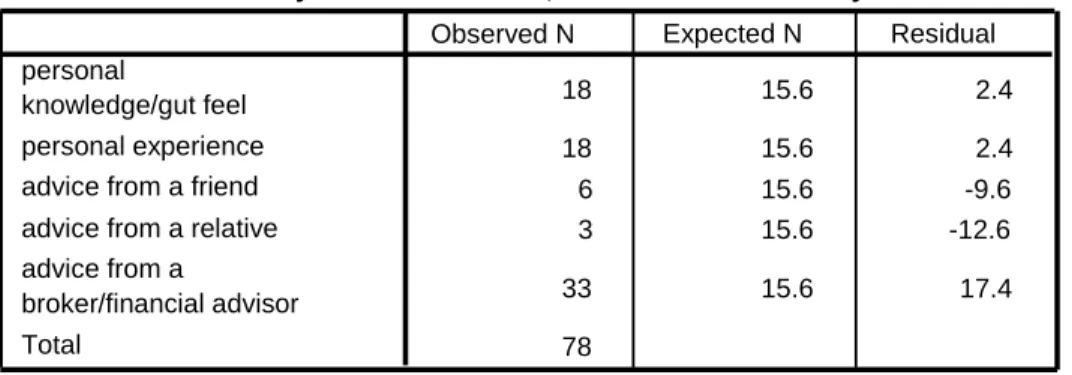
4.4 What influenced my choice of investment vehicle? 48
4.5 Highest qualification 48
4.6 Main activity 49
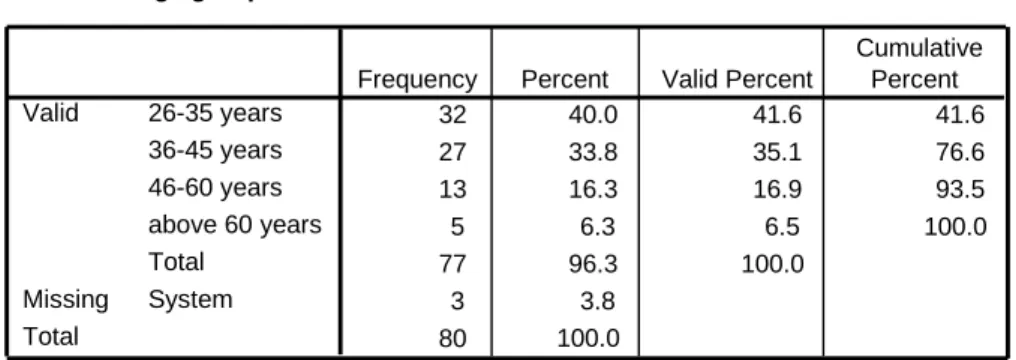
4.7 Age group 49
4.8 Investment horizon 51
4.9 Savings are placed with 52
4.10 What is your level of understanding of investment vehicle options? 53 4.11 Were you treated fairly and professionally by the financial advisor? 54 4.12 What appeared to be my financial advisor’s motive? 55
4.13 How much losses were suffered by investors? 56
How can the financial services industry encourage investors to place more investments with it?
4.14 Treat me fairly and not prey on my lack of knowledge 56 4.15 Educate investors, simplify their investment products… 57
4.16 Become transparent on their cost structure 57
4.17 Seek to fully understand my financial needs 58
Are investors happy with the way the regulatory bodies discharge their mandate to project them:
4.18 Are investors satisfied with the manner in which the financial services
industry is regulated? 58
4.19 Are literacy and awareness campaigns prevalent and helpful? 59 4.20 Do investors know how and where to lodge complaints? 60
CHAPTER ONE Introduction
1.1 Introduction
During the period of economic activity and income earning most people put aside some of their earnings in order to sustain their livelihoods when they retire and become economically inactive.
These savings are accumulated with the hope that they will be adequate to afford the retiree the desired or envisaged standard of living during retirement. Unfortunately not all people who save for retirement do retire financially independent. At retirement stage it often transpires that some of the investors receive what they expected, some get less than what they expected and some get almost nothing from their lifetime savings. There could be a number of reasons contributing to this dilemma, including poor choice of retirement vehicle, poor investment performance, exhorbitant fees/charges, and low levels of savings, economic conditions and foreign exchange fluctuations to mention just a few.
There are various options available to investors to choose from in making their investment decisions and they range from low risk to high risk investment plans. Financial institutions like banks and insurance houses are the most preferred institutions by investors when it comes to placing their savings. These institutions utilise financial models to compute various investment performance permutations using their peculiar language which is often not easily understandable to the majority of those who make use of the said financial services. It is for this reason that a financial advisor/broker is brought into the equation - to understand the financial needs of the investor and then sell (match these needs with) the “appropriate” financial product, offered by the financial institutions/investment houses like insurance companies and banks in order to realise the investor’s financial goals. The remuneration of the financial advisor often takes a form of commission based on the amount of sales/business generated for his employer.
This research project aimed to establish the most common reasons as to why investors’ savings yield less than what was anticipated or projected and advocated by the financial advisors/brokers at the time when the investment plan was put in place.
1.2 Motivation for the Study
The research project will be of benefit to users of financial services and to institutions tasked with the regulation of the financial services industry and those directly involved in the rendering of financial services. It highlights the interdependencies within the supply chain (investor, brokers/advisors, financial institutions, regulatory bodies and the broader society) and provides
an opportunity for all role players to leverage on the relationship to enhance their respective service offerings.
For regulatory bodies like the Financial Services Board (FSB) and Ombud for Financial Services Providers (FAIS Ombud), the observation that 52% of the investors do not know or are not sure of how and where to lodge a complaint and get remedies for losses suffered as a result of negligence or improper rendering of financial services by the financial institution, will help to direct the regulators focus to increasing consumer education and awareness levels. A number of cases adjudicated by the FAIS Ombud did point to the common dilemma and the fact that consumers are being preyed on.
The other benefit is the identification of areas of abuse whereby financial advisors advance their own interests at the expense of the investor. The study indicated that 37% of the investors indicated that their financial advisors’ motives were driven by commission maximisation as opposed to advancing the investors’ interests. Further, 17% of the respondents indicated that their financial advisors failed to conduct a proper client financial needs analysis before giving financial advice to investors. This is a pre-requisite for proper rendering of financial service and giving proper advice. These are clear failures to comply with the provisions of the Financial Advisory and Intermediary Services Act (2002). This suggests to the regulators that they should be more vigilant, increase focus on enforcing compliance and follow up on cases of non compliance and impose appropriate fines where applicable to discourage such incidents from recurring.
The research revealed that the majority (96%) of investors would have more trust in the financial services industry and place more investments with the financial institutions if they could (i) treat the investors fairly and not prey on their ignorance, (ii) be transparent regarding their cost structures, (iii) educate the investors on the intricacies of the product(s) they sell and (iv) use a simplified language when explaining their product(s).
The benefit to the financial institutions such as insurance houses and banks is that they can learn from these observations and root out all the unwarranted practices, such as, (i) preying of investors’ ignorance/lack of understanding of the products sold to them, (ii) advisors focusing on maximising their commission earnings at the expense of the investors all which have infected the industry. By so doing the industry is likely to win over the consumers’ confidence and sustain the business in a longer term by ensuring that their business models do not tolerate any behaviour that discredits the industry and appears to exploit investors in any form or nature.
The study will benefit the investors in that it calls for regulators to be more visible and easily accessible to investors should their services be required. With increased consumer education and awareness levels, investors, knowing their rights, are likely to report cases of misconduct or improper rendering of financial services to the regulator bodies (FAIS Ombud or FSB) for such to be dealt with accordingly. As cases are brought to book, investigated and appropriate sanctions awarded to wrong doers, this will serve as a deterrent and a clear message to perpetrators that their time is over and that their behaviour is not acceptable and will not be tolerated at all.
Financial institutions are likely to treat investors fairly when investors become knowledgeable of their rights. This will help to mitigate most forms of abuse and thus position the investor well to get fair treatment, proper advice and consequently maximum returns on his investment. If most people retire financially independent, the state will be freed up, to some degree, from social grants and rather direct its limited resources to development capital projects that have a potential to propel the economy forward, create jobs and yield better returns for current and future generations.
This study will benefit all stakeholders through its contribution to the following:
Advancing and protecting the interest of the vulnerable investors through increased awareness of regulatory bodies established to protect investors in time of need;
Encourage the financial services industry to treat all investors fairly thus safeguarding their retirement savings and ensuring that they could retire on something, in some instances pass their wealth onto the next generation thus breaking the poverty chain;
Weeding out the unscrupulous agents that are operating scams and defrauding the investors of their lifetime savings;
Restoring the integrity of the financial services industry, increase consumer confidence and thus channeling more business and more profits for the industry;
Improve the South African savings level and instill a savings culture in a longer term; and Relieve government on social grant spending as less people will be dependent on it thus affording National Treasury an opportunity to increase spending on capital investment projects that have a potential to grow the economy and create jobs.
1.3 Focus of the Study
The research project will focus on finding reasons that motivate people to save on one hand and why investors are vulnerable to improper selling of retirement or investment plans on the other hand. It will then make recommendations as to what interventions could be put in place by the institutions mandated to regulate the financial services industry to safeguard the interest of users of financial services (investors) and restore the credibility of the financial services industry.
1.4 Problem Statement
Since most potential investors who seek financial services are not experts in the field, they rely on advice given by the expert financial advisors who, in most cases, know the pros and cons of each financial product that they promote or sell to the users of financial services. It is in this unequal/unbalanced power or relationship that clients could at times be misled or misinformed about financial matters relating to investment choices. This happens often when a financial advisor knowingly promotes a more expensive financial product, say to maximum commission, to the detriment of a client even when a much cheaper product was appropriate for the client’s financial needs.
Those who save for retirement do not always retire financially independent. This could be attributable to a number of reasons including poor choice of investment vehicle, poor investment performance or improper rendering of financial services including but not limited to offering of improper financial advice.
It is often at the end of the investment period that the investor becomes aware/is told that his/her financial goals have not been met and that he/she has to temper his/her retirement expectations now that the capital amount available is less than what was anticipated. This causes emotional and other stresses. Even worse, it makes more people dependent on the state social grant which is a problem on its own as it denies government other opportunities to direct its limited resources to strategic areas of longer term sustainability and economic advancement.
At the end a question is raised as to what could be done to mitigate the mis-selling of retirement plans thus addressing the core and all the related sub problems.
1.5 Research Question(s)
The main question to be answered is whether the rendering of financial services, particularly the selling of retirement and investment plans is done properly to serve the interest of the investors and if not, then what could be done to mitigate the mis-selling of retirement plans? The research
aimed at addressing the main problem and the related sub problems including the following:
Financial services industry prospering at the expense of vulnerable investors;
Defrauding investors’ lifetime savings thus retiring with inadequate savings if at all;
The poverty legacy is inherited by younger generations - thus elongating the poverty chain;
Poor social conditions aggravate the state of health and deny access to better facilities;
and
More people become dependant on the state social grant which strains the fiscus and deny the Treasury opportunities to invest in infrastructural development projects.
1.6 Objectives
The objectives of the study are to:
Establish motives that drive investors to create savings;
Establish where do investors place their savings;
Determine what do investors base their investment decisions on;
Ascertain the level of investors’ understanding of the financial products sold to them;
Establish the common factors contributing to investors realising less than what they envisaged at the time of putting the investment in place; and
To suggest corrective measures that could be utilised by regulatory bodies such as the Financial Services Board (FSB) and the Financial Advisory and Intermediary Services Ombud (FAIS Ombud) in order to curb exploitation of investors through enforcement of compliance interventions to ensure adherence to the existing regulatory framework.
1.7 Limitations of the Study
The research does not attempt to look at all retirement related financial products available nor does it attempt to resolve all the mal-practices that prevail within the financial services industry.
In the main the study was limited by the following:
The study used a quantitative research methodology to source relevant data from 150 respondents; who
Have used financial services for retirement or financial planning purposes; and were Residents in South Africa particularly in Gauteng and KwaZulu Natal and were between 20 and 60 years old; who invited to
Participate in a survey to respond to a quantitative questionnaire that was distributed to random sample of respondents using a snowballing approach; and
All responses were due by not later than November 2010.
1.8 Summary
Having observed from the study that only 2.5% of investors are knowledgeable about the intricacies of the retirement and investment plans it could be reasonably expected that the remaining majority could easily fall prey on the hands of unscrupulous financial advisors due to their ignorance or lack of knowledge. The mis-selling of financial products to one investor is one too many. The socio-economic consequences of losses suffered as a result go far beyond what could be imagined.
The conduct of the financial advisor whilst rendering financial services to the client has an impact on the quality of the advice given. Instances were noted where financial advisors failed to conduct a proper financial needs analysis before giving financial advice. Other financial advisors appeared to be driven by maximising their own earnings at the expense of the investor. When adjudicating on one of the complaints received relating to the Leadergaurd scheme (FAIS Ombud Case number FOC 1807/05/KZN (5) 2007: page 47) the FAIS Ombud stated that:
“If one looks at the pertinent historical information, it is fair to say that South African citizens have repeatedly fallen prey to various bogus investment schemes. Tragically investors in many of these schemes, many of whom are pensioners, lose their life savings and are very often left destitute with only promises of attractive returns in their hands and nothing more. The perpetrators of these schemes usually get away and no money is ever recovered.” He goes on to say “Loss to investors occasioned by the Leaderguard scheme is largely estimated around R300 million”.
The study will contribute to raising awareness to financial services industry stakeholders with the hope that corrective action will be taken to address inherent shortcomings. The regulators will be alerted to a dire need for intensive drive for consumer/investor education in order to raise their level of understanding financial products available and their pros and cons including remedies available to them in time of need. This will enable investors to make informed investing choices when planning for retirement. It will also equip investors to rebut inappropriate advice given, intentionally or otherwise, by financial advisors during their rendering of services to investors.
In the end the corrective interventions will contribute towards fair treatment of investors and increase the likelihood of them realising their financial goals. The more people retire financially independent, the less they will depend on the state social grant system. This will ease the burden on the state resources and allow it to focus on infrastructural development programmes that
could help to grow the economy, create jobs and uplift the lives of SA citizens and generations to come.
The study now turns focus to reviewing literature in order to learn what others had to say or have done in attempt to resolve the problem.
CHAPTER TWO
Literature Review
2.1 Introduction
This chapter focuses of the review of literature relevant to the research problem statement.
2.2 Theoretical framework
According to Cameron (2004) retirement planning is not just a once off event about deciding when to retire. Retirement planning is a long term process and it starts from the day a person commences to work right through to living life after retirement. Cameron (2004) emphasises the point that individuals should start very early to plan and provide for retirement and urges all concerned not to leave this until too late. The earlier a person starts saving for retirement the higher the chances of accumulating enough savings to afford one to retire financial independent, all other things remaining equal.
Missing an opportunity to start saving for retirement earlier in life than at a stage when the retirement age is looming and getting closer and closer makes it expensive and sometime unaffordable, in future to catch up with the savings level required for the investor to realise his/her financial goals. Raphaelson (1982) pointed out that retirement planning is a long term process starting from the day one commences to work, during working life and at retirement age.
According to Cameron (2004) it is necessary for one to revisit one’s retirement plan and the actual financial performance during the build up stage when one accumulates savings towards provision for retirement. This should be done at regular intervals to check if one is on course to realise the financial goals set. This provides an opportunity to adjust the savings plan well in time should it be believed that the goals set are at risk of not being realised.
Schlossberg (2004) pointed out that one needs to have a proper and realistic retirement plan. This involves decisions on matters relating to (i) how much should be provided for retirement, (ii) over how long will the savings be accumulated up to retirement, (iii) for how long could they keep the retiree going at the desired level of lifestyle and living costs, (iv) when should one retire, (v) what savings and investment vehicles are available to make use of to achieve the desired financial and retirement goals. As it can be seen most of these questions could not be answered by any ordinary person without relying on the assistance from an appropriate and qualified person – the financial advisor. A proper financial needs analysis should be conducted to
inform the investor’s choice regarding the optimal retirement plan appropriate to deliver on his/her financial goals. During the investor’s working life the structure of the retirement portfolio and vehicle(s) chosen to provide for retirement must be reviewed and assessed regularly to ascertain if they still remain relevant and appropriate to deliver the desired results given the evolving investor’s financial needs and goals to be achieved at retirement and during the life after retirement.
Cameron (2004) pointed out that one can’t afford to make a decision on retirement planning and then shelve it until retirement age and hope for pleasant surprise when he/she retires. Regular engagements may be initiated by either party to update the other regarding developments that may have an impact on the retirement plan.
The investor may approach the financial services provider to provide an update relating to things like changes in jobs and/or income levels, change in marital status, having a dependent(s), contracting an illness or a life changing event important enough to have an impact on the investor’s financial needs. Similarly the financial services provider may require an engagement to update the investor on things like changes in tax legislation affecting provision for retirement, other new products that are better suited to deliver on the investor’s financial goals quicker or cheaper than the current products or investment portfolio.
There must be regular engagements with the financial services provider to review the performance of the retirement plan taking into account factors like tax implications, changes in the investor’s life circumstances (getting married, having children, changes in job and income levels etc) and age. These regular engagements and reviews provide valuable opportunity to amend/update the retirement plan taking into account the recent developments impacting on the investor’s financial needs.
According to the Old Mutual Personal Savings Survey (2009) it was noted that most people forget to plan for their retirement. The survey pointed out that many people think of retirement as a pain purchase and tend to delay it not realising that one get old and will have to retire eventually. It was further noted from the Old Mutual Personal Savings Survey (2009) that more than half (57%) of the recent retirees look back on the years before retirement and wish they had saved more to prepare for retirement.
Insurance houses suggest that at retirement one needs to earn a monthly income of 75% of one’s
retirement age of 60-65, one has between 38-43 years of working life during which to save for retirement. The question relating to when one may retire depends on a number of factors including one’s state of health, adequacy of the retirement savings accumulated to that point etc.
The results from the Old Mutual 6-monthly Savings Monitor (2010) showed that poor financial planning habits are at the root of poor money management and that failing to get into the habit of saving regularly is one of the biggest reasons why people don’t become financially secure.
According to Manyike (2011) one does need relevant qualification(s) or technical background to become an expert at managing own finances. He adds that by changing attitudes and habits around money, investors can achieve financial goals towards prosperity. Most people intuitively understand that they need to save ‘a little bit’ at the end of the month. But this often doesn’t work, as there always seem to be other expenses that eat into whatever is available. He believes that even if one starts with a small savings amount monthly, one will develop a savings habit that will make it easier to increase one’s savings over time.
Manyike (2011) added that it helps to ensure that monthly savings are automatically deducted from one’s monthly income, before one begins paying for other expenses. By paying ‘savings’ at the beginning of the month, it makes the money unavailable for spending. He mentioned that Old Mutual offers an ‘On the Money’ programme free of charge which teaches people to pay themselves first ahead of their creditors by saving at least 10% of income and live of the balance.
He added that eventually one will forget about the amount invested and not even miss it.
Psychologically it should just become another ‘fixed expense’ in one’s budget because if savings are not automatic or compulsory deduction from one’s income, one may soon find reasons for not putting the money away immediately, or ever, which may bring one’s savings plan to a halt.
He further mentioned that by implementing one of the following methods to make savings automatic one will be on the right path to disciplined savings:
Ask an employer to deduct the money from the salary and pay it into one’s savings account or investment each month;
Arrange a stop order against one’s bank account and deduct an amount towards savings;
and
Sign a debit order authorizing deduction of a sum of money into one’s savings vehicle.
When getting a savings plan together, he cautioned that:
One must always ensure that there are enough funds in the account to cover all debit or stop orders. Banks charge heavy penalties for having insufficient funds on the day that the automatic payments are due;
Make sure the savings/investment is relatively safe and earns good interest. There are thousands of saving and investment options, with different degrees of risk. Some investments go up very quickly in value, but can just as easily lose value suddenly. These are ‘high risk’ investments. Until one’s savings plan is well under way, it is best to steer clear of high risk; and
When starting to save, begin by putting the money into lower-risk investments such as those offered by the banks or post office. Once into the savings habit, one can look into other investments.
According to him the following options are offered as vehicles for saving:
Savings Club or Stokvel Method: Useful for short-term savings, but one should also have an own savings plan and accounts;
Savings Account at a Bank or Post Office: This is a good way to start a savings plan. It is relatively easy to open an account and access it through an Automated Teller Machine card. The accounts do not earn high interest rates;
Notice Deposits: Useful for saving a lump sum that one will need to access in the future;
Fixed Deposit: A safe way of saving for the medium or longer term; and Government Bonds: A good medium-term investment.
He added that other popular savings plans include:
Unit Trusts: A flexible way to grow one’s savings if one can afford to take a medium to long-term view. There is a wide range of fund choices, each with own risk profiles and return levels;
Endowment Policies: This is a long-term commitment – with best results coming through after five years or longer and can potentially provide certain tax advantages to
you. One should endeavor to keep the investment active until maturity to maximise returns; and
Retirement Annuity Fund (RA): This is a great way to build up retirement savings to live off when one retires. There are a number of tax concessions to be enjoyed when investing in a Retirement Annuity (RA) fund. The proceeds of an RA are normally available only from the age of 55 years.
Cameron (2004) agrees with the notion of relying on expert financial advice in making sound investment decisions by investors as he acknowledges that normal investors do not have the necessary and requisite understanding or knowledge required to comprehend the wave of complex financial issues and terms dealt with when considering options available for retirement planning. The following are some of the challenges faced by investors.
The complexities of financial products used to save for retirement are not easy to comprehend by normal investors. The study confirmed this dilemma as it indicated that only 2.5% of the investors had expert knowledge of the intricacies of the investment options sold to them. According to the Old Mutual Investor Survey (2011) 70% of the respondents indicated that they need more education to understand the financial products sold to them. Cameron (2004) indicated that saving for retirement is a long-term journey with inherent risks attached to the fact that the longer the term the more unpredictable the future becomes.
There is a wide choice of investment and portfolio managers to choose from, it is not always obvious which one is an appropriate option or best performer. Cameron (2004) pointed out that one needs to make use of good and reliable professional advice as a guide in deciding on crucial matters relating to retirement planning vehicles, investment horizon and who should invested funds be placed with. The study indicated only 31% of the investors had adequate understanding of the investment options sold to then while the remaining 65% had limited or less than adequate knowledge of the plans sold to then.
Different investment and retirement saving plans have different tax implications or treatments with some more favorable than others. The South African government encourages investors to invest in retirement plans by giving tax concessions to those that save for retirement either through pension fund or retirement annuity vehicles. Most retirement saving vehicles, registered under the Pension Funds Act, Act 54 of 1956, attract a tax concession to encourage the investor to save for retirement. Proper advice
regarding the tax implications of each retirement vehicle should be sorted and applied in manner that maximise returns for the investor.
There is necessity, according to Brueggeman (2005), for factoring in estate planning and proper writing of a will. Most investors are not aware of a requirement and implications of having to pay estate duty tax. This may have unpleasant consequences to the survivors as it erodes the capital base left by the deceased as a provision for the livelihood of his/her dependents. As much as 20% of the taxable estate value could be lost in a form of tax depending on the value of the estate. Others take out life assurance policies to cover for this eventuality.
The time and expertise required to plan and manage one’s own investment affairs. Most investors do not know how nor have the time to manage their portfolios properly. The study indicated that 92.5% of the respondents were employed. This suggests that they do not have the time to actively manage their investment portfolios hence a need to entrust someone to that on their behalf. Cameron (2004) pointed out that one needs to make use of good and reliable professional advice as a guide in deciding on crucial matters i.e.
retirement planning. Retirement is a long-term process and by virtue has uncertainties attached to it. The long-term horizon of retirement planning increases the level of inherent risks and uncertainties attached to it. The study indicated that most investment plans extend over a period of more than 10 to 20 years.
Cameron (2004) mentioned that investors need to make sure that pension savings accumulated during working life are adequate to cover the individual self and the spouse well into and after retirement until they both pass away. Planning for retirement does not just end at retirement stage. It goes on into life well after retirement. The life expectancy indicators are improving and suggest that an individual may live for 20-25 years after retirement. All these factors and many more should be taken into account in setting goals when planning for retirement. It is necessary therefore to be realistic and comprehensive when dealing with retirement planning issues.
Moodley (2002) observed that it was clear that investment clubs have played a major role in the rural local communities and their philosophy of saving. Investment clubs are established by a pool of local individuals who commit to contribute a certain sum of money at a particular period of time. The money is left in the savings pool to accumulate over time. Alternatively the money is made available to each member on a rotating basis to afford them large sums of cash to
purchase a valuable possession etc which they otherwise couldn’t afford to buy from their own savings. He concluded that this has helped rural communities over decades and is the most trusted way of saving among most primitive and rural communities and is commonly known as stokvel.
According to the South African Saving Institute (2010) the government is concerned about the low savings ratio (18% of GDP) and lack of a savings culture and is considering introducing compulsory savings in order to improve the situation. The SANLAM Retirement Benchmarks (2010) suggest that only 1 in 10 people will retire financially independent and noted that the working class of nowadays wants instant gratification and is not willing to wait and save (accumulate funds required) to fulfill their wants and needs. Those who retire with less income tend to rely more on social grants to sustain their livelihoods when they retire. According to Le Roux (2012) with many governments around the world needing to focus heavily on reducing their budget shortfalls and containing their outstanding debt levels, an early casualty of fiscal tightening has been social security cutbacks such as pension benefits and lifting the retirement age.
Le Roux (2012) added that as national budgets are under heavy pressure, people worldwide will have to accept that governments will not be able to lend much support during their retirement years and therefore people will have to care for themselves and this will likely require much higher savings during their working periods and that South Africa, while less constrained fiscally compared to America and other European countries, will be no different. Sonn (2011) observed that while most people are aware that saving and planning for their future are essential to their quality of life and financial security, many do not know how to go about it. He concluded that investor’s interventions should be geared towards creating a positive outlook to planning ahead because a clear vision, backed by definite financial plans, will enable South Africans to do great things with their hard earned money.
The extent of the country’s low savings rate (16%-18% of GDP in 2009) was so concerning that the former Minister of Finance, Hon Trevor Manual recommended the establishment of the South African Saving Institute (SASI) in 2011 as an independent non-profit organisation dedicated to developing a robust culture of saving in South Africa. When launching SASI in April 2001, the then Minister of Finance, Trevor Manuel, drew attention to the poor savings rate;
disparate living standards; lack of financial literacy and the poor growth of the economy. He
noted that these concerns may all be mitigated through improvements in the savings culture by all sectors in the South African population.
Since inception SASI aimed to raise awareness among South African citizens to be a saving nation in order to create wealth and reduce debt. In the key note address by the current Minister of Finance, Gordon (2011) at the 10th anniversary of SASI highlighted the following:
In comparison to other developing economies internationally, South Africa’s savings rate has not performed well. The 2010/11 Global Competitiveness Report noted that South Africa’s gross saving rate equated to 16% of GDP in 2009, compared to China’s 52%;
India’s 37%; and Russia’s 22% in the same year;
As a consequent, economies with higher savings ratio are the ones that lead the way in the 21st Century. These are the countries whose populations are investing heavily in their nation’s development;
South Africa’s savings rates have been significantly lower than its economic and structural characteristics permit. South Africa is missing out on the savings dividend that should result from having a large workforce relative to the retired population, not least because the high rates of youth unemployment means that the dependency ratio is not as low as it should be; and
The overall lack of savings by South African households. Between 2001 and 2010, the household savings rate declined by an average of 0.1% of GDP every year. Reasons for this include people’s ’short-term’ outlook, the lack of transparent and cost-effective savings products, and poor financial awareness among potential investors. This was compounded by the consumerist attitude in South Africa, which often has the ultimate impact of more people being highly indebted.
Gordon (2011) added that one of the most important factors in this poor savings culture is the persistence of high unemployment, which means people may not be earning enough income to save or might have to use up their savings during lengthy spells out of work. A sub-optimal equilibrium of low rates of savings and investment, low employment-intensity of production, and slow productivity growth has emerged. Yet a positive influence to any one of the three elements can generate a positive virtuous cycle of faster capital accumulation, job creation and technological advancement.
Gordon (2011) went on to explain the importance of being a saving nation by highlighting that:
An entrenched savings culture among South Africans would achieve important goals at both an individual level and for the country as a whole. A high savings rate would allow SA to meet its investment needs domestically, supporting the government’s commitment to a developmental state without borrowing from other countries and their investors. This would save on debt serving costs, make SA less reliant on volatile short-term capital inflows for funding, which can easily reverse and pose risks of instability for SA’s emerging economy;
SASI has been spreading the message of the many benefits of savings for individuals too.
For example, savings provide individuals with a decent retirement base, a basic right that only 10 per cent of South Africa’s pensioners currently enjoy. The rest of the elderly population – many of whom were once able to work and provide for themselves – is forced to rely on Government or others for support when they stop working. Savings also allow individuals to protect themselves against unforeseen events. Insurance against short-term risks like car accidents and loss of property, and against longer-term risks like death or disability, is an important form of saving. Medical aid contributions also ensure that one does not need to maintain large cash reserves to meet unpredictable future health care needs;
There is a need to go beyond what one calls ‘necessities’ in terms of the role of savings.
An entrenched savings culture means South Africans must develop an attitude of saving for major expenses and goals, instead of relying on easy credit and long repayments to purchase whatever luxury goods seem desirable at the time;
According to the SASI annual report (2011) one of SASI’s initiatives involves teaching children to save, inculcating the importance of saving for items that they want and need.
As adults one should lead by example – show the young people the value of setting money aside each month for future use, for a deposit on a house or provison for children’s education; and
South Africans should establish a culture of saving. No matter how well one manages one’s finances, events occur that one doesn’t have control over. Without savings, such
‘rainy days’ could wash away one’s money and drown one in debt. In terms of what is the government doing to encourage savings, Gordon added that Government is considering a
number of reforms and initiatives to support and encourage household savings including a development of a policy document, by the National Treasury, called ‘A safer financial sector to serve South Africa better’. This document touches upon important issues, such as financial inclusion, consumer protection, private and public sector retirement reforms, and the costs and transparency of financial products. A safer financial sector can go a long way in encouraging higher savings among consumers.
Gordon (2011) mentioned that Government is also engaging with the financial services industry to examine the various savings products offered, with the aim of trying to make these more transparent and cost effective as it is vital that those entrusted with looking after investors’
savings and providing financial advice ascribe to the highest standards of integrity and training.
He added that pension scandals, inter alia Leaderguard Scheme and Fidensure, have provided a timely and unhappy reminder of the need to enhance governance and educate trustees, if necessary, through legislation. Government will continue to engage with the industry on this matter and needs to find ways to align and orient the savings that people we have with our national goals.
Gordon indicated that Government has also developed its own set of affordable and safe savings products, available directly to savers. The RSA Retail Savings Bonds were introduced by the National Treasury in 2004; since then South Africans have invested a total of R9.3 billion in these bonds. Today, there are close to 77 000 active investments in the bonds, and over 37 000 active investors. Given the success of these products, Government was planning to introduce a New Top-Up Retail Savings Bond in 2011, aimed at attracting smaller investors. Currently, there are two series of bonds on offer – the Fixed Rate and Inflation linked bonds. Each need a minimum investment of R1,000.
He added that interactions with the public indicated that many more people would invest if they had the option to top up their investment rather than have a once-off investment. The National Treasury is therefore working on a new series of bonds, the Top-Up bonds, to meet this need.
These bonds will need a minimum investment of only R500 and will also allow investors to top up this investment whenever they can. They can top-up for as little as R100. At the end of the three year investment period, they will also have the chance to rollover (or reinvest) their payout.
Like all SA Retail Bonds, they will carry no fees or commission. Government hopes to see more and more South Africans, and especially the youth, take advantage of the competitive rates and the security that the bonds provide.
Gordon added that SA should also note the important role played by lower-tier banks like co- operative banks. These banks, which are member-based, encourage savings in a trusted common- bond set-up and provide an affordable, accessible and convenient alternative to those who may otherwise be financially excluded from the formal financial system. Encouraging savings in co- operative banks is particularly important because co-operative banks reach people who are situated in deep rural areas. It is because of this important role played by co-operative financial institutions that Government has put in place proper measures to supervise them through enacting the Co-operatives Banks Act in 2007.
According to Van Zyl, Botha and Skerrit (2003) when deciding which vehicle to use in saving for retirement, investors have a choice among the following:
Pension fund;
Provident fund;
Retirement Annuity;
Real estate/property investments; and
Direct investment through the Stock Exchange (shares).
For the purposes of this study focus will only be given to the first three vehicles i.e. the pension fund, provident fund and retirement annuity.
According to Van Zyl, Botha and Skerrit (2003) pension and provident funds are retirement funding vehicles available to persons that are employed. The funds must be registered under the Pension Funds Act of 1956. The main purpose of these funds is to collect, invest and administer money contributed by its members. The ultimate objective is to provide retirement funding benefits to participating members on the grounds of retirement or disability. The funds further provide benefits to the survivors of the members on the death of a participating member.
Van Zyl, Botha and Skerrit (2003) added that these funds are separate legal entities from the business of the employer. Their affairs are distinct from those of the employer as they are managed by trustees who have a duty to report to the members/investors and to the Registrar of Pension Funds at the Financial Services Board. Therefore money invested by members into these funds are safe from many problems/risks that may be encountered by the employer including sequestration. This is aimed at securing the savings in the event that the employer’s business is taken over or when the employer is bankrupt or insolvent. The trustees are entrusted with a duty to manage the fund on behalf of and for the benefit of the participating members. Using the guidance of actuaries and other experts the trustees design the most appropriate investment
strategies and implement them to achieve the funds objectives for the benefit of the members.
According to Van Zyl, Botha and Skerrit (2003) there are two types of retirement funds: defined contribution and defined benefit fund. A defined contribution fund is the one that sets a certain amount of contribution to be made on a regular basis until the age of retirement. The amount that would be received by the members/investor at retirement is not known and depends on factors like regular contributions made, duration of the investment and the fund’s performance during the investment period. On the other hand, a defined benefit fund is the one that stipulates the amount of the benefit that a member would be entitled to on the date of retirement, depending on his length of service, irrespective of how much he has contributed to the fund.
Van Zyl, Botha and Skerrit (2003) indicated that when both the employer and the employee contribute towards the fund, it is referred to as a contributory fund. Where only the employer contributes to the fund, it is called a non-contributory fund. Employers prefer defined benefit funds because of the following advantages:
It is easy for members to understand the nature of benefits and estimate the quantum;
Members have a wide choice of forms of benefit to choose from and thus greater flexibility; and
There are less complications in apportioning surplus to members when it is arises.
According to Van Zyl, Botha and Skerrit (2003) a defined benefit pension/provident fund have the following advantages to the investor:
Benefits are guaranteed. This means that the investor would get his/her amount promised no matter what;
The employer takes the risk of financial markets’ performance. Should returns on investments be not as expected, the employer fills up the gap; and
There is an opportunity to receive extra income if the returns are better than expected – surplus apportionment.
According to Van Zyl, Botha and Skerrit (2003) the above attributes of the defined benefit fund are watered down by the following disadvantages to the investor:
There is no room for choosing which investment portfolio to invest in since the employer takes responsibility for managing the fund and its performance; and
There is less flexibility of benefit options to choose from. This may adversely affect those whose needs might not be catered for by the current plan chosen by the employer. Since
the employer guarantees the benefits, he/she can also set the limits and leave no room for negotiating them.
Van Zyl, Botha and Skerrit (2003) noted that nowadays both employers and employees prefer a defined contribution fund. This is a fund where the employer and or the employee contribute, on a regular basis, often monthly, a fixed sum of money towards retirement savings and is often a percentage of the employees’ annual remuneration. According to Van Zyl, Botha and Skerrit (2003) the advantages to investors of a defined contribution fund include the following:
Members share directly from better investment returns;
Contribution is fixed by way of a formula and easily determinable;
It is easy for members to understand the benefits;
There is no cross-subsidisation among members – each investor pays for his equivalent cost and gets his fair share of the returns; and
Benefits purchased from insurers are flexible and may be structured to suit the individual needs of most members.
According to Van Zyl, Botha and Skerrit (2003) the above are attractive and compelling reasons for opting for a defined contribution fund. But it is worth noting the shortcomings of a defined contribution scheme which are the following:
No guarantee as to the eventual amount receivable at retirement. It could be more or less than what was expected depending on the investment returns or performance over years;
Members carry the investment risk or burden of poor investment returns which may be beyond their control; and
On retirement, the pension purchased by the members may be smaller thus not adequate to maintain the desired living standard envisaged prior to retirement.
Having noted the most commonly used vehicles for retirement saving, it is important to note that each has its own characteristics and pros and cons. Drew (2003) pointed out that it all depends on the circumstances of the investor at the time of making the choice. There is no one size fits all solution. There is a need to look at the age, risk appetite, the affordability, the health, the tax status of the investor before choosing the most appropriate retirement saving vehicle. Having dealt with pension and provident funds, the study now turns focus to retirement annuity.
According to Van Zyl, Botha and Skerrit (2003) a retirement annuity (RA) is a vehicle for saving for retirement whereby a person agrees to pay a particular sum of money usually on a
monthly basis until he/she reaches the age of retirement in return for a series of payments (annuities) to be made to his/her after retirement to sustain his / her livelihood post retirement.
Depending on the amount put aside monthly and the number of years remaining before the age of retirement, the value of annuities to be paid to the retiree is determined. As withdrawals are made, the capital sum accumulated at retirement is reduced until the full sum is depleted depending on the retiree’s length of life post retirement.
Van Zyl, Botha and Skerrit (2003) identified the following advantages for the RA:
It is owned by the investor and has a say on how best it could be managed. The investor has a say on how the RA is managed, how to structure the investment portfolio, risk tolerance etc;
It is portable in that a person may change jobs without affecting its ownership or terms.
Most pension schemes are administered by employers and allow only employees to be members to the fund. Upon termination of employment the investor usually looses entitlement to the membership to the pension or provident fund;
A person does not have to be employed – anybody may buy an RA. Self employed individuals or those appointed on temporal basis are allowed to buy an RA to save for retirement whereas membership to pension schemes is only allowed to persons that are employed on a permanent (or sometimes fixed term contract) basis;
Savings are secured and only accessible at retirement – no risk of early encashment or misuse. When a person changes jobs the RA savings are not affected at all. The person has no option what so ever to cash in the savings already accumulated before reaching the age of retirement; and
RA contributions are fully tax deductable (within the ambit of the Income Tax Act of 1962). All contributions to an RA are tax deductable up to 15% of the person’s non pensionable income. In effect a person taxed at a marginal tax rate has to part with only 60% his RA contributions.
According to Van Zyl, Botha and Skerrit (2003) the RA has the following disadvantages:
There is a huge cost structure associated with setting up a RA. Most RAs are
administered over a long-term under a life assurance framework. They attract commission and high set up costs since it is a long-term investment;
The value of the savings usually starts to accumulate only after three years. The high set up costs and commission makes the growth curve to be relatively flat during the initial stages of the RA and gradually pick up in later years; and
The RA savings may only be accessed at retirement or upon death. Even when the investor has a more important and compelling reason to cash in the savings accumulated on the RA the rules do not allow access to such until at retirement.
Cameron (2004) identified four broad stages in saving up to retirement as follows:
Build up to retirement (during working life);
The last five years before retirement;
At retirement (point or retiring); and In retirement (life after retirement)
2.2.1. In the build up to retirement
According to Le Roux (2011) one should ask a financial adviser to help to assess how much one need to save for retirement the moment they start working. He emphasises the point that starting sooner to save is better as time is one’s best asset when it comes to building capital over time. For example, if one had invested R250 a month in the Old Mutual Investors’ Fund (a unit trust) from January 1990, one would have R469,000 in 2011, having contributed a total of R68,000. This shows the power of compounded returns over time.
Cameron (2004) reminds investors to set realistic retirement income targets taking into account their living expenditures and lifestyles. The later one starts saving for retirement the most costly and heavy it becomes to realise one’s retirement goals. Investors need to be wary of the following factors:
2.2.1.1 The retirement income gap. It is common that accumulated savings at retirement do not always equate to what is ideally required to maintain the same life style or to support the envisaged living costs. According to Le Roux (2011) only six percent of retirement fund members retire financially secure, with most only realising shortly before
retirement that they have not saved enough. According to the South African Saving Institute (SASI) – Savers Review (2010) the level of savings in the SADC region reduced from 16% of GDP in 2006 to 11% of GDP in 2010 compared to United Nations benchmark of 25% required to reduce poverty.
The South African Reserve Bank economic report (2012) highlighted the following:
Savings ratio to GDP continues to perform poorly in South African economy when compared with other emerging economies in that the national savings rate decelerated to 16.1% in the second quarter of 2011 from 16.3% in the previous quarter;
The huge challenge faced by South Africa concerning savings is the higher levels of inequality in that the larger proportion of South African citizens fall in the lower income bracket and as a result the few high income earners can’t make up for the desired savings ratio; and
It is thus of critical importance for an enabling environment which will promote employment creation to be prevalent in South African economy. Generally, South Africans consume all they earn (i.e. I=C). They cannot save enough to finance future needs hence they resort to borrowing. They end up being caught in a debt trap and as a result prolong their saving plans.
According to The South African Reserve Bank economic report (2012) some South Africans use their children as substitutes for their retirement policy. They expect their children to finance their needs during retirement and this burden on children has huge negative implications on future savings by the present youth and end up being an endless cycle of non-saving South Africans.
Le Roux (2012) indicated that dependency ratios (the number of people who depend on the state for assistance) are rising because of weak employment growth. With unemployment standing at around 25.7% and the outlook for job creation looking dim due to slowdown in the domestic economy with spill over effects emanating from advanced economies, in the short-medium term, the savings rate is unlikely to grow due to pressure mounting on consumers and fears of a double-dip recession underway according to the South African Reserve Bank economic report (2012). A dedicated effort with focused interventions from the investor community (individuals and the entire
nation), the financial services industry and the state is required in order to address the current low savings ratios and the underlying issues in order to reverse this trend.
Le Roux (2012) noted that governments are struggling to meet the social demands and are cutting back on pension and other social benefits, while raising retirement ages. South Africa could be affected by these trends, so one must provide for one’s retirement. It is important to take into account all related cost factors when planning for retirement. These include medical costs during retirement, the cost of living and the cost of supporting extended families, children and parents etc.
According to Madikiza (2011) most SMEs do not yet offer retirement funds to their employees because retirement funds are perceived as costly, complicated and time consuming. Umbrella funds, which addresses many of these concerns, are an option for small employers. Furthermore, he noted that many South Africans, especially those in the lower income earning brackets, view retirement savings as a luxury and not a matter of urgency.
The Old Mutual Retirement Monitor (2011) revealed that 59% of the respondents' primary savings motivation was the need to save for their children's education. Madikiza (2011) explained that this pressure on middle aged people (35-49 years) to focus on saving for their children's education meant that their retirement preparation was likely to fall short. Madikiza (2011) added that a possibility exists that some respondents regard their children as a form of substitute retirement policy and that it remains very concerning that only 54% of respondents who are 10 years or less away from retirement are actually saving for that retirement.
2.2.1.2 The effect of inflation. According to Cameron (2004) inflation is a measure of the extent to which a commodity looses its value/buying power over time. It is also relative to the time value of money in that a rand is worth more today than in future. The retirement savings plan should build into it a cushion to absorb the erosive effect of inflation. This is crucial in instances where the average return on investment is lower than inflation. In essence investors’ money is not only stagnant (not growing) but it is also loosing its base capital (value of money). The savings plan should therefore realise nominal growth that is higher that inflation in order to grow in real terms.