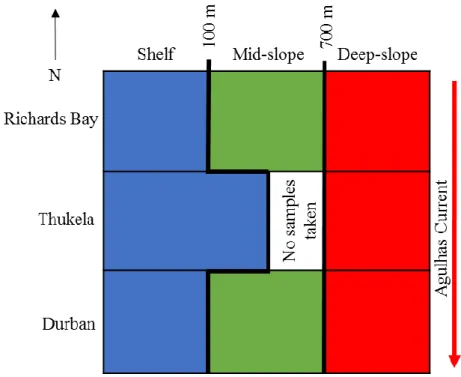
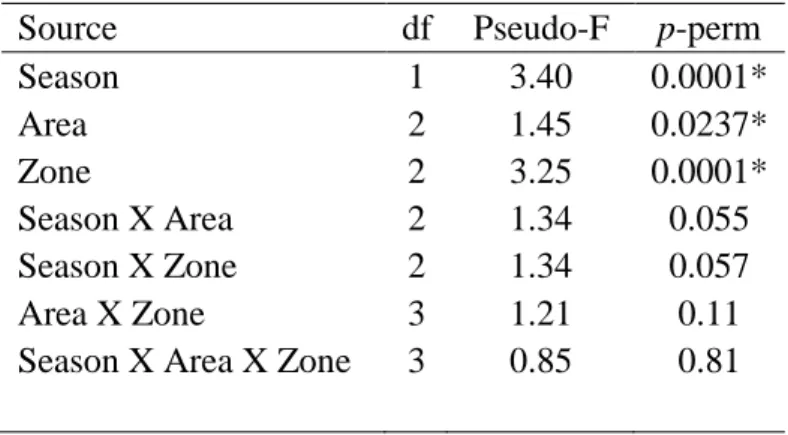
PERMANOVA of the larval fish community recorded in the Wet and Dry season across the KwaZulu-Natal Bay, 2010. PERMANOVA of the larval fish community recorded in the Dry season across Areas and Zones of the KwaZulu-Natal Bay, 2010.
INTRODUCTION
- Fishes of South Africa
- Larval fishes and research in South Africa
- Objectives and aims
- Thesis outline
Larvae of most fish occur in the photic zone of the water column, up to 200 m depths (also known as the epipelagic zone). Larvae of the family Sparidae (sea bream) were most abundant in the surf zone (Harris et al., 1999).
DESCRIPTION OF STUDY AREA
- Locality and climate
- Oceanography
- Substrate
- Nutrients and primary productivity
- Secondary productivity
Shelf sediments of the KZN Bocht are mainly sandy and interspersed with areas of reef (Green and MacKay, in press). Compared to the west coast of South Africa (an upwelling/phytoplankton driven system), the number of fish from the KZN Arc is relatively low.
MATERIALS AND METHODS
- Larval fish sampling
- Environmental parameters
- Laboratory procedures for larval fishes
- Data analysis
19 the depth of the sampler and overemphasize the abundance of organisms at a specific depth (Bowles et al., 1978). Water mass history is considered one of the most important factors in structuring large-scale fish larvae (Cowen et al., 1993).
RESULTS
General
Two samples had no larvae, both in the wet season, one on the shelf (T2) and the other above the Midslope (T14). During the two studies, 59 and 50 samples were taken during the day and at night, respectively. There were no significant differences in larval fishing densities or numbers of taxa sampled during daylight versus nighttime hours when data were pooled across seasons (Figure 8).
Analysis of community differences using ANOSIM also found no significant difference between day and night larval fish composition. This indicated that larval fish communities sampled during the day did not differ from those sampled at night and allowed further analyzes to be conducted without considering possible confounding effects of sampling time. Mean numbers of taxa and densities (±1 SD) of larval fish sampled during the day and night, pooled across Wet and Dry season surveys of the KwaZulu-Natal Bight, 2010.

Environmental conditions
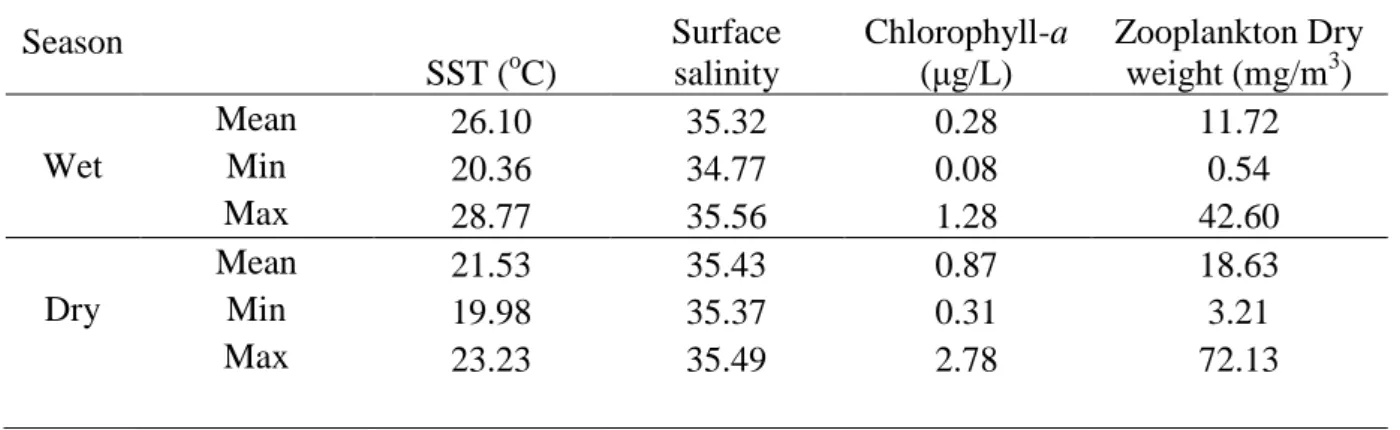
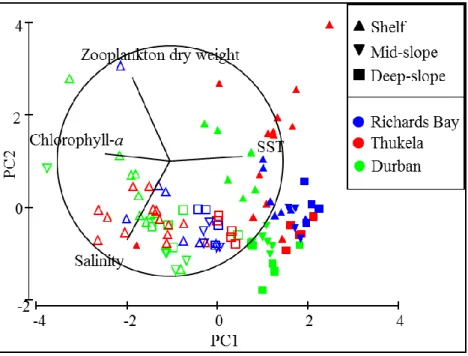
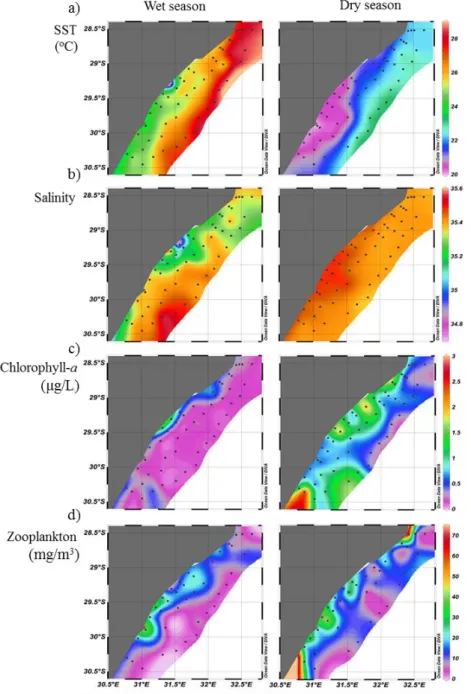
The highest readings occurred near the coast along the entire coastline in both seasons with peaks at the far northern and southern ends of the dry season (Figure 9d). In general, zooplankton dry weight was lower and more homogeneous with distance offshore, especially in the wet season (Figure 9d). The most influential parameters in these differences (as indicated by vector overlays) were SST, which was higher in the wet season, and chlorophyll-a, which was higher in the dry season.
During the wet season, salinity on the shelf (especially in the Thukel area) was lower than in the mid- and deep-slope zones. Principal components plot of environmental variables measured during wet and dry season surveys in KwaZulu-Natal Bight, 2010. PERMANOVA of environmental variables recorded during wet and dry season surveys in KwaZulu-Natal Bight, 2010.
Larval fish assemblage
Number of samples (N), mean number of larvae (larvae/100m3) and standard deviation (SD) of area zones during wet and dry season surveys of the KwaZulu-Natal Bight, 2010. Average densities (also expressed as % contribution to total density per season) of larval fish families and the total percentage occurrence (presence in samples) of each family across all samples recorded in the KwaZulu-Natal Bight during the wet and dry seasons, 2010. Contributions (in percentage of total larval fish density) of common fish larvae families on the Shelf, Mid-slope and Deep-slope of the KwaZulu-Natal Bight, 2010.
Contributions (by percentage of overall larval fish density) of larval fish families common along Durban, Thukela and Richards Bay along the KwaZulu-Natal Bight, 2010. Mean number of taxa, species richness and diversity (±1SD) of larval fish sampled in each Zone (Rak, Midslope and Deep slope) of the KwaZulu-Natal Bight. Results of ANOVAs of univariate indices of the KwaZulu-Natal Gulf larval fish community by Season, Area and Zone.

Multivariate analyses
Results of Pairwise PERMANOVA of the larval fish community between areas and zones recorded in the wet and dry seasons in the KwaZulu-Natal Bight, 2010. DistLM results (marginal and sequential tests) describing the relationship between the larval fish community and environmental variables of the KwaZulu-Natal Bight, 2010. PERMANOVA of the larval fish community in areas and zones recorded in the wet season in the KwaZulu-Natal Bight, 2010.
CAP plot of the larval fish community in the KwaZulu-Natal Bight area zones during the wet season, 2010. The separation between larvae in different zones is evident from CAP analysis (Figure 18) of the larval fish community in the dry season. CAP plot of the larval fish community in the KwaZulu-Natal Bight area zones during the dry season, 2010.
DISCUSSION
General
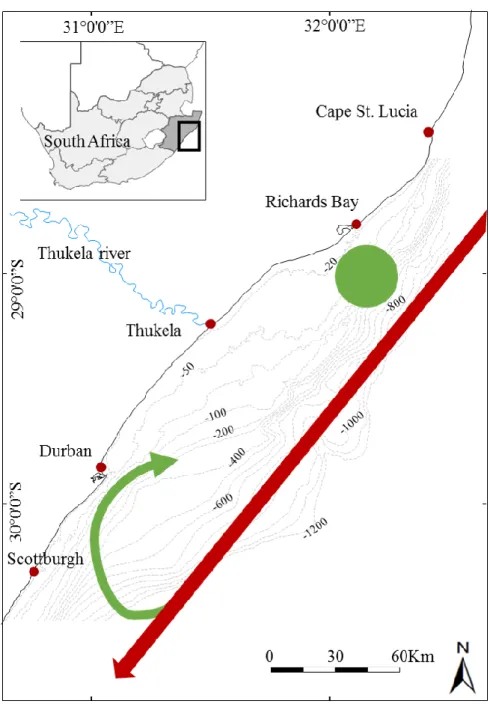
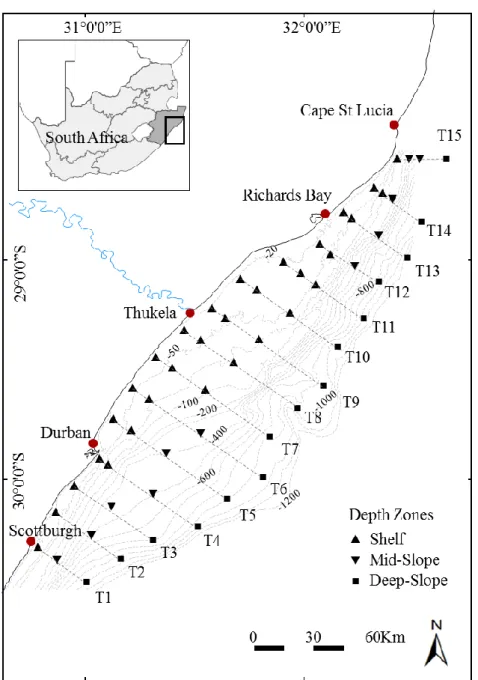
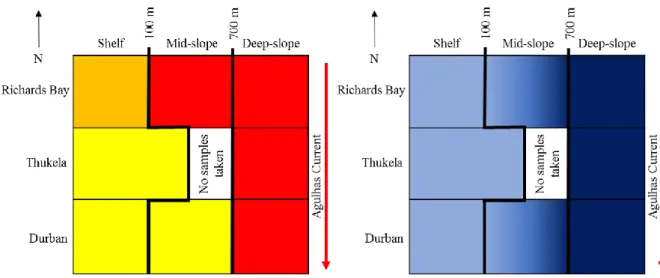
63 Also, in a downwash warm core off Western Australia, assemblages were patchy and varied considerably with distance from the center of the eddy and with depth, which was attributed to the depth of the mixed layer (Muhling , 2006). The first delineation, that of distance to shore, which separates each transect into Shelf, Mid-slope and Deep-slope zones, can be linked to the predicted presence of the Agulhas Current in the deep slope versus this first delineation was well thought out, because during the current study there was indeed a strong presence of the Agulhas Current over the deep slope, especially in the wet season (Figure 9).
This could potentially have influenced larval assembly patterns through habitat association, and was taken into account when testing the interactive effects of the different factors. Although no upwelling occurred at the time of sampling, overall its effects still appeared to have manifested, and other spatial principles of the conceptual model (proximity to the coast and the Agulhas Current, depth, latitude and habitat) still apply, i.e. as such, the data in the current study are considered fit for purpose and the results are considered to have substantial value in improving the understanding of this part of the life history of KZN fish.
Broad patterns in KZN Bight fish larvae
Chlorophyll-a concentrations in the Benguela upwelling region typically range from 5 – <15 µg/L, depending on the season (Carr and Kearns, 2003). However, a maximum chlorophyll-a concentration of 117 µg/L was recently observed in the Benguela ecosystem (Barlow and Lamont, 2012). In the KZN Bight, a study close to the sampling time of this study recorded chlorophyll-a levels between µg/L (Lamont and Barlow, 2014), similar to those recorded during this study.
The maximum zooplankton biomass recorded for northern Benguela by Kollmer (1963) was twice that recorded in the KZN Bight (Pretorius et al., in press), as was the average copepod biomass in southern Benguela during annual autumn and summer cruises over a 16-year period. annual time series (Huggett et al., 2009). In Australia, Smith and Suthers (1999) and Muhling et al. 2008) reported similar numbers of offshore taxa to those obtained in this KZN Bight study (Table 18) and attributed the high larval diversity to the convergence of tropical and temperate waters. While larval fish densities were relatively low (discussed above) compared to other southern African areas, the number of larval taxa recorded in the KZN Bight in this study was greater than those recorded in offshore studies to the west, south and south of the East Coast (e.g. Olivar and Shelton, 1993; Tilney and Buxton, 1994).
Commonly-occurring KZN Bight fish larvae
The tripterygids in this study were largely concentrated in shelf waters (Figure 20c), particularly south of Durban in the wet season and off Richards Bay in the dry season (Figure 20c). Atractoscion aequidens (geelbek) larvae occur commonly along our coastline (Tilney and Buxton, 1994; Wood, 1999; Beckley, 1993) and may be the more abundant of the three sciaenid taxa noted in this study. In the Durban seine fishery survey, Clupeidae (Sardinops sagax) were third highest in abundance (Beckley and Fennessy, 1996).
Pomadasys olivaceus of the family Haemulidae are extremely common in the study area (Fennessy, in press). The Gobiidae (gobies) in this study were mostly encountered during the wet season in the Thukel area. Therefore, it is interesting that objetids (left-finned flounder) were abundant and characteristic of the Deep-slope in this study.

Distribution of fish larvae in Wet and Dry seasons
For example, larvae of the migrating Pomatomidae and Sciaenidae are retained in shallow waters that are used as nursery areas (Beckley, 1993; Hutchings et al., 2003). Shallow-water leiognathids, sciaenids, and tripterygiids were characteristic of the shelf waters, while deep-water phosichthyids, several myctophids, scombrids, and bathylagids appeared in off-shelf samples. It has long been known that the oceanography of the east coast of South Africa has a major influence on the marine biological communities (McNae, 1962; Heydorn et al., 1977).
There is agreement with this observed in this study, with SST being the most reliable abiotic predictor of the larval fish communities. 80 to temperature directly, but more likely via the biology of the species, particularly their spawning periodicity. Historical studies have shown that the Agulhas Current is present 80% of the time outside Durban and that its inland boundary is found on average about 40 km offshore (minimum 10 km; maximum 100 km), but it is highly variable on a daily time scale (Schumann, 1981).
Future studies
1978) Ecology of the Agulhas Current region: an assessment of biological responses to environmental parameters in the southwestern Indian Ocean. Eggs and larvae of the santer Cheimerius nufar (Perciformes: Sparidae) from KwaZulu-Natal, South Africa. A review of the offshore trawl fishery for crustaceans on the east coast of South Africa.
1977) Ecology of the Agulhas Current region: an assessment of biological responses to environmental parameters in the southwestern Indian Ocean. 1981) Aspects of the biology of five species of reef fishes on the Natal coast, South Africa. Laboratory observations on the early development of the anchovy Engraulis capensis from the Cape Peninsula.
1994) Influence of the Agulhas Current on the distribution of lanternfish larvae off the southeast coast of Africa. An investigation of the bycatch of the offshore trawl fishery for crustaceans off the east coast of South Africa.
In conclusion