PROJECT REPORT ON
FIND YOUR LOST ONE (FYLO): A WEB-BASED AUTOMATED LOST-AND-FOUND SYSTEM FOR HUMANS
DAFFODIL INTERNATIONAL UNIVERSITY DHAKA, BANGLADESH
OCTOBOR 2020
© Daffodil International University Page i FIND YOUR LOST ONE (FYLO): A WEB-BASED AUTOMATED LOST-AND-FOUND
SYSTEM FOR HUMANS
BY
Anindha Mahalanabish ID:161-15-673
This Report Presented in Partial Fulfillment of the requirements for the Degree of Bachelor of Science in Computer Science and Engineering
Supervised By MD. NAZMUL HOQ Lecturer & Associate Head
Department of CSE Daffodil International University
DAFFODIL INTERNATIONAL UNIVERSITY DHAKA, BANGLADESH
OCTOBOR 2020
© Daffodil International University Page ii
APPROVAL
This project titled “FIND YOUR LOST ONE (FYLO): A WEB-BASED AUTOMATED LOST-AND-FOUND SYSTEM FOR HUMANS”, submitted by Anindha Mahalanabish (ID 161-15-673) to the Department of Computer Science and Engineering, Daffodil International University, has been accepted as satisfactory for the partial fulfillment of the requirements for the degree of B.Sc. in Computer Science and Engineering and approved as to its style and contents.
The presentation was held on Wednesday, 08 October, 2020.
© Daffodil International University Page iii
BOARDOFEXAMINERS
Dr. Syed Akhter Hossain Chairman
Professor and Head
Department of Computer Science and Engineering Faculty of Science & Information Technology Daffodil International University
Mr. Narayan Ranjan Chakraborty Internal
Examiner
Assistant Professor
Department of Computer Science and Engineering Faculty of Science & Information Technology Daffodil International University
Mr. Md. Nazmul Hoq Internal Examiner
Lecturer and Associate Head
Department of Computer Science and Engineering Faculty of Science & Information Technology Daffodil International University
Dr. Mohammad Shorif Uddin External Examiner
Professor and Chairman
Department of Computer Science and Engineering Jahangirnagar University
© Daffodil International University Page iv
DECLARATION
I hereby declare that; this project has been done by us under the supervision of Md. Nazmul Hoq Lecturer and Associate Head, Department of CSE Daffodil International University. I also declare that neither this project nor any part of this project has been submitted elsewhere for award of any degree or diploma.
Supervised by:
_______________
Md. NAZMUL HOQ Lecturer and Associate Head Department of CSE
Daffodil International University
Submitted by:
Anindha Mahalanabish ID: 161-15-673
Department of CSE
Daffodil International University
© Daffodil International University Page v
ACKNOWLEDGEMENT
First, I would like to express my heartiest thanks and gratefulness to Almighty God for His divine blessing for making it possible for me to complete the final year project successfully.
I am really grateful and wish my profound indebtedness to Md. Nazmul Hoq Lecturer and Associate Head, Department of CSE Daffodil International University, Dhaka. Deep Knowledge
& keen interest of our supervisor in the field of “Web Application” to carry out this project. His endless patience, scholarly guidance, continual encouragement, constant and energetic supervision, constructive criticism, valuable advice, reading many inferior drafts, and correcting them at all stages have made it possible to complete this project.
I would like to express my heartiest gratitude to the Prof. Dr. Syed Akhter Hossain Head, Department of CSE, for his kind help to finish our project and also to other faculty members and the staff of the CSE department of Daffodil International University.
I would like to thank our entire course mate at Daffodil International University, who took part in this discussion while completing the course work.
Finally, I must acknowledge with due respect the constant support and patients of our parents.
© Daffodil International University Page vi
ABSTRACT
A web-based application is presented, which is intended to find lost children using a face recognition system. The face recognition system is widely used to find missing children and other victims of human tracking. My application has a face recognition system that uses a mobile phone camera to take a picture of the lost one and match it with the stored data. The objective of my application is to find the lost human. My users are everyone with an Android mobile phone with a functional camera and with access to internet and a online browser. Mainly the lost one’s guardian will report the missing incident to the police. The police then will add the picture and information to our website. This application will help people to find their lost ones within a short period. It is designed and implemented using data collected from it’s user. The system was implemented and tested with 50 students and 76% of them found that this site system is beneficial.
© Daffodil International University Page vii
Table of Content
CONTENTS PAGE
Title i
Approval ii Board of examiners iii
Declaration iv
Acknowledgements v
Abstract vi
List of Figures vii List of Tables viii
CHAPTER
CHAPTER 1: INTRODUCTION 1-4
1.1 Introduction 11.2 Motivation 2
1.3 Objectives 3
1.4 Expected Outcome 3
1.5 Report Layout 4
1.6 Summary 4
CHAPTER 2: BACKGROUND 5-7
2.1 Preliminaries 5 2.2. Related Works 5 2.3 Comparative Analysis 7 2.4 Scope of the Problem 7 2.5 Challenges 7 2.6 Summary 7© Daffodil International University Page viii CHAPTER 3
: REQUIREMENT SPECIFICATION 8-11
3.1 Business Process Modeling 8
3.2 Requirement Collection and Analysis 8
3.3 Use Case Modeling and Description 8
3.3.1 Use Case Diagram 8
3.3.2 Description of Use Case Model 9
3.3.3 System Flow Diagram 10
3.4 Design Requirements 11
3.3 Summary 11
CHAPTER 4: SYSTEM DETAILS 12-23
4.1 Front-end Design 12
4.2 Back-end Design 12
4.3 Interaction Design and User Experience (UX) 12
4.3.1 Home page 13
4.3.2 Registration 14
4.3.3 Login into system 14
4.3.4 Create profile 15
4.3.5 Enter your info 15
4.3.6 Add new Issues 16
4.3.7 Submit lost issue 16
4.3.8 Submit found issue 16
4.3.9 Lost person profile 17
4.3.10 Found person profile 17
4.3.11 Search panel 18
4.3.12 Search for lost issues 18
4.3.13 Search for found issues 18
4.3.14 Lost person search by information 19
4.3.15 Found person search by information 19
© Daffodil International University Page ix
4.3.16 Lost person search by photo 20
4.3.17 Found person search by photo 20
4.3.18 Match person reporter 20
4.3.19 Resolving the issue 21
4.4 Implementation Requirements 22
4.5 Summary 23
CHAPTER 5: IMPLEMENTATION AND TESTING 24-27
5.1 Introduction 245.2 Implementation of Database 24
5.2.1 Database model 24
5.2.2 Main database 24
5.3 Testing Implementation 25
5.3.1 Face Detection system 25
5.3.2 Face Landmark Detection and Face Alignment system 25
5.3.3 Face Recognition system 25
5.4 Test Results and Reports 26
5.4.1 Loading the Model Data 26
5.4.2 Receive a Full Description for all Faces from an Input Image 26
5.4.3 Face Recognition 27
5.4.4 Conclusion 27
CHAPTER 6 Impact on Society, Environment and Sustainability 28
6.1 Impact on Society 28
6.2 Impact on Environment 28
6.3 Ethical Aspects 28
6.4 Sustainability Plan 28
CHAPTER 7 CONCLUSION AND FUTURE SCOPE
29
7.1 Discussion and Conclusion 29
7.2 Possibility for Additional Development 29
© Daffodil International University Page x
REFERENCES 30
Plagiarism Check 31-32
List of Figures
Figures Page
Figure 2.1.1: Reference site 6
Figure 2.2.2: Reference site 6
Figure-3.1.1: Use Case of find someone 9
Figure-3.1.2: System Flow Diagram 10
Figure 4.3.1: Home page 13
Figure 4.3.2: Home page bottom 13
Figure 4.3.3: Registration page 14
Figure 4.3.4: login page 14
Figure 4.3.5: profile page 16
Figure 4.3.6: lost issue page 16
Figure 4.3.7: found issue page 16
Figure 4.3.8: lost person profile 17
Figure 4.3.9: found person profile 17
Figure 4.3.10: search panel 18
Figure 4.3.12: Lost or found person search by information 19
Figure 4.3.13: Lost or found person search by photo 20
Figure 4.3.14: Match person reporter 20
Figure 4.3.15: Resolving the issue 21
Figure 5.2.1: main database model 24
Figure 5.2.1: main database 24
Figure 5.4.1: Loading the Model Data 26
Figure 5.4.2: Receive a Full Description for all Faces from an Input Image 26
Figure 5.4.3: Face Recognition 27
List of Tables
Table 3.1.2.1 Use case of Log in 9
© Daffodil International University Page 1
INTRODUCTION
1.1 Introduction
Find your lost one is a web-based project, through where a user can find the person who is lost.
They can be found by giving proper information on it. If a user searches for a person on this website, the website can define his/her location according to his/her information and the founder.
Actually, the user can search him /her in the find section.
This concept defines that a person can find within a short period of time. From where users of all ages can help them to find the person. If a user searches for a person by his or her age, photo, date of lost, location, address on this website it will show his/her location according to information.
In the days' information technology still, many people are using the traditional system when someone is lost, this is so backdated, by using this website people can find their lost person within a short period of time also they would be informed of their location.
© Daffodil International University Page 2 1.2Motivation
I have searched all over the internet for finding out a better web application for finding a lost person. But I found there is nearly no application that can help to implement. Then I discussed it with our honorable sir Md. Nazmul Hoq . After listening to the full idea, he also appreciates us doing this project and gave direction on how I can start.
I can make something else which is more important. So, for this purpose, I must say finding someone on this website is one of the most important things. The design and implementation of this website are, particularly due to its functionality and requirements. Here the find your lost one web-based needs to be applicable for its true informative feature. Here I included detailed information on the server. There are various reasons why it is hard finding lost people in our country. Reasons are given here:
Lost someone-In our society finding a lost person now a day is a very much trouble thing.
Because it’s not so easy to find someone in a country where there are millions of people.
Also, there is a problem with moving information quickly from one place to another. So it’s a very challenging issue nowadays to find someone in the easiest way. There is a greater problem if an autistic child is lost anywhere because most of them can say nothing not even, their location. On the other hand, the oldest person can’t recognize their location in a short time. So, it’s a very troublesome thing for a family to lose someone and get them back within a short period.
Find Someone– Find someone is also a trouble thing in our country because of the population also the location where they belong. In our country, if someone is lost, they can’t be found in the easiest way. So, I have tried to create a platform where people can find missing people by posting their information, image and they get them so easily.
© Daffodil International University Page 3 1.3 Objectives
This research is to deploy a web site that helps pre-tertiary users make a better option, with the following objectives. I have decided to make this web application about find your lost one (FYLO).
Then there are some objectives that we need to fulfill. Here are some of the targets of objectives that can be gained by our system:
Include Intelligence in it.
Make this application user friendly.
Finding the necessary resource.
To explore the problems encountered by the existing manual system.
Passing control to the users to maintain their profile,
Test this application for bugs and other errors.
Do necessary coding and build up an Application.
To design a web based define system that will improve upon the existing manual/ human nature.
To implement a web-based application that will help people in finding their lost ones.
1.4 Expected Outcome
This system will produce some outcome. Here we will discuss it:
Making a full furnish web application.
Easy to use system.
Get users in helping to find lost people.
All users can maintain their profile.
© Daffodil International University Page 4 1.5 Report Layout
Here is the report format that used to make this report on web application of find your lost one system.
All the topics are covered with related information.
All topics are divided into some paragraphs thus it can be easy to understand.
Figures and images are used to get the topic's content more easily.
Required font and size are used to organize all the contents of the report.
Specific margins and spaces are used to format the content.
Bullet points are used to describe the content value more exact.
Required format and menus are used to get all the contents more easily.
1.6 Summary
We cannot think of our daily life without modern technologies. After arriving this modern age we do not need to depend on anyone for anything. And losing someone is a very troubling thing and nobody likes it. For removing dependencies, this system is very much helpful. This system will take all responsibility to give the best idea to find lost people. This is the main aim of creating this system.
The small body of published research on find lost one website suggests that using finding a person in websites as part of a broader provision can impact positively on young people’s also every age readiness and the quality and diversity of their social networks.
© Daffodil International University Page 5
CHAPTER 2
BACKGROUND
2.1 PreliminariesFind your lost one (FYLO) is an online based automated lost and found system for humans. This is a web-based application, which is intended to find lost people using face recognition system.it Uses face recognition to find missing people and other victims of human trafficking.
It’s a true challenge to build and Implement this website to help people. They need to know about this website and how to find missing people.
2.2. Related Works
There are no sites exactly like my system. But there are other sites that we can somewhat relate to our project. I have tried to do something better and unique in our system. Here are some related websites that are featuring find lost one people and help users to find a better finding guideline.
1.[1] Vision Box, a digital identity management solutions company that donate a software that uses facial recognition technology. Company in Lisbon, Portugal, best known for its border control biometric deployments. The company will provide the software for one year, with the instructions it is only to be used to track down missing children.
https://www.independent.co.uk/life-style/gadgets-and-tech/news/india-police-missing- children-facial-recognition-tech-trace-find-reunite-a8320406.html
There is a company that donated a software that uses facial recognition technology. Indian police trace 3,000 missing children in just four days using facial recognition technology.
The software in question is being donated by Vision Box, a digital identity management solutions company headquartered in Lisbon, Portugal, best known for its border control biometric deployments. The company will provide the software for one year, with the instructions it is only to be used to track down missing children,
© Daffodil International University Page 6 2.LOFO is a centralized global platform to connect millions of items & animals that have been lost or found.
Website Link:
[2]https://www.facefirst.com/industry/missing-children/
[3]http://www.lofo.global/
Figures
2.2.1 The following figure shows Reference site facefirst.
Figure 2.1.1: Reference site 2.2.2: The following figure shows Reference site LOFO.
. Figure 2.2.2: Reference site
© Daffodil International University Page 7 2.3 Comparative Analysis
There are big differences between them. First of all, they don’t contain all information that users need the user’s objective & users will be benefited. In existing systems information is poor type.
There is not enough information. People can only know the specific details of any subject. But it is not a helpful development site like us. Users need to know every detail of all subjects that will be beneficial for the users. So, we kept these in our mind we have created this system. People can only know the specific details of any subject. But it is not a helpful development site like us.
2.4 Scope of the Problem
There were huge problems. Some of them are listed below:
learning to create a web site.
Implementing database
Using web socket for online verification.
Using tensorflow.js API.
Implementing AI in web site.
Making the user friendly
Designing the UI
Getting user feedback and implementing.
2.5 Challenges
In this find your lost one development project there were many challenges. Some of them are: - It was not easy for me to set WebSocket in my system because it was fully new to me. I faced real difficulties while implementing WebSocket. But finally, I did this in the system.
People can only know the specific details of any subjects. But it is not helpful for a site like this.
One of the difficulties was collecting appropriate data for this system and give a user-friendly look the system and make this system reliable.
Implementing AI based models to web sites. This was very difficult to do.
2.6 Summary
Before creating a system or develop a system it is very necessary to analyze the related work of that system. So, after long time analyzing I have decided to make it and I fixed a goal on which I will remove the lacking of existing system.
© Daffodil International University Page 8
CHAPTER 3
Requirement Specification
3.1 Business Process Modeling
I made this for the purpose of helping people. I didn’t intent to use for any Business purpose. But the more I think about it I am going to need money to run live severs and continue updating this project. If I want this project to be successful, I would need a lot of money and man power. As this project also needs to be Lawful in searching missing people and for me as a Single person that is a lot of things to do. I would be able to do that it would take a lot of time. So I would like to sell this project idea to The Bangladesh law enforcement department as they would be the best people to run this system or anyone who would be capable of running this system. I would like to sell them this Project for Hundred Million TAKA BDT.
3.2 Requirement Collection and Analysis
For this project there were a lot of requirements. I had to analyze all the tools I needed. I can divide these requirements into two type hardware and software. For hardware I needed a pc with general configuration to run the programs that I need to build this web site and to run this web this web site. Then I needed to asses the programs that I would use to build this site.
3.3 Use Case Modeling and Description
In this chapter I am going to discuss about Use Case Modeling. There are many types of Use Case Modeling. I am going to discuss two of them.
3.3.1 Use Case Diagram
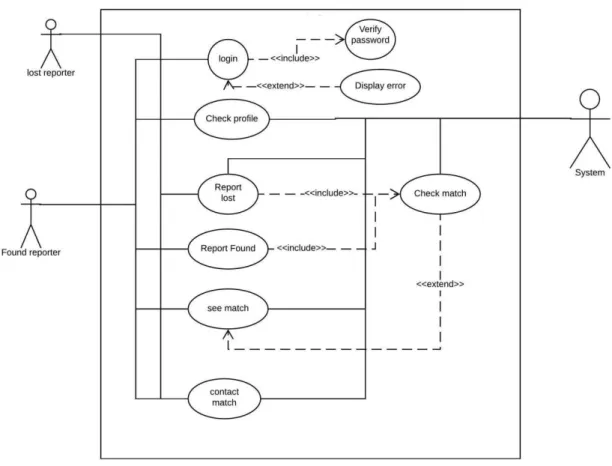
Use case diagram represent all the actors whose are related to the system and then show them how they can participate to the system. Figure-3.1 is the use case diagram of our system.
© Daffodil International University Page 9 Figure-3.3.1: Use Case of find someone.
3.3.2 Description of Use Case Model
In Use case diagram we can see there are three actors and they are (1) Lost reporter (2) Found reporter and (3) System. In this system user can log in and make all decisions. User can also posts.
And user can do all kinds of thing like check profile,report lost,report found,see match. And post what will be displayed to user that will be shown after analyzing the user’s profile.
Table 3.3.1: Use case of Log in:
Cases Details
Actors Lost reporter,Found reporter,System admin
Pre-Condition Registration is needed.
Post-Condition After Successful log in lost or found reporter will get access to features which is for logged in users.
© Daffodil International University Page 10 3.3.3 System Flow Diagram
The whole system has main actors is user. Registration is must be needed for actor. First, I will talk about user. After completing registration when user is going to log in into the user have to give user name and password. After log in, user will be redirected to the category page where he/she can see multiple categories. After log in, user will get some new options like add lost or found post in our system, find any post with other users, update his/her profile, users’ field etc.
User can update his/her profile from system & get dynamic value from user’s field category. User can see other user users post if matched.
Figure-3.3.2: System Flow Diagram
© Daffodil International University Page 11 3.4 Design Requirements
To develop this project, I need to do some designs to make this system easier and more reliable to user. So, this has two types of design and they are frontend and backend.
To do the frontend design I needed to sketch the layouts into paper first. Then when I started coding of the frontend, we needed to include bootstrap, bootstrap, JavaScript, ajax and some jQuery code for completing the design. Then we need to design the project as the documentation requirements and finish coding.
Now for the backend design I need to know about the database structure, the knowledge on relational database and to implement an AI based system to the website. There is also need to gain the relationship between the tables in the database and also need to mind redundancy things.
3.3 Summary
In this chapter I discussed about the full project using use case diagram and system flow chart. I also described them elaborately.
© Daffodil International University Page 12 CHAPTER 4
SYSTEM DETAILS 4.1 Front-end Design
To develop this project, I need to do some designs to make this system easier and more reliable to user. So, this has two types of design and they are frontend and backend.
To do the frontend design I needed to sketch the layouts into paper first. Then when I started coding of the frontend, we needed to include bootstrap, bootstrap, JavaScript, ajax and some jQuery code for completing the design. Then we need to design the project as the documentation requirements and finish coding.
4.2 Back-end Design
Now for the backend design I need to know about the database structure, the knowledge on relational database and to implement an AI based system to the website. There is also need to gain the relationship between the tables in the database and also need to mind redundancy things.
4.3 Interaction Design and User Experience (UX)
Now I will discuss briefly about my system. Anybody who has read this chapter will get the 100%
idea about my application. Here my system features, front-end design, back-end database and implementation requirement.
There are various kind of features in our system. At first, I am going to show our features list and I will describe them later. So, the features of this systems are
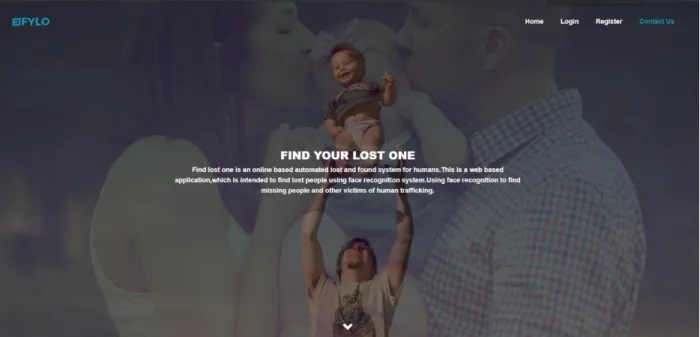
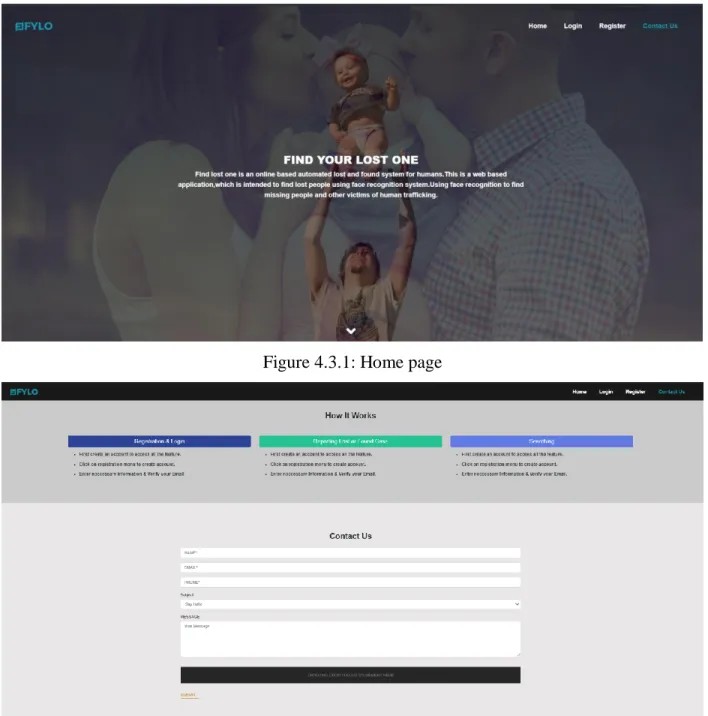
© Daffodil International University Page 13 4.3.1 Home page: This is my home page. From here one has to login or register. And there is instruction in the bottom to make things easier.
Figure 4.3.1: Home page
Figure 4.3.2: Home page bottom
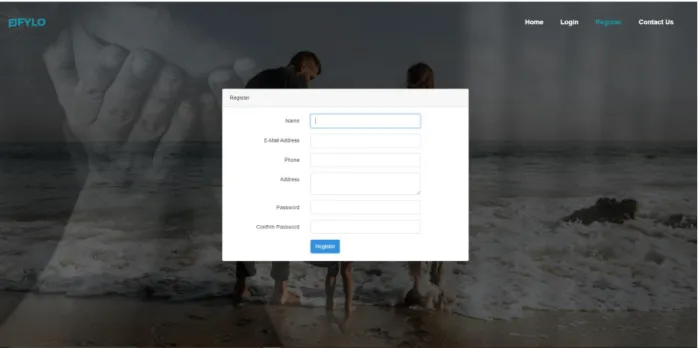
© Daffodil International University Page 14 4.3.2 Registration: This is for user to access this system. To register user, have to input some information like name, phone number, address, email & a unique password. And then has to verify by email.
Figure 4.3.3: Registration page
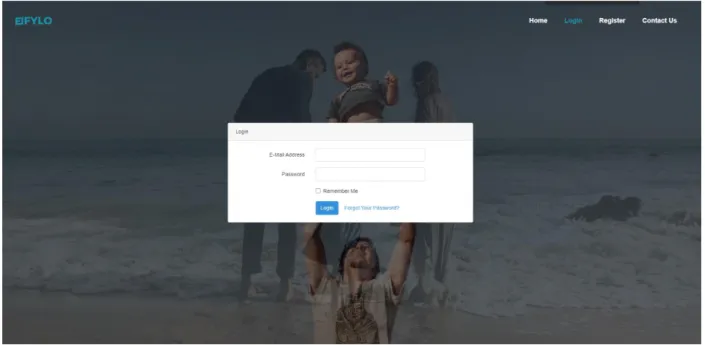
4.3.3 Login into system: Without logging in nobody can use this system. For login user should provide a registered email & a password.
Figure 4.3.3: login page
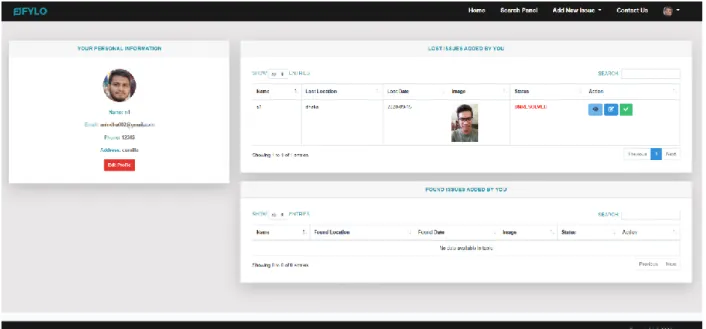
© Daffodil International University Page 15 4.3.4 Create profile: By logging in user can create profile. Profile shows some information’s of the logged in user like user name,email,phone no & address. From profile user can issue lost or found. User can also provide his or her image in the profile. User can also mark an already created issue as resolved or unresolved from here. The resolved issues will not go through the search again.
4.3.5 Enter your info: Users can also edit his/her profile if there is any mistake. If a user changes his/her house he has to provide his new address in the profile. Using this feature user can provide his changed information.
Figure 4.3.5: profile page
© Daffodil International University Page 16 4.3.6 Add new Issues: User can issue a lost or found person here.
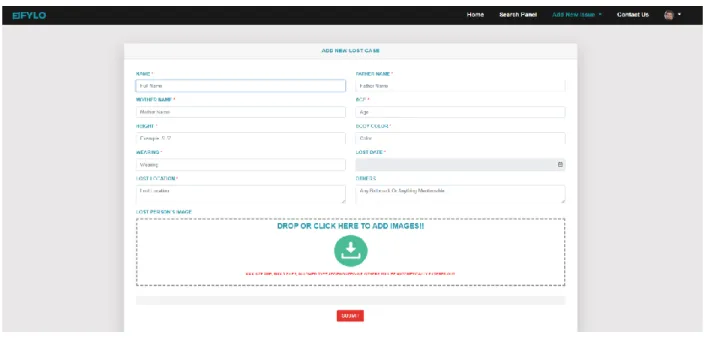
4.3.7 Submit lost issue: User can submit lost issue. In this lost issue entry form user have to fillup the fields such as fullname,father’s name,mother’s name,age,hight,body colour,lost date,wearing,lost location, others and most importantly images of the lost person.
Figure 4.3.6: lost issue page
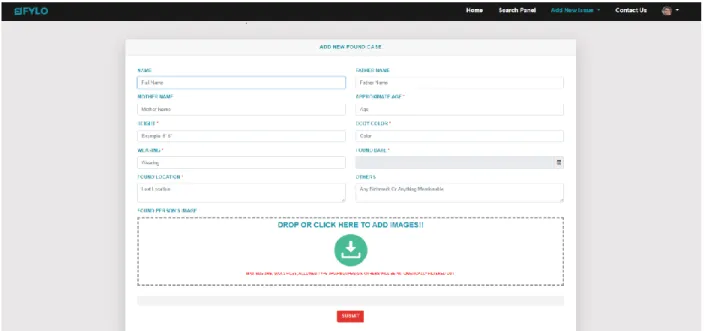
4.3.8 Submit found issue: User can submit lost issue. In this lost issue entry form user have to fillup the fields such as fullname,father’s name,mother’s name,age,hight,body colour,lost date,wearing,lost location, others and most importantly images of the found person.
Figure 4.3.7: found issue page
© Daffodil International University Page 17 4.3.9 Lost person profile: After lost issue a lost person profile will be created.Lost profile shows some information of lost person like fullname,father’s name,mother’s name,age,hight,lost date,lost location,body color ,wearing , others information and the given images. From this page user can user can update information about the lost person and images.
Figure 4.3.8: lost person profile
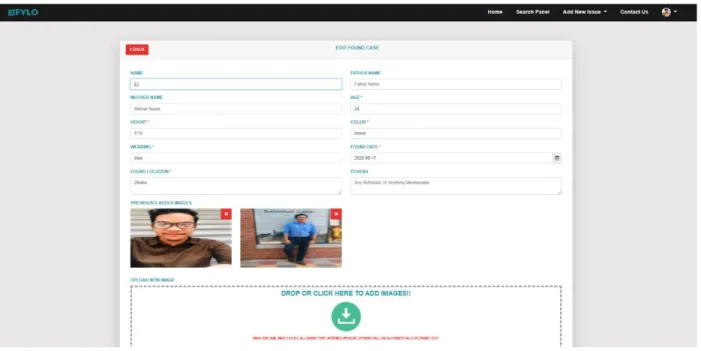
4.3.10 Found person profile: After found issue a found person profile will be created.found profile shows some information of lost person like fullname,father’s name,mother’s name,age,hight,found date,found location,body color ,wearing , others information and the given images. From this page user can user can update information about the found person and images.
Figure 4.3.9: found person profile
© Daffodil International University Page 18 4.3.11 Search panel: User can search his or her lost or found person by two methods here.one by information search and the other is by image search.
4.3.12 Search for lost issues: If you find a person search from here to check if anyone reported any lost case regarding the person. use information search or image search. If not then Please Report a found case.
4.3.13 Search for found issues: If you lost a person search from here to check if anyone reported any found case regarding the person. use information search or image search .If not then Please Report a lost case.
Figure 4.3.10: search panel
© Daffodil International University Page 19 4.3.14 Lost person search by information: User can search lost person. User simply have to input the lost person information in the given fields and it will automatically show the list of found people of the same information.
4.3.15 Found person search by information: User can search found person. User simply have to input the found person information in the given fields and it will automatically show the list of lost people of the same information.
Figure 4.3.12: Lost or found person search by information
© Daffodil International University Page 20 4.3.16 Lost person search by photo: User should enter his/her lost person’s image. The system will use face recognition to find the person in the database. If some is matched he will be shown .User can choose the file or image from his device.
4.3.17 Found person search by photo: User should enter his/her lost person’s image. The system will use face recognition to find the person in the database. If some is matched he will be shown .User can choose the file or image from his device.
Figure 4.3.13: Lost or found person search by photo
4.3.18 Match person reporter: when matched with someone one has to simply press the action key to see who is the reporter.
Figure 4.2.14: Match person reporter
© Daffodil International University Page 21 4.3.19 Resolving the issue: After resolving a missing person issue one should mark it as resolved
so that it does not come in another search.
Figure 4.3.15 Resolving the issue
© Daffodil International University Page 22 4.4 Implementation Requirements
These are following things and technology that we need to implement this project.
Internet Browser [5]: Internet browser is a software that is use to access the internet. So internet browser is needed to access our site.
https://www.google.com/chrome/?brand=CHBD&gclid=EAIaIQobChMIy_ez6_2d5gIV CA4rCh2B-wHQEAAYASAAEgKYJPD_BwE&gclsrc=aw.ds
Xampp Server [6]:Xampp is a free open source server site bundle. In our site i used xampp to store data.It is a local server hosting system where I used to store my database.
https://www.apachefriends.org/download.html
Text Editor (ex: Visual studio code ) [7]: A text editor is a program that help edit plain text.We used text editor to write our code easily. Visual Studio Code is a streamlined code editor with support for development operations like debugging, task running, and version control. It aims to provide just the tools a developer needs for a quick code-build-debug cycle and leaves more complex workflows to fuller featured IDEs, such as Visual Studio IDE
HTML 5 [8]: HTML5 is a programming language whose acronym stands for Hyper Text Markup Language. It is a system that allows the modification of the appearance of web pages. We used html 5 to create our site.
PHP 7 [9]: PHP 7 is a major release of PHP programming language and is touted to be a revolution in the way web applications can be developed and delivered for mobile to enterprises and the cloud.
CSS [10]: CSS is used along side html to make the web page more attractive.
jQuery 3.0+ [11]: To make java script more easy to use and for making html dom management more easy jQuery a java script library is used.
Bootstrap 4 [12]: Bootstrap is a free frontend frame work.For our site we used bootstrap 4 to make our site more user friendly.
JavaScript [13]: It is a programming language.We used java script for dom manipulation.
Ajax [14]: To make java script more easy to use and for making html dom management more easy ajax a java script library is used.
Json: JavaScript Object Notation is an open standard file format, and data interchange format, that uses human-readable text to store and transmit data objects consisting of attribute–value pairs and array data types.I had to use json library.
© Daffodil International University Page 23
Gitlab:For easy file transfer and package and database import export.
Composer:for package installation of php web socket.
Tensorflow [15]: Created by the Google Brain team, TensorFlow is an open source library for numerical computation and large-scale machine learning. TensorFlow bundles together a slew of machine learning and deep learning (aka neural networking) models and algorithms and makes them useful by way of a common metaphor.
Hardware Requirement
o Operating System (Windows, Linux, Mac OS, Android) o Ram 8 GB or Higher
o HDD 256 GB
o Modem or Broadband (Must have good speed)
Software Requirement
o Internet Browser (Google chrome v60 or above) o Internet Browser (Firefox v50 or above)
o Google Chrome
4.5 Summary
This system will give a very effective and detail information about Find Your Lost one. It will be the best web application for anyone. This will be the first application for Bangladesh from where user can get enough and easy to use system to finding lost people. Before creating a system or develop a system it is very necessary to analyze the related work of that system. So after long time analyzing we have decided to make it and we fixed our goal which will remove the lacking of existing system.
© Daffodil International University Page 24
CHAPTER 5
IMPLEMENTATION AND TESTING
5.1 IntroductionHere I am using face-api.js to match lost and found person in our database.Face-api.js is a JavaScript unit, constructed on top of tensorflow.js core, which apparatuses several CNNs (Convolutional Neural Networks) for face recognition for the web and for mobile devices.
5.2 Implementation of Database
5.2.1 Database model: this The relational model of the database
Figure 5.2.1: main database model
5.2.2 Main database: Following figure shows the main database. Main database has three table they are, user,losts,founds,founds images,lost images,migration,password reset. Our database name is
“fylo”.
Figure 5.2.2: main database
© Daffodil International University Page 25 5.3 Testing Implementation
5.3.1 Face Detection system
I have to first trace all the faces in the input image. Face-api.js apparatuses multiple face detectors for different use cases.
For detecting first, I used SSD (Single Shot Multibox Detector), which is basically a CNN based on MobileNet V1.
Face-api.js even implements an optimized Tiny Face Detector, basically an even tinier version of Tiny Yolo v2 , which is a much faster, but slightly less accurate face detector compared to SSD MobileNet V1.
Finally, there is also a MTCNN (Multi-task Cascaded Convolutional Neural Network) implementation. The networks return the bounding boxes of each face. The marks are used to unpolluted the bounding boxes, as there might an image does not cover any face at all.
5.3.2 Face Landmark Detection and Face Alignment system:
I need to call attention to that I need to adjust the bounding boxes, with the end goal that I can extricate the pictures focused at the face for each crate before passing them to the face acknowledgment organize, as this will make face acknowledgment substantially more exact.
5.3.3 Face Recognition system
Presently I can bolster the mined and went face pictures into the face acknowledgment organize, which is based on a ResNet-34 like design and for the most part parallels to the engineering applied in dlib. The system has been prepared to figure out how to delineate attributes of a human face to a face descriptor (a component vector with 128 qualities), which is additionally customarily expressed to as face embeddings.I will utilize the face descriptor of each mined face picture and contrast them and the face descriptors of the reference information. We can figure the Euclidean space among two face descriptors and audit whether two faces are comparable dependent on an edge esteem (for 150 x 150 measured face pictures 0.6 is a decent limit esteem).
© Daffodil International University Page 26 5.4 Test Results and Reports
5.4.1 Loading the Model Data
Figure 5.4.1: Loading the Model Data Here is the implementation of three models we used for face recognition.
5.4.2 Receive a Full Description for all Faces from an Input Image
Figure 5.4.2: Receive a Full Description for all Faces from an Input Image
This code shows the input of the image file to the system and conversation of train result saved in a variable.
© Daffodil International University Page 27 5.4.3 Face Recognition
Figure 5.4.3: Face Recognition Here the image information is checked for matching.
5.4.4 Conclusion
The same process runs twice in my system. Once for found database and once for lost database.
© Daffodil International University Page 28
CHAPTER 6
Impact on Society, Environment and Sustainability
6.1 Impact on Society: FIND YOUR LOST ONE (FYLO): AN WEB-BASED AUTOMATED LOST-AND-FOUND SYSTEM FOR HUMANS will have the best impact on society. This site is designed to help people find missing people. People go missing in our country all the time. But there is no system to finding them easily using the latest technology. My system is the first of its kind for Bangladesh to use Face recognition technology to find missing people.
Our society will greatly benefit from this site if it goes live which I intent to do so.
6.2 Impact on Environment:
The environment will be ok. Even with or without humans. This site is meant for missing people.
So, it cannot help the environment. The ongoing climate change, geo political issues, war, environmental destruction due to human greed and many other humane created environmental problems cannot be helped by this site. This site can only help finding missing people.
6.3 Ethical Aspects:
This site is very ethical .it designed to help people in need. With the help of FYLO people get a chance in finding their missing relatives. People go missing due to various reasons like human trafficking losing track of the road etc.IT becomes a great hassle finding the later on. But with the help of FYLO people can get a easy way to find them using latest technology.
FIND YOUR LOST ONE (FYLO): AN WEB-BASED AUTOMATED LOST-AND-FOUND SYSTEM FOR HUMANS is vey much Ethical and a very Nobel goal for the betterment humane kind.
6.4 Sustainability Plan
FYLO is a web-based application, to be usable by everyone it has to go on a live server and has to have domain and hosting. For all those thing I need money and time to develop it .For the future Sustainability Plan I alone can not handle all of this . so my Plane is to Sell this IP (intellectual property) to some other company or get a major company to be my publisher and share holder which will provide me money and rescores so that I can continue to develop this project further for the betterment of humane kind.
© Daffodil International University Page 29
CHAPTER 7
CONCLUSION AND FUTURE SCOPE
7.1 Discussion and ConclusionI tried my best to do this project. Now I’ve also made this report as user friendly so that it feels like step by step guide.
While doing this project, I’ve learned about real life programming. Though, it’s not a very big project but I’ve tried to use as much as tools I has been a great experience for me while doing this project. The more I researched about missing people I became more passionate about this project.
I hope this project works well and can help others the way I want it to.
7.2 Possibility for Additional Development
My planning is to extend this system in future. There are some extra features like making the site more dynamic by implementing a notification system. A more robust face recognition system. Bug fixing. Launching it and getting developing it more according to user feedback.
Here are some key future updates that I would like to do.
Bug fixing.
Implementing More robust face recognition system.
Making the site more user friendly.
Making the site more dynamic by implementing a notification system.
Using auto search system.
Making the loading time shorter.
Launching it and getting developing it more according to user feedback.
© Daffodil International University Page 30 References:
[1]https://www.independent.co.uk/life-style/gadgets-and-tech/news/india-police-missing- children-facial-recognition-tech-trace-find-reunite-a8320406.html ,last accessed on 05-10- 2020 at 12:00pm.
[2]https://www.facefirst.com/industry/missing-children/,last accessed on 05-10-2020 at 12:00pm.
[3]http://www.lofo.global/,last accessed on 05-10-2020 at 12:00pm.
[4] Vision Box, a digital identity management solutions company ENCES available at
https://www.facefirst.com/industry/missing-children ,last accessed on 05-10-2020 at 12:00pm.
[5] Internet browser available at
https://www.google.com/chrome/?brand=CHBD&gclid=EAIaIQobChMIy_ez6_2d5gIVCA4rCh 2B-wHQEAAYASAAEgKYJPD_BwE&gclsrc=aw.ds ,last accessed on 05-10-2020 at 12:00pm.
[6] Xampp Server available at: https://www.apachefriends.org/download.html ,last accessed on 05-10-2020 at 12:00pm.
[7] visual studio code <<https://code.visualstudio.com/>>,last accessed on 05-10-2020 at 12:00pm.
[8] HTML 5 available at: << https://www.w3schools.com/htm >> ,last accessed on 05-10-2020 at 12:00pm.
[9] PHP 7 available at: << https://www.w3schools.com/php >> ,last accessed on 05-10-2020 at 12:00pm.
[10] CSS available at: << https://www.w3schools.com/css/default >>,last accessed on 05-10-2020 at 12:00pm.
[11] jQuery available at <<https://stackoverflow.com/>>,last accessed on 05-10-2020 at 12:00pm.
[12] Bootstrap available at << https://getbootstrap.com/ >>,last accessed on 05-10-2020 at 12:00pm.
[13] JavaScript available at: << https://www.w3schools.com/js >>,last accessed on 05-10-2020 at 12:00pm.
[14] Ajax available at <<https://stackoverflow.com/>>,last accessed on 05-10-2020 at 12:00pm.
[15] Tensorflow available at <<https://itnext.io/face-api-js-javascript-api-for-face-recognition-in- the-browser-with-tensorflow-js- bcc2a6c4cf07 >>,last accessed on 05-10-2020 at 12:00pm.
© Daffodil International University Page 31 Plagiarism Result
© Daffodil International University Page 32