GROWTH AND FLOWERING OF LISIANTHUS (Eustoma grandiflorum) WITH NITROGEN DOSES AND PLANT SPACING
MST. ASMAUL HUSNA
DEPARTMENT OF HORTICULTURE
SHER-E-BANGLA AGRICULTURAL UNIVERSITY DHAKA-1207
DECEMBER, 2020
GROWTH AND FLOWERING OF LISIANTHUS (Eustoma grandiflorum) WITH NITROGEN DOSES AND PLANT SPACING
BY
MST. ASMAUL HUSNA REGISTRATION NO. 18-09216
A Thesis
Submitted to the Faculty of Agriculture Sher-e-Bangla Agricultural University, Dhaka
In partial fulfillment of the requirements for the degree
of
MASTER OF SCIENCE (MS) IN
HORTICULTURE
SEMESTER: JULY- DECEMBER, 2020
APPROVED BY:
Prof. Dr. Md. Nazrul Islam Department of Horticulture SAU, Dhaka
Co-Supervisor Prof. Dr. A. F. M. Jamal Uddin
Department of Horticulture SAU, Dhaka
Supervisor
Prof. Dr. Md. Jahedur Rahman Chairman
Examination Committee
“Blessed is he who has placed stars in the heaven and has set in it in the glowing sun
(that produces light) and the glittering moon (that reflects light)”
( Surah Al-Furqaan-25:61 )
DEDICATED TO- MY HONORABLE PARENTS
They are the very first instructors of my life who taught me that ‘good humanity is the greatest qualification’
Department of Horticulture
Sher-e-Bangla Agricultural University Sher-e -Bangla Nagar, Dhaka-1207
CERTIFICATE
This is to certify that the thesis entitled “GROWTH AND FLOWERING OF LISIANTHUS (Eustoma grandiflorum) WITH NITROGEN DOSES AND PLANT SPACING” submitted to the Faculty of Agriculture, Sher-e- Bangla Agricultural University, Dhaka, in partial fulfillment of the requirements for the degree of MASTER OF SCIENCE in HORTICULTURE, embodies the result of a piece of authentic research work carried out by MST. ASMAUL HUSNA, Registration No. 18-09216 under my supervision and guidance. No part of the thesis has been submitted for any other degree or diploma.
I further certify that any help or source of information, received during the course of this investigation has been duly acknowledged.
Dated: December, 2020 Place : Dhaka, Bangladesh
Dr. A. F. M. Jamal Uddin Professor
Department of Horticulture
Sher-e-Bangla Agricultural University Sher-e-Bangla Nagar, Dhaka- 1207 Supervisor
I
ACKNOWLEDGEMENT
Author is prostrated before Almighty Allah, most merciful and beneficent, for giving the strength and courage to successfully complete the research work.
This thesis owes its existence to the help, support and inspiration of several people.
Firstly, Author would like to express her sincere appreciation and gratitude to her honorable supervisor, Prof. Dr. A. F. M. Jamal Uddin for his guidance and constant encouragement during the entire period of the research work. His support and inspiring suggestions have been precious for the development of this thesis content.
The author is also deeply indebted to her co-supervisor Prof. Dr. Md. Nazrul Islam and all other teachers of Department of Horticulture, Sher-e-Bangla Agricultural University, who have been a constant source of encouragement and enthusiasm, not only during this thesis work but also during the two years of her Master’s program.
Furthermore, the author is heartily indebted to her fellow lab mates and well wishers specially Raisa Islam Nitu, Dina Akter, Rakibuzzaman Mony, Anil Mahto and Eshita Wasin of Horticulture Innovation Lab. BD. for their kind help and support which can never be forgotten.
- Author
II
GROWTH AND FLOWERING OF LISIANTHUS (Eustoma grandiflorum) WITH NITROGEN DOSES AND PLANT SPACING
ABSTRACT
A field experiment was accomplished at the Horticulture farm of Sher-e-Bangla Agricultural University, Dhaka during the period from November 2018 to April 2019 to study the effect of nitrogen doses and spacing on growth and flowering of Lisianthus (variety-SAU Blue Nandini). Nitrogen doses viz. N1=225 kgha-1 (BARI recommended for marigold), N2= 250 kgha-1, N3= 275 kgha-1 and Spacing viz. S1
(30 cm x 15 cm), S2 (30 cm x 20 cm), S3 (30 cm x 25 cm) were used in this experiment arranged in a Randomized Complete Block Design with three replications. Data on different growth, flower yield and quality attributes parameters were taken in which all the treatment showed significant variations.
Among nitrogen doses, maximum stem number per plant (5.8), peduncle length (13.4 cm), flower head diameter (6.2 cm), flower number per plant (42.6), petal number per flower (19.8) were found from N3 whereas minimum in N1. Among different spacing, maximum stem number per plant (6.5), stem length (58.4 cm), flower head diameter (6.0 cm), flower per plant (42.3) found in wider spacing S3
whereas minimum found in S1. Maximum flower number per plant (55.3) were found in N3S3 and minimum flower number per plant (14.6) were found in N1S1. The study showed that the higher nitrogen doses with wider spacing would be the potential for Lisianthus production.
III
TABLE OF CONTENTS
CHAPTER TITLE PAGE NO.
ACKNOWLEDGEMENT I
ABSTRACT II
TABLE OF CONTENT III-V
LIST OF TABLE VI
LIST OF FIGURE VII
LIST OF PLATES VIII
LIST OF APPENDICES IX
ABBREVIATIONS X
I INTRODUCTION 1-3
II REVIEW OF LITERATURE 4-24
III MATERIALS AND METHODS 25-34
3.1 Experimental site 25
3.2 Climatic condition 25
3.3 Characteristics of soil 26
3.4 Planting materials 26
3.5 Treatments of the experiment 26
3.6 Raising of seedling 26
3.7 Design and layout of the experiment 27-28
3.8 Production methodology 29
3.8.1 Land preparation 29
3.8.2 Application of manure and fertilizers 29
3.8.3 Transplanting of seedling 29
3.9 Intercultural operation 30
3.9.1 Weeding 30
3.9.2 Irrigation and drainage 30
3.9.3 Rogueing and gap filling 30
3.9.4 Disease and pest control 30
3.9.5 Staking 30
3.9.6 Harvesting 31
3.10 Parameter of the experiment 31
3.11 Data collection 31
3.11.1 Plant height 32
IV
CHAPTER TITLE PAGE NO.
3.11.2 Number of leaves per plant 32
3.11.3 Leaf length 32
3.11.4 SPAD value 32
3.11.5 Number of stem per plant 32
3.11.6 Stem length 33
3.11.7 Stem diameter 33
3.11.8 Number of bud per stem 33
3.11.9 Number of flower per stem 33
3.11.10 Number of flower per plant 33
3.11.11 Flower number per plot 33
3.11.12 Peduncle length 33
3.11.13 Receptacle diameter 34
3.11.14 Flower head diameter 34
3.11.15 Petal number per flower 34
3.11.16 Petal color measurement 34
3.12 Statistical analysis 34
IV RESULTS AND DISCUSSION 38- 64
4.1 Plant height 38-40
4.2 Number of leaves per plant 41-43
4.3 Leaf length 44-45
4.4 SPAD value 45-47
4.5 Number of stem per plant 48-49
4.6 Stem length 50
4.7 Stem diameter 51-53
4.8 Number of bud per stem 54
4.9 Number of flower per stem 55-56
4.10 Number of flower per plant 57-58
4.11 Flower number per plot 58
4.12 Peduncle length 59
4.13 Receptacle diameter 59
4.14 Flower head diameter 60
4.15 Petal number per flower 61-63
4.16 Petal color measurement 64
V
CHAPTER TITLE PAGE NO.
V SUMMARY AND CONCLUSION 67-72
5.1 Summary 67-70
5.2 Conclusion 71
5.3 Recommendation 72
5.4 Suggestion 72
REFERENCES 73-78
APPENDICES 79-82
VI
LIST OF TABLES Table
No. Title Page
No.
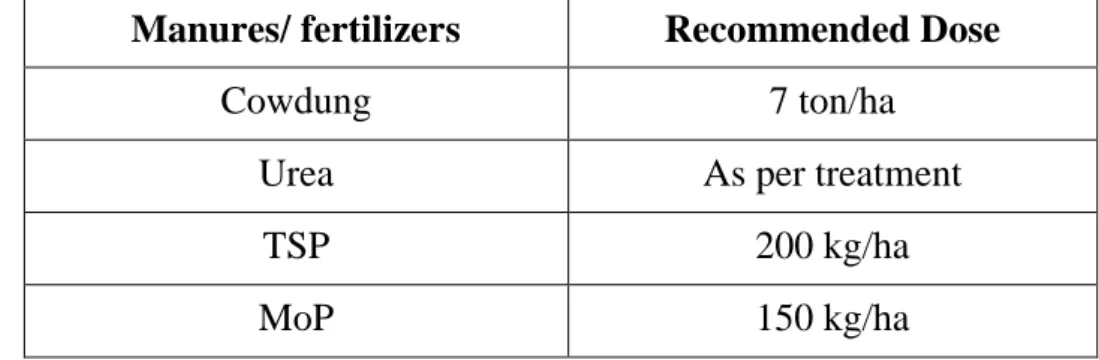
1 Manures and fertilizers application with BARI recommended doses (Marigold)
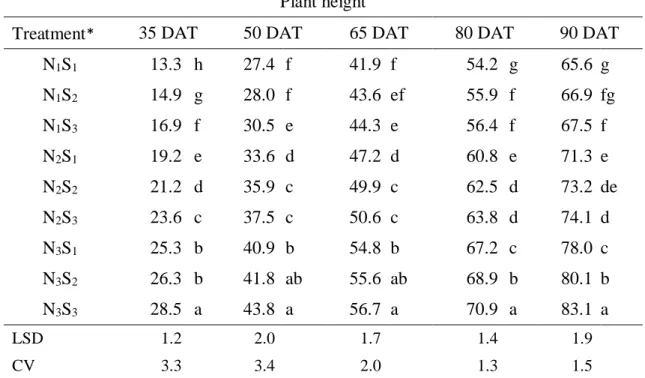
29 2 Interaction effect of nitrogen doses and spacing on plant height of
Lisianthus at different days after transplanting
40
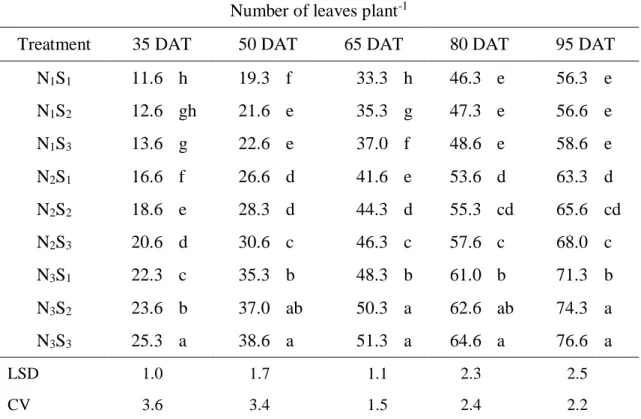
3 Interaction effect of nitrogen doses and spacing on number of leaves per plant at different days after transplanting
43 4 Interaction effect of nitrogen doses and spacing on SPAD value of
leaves at different days after transplanting
47 5 Interaction effect of nitrogen doses and spacing on leaf length,
stem number per plant, stem length and stem diameter of Lisianthus
53
6 Effect of nitrogen doses on number of flower bud per stem, number of flower per stem, number of flower per plant and yield per plot of Lisianthus
56
7 Effect of spacing on number of flower bud per stem, number of flower per stem, number of flower per plant and number of flower yield per plot of Lisianthus
56
8 Interaction effect of nitrogen doses and spacing on flower bud per stem, number of flower per stem, number of flower per plant and number of flower yield per plot of Lisianthus
58
9
10 11
12
Effect of nitrogen doses on of peduncle length, receptacle diameter, flower head diameter and number of petal per flower of Lisianthus
Effect of spacing on of peduncle length, receptacle diameter, flower head diameter and number of petal per flower of Lisianthus Interaction effect of nitrogen doses and spacing on of peduncle length, receptacle diameter, flower head diameter and number of petal per flower of Lisianthus
Combination effect of nitrogen doses and spacing on variations in petal color attributes in different Lisianthus
62
62 63
64
VII
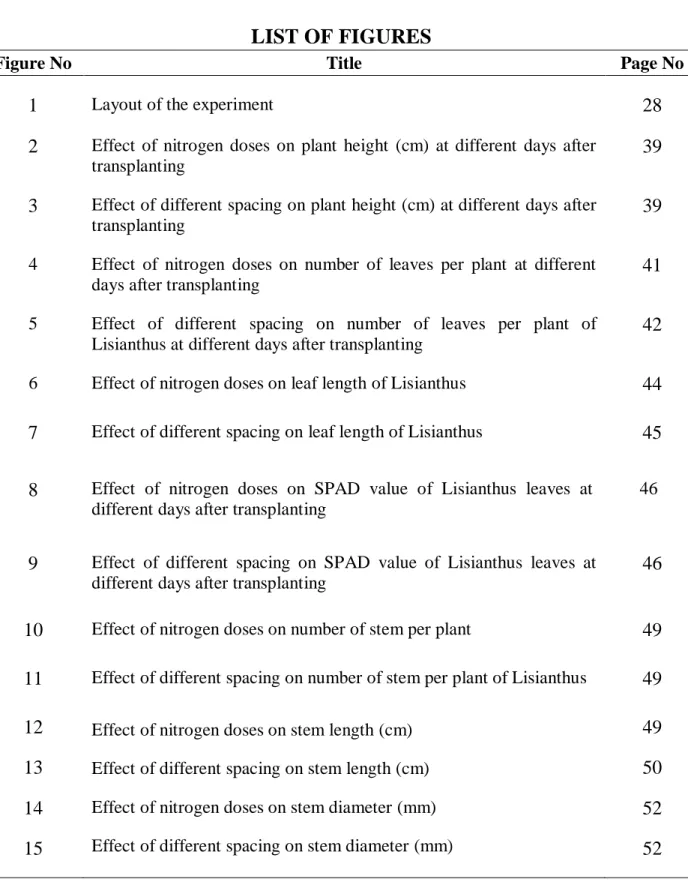
LIST OF FIGURES
Figure No Title Page No
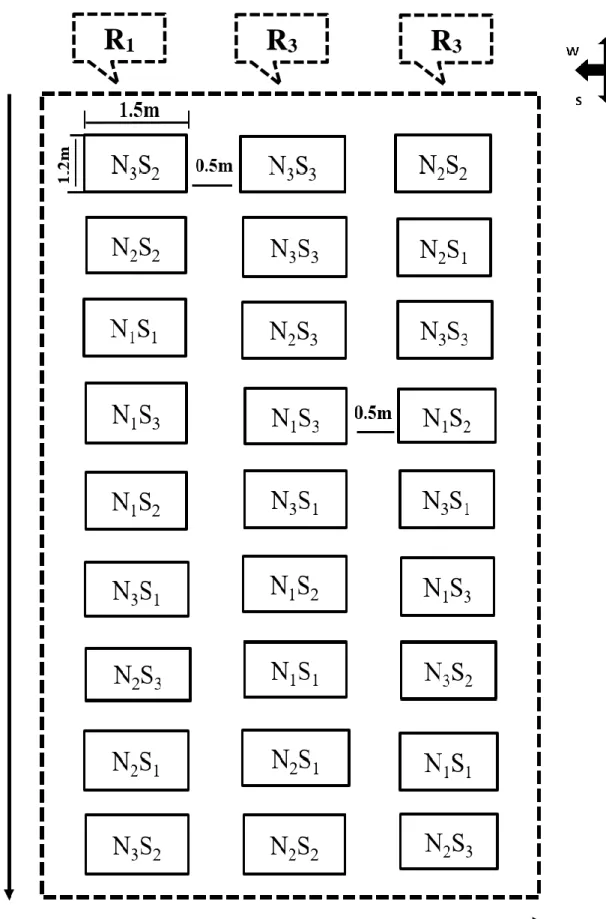
1 Layout of the experiment 28
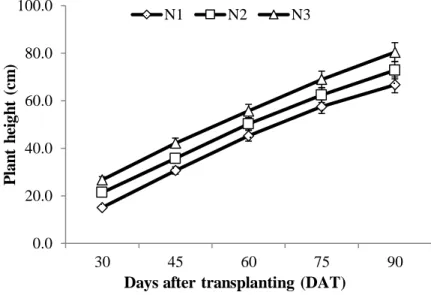
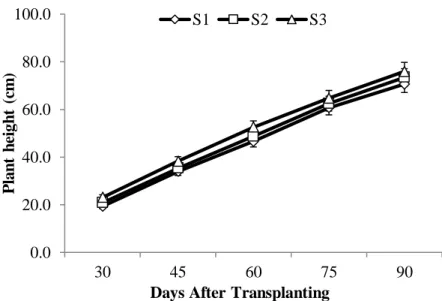
2 Effect of nitrogen doses on plant height (cm) at different days after transplanting
39 3 Effect of different spacing on plant height (cm) at different days after
transplanting
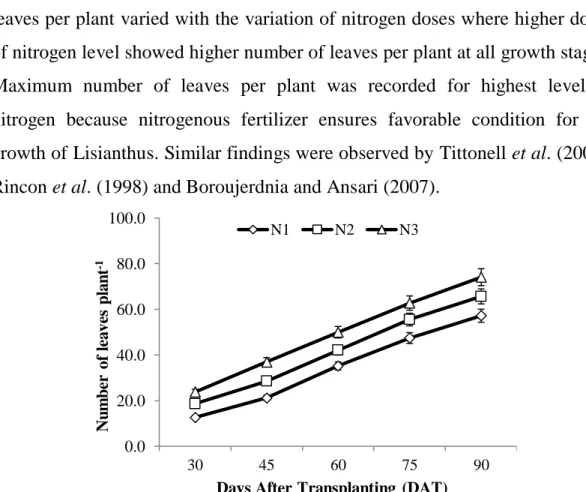
39 4 Effect of nitrogen doses on number of leaves per plant at different
days after transplanting
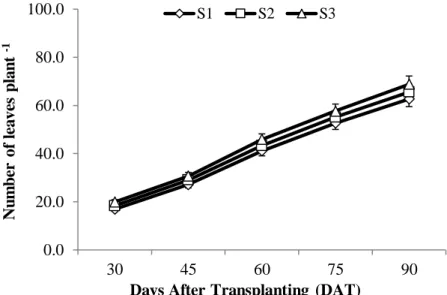
41 5 Effect of different spacing on number of leaves per plant of
Lisianthus at different days after transplanting
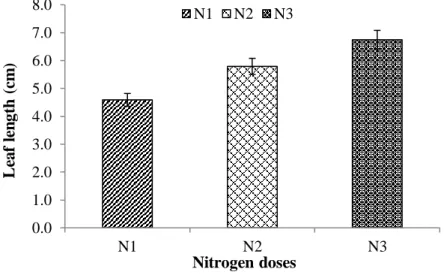
42 6 Effect of nitrogen doses on leaf length of Lisianthus 44 7 Effect of different spacing on leaf length of Lisianthus 45 8 Effect of nitrogen doses on SPAD value of Lisianthus leaves at
different days after transplanting
46
9 Effect of different spacing on SPAD value of Lisianthus leaves at different days after transplanting
46
10 Effect of nitrogen doses on number of stem per plant 49 11 Effect of different spacing on number of stem per plant of Lisianthus 49 12
13 14 15
Effect of nitrogen doses on stem length (cm) Effect of different spacing on stem length (cm) Effect of nitrogen doses on stem diameter (mm) Effect of different spacing on stem diameter (mm)
49 50 52 52
VIII
LIST OF PLATES Plate
No. Title Page
No.
1 Tools used in the study 35
2 Pictorial presentation of different growth related parameters
36 3
4
5
Pictorial view of CIELab color scale
Pictorial view of single Lisianthus flower according to treatment combinations
Pictorial view of growth and quality related parameters
37 65
66
IX
LIST OF APPENDICES Appendix
No. Title Page
No.
1 Monthly record of air temperature, relative humidity and rainfall of the experimental site during the period from November, 2018 to April, 2019
79
2 Analysis of variance on plant height of Lisianthus at different days after transplanting
79
3 Analysis of variance on the number of leaves per plant at different days after transplanting
80
4 Analysis of variance on the data of SPAD value at different days after transplanting of Lisianthus
80
5 Analysis of variance on the data of stem number per plant, stem length and stem diameter of Lisianthus
81
6 Analysis of variance on the data of leaf length number of bud/stem, number of flower/stem of Lisianthus
81
7
8
Analysis of variance on the data of number of petal/flower, number of flower/plant and flower yield/plot of Lisianthus
Analysis of variance on the data of peduncle length, receptacle diameter, flower head diameter of Lisianthus
82
82
X
ABBREVIATIONS AND ACRONYMS
AEZ = Agro-ecological Zone Agric. = Agricultural
ANOVA = Analysis of Variance
BARI = Bangladesh Agricultural Research Institute
Biol. = Biology
CV = Coefficient of variance DAP = Days after planting et al. = And others
Ex. = Experiment
FAO = Food and Agriculture Organization Hort. = Horticulture
i.e. = That is
J. = Journal
LSD = Least Significance difference
mm = Millimeter
RCBD = Randomized Complete Blocked Design Res. = Research
SAU = Sher-e-Bangla Agricultural University
Sci. = Science
spp. = Species Technol. = Technology
UNDP = United Nations Development Program
Viz. = Namely
1
CHAPTER I INTRODUCTION
Lisianthus (Eustoma grandiflorum) belongs to the family Gentianaceae, which is originated from the eastern slope of Rocky Mountains, USA (Halevy and Kofranek, 1984) and is a perennial herbaceous ornamental species that is used as cut flower due to its big and attractive flowers, long stalks, and long duration in vases. Lisianthus is a newcomer in Bangladesh and popularly known as Nandini, which has the advantage of striking bloom with great appeal.
Lisianthus has been ranked one of the lucrative and expensive cut flower in the world. It has a great cosmopolitan demand mainly for its large and attractive flowers, long and hard stem, wide range of colors specially have purple, blue, lavender and has a long vase life which are the common traits of an ideal and best quality cut flower. Day by day demand of this flower increasing to the people. Flower growers also are attracted towards its cultivation because of its habit of free flowering, earliness, broad range of attractive color, form, size, quality and more importantly, the high demand of cut-flower. Very often, Bangladesh has to import them from other countries like China, Japan, and India.The successful cultivation is influenced various agro-techniques.
However, in Bangladesh, there is no recommended technology for Lisianthus production. Specially, optimum fertilizers and planting density is still unknown for Lisianthus flower production to meet up the demand and it is imperative to provide more information to the growers for higher productivity and quality.
For Sustainable flower production requires optimal fertilizer management and nutrients. Nutrients such as nitrogen play a major role in the growth and development of plants (Scott, 2008). Nitrogen is one of the very important major plant nutrients which directly affect the plant growth and flowering behavior. Nitrogen is an essential element that improves the chemical and biological properties of soil, and thereby stimulates the production of higher yield in plants. It should be emphasized, that to increase plant quality and productivity nutrients need to be available from the soil during a plant’s growth
2
period. Among different essential plant nutrient, nitrogen is considered to be the most crucial and nitrogen applied as fertilizer is considered as the key source for meeting the nitrogen requirements of plant growth (Konnerup and Brix, 2010) because it is a constituent of protein and nucleic acid which is helpful in plant growth (Haque, 2001). Nitrogen promotes vegetative growth and stimulates the flower opening cycle during the flowering season (Fan et al., 2005). On the other side, excessive and improper use of nitrogen fertilization has a detrimental effect because high nitrogen application influences in dark green leaves and leads to delay flowering. Proper nitrogen application, at the correct rates and time, contributes to the optimal growth and, higher number of flower and seed yield of ornamentals (Swetha et al., 2018). Application of appropriate amount of nitrogen is important as its deficiency causes several abnormalities like over growth and less flowering. An optimum dose of application of nutrient elements will not only ensure better yield and quality but also lead to minimum wastage of the nutrients. There is a scope of increasing plant growth, yield of Lisianthus with the appropriate size of flower.
Furthermore, plant spacing is particularly important for the cultivation of flower to maximize the flower growth, yield, quality and quantity. Plant spacing can influences crop productivity and plant quality (Langton et.al., 1999). Spacing between plants is particularly important for the maximize flower production. In cut flower industry, the most important aspects are maximum production of better quality cut flowers in order to fetch more market prices. For obtaining better vegetative growth and thereby, increasing the yield of better quality flowers, plant spacing plays an important role. Very little research work has been carried out in Lisianthus regarding plant spacing and hence sufficient information on different agro-techniques followed in this crop as a cut flower is not available. In Bangladesh, no research work has been conducted to determine the optimum plant spacing so that flowers growers in our country still faced problem to produce large number and standard quality flower. Number of flowers and flowering attributes produced per plot was
3
affected by plant spacing and the performance of cut flower crops is greatly influenced by spacing (Singh and Bijimol, 2000). Spacing has been found to influence growth, flowering and yield of daughter bulbs in gladiolus (Swetha et al., 2018). Plant population affects crop yield by imposing competition among plants for nutrients, moisture, sunlight and other growth sources.If plants are planted far apart, they will not have to compete at all for resources. They may produce higher yields per plant than more crowded plants, but if they are spaced too far apart the yield for the entire field of plants can still be low. The optimum spacing helps not only in obtaining good quality cut flowers but also in better utilization of land, providing good open position for sunlight, soil moisture conservation, weed control and availability of nutrients vital for successive crop production and quality (Sanjib et al., 2002).
Keeping this in view, the present research was conducted with the following objectives-
Objectives:
1. To determine the optimum nitrogen doses for growth and flowering of Lisianthus
2. To find out the optimum plant spacing on growth and flowering of Lisianthus
3. To study the effect of nitrogen doses and plant spacing on growth and flowering of Lisianthus
4
CHAPTER II
REVIEW OF LITERATURE
Lisianthus is one of the most highly ranked cut flowers in the international market due to its rose like flowers, excellent post-harvest life and diverse color.
Furthermore, demand and popularity is increasing day by day in our country.
Lack of knowledge of production technology is the crucial issue for Lisianthus production especially application of proper amount of nitrogenous fertilizer as well as plant spacing. Farmers usually apply vast amount of urea or sometimes a little amount which hampers vegetative growth as well as flower yield. In addition, plant spacing also not maintained properly so that influence flower production. Therefore, information available regarding nitrogen doses (urea) and spacing has been reviewed and presented in this section.
Acharya and Dashora (2004) conducted an experiment in Rajasthan to study the response of graded levels of nitrogen and phosphorus on vegetative growth and flowering in African marigold. Among different levels of nitrogen and phosphorus, application of 200kg/ha each of nitrogen and phosphorus produced maximum plant height, plant spread, diameter of flower and early flowering.
Whereas, the maximum number of branches and flowers per plant with yield of flowers per plant and hectare basis were recorded with 150 kg N/ha and 200kg P/ha. The maximum weight of single flower was obtained with 150 kg N/ha and 100 kg P/ha in African marigold cv. Pusa Basanti Gainda.
A field experiment was carried out to study the effect of different doses of nitrogen on growth and flower yield of marigold under container gardening at Bharatpur-11, Bhojad, Chitwan, Nepal during autumn 2018. Five treatments including different doses of nitrogen, i.e. (T1: Control (0:90:75) kg NPK ha-1; T2: (45:90:75) kg NPK ha-1; T3: (90:90:75) kg NPK ha-1; T4: (135:90:75) kg NPK ha-1; and T5 (180:90:75) kg NPK ha-1) were evaluated in Randomized
5
Block Design with four replications. Results showed that plant height, plant spread, and number of branches were statistically significant. Marigold plant applied with 180 kg ha-1 nitrogen gave the maximum height (49.47 cm), spread (36.40 cm), and number of branches (24.75) in 45 DAT (days after transplanting) while the control plot showed the least. Similarly, nitrogen @ 180 kg ha-1 was found to be effective for early flowering initiation (32.50 DAT) and days (41.25 DAT) compared to control (39 and 48.75 DAT, respectively) and also resulted in maximum number of flower (34.73), flower diameter (7.03 cm) and yield (22.29 t ha-1) compared to other treatments. Thus, the overall results suggest that the application of 180 kg N ha-1 in marigold produced the highest flower production (Adhikari et al., 2020).
Ayub et al. (2007) conducted a field experiment to evaluate the effect of 0, 50, 100 and 150 kg N ha-1 on pearl millet sown at seeding rate of 10, 15 and 20 kg ha-1 was conducted at Agronomic Research area, University of Agriculture, Faisalabad, Pakistan. Nitrogen application significantly increased the green fodder and dry matter yield due to increased plant height, stem diameter and number of leaves per plant. Crude protein and crude fibre contents were also increased due to an increase in nitrogen level. However, increase in nitrogen level decreased the ash percentage. Nitrogen application of 100 and 150 kg ha- 1 produced statistically similar green fodder yield (79.37 and 79.74 t ha-1, respectively). Increase in seed rate significantly increased the plant density, plant height, green and dry matter yield and dry matter contents but decreased the stem diameter. The number of leaves per plant, crude fibre, and crude protein and ash contents were decreased with increased seed rate but not to a significant level. Pear millet sown at seed rate of 20 kg ha-1 and receiving 100 kg N ha-1 seems to be the best combination for getting higher green fodder yield of “BY-18” under Faisalabad conditions.
6
Baral (2012) carried out an experiment to access the influence of nitrogen level (100, 150, 200, 250, 300 kg/ha) on growth performance, cut flower characteristics and corm/cormel production of three varieties (American beauty, Interpret and Candyman) of gladiolus (Gladiolus hybrida L.) in the farmer’s field at Gunjanagar VDC, Chanauli, Chitwan, during September, 2010 to April, 2011. The experiment consisted of 15 treatment combinations laid out in 2 factorial randomized complete block design (RCBD) with 4 replications.
Nitrogen levels significantly influenced growth performance, cut flower characteristics and corm/cormel production of gladiolus. Increasing the level of nitrogen up to 200 kg/ha, increased the rate of sprouting (97.33%), number of sprout/corm (2.05), taller plant (106.7cm) with more number of leaves (9.85), longest spike(86.58cm) with more number of florets/spike (16.73) were produced. Moreover, largest spike (92.62 g weight) having thicker (1.14 cm girth) and longest rachis (54.5 cm) were produced by 300 kg/ha. Size of daughter corm (5.8 cm) was highest with 300 kg/ha while number of the cormels per plants (89.45) was highest at 200 kg/ha nitrogen.
A study was carried out during 2005 - 2006 at the Division of Floriculture to determine the effect of corm size (4.1-4.5, 4.6-5.0 and 5.1-5.5 cm) and spacing (10 x 20, 15 x 20 and 20 x 20 cm) on growth, flowering and corm production in gladiolus cv. White Prosperity. Larger sized corms (5.1-5.5 cm) with wider plant spacing (20 x 20 cm) gave the best performance. Number of days taken to spike emergence, plant height, number of leaves plant-1, spike length, number of florets spike-1 and diameter of floret were observed to be significantly better with larger-sized corms. Minimum days taken to slipping were also found to be due to larger size of the corms. Number of corms plant-1, corm weight, diameter of corm, number of cormel plant-1 and cormels weight plant-1, in terms of both quality and quantity, showed increasing trend with an increasing corm-size and spacing. Therefore, wider spacing and larger corm size may be recommended for realizing better quality and higher production in gladiolus cv.
White Prosperity under Kashmir conditions (Bhat and Khan, 2007).
7
Bijimol and Singh (2000) conducted an experiment to assess the effect of spacing and nitrogen levels on flowering, flower quality and vase life of gladiolus cv. Red Beauty. Four spacing’s (15x30, 20x30, 25x30 and 30x30 cm) and four nitrogen rates (0, 100, 200 and 00 kg/ha) were taken. Corms planted at 25x30 cm and 200 kg N/ha significantly increased the diameter of spike, number of florets per spike, number of spikes per plant and number of spikes per ha and early emergence of spike under field conditions (Nagaland, India).
Application of 200 kg N/ha also resulted in maximum length of spike and diameter of floret. However, early opening of flower was recorded with lower N rate (100 kg/ha), while length of floret with 300 kg N/ha. Spacing and N levels had significant effect on postharvest life of cut gladioli. Spacing 25x30 cm had striking effect on percent opening of florets per spike, number of open florets with drooping of minimum florets. N at 200 kg/ha had significant effect on percent opening of florets per spike, number of open florets per spike and water uptake during vase life.
Boroujerdnia and Ansari (2007) conducted an experiment at Shahid Chamran University of Ahwaz, Iran during 2005-2006 to determine the effect of nitrogen fertilizer rates and cultivars on growth and critical yield of lettuce. The treatments included four nitrogen rates (0, 60, 120, and 180 kg N ha-1) as the main plot and two lettuce cultivars (‘Pich Ahwazi’ and ‘Pich Varamini’) as the sub-plot. The criteria measured were plant length, fresh and dry weights of leaves, leaf area, number of leaves, crop growth rate (CGR), leaf area index (LAI) and yield. Results indicated that different levels of nitrogen fertilizer on all growth characteristics were significant at P<0.01. Increased plant length, fresh and dry weights of leaves, leaf area, number of leaves, crop growth rate (CGR), leaf area index (LAI) and yield were shown up to 120 kg N ha-1.
Nitrogen fertilizer caused head formation to accelerate and delayed the bolting date of lettuce. Cultivar had a significant effect on growth characteristics, on fresh and dry weights of leaves and on leaf number but not on plant length and leaf area. The highest yield was obtained with 120 kg ha-1 treatment by ‘Pich
8
Ahwazi’. Also, it took ‘Pich Varamini’ longer to form a head and to flower than ‘Pich Ahwazi’.
A study was carried out to standardize nitrogen application at different stages of tuberose (Polianthestuberosa L.) (cv. Double) for improving growth, flowering and vase life in a farmer’s field at Gunjanagar VDC, Chitwan, Nepal, during May to September, 2012. The experiment was laid out in randomized complete block design with 10 treatments of nitrogen in split doses and replicating thrice. The cut flower and vase life characteristics of tuberose were studied and the economics of production was also analysed. Significant difference was found between treatments of split doses of nitrogen in flowering and post-harvest characteristics of this flower. Three equal split doses of nitrogen, 33% N basal + 33% N at 30 days after planting + 33% N at 50 days after planting resulted in the earliest spike initiation (60 days) and the first flower opening (95.17 days). The same treatments recorded longest vase life (16.47 days). The longest (91.69 cm), heaviest (87.97g) and thickest (0.89 cm) spikes with longest rachis (38.77 cm) were produced by three equal split doses of nitrogen, 33% N basal + 33% N at 50 days after planting + 33% N at 70 days after planting. The same treatments produced maximum net income (NRs.
214,250/-) and benefit-cost (B:C) ratio (1.29) per hectare. Thus, three equal split doses of nitrogen, 33% N basal + 33% N at 50 days after planting + 33%
N at 70 days after planting are appropriate for commercial cultivation of tuberose in Nepal (Dahal et al., 2014).
The experiment was carried out to study the effects of nitrogen (0, 20, 40, 60, 80 g/m2), phosphorous (0, 5, 10, 20 g/m2) and potassium (0, 15, 20, 25 g/m2) on growth, flowering and yield in gladiolus cv. Jester Gold in FRBD at IARI, New Delhi, during 2000-1 and 2001-2. Application of 60 g N/m2 resulted into maximum leaves/shoot (6.0), leaf area/plant (330.83 cm2), plant height (80.6 cm), diameter of first floret on third day of opening (9.7 cm), durability of first floret (3.8 days) and whole spike (12.4 days) floret /spike (15.7), spike length
9
(58.8 cm), rachis length (44.7 cm) and useful life of the spike (7.2 days). N at 20 g/m2 resulted in earliest 50% sprouting (7.9 days). Higher dose of nitrogen (80 g/m2) resulted into maximum corms/plant (1.8), corm size (5.3 cm), corm weight (44.8 g), cormel weight (5.0 g), cormels/plant (19.3) and propagation coefficient (315.2%) (Eajiv and Mishra, 2000).
Evans (1998) conducted an experiment to find out the efficacy of nitrogen and Photosynthesis in the Flag Leaf of Wheat. The amounts of chlorophyll, soluble protein, nitrogen, and phosphorus were determined for each flag leaf and found that chlorophyll content and RuP2 carboxylase activity were approximately proportional to leaf nitrogen content.
Fan et al., (2005) examined the effects of non-flooded mulching cultivation and traditional flooding and four fertilizer N application rates (0, 75, 150 and 225 kg ha−1 for rice and 0, 60,120, and 180 kg N ha−1 for wheat) on grain yield, N uptake, residual soil N min and the net N balance in a rice–wheat rotation on Chengdu flood plain, southwest China. There were significant grain yield responses to N fertilizer. Nitrogen applications of >150 kg ha−1 for rice and
>120 kg ha−1 for wheat gave no increase in crop yield but increased crop N uptake and N balance surplus in both water regimes. High N inputs led to a positive N balance (160–621 kg ha−1), but low N inputs resulted in a negative balance (−85 to −360 kg ha−1).
Gaire et al. (2020) studied the effect of spacing and nitrogen level on growth and yield of maize in Parbat from February to July, 2019. The experiment was laid out in two Factorial Randomized complete Block Design (RCBD) comprising of spacing: 60×15 cm and 60×25 cm and nitrogen: 30, 60, 90 and 120 kg/ha level as treatment with three replications. “Arun-2” variety of maize was planted on clay loam and acidic soil (pH 5.3) having medium in total nitrogen (0.15%), medium in soil available phosphorus (48.1 kg/ha), medium in soil available potassium (218.8 kg/ha) and medium in organic matter content
10
(2.92%). Result shows that yield was significantly increased with increment in N-level up to 90 kg N/ha. The grain yield (5.18 mt/ha) was significantly higher at 90 kg N/ha than at 30 and 60 kg N/ha but at par with 120 kg N/ha.
Significant effect on grain yield due to spacing was observed. The grain yield (4.11 mt/ha) obtained at spacing 60×15 cm. Moreover, the highest grain yield showed that highest grain yield (4.33 mt/ha) was obtained under 90 kg N/ha plus 60×15 cm spacing. The result revealed that different spacing and nitrogen level significantly affect the plant height and leaf area index. The plant height and leaf area index were significantly high at close spacing (60×15 cm) and at 120 kg N/ha. Likewise, yield attributing characteristics like cob length, cob diameter, number of kernel/rows, number of kernel row, thousand gran weight were the highest at 90 kg/ha but as par with 120 kg/ha at close spacing (60×15 cm). This study suggested that maize production can be maximized by cultivating “Arun-2” maize fertilizing with 90 kg N/ha and maintaining 60×15 cm spacing.
Optimizing plant nitrogen (N) and phosphorus (P) nutrition is required in healthy propagation of strawberry nursery plants for fruit production.
Strawberry (Fragaria x ananassa Duch.) nursery plant ability for N and P acquisition was examined in a northern Atlantic coastal soil for providing field- based information for optimizing strawberry nursery plant nutrition. The study was conducted in a Cornwallis loamy soil in Nova Scotia, Canada in 2008. The treatments consisted of seven strawberry cultivars: ‘Darselect’, ‘Mesabi’,
‘V151’, ‘Seneca’, ‘Serenity’, ’K93-20’ and ‘Jewel’, all highly hardy cultivars.
Nutrient NPK supply was respectively at the rates of 105, 145 and 165 kg/ha, based on soil testing and regional recommendation. Results showed that strawberry nursery plant propagation and productivity expressed using runner and daughter-plant variables were significantly different among the seven cultivars (P < 0.05). Total nitrogen uptake (mean±SD) varied between 2.96±0.91 g/plant and total P uptake was 0.29±0.06 g/plant among the seven cultivars. The cultivar ‘Seneca’ and ‘Jewel’ showed a significantly higher
11
ability of N and P acquisition (P < 0.05). It was suggested that strawberry nursery plant propagation could be enhanced with nutrition accumulation ranges of 2.47-3.26 g N/plant and 0.25 0.34 g P/plant. Runner thinning would be an option for regulating strawberry plant N and P nutrition and nursery plant productivity (Hong et al., 2008).
Studies were undertaken to evaluate the response of autumn planted sunflower (Helianthus annuus L.) to different levels of N, P and K fertilizers at the Agronomic Research Farm, University of Agriculture, Faisalabad during, 2004 and 2005. Treatments comprised five N levels (0, 60. 90, 120 and 150 kg ha/sup -1/), five P levels (0, 30, 60, 90 and 120 kg ha/sup -1/), four K levels (0, 60, 90 and 120 kg ha/sup -1/) in different combinations and two hybrids viz.
FH-314 (standard height) and FH-245 (semi dwarf). Hybrid FH-314 produced significantly higher achene yield (2725.41 kg ha/sup -1/) than that of FH-245.
There was a progressive increase in achene yield and yield components With increasing levels of N, P and K. The highest achene yield (3023 kg ha/sup -1/) and highest net benefit (Rs.19743) was obtained when the crop was fertilized at the rate 120:90:60 kg NPK ha/sub -1 (Iqbal et al., 2008).
An experiment was conducted at the Horticultural Research Field of Bangabandhu Sheikh Mujibur Rahman Agricultural University (BSMRAU), Salna, Gazipur during September 2008 to May 2009 to determine the response of hippeastrum (cu. ‘Apple Blassom) to different combinations of nitrogen, phosphorus and potassium levels. There were 14 treatment combinations comprising four levels of nitrogen viz. 0, 100, 200, and 300 kg ha-1; five levels of phosphorus viz. 0, 200, 300, 400 and 500 kgha-1 and five levels of potassium viz. 0, 100, 200, 300 and 400 kgha-1. The experiment was laid out in a Randomized Complete Block Design with three replications. The growth and flowering parameter of hippeastrum were significantly influenced by combined application of N, P & K. The highest values in respect of leaves per plant (8.6), leaf breadth (5.4 cm), number of plants per bulb (3.07), flower scape per plant
12
(2.07), flowers per scape (4.2), length and diameter of flower (14 cm x 13.83 cm), flower scape (43.33 cm x 29.37 cm) and flowering duration (10.7 days) were observed with N200P400K300. The same treatment showed earliness in days to flower scape emergence (172.3 days), days to flower bud appearance (185.3 days) and days to first flower open (189.3 days) (Jamil et al., 2016).
A study was conducted in India during 1997-98 to determine the effect of spacing and nitrogen fertilizer application on C. coronarium Local White.
Treatments comprised: three spacings (30x20, 30x30 and 30x40 cm) and four nitrogen rates (0, 50, 100 and 150 kg/ha). The number of branches, plant spread, main stem diameter, fresh weight of plant and dry weight of plant were significantly highest in the widest spacing (30x40 cm) and highest nitrogen rate (150 kg N/ha) (Karavadia and Dhaduk, 2002).
A field experiment was carried out by (Khalaj and Edrisi, 2012) as a factorial in a Randomized Complete Block Design (RCBD) format with 3 replications.
Different levels of nitrogen (0, 50, 100, 150, 200, 250 Kg/ha), in the form of ammonium nitrate was the first factor and the second factor was the different plant spacing of (10 x 10, 15 x 15, 20 x 20, 25 x 25 cm). The spacing between plants of 25 x 25 cm had a significant effect on flower stalk height, flowering stem diameter, spike length, floret diameter, floret weight, vase life, bulb number and weight. Nitrogen levels affected stem diameter, stem and spike length. The results showed that an application of 200 Kg/ha N can improve growth and yield of tuberose in terms of flower stalk height, stem diameter and bulb weight. Data showed that the plant spacing of 25 x 25 cm with nitrogen application of 200 Kg/ha N obtained the maximum qualitative and quantitative characteristics of flowers.
The effects of inorganic nitrogen (N) source (NH4+, NO3− or both) on growth, biomass allocation, photosynthesis; N uptake rate, nitrate reductase activity and
13
mineral composition of Canna indica were studied in hydroponic culture. The relative growth rates (0.05–0.06 g g−1 d−1), biomass allocation and plant morphology of C. indica were indifferent to N nutrition. However, NH4+ fed plants had higher concentrations of N in the tissues, lower concentrations of mineral cations and higher contents of chlorophylls in the leaves compared to NO3− fed plants suggesting a slight advantage of NH4+ nutrition. The NO3−
fed plants had lower light-saturated rates of photosynthesis (22.5 μmol m−2 s−1) than NH4+ and NH4+/NO3− fed plants (24.4–25.6 μmol m−2 s−1) when expressed per unit leaf area, but similar rates when expressed on a chlorophyll basis (Konnerup, D. and Brix, H. 2010).
A study was conducted to evaluate the effect of plant density on growth, flowering corm and cormel production of gladiolus (Gladiolus sp.) cv.
American Beauty at the farm of the Department of Horticulture, C.C.R (P.G.) College, Muzaffarnagar (Uttar Pradesh). The experiment was laid out in randomized complete block design with four replications and three spacing’s viz. S1 (40cm x 20cm), S2 (30cm x 40cm) and S3 (40cm x 40cm). The observations were recorded for various vegetative, floral and corm parameters.
Maximum germination percentage (86.71%), plant height (105.66cm) and number of leaves per plant (8.01), number of days taken for initiation of spike (94.13 days), number of spikes per plant (0.96), length of spike (81.56cm ), number of florets per spike (17.86) and duration of flowering (18.54 days) was found with 30cm x 40cm spacing (S2). However, number of corms per plant (1.31), number of cormels per plant (21.56), weight of corms per plant (57.68g), weight of cormels per plant (36.43g) was found maximum with 40cm x 40cm spacing (S3) which was at par with S2, whereas, yield of corms and cormels per plot (3.18) was found maximum with 40cm x 20cm spacing (S1).
Hence, 30cm x 40cm spacing can be recommended for the commercial cultivation of gladiolus (Kuldip et al., 2016).
Kumar et al. (2001) worked in Mohanpur, India on Gladiolus grandiflorus cv.
Tropic Sea to find out the effect of different levels of N (40, 50 and 60 g/m2) at
14
2 splits (3 and 6 leaf stages) as side dressing, P205 (10, 20 and 30 g/m2) and K20 at 20 g/m2. They found that the fertilizer combination of N at 50 g/m2, P at 10 g/m2 and K at 20 g/m2 resulted in the highest spike weight, numbers of flowers per spike, flower diameter, number of open flowers at a time.
Langton et al. (1999) reported that average total fresh weight per plant varied greatly between experiments, but empirical linear regression relationships showed that changes in space per plant gave near proportional changes in weight per plant over the whole range of densities sampled. This suggests that the density responses were essentially mediated by the available light per plant.
Increasing density was associated with progressively slower flowering and this trend was most pronounced in 'Delta' and in the autumn and winter experiments. Stems were generally reduced in length at high density but this was not always the case. The development of a simple model to predict average stem weights and grade-outs for given spacings at particular times of year is discussed.
Lehri et al. (2011) conducted an experiment to determine the response of different doses of N and P2O5 on the growth and flower quality of gladiolus at farmer field district Quetta during the summer season 2008. Six treatments were included in the trial viz; T1 (125+100); T2 (125+200); T3 (150+100); T4 (150+200); T5 (175+100) and T6 (175+200) NP kg/ha were tested in four replicated randomized complete block design. The results reveal that fertilizer treatments had significant response on leaves length, leaves number, florets number per spike, corms number per plant, corm lets number per corm and spike length. The highest N and P2O5 dose 175+200 kg/ha produced significantly maximum length of leaves (44.4 cm), greater number of leaves (13.75), number of florets per spike (14.00), number of corms per plant (4.00), number of cormlets per corm (18.62) and longer spike length (99.75cm). It was concluded that for obtaining maximum number of florets per spike, number of
15
corms per plant, number of corm lets per corm and longer spike length application of nitrogen and phosphorus at 175+200 kg/ha may be applied.
Field experiments were conducted at Junagadh during 2002-05 to study the response of spacing (45×45, 45×30, 45×15, 30×30 and 30×15 cm) and crop duration (first year crop, first ratoon and second ratoon) on growth, flowering, cut-flower yield and bulb production in tuberose cv. Double. The widest spacing (45 cm × 45 cm) registered the highest values for plant height (46.18 cm), number of leaves per clump (67.25), spike length (89.64 cm), spike diameter (0.95 cm), diameter of open flower (4.6 cm), rachis length (34.8 cm), number of spikes per clump (4.1), number of florets per spike (48.2), number of bulbs per clump (18.40) and number of bulblets per clump (31.60). It also induced early spike emergence and flowering. A planting distance of 30×30 cm realized the highest cut flower yield (2.72 lakh ha-1) and that of 30 cm × 15 cm recorded the highest bulb production (22 lakh ha-1). Ratoon crops showed higher plant height, number of leaves, bulbs, bulblets and spikes per clump and cut flower yield as well as bulb production over the first year crop. Early spike emergence and flowering was also noted in ratoon crops compared to the first year crop. However, spike and flower quality was inferior to that of first year crop with regard to spike length and diameter, number of florets per spike, diameter of open flower and rachis length (Malam et al., 2010).
An experiment was laid out by Mane et al., (2007) with three spacing (15, 20, 25 cm), two bulb sizes (2.5, 3 cm diameter) and three depths of planting (3,5,7 cm). In respect of spacing, flower yield and quality parameters except girth of the spike were significantly influenced in widest spacing (20 x 25 cm2).
Longevity of spike (19.23 days) and keeping quality at room temperature (14.30 days) was highest in widest spacing. The large bulb size (B2) recorded significant increase in number of spikes per plant, the length and girth of spike, keeping quality of the spike at room temperature. Planting the bulbs at shallow
16
depth (3 cm) resulted in the earliest spike emergence, but had no identical difference with medium depth (5 cm) of planting. The length of spike, number of spikes per plant and longevity of spike in field increased significantly at 7 cm depth, while the treatment D2 (5 cm) recorded significantly superior results in case of diameter of spike, number of florets per spike and length of rachis.
The bigger sized bulb (3 cm diameter) planted at widest spacing (20 x 25 cm2) and at 5 cm depth of planting was found best to get maximum commercial advantage for achieving higher flower yield and quality of tuberose.
Mishra (1998) conducted an experiment to study the effect of nitrogen levels and planting density on gaillardia flower. Four levels of nitrogen, i.e., 0, 10, 20 and 30g/m2 and three spacings, i.e., 30 x 20, 30 x 30 and 40 x 30 cm along with all possible combinations were tried on gaillardia. Nitrogen @ 20 g/m2 significantly increased the number of flowers per unit area, stalk length and flower life as compared to other treatments. The height and spread of the plant, days to flower, size of flowers and flower weight were noted to be significantly higher at 30g followed by 20g N/m2 over control. So far planting density is concerned, 30 x 30 cm spacing was found superior in increasing all parameters except size, stalk length and weight of the flowers which were recorded higher with 40 x 30 cm spacing followed by 30 x 30 cm. Interaction effect of nitrogen and plant population showed that number of flowers and flower yield per unit area were significantly higher with N2S2.
In order to study the effects of different levels of nitrogen fertilizer and plant density on grain yield and its components in sunflower, Mojiri and Arzani (2003) conducted an experiment using 'Record' cultivar at the Research Farm of College of Agriculture, Isfahan University of Technology in 1996. Four levels of nitrogen (0, 75, 150 and 225 kg/ha) and four plant densities (65000, 75000, 85000 and 95000 plants/ha) were used in a split plot arranged in a randomized complete block design with three replications. Developmental
17
stages, plant height, stem diameter, head diameter, number of head per m2, grain yield, biological yield, harvest index, 1000-grain weight, number of grains per head, grain oil percentage, oil yield and grain protein content were measured. The results indicated that N fertilizer caused an extension of the growth period and means of days to physiological maturity. It also increased plant height, stem diameter and head diameter. While increasing plant density had an incremental effect on plant height, it negatively affected stem diameter and head diameter. N fertilizer up to 150 kg/ha increased the grain yield and biological yield, whereas higher levels of N fertilizer decreased both. Plant density of 85000 plants per hectare was observed as a suitable plant density, whereas the higher plant density had a negative effect on grain yield. Nitrogen fertilizers increased the number of grains per head, and plant density via increasing the number of heads per unit.
A field experiment was conducted to determine the response of different doses of N, P and K on plant growth, flower quality and yield of Gerbera (Gerbera jamesonii L.) in the Department of Horticulture, SHUATS, Allahabad, U.P.
during the Rabi season 2016-2017. Eleven treatments were included in the trial viz., T0 (10:15:20) RDN; T1 (11:16.5:22); T2 (12:18:24); T3 (13:19.5:26); T4 (14:21:28); T5 (15:22.5:30); T6 (16:24:32); T7 (17:25.5:34); T8 (18:27:36); T9
(19:28.5:38); T10 (20:30:40) N.P.K g/m2 were tested in three replication. The experiment of design was Randomized Block Design. The results revealed that fertilizer treatments had significant response on plant height, number of leaves per plant, plant spread, number of suckers per plant, number of flowers per plant, number of flowers per treatment, days to first flower bud appearance, flower diameter, stalk length, stalk diameter and vase life of flower. The maximum plant height (41.47 cm), number of leaves per plant (17.70), plant spread (56.57 cm), days to first flower bud appearance (50.13) were produced by the treatment (T7) of N:P:K in the ratio of 17:25.5:34 g NPK/m2. Maximum number of suckers per plant (6.47) was found in treatment (T9) in the ratio of 19:28.5:38 g NPK/m2 and the maximum number of flowers per plant (12.87),
18
number of flowers per treatment (49.03), flower diameter (14.47 cm), stalk length (46.47 cm), stalk diameter (0.90 cm) and vase life of flower (14.87 days) were recorded by treatment (T10) in the ratio of 20:30:40 g NPK/m2 (Nayak et al., 2005).
Pratibha et al. (2018) carried out in an experimental farm in the Department of Floriculture and Landscaping, Dr. Y. S. Parmar University of Horticulture and Forestry, Nauni, Solan (H.P.) during March to December, 2010. The experiment was laid out in split plot design, comprising of eight different planting dates and two spacing, (viz., 30 × 20 cm and 30 × 30 cm) as sub- plot treatment at monthly intervals from, mid-March to October, 2010.
Maximum flower size was recorded for April planting date crop, whereas, June planting date gave the best results for plant height and plant spread.
However, maximum number of flowers and maximum yield per plant were recorded in March planted crop. Plant height, plant spread flower size and yield per plant were at maximum in a wider spacing S2 (30 × 30 cm). Maximum number of flowers per plant as well as maximum yield per plant was recorded in March planting at closer spacing S2 (30 × 20 cm).
Ram et al. (2012) conducted an experiment to assess the effect of spacing and salicylic acid levels on vegetative growth and flowering of gladiolus cv. White Properity at HRC, SVPUAT, Meerut. The three levels of spacing (20 x 10, 20 x 20, and 20 x 30 cm) and three levels of salicylic acid ( 0, 50 and 100 ppm) were used in randomized block design (RBD) with three replications. Out of these a optimum spacing 20 x 20 cm was found superior with 100 ppm salicylic acid con centration in respect of number of leaves, leaf length (cm), days to opening of 1st floret and visibility of first spike, spike length, and number of florets per spike.
19
Rincon et al. (2002) investigated the effect of N (25, 50, 100, 150 and 200 kg/ha), applied in fertigation, on the yield and nitrate content of iceberg lettuce (Lactuca sativa var. capitata) in Murcia, Spain. Crop yield increased with N levels of up to 100 kg/ha, obtaining green biomass of 53.4 t/ha and commercial lettuce heads of 33.1 t/ha. Biomass and yield index decreased with N at 150 and 200 kg/ha. The nitrate content in the soil solution increased with the 150 and 200 kg N/ha treatments, and decreased with the 25 and 50 kg N/ha treatments. Nitrate concentration remained uniform during the growth cycle when 100 kg N/ha was applied, and the availability of nitrate was balanced with the absorption by the plant. N absorption increased between the 25 and 50 kg N/ha treatments and those of the 100, 150 and 200 kg N/ha treatments.
However, no significant differences were observed between the higher N treatments. The outer leaves of plants showed a nitrate concentration 3 times higher than that of the inner leaves. This concentration changed according to the quantity of N provided. At harvest, the nitrate concentration in the outer leaves ranged from 1635 to 4494 ppm, while that in the inner leaves ranged from 651 to 1508 ppm.
Roy chowdhury (1989) conducted the research for five years (1982-1987) under polythene tunnel with gladiolus cv. 'Psittacinus hybrid'. The corms (2.5- 2.7 cm in diameter) were soaked (for 6 hours) in GA3 (50 and 100 ppm), Ethrel (100 and 200 ppm) and Kinetin (25 and 50 ppm) before planting at 25 and 33 corms/m2 densities. Results show that higher plant density (33 corms/m2) increases the plant height, length of flower stalk and corm yield/unit area, while it decreases the number of florets/ spike, length and diameter of flower, irrespective of the treatments including control. Treatment with Ethrel inhibited plant growth but markedly increased the corm yield and the maximum corm yield of 132.5/plot (25 corms/m2) and 138.6/plot (33 corms/m2) were noted by soaking of corms with Ethrel at 100 and 200 ppm respectively, compared to 60.0 and 79.2 corms/plot in control. Soaking of corms with Kinetin however, showed an increase in the number of florets/spike and size of flowers.
20
Sanjib et al. (2002) conducted the experiment which was laid out in randomized complete block design with four replications and three spacing’s viz. S1 (40cm x 20cm), S2 (30cm x 40cm) and S3 (40cm x 40cm). The observations were recorded for various vegetative, floral and corm parameters.
Maximum germination percentage (86.71%), plant height (105.66cm) and number of leaves per plant (8.01), number of days taken for initiation of spike (94.13 days), number of spikes per plant (0.96), length of spike (81.56cm ), number of florets per spike (17.86) and duration of flowering (18.54 days) was found with 30cm x 40cm spacing (S2).
A study was conducted to determine the effects of varying light intensity and nitrogen nutrition on photosynthetic physiology and biochemistry were examined in the sun plant Phaseolus vulgaris (common bean) and in the shade plant Alocasia macrorrhiza (Australian rainforest floor species). Thus, the RuBP Case/chlorophyll ratio was quite responsive to N availability and light intensity in both species (but for different reasons), ranging from 6 grams per gram for Phaseolus and 2 grams per gram for Alocasia at high leaf N and 1.5 gram per gram for Phaseolus and 0.5 gram per gram for Alocasia at low leaf N.
These large changes in the proportions of components of the photosynthetic apparatus had marked effects on the sensitivity of these species to photoinhibition (Seemann et al., 1987).
This study was carried out to determine the effect of different application rates of nitrogen (N) on yield and quality of cotton (Gossypium hirsutum). N was applied to the soil at rates of 0, 100, 200 and 300 kg ha . Statistical results of study showed that N application significantly (P 0.05) increased boll number, boll 1 weight, seed cotton weight of boll, seed cotton yield and lint yield.
Moreover, leaf blade N concentration was affected by N application rate and increased significantly. Results of study also showed that the highest seed
21
cotton yield was obtained in case of 200 kg ha 1 N application rate and this application rate resulted in 19.6% increased seed cotton yield. Statistical results showed that effect of different application rates of N was not significant for all studied fiber properties (fiber length, fiber strength and fiber fineness).
Generally, application of 200 kg ha N resulted in the highest boll number, boll weight, seed cotton yield and lint yield (Seilsepour and Rashidi, 2011).
Present experiment was conducted to study the effect of pinching and nitrogen on growth, flowering and seed yield of African of marigold cv. Pusa Narangi Gainda at Horticulture Research Farm, Institute of Agricultural Sciences, Banaras Hindu University, Varanasi during 2015-2016. The experiment was planned out in Randomized Block Design with 12 treatments each replicated three times. The treatments include three levels of pinching i.e. no pinching, single pinching at 40 days after transplanting and double pinching at 40 and 60 days after transplanting with four levels of nitrogen i.e. 0%, 1%, 2% and 3%.
Data on growth characters revealed that interaction of no pinching with 2%
nitrogen recorded significantly maximum number of primary branches per plant (19.20), fresh weight of leaf (1.11 g), dry weight of leaf (0.25 g), leaf area (181.14 cm2), whereas maximum plant height (84.14 cm), leaf area index (13.42) was highest in interaction of no pinching with 3% nitrogen. Stem diameter was statistically non-significant and maximum stem diameter recorded in single pinching at 1% N (2.33 cm). Data on flowering characters showed that earliest days to bud initiation (51.67 days), days to flowering (63.67 days) and maximum duration of flowering (81.33 days) was recorded in interaction of no pinching with 0% foliar application of nitrogen, whereas interaction of no pinching with 3% nitrogen recorded maximum fresh weight of flower (4.86 g), dry weight of flower (1.01 g), flower diameter (5.12 cm), length of peduncle (5.38 cm). However number of flowers per plant (49.13) and flower yield per plant (193.52 g) recorded significantly maximum in combination of double pinching + 2% nitrogen (Singh and Kumar, 2009).
22
Steingrobe and Schenk (1994) reported that seeds of lettuce cv. ‘Clarion’ were sown in 4 × 4 cm peat blocks and seedlings were planted out 3 weeks later at a spacing of 30 x 30 cm. Seedlings received different amounts of N fertilizer before and after planting. They found that N application increased root growth in the first 3 weeks after planting out, but had no effect on yield.
An experiment was carried out by Sudhakar and Kumar (2012) to study the effect of corm size and spacing on growth and flowering of gladiolus Sp cv.
white friendship under Tamilnadu condition was carried out thein Floriculture unit, Department Horticulture, Faculty of Agriculture, Annamalai University, Annamalai nagar, during 2010-2011 with objectives of studying individual and interaction effects of different corm size viz., 3.5– 4.5 cm, 4.6-5.5 cm and above 5.5 cm and spacing viz., 30x20 cm, 30x25 cm and 30x30 cm on growth and flowering parameters. All nine possible combinations of the corm size and spacing were laid in combination as treatment in factorial randomized block design (FRBD) with three replications. The growth and yield parameters of gladiolus were significantly influenced by corm size and spacing adopted.
Corm size of above 5.5cm and spacing of 30x30cm were found excellent when compared to others. The interaction between corm size and spacing exhibited significant enhancement ingrowth and yield parameters. Combination of C3 x S3 with corm size of above 5.5cm and spacing of 30x30cm has exhibited the highest values in growth parameters viz., plant height ( 77.44 cm), number of leaves per plant (6.50), leaf length (45.47cm), leaf width (4.84 cm), and the yield parameters viz., days to spike emergence74.66 (days), number of floret per spike (10.52), length of spike (65.59cm), florets diameters ( 8.64cm), florets length(6.58cm), diameter of corm (5.06 cm) and number of cormels (19.12) when compared with other treatment combinations.
23
Swetha et al. (2018) conducted the experiment to evaluate the effect of spacing and nitrogen on vegetative growth and flower yield of Asiatic lily cv. Tressor at College of Horticulture, Venkataramannagudem, West Godavari district, Andhra Pradesh during the rabi season of 2016-17. Results showed that minimum number of days to bulb sprouting was observed with 30 cm x 15 cm and nitrogen at 200 kg ha-1. The vegetative parameters like plant height, number of leaves, leaf area per plant and total chlorophyll content was recorded highest with a spacing of 30 cm x 15 cm and nitrogen at 200 kg ha-1 both individually and in combination except to leaf area index. The spike yield per plot and spike yield per 1000 m2 was maximum with spacing of 30 cm x 15 cm, nitrogen dose of 200 kg ha-1 both individually and in combination.
The experiments were carried out as a factorial plot in a complete randomized block design with four replications. All the data was subjected to analysis of variance (ANOVA) using of SAS software and the means separated using the Duncan's Multiple Rang Test. In study of interaction of planting depth and bulb size, difference between treatments was not significant in parameters of days to emergence of spike, length of flower spike; total number of nodes per spike and length of inflorescence but differences in other characteristics were significant.
Bulb size had any influence on time of emergence of flower spike, diameter and length of spike, as well as germination percentage of bulbs, but influenced on other characteristics. Results revealed that smaller bulbs, Due to failure in physiological maturity, produced any flowers. Larger bulbs had the better quality in flowering, as well as because of more active metabolically processes such as carbohydrates breakdown latter germinated but developed earlier (Tehranifar and Akbari, 2012).
The effect of nitrogen application levels (0.16 and 0.24 g N kg−1 soil) on seed proteins and their amino acid compositions of amaranth (Amaranthus spp.) and quinoa (Chenopodium quinoa Willd) were studied. Total proteins of amaranth
24
and quinoa had high contents of lysine (6.3−8.2 g 100 g−1 proteins) but low contents of methionine (1.2−1.8 g 100 g−1 protein). Seed proteins were fractionated on the basis of different solubility in water, saline, and buffer as albumin-1 (Albu-1), albumin-2 (Albu-2), globulin (Glob), and glutelin (Glu) and were identified by sodium dodecyl sulfate−polyacrylamide gel electrophoresis. Albu-1 was high in lysine (5.4−8.6 g 100 g−1 protein), while Albu-2, which is a part of storage proteins, had a high leucine content (7.2−8.9 g 100 g−1 protein) as an effect of different nitrogen application levels. Glu fractions were well-balanced in their essential amino acids with the exception of methionine. In conclusion, nitrogen application can be used for the nutritional improvement in human diet by increasing and maintaining protein and essential amino acid contents (Thanapornpoonpong et al., 2008).
Tittonell et al. (2001) reported that, higher relative growth rates and lower dry matter content in leaf tissues can be expected when the N availability in the soil is increased by fertilization. Also added that, high nitrate uptake leads to increased nitrate accumulation in lettuce leaves. Nitrate reduction may be limited by many factors such as light intensity and plant population. Nitrate content in leaf tissues at harvest affects commercial and nutritional quality. It is strongly related to phenolic metabolism during storage and its accumulation tends to increase polyphenol oxidase (PPO) activity, as well as concentrations of chlorogenic acid and phenolic compounds. Moreover, part of the nitrate ingested by human beings may be converted into nitrite, thereby causing methaemoglobinemia or even formation of carcinogenic nitrosamine. Since pre-harvest conditions such as N availability in the soil affect lettuce quality and postharvest behavior, we hypothesize that adjustments in the level of N application are required when the number of plants grown per area is increased.
25
CHAPTER III
MATERIALS AND METHODS
A field experiment was accomplished at the Horticulture Farm of Sher-e- Bangla Agricultural University, Sher-e-Bangla Nagar, Dhaka-1207, Bangladesh, during the period from November 2018 to April 2019 to study the influence of Nitrogen doses and Spacing on growth and flowering of Lisianthus. This chapter contains brief description of location of the experimental site, climatic condition and soil, materials used for the experiment, treatment and design of the experiment, production methodology, intercultural operations, data collection procedure and statistical analysis etc.
which are presented as following headings:
3.1 Experimental sites
The experiment was conducted at the Horticulture Farm, Sher-e-Bangla Agricultural University, Dhaka, during the period from October 2018 to September 2019 to study the performance of growth and yield of Nandini (Lisianthus) to different application of nitrogen and planting spacing. The Location of the site is 23074' N latitude and 90035' E longitudes with an elevation of 8.2 meter from sea level (Anon., 1989) in Agro-Ecological Zone of Madhupur Tract (AEZ No. 28).
3.2 Climatic conditions
The experiment site was located in the subtropical monsoon climatic zone, set aparted by heavy rainfall during the months from April to September (Kharif season) and scantly of rainfall during the rest of the year (Rabi season).In addition, under the sub-tropical climatic, which is individualized by high temperature, high humidity, heavy precipitation with seasonal unexpected winds and relatively long in Kharif season (April- September) and sufficient sunlight with moderately low temperature, intensity humidity, and short day