GROWTH AND YIELD OF TOMATO AS INFLUENCED BY SEEDLING AGE AND IAA
UMME ZAHIDA AKHTAR
DEPARTMENT OF HORTICULTURE
SHER-E-BANGLA AGRICULTURAL UNIVERSITY DHAKA – 1207
JUNE 2015
GROWTH AND YIELD OF TOMATO AS INFLUENCED BY SEEDLING AGE AND IAA
BY
UMME ZAHIDA AKHTAR REG. NO. 14-06317
A Thesis
Submitted to the Dept. of Horticulture,Faculty of Agriculture Sher-e-Bangla Agricultural University, Dhaka-1207
in partial fulfillment of the requirements for the degree of
MASTER OF SCIENCE (MS) IN
HORTICULTURE
SEMESTER: JANUARY-JUNE, 2015
Approved by:
____________________________ _________________________
Prof. Md. Hasanuzzaman Akand Prof. Dr. Md. Ismail Hossain Department of Horticulture Department of Horticulture SAU, Dhaka SAU, Dhaka
Supervisor Co-Supervisor
__________________________
Tahmina Mostarin Chairman
Examination Committee
Dedicated To
“The Farmers working hard for the Development of Agriculture”
DEPARTMENT OF HORTICULTURE Sher-e-Bangla Agricultural University
Sher-e-Bangla Nagar, Dhaka- 1207
CERTIFICATE
This is to certify that the thesis entitled “Growth and Yield of Tomato as influenced by Seedling Age and Indole-3-acetic acid” submitted to the Department of Horticulture, Sher-e-Bangla Agricultural University, Dhaka, in partial fulfillment of the requirements for the degree of MASTER OF SCIENCE in HORTICULTURE, embodies the result of a piece of bona fide research work carried out by Umme Zahida Akhtar, Reg. No. 14-06317 under my supervision and guidance. No part of the thesis has been submitted for any other degree or diploma.
I further certify that such help or sources of information, as has been availed of during the course of this investigation has duly acknowledged.
________________________________
Dated: June 2015 Prof. Md. Hasanuzzaman Akand Dhaka, Bangladesh Department of Horticulture Sher-e-Bangla Agricultural University
Dhaka-1207 Supervisor
i
ACKNOWLEDGEMENTS
The author expresses her sense of gratitude to Almighty Allah for enormous blessings toward the entire research work and gives opportunity to complete the work successfully.
The author feels swollen with pride to state her deep sense of admiration, sincere appreciation and boundless gratitude to her supervisor Prof. Md. Hasanuzzaman Akand, Department of Horticulture, Sher-e-Bangla Agricultural University, Dhaka. for his continuous guidance, collaboration, positive criticism , helpful advice, valuable opinion in carrying out the research work and preparation of this thesis, without his support this work would not be have been properly completed.
The author feels honor to express her deepest regard, sincere gratitude to her co- supervisor Prof. Dr. Md. Ismail Hossain for his continuous guidance to make the paper free of fault.
The author grateful to Prof. Md. Ruhul Amin and Prof. Dr. A.F.M. Jamal Uddin for valuable suggestion that helped to conduct a research work properly with their valuable teaching, suggestion and excellent outline of research work.
The author also grateful to Tahmina Mostarin, Chairman and all other teachers, Department of Horticulture, SAU, Dhaka for their enormous help.
The author shows her heartiest gratitude to H.E.M. Khairul Mazed for his magnificent guidance and inspiration to prepare a research paper.
The author extremely thankful to Farm-in- Charge, Horticulture Farm, SAU, Dhaka along with officials and staffs of the farm to provide continuous support during the research work.
Author
ii
GROWTH AND YIELD OF TOMATO AS INFLUENCED BY SEEDLING AGE AND IAA
By
UMME ZAHIDA AKHTAR
ABSTRACT
An experiment was conducted at the Horticulture farm of Sher-e-Bangla Agricultural University, Dhaka, during the period from November 2014 to April 2015 to study the growth and yield of tomato as influenced by seedling age and Indole-3-Acetic acid. The experiment was laid out in a Randomized Complete Block Design with three replications and consisted of two factors, Factor A( 3 different age of seedling): S1=25 , S2= 30 , S3= 35 days old seedling respectively and Factor B (4 levels of IAA): I0 = 0 ppm, I0 = 0 ppm, I1 = 80 ppm I2 = 100 ppm, I3 = 120 ppm. The highest value in plant height (99.75 cm), weight of fruit (91.84 g), dry matter percentage of fruit (11.12%), length of root (37.83 cm), chlorophyll percentage of leaf (53.71%), carbon assimilation rate (11.32%) and yield of fruit (80.50 t/ha) were recorded from S1 treatment and lowest value was found in S3. In case of IAA, The highest value in plant height (88 cm), weight of fruit (91.12 g), dry matter percentage of fruit (11.72%), length of root (34.89 cm), chlorophyll percentage of leaf (56.04%), carbon assimilation rate (9.87 %) and yield of fruit (80.19 t/ha) were recorded from I1 treatment and lowest value was found in I0.. The treatment combination of S1I1 produced the highest value in plant height (108 cm), weight of fruit (110 g), dry matter percentage of fruit (12.17 %), length of root (43.01 cm), chlorophyll percentage of leaf (57.93%), carbon assimilation rate (12.55%) and yield of fruit (94.05 t/ha) and the S3I0 produced the lowest value in growth and yieldcharacteristics. So, 25 days old seedling and 80 ppm IAA combination was found suitable for growth and yield of tomato.
iii
CONTENTS
CHAPTER NO. TITLE PAGE NO.
ACKNOWLEDGEMENTS i
ABSTRACT ii
CONTENTS iii
LIST OF TABLES vii
LIST OF FIGURES viii
LIST OF APPENDICES ix
LIST OF ACRONYMS x
I INTRODUCTION 1
II REVIEW OF LITERATURE 4
2.1 Effect of Seedling age on the growth and yield of tomato 4 2.2 Effect of IAA on growth and yield of Tomato 9
III METERIALS AND METHODS 15
3.1 Location of the field 15
3.2 Climate of the experimental area 15
3.3 Soil of the experimental field 15
3.4 Plant materials collection 15
3.5 Raising of seedlings 16
3.6 Treatments of the experiment 16
3.7 Design and layout of the experiment 17
3.8 Cultivation procedure 18
iv
CONTENTS
CHAPTER NO. TITLE PAGE NO.
3.8.1 Land preparation 18
3.8.2 Manures and Fertilizers and it’s methods of application 18
3.8.3 Preparation of seedling 18
3.8.4 Transplanting of seedlings 18
3.8.5. Preparation and application of IAA 19
3.8.6 Intercultural operations 19
3.8.6.1 Gap filling 19
3.8.6.2 Weeding 19
3.8.6.3 Staking 20
3.8.6.4 Irrigation 20
3.8.6.5 Plant protection 20
3.8.6.6 Insect pests 20
3.9 Harvesting 20
3.10 Data collection 21
3.10.1 Plant height 21
3.10.2 Number of leaves per plant 21
3.10.3 Number of branches per plant 22
3.10.4 Number of flowers per cluster 22
3.10.5 Number of cluster per plant 23
3.10.5 Number of fruits per cluster 23
3.10.6 Length of fruit 23
3.10.7 Diameter of fruit 23
v
CONTENTS
CHAPTER NO. TITLE PAGE NO.
3.10.8 Fresh weight of individual fruit 22
3.10.9 Dry matter content of fruit (%) 23
3.10.10 Length of root 23
3.10.11 Chlorophyll percentage of leaf (%) 23
3.10.12 Dry matter content of leaf(%) 23
3.10.13 Carbon assimilation rate 24
3.10.14 Yield per plot(Kg) 24
3.10.13 Yield per hectare(Ton) 24
3.11 Statistical analysis 24
IV RESULTS AND DISCUSSION 25
4.1 Plant height 25
4.2 Number of leaves per plant 26
4.3 Number of branches per plant 32
4.4 Stem diameter of the plant 33
4.5 Number of fruit per cluster 37
4.6 Length of fruit 40
4.7 Diameter of fruit 40
4.8 Fresh weight of individual fruit 41
4.9 Dry matter content of fruit 44
4.10 Length of root 45
4.11 Chlorophyll percentage 45
vi
CONTENTS
CHAPTER NO. TITLE PAGE NO.
4.12 Dry matter content of leaf 46
4.13 Number of cluster per plant 49
4.14 Number of flower per cluster 49
4.15 Carbon assimilation rate 50
4.16 Yield per plot 51
4.17 Yield per hectare 51
V SUMMARY AND CONCLUSION 55
VI REFERENCES 60
APPENDICES 67
vii
LIST OF TABLES
TABLE NO. TITLE PAGE NO.
1. Combined effect of seedling age and IAA on plant height of tomato 28 2. Combined effects of seedling age and IAA on number of leaves per tomato plant 31 3. Combined effect of seedling age and IAA on number of branches of tomato plant 35 4. Effects of seedling age and different level of IAA concentration on stem diameter of
tomatoplant 38
5. Combined effects of seedling age and IAA on stem diameter of tomato plant 39
6.Effects of different levels of IAA and seedling age on yield characteristics of tomato plant 42
7. Combined effects of seedling age and IAAon yield characteristics of tomato of plant 43
8.Yield characteristics of tomato at different level of IAA concentration and seedling age 47
9.Combined effects of seedling age and IAAon yield characteristics of tomato of plant 48
10.Yield characteristics of tomato at different level of IAA concentration and seedling age 53
11. Combined effects of seedling age and IAA on yield of tomato plant 54
viii
LIST OF FIGURES
FIGURE TITLE PAGE NO.
1. Field layout of the experimental plot 17
2. Effect of seedling age on plant height of tomato 27 3. Effect of IAA on plant height of tomato 27
4. Effect of seedling age on number of leaves of tomato 30
5. Effect of IAA on number of leaves of tomato 30
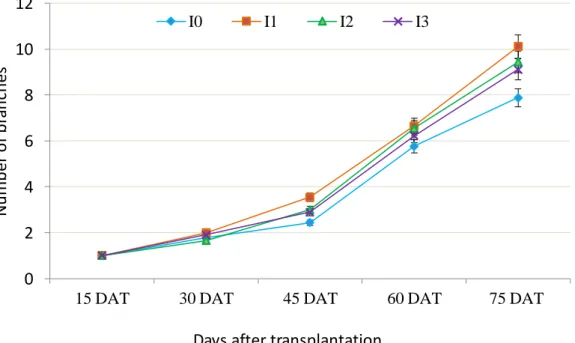
6. Effect of seedling age on branches per tomato plant 34
7. Effect of IAA on branches per tomato plant 34
ix
LIST OF APPENDICES
APPENDIX NO. TITLE PAGE NO.
I. Monthly average temperature, relative humidity and total rainfall of the experimental site during the period from
October 2014 to April 2015 67
II. Results of morphological, mechanical and chemical analysis of soil of the
experimental plot 67
III. Analysis of variance of data on plant height at different DAT of tomato plant 69 IV. Analysis of variance of data on number of leaves at different DAT
of tomato plant 70
V. Analysis of variance of data on number of branches per plant at different
DAT of tomato 71
VI. Analysis of variance of data on stem diameter of tomato plant at
different DAT 72
VII. Analysis of variance of data on yield Characteristics of tomato plant 73 VIII. Analysis of variance of data on yield Characteristics of tomato plant 74 IX. Analysis of variance of data on yield Characteristics of tomato plant 75
x
LIST OF ACRONYMS ABBREVIATION ELABORATION
AEZ Agr-Ecological Zone
Anon. Anonymous]
ANOVA Analysis of Variance
@ at the rate of
Adv. Advanced
Agric. Agricultural
BARI Bangladesh Agricultural Research Institute
BAU Bangladesh Agricultural University
BBS Bangladesh Bureau of Statistics
CV Coefficient of Variation
cv. Cultivar
df Degrees of Freedom
DMRT Duncan’s Multiple Range Test
DAT Days after Transplantation
e.g. example
et al. and others
etc. etcetera
FAO Food and Agricultural Organization
GA3 Gibberellic Acid
xi ABBREVIATION ELABORATION
HRC Horticultural Research Center
IAA Indole-3-Acetic Acid
J. Journal
MoP Muriate of Potash
ns Non Significant
NAA Naphthalene Acetic Acid
PGR Plant Growth Regulator
pH Hydrogen ion concentration
ppm Parts per million
% Percentage
Res. Research
RH Relative Humidity
SAU Sher-e-Bangla Agricultural University
SRDI Soil Resources Development Institute
Sci. Science
TSP Triple Super Phosphate
UNDP United Nations Development Program
µg Microgram
Vol. Volume
1
CHAPTER I INTRODUCTION
Tomato (Lycopersicon esculentum Mill.) which belongs to the solanaceae family is a self pollinated vegetable crop. It gains importance for its wide range of use and nutritional values. In Bangladesh, tomato is cultivated all over the country due to its adaptability to wide range of soil and climate (Ahmed, 1995).
At present, tomato ranks third, next to potato and sweet potato, in terms of worlds vegetable production (FAO, 2013). The leading tomato producing countries are China (50664255 ton), Egypt (8533803 ton), Italy (4932463 ton), Spain (3683600 ton), Brazil (4187646 ton), Mexico (3282583 ton) and USA (1257455 ton) [FAO, 2013].
Tomatoes are incredibly versatile food. Different stage of the fruit used for different purpose. It can be consumed either in fresh, cooked or as processed food like ketchup, sauce, juice, jam, jelly etc. Tomatoes are widely consumed either raw or after processing and can provide a significant proportion of the total antioxidants in the diet (Martinez-Valvercle et al., 2002).
Tomato contains various organic acids like citric, malic, acetic and folic acid. It is an excellent source of many nutrients and secondary metabolities that are important for human health; mineral matter, vitamins C and E, B-carotene, lycopene, flavonoids, organic acids, phenolics and chlorophyll (Giovanelli and Paradise, 2002). Tomatoes are a rich source of lycopene, lutein and beta- carotene, powerful antioxidants that have been shown to protect the eyes against light-induced damage associated with the development of cataracts and age-related macular degeneration (AMD). Tomato contains a number of nutritive elements almost double compared to fruit apple and shows superiority with regard to food values (Barman, 2007) that is why it is called “poor man’s apple” which can provide sufficient nutrient to the poor people in lower price.
2
Bangladesh produced 251000 tons of tomato in 23,827 hectres of land during the year 2012 -2013(BBS, 2012). The average yield of tomato in Bangladesh is quite low (10.54 t/ha) compare to that in China (48.1 t/ha), Egypt (34 t/ha), Italy (50.7 t/ha), Spain (74.0 t/ha), Brazil (60.7 t/ha), Mexico (30.5 t/ha) respectively (Anonymous, 2011).
Yield expression of a genotype largely dependent on environment and other management practices. Yield may vary with the variation of cultural practices.
Seedling age may be the limiting factors of yield. The age of seedlings to be transplanted is very important for proper establishment in the field and production of good quality fruits as well as high yield. . The duration of transplants growth affect the vegetable development, vegetative mass, biochemical composition, output of standard transplants, growth after transplantation, resistance to unfavorable conditions, labor expenses of transplant cultivation [Vavrina 1998, Schrader 2000, Handley and Hutton 2003, Henare and Ravanloo 2008].
Application of modern technology during growth stage of plant may increase growth and yield. Gustafson (1936) was the first to demonstrate that the application of substances closely related to auxins onto the stigmas of tomato and several other species causes the ovary to develop into a parthenocarpic fruit. IAA stimulates cell elongation by stimulation wall-loosening factors, such as elastins, to loosen cell walls and the effect is stronger if gibberellins are also present (Bunger-Kibler and Bangerth, 1983). IAA also stimulates cell division if cytokinins are present (Zhoa, 2008). IAA induces the formation and organization of phloem and xylem. When the plant is wounded, the IAA may induce the cell differentiation and regeneration of the vascular tissues (Ulmasov et al., 1999). IAA promotes root initiation and induces both growth of pre-existing roots and adventitious root formation, i.e., branching of roots (Varga and Bruinsma, 1976). As more native auxin is transported down the stem to the roots, the overall development of the roots is stimulated. The longer and branched root can uptake more nutrients from the soil which are
3
accumulated to the plant sink and increase the yield (Wang et al., 2005). If the source of IAA is removed, such as by trimming the tips of stems, the roots are less stimulated accordingly. IAA induces shoot apical dominance and the axillary buds are inhibited by IAA (Woodward and Bartel, 2005). IAA is required for fruit growth and development and delays fruit senescence and plays also a minor role in the initiation of flowering and development of reproductive organs (Asahira et al., 1967).
Therefore, as per requirement of recent agricultural policy to increase yield with better quality and less investment, an attempt was made to study the effects of different seedling age and different dose of Indole-3-Acetic Acid(IAA) on plant growth and yield of tomato with the following objectives:
i. To determine the effect of different seedling age on growth and yield of tomato.
ii. To investigate the effect of exogenous application of IAA(Indole-3- Acetic Acid) on growth and yield of tomato.
iii. To find out the suitable combination of seedling age and IAA for ensuring the maximum growth and yield of tomato.
4
CHAPTER II
REVIEW OF LITERATURE
Tomato is very important vegetable which can provide nutrition in relatively low price that has a great impact in developing countries like Bangladesh. This is why researchers are more concern about increasing yield in different parts of the worlds with different factors like seedling age and indole-3-acetic acid. But the combined effect of seedling age and indole-3-acetic acid has not clearly defined. Relevant available information in this connection has been described in this chapter:
2.1 Effect of Seedling age on growth and yield of tomato
Histamoni and Urabe (1973) reported that high soil temperature (15º C) use of the young tomato seedling supported vigorous vegetative growth, resulting in longer and thicker stems, more leaves and larger leaves. The proportion of large fruits increased with the use of young seedlings and additional nitrogen.
Size of fruit showed an interaction between soil temperature and moisture.
From the findings, it was possible to produce high yield of good quality fruit by controlling the nitrogen supply, plant density, high intensity, night temperature, soil temperature, soil moisture and seedling quality.
Tongova and Zhelev (1975) reported that both early sowing and early planting of tomato gave increased yield. The highest early and total yields were produced by plants sown on 20 September and transplanted at the 4-5 leaf stage.
Adelana (1976) reported that the earliest planting of tomato seedlings resulted in greater leaf area, higher yield and number of fruits per plant and greater average fruit weight than later planting. Souma et al. (1976) while investigating into the effect of the length of the seedling age on the growth, yield and quality of tomato reported that the seedling transplanted 40 days after sowing grow best and that abnormal fruits were produced by the plants transplanted 60 and
5
70 day after sowing. Dayan et al. (1978) have indicated that delayed planting reduced overall yield.
On the other hand, while investigating into the effect of different methods and time of sowing on yield and quality of tomato found that the number of fruits per plant and mean yield per plant decreased with delay in sowing date. Sowing date and transplant age have tremendous effect on growth and yield of tomato (Ravikumar and Shanmugavelu, 1983).
Adelana (1983) carried out an experiment to determine the right age to transplant tomato seedlings. Seedlings were transplanted at 3, 4, 5 and 6 weeks after sowing in the nursery. He found that the younger transplants grew faster and therefore produced greater dry matter than the older ones. Also, flowering and fruiting were earlier in the younger transplants. Fruit yield was highest in the 3-week old transplants but this was not significantly higher than those of 4- week old. It was therefore recommended that tomato seedlings should be transplanted when they are between 3 and 4 weeks old.
In Bangladesh, Rahman and Quasem (1986) carried out an experiment to observe proper age and yield contributing characters studied except days to first flower, days to 50% flower and seedling on yield of tomato. The age of seedling did not show any significant difference for all yield days to first fruit set where earliness was observed with the increased age of seedling. Yield increase of 8 tons per hectare was obtained from 40 days old seedling (64.53 t/ha) over 20 and 30 days of seedling.
In Thailand, Palamakumbura (1987) carried out an experiment to observe the effect of seedling age and spacing on growth and yield of tomato. Response of the tomato variety CL-143-0-10-3-0-1-10 to different seedling ages of 15, 20, 25 and 30 days as well as spacing of 50 × 100, 40 × 100, 30 × 100, 20 × 100 cm was studied during October 1st, 1986 to February 28th, 1987 at TOP/AVRDC experimental site, Kamphaeng Saen Campus of Kasetsart University, Thailand. He found that 20-day-old seedlings recorded the lowest
6
mortality in the field after transplanting, compared to other seedling ages. The highest number of fruits/plant and the highest fruit weight were recorded with seedlings transplanted at 40 × 100 cm spacing. It is evident that the 25-day-old seedlings planted at 20 × 100 cm produced highest yield.
Vavrina and Orzolek (1993) conducted the research to determine the optimum age at which to transplant tomatoes. It was concluded that transplants ranging from 2 to 13 weeks old could produce similar yields, depending on many factors involved in commercial production.
Rahman et al. (1994) reported that in experiments of tomato cv. Manik, seedling age at transplanting had a significant effect on the number of days until flowering commenced the number of days until harvest, number of fruits/plant and yield. Plants grown from younger seedlings flowered and were ready to harvest earlier than those grown from older seedlings. The numbers of fruit/plant and average fruit weight were greatest when seedlings were 40 day old at transplanting.
Chui et al. (1997) conducted a greenhouse and field experiment with three tomato cultivars to study the influence of seedling age (4, 6, 8 or 10 weeks) on growth and early yield of fresh market tomatoes. Seedlings more than 6 weeks old showed slower growth and recovery after transplanting (RAT) and took longer time to flower in all 3 cultivars. Although older seedlings (> 8 weeks) had restricted roots, they produced higher early yields than younger seedlings.
Three tomato cultivars were grown using the plug system or traditionally from seedlings sown in the field. They were then planted when 2 to 8 weeks old.
There were no differences in performance of seedlings from the 2 different nursery systems when seedlings were less than 4 weeks old at planting. After 4 weeks, the growth rate of the field sown seedlings was greater than those raised as plugs
Sanjoy Saha (1999) studied the impact of seedling age (15 or 30 days old) and planting time (early: 16 November or late: 16 December) on the fruit yield
7
performance of tomato (Lycopersicon lycopersicum) cultivars BT 18, BT 12, BT 10, BT 2 and MIXENT in upland rice (cv. Annada)- based cropping system. All cultivars performed well when planted early (with 15-day-old seedlings) and showed a declining trend in fruit yield and other yield- attributing characters when planted late with 30 days old seedlings. Among the tomato cultivars, remarkably good fruit yields of 60.7 and 47.0 t/ha were recorded from BT 18 during 1994-95 and 1995-96, respectively, when planted early with 15 days old seedlings. BT 12 gave fruit yields of 59.7 and 41.9 t/ha during 1994-95 and 1995-96, respectively. The economics of different tomato cultivars also showed the same trend. The gross return, net return and net return per rupee were highest in BT 18, followed by BT 12, respective of seedling age and planting time.
Benedictos et al. (2000) reported that young (5 weeks old) transplants of tomato had highest fruit setting rate (81.69%), followed by medium-aged (7 weeks old) transplants (76.94%) and old (9 week old) transplants (76.04%).
Okano et al. (2000) reported the effects of seedling age at planting on the quality of nursery plants, on plant from after planting and on growth rate and fruit yield. The younger the seedling at planting, the faster the plant grew after planting. When seedlings were raised for >35 days, growth was considerably retarded. Dry weight of roots and stems at harvest were higher when tomatoes were planted at a younger age. However, leaf dry weight, total leaf area and fruit yield were highest in the 25 and 35 days old seedling plots. Total leaf area per plant was positively correlated with fruit yield.
Okano et al. (2000) observed the effect of seedling age at planting on plant form and fruit productivity in single-truss tomato (Lycopersicon esculentum Mill.) grown hydroponically. Light interception and photosynthetic activity of the leaves were also examined in plants with different plant forms. Growth after planting was retarded in proportion to the duration of rising of seedlings.
25-day to 35-day (4 to 7 leaf stages) plug seedlings was considered to be most
8
suitable for single-truss cultivation of tomato. Fruit yield was positively correlated with total leaf area. Frequent emergence of lateral shoots could not be inhibited by the use of over mature seedlings. Interception of solar radiation which was highest for the uppermost leaf decreased for the leaves toward the lower part of the plant. Radiation interception by individual leaves varied depending on the plant form, which influenced the rate of field photosynthesis.
Only upper three leaves contributed to photosynthesis in a shorter plant, while many more leaves in a taller plant.
Mercik & Skapski (1960) evaluated five self determined tomato varieties and reported that apart from Fire ball in which the youngest(4-week-old) transplants produced the highest early yields, the highest early yields were produced from the oldest(8-week-old) transplants. A delay of 2 weeks in planting out resulted in late maturity and reduction in yield of all five varieties.
Pena-Lomeli et al. (1991) used three cultivars of tomato transplants of 2, 3, 4, 5, and 6 weeks of age. They found the 3-week-old transplants had the highest yields across cultivars.
Salik et al. (2000) found that the medium aged seedlings (5 weeks) had the highest number of fruits per plant, marketable yield and fruit weight followed by 6 week and 4 weeks. Time taken to flowering was less in the case of 4 week seedlings than others. Number of branches was highest in 5 week old seedlings.
Weston and Zandstra (1989) used 4, 5, 6 and 7 week-old seedlings of tomato and found that 4 to 5 week-old transplants produced higher number and weight of fruits than younger or older transplants.
F. Agble (1988) conducted a research on four transplanting ages of tomato cultivar Lauranto seedlings, namely 20, 25,30 and 35 days, were compared during the major and minor rainy seasons for 2 years. Field survival of seedlings was least for 20-day-old transplants but high for the 25 and 30-day-
9
old transplants. The 20-day-old transplants flowered before the 35-day old transplant. Both 25- and 30-day-old transplants matured early and gave higher yields than 20- and 35-day-old transplant
2.2 Effect of IAA on growth and yield of tomato
Sing et al. (2005) carried out an investigation to see the effects of different doses of PGRs (control, 25 or 75 ppm IAA, and 25 or 75 ppm NAA) and micronutrient(control, 2500 ppm Multiplex or 2000 ppm Humaur) mixtures and their interactions on plant growth, number of branches and yield of tomato at 35 and 70 days after transplanting(DAT). Plant growth was not affected significantly by any treatment and interaction, although the effect of P1(25 ppm IAA) x M2(Humaur) interaction was better in increasing the plant growth at 75 DAT. The number of branches was significantly and highly increased by the application of 75 ppm IAA and 25 ppm NAA. The initiation time of first flowering and first fruiting was significantly and highly increased by the interaction {4(75 ppm NAA) x M2(Humaur). Application of 35 ppm IAA and 2000 ppm Humaru was significantly increased the tomato yield. P4 (75 ppm NAA) x M2( 2000ppm Humaur) was also significantly increased the yield.It can be concluded that addition of PGR and micronutrient in tomato is useful for better produciton.
Djanaguiraman et al. (2004) conducted an experiment where the plants were with four different concentrations of Nitrophenols(ATONIK)at flowering and fruit setting stage. Observatios were recorded in the flowers and developing fruits. Application of nitrophenols significantly increased the activity of antioxidant enzymes namely superoxide dismutase (SOD), catalase CAT), peroxidase (POX) and auxin content coupled with decreased activity of polyphenol oxidase [catechol oxidase] (PPO) and IAA oxidase (IAAO) enzymes over the control significantly. Among the concentrations, experimented, application of nitrophenols at 0.4% during fruit set stage was found to be the most effective in recording high antioxidant enzymes activity
10
and auxin level which was reflected in an increased number of fruit clusters per plant, fertility coefficient and yield of tomato.
Gupta and Gupta (2004) studied the plants were sprayed with 25 or 75 ppm IAA and NAA, alone or in combination with the micronutrient mixtures Multiplex 2500 pp, amd 2000 ppm Humaur in a field experiment conducted in Allahahad, India to determine the effects of the treatments on the P content of tomato fruits and products. Application of 75 ppm NAA + multiplex resulted in the highest P content in tomato fruits , as well as in ketchup, and tomato puree and juice during both years.
Gupta et al. (2003) observed the response of plant growth regulators and micronutrients mixtures on fruit size, color and yield of tomato(Lycopersicon esculentum Mill.) An experiment was conducted by two years(1997-99) in Uttar Pradesh, India to determine the effect of growth regulators (25 ppm IAA and 45 ppm IAA) at 25 and 50 days after transplanting(DAY) and /or Micronutrient mixtures(2500 ppm Multiplex and 2000 ppm Humaur) at 25 and 50 DAT, respectively, on tomato cv. Krishna (F1 hyvrid). Among all Treatments, the largest fruit size (6.67 cm diameter), most attractive ripe fruit color(Phantom, 2L – 12) and the highest yield (63.61 t/ha) were observed with 45 ppm IAA + Multiplex micronutrient mixture at the maturity stage during 1998 – 99. The highest dry matter (12.7%) and ash content (1.0%) were obtained upon treatment with 45 ppm IAA + Humaur micronutrient mixture.
Singh et al. (2003) stated that the effects of 2,4-D. beta naphthoxyacetic acid 12-naphthoxyacetic acid] and IAA (1,10 or 100 ppm), applied as either seed Treatment or plant spray, on the growth and yield of tomato cv. Pusa Ruby were in Kanpur, Uttar Pradesh, India. Seed germination varied from 8.2 to 40.2% during the initial evaluation. Flowering was initially observed in treated plants at 77-87 days after sowing. 2,4-D at all concentrations resulted in earlier flowering, whereas 1 ppm BNOA and all concentrations of IAA delayed flowering, Plants treated with 100 ppm BNOA exhibited the greatest seed
11
germination and fruit set, and the lowest number of days to flowering. BNOA applied at 100 ppm as seed treatment gave the earliest fruit ripening (earlier than the control by 15 days).
Gupta et al. (2002)a conducted an experiment on the effect of, IAA and NAA (35 and 75 ppm, respectively, at 25 and 50 days after transplanting) and the micro nutrients mixtures Multiplex and Humaur (2500 and 2000 ppm, respectively), on the tomato cultivar Krishna was evaluated in Karnataka, India during 1997 – 98 and 1998 – 99. The application of auxins and micronutrients significantly improved the fruit size (length 6.32 cm and diameter 6.78), dry matter, ash content, longest root length and yield of the greatest fruit size and yield were obtained with 75 ppm NAA + multiplex; while the highest dry matter and ash content were recorded for 75 ppm NAA + Humaur.
Gupta et al. (2002)b conducted and experiment to observed the effect of the plant growth regulators (PGRs) IAA and NAA(15 and 75 ppm), and micronutrient mixtures Multiplex (2500 ppm), and micronutrient mixtures Multiplex (2500 ppm)[Ca, Mg, S, Fe, Zn, Mo, Mn, B and NAA, } and Humaur (2000 ppm) on the nutritive value of tomato (cv. Krishna) fruits. PGRs were applied at 25 and 75 days after transplanting IDAT). Treatment with micronutrient mixtures was conducted at 25 and 75 DAT. Higher nutritive content was obtained with the application of both PGRs and micronutrient mixtures than treatment with wither PGR or micronutrient mixture. NAA at 75 ppm + Multiplex increased P content by 16.12 % and iron content by 23.33 %.
The application of 75 ppm NAA + Humaur increased K content by 13.08% and Cs concentration by 52.38%. The Mg content increased by 43.84%due to the application of 25 ppm NAA + Humaur.
Singh et al. (2002) conducted a field experiment at Allahabad, Uttar Pradesh , India to determine the effect of plant growth regulators (PGRs) and commercially available micronutrient mixtures on growth, yield and quality of tomato cv. Gobi (F1 Hybrid). The treatments consisted of 2 concentrations (25
12
and 75 ppm) each of IAA and NAA, and micronutrients Humaur at 2000 ppm and multiplex at 2500 ppm. PGRs were applied in the form of foliar sprays at intervals of 26 and 29 days, respectively, and micronutrients were applied as a spray at 30 days after planting. Plant growth characters and fruit quality varied with the application of PGR and micronutrient mixture combinations.
Rai et al. (2002)conducted an experiment that application of IAA at 75 ppm along with Multiplex at 2500 ppm resulted in highest plant height and yield, and IAA at 75 ppm alone in the highest number of branches. Application of IAA at 25 ppm + Multiplex at 2500 ppm superior for ascorbic acid content.
Maximum chlorophyll content and acidity were obtained with NAA at 75 ppm along with Humaur at 2000 ppm IAA at 75 pp + Humaur at 2000 ppm were the best for total soluble solids and carotenoid content. NAA at 75 ppm along with Multiplex at 2500 ppm gave the highest sugar content.
Gupta et al. (2001) studied with Tomato (cv. Krishna) plants were treated with IAA (25 ppm at 25 days after transplanting, DAT) and NAA (75 ppm at 75 DAT), and supplied with Multiplex (2500 ppm) and Humaur (2000 ppm), in a field experiment conducted during the rabi seasons. The physicochemical characteristics of fruits were analyzed. Maximum total soluble sold content (5.4%) in total mature fruits was recorded from treatments of NAA and Humaur. The maximum lycopene and carotenoid content were recorded from NAA and Multiplex. Reducing and non-reducing sugar contents were the highest (4 mg/100 g and 31.5 mg/100 g) when plants were treated with NAA and Humaur.
Chung and Chori (2001) stated the foliar application of plant growth regulators affects distribution and accumulation of calcium ( 45 CaCl2) in tomato leaves.
All tomato(cv. Sunroad) leaves, except the 7th and 8th or 5th to 8th leaves from the cotyledons, stem apices and the inflorescence, were removed to investigate the effect of plant growth regulators (PGR) on the leaves. The application of GA3 to either of these leaves resulted in the accumulation of 45 Ca2 twice as high in the treated plants as in the plants which were sprayed distilled water
13
(control plants). When 2-(3-chloropllrenoxy) propanoic acid was applied onto the upper leaf, than 45 Ca2 accumulation was higher than in the control plants, whereas there was no difference when CPA was applied onto the lower leaf.
IAA or NAA treated leaves showed lower amount 45Ca2 than the leaves of control plants, showing more inhibiting effect of NAA, in particular. The present study indicates that the application of various PGR does not interrupt the acropetal movement of calcium ion. But increase the stem diameter of the tomatoes at several water.
Sun et al. (2000) reported the role of growth regulators on cold water fir irrigation reduces stem elongation of plug grown tomato seedlings. The effect of growth regulators (abscisic acid, gibberellic acid(GA), paclobutrazol, ethephone, IAA and silver thiosulphate) and cold water irrigation at different treatments (5, 15, 25, 35, 45 and 55 C) on the reduction of stem elongation and of plung grown tomato) seedlings was investigated. Paclobutrazol, ethephone and GA reduced the stem length but it increase the stem diameter of the tomatoes at several water temperature. Cold water irrigation with the addition of 1.8 ppm GA or irrigation at room temperature could promote stem elongation. Irrigation at room temperature with the addition of 10 ppm paclobutrazol (Gas biosynthesis inhibitor) or cold water irrigation could inhibit stem elongation. The reduction in stem elongation in plung-grown tomato seedlings was due to the relationship of Gas metabolism and sensitivity.
El-Habbasha et al. (1999) studied the response of tomato plants to foliar spray with some growth regulators under late summer conditions. Field experiments were carried out with tomato (cv. Castelrock) over two growing seasons (1993 – 94) at Shalakan, Egypt. The effects of GA3 IAA, TPA (tolylphthalamic acid) and 4-CPA) each at 2 different concentrations) on fruit yield and quality were investigated. Many of the treatments significantly increased fruit set percentage and total fruit yield, but also the percentages of puffy and parthenocarpic fruits, compare with controls.
14
Sumiati (1987) reported that tomato cultivars. Gondol, Meneymaker, Intan and Ratan sprayed with 1000 ppm chlorflurenol. 100 ppm IAA, 50 ppm NAA or 10 ppm, GA3 or left untreated , compared with controls, fruit setting was hastened by 4-5 days in all cultivars following treatment with 100 ppm IAA or 10 ppm GA3.
Perez and Ramirez(1980) carried out an experiment with the application of IAA at 25 and 35 ppm on tomato. They found increased fruit size quality with minimum seeds.
Younis and Tigani (1977) carried out an experiment with IAA application on tomato cv. John Moran plants. They observed that when IAA was applied to field grown tomato plants, 2 applications of IAA at 10 ppm increased the fruit set significantly.
Kaushik et al. (1974) reported that 10 ppm of IAA increased the number and weight of fruits per plant significantly. The application of IAA at 100 ppm markedly reduced fruit number and yield.
Singh and Upadhayaya (1967) studied the effect of IAA and NAA on tomato and reported that the regulators activated growth, increased the fruit set, size and yield of fruit and induced parthenocarpic fruit. The chemicals could be applied on seeds, roots, whole plants or flowers, but foliar application was very effective for increasing the size of fruit and the yield.
Mukharji and Roy (1966) found that application of IAA had protected the flower and premature fruit drop and increased length of size fruit in tomato plant.
Leopold (1964) observed that with the increase in concentration of auxin there was a comparable increase in percentage of flower cluster.
Chhonkar and Singh (1959) recorded increasing yield of tomato by seedling treatment with growth substances. They reported that high concentration of IAA reduced plant height but increased yield through induction and fruit set.
15
CHAPTER III
MATERIAL AND METHOD 3.1 Location of the field
The experiment was conducted at Horticultural farm of the Sher-e-Bangla Agricultural University, Sher-e-Bangla Nagar, Dhaka during the period from November 2014 to April 2015 The location of the experimental site was at 230 46/ N latitude and 900 22/ E longitude with an elevation of 8.24 meter from sea level.
3.2 Climate of the experimental area
The experimental area is characterized by subtropical rainfall during the month of May to September and scattered rainfall during the rest of the year.
Information regarding average monthly temperature as recorded by Meteorogical Department ( climate division) during the period of study is available in Appendix I.
3.3 Soil of the experimental field
Soil of the study site was silty clay loam in texture belonging to series. The area represents the Agro- Ecological Zone of Madhupur tract (AEZ No. 28) with pH 5.8 – 6.5, ECE – 25.28. The analytical data of the soil sample collected from the experimental area were determined in the Soil Resources Development Institute (SRDI), Soil Testing Laboratory, Khamarbari, Dhaka and have been presented in Appendix II.
3.4 Plant materials collection:
The tomato variety used in the experiment was “BARI Tomato 14”, a high yielding indeterminate type variety. The seeds were collected from Olericulture division of Horticulture Research Centre, Bangladesh Agricultural Research Institute (BARI), Joydevpur, Gazipur.
16
3.5 Raising of seedlings
Tomato seedlings were raised in three see beds of 2 m X 1 m size with the interval of 5 days. The soil was well prepared and made into loose friable and dried by spading. Before raising seedling the seed bed was cured by fungicide.
All weeds and stubbles were removed. The soil of seed bed was mixed with 5 kg rotten cow dung. Five gram of seeds were sown in first seed bed on 01 November 2014, then five gram in second seed bed on 05 November 2014 and another five gram seed in the third seed bed on 10 November. After sowing, seeds were covered with light soil. The emergence of the seedlings took place within 6 to 7 days after sowing. Weeding, mulching and irrigation were done as and when they required.
3.6 Treatments of the experiment
The experiment consisted of two factors as follows:
Factor A: Three ages of seedlings S1 = 25 days
S2 = 30 days S3 = 35 days
Factor B: Four levels of IAA (Indole-3-Acetic Acid) I0 = Control ( No IAA)
I1 = 80 ppm I2 = 100 ppm I3 = 120 ppm
There were altogether 12 treatment combination used in each block were as follows: S1I0, S1I1, S1I2, S1I3, S2I0, S2I1, S2I2, S2I3, S3I0, S3I1, S3I2, S3I3,
17
3.7 Design and layout of the experiment
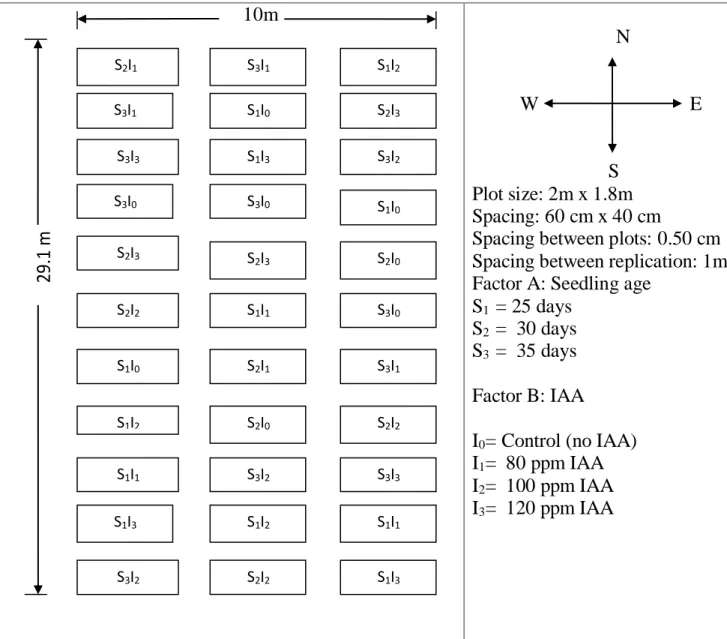
The experiment was laid out in Randomized Complete Block Design (RCBD) having two factors with three replications. An area of 29.1 m X 10 m was divided into three equal blocks. Each block was consists of 12 plots where 12 treatments were allotted randomly. There were 36 unit plots in the experiment . The size of each plot was 1.8 m X 2 m. The distance between two blocks and two plots were kept 1 m and 0.5 respectively. A layout of the experiment has been shown in Figure 1.
10m
N
W E
S Plot size: 2m x 1.8m Spacing: 60 cm x 40 cm
Spacing between plots: 0.50 cm Spacing between replication: 1m Factor A: Seedling age
S1 = 25 days S2 = 30 days S3 = 35 days Factor B: IAA
I0= Control (no IAA) I1= 80 ppm IAA I2= 100 ppm IAA I3= 120 ppm IAA
Fig. 1 : Field layout of the experiment plot
29.1 m
S2I1
S3I1
S3I0
S3I3
S2I3
S2I2
S3I1
S1I0
S1I3
S3I0
S2I3
S1I1
S2I1
S2I0
S3I1
S1I2
S1I0
S2I2
S3I0
S2I0
S1I0
S2I3
S1I2
S1I2
S3I2
S3I2
S1I3
S1I1
S2I2
S1I1
S3I3
S3I2
S1I3
18
3.8 Cultivation procedure 3.8.1 Land preparation
The soil was well prepared and good tilth was ensured for commercial crop production. The land of the experiment field was ploughed with a power tiller on November 2014. Later on the land was ploughed three times followed by laddering to obtain desirable tilth. The corners of the land were spaded and larger clods were broken into smaller pieces. After ploughing and laddering , all the stubbles and uprooted weeds were removed and then the land was made ready. The field layout and design was followed after land preparation.
3.8.2 Manures and Fertilizers and it’s methods of application:
Fertilizer Quantity Application of method
Cow dung 15 ton/ha Basal dose
Urea 400 kg/ha 20, 30 and 40 DAT
TSP 300 kg/ha Basal dose
MOP 250 kg/ha 20, 30 and 40 DAT mixed with
urea Rashid (1999)
Manure and fertilizers were applied according to Rashid (1999). The amount of cow dung and TSP were applied as basal dose during land preparation. Urea, TSP and MOP were applied at the rate of 400 kg/ha, 300 kg/ha and 250 kg/ha respectively. Urea and MOP were used as top dressing in equal splits at 20, 30 and 40 days after transplanting.
3.8.3 Preparation of seedling:
The seedlings were raised in different seed bed with the interval of 5 days. The seedlings were transplanted in the main field after completion of different age as 25 days, 30 days and 35 days.
3.8.4 Transplanting of seedlings
Healthy and uniform seedling with different age like 25 days, 30 days and 35 days were uprooted separately from the seed bed and were transplanted in the
19
experimental plots in 05 December, 2014 maintaining a spacing of 60 cm X 40 cm between the rows and plants respectively. This allowed an accommodation of 15 plants in each plot. The seedbed was watered before uprooting the seedlings from the seedbed to minimize damage to the roots. The seedlings were watered after transplanting. Seedlings were also planted around the border area of the experimental plots for gap filling.
3.8.5. Preparation and application of IAA
The stock solution of 1000 ppm of IAA was made by mixing of 1 g of IAA with small amount of ethanol to dilute and then mixed in 1 litre of distilled water. Then as per requirement of 80 ppm, 100 ppm and 120 ppm solution of IAA, 80, 100 and 120 ml of stock solution were mixed with 1 litre of distilled water respectively. Application of IAA was done at 15 days interval and was applied at 25, 40 and 55 days after transplanting.
3.8.6 Intercultural operations
After transplanting the seedlings, various kinds of intercultural operations were accomplished for better growth and development of the plants, which are as follows:
3.8.6.1 Gap filling
When the seedlings were well established, the soil around the base of each seedling was pulverized. A few gaps filling was done by healthy seedlings of the same stock where initial planted seedling failed to survive.
3.8.6.2 Weeding
Numbers of weeding were accomplished as and whenever necessary t keep the crop free from weeds.
20
3.8.6.3 Staking
When the plants were well established, staking was given to each plant by rope and bamboo stick to keep them erect. Within a few days of staking, as the plants grew up, other cultural operations were carried out.
3.8.6.4 Irrigation
Number of irrigation was given throughout the growing period by garden pipe and watering cane. The first irrigation was given immediate after the transplantation where as other were applied as and when required depending upon the condition of soil.
3.8.6.5 Plant protection
From seedling to harvesting stage , tomato is very sensitive to diseases and pest. After getting a maturity stage protection measure was taken against disease and pests. So that, any insect or fungal infection and insect infestation cannot appear in the plant.
3.8.6.6 Insect pests
Bavistin 50 WP and Ripcord 10 EC were applied @ 10 ml/L against the fungal disease, leaf curl disease and insect pests like cut worm, leaf hopper, fruit borer and others. The insecticide application was made fortnightly for a week after transplanting to two weeks before first harvesting.
3.9 Harvesting
Fruits were harvested at 7 to 8 days intervals during early ripe stage when they attained slightly red color. Harvesting was started from 8 March, 2015 and was continued up to end of 20 April 2015.
21
3.10 Data collection
Five plants were selected randomly from each plot for data collection in such a way that the border effect could be avoided for the highest precision. Data on the following parameters were recorded from the sample plants during the course of experiment.
3.10.1 Plant height
The plant height was measured in centimeters from the base of plant to the terminal growth point of main stem on tagged plants was recorded at 15 days interval starting from 15 days of planting up to 75 days to observe the plant height. The average height was computed and expressed in centimeter.
3.10.2 Number of leaves per plant
The number of leaves per plant was manually counted at 15, 30, 45, 60 and 75 days after transplanting from randomly selected tagged plants. The average of five plants were computed and expressed in average of leaves per plant.
3.10.3 Number of branches per plant
The number of branches per plant was manually counted at 15, 30, 45, 60 and 75 days after transplanting from randomly selected tagged plants. The average of five plants were computed and expressed in average number of branch per plant.
3.10.4 Number of flowers per cluster
The number of flowers per cluster was counted at 45 days after transplanting from the five sample plants. From each plant randomly five clusters were selected and counted the number of flowers per cluster to make an average value for one plant. The final average value of number of flower per cluster was calculated from five averages from five plants.
22
3.10.5 Number of cluster per plant
The number of clusters was counted at 60 days after transplanting from the five sample plants and the average number of clusters produced per plant was recorded.
3.10.5 Number of fruits per cluster
The number of fruits per cluster was counted at 60 DAT and harvesting time from selected five plants. From each plant randomly five clusters were selected and counted the number of fruits per cluster to make and average value for one plant. The final average value of number of fruits per cluster was calculated from five averages from five plants.
3.10.6 Length of fruit
Among the total number of fruit harvested during the period from first to final harvest, the fruits, except the first and last harvest, were considered for determine the length of fruit by slide calipers. The length of fruit was calculated by making the average of five fruits from each of the five plants.
3.10.7 Diameter of fruit
Among the total number of fruits harvested during the period from first to final harvest, the fruits, except the first and last harvest, were considered for determine the diameter of fruit by slide calipers. The diameter of fruit was calculated by making the average of five fruits from each of the five plants.
3.10.8 Fresh weight of individual fruit
Among the total number of fruit harvested during the period from first to final harvest, the fruits, except the first and last harvest, were considered for determine the individual fruit weight in gram. The weight was calculated from total weight of fruits was divided by total number fruits of every harvest and finally making the average was made from four times harvesting data.
23
3.10.9 Dry matter content of fruit (%)
After harvesting, randomly selected 100 gm of fruit sample previously sliced in to very thin pieces. The fruits were then dried in the sun for seven days and placed in oven maintained at 60⁰ for 72 hours. The sample was then transferred into desiccators and allowed to cool down to the room temperature. The final weight of the sample was taken. The dry matter was calculation by the following formula:
Dry matter of fruit (%) = 𝐷𝑟𝑦 𝑤𝑒𝑖𝑔ℎ𝑡 𝑜𝑓 𝑓𝑟𝑢𝑖𝑡 Fresh weight of fruitX100 3.10.10 Length of root
The length of root was manually measured at the time of harvest from randomly selected five plants. The averages root length of five sample plants were considered as root length of plant.
3.10.11 Chlorophyll percentage of leaf
The Chlorophyll percentage of leaf of the plant was measure by a SPAD meter, a product of Konica Minolta Sensing Ltd. Singapore, at 60 days after transplanting from randomly selected five tagged plants. This machine gives the direct calculated value of the chlorophyll percentage of leaf of the plant.
The Chlorophyll percentage of five tagged leaves of each plant was measured and calculated the average Chlorophyll percentage of leaf of each plant of five sample plants.
3.10.11 Dry matter content of leaf (%)
After harvesting, randomly selected 100 gram of leaf sample previously dried in the sun for seven days and were put into envelop and placed in oven maintained at 60⁰ for 72 hours. The sample was then transferred into desiccators and allowed to cool down to the room temperature. The final weight of the sample was taken. The dry matter was calculated by the following formula: Dry matter of leaf (%): Dry weight of leaf
Fresh weight of leaf X 100
24
3.10.12 Carbon assimilation rate
The carbon assimilation rate of the plant was measured by an automatic
“LCpro+ (advanced photosynthesis measurement system) meter” which is a product of ADC Ltd. Hertfordshire EN 11 ONT, United Kingdom at 60 days after transplanting from five tagged plants of each plot. This machine gives the direct calculated result of carbon assimilation rate of the plant. The Carbon assimilation rate of five tagged leaves of each plant was measured and calculated the average Carbon assimilation rate of one plant.
3.10.13 Yield per plot (Kg)
An electric balance was used to measure the weight of fruits per plot. The total fruit yield of each unit plot measured separately from each sample plant during the harvesting period and was expressed in kilogram (kg).
3.10.13 Yield per hectre (Ton)
It was measured by the following formula;
Yield of tomato (t/ha) =Fruit yield per unit plot(kg) X1000
Area of unit plot in square meter X 1000 3.11 Statistical analysis
The recorded data on various parameters were statistically analyzed using MSTAT-C statistical package program. The mean for all the treatments was calculated and analysis of variance for all the characters were performed by F- Difference between treatment means were determine by Duncan’s Multiple Range Test (DMRT) according to Gomez an Gomez, (1984) at 5% level of significance
25
CHAPTER – IV
RESULTS AND DISCUSSION
The present study was conducted to find out the growth and yield of tomato influenced by seedling age and IAA. Data on different growth and yield contributing characters were recorded. The analysis of variance (ANOVA) of the data on different growth and yield parameter are given in Appendix III-IX.
The results have been presented and discussed with the help of tables and graphs and possible interpretations were given under the following headings:
4.1 Plant height
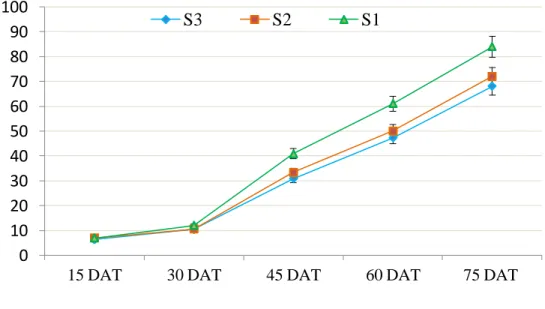
Significant difference was observed on plant height due to use of different age of seedling at 30, 45, 60 and 75 DAT except 15 days (Appendix III). At 30 DAT, the longest plant (32.58 cm) was recorded from S1(25 days) and the shortest plant (23.33 cm) was found in S3(35 days). At 45 DAT the longest plant (62.33 cm) was recorded in S1(25 days) and shortest (46.42 cm) plant was found in S3(35 days).The plant height was highest at S1(25 days) as 80.58 cm as followed by shortest of 60 cm in S3(35 days) at 60 DAT. The longest plant (99.75 cm) was found at 75 DAT in S1 as followed by shortest (70.08 cm) in S3. (Fig.2)
Significance difference was observed due to application of different levels of IAA at 30, 45, 60 and 75 DAT except 15 DAT (Appendix III). At 30 DAT, the longest plant (27.22 cm) was recorded from I1(80 ppm) and the shortest plant (23.78 cm) was found at I0 (control). At 45 DAT, the longest plant 56.22 cm found from I1 and the shortest plant (49 cm) obtained from I0. At 60 DAT, the longest plant (72.22 cm) was found from I1 and the shortest plant (63.22 cm) obtained from I0 (control) treatment (Fig. 3). Murphy (1964) found that application of IAA increased plant height up to 65%. Rai et al. (2002) observed that the application of 75 ppm increased the plant height significantly.
26
Combined effects of seedling age and IAA showed significant difference on plant height at all observation except 15 DAT (Appendix III). However at 30 DAT the longest plant (31.33 cm) was recorded from S1I1(25 days seedling + 80 ppm IAA) and the shortest (17.33 cm) at S3I0 (35 days seedling + no IAA).
At 45 DAT the longest plant (62 cm) was found at S1I1 which was statistically similar to S1I2 (61.67 cm) and S1I3 (56.67 cm) and the shortest plant (35.33 cm) was found at S3I0 (35 days seedling + no IAA) which was statistically identical to S3I3 (40.67 cm). At 60 DAT, the longest plant (82 cm) was found from S1I1
that was statistically similar to S1I2 (78.00 cm) and the shortest plant (50.67 cm) found from S3I0 combination. At 75 DAT, the longest plant (108 cm) was recorded as at S1I1 which was statistically similar to S1I2 (99.67 cm) combination and the shortest plant (62.33 cm) was found at S3I0 combination (Table 1).
4.2 Number of leaves per plant
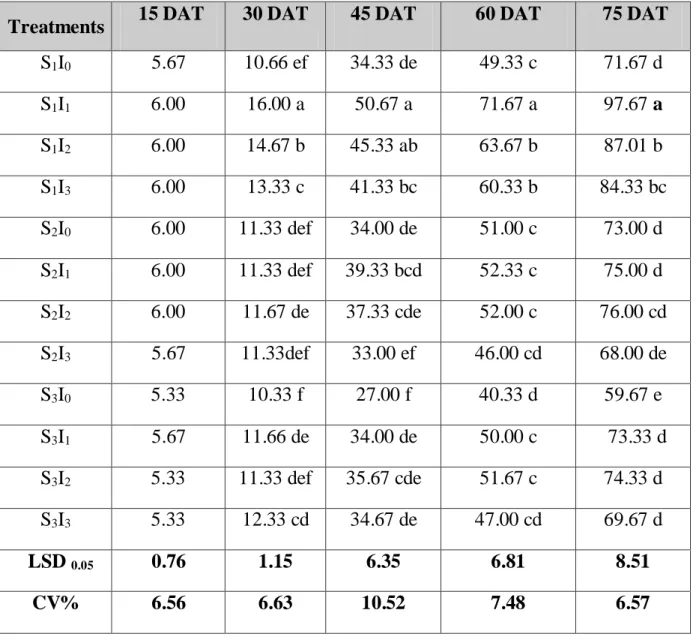
Due to use of different age of seedling showed significant difference on number of leaves per plant at all observation except 15 DAT (Appendix IV). At 30 DAT, the maximum number of leaves per plant (12) was counted from S1
(25 days) and minimum number of leaves per plant(10.14) was obtained from S3(35 days). At 45 DAT, maximum number of leaves per plant (40.93) was counted from S1 and the minimum number of leaves per plant (30.85) was counted from S3. At 60 DAT, the maximum number of leaves per plant (61.01) obtained from S1 and the minimum number of leaves (47.27) was counted from S3. At 75 DAT, maximum number of leaves per plant (84) was counted from S1
and the minimum number of leaves per plant (68.02) was obtained from S3
(Fig. 4). Histamoni and Urabe (1973) reported that high soil temperature (15º C) use of the young tomato seedling supported vigorous vegetative growth, resulting in longer and thicker stems, more leaves and larger leaves.
27
Fig. 2. Effect of seedling age on plant height of tomato
Fig. 3. Effect of IAA on plant height of tomato 0
10 20 30 40 50 60 70 80 90 100
15 DAT 30 DAT 45 DAT 60 DAT 75 DAT
Plant height (cm)
Days after Transplantation
I0 I1 I2 I3
S1 : 25 days old seedling; S2 : 30 days old seedling; S3 : 35 days old seedling.
I0 : control ( No IAA); I1 : 80 ppm IAA; I2 : 100 ppm IAA; I3 : 120 ppm IAA.
28
Table1. Combined effect of seedling age and IAA on plant height of tomato
S1:25 days old seedling S2: 30days old seedling S3:35 days old seedling I0 : control ( No IAA) I1 : 80 ppm IAA I2 : 100 ppm IAA I3: 120 ppm IAA In a column means having similar letter (s) are statistically identical and those having dissimilar letter (s) differ significantly as per 0.05 level of probability.
Treatments 15 DAT 30 DAT 45 DAT 60 DAT 75 DAT S1I0 18.02 26.67 bc 56.00 bc 72.00 bc 94.67 bc
S1I1 17.69 31.33 a 62.00 a 82.00 a 108.00 a
S1I2 17.35 28.67 b 61.67 ab 78.00 ab 99.67 ab S1I3 18.02 27.67 b 56.67 ab 74.00 bc 96.67 bc S2I0 17.69 21.33 fg 49.67 de 61.00 ef 77.33 ef S2I1 17.69 24.33 de 54.00 bcd 69.67 cd 88.67 cd S2I2 18.02 25.33 cd 55.67 bc 71.00 bcd 90.00 c S2I3 18.02 22.33 ef 50.33 cde 64.33 de 79.67 de
S3I0 17.02 17.33 h 35.33 f 50.67 g 62.33 g
S3I1 17.02 20.00 g 46.67 e 59.00 ef 73.33 ef S3I2 18.02 20.67 fg 47.00 e 59.00 ef 74.67 ef S3I3 17.35 19.33gh 40.67 f 55.33 fg 70.00 fg
LSD 0.05 1.01 2.25 5.83 7.22 9.16
CV% 6.03 5.19 6.71 6.29 6.85