EFFECT OF STEM PRUNING ON YIELD AND YIELD CONTRIBUTING CHARACTERS OF CHERRY TOMATO IN
SOILLESS CULTURE
MD. ABDUS SAMAD
DEPARTMENT OF HORTICULTURE
SHER-E-BANGLA AGRICULTURAL UNIVERSITY
DHAKA-1207
EFFECT OF STEM PRUNING ON YIELD AND YIELD CONTRIBUTING CHARACTERS OF CHERRY TOMATO IN
SOILLESS CULTURE BY
MD. ABDUS SAMAD
REG. NO. 14-06120 A Thesis
Submitted to the Faculty of Agriculture, Sher-e-Bangla Agricultural University, Dhaka
in partial fulfillment of the requirements for the degree of
MASTER OF SCIENCE (MS) IN
HORTICULTURE
SEMESTER: JANUARY-JUNE, 2021
APPROVED BY:
..………
Prof. Dr. Md. Ismail Hossain Department of Horticulture Sher-e-Bangla Agricultural University
Supervisor
...……….………
Prof. Dr. Md. Jahedur Rahman Department of Horticulture Sher-e-Bangla Agricultural University
Co-Supervisor
...
Prof. Dr. Khaleda Khatun Chairman
Examination Committee
DEPARTMENT OF HORTICULTURE Sher-e-Bangla Agricultural University (SAU)
Sher-e-Bangla Nagar, Dhaka-1207
Ref. No.: Date:
CERTIFICATE
This is to certify that thesis entitled “EFFECT OF STEM PRUNING ON YIELD AND YIELD CONTRIBUTING CHARACTERS OF CHERRY TOMATO IN SOILLESS CULTURE” submitted to the Department of Horticulture, Sher-e- Bangla Agricultural University (SAU), Dhaka in partial fulfillment of the requirements for the degree of MASTER OF SCIENCE (MS) in HORTICULTURE, embodies the result of a piece of bona fide research work carried out by MD. ABDUS SAMAD Registration No. 14-06120 under my supervision and guidance. No part of the thesis has been submitted for any other degree or diploma.
I further certify that any help or source of information, received during the course of this investigation has been duly acknowledged and style of this thesis have been approved and recommended for submission.
Dated: June, 2021 Prof. Dr. Md. Ismail Hossain Place: Dhaka, Bangladesh Department of Horticulture
Sher-e-Bangla Agricultural University Supervisor
DEDICATED TO
MY BELOVED
PARENTS
ACKNOWLEDGEMENTS
At first, the author takes the opportunity to express his deepest sense of gratefulness to Almighty Allah enables the author to complete his research work for the degree of Master of Science (MS) in Horticulture.
The author really does not have adequate words to express his heartfelt sense of gratification, ever indebtedness and sincere appreciation to his benevolent teacher and research supervisor, Prof. Dr.
Md. Ismail Hossain, Department of Horticulture, Sher-e-Bangla Agricultural University, Dhaka- 1207, for his constant help, scholastic guidance, planning experiment, valuable suggestions, timely and solitary instructive criticism for successful completion of the research work as well as preparation of this thesis.
It is a great pleasure for the author to express his sincere appreciation, profound sense, respect and immense indebtedness to his respected co-supervisor Prof. Dr. Md. Jahedur Rahman, and Chariman Prof. Dr. Khaleda Khatun, Department of Horticulture, Sher-e-Bangla Agricultural University, Dhaka-1207, for providing him with all possible help during the period of research work and preparation of the thesis.
The author would like to express his deepest respect and boundless gratitude to all the respected teachers of the Department of Horticulture, Sher-e-Bangla Agricultural University, Dhaka-1207 for their sympathetic co-operation and inspiration throughout the course of this study and research work.
Cordial thanks are also due to all laboratory staff and field workers of SAU farm for their co- operation to complete his research work in the field.
The author deeply acknowledges the profound dedication to his beloved parents and sisters for their moral support, steadfast encouragement and continuous prayer in all phases of academic pursuit from the beginning to the completion of study successfully.
The Author
EFFECT OF STEM PRUNING ON YIELD AND YIELD CONTRIBUTING CHARACTERS OF CHERRY TOMATO IN SOILLESS CULTURE
BY
MD. ABDUS SAMAD ABSTRACT
A pot experiment was conducted in the semi-greenhouse at the Horticulture Farm of Sher-e- Bangla Agricultural University, Dhaka 1207, Bangladesh, during October 2019 to March 2020 to investigate the effect of stem pruning on yield and yield contributing characters of cherry tomato in soilless culture. The experiment consisted of three level of pruning viz. P0= No pruning; P1 = One stem pruning and P2 = Two stem pruning and four different cherry tomato varieties viz. V1= BARI Tomato-11; V2= BARI Tomato-20; V3= Red Star and V4 = SAU Tomato-2. There were 12 treatment combinations and experiment were setup in Completely Randomized Design (CRD) with three replications. In case of pruning, the highest plant height, maximum branch number per plant, maximum chlorophyll content, minimum days required for first flowering and first fruiting, maximum flower cluster per plant, maximum fruit number per plant, highest single fruit weight (9.31 g), highest amount of TSS (9.46 degrees Brix) and yield per plant (2.37 kg) were obtained from P2
treatment at 60 DAT. Similarly, in case of varieties, the highest plant height, maximum branch number per plant, maximum chlorophyll content, minimum days required for first flowering and first fruiting, maximum flower cluster per plant, maximum fruit number per plant, highest single fruit weight (8.50 g), highest amount of TSS (8.92 degrees Brix) and yield per plant (2.63 kg) were obtained from V2 treatment at 60 DAT. In combined effect, the highest plant height, maximum branch number per plant, maximum chlorophyll content, minimum days required for first flowering and first fruiting, maximum flower cluster per plant, maximum fruit number per plant, highest single fruit weight (12.42 g), highest amount of TSS (10.53 degrees Brix) and yield per plant (2.98 kg) were obtained from V2P2 treatment. Among the treatment combination, V2P2 (BARI Tomato-20 variety with two stem pruning) treatment seemed to be more promising for obtaining the maximum yield of cherry tomato.
TABLE OF CONTENTS
CHAPTER TITLE PAGE
ACKNOWLEDGEMENTS I
ABSTRACT II
TABLE OF CONTENTS III
LIST OF TABLES VI
LIST OF FIGURES VIII
LIST OF PLATES IX
LIST OF APPENDICES X
LIST OF ABBREVIATIONS AND ACRONYMS
XI
CHAPTER I INTRODUCTION 01
CHAPTER II REVIEW OF LITERATURE 04
CHAPTER III MATERIALS AND METHODS 12
3.1 Experimental site and period 12
3.2 Experimental location 12
3.3 Plant and other materials 12
3.4 Experimental Design and treatments 13
3.5 Preparation of growing media 13
3.6 Experimental environment 14
3.7 Growing media preparation for seedling raising 14
3.8 Seed sowing 14
3.9 Transplanting of cherry tomato seedling 14
3.10 Intercultural operations 15
3.10.1 Staking and pruning 15
3.10.2 Application of Rahman and Inden solution 15
3.10.3 Irrigation 15
3.10.4 Weeding 15
3.10.5 Stalking 16
3.10.6 Insect management 16
3.10.7 Diseases management 16
3.11 Harvesting 16
3.12 Data collection 16
3.13 Data recording 17
3.13.1 Plant height 17
3.13.2 Number of branch per plant 17
3.13.3 Number of leaves per plant 17
3.13.4 Length of leaflet 17
3.13.5 Breadth of leaflet 17
3.13.6 Chlorophyll contents (SPAD value) 18
3.13.7 Days to first flowering 18
3.13.8 Number of flower cluster per plant 18
3.13.9 Number of flower per plant 18
3.13.10 Days of first fruit initiation 18
3.13.11 Number of fruit per plant 18
3.13.12 Fruit length 18
3.13.13 Fruit diameter 19
3.13.14 Individual fruit weight 19
3.13.15 Total soluble solids 19
3.13.16 Yield per plant 19
3.14 Statistical analysis 19
CHAPTER IV RESULTS AND DISCUSSION 20
4.1 Plant height 20
4.2 Branch number per plant 24
4.3 Number of leaves per plant 26
4.4 Length of leaflet 27
4.5 Breadth of leaflet 28
4.6 Chlorophyll percentage 30
4.7 Days to first flowering
iv
33
4.8 Days to fist fruiting 34 4.9 Number of flower cluster per plant 37
4.10 Number of flowers per plant 38
4.11 Number of fruit per plant 39
4.12 Length of individual fruit 41
4.13 Diameter of individual fruit 42
4.14 Weight of individual fruit 43
4.15 Total soluble solids (0Brix) content 45
4.16 Yield per plant 47
CHAPTER V SUMMARY AND CONCLUSION 50
CHAPTER VI REFERENCES 54
CHAPTER VII APPENDICES 58
LIST OF TABLES
TABLE
NO. TITLE OF THE TABLES PAGE
NO.
1 Combined effect of different level of pruning and varieties on plant height of cherry tomato at different days after transplanting (DAT)
22 2 Effect of different level of pruning on branch number per plant of
cherry tomato at different DAT
24 3 Effect of different variety on branch number per plant of cherry
tomato at different DAT
25 4 Interaction effect of varieties and different level of pruning on branch
number per plant of cherry tomato at different days after transplanting
26
5 Effect of different level of pruning on leaves number/plant, length of leaflet and breadth of leaflet of cherry tomato
29 6 Effect of different varieties on leaves number/plant, length of leaflet
and breadth of leaflet of cherry tomato
29 7 Interaction effect of different varieties and pruning on leaves
number/plant, length of leaflet and breadth of leaflet of cherry tomato
30 8 Effect of different pruning on chlorophyll content (%) at different
DAT
31 9 Effect of different varieties on chlorophyll content (%) at different
DAT
32 10 Interaction effect of different varieties and pruning on chlorophyll
percentage of cherry tomato at different days after transplanting
33 11 Effects of pruning on days to first flowering and days to first fruiting
from transplanting
34 12 Effects of varieties on days to first flowering and days to first fruiting
from transplanting
36 13 Combined effects of different varieties and pruning on days to first
flowering and days to first fruiting from transplanting
36 14 Effects of pruning on number of flower cluster per plant, number of
flower/plant and number of fruit/plants
40 15 Effects of varieties on number of flower cluster per plant, number of
flower/plant and number of fruit/plant
40 16 Interaction effects of different varieties and pruning on number of
flower cluster per plant, number of flower/plant and number of fruit/plant
41
17 Effect of pruning on yield attributing characteristics of cherry tomato 44
TABLE
NO. TITLE OF THE TABLES PAGE
NO.
18 Effect of different varieties on yield attributing characteristics of cherry tomato
44 19 Interaction effect of different varieties and calcium on yield
attributing characteristics of cherry tomato
45 20 Effect of pruning on total soluble solids content of cherry tomato 46 21 Effect of different varieties on total soluble solids content of cherry
tomato
46 22 Combined effect of varieties and calcium on total soluble solids
content of cherry tomato
47 23 Combine effect of varieties and pruning on yield per plant in cherry
tomato
vii
49
LIST OF FIGURES
FIGURE
NO. TITLE PAGE
NO.
1 Effect of different level of pruning on plant height of cherry tomato at different days after transplanting (DAT)
21 2 Effect of different varieties on plant height of cherry tomato at
different DAT
22 3. Effect of pruning on yield per plant (kg) in cherry tomato 48 4. Effect of different varieties on yield per plant (kg) in cherry tomato 49
LIST OF PLATES
Plate
No. Title Page
No.
1 1st harvested cluster of cherry tomato 61
2 Growing media and cherry tomato plant after transplanting 61
3 Interculture operation 61
4 Immature and mature fruit cluster 62
5 Data collection 62
LIST OF APPENDICES Table
No.
Title Page
No.
1 Map showing the experimental site 58
2 Analysis of variance of data on plant height of cherry tomato at different days after transplanting
59 3 Analysis of variance of data on branch per plant of cherry tomato at
different days after transplanting
59 4 Analysis of variance of data on Leaves/Plant, Length of Leaflet and
Breadth of Leaflet of cherry tomato
59 5 Analysis of variance of data on chlorophyll percentage of cherry
tomato at different days after transplanting
59 6 Analysis of variance of data on days of first flowering, days of first
fruiting, flower cluster per plant, flower/plant and fruit/plant of cherry tomato
60
7 Analysis of variance of data on yield attributing characteristics of
cherry tomato 60
LIST OF ABBREVIATIONS AND ACRONYMS Abbreviation Full meaning
AEZ Agro-Ecological Zone
Agric. Agriculture Agril. Agricultural
BBS Bangladesh Bureau of Statistics BCPC British Crop Production Council
Cm Centi-meter
CV Coefficient of variation
oC Degree Celsius
Df Degrees of freedom
DAT Days After Transplanting
et al. And others
FAO Food and Agriculture Organization of the United Nations
G Gram
Ha Hectare
CRSP Collaborative Research Support Program
J. Journal
Kg Kilogram
LSD Least Significant Difference
Mg Milligram
MP Muriate of Potash
CRD Completely Randomized Design SAU Sher-e-Bangla Agricultural University TSP Triple Super Phosphate
CHAPTER I INTRODUCTION
Cherry tomato (Solanum lycopersicum var. cerasiforme) is a popular type of table tomato with small fruits (1.5-8.5 cm in diameter) on long panicles and the demand for cherry tomato has increased in the market, chiefly due to the recognition of their high quality and good taste (Kobryn and Hallmann, 2005). However, cherry tomato is now very popular in the whole world for its nutritive value, taste and attractive color.
Furthermore, it has high content of vitamin A, C and sugar, low calories, lycopene and β- carotene (Rosales et al., 2011). They are a great source of vitamin-C (13 mg/100 g), dietary fibre (2.0 g), vitamin A (25%) and vitamin K and also a good source of vitamin E (Alpha Tocopherol), thiamine, niacin, vitamin B6, foliate, phosphorus, copper, potassium and manganese (Anon, 2009). This composition explains the high antioxidant capacity in both fresh and processed tomatoes, associating the fruit with lower rates of certain types of cancer and cardiovascular disease (Rao and Aggarwal, 2000). Use of cherry tomatoes is now available for meal decoration of home, hotel and restaurant. Especially, children like to eat cherry tomato.
Fruit set can easily occur in comparatively high temperature which is very significant for tropical climate. Furthermore, Cherry tomatoes are source of germplasm for providing disease resistance and adaptability to cool and hot seasons (Anon, 2009). In Bangladesh, cherry tomato is new type for tomato production and still infancy for farmer field and as well as for consumer market (Uddin et al., 2015). Due to the awareness of food consumption and nutritive status of Bangladeshi people, cherry tomato can supply both of demand. In general, with ever increasing demand, it has
become imperative to develop high yielding varieties with resistance to biotic and abiotic stresses and adoption of proper cultural practices.
The growing demand for increased productivity and quality of agricultural products is a catalyst for agricultural development, thus, there is a constant need to adapt products and the means of production. This aspect is particularly relevant to horticulture because most producers have a small growing area in which they seek to obtain the maximum possible income (Rinaldi et al., 2008). Soilless crops allow production in a small area and can maintain product quality at satisfactory levels, as well as serving as a strategy for soil conservation and preservation of water sources (Oliveira et al., 2014, Oliveira et al., 2016). Pruning is the selective removal of side shoots or stem to limit plant growth and to divert nutrients to flower clusters on the remaining shoot or stem. Yield, quality and fruit size of tomatoes is influenced by many factors, including plant population (Ara et al., 2007), fruit pruning as well as stem pruning and cultivar selection (Maboko and Plooy, 2008). Fruit pruning is used to limit the number of fruits per truss/cluster and reduce the competition to increase fruit mass. Reducing fruit number from six to three fruits per truss increased the fruit weight by 42%, while the marketable yield reduced by 15 to 25% (Fanasca et al., 2007).
Pruning in tomatoes has been reported to increase yields and quality of fruits (Srinivasan et al., 2001). In order to maximize the efficiency of photosynthesis and minimize the risk of diseases pruning is necessary when the growth is extremely dense.
Franco et al. (2009) stated that choosing a proper pruning system was important to keep a balance in the relationship’s source/sink and the carbon/nitrogen (C/N) ratio. The pruning of side shoots plays a key role in the efficient use of the planting area in protected cultivation (Mantur and Patil, 2008) and shoot pruning maintains a proper balance between vegetative growth and the fruit load (Utobo et al., 2010). Cockshull et
al. (2001) found a tendency for side shoots to reduce the yield of marketable fruit produced on each cluster in greenhouse production. Guan and Janes (2011) also reported that pruning tomato plants regulate N:CHO ratio within the plant, and enhance fruiting. Literature indicates that productivity per area increases when pruning tomato plants to two stems. Aung (1999) reported that greater marketable yield/area was obtained by pruning indeterminate tomato plants to two stems rather than one stem.
Bennewitz et al. (2011) reported that yield of pruned tomato plants was significantly lower than unpruned plants, in a determinate variety, but significantly higher in indeterminate and semi-indeterminate varieties. So, the requirements of stem pruning are variable for different variety and growing conditions. Limited information exists on how pruning and varieties affected individual fruit size of hydroponically grown cherry tomatoes. Moreover, in Bangladesh, majority of the growers don not get quality fruit and high yield because of their very little knowledge about suitable varieties and proper pruning practices.
Considering the above facts, the experiment has been undertaken with the following objectives:
1. To find out a suitable pruning practice for the maximum growth and yield of cherry tomato, and
2. To find out the suitable combination of different varieties and level of pruning for ensuring the maximum yield of cherry tomato.
CHAPTER II
REVIEW OF LITERATURE
Cherry tomato is an important vegetable crop and received much attention of the researchers throughout the world to develop its suitable production technique. Among various research works investigations have been made in various parts of the world to determine suitable varieties and pruning practices for its successful cultivation.
However, the combined effects of these production practices have not been defined clearly. In Bangladesh, there has not much studies on the technique of improving yield and quality of cherry tomato cultivation through stem pruning in hydroponic culture.
Relevant available information in this connection have been described this chapter with the hope that this may contribute useful information to the present study. The information were compiled and presented below:
Methela et al. (2019) carried out an experiment at the Horticulture Farm, Bangladesh Agricultural University (BAU), Mymensingh, Bangladesh during the period from 2015 to 2016 to determine the performance of stem pruning on the growth and yield of tomato variety, Ratan. Result showed that the shoots had significant effects on the plant height of two and three stem pruning over no pruning. Number of flowers, fruit length, fruit diameter was significantly higher in double stem pruning over triple stem pruning and no pruning. Number of fruits per cluster, number of ripe fruits per plant, individual fruit weight, fruit weight per plant and fruit yield per plot were higher in double stem pruning followed by triple stem pruning over no pruning. Moreover, double stem pruning had higher yield (57.16 t/ha), afterwards triple stem pruning (54.55 t/ha) over no pruning (49.77 t/ha).
Ali et al. (2018) conducted a field experiment to evaluate the effect of different pruning systems on the production of tomato (Lycopersicon esculentum Mill.) during winter in Bangladesh. BARI Tomato 2 (V1) and BARI Tomato 15 (V2) were pruned differently, such as, one shoot (P1), two shoot (P2), three shoot (P3) with normal pruning (P0) as a check. There was no significant difference was found in case of 50% flowering, number of fruits/plant, single fruit weight and fruit yield/plant for the pruning treatment irrespective to the varieties. Two shoot pruning (P2) showed highest seed yield (14.5 g/plant; 49.6 kg/ha) and viability (85.2%). The highest seed yield was found from P0V1
(60.2 kg/ha), whereas the lowest (34.7 kg) from P0V2. The highest viability was found from P1V1 and P3V3 (99.0%) and the lowest viability (3.3%) recorded from P1V2. Both varieties performed differently to the different stem pruning.
Athulya and Vethamoni (2018) carried out an experiment to study the influence of pruning techniques to improve the yield and quality characters of capsicum (Capsicum annum var. grossum) under shade net condition. The study consisted of three stem pruning systems viz., Two main stems, four main stems, Unpruned (control) and three fruit pruning systems one fruit per node, one fruit on alternate nodes, one fruit on every two nodes. Plants pruned to four shoots with one fruit per node recorded the best results for yield hectare-1 (64.09 tonnnes). Capsicum plants with two main shoots recorded the highest ascorbic acid (75.61 mg g-1), carotenoid (6.38 mg g-1), TSS content (5.18°brix), except fruit chlorophyll content (0.57 mg g-1), which was found to be highest in unpruned plants. Capsicum plants with one fruit on every two nodes excelled in the qualitative characters viz., carotenoid content (5.52 mg g-1), and TSS content (5.11).
The capsaicin content and phenol content was not affected by the pruning treatments.
Alam et al. (2016) conducted a field experiment at the Olericulture farm of Bangladesh Agriculture Research Institute, Joydebpur, Gazipur, Bangladesh during summer of
2012 with BARI hybrid tomato 4 in order to find out the response of plants to some staking and pruning treatments on yield, fruit quality and cost of production. Results showed that that summer tomato produced by string staking with four stem pruning exhibited better performance compared to other treatment combinations in relation to net return and BCR (2.10).
Sultana et al. (2016) conducted an experiment to determine the effect of pruning on growth and yield of tomato. The experiment consisted of four levels of pruning: No pruning; one stem pruning; two stem pruning and three stem pruning. Three stem pruning produced the maximum fruits per plant (35.33) and highest yield (66.86 t/ha) while the minimum fruits per plant (27.05) and yield (52.32 t/ha) was obtained from one stem pruning.
Muhammad et al. (2016) conducted an experiment during rainy seasons on the Teaching and Research Farm of the College of Agriculture, Zuru, to determine the growth and yield response of Tomato (var. UC82B) to stem pruning and weeding frequency. Results showed that plant height and mean fruit weight were significantly (P<0.05) higher in two-stem pruned plants; Leaf Area Index (LAI) and fruit number per plant were favored by unpruned treatment while the highest yield was recorded by three-stem pruned plants in both 2007 and 2008 and the combined years
A field experiment was conducted by Razzak et al. (2013) to determine the most efficient pruning system and optimum irrigation rate on cherry tomato to achieve the maximum production and high fruit quality in protected agriculture. Two pruning systems, one and two branches and four irrigation system, 100%, 80%, 60% and 40%
of crop evapotranspiration were compared. It was observed that the highest productivity in plants pruned to two branches was related to the increase in fruit cluster than that detected in plants pruned to one branch. Whereas, the plants pruned to one branch
exhibited improved fruit quality (dry matter, titratable acidity, vitamin C, total soluble solids and total sugars).
A field experiment was conducted by Nodi (2012) to study the effect of different levels of pruning and nitrogen on the growth and yield of tomato cv. BAR1 Tomato-14 at the Horticulture Farm of Sher-e-Bangla Agricultural University, Dhaka during the period from October 2011 to March 2012. There were three nitrogen levels, viz., 0, 115, 161 kg N ha-1 and three pruning levels, viz., no pruning, single pruning and double pruning.
For pruning, maximum yield (45.5 t/ha) was obtained from double pruned plants and the minimum (34.6 t/ha) from no pruned plants.
A study was conducted by Maboko et al. (2011) in 2009 to 2010 and 2010 to 2011 to investigate the effect of plant population, and fruit and stem pruning of hydroponically grown tomatoes in a 40% (black and white) shade-net structure at the ARC-Roodeplaat VOPI. Tomato plants were subjected to three plant populations (2, 2.5 or 3 plants/m2), two stem pruning treatments (one stem and two stems) and three fruit pruning treatments (four fruits, six fruits per truss, and no fruit pruning). They reported that plants pruned to two stems with zero fruit pruning or pruned to six fruits produced significantly higher marketable and total yield, as compared to the other treatments.
Results showed that tomato yield and quality can be effectively manipulated by plant population and stem pruning, while fruit pruning had only a limited effect.
Juel (2011) carried out an experiment in the experimental field of Sher-e-Bangla Agricultural University, Dhaka during the period from October 2010 to March 2011 to find out the effect of GA3 and pruning on the growth and yield of tomato. The experiment consisted of three doses of GA3 such as 80, 100 and 120 ppm with control;
three different pruning levels such as 1, 2 and 3 stem pruning. Both GA3 and pruning had significant influence on growth and yield contributing characters of tomato. Result
revealed that plant height (113.60 cm), leaves per plant (67.00) and yield (28.11 t/ha) were highest in 2 stem pruning.
The effect of pruning on yield and quality of two cherry tomato cultivars (Naomi and Josefina) with an indeterminate growth habit were investigated in an open bag hydroponic system at ARC-VOPI (25° 59' S; 28° 35' E) Pretoria. The plants were subjected to three pruning treatments (one, two and three stems) in a complete randomized block design with three replications. An increase in fruit size was evident in plants pruned to a single stem compared to plants pruned to two or three stems in both cultivars. The yield of plants increased with an increase in the number of stems.
Cultivar Josefina had a significantly higher marketable yield compared to cultivar Naomi. Regardless of cultivar, pruning to two or three stems was effective in increasing yield and reducing fruit size to a size which is currently more acceptable to the market (Maboko and Plooy, 2008).
Replicated field trials were carried out by Muhammad and Singh (2007) at the Usmanu Danfodiyo University Fadama Teaching and Research Farm, Sokoto, during 2004/05 and 2005/06 dry seasons, to examine the effects of training and pruning on growth and yield of tomato (Lycopersicon lycopersicum Mill.) variety Roma VFN. Treatments consisted of factorial combination of two levels of training (staked and unstaked) and three levels pruning (three-stem, two-stem and unpruned) and three levels of intra-row spacing (20, 40 and 60 cm) laid out in a split-plot design replicated three times, with training allocated to the main plots and pruning intra-row spacing to the sub-plots.
Results on pruning showed that mean fruit length, diameter and weight in both trials were significantly higher in three-stem and two-stem pruned plants than unpruned plants. Similarly, three-stem pruned plant produced the highest total fresh fruit yield in both trials.
Hossain (2007) conducted a field experiment at the Horticulture Farm of Bangladesh Agricultural University, Mymensingh during the period from October, 2006 to March, 2007 in order study the effects of nitrogen and stem pruning on the yield of tomato cv.
Pusa Ruby. The experiment consisted of four doses of nitrogen, viz., 85, 171, 256 and 342 kg N ha-1 and three levels of pruning, viz., single stem, double stem and triple stem.
Different pruning methods showed significant effects on most of the characters.
Maximum yield (82.21 t ha-1) was obtained from double stem pruned plants and the minimum yield (68.15 t ha-1) was obtained from single stem pruned plants.
The highest fruit yield plant-1 (5.1 kg plant-1) was obtained from plants with two main stems on each plant adjusted at the widest spacing, the highest fruit with two main stem on each plant adjusted at the widest spacing, the highest fruit yield ha-1 (912.0 q ha-1) was obtained when the cherry tomato plants with two main stems were grown at the closest spacing for long duration under semi-controlled greenhouse conditions in Delhi, India (Balraj and Mahesh, 2005).
A field experiment was conducted by Islam (2005) with three mulching treatments eg.
Mulching with black polyethylene, mulching with straw and control (no mulch) and three pruning treatments eg. Single stem pruning, pruning up to 1st flower cluster and control (no pruning) at the research farm of Olericulture Division of the Horticulture Research Center (HRC), Bangladesh Agricultural Research Institute, Joydebpur, Gazipur during the period from 20 October 2004 to 20 March 2005 to find out the suitable mulching and pruning practices on growth and yield of tomato (BARI-6). The result of the experiment revealed that pruning up to 1st flower cluster produced highest yield (89.57 t/ha) than no pruning (89.17 t/ha) and the single stem pruning (76.53 t/ha).
Kanyomeka and Shivute (2005) conducted an experiment to evaluate the influence of pruning on tomato production. Experiments were conducted under controlled
environments in plastic tunnels in central Namibia. Hydroponics system with gravel as a growing medium was used. Results revealed that pruning does not increase tomato yield. The only benefits obtained from tomato pruning were increased quality and plant health. Pruned tomatoes were less prone to pest attack than those, which were not pruned. These findings suggest that pruning tomatoes under these environments does not help in increasing the yield.
A field experiment was conducted by Basunia (2004) to study the effect of different levels of nitrogen and pruning on the growth and yield of tomato cv. BAR1 Tomato-6 at the Horticulture Farm of Bangladesh Agricultural University, Mymensingh during the period from October 2003 to March 2004. There was four nitrogen levels, viz., 0, 100, 200, 300 kg N ha-1 and three pruning levels, viz., no pruning, single stem and double stem pruning. The maximum plant height, length, diameter and weight of individual fruit were observed in single stemmed plant. The total number of leaves, number of green leaves plant-1 at final harvest, days to first flowering, number of flower cluster-1, flowers plant-1, number of fruits cluster-1 and fruits plant-1 were maximum in unpruned plants. But the highest number of flowers cluster-1, fruits cluster-1, yield of tomato plant-1, plot-1 as well as hectare-1 was obtained from double stemmed plants.
Islam (2004) carried out an experiment at the Horticulture Farm of Bangladesh Agricultural University, Mymensingh to study the effect of number of plants hill-1 and stem pruning on growth and yield of tomato. The two-factor experiment consisted of one, tow and three plants hill-1 and five pruning levels, namely, one stemmed, two stemmed, three stemmed, four stemmed and unpruned plant. From the experiment he found that plant height was maximum in one stemmed plants. The number of flower clusters plant-1, number of flowers plant-1, number of fruit clusters plant-1 and number of fruits plant-1 were maximum in unpruned plants. Weight, length and diameter of
individual fruits were maximum in one stemmed plants. The highest yield of tomato plant-1, plot-1 as well as hectare-1 (107.66 t ha-1) were obtained from two stem plants.
A field experiment was conducted by Navarrete and Jeannequin (2000) to determine the effect of optimum deshooting frequency on vegetative growth and yield of tomato, in order to help the growers. They worked with four deshooting frequencies and compared these on two cultivars: every 7 (control) 10, 14 and 21 day. When deshooting was performed seldom (every 21 day), a decreasing trend was found in stem diameter and fruit m2, leading to lower yield. But when the auxiliary buds were eliminated frequently (7 day), even those located near the apex, it reduced only vegetative growth.
From a biological point of view, they concluded that the optimum deshooting frequency lies between 7 and 14 day.
CHAPTER III
MATERIALS AND METHODS
The experiment was conducted during the period from October 2019 to March 2020 to study the growth and yield performance of different Cherry tomato varieties through stem pruning in hydroponic culture. The materials and methods that were used for conducting the experiment have been presented in this chapter. It includes a short description of the location of experimental site, soil and climate condition of the experimental area, materials used for the experiment, design of the experiment, data collection and data analysis procedure.
3.1. Experimental site and period
The pot experiment was conducted in the semi-greenhouse at the Horticulture Farm of Sher-e-Bangla Agricultural University, Dhaka 1207 in Bangladesh during October 2019 to March 2020.
3.2. Experimental location
The location of the study site was situated in 23°74′N latitude and 90°35′E longitudes.
The altitude of the location was 8m from the sea level as per the Bangladesh Metrological Department, Agargaon, Dhaka-1207, which have been shown in the Appendix I.
3.3. Plant and other materials
The study included four cherry tomato varieties, viz. BARI Tomato-11, BARI Tomato- 20, Red Star, and SAU Tomato-2. The seeds of the varieties BARI Tomato-11 and BARI Tomato-20 were collected from Horticulture Research Centre (HRC), Bangladesh Agricultural Research Institute (BARI), Joydebpur. The seeds of SAU Tomato-2 were collected from Sher-e-Bangla Agricultural University (SAU) and the
Red Star seeds were collected from Siddik Bazar, Gulistan, Dhaka. The styrofoam, cocopeat, plastic pot, plastic tray, plastic pipe, polythene sheet, etc. were collected from Town Hall, Mohammadpur, Dhaka. Sawdust was collected from Mazar Road, Gabtoli, Dhaka. Experimental chemicals were bought from Agargaon Nursery, Dhaka. Different types of daily instruments also used from many purposes to complete the experiment.
3.4. Experimental Design and treatments
The experiment was conducted in a Completely Randomized Design (CRD) with three replications. Two factors were considered as treatments denoted as P (Different level of pruning) and V (Different Varieties).
Factor-A: Pruning (3 levels) P0= No pruning P1= One stem pruning P2= Two stem pruning Factor-B: Tomato varieties
V1= BARI Tomato-11 V2= BARI Tomato-20 V3= Red Star
V4= SAU Tomato-2
There were 12 (3 × 4) treatments combination such as P0V1, P0V2, P0V3, P0V4, P1V1, P1V2, P1V3, P1V4, P2V1, P2V2, P2V3 and P2V4.
3.5. Preparation of growing media
The mixture of coco peat, sawdust, ash and khoa were used to make the growing media.
Sawdust was soaked in a big bowl for three days. Coco peat blocks were also soaked a plastic container for overnight. The soaked coco peat was washed well in water and spread in a polythene sheet for three hours. Then four ingredients sawdust, coco peat, ash & khoa were mixed according to mixer ratio.
3.6. Experimental environment
Round eight-inch 36 plastic pots were prepared for culturing the plants. Polythene sheet was placed in the surface of the soil. Pots were filled with different substrates mixture according to the ratio. For seedling growing, Styrofoam box filled with media mixture of coco peat, brick broken and rice husk at the ratio of 6:2:2 (v/v). Two-week-old seedlings were transferred into the 250 mL plastic pots. The experiment was conducted in a white net house under intensive care. The room was kept clean and tidy during the time of the experiment. Daily supervision was maintained to protect plants. The plants were cultivating and it continued until March 2020.
3.7. Growing media preparation for seedling raising
The mixture of coco peat, broken bricks (khoa) and rice husk at the ratio of 50:30:20 (v/v). Coconut block was soaked in a big bowl for 24 hours. Then they are mixed with khoa and rice husk properly. This mixer was placed in a styrofoam sheet box for using seedbed.
3.8. Seed sowing
The seeds were soaked in water for 24 hours and then wrapped with piece of thin cloth.
The socked seed were then spread over polythene sheet for 2 hours to dry out the surface water. After that seeds were sown in styrofoam sheet box and covered with newspaper under room temperature for rising seedling.
3.9. Transplanting of cherry tomato seedling
15 days old cherry tomato seedlings were transferred to 250 ml earthen pot contains the mixture of coco peat, khoa and ash. After four weeks these seedlings were transplanted to the main 12-inch plastic pot. The plants were transplanted carefully so that the roots were not damaged. After transplanting of tomato plant in the earthen pot light watering was done with sprayer so that the plant was got proper moisture.
3.10. Intercultural operations 3.10.1. Staking and pruning
When the plants were well established, staking was done using Dhaincha (Sesbania sp.) sticks to keep the plants erect. Within a few days of staking, as the plants grew up, the plants were pruned as per the treatments. In case of single stem pruning, all the side shoots were removed and only the main stem was allowed to grow. In case of double stem pruning, the main and the axillary stem just after first truss were kept. Pruning was started 35 days after transplanting and continued throughout the whole period of plant growth leaving the required number of stem as treatments.
3.10.2 Application of Rahman and Inden solution
Rahman and Inden (2012) nutrient solution was applied to the plants for all the treatments until 2 weeks after transplanting until harvest. The constituents of the nutrient solution (meq L−1) were NO3-N (17.05), P (7.86), K (8.94), Ca (9.95), Mg (6.0), and S (6.0), along with the micronutrients (mg L−1) Fe (3.0), B (0.5), Zn (0.1), Cu (0.03), Mo (0.025), and Mn (1.0). The pH and EC of the solution were ~6.0 and 3 mS cm−1, respectively.
3.10.3. Irrigation
Immediately after transplanting, light irrigation to the individual pot was provided to overcome water deficit. After establishment of seedlings, each pot was watered in alternate days to keep the soil moist for normal growth and development of the plants.
During pre-flowering stage, irrigation was done sincerely.
3.10.4. Weeding
No weeding was done in the experiment.
3.10.5. Stalking
Firstly, a bamboo stick was used for support cherry tomato plant. Secondly, a small plastic pipe was cut roundly different pieces. Then it used as a hook in plant base and plastic rope used for support the plant.
3.10.6. Insect management
Cherry tomato plants were grown in controlled environment. So, no insecticides were applied in the experiment.
3.10.7. Diseases management
Cherry tomato plants were grown in controlled environment in hydroponic system and all nutrients required for plant were supplied artificially to the plants. The growing environment was clean and no disease attacked to the plant.
3.11. Harvesting
The crop was harvested after 120 and 150 DAT. Harvesting of the crop was done according to treatment.
3.12. Data collection
Data on physicochemical properties of growing media mixtures were collected before transplanting cherry tomato seedling described below. Different data on the growth and physiological traits were recorded during the experiment. Data were collected from each plant described below.
Data on the following parameters were recorded 1. Plant height
2. Number of branches per plant 3. Number of leaves per plant 4. Length of leaflet
5. Breadth of leaflet
6. Leaf chlorophyll content
7. Days of first flowering
8. No. of flower cluster per plant 9. No. of flower per plant
10. Days of first fruit initiation 11. No. of fruit per plant 12. Fruit length
13. Fruit diameter
14. Individual fruit weight 15. Total soluble solids 16. Yield per plant 3.13. Data recording 3.13.1. Plant height
Plant height was measured in centimeter (cm) by a meter scale at 20, 40 and 60 DAT (days after transplanting) from the point of attachment of growing media up to the top of the trunk.
3.13.2. Number of branch per plant
Total number of branches per plant was counted from the plant of each of unit pot. Data recorded at 20 days interval started from the 20 days of planting up to 60 days.
3.13.3. Number of leaves per plant
Total number of leaves per plant was counted from the plant of each of unit pot. Data was recorded at 20 days interval started from the 20 days of planting up to 60 days.
3.13.4. Length of leaflet
The length of leaflet was measured with a scale from the neck of the leaf to the bottom of 10 selected leaves from each plant and their average was taken in centimeter (cm).
3.13.5. Breadth of leaflet
The breadth of leaflet was measured with a scale from 10 selected leaves from each plant and their average was taken in centimeter (cm).
3.13.6. Chlorophyll contents (SPAD value)
Leaf chlorophyll content as SPAD values were measured from the youngest fully expanded leaf in the third position from the tip by a portable chlorophyll meter (SPAD- 502, Konica Minolta Sensing, Inc., Japan). The SPAD-502 chlorophyll meter can estimate total chlorophyll amounts in the leaves of a variety of species with a high degree of accuracy and is a nondestructive method. Data was recorded at 25 days interval started from the 25 days of planting up to 75 days.
3.13.7. Days to first flowering
The date of flower blooming was recorded from the number of days of 1st the date of flower blooming after transplanting.
3.13.8. Number of flower cluster per plant
Total number of flower cluster of individual plant was recorded.
3.13.9. Number of flower per plant
Total number of flower cluster of individual plant was recorded.
3.13.10. Days of first fruit initiation
The date of fruiting was recorded from the number of days of 1st the date of fruiting after transplanting of cherry tomato.
3.13.11. Number of fruit per plant
Number of fruits per plant were counted at 75 (First harvesting), 120 (Second harvesting) and 150 (Third harvesting) DAT. All the fruits of each plant were counted separately. Only the smallest young fruits at the growing point of the plant were excluded from the counting and the average number was recorded.
3.13.12. Fruit length
The length of fruit was measured with a slide caliper from the neck of the fruit to the bottom of 5 individual fruits from individual plant three times and their average was taken and expressed in centimeter (cm).
3.12.13. Fruit diameter
Diameter of fruit was measured at middle portion of 5 individual fruits from individual plant three times with a slide caliper. Their average was taken and expressed in centimeter (cm).
3.12.14. Individual fruit weight
The fresh weight of 5 individual fruits from individual plant was recorded by an electric balance three times and the mean value was calculated by the following formula:
𝐼𝑛𝑑𝑖𝑣𝑖𝑑𝑢𝑎𝑙 𝑓𝑟𝑢𝑖𝑡 𝑤𝑒𝑖𝑔ℎ𝑡 = 3.13.15. Total soluble solids
Total weight of fruits per plants Total number of fruits per plant
Total soluble solid (TSS) content of pineapple pulp was estimated by using Abbe refractometer. A drop of pulp solution squinted from the fruit pulp was placed on the prism of refractometer. Percent TSS was obtained from direct reading of the instrument.
3.13.16. Yield per plant
Yield of cherry tomato per plant was recorded as the whole fruit per plant harvested in different times and was expressed in kilogram (kg).
3.14. Statistical analysis
The data obtained from the experiment were analyzed statistically using MSTAT computer package program to find out the significance of the difference among the treatments. The mean values of all the treatment were calculated and analysis of variances for all the characters was performed by the Ft (variance ratio) test. The significance of the differences among the pairs of treatment means was estimated by the Duncan Multiple Range Test (DMRT) at 5% level of probability (Gomez and Gomez. 1984) for the interpretation of results.
CHAPTER IV
RESULTS AND DISCUSSION
The present study was conducted to evaluate the effect of pruning on the growth and yield of different cherry tomato varieties. Data on different growth, yield contributing characters and yield of cherry tomatoes were recorded. The results have been presented and discussed in this chapter. A summary of the analyses of variances (ANOVA) of the data in respect of all the parameters have been shown in Appendices II to VII. The results have been presented, discussed and possible interpretations have been given under the following headings:
4.1. Plant height
Plant height is one of the most important parameters, which is positively correlated with the yield of cherry tomato. The tomato plants responded significantly to different level of pruning and varieties. For better understanding the trends of plant height at different days after transplanting (DAT) have been presented graphically.
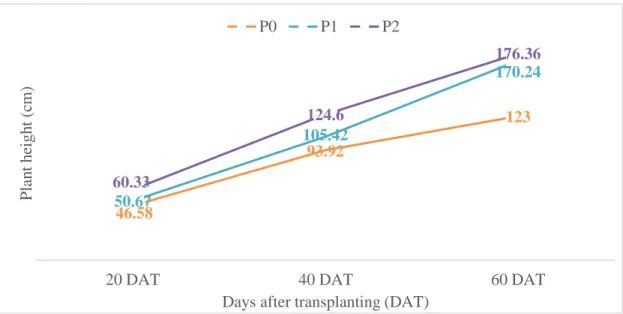
A marked variation in plant height was observed due to influence of different pruning levels of cherry tomato. This variation in plant height was highly significant at different DAT (Appendix-II). In all the cases, the highest plant height was observed from two stemmed plants and the lowest plant height was observed from unpruned plants (Figure 1). At 20 DAT, the tallest (60.33 cm) plant was recorded from P2 (Double stem pruning) and the shortest plant (46.58 cm) was recorded from P0 (No pruning). Similarly, at 40 DAT, the highest plant height (124.60 cm) was recorded from P2 and the lowest plant height (93.92 cm) was recorded from P0. At 60 DAT, the maximum plant highest (176.36 cm) was obtained from P2 which was statistically similar to P1 (170.24 cm), while the minimum plant height was obtained from P0 (123.00 cm). Results revealed
that two stems’ plants significantly increased plant height followed by one pruning treatment of one stem, while the non-pruned plants were the poorest. The increase in plant height of tomato might be due to removal of branches that leads to supply nutrients in the remaining branches. These results are in harmony with the findings of Razzak et al. (2013) on cherry tomato and Alam et al. (2016) on summer tomato. Razzak et al.
(2013) reported that two-branch pruning produced the tallest (195.3 cm) cherry tomato plants. Alam et al. (2016) found that two stems plant significantly increased plant height followed by pruning treatment of three stems per plant and four stems pe plant, while the non-pruned plants were the poorest in summer tomato.
[P0 = No pruning; P1 = One stem pruning and P2 = Two stem pruning]
Figure 1. Effect of different level of pruning on plant height of cherry tomato at different days after transplanting (DAT).
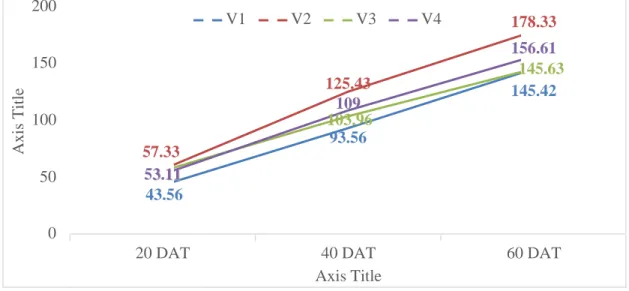
The variation in plant height at different days after transplanting (DAT) among the studied varieties was statistically significant (Figure 2). At 20 DAT, the maximum (57.33 cm) plant height was recorded from V2 (BARI Tomato-20) and the minimum plant height (43.56 cm) was obtained from V1 (BARI Tomato-11). On the other hand, at 40 DAT, the tallest plant (125.43 cm) was recorded from V2, while the minimum
P0 P1 P2
176.36 170.24
124.6 105.42
93.92
123
60.33 50.67 46.58
20 DAT 40 DAT
Days after transplanting (DAT)
60 DAT
Plant height (cm)
Axis Title
plant height (93.56 cm) was obtained from V1. Similarly, at 60 DAT, the maximum plant height (178.33 cm) was recorded from V2 which, while the minimum plant height (145.42 cm) was found from V1 treatment which was statistically similar with V3 and V4. Variation of plant height might be due to the genetic variation among the varieties.
Rina (2015) reported that plant height varied significantly due to use of different groundnut varieties. Parvin (2012) also found same type of result in tomato. She found that BARI Tomato 15 gives the tallest plant at different days after transplanting.
200
57.33 533.1111 43.56
V1 V2 V3
125.43 109 103.96
93.56
V4 178.33
156.61 145.63 145.42 150
100
50
0
20 DAT 40 DAT 60 DAT
Axis Title
[V1 = BARI Tomato-11; V2 = BARI Tomato-20; V3 = Red Star and V4 = SAU Tomato-2]
Figure 2. Effect of different varieties on plant height of cherry tomato at different DAT.
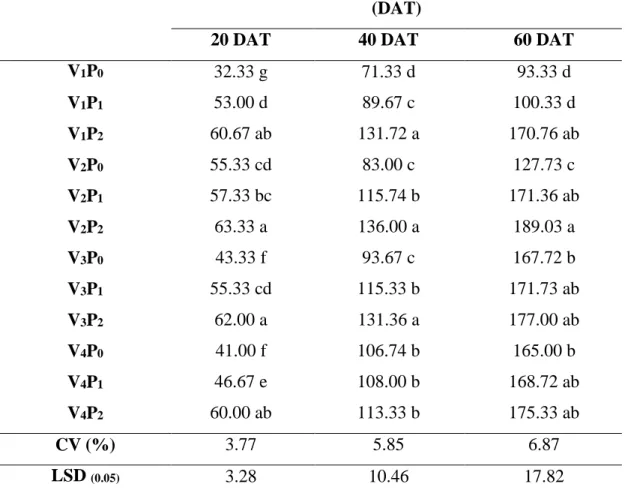
Due to combination of variety and level of pruning showed significant variation for plant height throughout the growing season (Table 1 and Appendix II). At 20 DAT, the longest plant (63.33 cm) was recorded from the V2P2 (BARI Tomato-20 variety with two stem pruning) treatment which was statistically similar with V3P2 (62.00 cm); V1P2
(60.67 cm) and V4P2 (60.00 cm) while, the shortest plant (32.33 cm) from V1P0 (BARI Tomato-11 variety with no pruning). Similarly, at 40 DAT, the longest plant (136.00 cm) was recorded from the V2P2 treatment combination which was statistically similar
with the V3P2 (131.36 cm) and V1P2 (131.72 cm) treatment while, the shortest plant height (71.33 cm) was recorded from V1P0 treatment combination. At 60 DAT, the tallest plant (189.03 cm) was recorded from V2P2 treatment combination and the shortest plant (93.33 cm) was obtained from V1P0 treatment combination which was statistically similar with V1P1 (100.33 cm).
Table 1: Combined effect of different level of pruning and varieties on plant height of cherry tomato at different days after transplanting (DAT)
Interactions Plant height (cm) at different days after transplanting (DAT)
20 DAT 40 DAT 60 DAT
V1P0 32.33 g 71.33 d 93.33 d
V1P1 53.00 d 89.67 c 100.33 d
V1P2 60.67 ab 131.72 a 170.76 ab
V2P0 55.33 cd 83.00 c 127.73 c
V2P1 57.33 bc 115.74 b 171.36 ab
V2P2 63.33 a 136.00 a 189.03 a
V3P0 43.33 f 93.67 c 167.72 b
V3P1 55.33 cd 115.33 b 171.73 ab
V3P2 62.00 a 131.36 a 177.00 ab
V4P0 41.00 f 106.74 b 165.00 b
V4P1 46.67 e 108.00 b 168.72 ab
V4P2 60.00 ab 113.33 b 175.33 ab
CV (%) 3.77 5.85 6.87
LSD (0.05) 3.28 10.46 17.82
In a column means having similar letter(s) are statistically identical and those having dissimilar letter(s) differ significantly as per 0.05 level of probability.
[P0 = No pruning; P1 = One stem pruning and P2 = Two stem pruning; V1 = BARI Tomato-11;
V2 = BARI Tomato-20; V3 = Red Star and V4 = SAU Tomato-2]
4.2 Branch number per plant
Different pruning levels showed significant variation on number of branches per plant at different days after transplanting of Cherry tomato (Appendix III and Table 2). The maximum number of branches per plant (3.25, 3.50 and 5.50) was recorded from P0
(No pruning) while, the minimum number of branches per plant (2.18, 2.80 and 3.90) was recorded from P2 (Double stem pruning). Juel (2011) also found similar type result in case of tomato. He found lowest number of branches per plant in case of double stem pruning and highest number of branches in non-pruning tomato plant.
Table 2. Effect of different level of pruning on branch number per plant of cherry tomato at different DAT
Level of pruning Branch number per plant at different days after transplanting (DAT)
20 DAT 40 DAT 60 DAT
P0 3.25 a 3.50 a 5.50 a
P1 2.92 a 3.67 a 5.25 a
P2 2.18 b 2.80 b 3.90 a
CV (%) 21.66 14.73 18.53
LSD (0.05) 1.06 0.86 1.59
In a column means having similar letter(s) are statistically identical and those having dissimilar letter(s) differ significantly as per 0.05 level of probability.
[P0 = No pruning; P1 = One stem pruning and P2 = Two stem pruning]
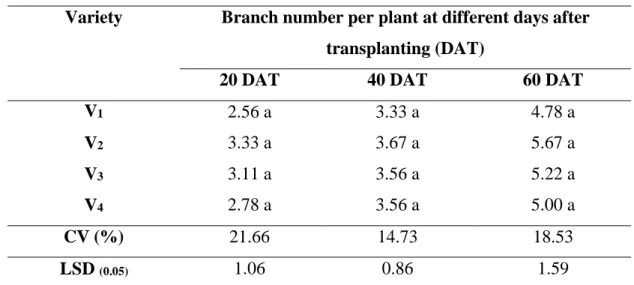
Statistically non-significant variation was recorded for branch number per plant due to use of different cherry tomato varieties at 20, 40 and 60 DAT (Appendix III and Table 3). Numerically, at different days after transplanting (DAT) the maximum number of branches per plant (3.33, 3.67 and 5.67) was recorded from V2 (BARI Tomato-20) at 20, 40 and 60 DAT, respectively. On the other hand, at the same DAT the minimum
number of branches per plant (2.56, 3.33 and 4.78) was recorded from V1 (BARI Tomato-11).
Table 3. Effect of different variety on branch number per plant of cherry tomato at different DAT
Variety Branch number per plant at different days after transplanting (DAT)
20 DAT 40 DAT 60 DAT
V1 2.56 a 3.33 a 4.78 a
V2 3.33 a 3.67 a 5.67 a
V3 3.11 a 3.56 a 5.22 a
V4 2.78 a 3.56 a 5.00 a
CV (%) 21.66 14.73 18.53
LSD (0.05) 1.06 0.86 1.59
In a column means having similar letter(s) are statistically identical and those having dissimilar letter(s) differ significantly as per 0.05 level of probability.
[V1 = BARI Tomato-11; V2 = BARI Tomato-20; V3 = Red Star and V4 = SAU Tomato-2]
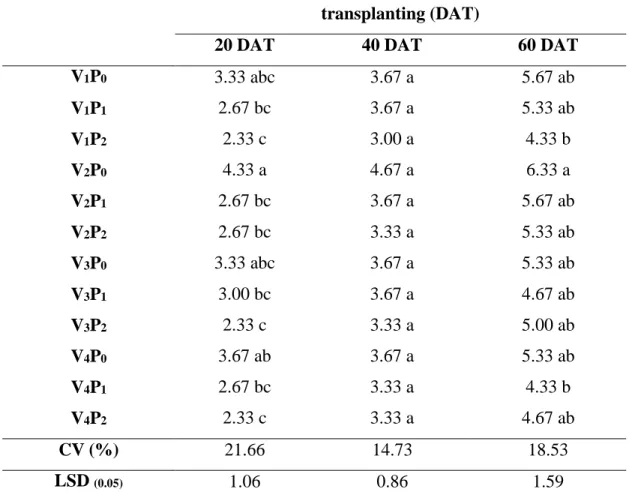
Due to combined effect of variety and different level of pruning also showed significant differences of the branch number per plant of cherry tomato at 20, 40 and 60 DAT (Table 4 and appendix III). Numerically, at different days after transplanting (DAT) the maximum number of branches per plant (4.33, 4.67 and 6.33) was recorded from V2P0
(BARI Tomato-20 variety with no pruning) treatment combination at 20, 40 and 60 DAT respectively. On the other hand, at the same DAT the minimum number of branches per plant (2.33, 3.00 and 4.33) was recorded from V1P2 (BARI Tomato-11 variety with two pruning) treatment combination, respectively.
Table 4: Interaction effect of varieties and different level of pruning on branch number per plant of cherry tomato at different days after transplanting Interactions Branch number per plant at different days after
transplanting (DAT)
20 DAT 40 DAT 60 DAT
V1P0 3.33 abc 3.67 a 5.67 ab
V1P1 2.67 bc 3.67 a 5.33 ab
V1P2 2.33 c 3.00 a 4.33 b
V2P0 4.33 a 4.67 a 6.33 a
V2P1 2.67 bc 3.67 a 5.67 ab
V2P2 2.67 bc 3.33 a 5.33 ab
V3P0 3.33 abc 3.67 a 5.33 ab
V3P1 3.00 bc 3.67 a 4.67 ab
V3P2 2.33 c 3.33 a 5.00 ab
V4P0 3.67 ab 3.67 a 5.33 ab
V4P1 2.67 bc 3.33 a 4.33 b
V4P2 2.33 c 3.33 a 4.67 ab
CV (%) 21.66 14.73 18.53
LSD (0.05) 1.06 0.86 1.59
In a column means having similar letter(s) are statistically identical and those having dissimilar letter(s) differ significantly as per 0.05 level of probability.
[P0 = No pruning; P1 = One stem pruning and P2 = Two stem pruning; V1 = BARI Tomato-11;
V2 = BARI Tomato-20; V3 = Red Star and V4 = SAU Tomato-2]
4.3 Number of leaves per plant
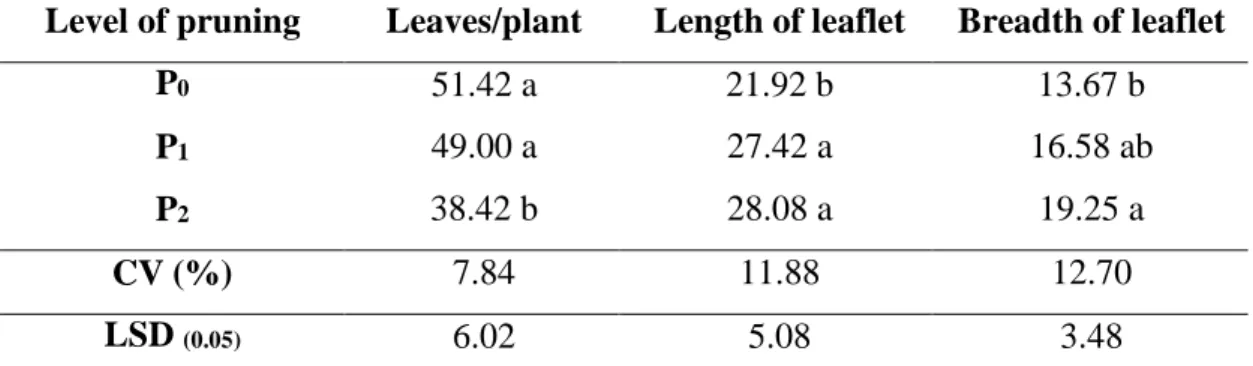
The effect of different pruning practices in respect of total number of leaves per plant was found to be significant (Table 5 and appendix IV). The maximum number of leaves (51.42) was observed in no pruning and the minimum (38.42) number of leaves was obtained from two stem pruning plant. Similar trend of results was found by Juel (2011) and Basunia (2004). Basunia (2004) reported that the maximum number of leaves (33.91) was observed from no stem pruning and minimum number obtained from
double stem pruning tomato plant. Juel (2011) also found maximum number of leaves from double stem pruning at different days after transplanting.
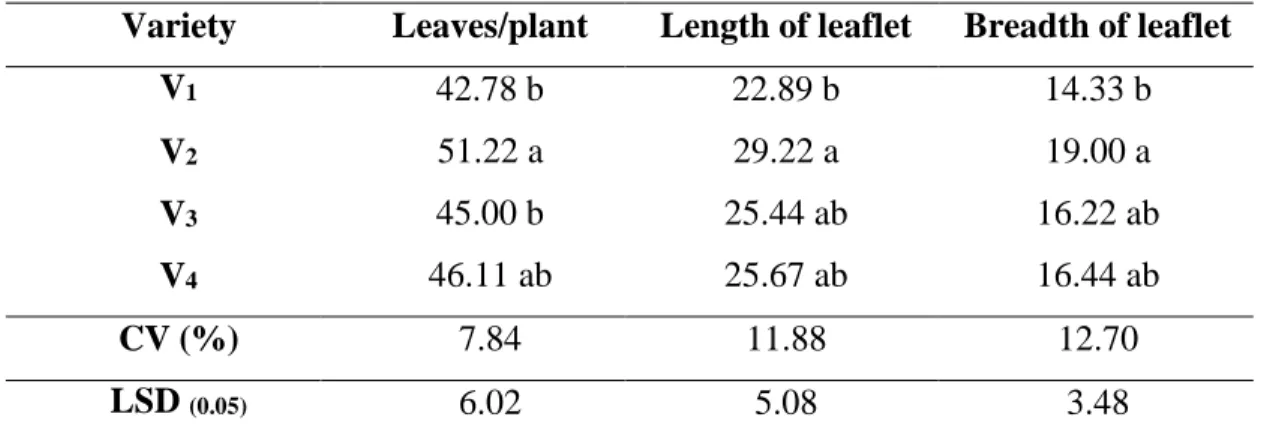
Different varieties had significant influences on number of leaves per plant of cherry tomato (Table 6 and appendix IV). The maximum number of leaves (51.22) per plant was recorded from V2 (BARI Tomato-20) treatment. On the other hand, the minimum number of leaves (42.78) per plant was recorded from V1 (BARI Tomato-11) treatment which was statistically identical with V3 (Red Star). Similar trend of results was found by Parvin (2012). She found that BARI Tomato 15 gives the maximum number of leaves per plant at different days after transplanting.
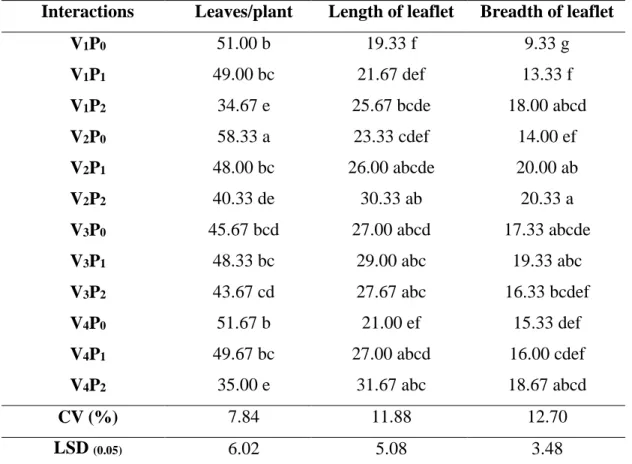
Due to combine effect of varieties and different level of pruning showed statistically significant differences on number of leaves per plant in cherry tomato (Table 7 and appendix IV). The maximum number of leaves per plant (58.33) of cherry tomato was recorded from V2P0 (BARI Tomato-20 variety with no pruning) treatment combination while, the minimum number of leaves per plant (34.67) was recorded from V1P2 (BARI Tomato-11 variety with two stem pruning) treatment combination which was statistically similar with V4P2 (35.00) treatment combination.
4.4 Length of leaflet
Different levels of pruning significantly affected the length of leaflet of cherry tomato (Table 5 and appendix IV). The longest leaflet (28.08 cm) was recorded from P2
(Double stem pruning) which was statistically similar to P1 (27.42 cm). On the other hand, the shortest leaflet (21.92 cm) was recorded from P0 (No pruning).
Leaflet length of cherry tomato varied significantly due to use of different varieties (Table 6 and appendix IV). The longest leaflet length (29.22 cm) was recorded from V2
(BARI Tomato-20) which was statistically similar with the V3 (25.44 cm) and V4 (25.67 cm), while the shortest leaflet length (22.89 cm) was recorded from V1 (BARI Tomato- 11).
Combine effect of varieties and different level of pruning showed statistically significant differences on leaflet length of cherry tomato (Table 7 and appendix IV).
The highest leaflet length (30.33 cm) of cherry tomato was recorded from V2P2 (BARI Tomato-20 variety with two stem pruning) treatment combination while, the lowest leaflet length (19.33 cm) was recorded from V1P0 (BARI Tomato-11 variety with no pruning) treatment combination.
4.5 Breadth of leaflet
Different levels of pruning significantly affected the breadth of leaflet of cherry tomato (Table 5 and appendix IV). The highest leaflet breadth (19.25 cm) was recorded from P2 (Double stem pruning) which was statistically similar with P1 (27.42 cm). On the other hand, the lowest leaflet breadth (13.67 cm) was recorded from P0 (No pruning).
Different varieties had significant influences on breadth of the leaflet of cherry tomato (Table 6 and appendix IV). The highest leaflet breadth (19.00 cm) was recorded from V2 (BARI Tomato-20) treatment, while the shortest leaflet breadth (14.33 cm) was recorded from V1 (BARI Tomato-11) treatment.
Combine effect of varieties and different level of pruning showed statistically significant differences on leaflet breadth of cherry tomato (Table 7 and appendix IV).
The highest leaflet breadth (20.33 cm) of cherry tomato was recorded from V2P2 (BARI Tomato-20 variety with two stem pruning) treatment combination while, the lowest