A network design and simulation of a Smart Railway Station using Cisco Packet Tracer.
Final thesis report submitted to the School of Business and Economics (SOBE) to receive a degree for the project under the Department of BBA.
Md. Ashikur Rahman ID: 111 181 127
Supervised by Ahmed Imran Kabir
Lecturer
School of Business and Economics (SOBE) United International University (UIU)
United International University (UIU)
United City, Madani Avenue, Badda, Dhaka 1212, Bangladesh. 28thMay, 2023.
Approval
This thesis titled “A Network Design and Simulation of a Smart Railway Station using Cisco Packet Tracer” is presented by Md. Ashikur Rahman, bearing ID 111 181 127. The report for this thesis is forwarded to the Department of Bachelor of Business and Administration (BBA) under the reign of the School of Business and Economics (SOBE), United International
University (UIU) for the fulfilment of a degree under Bachelor of Business and Administration (BBA) that has a deadline on 28/05/2023.
Department of BBA
Prof. Dr. Khandoker Mahmudur Rahman BBA Program and Member
United International University
Declaration
I, Md. Ashikur Rahman, bearing ID 111 181 127, has completed the report of the following thesis titled “A Network Design and Simulation of a Smart Railway Station using Cisco Packet Tracer.” I have completed this project under the supervision of Lecturer Ahmed Imran Kabir, Bachelor of Business and Administration (BBA), School of Business and Economics (SOBE), United International University (UIU). Therefore I have submitted this report to fulfil the degree required for my BBA program partially. I also declare that no part of the thesis has been studied and created for grant in any institute.
Supervised By
Ahmed Imran Kabir Lecturer
Department of BBA, SOBE United International University
Submitted by
Name: Md. Ashikur Rahman ID: 111 181 127
Major 1: MIS (Management Information System) Major 2: Supply Chain Management
Department of BBA, SOBE United International University.
Acknowledgement
I want to give my warmest thanks to my supervisor Ahmed Imran Kabir for your consequential support cognizance that helped me to write this support. Thank you for your continuous
mentorship and ongoing fascination for the tasks. Your modest approach to this research is an example of my inspiration. This address is proof of your simple but evident in your writing style, which I aspire to consider throughout my career. Thank you for your patience and faith in me, as this thesis took a lengthy time to complete. You want me to lay my basis for gaining knowledge behind my learning eagerness, and I hope my willingness to learn along with the progenitive cooperation will continue.
I would also like to show gratitude to my father, Md. Nur Hossain and my late mother, Mrs Kanchan Begum, for their prayers and support through the tough times and challenges I faced during the project timeline. Their nonstop brace has helped me develop this thesis and implement the idea to show its effectiveness and importance.
And lastly, I would like to be grateful to Almighty Allah, the most Forgiving and the most Merciful. Your guidance and path have shown me the right track to my life where there is the light of peace. Your direction has encouraged me to take the challenges throughout my life and stand firm with patience to find the constant flow of peace and eternity.
Abstract
In our daily basis activities, networking has created a significant impact on our life. To make our life easier, computers have emerged with our networking. The earlier computer network was only used in the military, but then it was generated for civilian use for faster communication.
Today’s businesses, institutes, industries, hospitals, and banking sectors choose computer networks for solutions, online services, e-commerce, administration, communication, and automation. Every business and services sector has its own specific area of the network, considered as LAN(Local Area Network). An industry with the massive pressure of data loads and transmission requires a substantial amount of hardware, end devices, computers, and servers connected centrally to process and store data securely. Creating a LAN is effective in that case.
By building a LAN, all the functions and operations for the employees and managers become faster, quicker, and more accurate. This research paper proposes a network design for an intelligent railway station that runs centrally within a LAN. To run the LAN of this station, it is crucial to keep specialized IT experts and system operators continuously, ensuring the end users transmit information without any technical errors. The LAN was designed and implemented on Cisco Packet Tracer software. This software has simulators to test connections between the classical and IoT devices and identify necessary upgrades to any systems, replace the topologies, and increase the capacity of traffic when new IP addresses are assigned in that LAN. This report explains the simulation design of a railway station in Bangladesh context. The study then defines the end devices placed and connected to network devices along with the configuration of IP addresses and the packets travelling from the source to destinations amongst the departments of the railway station with the utilization of VLAN(Virtual Local Area Network). At the end of this report, it will be clear how a constructive computer network eliminates the barriers of
unavailable computer controls, less knowledge of operating a computer in a LAN and technical errors that can be solved for sustainable times.
Contents
A network design and simulation of a Smart Railway Station using Cisco Packet Tracer...1
Chapter 1: Introduction...11
Background Study...12
Problem Statement...13
Motivation of the study...14
Objective of the study...14
Scope and limitations of the study...15
Limitations:...16
Chapter 2: Literature Review...17
Introduction...18
Conclusion...22
Chapter 3: Research Methodology...23
Introduction...24
Planning...24
Designing...24
Resizing And Fitting...25
Introduce Devices...25
Connections...25
Testing and Result...25
Conclusion...26
Chapter 4: Introduction to Software...27
Software used in this study...28
AutoCAD...28
Figma...28
Cisco Packet Tracer...28
Conclusion...29
Chapter 5: Planning and Designing...30
Designing and Planning of the station:...31
Engineering and Technician Department...32
Station Master’s Room...33
Signals and Announcement Room...34
Ticket Counters...35
Security and Checking...37
Server and IT department...38
HR department...39
Logistics Department...40
Parking, Staff & Passenger Lounge...41
Entrance...42
Platforms...43
Conclusion...43
Chapter 6 : Implementation...44
Introduction...45
Network Devices...46
Wired Connections...46
Router Configuration...46
Switch Configuration...48
PC, Laptop, Server and Printer configuration...48
Wireless routing...50
Remote IoT controlling...52
Conclusion...65
Chapter 7 Real Time Network Testing and Simulation in Cisco Packet Tracer...66
Introduction...67
Testing...67
Simulation...69
Conclusion...73
Chapter 8: Conclusion and Future Scope...74
Conclusion...75
Future Scope...75
List of Figures:
Figure 1: Basic Network Architecture...13
Figure 2: Research Methodology...26
Figure 3:Engineering and Technician Department...32
Figure 4 : Station Master's Room...33
Figure 5 : Signals and Announcement department...34
Figure 6: Ticket Counter and Passenger que...35
Figure 7: Information Booth...36
Figure 8: Security and Checking...37
Figure 9: Server & IT department...38
Figure 10: HR department...39
Figure 11: Logistics department...40
Figure 12: Parking, Staff and Passenger Lounge...41
Figure 13: Entrance...42
Figure 14: Platforms...43
Figure 15: Physical view of a router...47
Figure 16: Router configuration...47
Figure 17: Physical view of a switch...48
Figure 18: Physical view of a PC...49
Figure 19: PC Configuration...49
Figure 20: PCs connected to switches...50
Figure 21: Configuring Home Gateway...50
Figure 22: Configuring IoT devices to wireless router...51
Figure 23: Setting default gateway IP Address to routers...51
Figure 24: IoT Devices connected to Home Gateway...52
Figure 25: Wireless router configuration...53
Figure 26: Accessing to server by registering new account...53
Figure 27: IoT device connecting to wireless router...54
Figure 28: IoT devices accessing to registration server...54
Figure 29: IoT devices connected to registration ser to be controlled through wireless routers...55
Figure 30: IoT device functioning from remote server...55
Figure 31: End devices pinging IP address to other end devices...67
Figure 32: Simulation of packets travelling to other end devices(a)...69
Figure 33: Simulation of packets travelling to other end devices(b)...70
Figure 34: Simulation of packets travelling to other end devices(c)...70
Figure 35: Simulation of packets travelling to other end devices(d)...71
Figure 36: Simulation of packets travelling to other end devices(e)...71
Figure 37: Simulation of packets travelling to other end devices(f)...72
Figure 38: Simulation of packets travelling to other end devices(g)...72
List of Tables:
Table 1: Engineering and Technician department...56
Table 2: Station Master's room...56
Table 3: Signals and Announcement room...57
Table 4:Ticket Counter 1....58
Table 5:Information Booth 1....58
Table 6: Gallery 1....59
Table 7: Security and Checking 1...59
Table 8: Railway Staff lounge...60
Table 9: Exit 1 & Parking 1...60
Table 10: Server and IT department...60
Table 11: HR Department...61
Table 12: Logistics Department...61
Table 13: Ticket Counter 2....62
Table 14: Information Booth 2....63
Table 15: Gallery 2....63
Table 16: Security and Checking 2....63
Table 17: Passenger Lounge...64
Table 18: Exit 2 & Parking 2...64
Table 19: Entrance 1,2 & 3...64
Table 20: Platform 1 to 10...64
List of Acronyms:
VLAN Virtual Local Area Network
WAN Wide Area Network
LAN Local Area Network
IoT Internet of Things
CCNA Cisco Certified Network Associate
DTE Data Terminal Equipment
DHCP Dynamic Host Configuration Protocol
SSID Service Set Identifier
Chapter 1: Introduction
Background Study
There was a time when every occupation conducted was manual. The lack of machinery forced employees to record information on paper and store it in huge piles. Often this information and data took up considerable space in stores when reports and entries came from many departments under an organization. It wasn't easy to verify and search any of the entries that were recorded a long time back and required a lot of time. Communication was another big challenge due to the need for more technology and devices. After the first and second industrialization in 1840 and 1870, the introduction of new devices and data communication changed how individuals work in an office. The growth of telecommunication, speed and the volume of data transmission
transferred large quantities of information within a fraction of a second. This saved huge time and cost, and the industries, along with other management systems such as dockyards and airports, shifted to the revolution of Globalization of Networks.
This research aims to design a network architecture of an intelligent railway station under the Cisco Packet Tracer. The railway is one of the vital transport systems in a country, with
significant stations managing all the schedules of trains from different destinations. The station employees and master have to control vast waves of information daily, once done manually.
Still, as technology became accessible, the railway also upgraded to an information system. The massive chunk of files and data is passing with speed and less time-saving cost. The schedules of departures and arrivals are on time, and passengers can identify the correct train and platform with significantly fewer errors. The intelligent station is designed from Bangladesh's perspective, as this sector is one of the most poorly transported sectors.
Figure 1: Basic Network Architecture.
Problem Statement
This research aims to design a modern network system for a railway station. A current railway station will enhance the service desired by a regular traveller dependent on rail transport. More than 30,000 passengers travel daily from Kamalapur Railway station to different intercity and districts. Handling these passengers is a daily challenge for railway management and the schedules to be arranged on time. Therefore intelligent networking of a station will increase the effectiveness of high-speed data and information transfer on time, reduce errors and delays and boost more fabulous service for the passengers.
However, due to a lack of IOT device configuration and poor networking, the railway station needs help supervising the service and schedules. Often passengers suffer the most from delayed departures and arrivals of trains. There need to be proper restrooms for long-haul travellers and loco operators. The station still operates on equipment and machinery left by the British rule, and due to the unavailability of intelligent devices and access to technology, there are frequent errors and failures in information transmission, which hampers the timetable of all intercity, district and
Therefore, with the introduction of intelligent IOT devices and old machinery, the station will be able to provide maximum ministrations for the passengers travelling daily, automate the tasks, and reduce errors for the station operators. This will speed up communication and networking, and IT will replace the traditional storage of files of slots of all the interlinked trains.
Motivation of the study
Despite increasing investment in Bangladesh Railway over the years, railway services have yet to show much improvement and are still incurring yearly losses. With shabby compartments, dirty toilets, long delays, uncongenial access to stations and platforms, ticketing issues, and lack of security, the service offered by Bangladesh Railway is far away from the modern
transportation system. The station employees face common challenges in daily operations.
Therefore this research is motivated to solve particular and significant segments of this transport sector to reduce the sufferings of the passenger and to alleviate the day-to-day operations of railway stations. This research is also fruitful for studies related to advanced networking under Cisco Academy. Institutes can access knowledge about the configuration of different devices and connections. If designed and implemented, smart railway stations will also encourage academies to outline many projects and infrastructures effectively. The human resources will be more skilled and efficient in operations and get access to modern devices purposes.
Furthermore, this project was initiated to solve the process of tickets going into the trap of the black market. Due to special occasions, this particular transport gets busier, and fraud sellers get access to the black market. Hence this project is encouraged to increase the security of the overall system.
Objective of the study
The main goal of this project is to design a network architecture of railway stations under a Cisco packet tracer that will show the real-time simulation of all the devices and their configurations.
Bring all the functional departments and operations units under a system.
Increase efficiency between railway staff and employees
Save time and cost by bringing the system under automation and replacing traditional operating methodology
Reduce errors and provide accurate data to all the end users
Minimize passenger suffering and improve the quality of service
Allocate the daily schedules of all the trains on time
Configure the IOT devices and connections to each department.
Design a 3D model of the whole map of the station.
Implement the network architecture of the entire station.
Run the simulation process to finalize all connections and configuration using Cisco Packet Tracer.
Scope and limitations of the study
The system only aims to create an intelligent IOT system for a railway station under software known as Cisco Packet Tracer. The software contains various end devices, connections, configuration and IOT devices needed to test a modern network architecture for educational institutions, corporate head offices, banks, hospitals and restaurants. A 3D floor map is designed using Autocad software. The floor consists of departments and their devices required. The project officially started on 11th October 2022 and is expected to be completed on 7th January 2023. This project was brought to design a network architecture of various end and network devices, connections, wireless connections, and ports for a railway station. The aim is to speed up the operations of a station’s management system and replace manual activities. This includes signalling, scheduling, safety, logistics, IT service, and support to make superintendence easier and faster. Cisco Academy supports the network simulation under the Cisco laboratory and online sessions at United International University. The team members include IT professionals, CSE undergraduates, Cisco academy instructors, and BBA undergraduates. The project is managed under Professor Ahmed Imran Kabir under the MIS program of United International
Limitations:
This thesis, while in the development phase, faced many challenges:
Lack of software knowledge:
o Cisco Packet Tracer
o AutoCAD
o Figma
A lengthy time required
The financial cost of designing the railway station
Lack of idea for the floor map design of the railway station.
Chapter 2: Literature Review
Introduction
While conducting the thesis it is also important to study related research about Cisco Packet Tracer. This study will give a clear presentation of how to design an appropriate network design for a smart railway station. The review of each paper will also provide the basics and the
knowledge of using the software. The literature review will also solve the problems of software errors and performance declination
Kabir et.al have developed a project of a network design of an airport using Cisco Packet Tracer[1]. The institute that conducted the project was United International University. This prototype explicates how the network system might work in the real-life scenario and the data transmission being simulated. This project tested the real time simulation built in the Cisco Packet tracer that has been declared successful for faster and secured data transmission. The network design of the airport prevents all types of unnecessary data transmission and enabled a smooth and secured network connections to be operated and thus have all the connectivity between each system.
Sahana et.al conducted a project of wireless IOT under RV College of Engineering in Cisco Packet Tracer for a smart greenhouse that has showcased satisfied output and results[2]. The Greenhouse is now encouraged to use in order to grow more plants and control the climate change. This project basically simplified the activities of greenhouse device installation by introducing an IOT based platform that brings all the work under a system making it easier for the operator. The thesis basically explains the activations of all the sensors and devices required to maintain the greenhouse under the conditions predesigned.
Nathaniel et.al built a project under University of Agriculture, Markurdi, Nigeria of LAN using Cisco Packet Tracer[3]. The publication described the simulation use of LAN for the College of Engineering for that institution. In depth the project showcased the design and configuration of the topology and IP address and the packets sending information by VLAN through each traffic for each departments with both wired and wireless connections. The study further claims that it
was an initial prototype and can reach for further development for more assistance in future for NGN design appliance.
Yunisha et.al have virtually designed a college campus network in Cisco Packet Tracer under the department of Computer Engineering, SRPCE College of Engineering.[4] In that paper they planned a design network for real time simulation showing successful data transmission and tested the final run for practical requirements that will be achievable for future framework. The overall system was designed to be centralized under one administration that connects several layers with office, server room, lab and classrooms. As the paper showed the multiple layers connected to group device which claims to be hierarchical.
Hussain et.al came up with a study of simulation and design of university area network scenario (UANS) where users will be able to communicate from remote distances sharing the same UANS under cisco packet tracer[5]. The network was designed to bring automation for administration, education, communication, e-library for Pabna University of Science and Technology. The paper describes each department with its own traffic that sends information through packets through designated IP address and topology by Virtual Local Area
Network(VLAN). The network architecture claims to provide security and wireless connections, made operation efficient and virtual classes for students.
Ordabayeva et.al developed and designed a simulation Virtual Local Area Network (VLAN) using Cisco Packet Tracer to highlight the importance of integrating computers for faster transmission and exchange of information of messages between users from remote distances as well different organizations [6]. The study further brings the problems of large traffic in network that decreases the efficiency network as a result a VLAN allows the network to be broken down various subnets. The study sorts the advantage of administration control that are large by the devices routing between VLAN have enough security and prevents unnecessary traffics and bandwidth consumption.
Another study conducted by Dogman & Jewiley about a design and implementation of an IOT Smart Home via Cisco Packet Tracer that consists of IOT devices connected through home gateway allowing the user to control the system using smart phone[7]. The Smart Home study
allow the user to contrive and monitor the home surroundings to improve security and run the energy efficiently as a result the IOT devices used are sensors and actuators used for transmitting information. To learn more about IOT the study suggests to use the latest version of cisco packet tracer as the software contains more IOT devices. The Home Gateway, servers and access points are the main devices for linking the wireless devices as most devices are used to be controlled remotely, others devices were controlled automatically by setting condition on the sensors.
A study directed by Lubis et.al using Cisco Packet Tracer by designing and simulating a secured café network with Security Awareness Domain and Resource (SADAR) [8]. The network was designed to facilitate service by providing internet browsing, gaming for the cafe to the customer expand the business and reduce cost. Thus, for the sake of secured internet connection and service the study came with the development of SADAR that had configured VLAN as well as DHCP protocol. The final testing was conducted by PING and detect host to destination routing.
The purpose of this network connectivity is to increase efficiency and performance for the consideration in the long run by eliminating faulty security management and unauthorized access to any business operation is the main principal of SADAR.
Kabir et.al implemented a smart university network using Cisco CCNA with Packet Tracer[9].
The study prepares a design of network in the initial stage that meets the university standards lowering installation cost. Upon designing the availability of equipment, devices and
components is considered. The security is provided by the DNS server, switch and firewall backup, passwords and encryption. The design is built in such a way that can be expanded in future when more host connection is required and this will make the network system more powerful once more security with servers is added. Using the concept of DHCP, DNS, Email and VLANS the project included both wireless and wired topology and was kept as a prototype ready for expansion and development to capture more coverage and support.
In 2018 Bawa and Selby carried a study for design and simulation of IOT for a city in Ghana called Accra. The goal of this study was to create a model IoT system for the city that uses smart webcam with IP address assigned for each of the device. The smart city will capture live
condition of traffics on the roads. The Cisco Packet Tracer will be able to simulate the IoT devices from remote distances and transfer packets of data from host to destinations[10]. All the webcamera is accessed through smartphone. The smartphones used the protocols of web services and the method of data transmitting through the devices. The webcamera is configured with motion detectors connected to a gateway under some conditions set within to detect objects. The implementation of this model will allow people to view image set a proper plan of using routes to avoid congestions and streets that are flooded after rain and allow Accra to become a modern intelligent city as claimed in the study.
Faris A. Almaki designed and implemented a 5G IoT Based Smart Buildings using VLAN configuration via Cisco packet tracer[11]. The purpose of this study is to upgrade wireless connectivity in order to enhance quality life and ensure safety for people’s life. According to this study the a 5G IoT architecture includes RFID, lightning, wide range of smart device safety and energy efficiency that can be controlled independently by the users and is considered cost efficient. The VLAN simulation shown in this paper manifest to effective if implemented in real life that will guarantee cost reduction, comfort, safety and conserve energy.
Enoch et.al carried research of a design and simulation of a Secured Enterprise Network for the Faculty of Engineering that is more secured, ascendable and practicable[12]. The model designed for the enterprise network is hierarchical where both the logical and physical topology is created only for the Faculty of Engineering. A user whenever wants to connect to the network is asked for the authentication and verification. The designed intensified faster connectivity and even introduction to new devices would not affect the packet transmission. The network is designed to reduce load and reduce cost. The study further states that this computerization of any institute will provide flexible, comfortable, and dynamic environment making the life of teachers and students easier with the fundamentals of e-learning.
Seth et.al conducted a research for implementation of College Network scenario using Cisco Packet Tracer[13]. The study executes the various network topologies that is suitable inside a college. The College Network studied here connects all the departments here that can
communicate and transfer data within the departments. The departments includes, libraries,
administration office, sports room, classroom and other buildings as well into one that are connected through network devices where all the applications of this network of the devices are accessible.
Aye et.al carried research of a design and simulation of VoIP for campus usage. VoIP is widely used communication system that allows to make voice calls using internet. It uses internet protocol to transfer fax and voice along telephone over network shared within and so this paper shows the network architecture-based VoIP routing protocol and technology along with wireless connectivity[14]. The study further shows the process to set up VoIP telephones through
packetization, encoding, signaling, media channel set up, and testing packet transmission. The simulation consists of two protocols inside the VoIP protocol signaling protocol and data
exchange protocol. This enabled the user to use IP phones instead of dedicated telephony system and is considered more structured and low cost.
Conclusion
The related works regarding the packets tracer has shown the use of this software to design many smart prototypes from LAN, WAN to VLAN connectivity. This study has also provided in depth knowledge regarding computer networks along with the software and its importance. Once designed and ran the network design can be taken to real life implications claimed by the studies if the results are satisfied. The studies also identified the gap analysis that no network design have been proposed and implemented for a smart railway station.
Chapter 3: Research Methodology
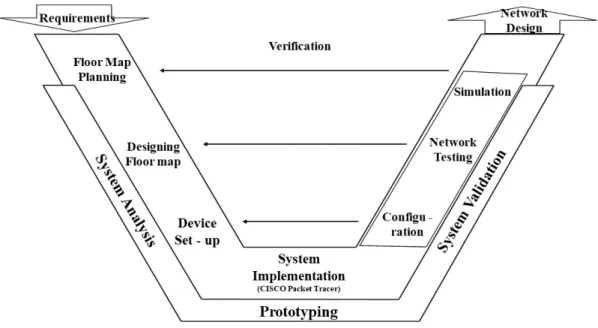
Introduction
Following the inefficiency in the railway management system, the challenge in this research is to design a proper floor map for a railway station. Adequate floor planning was considered the main foundation of this research to set the network design in the software. The study is not about the network design and simulation using Cisco Packet Tracer but about proposing and designing a floor map for a railway station since stations in Bangladesh do not have a conventional method for smooth operation, costing crore of TK and delays for automation to improve potency.
Planning
Even though the project is related to network simulation, the floor plan was crucial for designing an intelligent railway station. As a result, collecting data was started by selecting a suitable location for the railway station for the city. The background consists of the area appropriate for the town where all the tasks and functions of the station, including passengers' ease to access, will provide the most efficient management system of the station. Even though people reach the station by road, with the introduction of the metro rail, it will be more effortless to get there on time. Knowing the area to be covered was mandatory to design a railway station.
Designing
Once planted, the station is designed under AutoCAD. A draft was drawn to show how the station will be developed. Once finalized, the station was designed according to the draft. The station has 14 departments, two parking, two lounges, three entrances, and ten platforms. Each room has its size measured according to the number and types of devices required and a master measurement of the whole station that ranges all the departments, entrances, parking and platforms.
Resizing And Fitting
Once the station was designed, the file was resized under an interface design application called Figma. Using Figma, the station's design is resized and edited several times to fit in Cisco Packet Tracer. The design interface is set on the physical mode of the Cisco Packet Tracer. The file is captured and saved in PNG format for better resolution.
Introduce Devices
Once the PNG file of the station is prepared, it is set on Cisco Packet Tracer in physical mode.
The end devices, components, and network devices were placed in proper places all over the departments of the railway station design. The packet tracer software contains all types of end devices and connections, making it the bedrock of this thesis.
Connections
All the devices placed on the map were then connected using wired and wireless connections.
The connections were settled with network devices with wired and wireless connectivity and several connection features and hardware. Every end device placed in all the departments is configured to link with the end devices and then to all the departments.
Testing and Result
Once the connection and configuration are completed, the whole network design is tested to see whether all the rooms, entrances, parking and platforms are linked to the end devices. The simulation shows the packets and data traced that travel to the designated devices requested by the end users. These will provide the result of an entire network simulation of the railway station that can be controlled and communicated centrally. Once the testing is completed, the project
Figure 2: Research Methodology
Conclusion
Even though the research is about network design using Cisco Packet Tracer, other software is used for infrastructural projects. Along with the combination of all these software, the network design of this railway station will be able to show its effectiveness. The research methodology follows the qualitative approach in some instances because the initial planning was organized with the help of experts and engineers based on their experience with many ongoing frameworks in Bangladesh, such as Metro Rail and Padma Bridge construction. Therefore the methods of this research have given a clear view of how the study was conducted and will explain further.
Chapter 4: Introduction to Software
Software used in this study
As this project is related to the design of a network simulation of an intelligent railway station using a Cisco packet tracer, there is other software used for this project:
AutoCAD
This software is first and foremost used for 2 Dimensional and enhanced 3D modelling for any object, room and structure. It is required to draw significant infrastructural developments such as bridges, highways, apartments, airports etc. It is widely used in construction by engineers, architects, project managers, graphic designers and many professionals. It also allows designers to draw walls, doors, tables, windows and complex objects. Once removed, the data can be represented to clients at construction sites to obtain information regarding project cost, forecast and material estimations.
Figma
It is a web application for designing interfaces that is compatible with Windows as well as macOS. It focuses on the real-time combination for experiencing user interfaces on mobile and desktop and has plenty of vector editing tools, prototyping and graphics. The files can be saved in JPG and PNG format. Users can publish their tasks and share them with the others for perspective with sticky notes, emojis and sketch tools.
Cisco Packet Tracer
This software is used for several computing platforms and is a simulation tool that allows users to design modern computer networks for network topologies. It is an educational tool for students enrolled on Cisco Networking Academy. The packet tracer helps to drag and drop devices and connections that are later configured with network devices to communicate where necessary. It runs on iOS, Windows, Linux and Android. The Packet Tracer allows users to
and complex networks, which is very costly if purchased by hardware in real life. Therefore it saves a tremendous amount of cost by showing the connections and simulations only on the software and thus gives the fundamental requirements of hardware when designed practically.
Students can download these products enrolled under CCNA for learning aid.
Conclusion
This software was essential to develop a network simulation in Cisco packet tracer to show a relevant and worthwhile project for a computer network design. AutoCAD will provide the method of infrastructural calculation used by professionals. The Figma application will edit and resize the interface into a suitable image background. Finally, the Cisco Packet Tracer will create the network design and simulation of all the devices and configurations.
Chapter 5: Planning and Designing
Designing and Planning of the station:
The intelligent railway station consists of 23 sections drawn in AutoCAD with proper
measurements of each area. In the beginning, a 2D drawing was made, and the 3D was finalized after :
Engineering and Technician department
Station Master’s room
Signals and Announcement room
Ticket Counter 1.
Information Booth 1.
Gallery 1.
Security and Checking room 1.
Server and IT department
HR department
Logistics department
Ticket Counter 2.
Information Booth 2.
Security and Checking 2.
Gallery 2.
Parking 1.
Parking 2.
Passenger Lounge
Railway Staff Lounge
Entrance 1.
Entrance 2.
Entrance 3.
Platforms
Exit 1.
Exit 2.
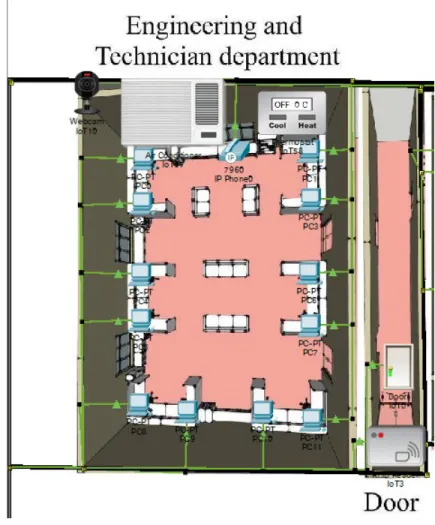
Engineering and Technician Department
This department is responsible for the development and introduction of new devices and implementation for any infrastructure that will run for more straightforward and fast operations within the project.
Figure 3:Engineering and Technician Department
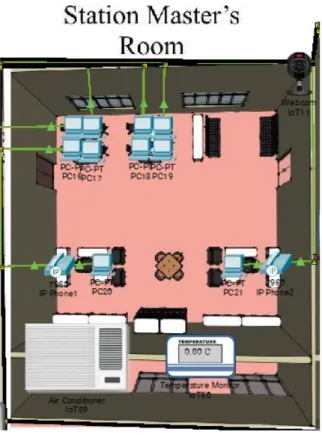
Station Master’s Room
The Station Master is in charge of the overall station and its control. The master plans the
schedule of the trains and ticket management and gives the command to all departments involved in the station along with signals, announcements and necessary improvements.
Figure 4 : Station Master's Room
Signals and Announcement Room
All the schedules of arrival and departure of the trains will be announced from this room. As well as for emergency announcements to any passengers and other staff. The signal core team provide clearance for the trains to pause and run on their tracks.
Figure 5 : Signals and Announcement department
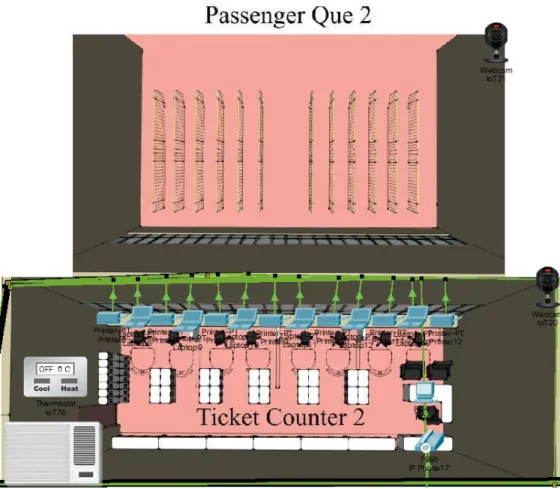
Ticket Counters
The figure below shows the ticket counter with passenger que of the station.
Figure 6: Ticket Counter and Passenger que
Information Booth
The information booth will give reply to any queries related to train schedules and dates, ticketing price and classes and emergency information.
Figure 7: Information Booth
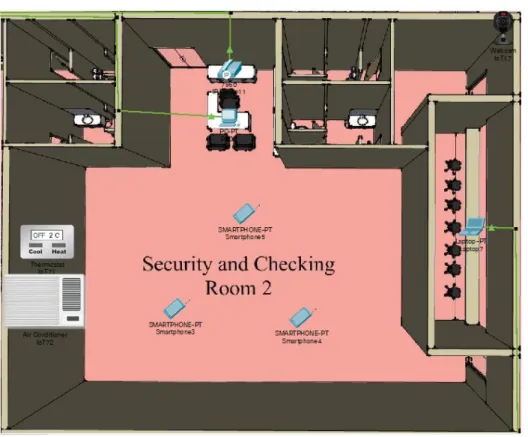
Security and Checking
The station is concerned for the safety of the passengers, the railway assets, and any sabotage, so the passengers will be checked carefully with sniffers and detectors to identify suspects of illegal drugs and objects.
Figure 8: Security and Checking
Server and IT department
This department consists of servers and network devices that function as the end devices throughout all the departments of the station. The server will store all the overall computer network's data, services and programs.
Figure 9: Server & IT department
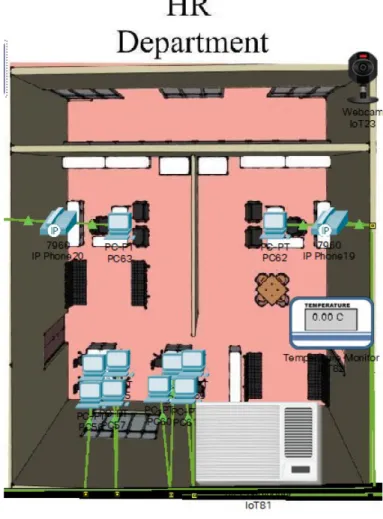
HR department
The HR department is responsible for recruiting and training the employees and staff associated with that station. The departments control and guide the employees of each department and observe their daily tasks.
Figure 10: HR department
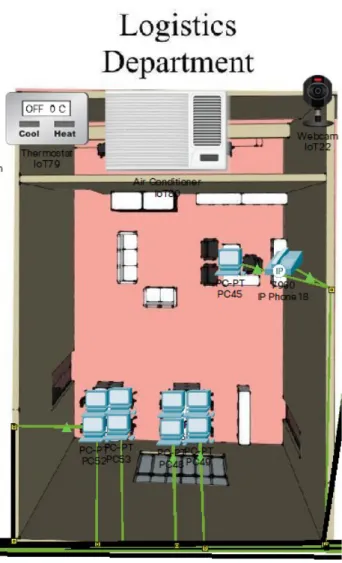
Logistics Department
Logistics is part of the station's service that engages in a systematic service flow to the
passengers. It supports all departments and their requirements, such as devices, technical errors, and procurement.
Figure 11: Logistics department
Parking, Staff & Passenger Lounge
Figure 12: Parking, Staff and Passenger Lounge
Entrance
The station has 3 entrance to the paltforms
Figure 13: Entrance
Platforms
There are 10 platforms in the station
Figure 14: Platforms
Conclusion
The station has 23 section that was designed to make the project exquisite. These sections are essential to operate a station flawlessly, and each unit is planned to hold a maximum number of IoT devices and configurations, making it an intelligent railway station.
Chapter 6 : Implementation
Introduction
Once the planning of the floor map and designing of the floorplan is finalized, the railway station, the image captured as the PNG file, is set on the background of the Cisco Packet Tracer.
The study used the idea for the customer experience in the physical interface of the packet tracer.
The connections and the end device installation is accomplished on the logical interface of the software. The image is designed like end devices; the network devices would fit perfectly.
End Devices
Images Device Names
Web camera PC IP Phone Smartphone
Tablet PC Laptop Printer Sniffer TV
Network Controller Server Air Conditioner
Speaker Water Sprinkler
Door RFID Reader
RFID Card
Network Devices
Images Devices
Switch
Router Home Gateway Wireless Router
Cloud
Wired Connections
The end devices connected with wires use copper straight-through cables, coaxial cables and copper crossover cables, and the network devices are connected using serial DTE cables.
Router Configuration
All the end devices using wired connections are connected to their designated switches. In this project, nine switches engage all the end devices within the buttons along the departments. But these switches are not connected. As a result, the whole station still needs to be centrally connected. In that case, routers were used to click each button. There were four routers in this case, and each router was connected using Serial DTE cables. In this study static routing method was used, where all the routers were given their default gateway IP address. The default gateway IP Address will be used for those end devices connected to its router through the switch. The switches are connected with Gigabyte ethernet ports, and the router-to-router connection is made using a Serial port. The serial DTE connects the following path to the next router.
Figure 15: Physical view of a router
Figure 16: Router configuration.
Switch Configuration
All the end devices are connected to a switch initially. A switch has more capacity than a hub to connect up to 24 devices at a time. The are 24 Fast ethernet port and 2 Gigabyte ethernet port for the router. There are total 9 switches connecting total 23 sections of the railway station using wires.
Figure 17: Physical view of a switch
PC, Laptop, Server and Printer configuration
The pc is the most commonly used device in Cisco Packet Tracer. The PC can be connected using both wired and wireless. To communicate with wire, the PC must use a copper straight- through cable to the switch using the fast ethernet port. Each PC is assigned an IP address and default gateway IP address for its designated router connections. The same way goes for printer, laptop and server connections as well.
Figure 18: Physical view of a PC.
Figure 19: PC Configuration
Figure 20: PCs connected to switches.
Wireless routing
All the end devices are connected to a switch initially. A button has more capacity than a hub to connect up to 24 devices simultaneously. The router has 24 Fast Ethernet ports and 2 Gigabyte ethernet ports. Nine switches connect the entire 23 sections of the railway station using wires.
Figure 21: Configuring Home Gateway.
Figure 22: Configuring IoT devices to wireless router.
Figure 23: Setting default gateway IP Address to routers
Figure 24: IoT Devices connected to Home Gateway
Remote IoT controlling
The IoT devices can be monitored and controlled from a remote distance, so a server is also required along with the wireless routers. This study requires the DHCP configuration for the server to access the WRT 300N wireless router. At first, the wireless router is set with the default gateway IP address and SSID title. Then the radius server can serve the IoT devices using its IP address, which is encrypted with a password. The server has the registration system to create an account online in the web browser tab, where the user is requested to sign up. Once the server is
ready, all the IoT devices are accessed using the server's account and password to connect to the server. The whole process is shown below.
Figure 25: Wireless router configuration.
Figure 26: Accessing to server by registering new account.
Figure 27: IoT device connecting to wireless router.
Figure 28: IoT devices accessing to registration server.
Figure 29: IoT devices connected to registration ser to be controlled through wireless routers
Figure 30: IoT device functioning from remote server.
Below is the list of tables that includes all the IP addresses and Default Gateways of the end devices from all the department:
Table 1: Engineering and Technician department
Devices IP Address Default Gateway
PC 0 10.10.10.3 10.10.10.1
PC 1 10.10.10.4 10.10.10.1
PC 2 10.10.10.5 10.10.10.1
PC 3 10.10.10.6 10.10.10.1
PC 4 10.10.10.7 10.10.10.1
PC 5 10.10.10.8 10.10.10.1
PC 6 10.10.10.9 10.10.10.1
PC 7 10.10.10.10 10.10.10.1
PC 8 10.10.10.11 10.10.10.1
PC 9 10.10.10.12 10.10.10.1
PC 10 10.10.10.13 10.10.10.1
PC 11 10.10.10.14 10.10.10.1
IoT 18 192.168.25.110 192.168.25.1
IoT 0 169.254.197.109 169.254.197.1
Smartphone 6 192.168.25.119 192.168.25.1
IP Phone 0 15.15.15.133 15.15.15.1
Tablet PC 3 192.168.25.109 192.168.25.1
IoT 53 15.15.15.3 15.15.15.1
IoT 54 15.15.15.4 15.15.15.1
IoT 55 - -
Table 2: Station Master's room
Devices IP Address Default Gateway
PC 12 10.10.10.15 10.10.10.1
PC 13 10.10.10.16 10.10.10.1
PC 14 10.10.10.17 10.10.10.1
PC 15 10.10.10.18 10.10.10.1
PC 16 10.10.10.19 10.10.10.1
PC 17 10.10.10.20 10.10.10.1
PC 18 10.10.10.21 10.10.10.1
PC 19 10.10.10.22 10.10.10.1
PC 20 10.10.10.23 10.10.10.1
PC 21 10.10.10.24 10.10.10.1
Smartphone 3 192.168.25.114 192.168.25.1
Tablet PC 1 192.168.25.122 192.168.25.1
IP Phone 2 15.15.15.132 15.15.15.1
IoT 19 192.168.25.120 192.168.25.1
IoT 1 169.254.197.116 169.254.197.1
Table 3: Signals and Announcement room
Devices IP Address Default Gateway
PC 22 10.10.10.2 10.10.10.1
PC 23 10.10.10.25 10.10.10.1
PC 24 10.10.10.26 10.10.10.1
PC 25 10.10.10.27 10.10.10.1
PC 26 10.10.10.28 10.10.10.1
PC 27 10.10.10.29 10.10.10.1
PC 28 10.10.10.30 10.10.10.1
PC 29 10.10.10.31 10.10.10.1
PC 30 10.10.10.32 10.10.10.1
Smartphone 4 192.168.25.102 192.168.25.1
Tablet PC 0 192.168.25.105 192.168.25.1
IP Phone 3 15.15.15.174 15.15.15.1
IoT 20 192.168.25.117 192.168.25.1
IoT 2 169.254.117.190 169.254.117.1
Table 4:Ticket Counter 1.
Devices IP Address Default Gateway
IoT 3 192.168.25.116 192.168.25.1
PC 31 10.10.10.33 10.10.10.1
IP Phone 4 15.15.15.173 15.15.15.1
Laptop 0 10.10.10.34 10.10.10.1
Smartphone 5 192.168.25.123 192.168.25.1
Tablet PC 2 192.168.25.123 192.168.25.1
Printer 0 10.10.10.35 10.10.10.1
Laptop 1 10.10.10.36 10.10.10.1
Printer 1 10.10.10.37 10.10.10.1
Laptop 2 10.10.10.38 10.10.10.1
Printer 2 10.10.10.39 10.10.10.1
Laptop 3 10.10.10.40 10.10.10.1
Printer 3 10.10.10.41 10.10.10.1
Laptop 4 10.10.10.42 10.10.10.1
Printer 4 10.10.10.44 10.10.10.1
Laptop 5 10.10.10.44 10.10.10.1
Printer 5 10.10.10.45 10.10.10.1
IoT 21 192.168.25.115 192.168.25.1
Table 5:Information Booth 1.
Device IP Address Default Gateway
IoT 4 169.254.197.120 169.254.197.1
Smartphone 8 192.168.25.121 192.168.25.1
IP Phone 5 15.15.15.224 15.15.15.1
IoT 22 192.168.25.118 192.168.25.118
PC 32 12.12.12.3 12.12.12.1
PC 33 12.12.12.4 12.12.12.1
PC 34 12.12.12.5 12.12.12.1
IP Phone 6 15.15.15.222 15.15.15.1
IP Phone 7 15.15.15.187 15.15.15.1
Table 6: Gallery 1.
Device IP Address Default Gateway
IoT 5 169.254.197.110 169.254.197.1
TV 0 - -
IoT 23 192.168.25.107 192.168.25.1
Table 7: Security and Checking 1.
Device IP Address Default Gateway
IoT 6 169.254.55.78 -
Smartphone 0 192.168.25.106 192.168.25.1
Laptop 6 12.12.12.7 12.12.12.1
PC 35 12.12.12.6 12.12.12.1
IP Phone 8 15.15.15.177 15.15.15.1
IoT 24 192.168.25.113 192.168.25.1
Sniffer 0 - -
Table 8: Railway Staff lounge
Device IP Address Default Gateway
IoT 17 192.168.25.125 192.168.25.1
TV 1 - -
IoT 7 169.254.197.117 169.254.197.1
Table 9: Exit 1 & Parking 1
Device IP Address Default Gateway
IoT 16 192.168.25.128 192.168.25.1
IoT 49 192.168.25.103 192.168.25.1
Table 10: Server and IT department
Device IP Address Default Gateway
IoT 8 169.254.197.103 169.254.197.1
Laptop 14 169.254.197.119 169.254.197.1
Tablet PC 7 192.168.25.131 192.168.25.1
Smartphone 12 198.168.25.111 192.168.25.1
Server 3 14.14.14.23 14.14.14.1
Server 0 15.15.15.2 15.15.15.1
Server 1 169.254.197.200 169.254.197.1
PT-Controller 0 14.14.14.25 14.14.14.1
PT-Controller 1 14.14.14.26 14.14.14.1
IoT 38 192.168.25.100 192.168.25.1
IP Phone 17 115.15.15.223 15.15.15.1
Table 11: HR Department
Device IP Address Default Gateway
IoT 9 169.254.197.113 169.254.197.1
IP Phone 9 15.15.15.218 15.15.15.1
IoT 39 192.168.25.115 192.168.25.1
Tablet PC 6 192.168.25.122 192.168.25.1
Smartphone 11 192.168.25.126 192.168.25.1
PC 44 14.14.14.3 14.14.14.1
PC 45 14.14.14.4 14.14.14.1
PC 36 14.14.14.5 14.14.14.1
PC 37 14.14.14.6 14.14.14.1
PC 38 14.14.14.7 14.14.14.1
PC 39 14.14.14.8 14.14.14.1
PC 40 14.14.14.9 14.14.14.1
PC 41 14.14.14.10 14.14.14.1
PC 42 14.14.14.12 14.14.14.1
PC 43 14.14.14.11 14.14.14.1
IP Phone 15.15.15.182 15.15.15.1
Device IP Address Default Gateway
IoT 10 169.254.197.104 169.254.197.1
IP Phone 11 15.15.15.178 15.15.15.1
IoT 40 192.168.25.101 192.168.25.1
Tablet PC 5 168.254.61.148 168.254.61.1
Smartphone 10 192.168.25.124 192.168.25.1
PC 47 14.14.14.14 14.14.14.1
PC 48 14.14.14.15 14.14.14.1
PC 49 14.14.14.16 14.14.14.1
PC 50 14.14.14.17 14.14.14.1
PC 51 14.14.14.18 14.14.14.1
PC 52 14.14.14.19 14.14.14.1
PC 53 14.14.14.20 14.14.14.1
PC 54 14.14.14.21 14.14.14.1
PC 55 14.14.14.13 14.14.14.1
Table 13: Ticket Counter 2.
Device IP Address Default Gateway
IoT 41 192.168.25.121 192.168.25.1
IP Phone 12 15.15.15.226 15.15.15.1
IoT 11 169.254.75.141 169.254.75.1
Laptop 7 13.13.13.19 13.13.13.1
Laptop 8 13.13.13.17 13.13.13.1
Laptop 9 13.13.13.15 13.13.13.1
Laptop 10 13.13.13.13 13.13.13.1
Laptop 11 13.13.13.11 13.13.13.1
Laptop 12 13.13.13.9 13.13.13.1
Printer 6 13.13.13.18 13.13.13.1
Printer 7 13.13.13.16 13.13.13.1
Printer 8 13.13.13.14 13.13.13.1
Printer 9 13.13.13.12 13.13.13.1
Printer 10 13.13.13.10 13.13.13.1
Printer 11 13.13.13.8 13.13.13.1
Table 14: Information Booth 2.
Device IP Address Default Gateway
IoT 12 169.254.197.107 169.254.197.1
Smartphone 9 192.168.25.129 192.168.25.1
IoT42 192.168.25.108 192.168.25.1
IP Phone 13 15.15.15.210 15.15.15.1
IP Phone 14 15.15.15.186 15.15.15.1
IP Phone 15 15.15.15.179. 15.15.15.1
PC 57 13.13.13.7 13.13.13.1
PC 58 13.13.13.6 13.13.13.1
PC 59 13.13.13.5 13.13.13.1
Table 15: Gallery 2.
Device IP Address Default Gateway
IoT 13 169.254.197.108 169.254.197.1
TV 2 - -
IoT 43 192.168.25.118 192.168.25.1
Table 16: Security and Checking 2.
Device IP Address Default Gateway
IoT 14 169.254.197.106 169.254.197.1
Smartphone 2 192.168.25.128 192.168.25.1
Laptop 13 13.13.13.3 13.13.13.1
PC 60 13.13.13.4 13.13.13.1
IP Phone 16 15.15.15.181 15.15.15.1
IoT44 192.168.25.106 192.168.25.1
Sniffer 1 - -
Table 17: Passenger Lounge
Device IP Address Default Gateway
IoT 15 169.254.197.102 169.254.197.1
TV 3 - -
IoT35 192.168.25.116 192.168.25.1
Table 18: Exit 2 & Parking 2
Device IP Address Default Gateway
IoT 37 192.168.25.105 192.168.25.1
IoT 36 192.168.25.110 192.168.25.1
IoT 48 192.168.25.125 192.168.25.1
Table 19: Entrance 1,2 & 3
Device IP Address Default Gateway
IoT 60 169.254.197.121 169.254.197.1
IoT 45 192.168.25.103 192.168.25.1
IoT 56 169.254.197.112 169.254.197.1
IoT 46 192.168.25.104 192.168.25.1
IoT61 169.254.197.118 169.254.197.1
IoT 57 169.254.197.105 169.254.197.1
IoT47 192.168.25.113 192.168.25.1
Table 20: Platform 1 to 10
Device IP Address Default Gateway
IoT 25 192.168.25.111 192.168.25.1
IoT 26 192.168.25.104 192.168.25.1
IoT 27 192.168.25.126 192.168.25.1
IoT 58 169.254.197.115 169.254.197.1
IoT 28 192.168.25.112 192.168.25.1
IoT 29 192.168.25.124 192.168.25.1
IoT 30 192.168.25.114 192.168.25.1
IoT 62 169.254.197.101 169.254.197.1
IoT 31 169.254.197.120 169.254.197.1
IoT 32 192.168.25.102 192.168.25.1
IoT 33 192.168.25.119 192.168.25.1
IoT 54 169.254.197.111 169.254.197.1
IoT 34 192.168.25.112 192.168.25.1
Conclusion
It can be concluded that all the end devices are placed according to the design of the department floor map. The connections are shown clearly and can be easily identified through wired and wireless. The configuration of the network devices is the most crucial part of this packet tracer as they connect all the department's end devices centrally.
Chapter 7 Real Time Network Testing and
Simulation in Cisco Packet Tracer.
Introduction
In the previous chapter, the end devices are strapped to the switches and routers with cables and wireless routing support. Each machine is given its IP address and default gateway to tether with other end devices. After implementing all the instruments and network devices, the next phase is to test the whole network design in Cisco Packet Tracer in real-time and the simulation to check the packets transferring from host to end users.
Testing
End Devices such as PCs, Laptops and servers have features to send packets to any end device.
The user has to open the Command Prompt Icon and ping the IP address of any of the end devices. The command line will show the status of the four packets sent to the pinged IP address.
If all the packets are shown lost, there is an error in the configuration in the end devices from both ends of the network devices. If a minimum of 3 packages are shown received, the end device with its IP address pinged from the sender is properly tethered.
Figure 31: End devices pinging IP address to other end devices.
Simulation
Cisco Packet Tracer have Real-Time Simulation features to track packets that are transferring through the wires from sender to receiver through network devices and cables. The packets travel through the wires through the lines and respond with different colours. Each colour indicates the other status of a transfer.
Figure 32: Simulation of packets travelling to other end devices(a).
Figure 33: Simulation of packets travelling to other end devices(b).
Figure 34: Simulation of packets travelling to other end devices(c).
Figure 35: Simulation of packets travelling to other end devices(d).
Figure 36: Simulation of packets travelling to other end devices(e).
Figure 37: Simulation of packets travelling to other end devices(f).
Figure 38: Simulation of packets travelling to other end devices(g).
Conclusion
The network testing showed are the packets pinged through the IP address by the sender to the receiver were successful, indicating only one packet loss. The simulation shows that packets travel without barriers from the sender to the receiver through the cables and network devices.
Chapter 8: Conclusion and Future Scope
Conclusion
The thesis has shown the current railway station management failure. As a result, the idea of an intelligent railway station was proposed. The floor plan of the station was designed under AutoCAD. The network design of the station is secured according to its requirements at several layers. The clients or end users can transfer data and information securely without any
restrictions, as shown in the simulation phase. To improve the service of the railway station, the project is built with a combination of classical and IoT devices. The smart home devices are controlled by registering in the server and configuring with the wireless router sharing the SSID titles. This network design consists of multiple layers, including several devices inside a
hierarchical network design. The project created is a LAN(Local Area Network) that has applied the concept of DHCP, DNS, and Static in the Cisco Packet Tracer. In the LAN, the users usually connect with the assistance of switches and routers. The overall design of the station is explained on the physical interface, where the connections and processes are shown on the logical
interface. It is one of the prototypes developed for faster communication and a secured network strap. The configuration process had the option for data encryption, as railway data and
information are national property and can restrict unwanted access and malware. The server and the IT are heavily built to support a load of massive data transmission to ensure the best service for the passengers and logistics support. All the testing and implementation are accomplished for all the end devices and network devices on wired and wireless topology. The report includes all the details and planning of the software, its demonstration, and reliability for students interested in learning computer networks.
Future Scope
The significant fact of this thesis is that it was developed for the initial basics of the prototype.
The station will expand and reach for more automation in the future, so the network design was planned for future service enrichment. As a result, the study will have the option for more coverage and support for network devices and end devices. Therefore, This research is undeniable for any network design falling under LAN and VLAN and its end users for the architecture for the generation time ahead. The software used in this project is adequate for educational purposes and any infrastructure.
References:
[1] A. I. KABIR, S. MITRA, S. AKTER, M. R. ISLAM, and S. S. DAS, “Developing a Network Design for a Smart Airport Using Cisco Packet Tracer,” Informatica Economica, vol. 26, no.
1/2022, pp. 25–38, Mar. 2022, doi: 10.24818/issn14531305/26.1.2022.03.
[2] D. K. Sravani and D. R. Prasad, “Smart Green House Monitoring based on IOT.” [Online].
Available: www.ijert.org
[3] N. S. Tarkaa, P. I. Iannah, and I. T. Iber, “Design and Simulation of Local Area Network Using Cisco Packet Tracer”, doi: 10.9790/1813-0610026377.
[4] “VIRTUALLY DESIGN COLLEGE CAMPUS NETWORK USING CISCO PACKET
TRACER,” International Research Journal of Modernization in Engineering Technology and Science, Mar. 2023, doi: 10.56726/IRJMETS34934.
[5] B. Md Anwar Hossain, M. Zannat, M. Anwar Hossain α, and M. Zannat σ, “Simulation and Design of University Area Network Scenario (UANS) using Cisco Packet Tracer,” 2019.
[6] G. Оrdabayeva, G. Dzhsupbekova, and N. Rakhymbek, “DESIGN AND SIMULATION OF VIRTUAL LOCAL AREA NETWORK USING CISCO PACKET TRACER,” Number, vol. 6, pp. 6–14, 2020, doi: 10.32014/2020.2518-1467.176.
[7] A. Dogman and M. Jewiley, “Design and Implement IoT Smart Home via Cisco Packet Tracer:
Applications & Simulations.”
[8] M. Lubis and A. R. Lubis, “Designing Secured Cafe Network with Security Awareness Domain and Resource (SADAR) by Simulation using Cisco Packet Tracer,” in ACM International Conference Proceeding Series, Association for Computing Machinery, Jul. 2022, pp. 233–238.
doi: 10.1145/3556223.3556258.
[9] A. I. Kabir, S. Basak, M. H. Tanim, and A. Islam, “Smart University Network Module Implementation by Using Cisco CCNA with Packet Tracer,” Journal of Network Communications and Emerging Technologies, doi: 10.13140/RG.2.2.16585.16482.
[10] A. Bawa and M. L. Selby, “Network and Complex Systems Design and Simulation of the Internet of Things for Accra Smart City Effective use of the scarce and costly internet bandwidth in higher learning institutions in developing countries View project Network and Complex Systems Design and Simulation of the Internet of Things for Accra Smart City,” 2018, [Online].
Available: www.iiste.org
[11] F. A. Almalki, “Implementation of 5G IoT Based Smart Buildings using VLAN Configuration via Cisco Packet Tracer,” 2020.
[12] “Design and Simulation of a Secured Enterprise Network for Faculty of Engineering, Rivers State University,” Computer Engineering and Intelligent Systems, Jun. 2019, doi:
10.7176/ceis/10-5-04.
[13] V. Kumar, G. Jacek, and M. Zurada Editors, “Lecture Notes in Networks and Systems 237.”
[Online]. Available: https://link.springer.com/bookseries/15179
[14] M. M. Aye, N. Kyaw Soe, and Z. C. Soe, “Design and Simulation of VoIP System for Campus usage: A Case Study at PTU the Creative Commons Attribution License (CC BY 4.0),”
International Journal of Trend in Scientific Research and Development (IJTSRD) International Journal of Trend in Scientific Research and Development, no. 5, pp. 1350–1354, 2019, doi:
10.31142/ijtsrd26657.