THE ROLE OF MOBILE MONEY FOR SOCIO-ECONOMIC DEVELOPMENT OF MOGADISHO, SOMALIA
BY
Abbas Abdi Mohamed ID: 183-49-058
This Report Presented in Partial Fulfillment of the Requirements For the Degree of
Masters in Development Studies
Supervised By
Md.
Fouad Hossain Sarkar Assistant Professor and Head Department of Development Studies
Daffodil International University
DAFFODIL INTERNATIONAL UNIVERSITY
DHAKA, BANGLADESH DECEMBER, 2019
APPROVAL
This thesis titled “the role of mobile money for socio-economic development of Mogadishu, Somalia”
submitted by Abbas Abdi Mohamed the Department of Development Studies, Daffodil International University, has been accepted as satisfactory for the partial fulfillment of the requirements for the degree of Masters in Development Studies and approved as to its style and content.
BOARD OF EXAMINERS
______________________
Md. Fouad Hossain Sarker Chairman
Assistant professor and Head Department of Development Studies Faculty of Humanities and Social Sciences Daffodil International University
Prof. A. M.M. Hamidur Rahman, Dean, FHSS Member Professor
Department of Development Studies Faculty of Humanities and Social Sciences Daffodil International University
Mr. Rafi Al Mahmud Internal Examiner Senior Lecturer
Department of Development studies Daffodil International University
______________________
Dr. M. Saiful Islam External Examiner Associate Professor
Department of Development Studies Dhaka University
DECLARATION
I hereby declare that this research project has been done by the supervision of Md. Fouad Hossain Sarker, Assistant Professor and Head, Department of Development Studies, Daffodil International University. I also declare that neither this thesis nor any part of this thesis report has been submitted elsewhere for award of any degree.
Supervised by:
Md. Fouad Hossain Sarker
Assistant professor and Head, Department of Development Studies Department of Development Studies
Daffodil International University
Submitted by:
Abbas Abdi Mohamed ID: 183-49-058
Department of Development Studies Daffodil International University
ACKNOWLEDGEMENT
All praises and thanks are due to Allah (SWT) the creator of everything and the king of this universe and the later one, and the most merciful, who gave us the courage, endurance, willingness and ability to complete this paper successfully.
First of all, I would like to express deep appreciation to my respected supervisor, Md. Fouad Hossain Sarker, Assistant Professor and Head, Department of Development Studies, Daffodil International University, Dhaka without his works this thesis work wouldn’t have been a reality. I am really indebted to his tireless efforts, constructive advice, patience, and rich contribution.
I would also like to thank and grateful to Mr. Alvy Al Srijohn, Lecturer at Daffodil International University (DIU) for his supports, academic advice and moral grounds which helped me to possibly complete this research paper.
Last but not least, I am grateful for my classmates at the Department of DS, for their golden times which cherished me a lots. You all were inspirations to me. Thanks a lot, and so long!
DEDICATION
I dedicate this thesis to my family especially my mother, Ardo Warsame Khayre, who has been supporting me for whatever I went throughout my life, who is also my best teacher and guidance in the important stages of my life. She has made everything easy and has been with me throughout my whole journey in my education. I am also indebted to my Abdi Mohamed Ibrahim, who has been the best teacher in all the right and wrong path I went through life, also my brothers and sisters specially my older brother Hassan Abdi Mohamed, and special thanks Muna Abdi Barre.
ABSTRACT
This study is mainly aimed at identifying the role of Mobile Money for the socio-economic development of household income and financial security in Mogadishu, Somalia since mobile money has positive effect on standard living of the society and generally of the nation. Two hundred fifty respondents were selected from the different groups in the society those used by mobile money as their daily life using purposive techniques. Self-administered questionnaire was used for collecting primary data and literature review is made to gather for secondary data. The study has found that the mobile money has a positive effect on socio-economic development.
Because mobile money is source which households got the income from their relative as remittance that increases modern living of the households. The Mobile payments facilities are: to pay any kind of bills such as agriculture production, education purpose, transportation and health sector.
Moreover, the research has found out mobile money has positive effect for the women’s investment in the Minro-finance system and poverty alleivation.
TABLE OF CONTENTS
APPROVAL……….….... I
BOARD OF EXAMINERS
……….…II
DECLARATION………III ACKNOWLEDGEMENT……….…….... IV DEDICATION………...…...V ABSTRACT……….……VI TABLE OF CONTENTS………. VII LIST OF TABLES AND FIGURES………...…...….X ABBREVIATIONS……….….…...XI
CHAPTER ONE: INTRODUCTION ... 1
1.0 Background of the study………..1
1.1 Statement of the problem ………...3
1.2 Purpose of the study ………3
1.3 Objectives of the study……….4
1.4 Significance of the study………...4
1.5 Scope of the study……….4
1.5.1. Content scope ………...4
1.5.2. Geographic scope……….………...5
1.5.3. Time scope……….……….5
1.6 Operational definitions……….……….……….………….5
1.7 Overview of methodology………,.……….….5
1.8 Organization of the thesis………5
CHAPTER TWO: LITERATURE REVIEW ….….……….………...…6
2.1 Concept mobile money ………6
2.2 Types of mobile money service ………….……….9
2.2.1 Mobile Banking………...………9
2.2.2 Mobile Money Transfer………...……….10
2.2.3 Mobile Payments………...………10
2.3 Socio-economic developments………10
2.4 Role of mobile banking for socio-economic development………13
2.5 Conceptual frame work………...15
CHAPTER THREE: METHODOLOGY………...…16
3.1 Introduction………...16
3.2. Research Design………...16
3.3. Research Population………16
3.3.1. Sample Size………...……….17
3.4. Sampling Procedure……….17
3.5. Research Instrument and Data Collection……….17
3.5. Research Instrument and Data Collection……….17
3.5.1. Sources and Types of Data………17
3.6. Validity and Reliability……….18
3.7. Data Gathering Procedures……….….18
3.8. Data Analysis and Interpretation……….19
3.9. Limitations of the Study………...………19
CHAPTER FOUR: ANALYSIS AND INTERPRETATION………..20
4.1. Introduction………...20
4.2. Demographic profile of the Respondents ………...………...…...……….….20
4.3.2 Role of mobile money in socio-economic development……...……....……….23
4.3.3 Mobile money and economic development………...30
4.3.4 Negative impact of mobile money ……….………....32
4.3.5 Respondents Opinions’ for the development of mobile banking in Somalia………...33
CHAPTER FIVE: CONCLUSION AND RECOMMENDATIONS…...34
5.1. Introduction………..…..…….34
5.2. Conclusion………35
5.3. Recommendations………36
References………..………...………..37
Appendix………...………...40
LIST OF TABLES AND FIGURES
Figure 1: Conceptual frame work………..………15
Figure 2: Mobile bank makes banking faster and safer………...……….23
Figure 3: Mobile payments connects family and friends over the world………..….24
Figure 4: Mobile money reduces potential for corruption………...24
Figure 5: Mobile money helps, solving the problem after natural humanitarian...……..25
Figure 6: M. payments makes easier for the family get daily commodities…..…….……26
Figure 7: Mobile payments makes easier to pay any kind of bills……..………26
Figure 8: Mobile payments using to pay health facilities………....27
Figure 9: Mobile payments makes easier to pay agricultural goods………..……28
Figure 10: M. banking using for kinds education purpose………...29
Figure 11: Mobile money can lead Economic development………...……….30
Figure 12: Mobile money contributes poverty reduction……….…...31
Figure 13: M.M creates employment opportunity by society ………....31
Figure 14: M.M has positive impact on micro-finance of women………..………32
Table 1: sample size………17
Table 2: Demographic characteristics of the respondents………..20
ABBREVIATIONS
AMA: American Marketing Association
DFID: Department for International Development GDP: Gross Domestic
MFI: Micro Financial Institution M-PESA Mobile Pesa
NFC: Near Field Communication NGO: Non-governmental Organization SMS: Short Message Service
SPSS: Scientific Package for Social Science TAM: Technology Acceptance Model
USSD: Unstructured Supplementary Service Data
CHAPTER ONE
Introduction 1.0 Background of the study
Mobile money is a form of electronic money that allows you to conduct financial transactions by using your mobile phone. It cannot provide mobile money unless as telecom company. it allows financial services extended to unbanked people at a significantly lower cost because physical infrastructure is limited. Mobile money is an instrument that enables people to make budgetary exchanges utilizing phone innovation. Mobile money refers to the tools perform banking and financial transaction services using mobile phones or devices. mobile money can serve as a platform for bill payment, person-to-person transfers, government-to-person transfers, payment of services such as public transport, etc (Gutierrez & Choi, 2011).
Mobile phones have been widely spread all over the globe, mobile money has flourished both in developed and developing countries in various forms reflecting country context, level of financial sector development, market and competition landscape, relevant regulations, etc. business models for mobile money can be led by mobile network operators (mno), banks and third parties and collaborative efforts of them. (Jack & Suri, 2011).
In additional, mobile money model efforts to give clients increasingly helpful and simple access to money related administrations to a great extent driven by banks. Transformational models rather target giving the unbanked populace money related administrations. As indicated by information from global findex, most portable cash clients on the planet have a financial balance, mirroring the strength of the added substance mode. Mobile money (mm) were initially created for the sole purpose of increasing the financial inclusion of the people who were before financially excluded, as recently stated by Kenya government in defiance of international banks, stating that they will only limit access of mpesa when these banks start to operate in every community across the country. mm is simply a movement of electronic value that is made from one mobile wallet to another, from personal account to personal or merchant account. Thus, mm is referred to as “poor man’s bank” (Chitungo & Munongo, 2013).
Nevertheless, in some creating nations with huge fragments of unbanked populace, for example, ya, the transformative model has grown effectively. Versatile cash can possibly offer poor people and unbanked populace the way to deal with their restricted money assets in more secure and increasingly proficient ways. it has likewise risen as an approach to empower individuals in the most remote zones to move cash utilizing their cell phone, (Munyegera & Matsumoto, 2016).
Somalia has been without effective central government for the past two decades and, during that period, the value of local currency eroded exponentially, counterfeit money was extensively printed and people lost confidence in Somali shillings, leading to dollarization of Somalia economy. Concerns over the high prevalence of fake money, absence of monetary regulation, capacity and limited access to traditional banking services also make mobile money an effective substitute for cash. Today, mobile money facilitates vast remittance flows, which are critical to most Somali households. People tend to pay through mm almost everything with ease. (Jenkins, 2008).
Mobile money is convenient, easy to use and enables quicker, cheaper and more reliable money transfers over greater distances. it also charges least in terms of transaction costs. in turn, this has allowed mobile money users to diversify their informal risk-sharing networks, top-up their airtime, buy competitive data bundles and draw on a wider network of social support, It should be underscored that the idea of advancement is a lot more extensive than that of economic development. Improvement includes a wide scope of changes in an assortment of social economic, for example, wellbeing, training, innovation or future, which are legitimately or by implication connected to financial changes, however which should be contemplated in their own right. This is reflected in the title of the book, which alludes to financial improvement. The structure of the book takes the key components recognized in monetary speculations of development -work, capital and land and mechanical change - as its central matter of takeoff. Be that as it may, in accordance with the interdisciplinary idea of the book, these elements are deciphered in expansive style.
Technological change lies at the core of development and economic development. (Szirmai &
Yakub, 2015).
Socio-economic development is a product of development and can be characterized as the procedure of social and economic change in a general public. Socio-economic development changes occurring in the social circle for the most part of an economic nature. In this manner,
financial advancement is comprised of procedures caused by exogenous and endogenous components which decide the course and bearing of the advancement. Socio-economic development is estimated with markers, for example, Gross domestic product, future, proficiency and levels of work. Changes in less-substantial variables are likewise viewed as, for example, individual nobility, opportunity of affiliation, individual wellbeing and opportunity from dread of physical damage, and the degree of cooperation in common society. Reasons for financial effects are, for instance, new advances, changes in laws, changes in the physical condition and natural changes. (Ewetan & Urhie, 2014).
1.1 Statement of the problem
African countries faced greater economic insecurity than any other regions of the world during past decade. Problem not only economic security but also social security’s and safe of property citizens are very low according report published ilo. Similarly, Somalia is one east African country has suffered political instability and civil war in long periods. As well as in financial instruction, protection of the property, banks and all economic circulation collapsed. There are insecurities person’s property, because it is difficult citizens take paper money to the market even they cannot save their homes. In economical lack of access in financial transaction of bank could be worst of economic development of nation. In additional, mobile money has helped to expand financial inclusion, but the biggest of risks in the mobile money system are lack of regulation, which makes the system fragile and fragmented. (Wray, 2004).
This study, therefore, tries to investigate the role of the mobile money in socio-economic development of Mogadishu, Somalia. How mobile money can ensure the social-economic development of the customers and companies provided mobile money system. The study discusses how the transaction of the mobile money contributes to the standard living of the household income and economic of the nation
1.2 Purpose of the study
The purpose of this study to investigate the role of mobile money in socio-economic development of Mogadishu -Somalia.
1.3 Objectives of the study
1. To describe how mobile money contribute to household income
2. To examine the relationship between mobile money and economic development.
3. To identify role of mobile money in socio-economic development of Mogadishu Somalia.
1.4 Significance of the study
This research will help telecommunication companies provided this service. In addition, it will help the financial banks. Ministry development agencies of Somalia, finally this study will help the other researchers who wants to do another study that concern the role of mobile money in socio-development of Mogadishu Somalia support as literature.
1.5 Scope of the study
This study has content geographical and time scope which will be:
1.5.1. Content scope
The role of mobile money on financial security in Mogadishu Somalia.
1.5.2. Geographic scope
Geographical scope of Mogadishu Somalia because the study are relevant mobile money users in Mogadishu Somalia because the study is the role of mobile money in socio-economic development.
1.5.3. Time scope
Time scope of this study is September 2019 to december2019 1.6 Operational definitions
Money makes the world to go around, economies depend on the trading of cash for items and administrations, financial analysts characterize cash, where it originates from, and what its value.
Here are the multifaceted attributes of cash. (Donovan, 2012).
Mobile money is an electronic wallet administration. This is open in numerous nations and empowers customers to store, send, and get money using their phone, the protected and basic electronic portions benefit an outstanding decision to records. It will in general be used on both mobile phones and basic part phones. (Merritt, 2011).
Socio-economic development is the methodology of social and money related improvement in an overall population. Socio-economic development is evaluated with pointers, for instance, GDP, future, instruction and levels of business. Changes in less-indisputable components are also thought to be, for instance, singular regard, chance of connection, singular security and opportunity from fear of physical fiendishness, and the level of interest in like manner society. Explanations behind money related impacts are, for example, new advancements, changes in laws, changes in the physical condition and natural changes. (Lal and Sachdev, 2015).
1.7 Overview of methodology
This current study the researcher will be used the mixed-method approach to identify deeply and get further information the role of mobile money in socio-economic development in Mogadishu Somalia. It was conducted at Mogadishu Somalia. To determine the role of mobile money in socio- economic development a survey will be conducted from the clients of mobile money services and companies that provides this service. In the survey a questionnaire will be used to collect data from customer of mobile money service, in the questionnaire close-ended questions will be asked from the target population.
1.8 Organization of the thesis
This study contains five chapters. The first chapter focuses the introduction, backgrounds of the study, problem statements, research objectives, and purpose of the study, objectives of the study, research questions, and significance of the study, scope of the study, operational definitions and finally organizational study. Chapter two also presents literature review which contains the introduction of the chapter, concept of mobile money and also financial security, what caused establishment of mobile money. Chapter three provides the research design and methods. Chapter four focuses data presentation, analysis and discussion. Chapter five discusses summary, conclusion and finally it provides a recommendation. The last part of the study it provides a list of references.
CHAPTER TWO
Literature review
2.1 Concept mobile money
Following the breakdown of central government driven by President Siyad Barre in 1991, the budgetary framework has been obliterated including the Central Bank of Somalia and the whole banking framework in Somalia (Siad Barre's Fall Blamed for Somalia's Collapse into Civil War:
2011). Notwithstanding, In December 2006, the Central Bank had the option to revive its workplaces in Mogadishu and Baidoa after 18years out of the support of keep government yearly spending limit and to pay its pay rates (African Development Bank, 2010).
Despite the fact that, the national bank is by all accounts latent and there is far to go to recover its capacity and control on economy and money related arrangements in the nation. Hence, the Cash Transfer Companies (Hawaleh System) have emerged with the would like to satisfy this hole and convey some of fundamental financial administrations. Thus, Hawaleh System progresses toward becoming the major money related foundations in the nation because of their quicker and modest assistance charges, developing open trust and the dependability on its administration and due to having organizations over the world, which are dealing with up to $1.6 billion in settlement every year to the country (CIA world truth book measurements, 2012).
The job of the Hawaleh framework isn't finished with moving cash from abroad to back home, however it assumes significant job in exchange and neighborhood venture financing since there is no speculation and business banks in Somalia. In addition, the Hawaleh framework acts as a sparing bank by tolerating the open stores in its present and sparing records (Abdusalam, 2002).
At the most fundamental level, mobile money is the arrangement of money related administrations through a portable gadget. This expansive definition envelops a scope of administrations, including installments, account, and banking. By and by, an assortment of methods can be utilized, for example, sending content messages to move worth or getting to financial balance subtleties by means of the versatile web. Exceptional "contactless" innovations are accessible that enable telephones to move cash to contactless sales registers (Sachombe, 2017)
Mobile money is a developing aspect of electronic financial that, not at all like conventional money related administrations, which offer extremely constrained capacities, is a potential stage for computerized banking and other monetary administrations. It is a remote help conveyance channel that offers extra incentive for clients by giving "whenever, anyplace" access to monetary administrations (Dannaoui & De Koker, 2011).
A few investigations have analyzed the demeanor as well as expectation to embrace Mobile money benefits in various nations. Daud,et al. (2011) inspected the basic achievement elements affecting the selection of Mobile money in Malaysia utilizing technology acceptance model (TAM). The creators found that apparent helpfulness, saw believability and mindfulness have huge impact on client's frame of mind and in this manner impact the aim toward utilizing Mobile money. A comparable report was led by Cheah et al. (2011), and found that variables for example, saw helpfulness, saw usability, relative focal points and individual ingenuity were emphatically identified with the expectation to receive Mobile money. In the equivalent setting Riquelme and Rios (2010) found that value, social standards and social hazard, are the elements that impact the aim to embrace Mobile money in Singapore.
Mobile money solved this problem by allowing people to purchase all that they need that incorporates some tea, espresso, sandwich, lunch or some likeness thereof, garments, shoes, staple with versatile cash. This delivered two things: It dollarized the entire economy to the degree that we can presently state that Somalia utilizes the US dollar as legitimate delicate like Panama, El Salvador, Ecuador and so forth. Furthermore, it decreased the interest for Somali shillings in accordance with its diminished stockpile and consequently balanced out the conversion scale at 20,000 per US dollar. In previously, when the stock of US dollars expanded, the Somali pushing used to acknowledge as the US dollars were changed over into shillings. Presently, individuals utilize the US dollars legitimately without purchasing Somali shillings and influencing the swapping scale. (Dalmar, M, 2015)
While limiting financial dangers and misrepresentation. Such examinations investigate the variables that drive a fruitful portable cash usage and how versatile cash arrangements can arrive at a minimum amount of clients so as to scale the support of a fruitful organization. Different works center on how strategy creators and professionals can make and empower an ideal domain for portable cash to nourish and how versatile cash can advance financial consideration in the creating
scene [18, 38]. For instance, the principle factors behind portable cash reception furthermore, the monetary effect of versatile cash are depicted in a large portion of these works focus on a special sort of group of spectators, in particular policymakers and controllers (Sayid, & Echchabi, 2012).
Initial analysis seems to indicate that while today’s mobile banking systems are providing good money transfer and payment services to early users, there should be better showcasing and preparing included to enable customers to comprehend what the frameworks are prepared to do, just as improved arrangement measures to guarantee that the advantages of versatile banking are uniformly appropriated over all banking and buyer parts (Ivatury, 2012). Be that as it may, if the way to acknowledgment of versatile cash move is in the hands of clients, this prompts the topic of the impact of portable cash move on the pay levels of its operators (Karlan, Ratan and Zinman, 2014).
The speculation cost of portable cash move administrations is installed in the exchanges to be completed. The advertising and marking of the reason or outlet which will be utilized for the arrangement of the portable cash move benefits by the suppliers is one of the ventures costs that must be investigated (Jenny and Isaac, 2010). The American Marketing Association (AMA) characterizes a brand as a name, term, sign, image or plan, or on the other hand a mix of them expected to distinguish the merchandise and ventures of one dealer or gathering of merchants and to separate them from those of different dealers (AMA, 2011). Accordingly it bodes well to comprehend that marking isn't tied in with getting the objective market to pick a specific brand over the challenge, yet it is tied in with getting the prospects to consider the to be as the one in particular that gives an answer for their concern AMA, 2011 (Maurer, B. 2012)
Versatile cash upgrades people sparing conduct and encourages them understood their speculation venture by keeping cash inside (Karlan, Ratan and Zinman, 2014). As the versatile cash record is close to home, people can decide their very own objective to reach in request to understand their venture (Morawczynski and Pickens, 2009). In any case, it has been demonstrated that getting ready for long haul targets requires less access to the cash (Mbarathi, 2014). As versatile cash expands access to money its effect on putting something aside for unsurprising occasions can be moderated. Versatile cash upgrades people sparing conduct and encourages them understood their speculation venture by keeping cash inside (Karlan, Ratan and Zinman, 2014). As the versatile cash record is close to home, people can decide their very own objective to reach in request to
understand their venture (Morawczynski and Pickens, 2009). In any case, it has been demonstrated that getting ready for long haul targets requires less access to the cash (Mbarathi, 2014). As versatile cash expands access to money its effect on putting something aside for unsurprising occasions can be moderated.
Mobile money services are becoming winding up significant instrument, particularly in the creating nations, for individuals (generally low salary family units) that don't have an expansive access to monetary administrations [African Development Bank. Portable installments assume an indispensable job in money related incorporation, express that both, worldwide and national-level approach creators have been holding onto monetary incorporation as a significant advancement need. (Tilman Ehrbeck and Holle, 2014).
Among those areas is Africa, which is amidst high improvement in the versatile installments zone.
The African mainland faces difficulties in the region of money related innovation, which is associated with the reality, that about 80% of grown-up individuals in Africa don't have an entrance to banking administrations and most of the landmass is still unbanked On the opposite side, there is an expanding requirement for money related items, which is the aftereffect of the development of African economies. This need can be seen for instance as far as making framework furthermore, administrations for the individuals, who have never entered a bank Versatile cash administrations assume a conspicuous job in coordinating low-salary and unbanked family units into more extensive budgetary framework, particularly by giving access to such administrations as credit, store and reserve move capacities.( Alampay & Bala, 2009).
2.2 Types of mobile money service
Mobile Money Services are divided into the following three groups:
2.2.1 Mobile Banking incorporates instructive administrations and value-based administrations connected to an ordinary financial balance and conveyed by means of a versatile application, versatile site or essentially through 2-way SMS/USSD informing. It is normally offered by monetary administrations associations that treat portable as an extra channel for helpful access for existing clients or to broaden their venture into new client fragments. This especially remains constant for nations with a development budgetary administrations industry. (Donner & Tellez 2008).
2.2.2 Mobile Money Transfer incorporates household cash move and worldwide settlements conveyed where one entertainer in the worth chain utilizes a cell phone (for example versatile to money or money to portable). These administrations are generally given by a settlement specialist co-operation and administrators, yet can likewise be given by standard budgetary administrations associations. In spite of versatile banking these administrations are not consistently connected to a financial balance, and subsequently, don't require a full financial relationship. (Albuquerque
&.Diniz, 2016).
2.2.3 Mobile Payments incorporates nearness installments and remote installments. Vicinity versatile installments include two telephones or a telephone and a trader purpose of offer terminal conveying through contactless, near field communication (NFC) or scanner tag innovations to do an installment exchange. Remote versatile installments allude to exchanges without a physical association between telephones or terminals, but instead through SMS, USSD or information availability. The two sorts of administrations more often than not include some sort of electronic wallet (likewise called put away worth record) that is connected to a cell phone account, a financial balance, a prepaid Visa, a customary MasterCard, a plastic or another electronic wallet. (Antos &
Cernev, 2016).
2.3 Socio-economic developments
Generally, development is characterized as a state wherein things are improving. In any case, it is characterized in various routes in different settings, social, political, natural, science and innovation, language and writing. In the financial setting, advancement implies the improvement of individuals' ways of life through improved training, wages, aptitudes improvement and work. It is the procedure of financial and social change dependent on social and natural variables. Socio- economic development, in this way, is the procedure of social and monetary advancement in a general public. It is estimated with pointers, for example, total national output (GDP), future, education and levels of business. For better understanding of socioeconomic development, we may comprehend the importance of social and monetary improvement independently. (Kumar &
Koppula, 2009)
Social development is a procedure which results in the change of social establishments in a way which improves the limit of the general public to satisfy its goals. It infers a subjective change in the manner the general public shapes itself and does its exercises, for example, through increasingly dynamic mentalities and conduct by the populace, the selection of progressively compelling procedures or further developed innovation. As you find in the outline beneath, there is a nearby connection among situations, methods for living and innovation. (Ingham & Pettapiece, 2016)
Economic development is the improvement of financial abundance of nations or locales for the prosperity of their occupants. Monetary development is regularly expected to show the degree of financial advancement. The expression "financial development" alludes to the expansion (or development) of a particular estimates, for example, genuine national salary, total national output, or per capita pay. The term financial improvement then again, infers significantly more. It is the procedure by which a country improves the financial, political, and social prosperity of its kin.
(Dincer, 2013)
Socio-economic development, along these lines, is a procedure of progress in an assortment of ways. It needs to impact all parts of human life in a nation. In any case, do you think the idea of financial improvement deals with all parts of advancement? Its significant marker, the GDP is a particular proportion of financial welfare that doesn't consider significant perspectives, for example, relaxation time, natural quality, opportunity, social equity, or sexual orientation equity.
Another marker, the per capita salary likewise doesn't demonstrate the degree of pay fairness among individuals. These markers don't guarantee that the advantages of advancement have been similarly disseminated and have come to especially to the impeded gatherings of society. Which is the reason, another idea of human advancement is being utilized. It is centered around the general personal satisfaction that individuals appreciate in a nation, the open doors they have and the opportunities they appreciate.( Ozaslan & Ozgur, 2006)
The unbanked have a critical requirement for formal monetary administrations, however they need access for an assortment of reasons, and utilize casual channels. For example, out of a need to deal with the transient instability of incomes, they frequently acquire cash from, or set aside cash with, companions and relatives. To oversee low-recurrence yet significant expense dangers, they acquire momentary credit from proprietors, businesspeople, or managers, contingent upon the
circumstance. At the point when they need a critical singular amount of money, they some of the time take part in casual investment funds clubs or will utilize unlawful moneylenders. Also, to get cash moves from family working somewhere else, for example, they may search out casual settlement channels. The casual money related administrations pervasive among the unbanked are frequently expensive, in transparent, and dangerous. (Szirmai, 2015).
A reliably extending array of research has demonstrated the beneficial outcome of convenient money on individuals, nuclear families and associations. In this way, how much adaptable money impacts a country's macroeconomic and financial division improvement has not been totally reviewed. Despite this verification opening, there is a perception all through the formal budgetary organizations section that adaptable money providers are: (I) disintermediating regular providers of banking organizations without being presented to a comparative level of rule, and; (ii) possibly familiarizing fundamental risks with portions systems. (McGranahan, 2013)
Money is a significant, omnipresent however tricky social development. A large number of its institutional what's more, representative highlights are clear. More subtle maybe is cash's materiality. Cash is a socially characterized and acknowledged guideline or principle framework that characterizes and supports some article or material as a mechanism of trade. To viably achieve this work, it needs to satisfy certain material necessities of comfort, sturdiness, and distinctness.
Among the kinds of cash are: ware "cash" - anything with inherent worth which is commonly adequate for installment or trade. Items, for example, shells, cows, salt, hides, coins of gold or silver, and so forth have worked as cash. In a specific sense, trade with such assets is near "deal"
and the idea also, usage of the important as cash rose through rehashed connections and natural procedures. fiat cash - bits of paper, bits of metal, or attractive follows pronounced to be "cash", that is, a mechanism of trade, by a few authority, the Prince, an official organization, a legislature or a particular sort of bank. Such cash could possibly be convertible to gold or other perceived and confided in money. That is, in a specific sense all monies are social developments, regardless of whether it can be certified receipts, bookkeeping cash, plastic and electronic monies, or metals.
What recognizes various kinds of cash is the sort of materiality, its specific maker and controller, the bases of trust in it and its security. (Wiggering, , Dalchow & Glemnitz 2016)
2.4 Role of mobile banking for socio-economic development.
Commonly Mobile Banking is given by a budgetary administrations association, while Mobile Transfers and Mobile Payments are offered by money related administrations associations, portable administrators and elective installment administrations suppliers the same. Be that as it may, a few effective portable exchange and installments administrations organizations have begun to turn out fundamental versatile financial administrations without being completely directed money related administrations associations.( Budree & Williams, 2013)
A number of comments and responses mentioned that maybe it was the environment of Kenya that was the significant purpose behind its prosperity. Kenya has an immature financial foundation, high destitution and enormous vagrant populace. The incentive of M-PESA was customized for Kenya and henceforth is amazingly effective. I don't deny these contributing elements and yet there are a few other creating nations which are like Kenya and I not certain on the off chance that it is anything but difficult to imitate M-Pesa's accomplishment in those creating nations. (Hughes
& Lonie, 2007)
Proceeding with the contextual investigation on M-PESA, I would assess the financial advantages of M-PESA in this last piece of the contextual investigation. There is a little know actuality that the M-PESA administration was initially imagined as a help to help the Micro Finance Institutions (MFIs). The thought was to build up a stage that would enable a client to get and reimburse little advances utilizing their handset. The use of mobile techno in MFIs brings down the expense of business (read accumulations) prompting lower financing costs. Be that as it may, the cash move administration ended up being the greater draw and together with MFI support, it brought numerous advantages. The key advantages of mobile money transfer are:
Financial Inclusion: creating nations are seriously limitation by the physical foundation of the monetary establishments which implies that a huge piece of its populace is avoided from the conventional financial framework.( Pope & Pantages, 2011).
Enhanced Economic Activity: getting money under the control of individuals who can utilize it is constrained on the inventory side as opposed to request side; more than the lack of assets, it's the capacity to move cash from the sender to the recipient that is the hindrance. (Lazzerini &
Bramuzzo, 2010).
Indeed, even in spots without business mobile banking frameworks, numerous versatile systems enable clients to move broadcast appointment between records. Merchants in Nigeria have been seen utilizing broadcast appointment as a feature of a trade procedure (Ray, 2007).
The arrangement of broadcast appointment trade in Uganda, where might be senders can top-up the broadcast appointment records of go between (paid ahead of time broadcast appointment affiliates), who will take rather sizable commissions to give money out administrations to other would-be collectors. Nonetheless, the degree to which these casual frameworks have spread involves some discussion the empowering condition for portable banking in Africa, London:
DFID. (Porteous & Porteous, 2006).
One can contend that money in and money out capacities are an adjustment of an innovation produced for an alternate reason. In the Philippines, Smart Telecom had made a 'brilliant burden' framework, which expelled the requirement for merchants to sell physical prepay cards; rather, Smart's foundation enabled dealers to take money and legitimately convert it into broadcast appointment on the record. With a huge number of partaking dealers, it was moderately simple for Smart to encourage a second put away worth framework designated in pesos (Mishra & Bisht, 2013)
As mobile phone utilize by and large continues growing, so too does client responsibility with grouped applications and features expected to help regular exercises. Phone penetration has provoked a comfort and dependence on this dynamic development that serves to draw in, interface, prompt, or even investigate those end-customers that incorporate the sweeping customer base.
These extended buyer usage structures and the progressing ascent of NFC-enabled convenient development have merged to make a basic open entryway for banks, adaptable framework managers, retailers, and other cash related business individuals to utilize correspondence advances and separate themselves from contenders by giving clients another segment: an elective system for portion to be realized by methods for their phones. The point of convergence of this examination is to give a prevalent perception of the current state of convenient portions in The United States, Singapore, Hong Kong, and India, similarly as to recognize the mechanical, authoritative, and money related components that may empower or control the gathering of adaptable portions in each country. This assessment highlights key methods and organization commitments that can be utilized by key players in each outstanding business sector to push forward the regular headway
of convenient portions as the accompanying achievable elective portion system. (Pope, Pantages, Enachescu, Dinshaw, Joshlin & Seal 2011).
2.5 Conceptual frame work
In Dependent Variables Dependence Variables
Figure 1; conceptual framework
This figure illustrates the different roles that mobile money vital in the socioeconomic of the society, which lead to positive effect for basic livelihood of the households. Mobile banking facilitate of economic transaction, it accesses to use for daily transaction without going bank and it can help save money and keep money for security. The mobile bank has a low positive effect on alleviation of poverty among both the man and women. Mobile Money Transfer create financial inclusion; Enhanced Economic Activity; this means increases purchasing, or selling goods or services. In addition, it contributed of producing, distributing, or consuming products or services.
MMT helps sent money and increasing communication for money to send one person to other person for example in Somalia, sending remittance, and bills for household. The lead to improve the income and basic needs in the household. Mobile payment is another type of mobile money, which is support in each person to paid bills and other payments on his or her hand phone. Mobile payment have been able to pay educational fee, public transactions, and even any level of real life, such as health, food, rents etc. Mobile payment plays important role for security for the money and economic circulation in the nation.
Mobile money:
• Mobile Banking
• Mobile Money Transfer
• Mobile Payments
Socio-economic
development
CHAPTER THREE Methodology
3.1 Introduction
The terms mobile banking, mobile payments, mobile transfers, m-payments, and m-finance refer money allude by and large to a lot of uses that empower individuals to utilize their cell phones to control their financial balances, store an incentive in a record connected to their handsets, move reserves, or on the other hand even access credit or protection items. This paper utilizes the compound term m-banking/installments frameworks to allude to the most widely recognized highlights. (Jack and Suri, 2011)
Mobile money transfer, banking and payments are starting to take off, with developing markets Frequently leading the pack. "The benefit of versatile banking is that you can get the opportunity to scale rapidly," says Michael J Redding, Director of Development, and Accenture Technology Labs. "As a minimum amount of telephones is accomplished in each market, so you can have a progressively fast take-up. In any case, in the created world the greater part of the populace is as of now content with utilizing standard retail outlets and web banks, which means there's just a constrained need in these business sectors for versatile banking to cover the little piece of the day when a purchaser isn't close to a PC or near a bank in a town focus " (Munyange, 2012).
3.2. Research Design
The researcher used descriptive study and the reason it is chosen particular the role of mobile money in socio-economic development. The study also used qualitative approach in form of obtaining respondents’ views and opinions through the questionnaire this approach uses for collecting of numerical form of questioners.
3.3. Research Population
The study was conducted on the data collected from different parts students, teachers, government stakeholders, NGO workers, farmers, doctors and mobile company stakeholders consist of 250 respondents.
3.3.1. Sample Size
Respondents Population Size Sample Size
Students 50 20%
Teachers 50 20%
government stakeholders 25 10%
NGO workers 25 10%
Farmers 25 10%
Doctors 25 10%
Mobile company stake holders 50 20&%
Total 250 100%
Table 1, the number of the respondents
3.4 Sampling Procedure
The study was carried out used purposive sampling. Because it is the sampling method was used to carry out research for data for specific purpose, researcher selected a sample based on their knowledge about the study and population and this was applied to select mobile money company , and Somali students those have experience of mobile money users.
3.5. Research Instrument and Data Collection
This study was used standard questionnaires as the main tools for collecting data. The selection of these tools was guided by the nature of the data to be collected; the time available as well as by the objectives of the study. The overall aim of this study is to identify role of mobile money in socio-economic development of Mogadishu Somalia and find out results excluded money and economic development and how mobile money contribute to household income. Information can be best collected through the use of questionnaire technique. The researcher used a standard self- administered questionnaire, which was close end in nature, to collect required data on direct the role of mobile money.
3.5.1. Sources and Types of Data
The researcher was used both data secondary and primary data. Secondary data: That was obtained from periodical reports, relevant textbooks, and other publications journals/articles and servicing internet on specific websites and other research topics, and Primary data: That was obtained from
the respondents who include the above mentioned of mobile money company and some of mobile money users.
3.6. Validity and Reliability
According to (Krieger, 2005) or the instrument to be accepted as valid, the average index should be 0.7 or above, which confirms to be valid. Validity means ascertaining the accuracy of the instrument by establishing whether the instruments focus on the information they are intended to collect. The validity of the instrument was assuring through expert judgment and the researcher was made sure that the coefficient of validity to be at least 70%.
The researcher was consulting the supervisor for expert knowledge on questionnaire construction.
After the assessment of the questionnaire, the necessary adjustment was made bearing in mind the objectives of the study. The formula that was used to calculate the validity of the instrument is content validity index (CVI) = no of items declared valid/total no of items
CVI = 𝑁𝑢𝑚𝑏𝑒𝑟 𝑜𝑓 𝑖𝑡𝑒𝑚𝑠 𝑟𝑎𝑡𝑒𝑑 𝑎𝑠 𝑟𝑒𝑙𝑒𝑣𝑒𝑛𝑡
𝑇𝑜𝑡𝑎𝑙 𝑛𝑢𝑚𝑏𝑒𝑟 𝑜𝑓 𝑖𝑡𝑒𝑚𝑠 𝑟𝑎𝑡𝑒𝑑 𝑖𝑛 𝑡ℎ𝑒 𝑞𝑢𝑒𝑠𝑡𝑖𝑜𝑛𝑛𝑎𝑖𝑟𝑒
3.7. Data Gathering Procedures
The researcher has collected data for two procedures; Step one; the researcher has explained the respondents the aim of study and request to answer all questions and sign more so, the researcher has distributed questioner to the respondents in order to answer.
Step two; The researcher sent the questionnaires some academic friends to help the collection of data from students, teachers, government stake holders, NGO workers, farmers, doctors and mobile company stake holders in Somalia. When helpers collected questioners and sends to the researcher by Gmail account.
After, filling in the questionnaires, the data collected was organized, summarized, statistically treated and drafted in tables and analyzed was use the Statistical Package for Social Science (SPSS) version 23.
3.8. Data Analysis and Interpretation
The researcher was applied and used to analyze for the research for descriptive analysis because of the study variables. Frequencies and percentages were used to analyses to determine the demographic characteristics of respondents; therefore, the flowing numerical values and interpretation were used to interpret the respondent based on highest level of percentages in each questionnaire.
The study used quantitative data analysis at the end of each section; the data summarized major appropriate standards. The data was displayed in a calculating table, graphs and percentages as statistics approach the method of analyzing, the research was showing the consequences of the variables of the study and the researcher was used as mentioned earlier, the Statistical Package for the Social Sciences (SPSS) version 23.
3.9. Limitations of the Study
There are the limitations and most problems faced the researcher in this study, there were more limitations faced the researchers
1. According to this paper’s secondary data available for both those searching engines and available books. So the most used and available data were primary or raw data.
2. Some of the respondents abstained to the accepted the questionnaires during data collecting process, so this was another problem for those were this paper’s respondents.
3. The researcher doesn’t possible to go to the area of make in this study.
4. There wasn’t enough time for preparing this paper, because it needed more time.
CHAPTER FOUR
Presentation, Analysis and Interpretation of Data 4.1. Introduction
This chapter presents the analysis and interpretation of the study results on the role of mobile money on socio-economic development in Mogadishu, Somalia. This followed by a presentation of the study findings in relation to the research questions.
4.2. Demographic profile of the Respondents
This section presents features that emerged from the analysis of the respondents’ demographic characteristics, which includes; age, sex, marital status, educational level, and capacity of work.
The aim was to find out whether there were variations in the respondents’ background and to check whether these factors had an impact on the respondents’ views. The purpose of this background information is also to find out the characteristics of the respondents and show the distribution of the population in this study. Their responses are summarised and shown below.
Age Frequency Percentage
21-30 years 105 42%
31-40 years 109 43.60%
41-50 years 30 12%
Above 50 years 6 2.40%
Total 250 100%
Sex Frequency Percentage
Male 147 58.80%
Female 103 41.20%
Total 250 100%
Marital status Frequency Percentage
Single 133 53.20%
Married 105 42%
Divorced 11 4.40%
Widowed 1 0.40%
Total 250 100%
Educational level Frequency Percentage
Secondary level 55 22%
Undergraduate level 118 47.20%
Postgraduate level 77 30.80%
Total 250 100%
The capacity of the work area Frequency Percentage
Student 50 20%
Teacher 50 20%
NGO worker 25 10%
Farmer 25 10%
Doctor 25 10%
Mobile company stake holders 50 20%
Government stake holders 25 10%
Total 250 100
Table 2: Demographic characteristics of the respondents
Table 2 shows that a majority of the respondents 43.6% were aged between 31-40 years followed by 42% who were aged between 21-30 years while 12% of the respondents were aged between 41- 50. Those who were aged above 50 years constituted only 2.4% of the total number of respondents.
Majority of the respondents were between the ages 31-40. Similarity, Table 2 shows that the male respondents constitute the highest number of respondents representing 58.8% while the female constitutes only 41.2%.
As can be seen from Table 2, 133 of the respondents who represent 53.2% of the respondents are Single and 105 who represent 42% of the respondents are married, while 11 of them who represent 4.4% the respondents are divorced, final group 0.4% of the respondents. Therefore, majority of the respondents are single.
As far as the education level of the respondents is concerned, Table 2 above shows that a majority of 47.2% attended undergraduate level followed by 30.8% who had postgraduate level; the remaining 22% had attained a secondary level of education. This finding suggested that the majority respondents of the study their education is university level and this helped them to understand the important mobile money in society daily life and economic activities.
Tables 2 above shows that the respondents were mobile company stakeholders, Teachers and Students are the highest numbers of respondents representing each one 20% them 60% of the respondents. While the government stakeholders 10%. In addition, the doctors represented 10% of the respondents, NGO worker represented 10% and last groups are farmers represented only 2%
of the total respondent.
4.3.2 Role of mobile money in socio-economic development
As the above figure 2 states, according to respondents’ answers, the researcher has found that the most of the respondents are telling they are strongly agreed there is emphasizes toward mobile bank to encouraged banking transfer and increasing security money thus, a per cent of 57% are saying Mobile bank lead to positive financial transfers and safer money of the citizens. The higher number of people who say agree, those people saying the result of mobile bank inspire use of online money have got a per cent of 35% for the collecting the data the other hand, there are people abstaining that there are significant mobile money rises banking and financial security and they have refused the other people have said, they are around 2% of the respondents. Similarly, 1% of respondent says strongly disagree in mobile money makes banking faster and safer. The last part saying there are no supported and refused and they have the least percent of numbers of 5%, they have the minor votes accordingly.
1% 2% 5%
35%
57%
Mobile bank makes banking faster and safer
strongly disagree disagree neuteral agree strongly agree
Figure 1: Mobile payments connects family and friends over the world
Figure 3 tells that the majority of the respondents have chosen that there are mobile payments increase communication by family members and relative with sent money, strongly agree 54.8%
and agree which is 32.8%, are those respondents said yes there is higher connects with in persons to send and pay bills, those respondent choose neutral as small per cent 4.4%, lastly in this figure shown, those respondents disagreed and also those strongly disagreed are 4.4% and 3.6%
respectively.
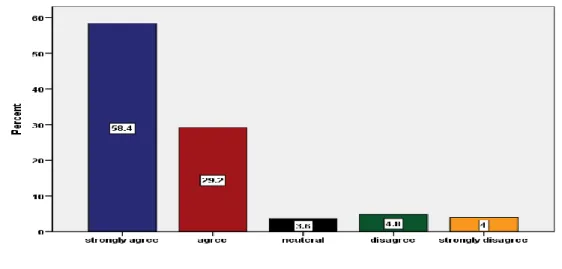
Figure 2: Mobile money reduces potential for corruption
As this above figure 4 shown, most of the respondents strongly agreed the mobile money is increase transparent of the money transaction, those have the highest number of per cent 58.4%
are strongly agreed during data collection, while those said we are agreed and having a number of 29.2%, few numbers of people, 3.6% of respondent said not inform any related mobile money reduced by corruption system. Those strongly disagree that there are not any related mobile money and curtail corruption of 4%. The last part those refused or disagree was 4.8%.
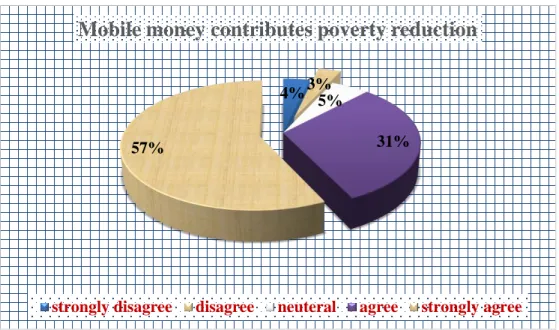
This bellow figure 5 has mentioned that a majority of the respondents are chosen that there
are mobile money helps and sometimes support poor family to send money through personal and other supporter in particular time like emergence aid in during hazards situation there is. A per cent reached 57% are chosen and strongly agree flowed that it's true there is mobile money has positive effect within family income and househod spending, also 31% absolutely, agreed it's true, 5% of respondents answered as neutral. The other side of the respondents those have denied and disagree only 4% of the total respondents and strongly disagree, 3%. The meaning of this is, the mobile money effect within household income and their standard of livelihood in kind of humanitarian issue.
3%4% 5%
57% 31%
Mobile money helps, solving the problem after natural humanitarian
strongly disagree disagree neuteral agree strongly agree
The mobile payments lead to get for the family daily spending, as this above figure 6 shows, most of the respondents are strongly agree that there are mobile payments makes easier for the family get daily commodities, the highest per cent which is 60% are strongly agreed and additionally a per cent 29% are agree also, 3% of respondent are given medium side or neutral, The other sides of the respondents those have denied and disagreed or strongly disagreed are 2% and 6%
respectively
The mobile payments lead to access for the family daily use paid in basic needs expensess, as this above figure 7 shows, most of the respondents are strongly agree that there are mobile payments facilitate bill pay in every needs for persons and family, the highest per cent which is 58% are
1%
4%
5%
58% 32%
Mobile payments makes easier to pay any kind of bills
strongly disagree disagree
neuteral agree
strongly agree 2% 6%
3%
29%
60%
M.payments makes easier for the family get daily commodities
strongly disagree disagree
neuteral agree
strongly agree
agreed and additionally a per cent 32% are agree also, 5% of respondent are given medium side or neutral. The other sides of the respondents those have denied and disagreed or strongly disagreed are 4% and 1% respectively.
This above figure 8 showing, most of the respondent are strongly agreed that there are mobile payments using to pay health facilities, the highest per cent which is 59% are strongly agreed and additionally a per cent 32% are agree also, only 3% not either accept or refused, was neutral.
Another side 4% was denied said strongly disagree lastly there is only 2% of the respondents said disagree. This found researcher mobile payment makes easier for pay the product goods from agriculture and famer can easy buy and get income as properly security their money.
S. disagree 4%
disagree
2% neutral 3%
agree strongly agree 32%
59%
Mobile payments using to pay health facilities
This above figure 9 showing, most of the respondent are strongly agreed that there are mobile payments used to pay agricultural goods because agriculture products in the market both producer and consumer to use mobile payment for bills the highest per cent which is 56% are strongly agreed and additionally a per cent 30% are agree also, only 6% not either accept or refused, was neutral.
Another side 2% was denied said strongly disagree lastly there is only 6% of the respondents said disagree. This found researcher mobile payment makes easier for pay the product goods from agriculture and famer can easy buy and get income as properly security their money.
2% 6
6%
56% 30%
Mobile payments makes easier to pay agricultural goods
strongly disagree disagree neuteral agree strongle agree
The mobile banking used to pay education fee, as this above figure 10 shows, most of the respondents are strongly agree that there are Mobile banking is using payment for education expenses, the highest per cent which is 59% are strongly agree and additionally a per cent 30% are agree also, 4% of respondent are given medium side or neutral, The other sides of the respondents those have denied and disagreed or strongly disagreed are 2% and 5% respectively
2%
5%
4%
30%
59%
M. banking using for kinds education purpose
strongly disagree disagree neuteral agree strongly agree
4.3.3 Mobile money and economic development
As this above figure 11 is shown, most of the respondents strongly agreed that mobile money can lead economic development, because it sources which households got the money from other relative as Remittance income that results to effect the basic livelihood of family and over whole society as positively, highest respondents those have highest number of per cent 62% are strongly agreed during data collection, while those said we are agreed and having a number of 31% and those strongly disagree from that there are the Mobile money is not impact of livelihood in the society and development of the nation having a number of 1%. Another group of respondents was said disagree, 2% of total respondent. The final group of respondents was said neutral, 4%. These Findings means the majority of the respondents are strongly agreeing the Mobile money is positive effect of economic development.
1% 2%
4%
31%
62%
Mobile money can lead Economic development
strongly disagree disagree neuteral agree strongly agree