ENGLISH BORROWINGS IN INDONESIAN
ENTERTAINMENT TERMINOLOGY
A Thesis
Submitted to Letters and Humanities Faculty in Partial to Fulfillment of the Requirements for
the Strata I Degree
NABILAH ALAWI NO. 103026027629
ENGLISH LETTERS DEPARTMENT
LETTERS AND HUMANITIES FACULTY
STATE ISLAMIC UNIVERSITY
“SYARIF HIDAYATULLAH”
ABSTRACT
Nabilah Alawi, English Borrowings in Indonesian Entertainment Terminology. Paper. Jakarta : English Letters Department, letters and Humanities Faculty, State Islamic University (UIN) Syarif Hidayatullah, July 2007.
This research is aimed to know the English Borrowed word into Indonesian language in Entertainment terminology, the important purpose in this research is to know the change of meaning that is happened in the borrowing word from English into Indonesian Language in Entertainment terminology.
The writer uses descriptive qualitative method, where she describes one by one the borrowed words from English, and analyzes those words in Indonesian Entertainment terminology which are experienced the change of meaning, such as in Extension, Narrowing, and in the same of meaning. To support the analysis the writer uses some dictionaries and the other related references.
The writer uses some theories that are the definition of language, terminology, borrowing and the change of meaning. To find the words which are borrowed from English, the writer uses three different magazines as the unit of analysis. Such as Cita Cinta, Intisari, and Spice!. The writer has been already found fourty terminologies from those magazines and analyzed them one by one.
APPROVEMENT
ENGLISH BORROWINGS IN INDONESIAN
ENTERTAINMENT TERMINOLOGY
A Paper
Submitted to Letters and Humanities Faculty in Partial Fulfillment of the Requirements for
the Strata I Degree
NABILAH ALAWI N0. 103026027629
Approved by Advisor
DR. FRANS SAYOGIE, M.PD. NIP. 150 299 481
ENGLISH LETTERS DEPARTMENT
LETTERS AND HUMANITIES FACULTY
STATE ISLAMIC UNIVERSITY
“SYARIF HIDAYATULLAH”
LEGALIZATION
The paper entitled “English Borrowings In Indonesian Entertainment Terminology” has been defended before the Letters and Humanities Faculty’s Examination committee on November 12, 2007. The paper has already been accepted as a partial Fulfillment of the requirements for the strata I degree.
Jakarta, November 12 2007
Examination Committee
Chair Person, Secretary,
Dr. Muhammad Farkhan, M.Pd. Drs. A. Saefuddin, M.Pd.
NIP. 150 299 480 NIP. 150 261 902
Members:
Examiner I Examiner II
Sholikatus Sa’diyah, M.Pd. Drs. Abdul Hamid, M.Ed.
DECLARATION
I hereby declare that this submission is my own work and that, to the best of my knowledge and belief, it contains no material previously published or written by another person nor material which to a substantial extent has been accepted for the award of any other degree or diploma of the university or the other institute of higher learning, Except where due acknowledgment has been made in the text.
Jakarta, September 24 2007
ACKNOWLEDGMENT
In the name of Allah, the Most Gracious, the Most Merciful.
All praise be to Allah SWT, the Lord of the universe, who has bestowed upon the writer completing this paper. Peace and blessing of Allah be upon our prophet Muhammad SAW, his families, his companions and his followers.
In this occasion the writer would like to convey her heartfelt thanks to these amazing people, especially to Dr. Frans Sayogie, M.Pd., as the writer’s advisor for his time, guidance and kindness in correcting and helping her to finishing this paper.
1. Her beloved parent H. Alawi Zen, M.A and Hj. Farhiah Thoyyib, for their prayers, trust and support to the writer. They have been and still are ready and patient to assist her education morally and materially until finishing this paper with their various ways, she conveys her truly grateful to have them
2. Dr. H. Abd. Chair, M.A., the Dean of Letters and Humanities Faculty
3. Dr. H. Muhammad Farkhan, M.Pd., the Head of English Letters Department, and Drs. A. Saefuddin, M.Pd., the Secretary of English Letters Department 4. All lecturers in English Letters Department, especially to Mr. Zaharil Anasyi,
S.Pd., who has give his advices and ideas to the writer.
5. The library staff of Letters and Humanities Faculty, the library staff of Cultural Faculty of Indonesia University, and the library staff of ‘PKKB’ Atmajaya.
6. Her beloved sisters (K’o, Kk Uwa, Suhe, Ndu’ and Dende) and also her brothers (A Cory and Oeton) for their support, compassion, contribution, and moral encouragement that they always give to the writer.
8. And also all her friends and classmates in English Letters Department especially to Yoentze, Paul, Yuni, Emma, and Maz Dew
9. All who have given their support for the writer.
The words are not enough to say any appreciation for your help and contribution on this paper. May Allah SWT always guides you and gives all happiness throughout your life.
Jakarta, September 24 2007
TABLE OF CONTENTS
ABSTRACT……….... i
APPROVEMENT……….... ii
LEGALIZATION………. iii
DECLARATION………. iv
ACKNOWLEDGMENT……….. v
TABLE OF CONTENTS………. vii
CHAPTER 1 : INTRODUCTION A. Background of the Study……… 1
B. Focus of the Study……….. 3
C. Research Question……….. 4
D. Significance of the Study………. 4
E. Research Methodology……… 4
I. Objective of the Study……… 4
II. Method of the Study……….….. 5
III. Technique of Data Analysis……….. 5
IV. Unit of Analysis………. 5
CHAPTER II : THEORETICAL FRAMEWORK
A. Language……….. 7
B. Terminology………. 9
C. Borrowing………. 13
D. Change of Meaning……….. …… 15
CHAPTER III : RESEARCH FINDING A. Description of the Data………. 20
B. Analysis of the Data……….. 23
CHAPTER IV : CONCLUSIONS AND SUGGESTIONS A. Conclusions……….. 48
B. Suggestions……….. 49
BIBLIOGRAPHY………. 50
CHAPTER I
INTRODUCTION
A. Background of the Study
Human uses language as communication device to interact each other, we use language to ask for, give people information, and express our mind and feeling. The simple definition of language is a set of signals by which we communicate.1 In linguistics, language is a sound system of signals which is agreed to use by part of group in certain society to cooperate, communicate, and identify theirself.2
In modern era, people communicate and cooperate with two or more countries. Many people speak foreign language in their daily conversation. Nowadays, educated people and scientists of every kind are induced to learn to read, if not to speak several languages. It is not easy to see how a foreign language which is learned and used by the most influential social classes of a nation may cease to be a foreign language and become a common language which gradually eliminates the ancient nation language, the process being one of dialectalization and fragmentation.3
As a social creator, a person depends on another, enable them to complete their deficiency, it is not impossible if one nation borrowed foreign terms from another nation to complete their vocabularies. Moreover, perhaps it becomes their
1
Lorelo Todd, An Introduction to Linguistics, (Singapore: Longman York Press, 1987), p.6
2
Kushartanti , et.al. (ed), Pesona Bahasa: Langkah Awal Memahami Linguistik, (Jakarta: PT. Gramedia Pustaka Utama, 2005), p.3
3
own national terms. By the development of culture, science and technology is definitely think out the new concepts, with the new words or terminologies as the cross-section.4
Indonesian language borrowed many foreign vocabularies from several languages. Such as Chinese, Arabic, Latin, Dutch, Germany, and also English. As an International language, many people speak English language in their conversation. Because of that, English borrowing into Indonesian language is used in many fields, such as, in Economic, Law, Education, Medical and also in Entertainment field.
Language has meaning and a meaning can experience to change, because language has dynamic characteristic. A change of meaning happens because of time and place in certain district or country which is urge the meaning changing. In meaning, changes result from language contact, from cultural development requiring new vocabulary, and from reshaping existing meanings.5
Synchronically, meaning of word does not change, but in diachronically it enables to change. It means, in a very short period meaning of a word is same does not changed, but in a long periods it enables the meaning of word will be changed.6 The words which are borrowed from foreign language will get the change of meaning based on time and place.
In Indonesian Entertainment terminology which is borrowed from English language, because English is International language in this world. Some of those
4
Abdul Chaer, Linguistik Umum, (Jakarta: PT. Rineka Cipta, 1994), p. 54
5
Ronald Wardhaugh, Introduction to Linguistics, (USA: Mc Graw-Hill, Inc, 1972), p. 185
6
terminologies which are borrowed experience to have the change of meaning. For example, the word “artis” is taken from English language “artist”. This word gets the change of meaning in Kamus Besar Bahasa Indonesia, it means “ahli seni; seniman; seniwati (seperti penyanyi, pemain film, pelukis dan pemain drama)”.7 In Oxford dictionary it means “a person who paints or draw picture, produces
SCULPTURE,” 8 Nowadays, Indonesian language calls the word of “artis” as a
person who acts in a film, drama or a singer than an artist (painter), as a person who draws picture. It means that the word of “artist” in Indonesian Entertainment terminology ‘artis” gets the change of meaning, that is generalization or it is changed from the narrow meaning into the general one. In this research, the writer will analyze the English borrowings in Indonesian Entertainment terminology whether it has the change of meaning or not.
B. Focus of the Study
The writer focused this research on Indonesian Entertainment terminology which was borrowed from English into Indonesian language and the change of meaning that happened in it.
7
Depdikbud, Kamus Besar Bahasa Indonesia, (Jakarta: PT. Balai Pustaka, 2005), p. 57
8
C. Research Question
The question in this research is how does the change of meaning in English borrowings into Indonesian language in Entertainment terminology happen?
D. Significance of the Study
As one of the references in studying of the linguistic work, this research dedicates as a requirement to finish undergraduate study in English Letters Department, Letters and Humanities Faculty of State Islamic University Syarif Hidayatullah. Generally, the writer hopes that the result of this research can be useful for the readers and to get more understanding and knowledge about the borrowing and the change of meaning that happen in Entertainment terminology. Such as on music, film, and mode as the contents of Entertainment.
F. Research Methodology
I. Objective of the Study
II. Method of the Study
The method that is used in this research is descriptive qualitative method, the writer will describes the data which are found in three different magazines about English borrowing into Indonesian language in Entertainment terminology. After that, the writer will classify the data that experience in the change of meaning.
III. Technique of Data Analysis
In this research, the writer uses the technique of analytic descriptive by comparing the English borrowing into Indonesian Entertainment terminology with the general terminology of Indonesian language. To support this research, the writer will use some dictionaries and books as reference.
IV. Unit of Analysis
V. Instrument of the Research
CHAPTER II
THEORETICAL FRAMEWORK
A. Language
Language is a sound system of signals which is agreed to use by part of group in certain society to cooperate, communicate, and identify theirself.9 Victoria Fromkin and Robert Rodman said in their book An Introduction to Language, that when you know a language, you can speak and be understood by others who know that language. This means, you are able to produce sounds which signify certain meanings to understand or interpret the sounds produced by other.10
From those statements, we know that a language is communication device. People talk use a language because their live in a world of words because people talk, communicate, and cooperate by others with a language every day, more than any other attributes, distinguishes human from other animals.
The other definition about language is language as a finite system of elements and principles that make it possible for speakers to construct sentences to do particular communicative jobs.11
9
Kushartanti , et.al. (ed), op. cit., p.3
10
Victoria Fromkin and Robert Rodman, An Introduction to Languge, second edition (Tokyo: Holt-Saunders Japan Ltd, 1981), p. 1-2
11
The most aspect of knowing a language is knowing that certain sounds or sound sequences signify or represent different concept or “meanings”.12 Knowing a language therefore knows the system which relates sounds and meanings. It means that when you do not know a language, the sounds spoken to you from foreign tongue mean nothing to you. So, you can not understand what the speaker’s message is.
Language has many functions, there are five important communicative functions of language:
1. Informational function
Language is used for giving information to another people 2. Expressive function
Language can be used to express our feelings 3. Directive function
Language can be aimed to influence the other behaviors or attitudes 4. Aesthetic function
Language can be used to sake the linguistic artifact, although with ulterior purpose.
5. Phatic function13
In this function the communicative work is done by language, by keeping communicative lines open and social relationship in good repair.
12
Victoria Fromkin and Robert Rodman, op. cit., p.2
13
B. Terminology
Term is a lexical unit consisting of one or more than one word which represents a concept inside a domain, and the terminology is the vocabulary of a subject field.14
Terminology is a word or the combination of words that express a concept meaning, process, condition or special characteristics in a certain field and give the term which is known generally or specifically.15 Terminology is special terms or vocabularies customarily used by those engaged in a specific activity or field of endeavor.16
It is necessary for every science to have its own terminology in its work. Terminology is the expression which has certain meaning that is used in branch of science.17 Terminology is different from word, terminology have a meaning which is certain, clear and unhesitatingly, although without context sentence.18 The terminology is free from context on the contrary word is not free from context. For example, the word of tangan and lengan as the terminology in Medical term, both of them have different meaning in medical field. Tangan is a part from circle until
14
Kyo Kageura, The Dynamic of Terminology, (Amsterdam: John Benjamin Publishing, 2002), p.9
15
John S. Hartanto, Pedoman Umum Pembentukan Istilah dan Pedoman Ejaan Bahasa Indonesia Yang di Sempurnakan (EYD), (Surabaya: Indah, 1995), p.8
16
Mario Pei and Frank Gaynor, Dictionary of linguistics (New Jersey: Littlefield, Adams&CO.1975.
17
Harimurti Kridalaksana, Fungsi Bahasa dan Sikap Bahasa, (Jakarta: PT. Nusa Indah, 1982), p.73
18
fingers, and lengan is a part from circle until shoulder. Whereas in word, tangan and lengan is have the same meaning.
In development of language there are numbers of terminology which are often used become general vocabulary. It means, that terminology is not only used in its own science field but also used generally outside the field.19 For example the terminology of spiral, and virus have been become general vocabulary.
There are seven sources of terminology according to John S Hartanto, as follow:
1. Indonesia vocabularies
This source has to fulfill one or more requisite that is concise, the meaning is not deviate, there is no bad meaning (connotation), pleasant to hear and by generalization or specialization of the origin meaning. Such as: Garis Ibu and Peka..
2. Family language vocabularies
If the terminology in Indonesian language is not found, it is desirable to find the terminology in family language vocabularies. Such as: Nyeri from Sunda, Pain from English.
3. Foreign language vocabularies
If the terminology is not found neither in Indonesia nor family language vocabularies, foreign language vocabulary can be used as the source to find the terminology. Such as: Music in English and music in Indonesia.
19
4. Absorbed the foreign terminology
The process of absorbed can be done with or without change in adaptation spelling and pronunciation. Such as the term of Kimia in Indonesia and Chemistry in English, it means ilmu urai but we do not use this terminology in the dialogue, we often use the term of Kimia only.
5. Types of absorption
These types are the context of situation and bound of sentence, easy to learn language and practicality. Such as the term of electron, in Indonesia language is elektron.
6. Common foreign terminology usage
The usage of common foreign terminology can be used as the Indonesian terminology. Such as fabriek becomes pabrik.
7. Constants foreign terminology spelling.20
We can use it with requisite give italics or underline the word. Such as Cum Loude means graduated from university with cumulative achievement index between 3.50 without C value until 4.00
Word with general meaning have a function as the terminology. George Yule in his book The Study of Language explained that the processes to form the word. There are etymology, coinage, borrowing, compounding, blending, clipping,
20
backformation, conversion, acronyms. Derivation, prefixes and suffixes, infixes and multiple processes.21 These are the explanation about the word formation:
1. Etymology
It is known as the origin and history of a word. For example: the word of etymology itself
2. Coinage
It is by invention the totally new terms, it is used for commercial products or for any version of that product. For example: aspirin and teflon
3. Borrowing
It is by taking over the words from other language. For example: yogurt (borrowed from French)
4. Compounding
It is joining or compounds the two separate words to produce a single form. For example: wallpaper
5. Blending
It is combination the two separate forms to produce a single new term. For example: infotainment (information / entertainment)
6. Clipping
It is happened when a word of more than one syllable is reduced to a shorter form. For example: flu (influenza)
7. Backformation
The process is by reduced one type of word to form a word of another type. For example: televise (verb) into television (noun)
8. Conversion
It is changed the version n of word. As when a noun comes to be used a verb without any reduction. For example chair (noun) become verb in someone has to chair the meeting.
9. Acronyms
It is formed a new word from the initial letters of a set of other words. For example: CD (compact disk) and radar (radio detecting and ranging). 10.Derivation
It is accomplished affixes of the English language. For example: unhappy with affixes un.
11.Prefixes and suffixes.
Prefixes is added the affixes in the beginning of the word. For example: mislead
Suffixes is added the affixes in the end of the word. For example: foolishness
21
12.Infixes
It is incorporated inside another word and possible to see in certain expression. For example: unfuckingbelievable! With infixes fucking
13.Multiple processes
It is can be done by trace the operation of more than one process at work. For example: problems with the project have snowballed. The word snow and ball were combined to form the noun snowball, the turn in the verb through conversion.
C. Borrowing
Languages often change as a result of contact with a speaker of another language. Language contact occurs when there is increased social interaction between people from neighboring territories who have traditionally spoken different language.22 Borrowing is one of the language contact studies that overlaps with the discipline of historical linguistics.
According to Ronald Wardhaugh in his book, Introduction to Linguistics borrowing is another way of adding new vocabulary items to a language.23 Borrowing is a technical term for the incorporation of an item from one language into another.24
Victoria Fromkin and Robert Rodman said that borrowing occurs when one language adds to its own lexicon a word or morphemes from another language, often altering its pronunciation to fit the phonological rules of the borrowing language.25
A language may borrow a word directly and indirectly. A direct borrowing is the borrowing items of native word that language from which it is borrowed. For
22
Rajend Mesthrie, et.al., Introduction to Sosiolinguistics, (Edinburg: Edinburg University Press, 2000), p.248
23
Ronald Wardhaugh, op.cit., p.181
24
Rajend Mesthrie, et.al. op.cit., p.249
25
example: the word feast was borrowed directly from French and can traces back to Latin festum. Indirect borrowing is the borrowing items of native word that language from which it is not borrowed. For example the word algebra was indirectly borrowed from Arabic with Spanish as an intermediary.
Grosjean (1982) distinguishes between speech and language borrowing.26 Speech borrowing is when an individual speaker spontaneously uses a form from another language in his utterance, perhaps by adapting phonologically and morphologically. Language borrowing is when word from one language have been borrowed by another and used by monolingual speakers of that recipient language.
Leonard Bloomfield, classifies three types of borrowing, they are: 1. Cultural borrowing
It is happened where the borrowed features come from different language. For example: garage and camouflage that borrowed from French
2. Imitate borrowing
It is occurs when two languages are spoken in what is topographically and politically a single community. For example: the word Jury was borrowed from English language from French in Law terminology.
3. Dialect borrowing
Where the borrowed features come from within the same speech area. For example: the native London development of Old English [y] is probably [i] as
26
in fill and kiss.27
There are two different factors why one language borrows other language: 1. Social factors
a. the intensity and length of contact
b. the relative number of speakers of each variety
c. cultural, political and economic dominance of one group of speaker. 2. linguistic factors
a. frequency
a.1. contact items. Such as: noun, verbs and adjective.
a.2. vocabulary items. Such as: word for certain basic parts of body. a.3. particular content items
b. equivalence.28
Borrowing is a technical term for the incorporation of an item from one language into another, the items could be words, grammatical elements or sounds. Borrowing usually involves the adaptation of a word into the phonetic and grammatical system of the other language.
D. Change of Meaning
Change of meaning means change of references.29 The reference which has changed with the new reference, meaning can be changed based on the times and places. A known word with the origin meaning by all language society, once time will have shift of meaning in a certain area.
27
Leonard Bloomfield, Language, (London: George Allen & Unwin Ltd., 1935), p. 444 & 461
28
Fredric W. Field, op.cit., p. 4-6
29
Leonardo Bloomfield said in his book Language is the innovation which change the lexical meaning rather than the grammatical function of a form, are classes as the change of meaning.30
The vocabulary of language always add and develop, one of the meaning of vocabulary in language is not static but dynamic, so it can be changed appropriate with period development and the human which is used. Changes in the meaning of a speech form is merely the result of change in the use of it and use the other speech form that related semantically. For example, the word “canggih” is used to means “suka mengganggu (ribut, bawel, dsb)”, But now “canggih” is changed become “sangat rumit dan ruwet dalam bidang teknologi karena keterikatan antar komponen atau unsur”.31
There are five factors that caused the meaning of word changed: 1. The science and technology development
The development of science and technology can caused the origin word changed to a different meaning from its origin word. The meaning of words in the science and technology based on the general word in society, then experience reducing, restriction and constriction that appropriate with its field.
30
Leonardo Bloomfield, op.cit., p. 425
31
2. The social and cultural development.
The change of meaning also can cause by the social and cultural development, a user of Indonesian language caused the word of meaning to describing their experiences.
3. The using of word development
Every science fields have their own vocabularies, but the vocabularies of theirs can be used to other fields with the new meaning or different with the origin meaning. Finally, the vocabulary become general and has several meaning because its use not only in one field but also another fields, it means that the meaning can be general from one vocabulary changes from its original meaning.
4. The conception of sense exchange
All of the conceptions of sense have their own function to feel what happen with them. In development of language using, many cases of the conception of sense exchange from the one sense into another. Such as sweet taste, it should be received by the sense of seeing.
5. Because of Association.32
There is a relationship between forms of utterance with something else that is related with its form of utterance.
32
According to Albert C. Baugh in his book A story of English language stated that there are four kinds of the change of meaning:
1. Extension of meaning
That is a process of word experience the change of meaning from specific into general meaning. It is also called widening or generalization, it means the word is widening from the special meaning. When the word became widening its meaning, that word means have several meaning, not only in one field of science but also in another field. For example: the word of putera and puteri used to mean King’s sons or daughters, but now boy also can called putera and girl also can called puteri.
2. Narrowing of meaning
Narrawing also called specialization. This is a process of word experience of meaning from general into specific meaning, In narrowing, the general word change became narrow meaning. For example: The word of sarjana used to mean a smart person, but now sarjana have a meaning university graduated. 3. Regeneration of meaning
4. Degeneration of meaning33
Degeneration also called pejorative is aprocess of meaning changes where the new meaning changed go down more lower than the old meaning. Degeneration aim to the negative or unpleasant meaning. For example: the word of hostes now have negative or lower meaning whereas originally the meaning of hostes is was not low.
33
CHAPTER III
RESEARCH FINDING
A. DESCRIPTION OF THE DATA
In this data description, the writer takes the Indonesian Entertainment terminologies which are borrowed from English language, those terminologies taken from three different magazines as the unit analysis of researcher, as follow:
a.CitaCinta ( May - June 2007, No.11/VII) b.Intisari (November 2006, No.250) c.Spice! (June 2007)
In this research, the writer uses three dictionaries to support her research to find the meaning of each word, the dictionaries are;
a.The meaning is collected from the current English dictionary (Hornby AS, Oxford Advanced Learner’s Dictionary of Current English, Fifth edition, 1995) b.The meaning is collected from Kamus Besar Bahasa Indonesia (Departemen
Pendidikan dan Kebudayaan, Edisi ketiga, 2005)
c.The meaning is collected from Kamus Kata-Kata Serapan Asing dalam Bahasa Indonesia (J.S. Badudu, 2003), and Kamus Kata Serapan (Surawan Martinus, 2001)
There are eleven terminologies which get the change of meaning in extension of meaning or generalization:
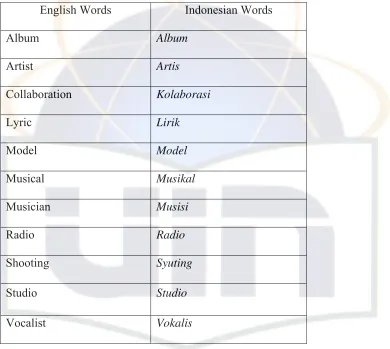
Table. 1. The terminologies which get the change of meaning in extension. English Words Indonesian Words
Album Album
Artist Artis
Collaboration Kolaborasi
Lyric Lirik
Model Model
Musical Musikal
Musician Musisi
Radio Radio
Shooting Syuting
Studio Studio
Vocalist Vokalis
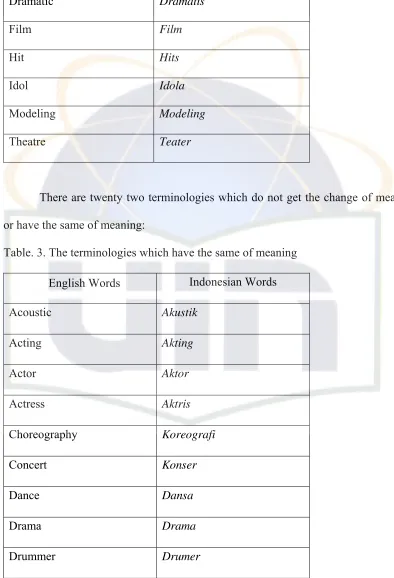
There are seven terminologies which get the change of meaning in narrowing of meaning or specialization:
Table. 2. The terminologies which get the change of meaning in narrowing. English Words Indonesian Words
Dramatic Dramatis
Film Film
Hit Hits
Idol Idola
Modeling Modeling
Theatre Teater
There are twenty two terminologies which do not get the change of meaning or have the same of meaning:
Table. 3. The terminologies which have the same of meaning English Words Indonesian Words
Acoustic Akustik
Acting Akting
Actor Aktor
Actress Aktris
Choreography Koreografi
Concert Konser
Dance Dansa
Drama Drama
Glamour Glamor
Gossip Gosip
Guitarist Gitaris
Jazz Jazz
Mode Mode
Music Musik
Opera Opera
Orchestra Orchestra
Popular Populer
Popularity Popularitas
Poster Poster
Scenario Skenario
Superstar Superstar
B. ANALYSIS OF THE DATA
These are the 40 Indonesian Entertainment terminologies, which one presented by alphabethical order, these analyses are as follows:
B.1. Extension of Meaning.
1. “Album” is taken to Indonesia language “Album”
a.A book in which a collection of photograph, stamps, etc can be kept (Oxford Dictionary)
b.Buku tempat menyimpan kumpulan foto atau potret, gambar-gambar, perangko dan sebagainya (KBBI)
c.Sekumpulan lagu yang direkam dalam kaset atau CD atau piringan hitam (KKS)
From three different meanings, we can know that this terminology gets the change of meaning in extension of meaning or generalization, because the terminology of Album refers to the collection of songs which are recorded in a cassette, CD, or phonograph record. Such as in example:
Album (n) = “We can put our picture in this album.”
Album (n) = “Album debut Norah Jones terjual sebanyak 20 juta keping.”
2. “Artist” is taken to Indonesia language “Artis”
a.A person who paints or draws pictures, produces sculpture (Oxford Dictionary)
c.Seniman dan seniwati (penyanyi, pemain film atau sinetron, dramawan/-wati) (KKSABI)
This terminology gets the change of meaning that is widening or extension meaning or generalization. The terminology of Artis changes into general meaning, because in Entertainment terminology this term means not only a painter but also it could be a celebrity, a movie star, a singer or an actor. Such as in example:
Artist (n) = “Leonardo Da Vinci was a great artist.”
Artis (n) = “Agnes Monica adalah seorang artis multi talenta.”
3. “Collaboration” is taken to Indonesia language “Kolaborasi” a.The action of collaborating (Oxford Dictionary)
b.Kerjasama dengan musuh (KBBI)
c.(Perbuatan) Kerja sama dengan musuh (KKSABI)
The terminology of Kolaborasi gets the change of meaning in generalization or extension of meaning, because the word of Kolaborasi just refers to cooperation. Such as in example:
Collaboration (n) = “He was suspected of collaboration with the enemy.”
Kolaborasi (n) = “Album kolaborasi Melly dengan Krisdayanti terjual habis. ”
4. “Lyric” is taken to Indonesia language “Lirik”
c.Lagu yang dinyanyikan dengan perasaan yang ringan atau bebas dengan iringan lira (syair lagu) (KKS)
Based on those meanings, this terminology gets the change of meaning in generalization or extension of meaning, because the meaning of Lirik becomes general not only means the poem contains of personal feeling but also means the poem of song. Such as in example:
Lyric (adj) = “As a good artist, he able to compose a good poem lyric. ” Lirik (n) = “ Anang adalah pencipta lirik lagu itu. ”
5. “Model” is taken to Indonesia language “Model”
a.A representation of something, usually smaller than original (Oxford Dictionary)
b.Pola (contoh, acuan ragam dsb) dari sesuatu yang akan dibuat atau dihasilkan (KBBI)
c.Gadis-gadis cantik yang memamerkan pakaian-pakaian bercorak baru (KKSABI)
The specialization or narrowing of meaning happens in this terminology, because the meaning is change into narrow from general meaning. In Entertainment terminology the word of Model means beautiful girls who display the new design clothes. Such as in example:
Model (n) = “We use this picture for the model of our design.”
6. “Musical” is taken to Indonesia language “Musikal”
a.Usually attribute of or for music (Oxford Dictionary) b.Berkenaan dengan music (KBBI)
c.Cerita atau pentas yang sering kali jenaka dan sentimental, menggunakan nyanyian, tari dan dialog (KKS)
This terminology gets the change of meaning that is extension of meaning or generalization, the word of Musikal is widening into general meaning that means humorous or funny and sentimental story which is shown used song, dance and dialogue. Such as in example:
Musical (adj) = “He is a musical composer.”
Musikal (a) = “Drama musikal yang ditayangkan RCTI itu berjalan sukses”
7. “Musician” is taken to Indonesia language “Musisi”
a.A person who plays a musical instrument (Oxford Dictionary) b.Para musikus (KBBI)
c.Pencipta dan pemain musik (KKSABI)
This terminology gets the change of meaning that is extension of meaning or generalization, the word of Musisi is widening into general meaning that has meaning not only a person who plays a musical instruments, but also an instruments composer. Such as in example:
Mucisian (n) = “The band consist of ten mucisians.”
8. “Radio” is taken to Indonesia language “Radio”
a.The process of sending and receiving messages through the air by electromagnetic waves (Oxford Dictionary)
b.Siaran (pengiriman) suara atau bunyi melalui udara (KBBI) c.Pesawat radio (KKSABI)
The meaning of Radio in Entertainment terminology gets the change of meaning in generalization. It is not only mean the process of sending and receiving messages through the air by electromagnetic waves, but also radio tape that has functions to listen music, news, etc. Such as in example:
Radio (n) = “They are communicate each other by radio at sea.” Radio (n) = “Kakek saya selalu mendengarkan berita melalui radio.”
9. “Shooting” is taken to Indonesia language “Syuting”
a.An occasion when a professional photographer takes photograph or a particular purpose (Oxford Dictionary)
b.Melakukan pengambilan gambar untuk pembuatan film dengan kamera (KBBI)
picture or photograph by the professional photographer for particular purpose. Such as in example:
Shooting (n) : “He is shooting a picture for calendar.”
Syuting (n) : “Syuting film Naga Bonar itu dilakukan selama 2 tahun.”
10. “Studio” is taken to Indonesia language “Studio”
a.A room from which radio or television programmes are regularly broadcast or in which they are recorded (Oxford Dictionary)
b.Ruang yang dipakai untuk menyiarkan acara-acara radio atau televise (KBBI)
c. Ruang yang digunakan untuk tempat bekerja (pelukis, foto, musik) (KKSABI)
The meaning of Studio in Entertainment terminology is a place for working for an artist or painter, photograph or music, it changes from broadcasting and recording room for radio or television programmes. It means that this terminology gets the change of meaning in generalization or extension of meaning. Such as in example:
Studio (n) = “The minister was interviewed in the BBC’s Oxford studio.” Studio (n) = “Pelukis itu mengerjakan lukisannya di dalam studionya.”
11. “Vocalist” is taken to Indonesia language “Vokalis”
c.penyanyi (terutama penyanyi tunggal) (KKSABI)
Vokalis gets the change of meaning in this terminology that is extension Sor generalization, this terminology is not only specific with the jazz or pop music but also in any kinds of music. Such as in these examples:
Vocalist (n) = “She was a cute vocalist in the concert last sunday.” Vokalis (n) = “Kaka adalah vokalis band Slank.”
B.2. Narrowing of Meaning.
1. “Arrangement” is taken to Indonesia language “Aransemen”
a.The action of putting something in order the arranging of something (Oxford Dictionary)
b.Penyesuaian komposisi music dengan nomor suara penyanyi atau instrument lain yang didasarkan pada sebuah komposisi yang telah ada sehingga essensi musuknya tidak berubah (KBBI)
c.Penyusunan komposisi lagu atau musik dengan instrument dan penyesuaiannya supaya hasilnya harmonis (KKSABI)
The terminology of Aransemen gets the change of meaning in specification or narrowing because it just refers to the action of putting song composition or music instrument. Such as in example:
2. “Dramatic” is taken to Indonesia language “Dramatis”
a.Attribute of or in the form of drama (Oxford Dictionary) b.Bersifat drama (KBBI)
c.Peristiwa yang menyedihkan atau mengharukan (KKSABI)
The change of meaning happens in this terminology that is narrowing of meaning or specialization, the terminology just refers to the events that is saddened or touch someone’s emotions. Such as in example:
Dramatic (adj ) = “The dramatic drama is the representation of a real event.” Dramatis (a) = “Saya menangis ketika menyaksikan film yang sangat
dramatis seperti itu.”
3. “Film” is taken to Indonesia language “Film”
a.A story, etc recorded as asset of moving pictures to be shown on television or at cinema (Oxford Dictionary)
b.Selaput tipis yang dibuat dari seluloid untuk tempat gambar negative (yang akan dibuat potret) atau untuk tempat gambar positif (yang akan dimainkan di bioskop) (KBBI)
c.Cerita yang diputar di bioskop (KKSABI)
The terminology of Film gets the change of meaning that is narrowing of meaning or specialization, the word of Film in Entertainment terminology is a story that is shown at the cinema. Such as in example:
4. “Hit” is taken to Indonesia language “Hits”
a.An act of hitting somebody or something (Oxford Dictionary) b.Lagu yang sangat populer dalam musik hiburan (KBBI)
c.Musik populer yang berada pada tangga puncak tentang lagu-lagu (KKSABI)
The change of meaning happens in this terminology that is specialization or narrowing of meaning. The terminology of Hits just refers to the popular music that is in the top of songs chart. Such as in example:
Hit (n) = “It is ironic when we find the hit of innocent people.” Hit (a) = “Lagu-lagu yang diputar di radio itu adalah lagu-lagu hit
terkini.”
5. “Idol” is taken to Indonesia language “Idola”
a.A person or thing that is greatly loved or admired (Oxford Dictionary) b.Orang, gambar dan sebagainya yang menjadi pujaan (KBBI)
c.Orang atau tokoh yang dijadikan pujaan (KKSABI)
From three different meanings we can know that the terminology of Idola gets the change of meaning in specialization or narrowing of meaning. In the entertainment terminology, it has specific meaning that refers to a person or figure that is greatly loved or admired. Such as in example:
6. “Modeling” is taken to Indonesia language “Modeling” a.The art of making model (Oxford Dictionary) b.Hal menjadi (gadis, pria) model (KBBI) c.Hal menjadi gadis atau pria model (KKSABI)
The terminology of Modeling gets the change of meaning in specialization or narrowing of meaning. In the entertainment terminology, it has specific meaning that refers to the art of making model. Such as in example:
Modeling (n) = “My father made the architectural modeling for his project.” Modeling (n) = “Para model itu sebelumnya belajar di sekolah-sekolah
modeling.”
7. “Theatre” is taken to Indonesia language “Teater”
a.a building or outdoor area where plays and similar entertainments are performed (Oxford Dictionary)
b.gedung atau ruangan tempat pertunjukan film atau sandiwara (KBBI) c.sandiwara, senidrama (KKSABI)
Based on those meanings, we know that the terminology of Teater gets the change of meaning that is narrowing of meaning or specialization, this terminology used to a building or a place where a film or drama plays. In Entertainment terminology Teater means drama or play. Such as in example:
B.3. The Same Meaning.
1. “Acoustic” is taken to Indonesia language “Akustik”
a. Relating to sound or the sense of hearing (Oxford Advanced Learner’s Dictionary)
b.Mengenai atau berhubungan dengan organ pendengar, dengan suara atau dengan ilmu bunyi (Kamus Besar Bahasa Indonesia/ KBBI)
c.Berhubungan dengan pendengaran atau suara (Kamus Kata Serapan/ KKS) From three meanings above, we can know that the terminology of Akustik does not get the change of meaning because it has the same of meaning that is relating to sound or the sense of hearing. Such as in example:
Acoustic (adjective/adj) = “We find the acoustic properties in the music studio.” Akustik (adjektiva/a) = “Kami menyaksikan pertunjukan musik akustik di JCC.”
2. “Acting” is taken to Indonesia language “Akting”
a.The art of occupation of performing in plays, films, televisions, etc. (Oxford Dictionary)
b.Seni atau profesi berperan diatas pentas, televisi atau film (KBBI)
c.Seni berperan diatas pentas (panggung) atau di film (Kamus Kata-Kata Serapan Asing dalam Bahasa Indonesia/ KKSABI)
Acting (noun/n) = “She did a lot of acting while he was at collage.”
Akting (nomina/n) = “Dian Sastro beradu akting dengan Nicholas Saputra di AADC.”
3. “Actor” is taken to Indonesia language " Akting "
a.A person who acts on the stage on televisions or in film (Oxford Dictionary) b.Pria yang berperan sebagai pelaku di pementasan cerita, drama, dan
sebagainya di panggung, radio, televisi atau film (KBBI)
c.Pria yang melakonkan cerita diatas pentas (drama), di radio, televisi atau film (KKSABI)
From three meanings above, we can know that this terminology also does not get the change of meaning, it has the same meaning that is a person who acts on stage, radio, television or film. Such as in example:
Actor (n) = “He is a Bollywood actor.”
Aktor (n) = “Dia adalah seorang aktor di film Candy.”
4. “Actress” is taken to Indonesia language “Aktris” a.A woman actor (Oxford Dictionary)
b.Wanita yang berperan sebagai pelaku dalam pementasan cerita (KBBI) c.Wanita pemegang peran dalam lakon sandiwara atau drama, radio, televisi
From those meanings we can know that this terminology does not get the change of meaning because has the same of meaning that is a woman actor who acts on stage, radio, television or film. Such as in example:
Actress (n) = “Angelina Jolie is a beautiful actress in Hollywood.” Aktris (n) = “Ira Maya Sopha adalah aktris Indonesia era 1980an.”
5. “Choreography” is taken to Indonesia language “Koreografi”
a.The art of designing and arranging the step and movements in dances, especially ballet (Oxford Dictionary).
b.Seni tari (KBBI)
c.Seni mencipta dan mengubah tari (Balet) (KKSABI)
From those three meanings, we can know that this terminology does not get the change of meaning. Such as in example:
Choreography (n) = “He is a student of choreography school.”
Koreografi (n) = “Dia berhasil memasukkan unsur-unsur tari itu ke dalam koreografinya.”
6. “Concert” is taken to Indonesia language “Konser”
a.A musical entertainment given in public by one or more performers (Oxford Dictionary)
b.Pertunjukan musik didepan umum atau pertunjukan sekelompok pemain musik yang terjadi di beberapa komposisi perseorangan (KBBI)
The change of meaning does not happen in this terminology, because it has the same of meaning. Such as in example:
Concert (n) = “We will see a Jazz concert tonight.”
Konser (n) = “Kami menyaksikan konser Tiga Diva di Malaysia.”
7. “Dance” is taken to Indonesia language “Dansa”
a.A series of movements and steps that match the speed and rhythm of music (Oxford Dictionary)
b.Tari cara barat yang dilakukan oleh pasangan pria wanita dengan berpegangan tangan atau berpelukan yang diiringi musik (KBBI)
c.Menari atau tarian gaya barat yang ditarikan secara berpasangan dan diiringi musik (KKS)
We can know that it has the same of meaning, so this terminology does not get the change of meaning. Such as in example:
Dance (n) = “We always learn Bali dance steps every month.” Dansa (n) = “Kami menghadiri pesta dansa semalam.”
8. “Drama” is taken to Indonesia language “Drama”
a.A play for the theatre, radio or television (Oxford Dictionary)
c.Sandiwara yang dipentaskan; cerita atau kisah yang berisi konflik antara pelaku-pelakunya (yang dipentaskan) (KKSABI)
The change of meaning does not happen in this terminology, because it has the same of meaning. Such as in example:
Drama (n) = “She will play a classical drama tomorrow.”
Drama (n) = “Film itu memenangkan penghargaan sebagai film drama terbaik.”
9. “Drummer” is taken to Indonesia language “Drumer”
a.A person who plays a drum or drums (Oxford Dictionary) b.Pemain drum (KBBI)
c.Penabuh gendang atau drum (KKSABI)
This terminology has the same of meaning, it means that the change of meaning does not happen in this terminology. Such as in example:
Drummer (n) = “He is the drummer of Linkin Park band.” Drumer (n) = “Tio adalah drumer band Dewa.”
10. “Glamour” is taken to Indonesia language “Glamor”
a.The attractive or exciting quality that makes certain activities, jobs, etc seem special (Oxford Dictionary)
b.Serba gemerlapan (KBBI)
This Entertainment terminology does not get the change of meaning, because it has the same of meaning. Such as in example:
Glamour (n) = “Paris Hilton is the glamour Hollywood celebrity.” Glamor (n) = “Para undangan datang ke acara FFI dengan dandanan
yang serba glamour.”
11. “Gossip” is taken to Indonesia language “Gosip”
a.Casual talk about the affair of other people (Oxford Dictionary) b.Obrolan tentang orang-orang lain (KBBI)
c.Gunjingan, desas-desus, perkataan untuk menjelekkan nama orang yang digosipkan itu (KKSABI)
From those meaning, we know that the change of meaning does not happen in this terminology, because it has the same meaning. Such as in example:
Gossip (n) = “It is a common gossip that they are having an affair.” Gosip (n) = “Dia putus dengan kekasihnya karena gossip
perselingkuhannya terbuka.”
12. “Guitarist” is taken to Indonesia language “Gitaris” b.A guitar player (Oxford Dictionary)
c.Orang yang ahli bermain gitar (KBBI)
d.Orang yang pandai memainkan gitar (KKSABI)
Guitarist (n) = “He is a great guitarist.”
Gitaris (n) = “Dewa Budjana adalah gitaris band Gigi.”
13. “Jazz” is taken to Indonesia language “Jazz”
a.Music of African-American origin with strong rhythms that are freely developed by players during a performance (Oxford Dictionary)
b.Musik dengan ciri irama yang hidup dan dramatis, intonasi yang menarik serta peranan improvisasi yang besar (KBBI)
c.Jenis musik yang dimainkan secara bebas atau improvisasi namun selaras (KKS)
Historically the terminology of Jazz gets the change of meaning that is extension of meaning or generalization, because this terminology is widening from special meaning. Jazz is the music of African-American, but nowadays, the music of Jazz can be played by all people in many countries.
But, in Entertainment terminology the word of Jazz does not get the change of meaning, because has the same of meaning. Such as in example:
Jazz (n) = “He is a famous Jazz mucisian.”
Jazz (n) = “Saya suka sekali musik Jazz.”
14. “Mode” is taken to Indonesia language “Mode”
b.Ragam (cara, bentuk) yang terbaru pada suatu waktu tertentu (tentang pakaian, potongan rambut, corak hiasan dan sebagainya) (KBBI)
c.Bentuk, cara, ragam (pakaian, rambut, dll) (KKSABI)
The change of meaning does not happen in this terminology. Such as in example:
Mode (n) = “His collection will become a mode of the latest bag.” Mode (n) = “Pakaiannya selalu mengikuti trend mode terkini.”
15. “Music” is taken to Indonesia language “Musik”
a.The arrangement of sounds in pleasing sequence or combination to be sung or played on instruments (Oxford Dictionary)
b.Ilmu atau seni menyusun nada atau suara dalam urutan atau kombinasi dan hubungan temporal untuk menghasilkan komposisi suara yang mempunyai kesatuan dan kesinambungan (KBBI)
c.Susunan nada yang indah yang dimainkan dengan alat-alat (musik) yang enak didengar karena beriram yang harmonis (KKSABI)
Based on the meanings above, we can know that this terminology does not get the change of meaning because has the same of meaning. Such as in example:
Music (n) = “My hobby is listening to the music.” Musik (n) = “Saya suka sekali musik pop.”
16. “Opera” is taken to Indonesia language “Opera”
Dictionary)
b. Bentuk drama panggung yang seluruhnya atau sebagian dinyanyikan dengan iringan orkes (KBBI)
c. Drama yang dimainkan dipanggung dilakukan dengan lagu dan nyanyian dan iringan (KKSABI)
From those different meanings, the terminology of Opera does not get the change of meaning because it has the same of meaning. Such as in example:
Opera (n) = “We saw the opera show of Verdi and Puccini last night.” Opera (n) = “Kita bisa menyaksikan pertunjukan opera di Singapura
besok.”
17. “Orchestra” is taken to Indonesia language “Orkestra”
a.A large group of people playing various musical instruments together (Oxford Dictionary)
b.Kelompok pemain musik yang bermain bersama pada seperangkat alat musiknya (KBBI)
c.Kelompok pemain musik dengan perangkat alat-alat musiknya yang beraneka ragam (KKSABI)
The change of meaning does not happen in this terminology, because from three different meaning above it has the same of meaning. Such as in example:
Orchestra = “She plays the flute in the school orchestra.”
18. “Popular” is taken to Indonesia language “Populer”
a. Like, admired, or enjoyed by many people (Oxford Dictionary) b. Dikenal dan disukai orang banyak (KBBI)
c. Terkenal dan disukai orang banyak atau masyarakat luas (KKSABI) It has the same of meaning, so the change of meaning does not happen in this terminology. Such as in example:
Popular (adj) = “He is a popular artist.”
Populer (a) = “Lagu Kucing Garong menjadi lagu yang sangat populer sekarang ini.”
19. “Popularity” is taken to Indonesia language “Popularitas”
a.The quality or state of being liked or admired by many people (Oxford Dictionary)
b.Perihal populer, kepopuleran (KBBI)
c.Kepopulerean, ketenaran, kemasyhuran (KKSABI)
Same as the Populer, the word of Popularitas does not get the change of meaning. Such as in example:
Popularity (n) = “Harry Potter JK. Rowling’s novel has grown in popularity recently.”
20. “Poster” is taken to Indonesia language “Poster”
a.A large notice, often with a picture on it, that is displayed in public place (Oxford Dictionary)
b.Plakat yang dipasang di tempat umum berupa pengumuman atau iklan (KBBI)
c.Plakat atau dipasang di tempat yang mudah terlihat oleh umum berisi suatu pengumuman (KKSABI)
We can know from those meanings that the word of Poster does not get the change of meaning because it has the same of meaning. Such as in example:
Poster (n) = “Put on this poster on the wall!”
Poster (n) = “Poster itu berisi bahayanya penyakit HIV.”
21. “Scenario” is taken to Indonesia language “Skenario”
a.A written outline of a film, play, etc giving details of the scenes and plot (Oxford Dictionary)
b.Rencana lakon sandiwara atau film berupa adegan demi adegan yang tertulis secara terperinci (KBBI)
c.Lakon sandiwara atau film yang tersusun dalam adegan demi adegan secara rinci yang akan dipentaskan atau dimainkan (KKSABI)
Scenario (n) = “The scenario of this movie is based on the true story.” Skenario (n) = “Dia aktif sekali dalam menulis skenario film.”
22. “Superstar” is taken to Indonesia language “Superstar”
a.A very famous actor, singer, sport player, etc (Oxford Dictionary)
b.(Orang) yang unggul (cemerlang dsb) dalam tugasnya (profesinya dsb) mahabintang (KBBI)
c.Bintang lapangan, bintang panggung dsb (KKSABI)
It has the same of meaning, the change of meaning does not happen in this terminology. Such as in example:
Superstar (n) = “Madonna is a Hollywood superstar.”
Superstar (n) = “Pele dan Elvis Presley adalah superstar legendaris yang dikagumi.”
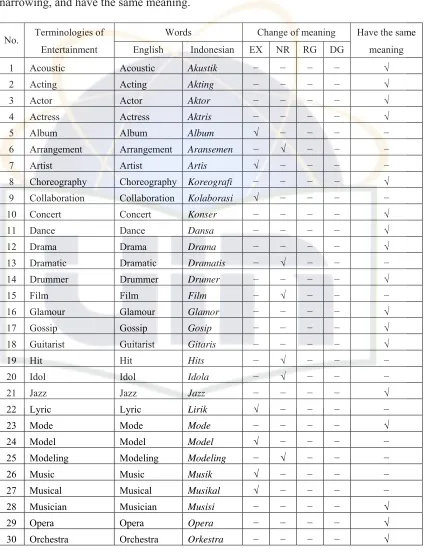
From the data analysis above, we can see that many Indonesian Entertainment terminologies do not experience the change of meaning, because they have the same of meaning. The writer also found the change of meaning in extension or generalization and narrowing or specialization but she did not find the change of meaning in regeneration or ameliorative, and degeneration or pejorative.
Table.4. The fourty terminologies which get the change of meaning in extension, narrowing, and have the same meaning.
Terminologies of Words Change of meaning Have the same
No.
Entertainment English Indonesian EX NR RG DG meaning
1 Acoustic Acoustic Akustik − − − − √
9 Collaboration Collaboration Kolaborasi √ − − − −
31 Popular Popular Populer − − − − √
32 Popularity Popularity Popularitas − − − − √
33 Poster Poster Poster √ − − − −
34 Radio Radio Radio − − − − √
35 Scenario Scenario Skenario √ − − − −
36 Shooting Shooting Syuting √ − − − −
37 Studio Studio Studio − − − − √
38 Superstar Superstar Superstar − − − − √
39 Theatre Theatre Teater − √ − − −
40 Vocalist Vocalist Vokalis √ − − − −
Note :
Changes of Meaning: Sign :
EX : Extension (generalization) √ : Yes NR : Narrowing (specialization) − : No RG : Regeneration
CHAPTER IV
CONCLUSIONS AND SUGGESTIONS
A. Conclusions
After analyzing the data, the writer would like to draw some conclusions about her research, as follows:
In her research, the writer has found a lot of terminologies which experienced the change of meaning such as in Extension, Narrowing, and in the same of meaning. From the fourty terminologies, the majority of terminologies or about twenty two words have the same meaning.
English borrowed words in Entertainment terminology are often happened in Indonesian, and there are many words which get the change of meaning as have been mentioned above. It means that, the borrowing and absorption from English language into Indonesian language, especially in Entertainment terminology is quite high.
The writer can categorize those fourty words of Indonesian Entertainment terminology that experience the change of meaning in each terminology. The details of the number are:
B. Suggestions
After finishing this paper, the writer would like to suggest to whom are interested in studying of Indonesian Lexical borrowings especially on entertainment terminologies, they should understand the types of the change of meaning.
BIBLIOGRAPHY
Badudu, J.S. Kamus Kata-kata Serapan Asing Dalam Bahasa Indonesia. Jakarta: Kompas, 2003.
Baugh, Albert. C. A History of the English Language, Fourth Edition. London: Routledge, 1993.
Bloomfield, Ronald. Language. London: George Allen & Unwin Ltd, 1935. Chaer, Abdul. Linguistik Umum. Jakarta: PT. Rineka Cipta, 1994.
Depdikbud. Kamus Besar Bahasa Indonesia, Edisi Ketiga. Jakarta: PT. Balai Pustaka, 2005.
Fasold, Ralph and Connor-linton, Jeff. An Introduction to Language ang Linguistics. UK: Cambridge University Press, 2006.
Field, Fredric. W. Linguistics Borrowing in Bilingual Context. Amsterdam: John Benyamin Publishing Company, 2002.
Fromkin, Victoria and Rodman, Robert. An Introduction to Language, Second Edition. Tokyo: Holt-Saunders Japan Ltd, 1981.
________ . An introduction to Language, sixth edition. USA: Harcourt Brace College Publishers, 1998.
Hartanto, John. S. Pedoman Umum Pembentukan Istilah dan Pedoman Ejaan Bahasa Indonesia Yang di Sempurnakan (EYD). Surabaya: Indah, 1995.
Kageura, Kyo. The Dynamic of Terminology. Amsterdam: John Benyamin Publishing. 2002.
Kridalaksana, Harimukti. Fungsi Bahasa dan Sikap Bahasa. Jakarta: PT. Nusa Indah, 1982.
Kushartanti, et.al. Pesona Bahasa: Langkah Awal Memahami Linguistik. Jakarta: PT. Gramedia Pustaka Utama, 2005.
Leech, Geoffrey. Semantics. England: Penguin Book, Ltd, 1974.
Martinet, Andre. Element of General Linguistics. London: Faber and Faber Ltd, 1964. Mesthrie, Rajend, et.al. Introduction to Sociolinguistics. Edinburg: Edinburgh
University Press, 2000.
Parera, J.D. Teori Semantic, Edisi Kedua. Jakarta: Erlangga, 2004.
Pei, Mario and Gaynor, Frank. Dictionary of linguistics. New Jersey: Littlefield Adam &CO, 1975.
Surawan, Martinus. Kamus kata serapan. Jakarta: PT. Gramedia Pustaka Utama, 2001.