AN ANALYSIS OF SPEAKING MATERIALS
ON STUDENT TEXTBOOK
A THESIS
Submitted in Partial Fulfillment of the Requirement for the Degree of Sarjana Pendidikan
By:
ANNA ELISABET SINAGA
Registration Number 2113121005
ENGLISH AND LITERATURE DEPARTMENT
FACULTY OF LANGUAGES AND ARTS
i
ABSTRACT
Sinaga, Anna Elisabet. 2113121005. An Analysis of Speaking Materials on Student Textbook. A Thesis: English Department. Faculty of Languages and Arts, State University of Medan. 2016.
This study was aimed at analyzing the speaking materials of eleventh grade students in Look Ahead 2 English textbook and KTSP syllabus. The data were taken from speaking materials for each unit in the textbook. This study was done to explain speaking materials and forms of speaking materials that are in student textbook and find out speaking materials contained in the student textbook used in SMA Parulian 2 Medan. It was conducted by using descriptive qualitative research design and used documentary checklist analysis. The techniques of analyzing data were conducted by identifying, classifying, quantifying, and interpreting the data, and the last was concluding the result of the study. Based on the analysis, it showed that the textbook had the various forms of speaking materials especially in unit 1 and 4 are 100% fulfilled while in unit 2, 3,5, and 6 are not. Furthermore, based on the documentary checklist analysis, it was found that the percentage of each criteria of good speaking materials are 75% in first criteria describes good, 66.67% in second criteria describes good, and 100% in third criteria describes very good in which those criteria are almost fulfilled. Based on the result, Look Ahead 2 English textbook is able to be used by students and and English teachers because it shows that speaking materials in the textbook are almost relevant to the KTSP syllabus and described as the good criteria, because it has met the rate of the criteria is over 60%. As the suggestions, both English teacher and educational institution should concern and pay attention to the content of the textbook, relevant to the current curriculum and students’ needs. Thus, the students can improve their speaking skill because the speaking materials are suitable to be learnt. It is expected that the findings of this study are useful for everyone who wants to study about the relevancy of speaking materials in English textbook.
ii
ACKNOWLEDGEMENTS
First of all, the writer would like to express her deepest gratitude to Almighty God, Jesus Christ for His amazing grace, uncountable blessing, love, strength given to the writer during her study and in completing this thesis which entitled “An Analysis of Speaking Materials on Student Textbook”. This thesis has been written in partial fulfillment of the requirements for the degree of Sarjana Pendidikan (S.Pd.) at the English and Literature Department, Faculty of Languages and Arts, State University of Medan (UNIMED).
In completing this thesis, the writer realized that she faced some difficult problems and she had received the academic guidances, suggestions, and comments and also got a lot of assistance and moral support from many people. Therefore, the writer would like to express her gratitude and special thanks to:
Prof. Dr. Syawal Gultom, M.Pd., the Rector of State University of Medan.
Dr. Isda Pramuniati, M.Hum., the Dean of Languages and Arts Faculty. Prof. Dr. Hj. Sumarsih, M.Pd., the Head of English Department and
taken the role of being her Second Thesis Advisor.
Dra. Meisuri, M.A., the Secretary of English Department.
Nora Ronita Dewi, S.Pd., S.S., M.Hum., the Head of English Education Study Program, State University of Medan.
Dr. Siti Aisah Ginting, M.Pd., the First Thesis Advisor who has given advices, guidance, and precious time in the process of completing this thesis.
Johannes Jefria Gultom, S.Pd., M.Hum., her Academic Advisor and taken the role of being her Reviewer and Examiner.
Morada Tetty, S.S., M.Hum., as her Reviewer and Examiner.
All the Lectures of English Department who have taught, guided, and advised her throughout the academic years.
Eis Sri Wahyuningsih, M.Pd., and Mr. Pantes, the Administration Staffs of English Department, for the attention and assistance in completing this thesis.
The Late Drs. Milter Nababan, the Headmaster of SMA Swasta Parulian 2 Medan, for his permission in allowing her to do observation and Dra. Rosta Ambarita, the English Teacher of SMA Swasta Parulian 2 Medan, for the helps and motivations in completing this thesis. And all the teachers at the school for the good cooperation.
Her beloved parents, Drs. Humiras Sinaga and Minar Pangaribuan, S.Kep., Ns., for their endless love, prayer, courage,
iii
Her beloved brother and sisters; Andar Ricky Sinaga, Amd., drh. Anggreni Sinaga, and Anita Megawati Sinaga; my niece, Prawita
Sinaga and my cousin, Radot Sinaga for their prayer, stupid acts, support and motivation for her in completing her education.
Her beloved friends, Fransiska Insani Rahesty Sinaga, S.Pd., Ester Margaretha Sitorus, S.Pd., her best friend ever, Randa Ilsam Wahyudana Lubis, S.Pd., for the supports, prayer, motivations, and companion to the succesful of her thesis , her KK; B’Bernard, Aguni, Riana, Wemmy, and Maria, her AKK; Nova, Poppy, Roma, and Rona, her friends, Nurul Fadila Lubis, S.Pd., K’Melba, S.Pd., K’Nurul Hidayah, S.Pd., Desi Mita, S.Pd., Pevi Handayani, S.Pd., Arie Dwi Utami, S.Pd., Sirikit Karola, S.Pd., Bernika Ursula Sinaga, S.S., Laura Atika, S.S., and Fauziah Matondang, S.Pd., for the motivation, help, and nice friendship. Her friends in Dik Regular A 2011, for the togetherness throughout the four years; Her friends in PPLT SMP Negeri 1 Galang for the togetherness and the memories for three months. The last but not the least also for those who cannot be mentioned one by one.
The writer realizes that this thesis still has the paucity, she conveniently welcomes any suggestions, comments, critics, and advices that will improve the quality of this thesis. She hopes that this thesis would be useful for those who read and feel interested in the field of this study.
Medan, September 2016 The Writer
iv
TABLE OF CONTENT
Page
ABSTRACT ... i
ACKNOWLEDGEMENTS ... ii
TABLE OF CONTENTS ... iv
LIST OF TABLES ... vii
LIST OF APPENDICES... viii
CHAPTER I: INTRODUCTION ... 1
A. The Background of The Study ... 1
B. The Problems of The Study ... 6
C. The Objectives of The Study ... 6
D. The Scopes of The Study... 7
E. The Significances of The Study ... 7
CHAPTER II: REVIEW OF RELATED LITERATURE ... 9
A. Theoretical Framework ... 9
1. Curriculum ... 9
a. Curriculum in Indonesia ... 10
b. 2006 Curriculum (KTSP) ... 11
2. Syllabus ... 12
3. Textbook ... 13
a. Function of Textbook ... 14
v
4. Material ... 16
5. Speaking Material ... 17
a. Speaking ... 17
b. Speaking Material ... 18
c. The Form of Speaking Material ... 18
d. The Criteria of Good Speaking Material ... 19
B. Relevant Studies ... 22
CHAPTER III: RESEARCH METHODOLOGY ... 25
A. Research Design ... 25
B. The Data and Source of Data ... 26
C. Techniques of Collecting Data ... 26
D. Techniques of Analyzing Data ... 27
CHAPTER 1V: THE DATA AND DATA ANALYSIS ... 31
A. The Data ... 31
B. The Data Analysis ... 32
a. The Description of Look Ahead 2 English Textbook Content ... 32
b. The Forms of Speaking Materials in Look Ahead 2 English Textbook for Eleventh Grade Student ... 33
c. Analysis The Criteria of Good Speaking Materials ... 36
vi
C. Research Findings ... 42
D. Discussions ... 43
CHAPTER V: CONCLUSIONS AND SUGGESTIONS ... 45
A. Conclusions ... 45
B. Suggestions ... 45
REFERENCES ... 47
vii
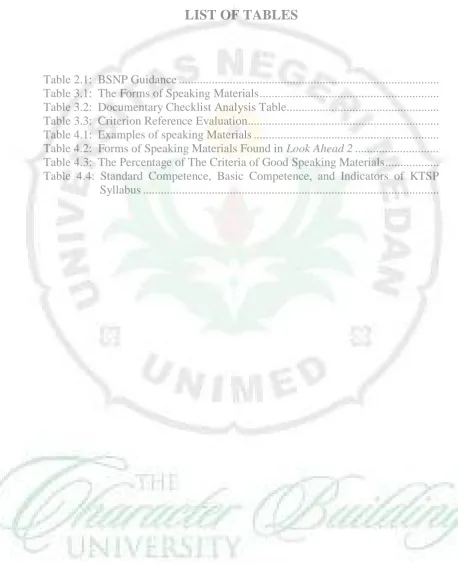
LIST OF TABLES
Page
Table 2.1: BSNP Guidance ... 20
Table 3.1: The Forms of Speaking Materials ... 27
Table 3.2: Documentary Checklist Analysis Table... 28
Table 3.3: Criterion Reference Evaluation... 30
Table 4.1: Examples of speaking Materials ... 31
Table 4.2: Forms of Speaking Materials Found in Look Ahead 2 ... 35
Table 4.3: The Percentage of The Criteria of Good Speaking Materials ... 37
viii
LIST OF APPENDICES
Page
Appendix A: Speaking Materials in Look Ahead 2 English Textbook ... 50
Appendix B: The Forms of Speaking Materials ... 52
Appendix C: Precentage of The Forms of Speaking Materials... 56
Appendix D: The Documentary Checklist Analysis Table ... 57
Appendix E: Percentage Table of Criteria of Good Speaking Materials ... 59
Appendix F: Silabus Pembelajaran ... 60
Appendix G: The Relevancy Between KTSP Syllabus and Look Ahead 2 English Textbook ... 77
Appendix H: The Relevancy of Speaking Materials in Look Ahead 2 English Textbook and KTSP Syllabus ... 81
1
CHAPTER I
INTRODUCTION
A. The Background of The Study
In teaching-learning process, a teacher should have a textbook as a
guidance. Textbook is one of instructional materials beside syllabus, lesson plan,
media, and teaching instruments that should be arranged by the teacher.
According to Pudjosoedarmo (in Simatupang, 2012:1) a textbook is the most
important media in the process of teaching. It has the function as a media in
giving the instruction to the teacher and students in the classroom, especially an
English textbook which has an essential role in English as a foreign language
(EFL) classrooms. It helps the teacher in summarizing the material and measures
the students’ comprehension of every language skills that already taught by the
teacher.
Additionally, an English textbook is the complete package of English
skills and concern to the suitable materials based on the needs of the learners.
Each component helps teacher and students in facilitating both of them as their
source of materials and practices the skill exercises when learning English.
The textbook provides the standard and basic competencies to complete
the teaching-learning process. The teacher also must be considered to the
textbook’s criteria and basic competencies of the textbook. In this case, as a main
2
and syllabus. It must be selected to be a good and appropriated one. Byrd (2001)
states that decisions made in selecting textbook must be considered between
curriculum and text. It means that the materials inside of the textbook have to
follow the curricular guidelines, in this case, School Based Curriculum or
well-known as KTSP. So it will stay in line of the curriculum or in other words, the
learning process will be run well and more effective to achieve the goal. In
gaining the goal, the teacher has a responsibility to select which textbook is good,
readable and suitable which is used as a material, because the process of selecting
the good textbook is actually difficult. The teacher should be considered to some
aspects when do the teaching-learning activity as well as possible to make the
students easy to comprehend and even have the desire and motivation in learning
English.
National Education Standard Organization (BSNP) has arranged the 2006
Curriculum (KTSP) as the standard curricular guidelines of education. In the
school based curriculum, there are many learning materials that should be taught
(especially in English) for students. Under KTSP, the syllabus is developed into a
lesson plan for a subject. It considers to the standard competencies, basic
competencies, learning objectives, learning activities, learning indicators, learning
assessment, time allocation, and learning source.
In school, there are so many subjects that should be learnt by the students.
One of them is English. English is used to communicate with other people
throughout the world. It dominates many aspects of international life, such as
3
Indonesia still as foreign language which means that English is not used as the
main language of communication in daily life. In order to compete and
communicate in a global community (for example facing ASEAN Economic
Community/ AEC), Indonesia government has placed the subject of English
taught from kindergarden level to university level to be mastered by considering
to the four language skills: listening, speaking, reading, and writing. In this case,
syllabus obligates the students more active in communicating to others with the
language skills. One of language skills in English is speaking: able to express the
interpersonal and transactional conversation, express the meaning, and able to
practice the speaking ability for the simple conversation in daily life.
Speaking deals to the communication which is a fundamental feature of
social life. Speaking is one of language skills aspect and productive skills. It
realizes with the conversation that really needed for students in their social
interactions. They can express their feelings, ideas, and thoughts by having a good
speaking skills. It is influenced by the communicating skills. Because of that, it
needs more practice to be able to speak fluently.
Therefore, in supporting the students’ speaking skill, the teacher should
pay attention to the speaking materials from the textbook. In this case, the teacher
has a big opportunity to choose and select the compatible textbook based on the
exist syllabus and curriculum. She/ he also pays attention to the standard and basic
competencies, indicators, and learning objectives must be achieved.
In the KTSP syllabus, there are basic competencies of speaking materials
4
of surprising, 2) Expressing of warning, 3) Asking and giving advice, 4)
Expressing of permission, 5) Expressing of relief, 6) Expressing of feeling pain,
7) Expressing of feeling pleasure, 8) Expressing of feeling scared, 9) Asking and
giving opinion, 10) Expressing of feeling satisfy, 11) Expressing of feeling
unsatisfy, 12) Expressing of feeling love, 13) Expressing of feeling sorrow, 14)
Expressing of feeling embarrasment, 15) Expression of feeling anger, 16)
Expressing of attitude, 17) Expressing of feeling annoyance, 18) Expressing the
meaning of functional text in a form of narrative, spoof, hortatory exposition,
report, and analytical exposition. Most of the speaking materials should be taught
in the syllabus are interpersonal and transactional conversation text which are
needed by the students in order to improve the students’ speaking skill.
All materials should be integrated with all language skills and in
accordance to the curriculum. It is undeniable fact that most of the educational
institutes used textbook as a tool in teaching learning activity are elementary level
up to university level. So, it means that the usage of textbook is very dominant in
teaching practice. As the fact, many teachers are lack of creativity or got
difficulties in creating their own learning materials, for example the teachers use
the conventional method or teach without using textbook as a source of learning.
Regarding of it, the teacher must be smart in selecting a good textbook as learning
source to support teaching and learning activity. Additionally, the selection of
materials must be adjusted for students’ grade level, students’ circumstance,
situations and conditions, encapsulate the basic competencies to be achieved at
5
good and suitable English textbook for students from certain publisher that has
choosen by school. They supposed that English textbook which has choosen from
certain publisher is better than others. As a result, every year, they always use
english textbook from the same publisher, nevertheless its content may change
year by year.
Based on the preliminary observation at SMA Parulian 2 Medan, many
teachers stated that speaking materials in the textbook did not relevant to the
KTSP syllabus. It is an undeniable fact that some English textbooks published in
Indonesia meet the standards and criteria of good textbooks that determined by the
curriculum and some others do not. In this case, analyzing English textbook will
be done at SMA Parulian 2 Medan. This school implements KTSP as the guidance
and uses Look Ahead 2 English textbook for second grade of senior high school
which is published by Erlangga. According to the English teacher, she found that
there are some parts of speaking materials in the textbook (e.g.: expressions of
agreement and disagreement, expressions about guessing right and wrong
guessing, and have not a clue, and etc) that are unappropriate to the syllabus and
there are some speaking materials in the KTSP syllabus (e.g.: expression of relief,
expression of pain, etc) that are displayed in the textbook. In addition, it was also
found that there are no example of dialogue or conversation about a certain
expression to be practiced by the students in the textbook.
It is interested to find out whether the English textbook materials
especially speaking materials are in line with KTSP and analyzed the quality of
6
solution in choosing the compatible material and which topic is needed to be
strengthened.
B. The Problems of The Study
Based on the previous discussion in the background of the study above,
the problems of this study could be formulated as follows:
1. Are the speaking materials in student’s textbook entitled “Look Ahead 2:
An English Course for Senior High School Students Year XI” published by
Erlangga for eleventh grade students at SMA Parulian 2 Medan relevant to
the KTSP syllabus?
2. How are the speaking materials in student’s textbook entitled “Look Ahead
2: An English Course for Senior High School Students Year XI” published
by Erlangga for eleventh grade students at SMA Parulian 2 Medan
relevant to the KTSP syllabus, specifically to the criteria of good speaking
materials?
C. The Objectives of The Study
In line with the problems, the objectives of the study are aimed:
1. To explain speaking materials and forms of speaking materials that are in
the student textbook entitled “Look Ahead 2: An English Course for Senior
High School Students Year XI” published by Erlangga for eleventh grade
7
2. To find out speaking materials contained in the student textbook entitled
“Look Ahead 2: An English Course for Senior High School Students Year
XI” published by Erlangga that relevant to the KTSP syllabus, specifically
to the criteria of good speaking materials.
D. The Scopes of The Study
In order to reach the expected goal, the writer limited the problems on the
following terms:
1. English textbook displays reading, listening, writing, and speaking
materials. This study only limits to speaking material which will be
focused on the forms of speaking materials in the textbook.
2. At SMA Parulian 2 Medan, Look Ahead 2 English textbook is used for
students grade eleven of nature science and social science class. This study
also only limits to the analysis for eleventh grade students of nature
science class in academic year 2015/2016 at SMA Parulian 2 Medan.
E. The Significances of The Study
Findings of the study are expected to be useful and relevant both
8
Theoretically, the finding is expected:
1) To broaden and apply on theories of analyzing the textbook by consider to
the criteria of a good textbook, especially criteria of good speaking
materials
Practically, the findings are relevant and useful for:
1) English teachers, to be aware in choosing and selecting the textbook and
speaking material which are compatible with the curriculum and paid
attention to the content of the textbook that they used to teach their
students,
2) English textbook writers, to help them to be more careful in writing and
developing English textbook for students,
3) Students, to improve their speaking competence and help them in having
good learning source, and
4) Other researchers, to be used as a referential contribution for those who
want to conduct a further in depth research in analyzing the textbook and
45
CHAPTER V
CONCLUSIONS AND SUGGESTIONS
A. Conclusions
From this study, the conclusions could be drawn:
1) There are 29 speaking materials found in the textbook, it has the
various forms of speaking materials, but the most dominant forms
displayed in Look Ahead 2 English textbook are forms of dialog and
expression.
2) The speaking materials almost fulfilled the criteria of good speaking
materials, because the rate is over 60% (75% in first criteria, 66.67%
in second criteria, and 100% in third criteria).
B. Suggestions
Relating to the conclusions of the result in analyzing the speaking
materials in Look Ahead 2 English textbook for the eleventh grade students of
senior high school, The following suggestions are:
1. For the English teachers
The English teachers should pay attention in choosing the English
textbook which is provided by the school and must be compatible with the
existing curriculum. Therefore, it is better for them to be more wise in
46
additional English textbook as the other instructional material, and master
the materials of the textbook before conducting the teaching-learning
process.
2. English textbook writers
The English textbook writers should pay attention the standard
competence and basic competence in KTSP syllabus when arranged the
materials in the textbook. So, the English textbook will fulfill to the
English standard competence and students’ interests and also appropriate
to the students’ ability level. Therefore, the English textbook can be as a
good learning source and help the teacher and students in
teaching-learning process.
3. Students
The students practice their speaking ability in their daily life. Practice to
use the expressions relate to daily life with friends/ classmate. Dare to
express and use it.
4. Other researchers
There are still so many English textbook offered by other publishers. The
other researchers can do the analysis relate to the speaking materials or
other subject and develop the speaking materials to be better one. This
thesis would be used as a reference in order to conduct a further research
47
REFERENCES
BSNP. 2006. Panduan Penyusunan Kurikulum Tingkat Satuan Pendidikan Jenjang Pendidikan Dasar dan Menengah. Jakarta
Cahyaningrum, Dika P. 2013. An Analysis of Materials in A Student Textbook (A
Descriptive Research on “Effective Communication” Book for Elementary Level Students of SMK Grade XI. A Thesis. Yogyakarta: Faculty of Languages and Arts. State University of Yogyakarta
Creswell, J. W. (2012). Educational Research : Planning, Conducting and Evaluating Quantitative and Qualitative Research, Fourth Edition. Boston : Pearson Education
Dὄrnyei, Zoltản. 2007. Research Method in Applied Linguistics. New York: Oxford University
Fatima, G., Shah, S., and Sultan, H., 2015. Textbook Analysis and Evaluation of 7th & 8th Grade in Pakistani Context. International Journal of English Language Teaching. Vol.3, No.4, June 2015, pp. 79-97. ISSN 2055-0820 (Print), ISSN 2055-0839 (Onlline). (Accessed on December, 13th 2015)
Firmansyah, W and Pusparini, R. 2012. The Analysis of Speaking Materials in
48
Limsui, 2011. An Analysis of The Speaking Materials on “English On Sky” Published By Erlangga for The First Grade of Junior High School. A Thesis. Riau: Faculty of Languages and Arts. Islamic University of Riau
Nasution, S. 2008. Asas-asas Kurikulum. Ed., Cet.9. Jakarta: Bumi Aksara
Nunan, David. 2002. Second Language Teaching Learning. Canada: Heinle & Heinle
Richard, J. C. 2001. Curriculum Development in Language Teaching. USA: Cambridge University
____________. 2010. Curriculum Approaches in Language Teaching: Forward, Central, and Backward Design. Singapore: RELC.
Retrieved from: http://www.professorjackrichards.com/wp-content/ uploads/Curriculum-Approaches-in-Language-Teaching.pdf accessed on June, 15th 2015
Rynanta, R. & Ruslan, S. 2015. Content Analysis on The English Textbook
Entitled “English in Mind Starter (Student’s Book)”. A Thesis. Malang: State University of Malang
Simatupang, Laurika L. 2011. An Analysis on Speaking Materials of A Student
Textbook: A Descriptive Research on “Pista Modul Bahasa Inggris SMK Kelas X Semester 1” of SMK Pariwisata Pontianak in 2011/2012. Pontianak.
Retrieved from: http://jurnal.untan.ac.id_index.php_jpdpbarticle view File27592737 . accessed on November, 2nd 2015
Sudarwati, Th. M. and Grace, E. 2007. Look Ahead 2: An English Course for Senior High School Students Year XI Science and Social Study Program. Jakarta: Erlangga
49
Temu, A. B and Kasolo, W. 2013. Reviewing Curricula – Rationale, Process and Outputs: ANAFE Experience with the DACUM Method in Africa.
Retrieved from: http://www.fao.org/docrep/meeting/007/ y2993e/ y2993e13.htm. accessed on January, 06th 2016
Tomlinson, Brian. 2014. Developing Materials for Language Teaching (Second Ed.). London: Bloomsbury