1.24
Aditama and Andannt Med J IndonesSick building
syndrome
Tjandra Yoga Aditama, Sita Laksmi Andarini
Abstrak
Sindroma gedung sakit adalah suatu keadaan yang menunjukkan timbulnya berbagai keluhan tidak spesifk pada sebagian besar
pengguna
suatu
iologinya belumlahmerupakan resu ruPa fisik, kimiawi, kasus sindroma ini terjadi akibat tidak terpeliharanya sistem pe
dapat cukup berat dan meliputi iritasi mimbran mukus, gejala neurototsik, gejala menyerupai asma, keluhan di kulit' keluhan gàstrointestinal dan lain-laii. Untuk menegakkan diagnosis maka beberapa prosedut perlu dilahtkan, dan pemeil<saan langsung "terhadap
lingkungan gedung di lapangan àkan amat membantu ditegakkannya diagnosis. Pencegahan terjadinya keadaan ini jauh Iebih iengu-ntungkon-t
"ti,;Aang àen[obati keadaan yang sudah terjadi. Polusi udara dalam ruangan dan sindroma gedung sakit merupokai salai satu paradignn baru dalam ilmu kesehatan kerja dan lingkungan. (Med J Ind.ones 2002; 11: 124-31)
Abstract
Sick buitding syndrome describes
a
number of mostly unspesific complaints of some occupants of the building. The exactpathophysiologic
elusive. It is a multifactorial event which may include physical, chemical, biological as well 'aspsyc'hologiial
s it is due to insfficient atinsys'tem in thi
bui
ms can be unconfortable inclneurotoxic symptoms, asthma like symptoms, skin complainls,
gastr
relntd
ention through at:
the sick buildingKeywords: indoor air pollution, sick building syndrome, building related illness
Indoor air quality has deteriorated so much since the 1970s
oil
shortage and subsequent energy-efficientconstruction
of
buildings that people are becoming seriouslyill
by just breathing the indoor air. This is a problem with all industrial buildings.' ln the past two decades,a
groupof
health Problems related to theindoor environment--generally termed sick building syndrome (SB S)--has emerged.
In the past 20 years we have seen the replacement of
naturally ventilated buildings by buildings with tight
shells that are lvholly
or
substantially dependent on mechanical ventilation. Heating, ventilation, and air-conditioning (I{VAC) system design, structural design, and material finishes are specified to a large exlent byPulmonology Department Faculty of Medicine University oJ lndonesia / Persahabatan Hospital, Jakarta, Indonesia
architects, mechanical engineers, and interior designers to meet building codes and, at the same time, provide
aesthetic appeal
along
with
structural integrity.Unfortunately, building requirements necessary to promote the health
of
occupantsof
buildings have historically been neglected or given minimal aftention. This switch to tighter buildings combined with a lackof knowledge of and altention to the potential adverse health etfects of ineffective ventilation and indoor air contaminants has spawned a marked increase
in
the numberof
reportsof
human illnesses linkedto
the' indoor environment.'Some contaminants causing ill health have been identified within buildings
for
decades (e.g., paintcontaining lead and allergenic components
of
moldspores). Indoor environmental contaminants cause building related illness (BRD through
four
major mechanisms:(1)
immunologic,(2)
intèctious, (3) toxic, and (4) initant. Because the agents causing BRIl -,1
,l
Vol I 1, No 2, ApriL - June 2002
routinely coexist,
it
is
not unusualto
have two or more mechanisms of disease operating simultaneouslywithin
a
problem building.The
challengeis
toidentify the cause or causes of the health complaints
of
those who allege that they have becomeill
as aresult of a building they occupy and then locate the source
or
sources.The
first
stepin
solving the mysteryis
to developa
solid understandingof
themechanisms
of BRIs
and
th"e offending agents associated with each mechanism."Building
related illnesses(BRI)and
Sick-buildingsyndrome (SBS)
are
an
increasinglya
coûImonproblem
in
developed countries and- are expected toin"."u*"
in
developing countries.3'a Increasingly, physicians are being asked to evaluate patients with putative environmentally associated illnesses. Thesecan include a variety of problems, including infectious illnesses (Legionnaire's disease), chemical exposure in the workplace, and sick building syndromes.'
Terminology
The terminology used to describe illnesses caused Qy building environmental factors can cause confusion. Building-associated illness refers to any illness caused by indoor environmental factors. We divide
building-associated illness into two categories: sick building
syndrome (SBS) and building-related illness (BRD. Excluded from these categories are illnesses that have a long latency period (e.g., lung cancèi iaused by
radon exposure). The t'erm building-relaÈed illness applies to those adverse health effects for which we
have
a
well-definedlink
between environmental agentsin
a specific building and the resultant health disorders. This classof
illnesses frequently involves the skin and respiratory tract because of the ease with which indoor environmental contaminants come in contact with these tissues.2SBS describes
a
complexof
vague, predominantlysubjective complaints consisting
of
neurobehavioral symptoms such as memory loss, headache, depression, dizziness, and respiratory complaints such as chesttightness, coughing, and shortness of breath. Buming eyes, nose, throat, and sinuses are symptoms of mucous membrane
initation that
are
frequently associatedwith
"sick" building complaints. Itchingand rashes may occur. However, the exact patho-physiologic mechanisms explaining how environmental
factors cause
"sick"
building
symptoms remainelusive. Studies, both
in
the United States and inSick building
syndrome
I25Europe, conducted over the past 20 years indicated
that
manyof
these buildings shareda
cornmonproblem
of
inadequate ventilation.Yet,
data to support the hypothesis ihat inadequate ventilation inthe
absenceof
identifiable pathogenic -levels ofcontaminants causes human illness remain sparse. Even more importantly,
it
has beendifficult
to demonstrate,in
properly designed studies, objective evidence of cause and effect between the ubiquitous chemical compounds found in all indoor environments and many of the neurobehavioral symptoms reportedly associated with SBS. However, a few well-designed studies suggest that certain functions, such asshort-term memory, mental efficiency, and visuospatial
functioning, may be adversely affected
by
volatileorganic compounds. The term building-related illnesses
refers
to
reasonablywell
characterized human illnesses caused by indoor environmental factors that can be related to the clinical and laboratory findingsin
those building occupants with health complaints, basedon
validated principlesof
pathophysiology.'Other definition by Seifert mentioned that the term
"sick building syndrome" (SBS) has been used for several years
to
describea
numberof
mostlyunspecific complaints
of
some occupantsof
air-conditioned buildings. Engelharto classified a groupof health problems related to the indoor environment--generally termed as sick building syndrome (SBS)
Multi
FactorialSBS
is
a
multifactorial event which may include physical, chemical, biological as well as psychologicalfactors.In many cases, the occurrence
of
SBSin
a buildingis
dueto
insufficient maintenanceof
theIryAC
system. A broad range of pollutants is presentin indoor spaces. Even something as easily recognized
as environmental tobacco smoke consists of multiple
pollutants that cause irritation and annoyance. The specific culprits are still unknown. Nevertheless, the broad range of pollutants trigger responses in several receptors. How effects on similar receptors can be summed remains uncertain. When agents affect the
same receptor, such as the "irritant" receptor
of
thetrigerninal nerve (comrnon chemical sense),
it
isreasonable and possible to model their
joint
effects.On the other hand, different chemical classes may
trigger that receptor differently. Where irritants have
differing mechanisms
of
aclion,their
interaclions(antagonism and synergism) remain unpredictable.
Given the broad range of agents and their influences
126
Aditama and Andariniparticulates to volatile organic compounds and air
currents,
joint modeling
and effect estimation iscertainly difficult now and may remain impossible .
At
the present we do not know enough to identify all important compoundsin
the indoorair
that causeunnoyun.. and ôdor or how to sum their etfects.T
Ooi et al8 found an incremental trend in prevalence of
sick
building syndrome amongoffice
workers in Singapore who reported high levelsof
physical and mental stress, and decreasing climate of co-operation.This
association was confirmed after multivariate adjustment for significant personal and environmental exposure factors. Using a subsample, further modelled interaction between stress and the other covariates but none achieved statistical significance.This
srudyconfirmed slress to be a significant and independent
determinant
of
the
health complaints,and
that symptoms compatiblewith the
sick
building syndromein
many cases were slress-related. Ourfindings underscore the importance
of
personal and organizational stress management to preventill
health at the office.6Li
et al
founda
significant relationship between dampness and work-related sick building syndrome in the day-care-center workers. Fufthermore, concentrationsof fungi were lower in the day-care centers equipped
with air conditioners/air cleaners than in centers that
lacked such
equipment.Also,
Aspergillus wasas
ronglywi
d
ngsy
theday-c
ke
artet
aninvesli
in
of'a
ministry workingin
a
naturally ventilated office building that formerly had been used by a pharmaceutical company. The highest level of complaints was found amolg the employees workingin
rooms thatin
the past had been used for the production or storage ofvarious pharmaceutical products suggesting that pharmaceutical odors may be a risk factor for SBS. The authors conclude that the former use of a building
for production and storage of pharmaceutical products
should be considered as
a
possible. risk factor for complaints aboutindoor
air
quality, e.9., when advisingabout
or
planningfor
renovalions of buildings formerly used For production, handling, or storing of chemicals.6There has been increased concern over health effects related to potenlial eKposure of building occupanls to bioaerosols. Trout et all0 report the case of a worker
with a
respiratoryillness
relatedto
bioaerosol exposure in a water-damaged building with extensiveMed J Indones
fungal contamination. The authors performed environ-mental tests to evaluate potential exposure to fungi,
and
we
used mycotoxin-specificIgG antibody
in serologic studies in the attempt to evaluate exposure to mycotoxins. Extensive fungal contamination was documented in many areas of the building. Penicillium,Aspergillus, and Stachybotrys species were the most
predominant fungi
found
in
air
sampling. Our serologic test was not useful in differentiating workerswho
were
probably occupationally exposed to mycotoxins from those who were not; however, it did yield evidence that individuals may make specific IgGantibodies
to macrocyclic tricothecene
mycotoxins.Further research is needed conceming health effects related to bioaerosol exposures, particularly regarding
markers,^of exposure
to
specificfungi
that
may produce'" mycotoxins. In the absence of clinical tools specific for evaluation of mycotoxin-related illness, a systematic clinical approachfor
evaluating personswith suspected building-related respiratory illness is warranted.lo
Engvall et
allt
perform a study to analyzerelation-ships
between symptoms compatiblewith
sickbuilding syndrome (SBS) on one hand, and different
indicators
of building
dampnessin
Swedish multi-family buildings on the other. The sfudy was done in Stockholm, 609 multi-family buildings with 14,235dwellings were identified, and. selected
by
stratifïed random sampling with a response rateof
TTVo.Their result showed that condensation on windows, high airhumidity in the bathroom, mouldy odour, and water leakage was reported from 9.OVo, l2.47o, 7.77o and l2;7Vo of the dwellings, respectively. In total 28.57o reported at least one sign of dampness.
All
indicators of dampness were related to an increase of all types ofsymptoms, significant even when adjusted
for
age, gender, population density, type of ventilation system,and ownership
of
the building.A
combination of mouldy odour and signs of highair
humidity wasrelated
to
an increased occurrenceof
all
types of symptoms (OR=
3.7-6.0). Similar findings were observedfor a
combinationof
mouldy odour and structural building dampness (water leakage) (OR =2.9 5.2).
In
addition,a
dose-response relationship be[ween symptoms and number of signs of dampnesswas observed.
In dwellings
wilh all
four dampness indicators, OR was 6.5,7.1, 19.9,5.8,6.1,9.4, 15.0for
ocular, nasal, throat, dermal symptoms, cough, headache and tiredness, respectively.The
authors conclusion mentioned that signs of high air humidity,as well as
of
structural building dampness, areVol I I, No 2, April- June 2002
Reports of building dampness in dwellings is related
to
a
pronounced increaseof
symptoms compatiblewith the
SBS, even when adjustedfor
possibleconfounding by age, gender, population density, and building-related risk factors. I I
Indoor air polution in the building are quietly related
with various respiratory diseases particularly in asthma because
of
the associationof
mold and increased bronchial responsiveness. Recently, attention has been focused on the mold Stachybotrysin
human disease. Stachybotrys was first identified more than 60 years agofollowing an
epidemicof
stomatitis, rhinitis, conjunctivitis, pancytopenia, neurologic disorders, and death in horses. Since then, Stachybotrys has been identified in several outbreaks of disease in animals. Ithas also attracted attention as
a
possible agent inidiopathic
pulmonary
hemonhagein
infants. Stachybotrys is a relatively uncommon fungus but has been isolated froma
varietyof
sources, includingcontaminated grains, tobacco, indoor
air,
insulatorfoams,
and
water-damaged buildingswith
highhumidity.
This
fungusis
particularly important becauseit
is
oneof
a seriesof
fungi that produce5 trichothecenes mycotoxins; these mycotoxins are biologically active and can producea
variety of physiological and pathologic changes in humans and animals, including modulationof
inflammation and altered alveolar surfactant phospholipidconcen-trations. The presence
of
Stachybotrysin
a buildingdoes
not
necessarilyimply
a
causê-ànd-effectrelationship with illness, but should alert physicians
and healthcare professionals
to do
more vigorous environmental teiting.5Chang et alr2 mentioned that not only the potential and unique infectious diseases. but also the implicating
noninfectious etiologies
of
sick building syndromeand building-related illnesses.
In
addition, there are quitea
role
of
psychological factorsand
masspect to the nature
ànd symptoms.r2
flictive processes wilhin the building were also a factor in chronically sick building.
It
was revealed that the organisation fordealing with environmental problems was split, and ineffective with poor patterns
of
communication. Itwas suggested
that
this
generateda
situation ofchronic stress leading to the persistence of symptoms. The results of Thom's study suggest that psychosocial
factors, among them organisational structures and communic-ation patterns, should
be given
close attention. t'tSick building
syndrome
127Signs & symptoms
Although objective physical abnormalities of SBS are not generally founC except in a few specific diseases
like
Legionnaires' disease,the
symptomscan
be uncomfortable and even disabling.It
is commonly
accepted to represent eye, nose, and throat irritation;
headaches, lethargy,
difficulty
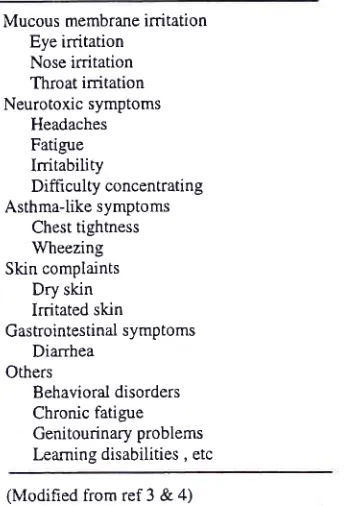
concentrating, and sometimes dizziness; nausea, chest tightness; and other sympto*r.''o'tTable l. SBS signs and symptoms
Mucous membrane irritation
Eye irritation
Nose irritation Throat irritation Neurotoxic symptoms
Headaches Fatigue
Irritability
Difhculty concentrating Asthmalike symptoms
Chest tightness
Wheezing Skin complaints
Dry skin Irritated skin
Gastrointestinal symptoms
Diarrhea
Others
Behavioral disorders
Chronic fatigue Genitourinary problems
Learning disabilities , etc
(Modified from ref 3 & 4)
Although objective physiological abnormalities are not generally found and permanent sequelae are rare, the symptoms
of
SBS can be uncomfortable, even disabling, and whole workplaces can be rendered non-functional.aIt
is commonly accepted to represent eye, nose,and
throat irritation;
headaches, lethargy,difficulty
concentrating, and sometimes dizziness;nausea,
chest
tightness;and
other
symptoms. Evidence suggests that what is called the SBSis
at least three separate entities, eachof
which has at at least one cause.toWyon et alr5 assessed the perceived air quality and SBS symptoms while periorming simulated oflice
work. The subject-rated acceptability of the perceived
air quality
in the office
conespondedto
22Vo dissatisfied when the pollution source was present, [image:4.612.303.483.254.507.2]-t
128
Aditama and Andariniabsent.
In
the
former condition there
was
asignificantly increased prevalence of headaches (P
-0.04) and significantly lower levels of reported effort (p = 0.02) during the text typing and calculation tasks,both
of
which
required a sustained level of concentration. In the text typing task, subjects worked significantly more slowly when the pollution source was present in the office (P = 0.003), typing 6.57o lesstext than when the pollution source was absent from the office Reducing the pollution load on indoor air proved
to
be an effective meansof improving
theôomfort, health and productivity of building ô."upants.tt
Diagnosis
Indoor
air
and the sick building syndrome (SBS)serves as a paradigm
of
modern occupational andenvironmental medicine
with
its inherent
scientificuncertainties, expectations, and knowledge on the part
of affected persons, and economic conflicts between
owners, managers, tenants, and occupants. The first approach physicians generally take with patients who
have
a
specific
concern regarding
potentialenvironmentally caused disease is to obtain a careful medical
and
occupational history and perform aphysical examination and, when applicable, laboratory
tests. The first goal is to exclude other conditions that
might
be causing the
problem. Physicians may identify an underlying condition (such as inadequate tear film production and stability or fatigue associated with hypothyroidism) associated with other diseases that may influence the pertinent symptoms. The nextstep
is to
identify
the likely
pathophysiologic mechanism underlying the complaint and quantify organ function. Complaintsof
chest tightness or wheezing require documentationof
changes in airways relatedto
work using peak expiratory flow tracingsor
spirornetry before and after work.If
no abnormalilyis
found,no
"measurable disease" ispresent. That is, physicians can convincingly state that even
if
discomfortis
present,it
does not represent measurable pathotogy.t As always, timing in diseaseis
important; disease may progress, and tests mayneed to be repeated
if a
patient's condition worsens. Physicians must also recognize that the appropriatetest has sometimes not been applied or even identified. When discomfort
is
convincingly associated with particularwork
environments andno
physiologic dysfunctionis
identified, the absenceof
"disease"ma^kes
it
possible for physicians to explain both the ubiquitousnessof
discomfort and initation and theidea that discomfort does not usually represent true
Med J [ndones
disease that progresses
or
leadsto disability.
Such discussions are designed to prevent destructive illnessbehavior.'
In
the
absenceof
physiologic dysfunction or anticipated impairment, the question is always raisedas
to
whether some discomfort may haveto
be tolerated in the workplace in the same fashion as athome or on the street. One aspect of the discussion is to refocus the problem
to
discomfort and economic trade-offsfor
employers.[t
is
often much easier topersuade employers that general initation may lead to discomfort and decreased productivity than to deal
with adversarial workers' compensation procedures.
Such an approach
will
work onlyif
there is general agreement on goals of solving problems . If patients do not have measurable or identifiable disease, they may have complaints consistent with the SBS. As thedescription here makes clear, the physiologic basis of the SBS
is
under active investigation. Even as the arguments are being madethat
the syndrome
isprimarily
a
matterof
discomfort, effortsto
explain that discomfort suggest that there are identifiablephysiologic responses to the "sick building" environment.
To
date thereis
no evidence suggesting that these responses lead to long-term impairment or established disease. Nevertheless, several investigations cited underthe appropriate
organ system suggest thatconditions in general may be associated with at least physiologic if not palhologic responses.T
T able 2. Investigation methods
Ey"
Tear film break-up time
Fat layer determination Conjunctival photography
Lissamine green staining (punctate conjunctivitis)
Nose
Acoustic rhinometry
Anterior and posterior rhinomanometry
Nasal lavage
Stereoscopic microscopic examination
Chest
Peak flow meters
Spirometry
Central nervous system
Neuropsychologic testing Evoked potentials
Vestibular testing with solvent provocacion
I
VoL I l, No 2, April - J,,me 2002
Chest tightness and asthma-like symptoms are common. Some persons have documentable variability in their airways caliber related to work; asthma caused by or exacerbated by a particular environment is traditionally not tonsidered part of the SBS. One report describes
the new development of asthma and exacerbations in
the workplace
in
a
groupof
office workers. Otherworkers
in
the building described excess coughing, wheezing, and mucous membrane irritation. Outbreaks of hypersensitivity pneumonitis have demonstrated a similar association. This suggests that at least someoffice
workers may have unrecognized asthma or pneumonitis. There may be another group of persons who have subjective chest tightness, wheeze, or coughin
whom thereis
no physiologic abnormality. Thisoccurrence
may
be
associatedwith
-1,3-glucan exposure. Useof
peakflow
meters and spirometrybefore and after exposure
is
essentialin
efforts to differentiate building-related asthma from SBS and to clarify whether this symgtom iomplex is distinct fromreactive airways disease.'
In summary, individual complaints may be characterized and attempts at confirmation or quantification undei-taken. The absence of physiologic abnormalities may
allow
physiciansto
move
the level of
patient discourseto
discomfort rather than disease. On theother hand,
if
individual patients have convincingsymptoms alternative approaches to documentation must be undertaken. These include traditional challenge
tests or n-of-one clinical
trials.T
\Palients are usually a member of some group defined
through corrlmon exposures.
They
may perceive themselves as the most sensitive persons or simply be the only ones willing to voice complaints. It is rare for an officeto
generale complaintsin
onlya
single patient.If
diagnostic tests in individual patients aloneare inconclusive
but
strong suspicion continues to exist, physicians may then chooseto
examine the group members informally, dirring a walk-through, orformally. Group measurements should be undertaken
thoughtfully, with a clearly defined goal. This goal may be to oblain more information on the spectrum or
prevalence
of
complaints,to
compare symptom frequencies with'some external -control groups (other buiiOings), or to address disease.TOn-site assessment of buildings is extremely useful.
Thomtr
investigatethe
meritsof
case studies as complementary methodological approachesin
the studyof
the sick building syndromein
a
Swedishoffice building
with
longstanding health problems,Sick building
syndrome
129and
its
inhabitants.By
their
capacityto
identifyinternal processes within building contexts, case study
a better understanding
buitding
syndrome.t:the majority
of
cases, engineering problems and pollutant sources can be identifiedthat
contributeto
the
generation ofcomplaints. Although psychosocial factors are likely to exacerbate underlying complaints, they should not distract from identifying solutions.to
Control
ln assessment of patients with SBS complaints, specific
building-related illnesses suggested
by
history orphysical examination should be ruled out. On-site
assessment of buildings is extremely useful. Treatment involves both the patient and the building. Whenever possible, changes such as ventilation improvements and reduction of sources of environmental contamination should be initiated even
if
specific aetiological agents havenot
been identified.aOoit
mentionedthat a
biopsychosocial approach
is
neededto
the problem involving symptomatic featment, environmental confol, good ergonomic design, and stress management in SBS. Redlich stressed that treatment should involves both the patient and the building. Whenever possible,changes
such
as
ventilation improvements and reduction of sources of environmental contamination should be initiated evenif
specific aetiological agents have not been identified.aPrevention through a proactive air quality monitoring
program is far more desirable than dealing with an actual sick building. Regardless, there are effective,
rational approaches for diagnosing sick buildings. In the upcoming years,
it
is inevitable that extensive airmonitoring
will
be
requiredin all
commercial buildings.Ï7The
sick building syndrome (SBS) has been thesubject of serious scientific inquiry only in the past
l0
y"orr.tt
New
directionsfor
indoor
environmeni research are in the following 4 themes: (i) the current change in office work pattern, workplace design, andincreasing demands from the work force, (ii) the large
individual variation
in
requirementsfor
optimelconditions pointing at the key factors
of
individualresponse and individual control options hased on
trade-off experiments,
(iii)
psychosocial factors asdeterminanls of symptoms, comfort, and productivity,
130
Aditama and Andarinienvironment, the identification
of
causes, andlong-term consequences.ls
The sick building syndronre has been widely discussed from epidemiological perspectives. Although there is considerable difference
in opinion
regarding theconcrete and objective evidence to support a distinct
sick
building
syndrome and./or building-relatedillness, much data indicates that numerous variables
within
buildings can potentially influence humanhealth. Different building construction types
of
oldversus new buildings to highlight changes in modern
construction may have led to a putative increase in work-related symptomatology.
t'
Some
of
the
emerging events that are assumingincreasing relevance
as
work-related respiratorydiseases
(indoor
air
pollutionand sick
building syndrome, respiratorytoxicity
of
formaldehyde,pollulant-induced asthma, dental technician lung
diseases, lung cancer from diesel exhaust, environmental
silicosis). The industrial hygienist's role in recognition,
evaluation, and control of health hazards is stressed as
an essenlial
contributionto
both
preventiorl and diagnosisof
occupationallung
disease.le Worker-related complaintsof sick building
and/orbuilding-related illnesses are being recognized increasingly.
Clinicians need to become more familiar with these
syndromes which include asthma, humidifier fever,
hypersensitivity pneumonitis and allergic rhinitis.20 In
addition,
various
infectious
diseàsessuch
aslegionellosis, Q fever and viral respiratory conditions
may
be
building
exposure linked. Finally, toxinexposures
to
indoor
air
chemicals ranging from volatiles, copy paper, glue, and pesticides may be linked to health sequelae. Thus, these patients should have serious considerations, particularly where clusterillnesses with documented respiratory disorders and skin rashes are identified. Appropriate measures for
diagnosis, treatment, documentation and advocacy for
employee relocation pending corrective actions should follow.20
The collision of escalating technological sophistication
and surging environrnental awareness has caused the reexamination
of
many societal paradigms. Honor stories abouË lethal chemical exposures involvingisolated cases of ignorance, carelessness or greed have
caused the public
to
demand constant vigilance toprevent exposure to potentially hazardous substances.
Accordingly, much
time
and
resource has beenexpanded
by ttre
U.S. government and citizens to abate and prevent air and water pollution. While theseMed J Indones
efforts have met
with
measurable success, there isincreasing public concem about a new generation of pollution-related human illness
in office, home
andtransportation environrnents. New instances
of
SickBuilding Syrdrome
or
Building Related Illness arereported daily
by
the popular press. Human healtheffects such as cancer, infectious disease, allergy and
irritation have been ascribed to indoor air pollution. The clinical aspects of indoor air pollution are often
discounted
by consulting
engineer's and industrial hygienists involvedin
indoor air quality. Physiciansand
clinically-trained scientistshave
received a"Macedonian call" to sift clinical relevance from the emotional aspects
of
indoorair
quality problems.Point sources of pollutants, associated human health
effects, and problem solving approaches associated with indoor air pollution are described. Regulatory
and litigational aspects of indoor air pollution are also
important part that should be discussed.2r
Indoor
air and
the
sick building syndrome (SBS)serves as
a
paradigmof modern occupational
andenvironmental medicine with .its inherent scientific
uncertainties, expectations, and knowledge on the part of affected persons, and economic conflicts-between owners, managers, tenants, and occupants.T
As
wedevelop a better understanding of the adverse effects
of
the
indoor environmenton
health,the
patho-physiologic mechanisms contributing illnesses caused
by
indoor environmental factorswill become
moreclearly defined.2
The
term building-related illnessapplies to those adverse health effects for which we have
a
well-definedlink
between environrnentalagents in a specific building and the resultanr health
disorders. This class of illnesses frequently involves
the skin and respiratory tract because of the ease with which indoor environmental contaminants come in
contact with these tissues. Agents that cause building-related illnesses generally induce iilness
by
one offour mechanisms: (1) immunologic, (2) infectious, (3)
toxic, or (4) irritant. Some agents rnay work through
more than one mechanism.
REFERENCES
1.
Brownson K. Hospital air is sick. Hosp Mater lv{a-'rage Q2000;22(2):l-8
2.
SettzerJlvI
Building-related illnesses. J Allergy Clin lmmunol 1994:94:351 - 62l3
l4
15.
4.
5
Vol 11, No 2, April - Jwe 2002
Redlich
CA,
SparerJ,
CullenMR.
Sick-building syndrome. Lancet 1997; 349(9057) : l0l3-6lvlahmoudi M, Gershwin ME. Sick building syndrome. III.
Stachybotrys chafiarrm. J Asthma 200û, 37(2):191-8 Engelhart S, Burghardt H, Neumann R, Ewers U, Exner
M, Kramer MH. Sick building syndrome in an office
building formerly used by a pharmaceutical company: a
case study. Indoor Air 1999;9(2):139-43
Hodgson, M, Storey, E,
,
Conn S. Patients and the sickbuilding syndrome. Multiple contaminants problem. J
Allergy Clin Immun 1994;94 (2):374-6
Ooi PL, Goh KT. Sick building syndrome: an emerging
s tress- rel ated di so rder? tnt J Epidemiol 1997 ; 26(6): 1243
-9
9.
Li
CS, Hsu CW, Tai ML. Indoor pollution and sickI l.
building syndrome symptoms among workers in day-care
centers. Arch Environ Health 1997; 52(3):200-7
Trout D, Bernstein J, Martinez K, Biagini R, Wallingford K. Bioaerosol lung damage in a worker with repeated
exposure to fungi in a water-damaged building. Environ Health Perspect 2001 ; 109(6);641-4
Engvall K, Nonby C, Norback D. Sick building syndrome
in
relationto
building dampnessin
multi-familyresidential buildings
in
Stockholm.Int
Arch OccupEnviron Health 2001 ;'l 4(4):270-8
Chang CC, Ruhl RA, Halpern GM, Gershwin ME.
Building components contributors of the sick building
syndrome. J Asthma 1994;31(2):127-3'l .
Sick building
syndrome
131Thom A. Emergence and preservation of a chronically
sick building.
J Epidemiol Community Health
2000; 51Q):552-6Apter A, Bracker A, Hodgson Nl, Sidman J, Leung W'/. Epidemiology of the sick building syndrome. J Allergy
Clin Immunol 199 4; 94(2 Pt 2):27 7 -88.
Wyon DP, Baik YK, Clausen G, Fanger PO. Perceived air
quality, sick building syndrome (SBS) symptoms and
productivity
in
an ofhce with two different pollutionloads. Indoor Air 1999; 9(3):165-79
Hodgson M. The sick-building syndrome. Occup Med 1995: l0(t):167-75
Montz WE Jr. Indoor air quality in hospitals. Med Waste Anal 1993;2(2):1,3-7
Schneider T, Skov P, Valbjom O. Challenges for indoor
environment research in the new office. Scand J Work Environ Health 1999; 25(6):574-9
Franco G. New trends in occupational and environmental
diseases: the role of the occupational hygienist in recognizing
lung diseases. Monaldi Arch Chest Dis 1994;
49(3):239-42
Sherin KM. Building-related illnesses and sick building
syndrome. J Fla Med Assoc 1993; 80(7):472-4
Brooks BO, Utter GM, DeBroy JA, Schimke RD. Indoor air pollution: an edifice complex. J Toxicol Clin Toxicol
l99l:29(3):315-74
7
l6
n.
18.
t9
20.
2t
10