• Tidak ada hasil yang ditemukan

Design Wideband Microstrip Antenna Using Graphene.

N/A
N/A
Protected

Academic year: 2017

Membagikan "Design Wideband Microstrip Antenna Using Graphene."

Copied!
24
0
0

Teks penuh

(1)

DESIGN WIDEBAND MICROSTRIP ANTENNA USING GRAPHENE

ZETTY ZURAIDA BINTI SAHARUDIN

This Report Is Submitted In Partial Of Requirements For The Bachelor Degree of Electronic Engineering (Telecommunication Electronics) With Honours

Fakulti Kejuruteraan Elektronik dan Kejuruteraan Komputer

Universiti Teknikal Malaysia Melaka

(2)

ii

UNIVERSTI TEKNIKAL MALAYSIA MELAKA

FAKULTI KEJURUTERAAN ELEKTRONIK DAN KEJURUTERAAN KOMPUTER

BORANG PENGESAHAN STATUS LAPORAN

PROJEK SARJANA MUDA II

Tajuk Projek : DESIGN WIDEBAND MICROSTRIP ANTENNA USING GRAPHENE

Sesi

Pengajian : 1 2 / 1 3

Saya ZETTY ZURAIDA BINTI SAHARUDIN mengaku membenarkan Laporan Projek Sarjana Muda ini disimpan di Perpustakaan dengan syarat-syarat kegunaan seperti berikut:

1. Laporan adalah hakmilik Universiti Teknikal Malaysia Melaka.

2. Perpustakaan dibenarkan membuat salinan untuk tujuan pengajian sahaja.

3. Perpustakaan dibenarkan membuat salinan laporan ini sebagai bahan pertukaran antara institusi

pengajian tinggi.

4. Sila tandakan ( ) :

SULIT*

*(Mengandungi maklumat yang berdarjah keselamatan atau kepentingan Malaysia seperti yang termaktub di dalam AKTA RAHSIA RASMI 1972)

TERHAD** **(Mengandungi maklumat terhad yang telah ditentukan oleh organisasi/badan di mana penyelidikan dijalankan)

TIDAK TERHAD

Disahkan oleh:

__________________________ ___________________________________

(TANDATANGAN PENULIS) (COP DAN TANDATANGAN PENYELIA)

(3)

iii

“I hereby declare that this report is the result of my own work except for quotes as cited in the references”

Signature : ... Author’s name : ZETTY ZURAIDA BINTI SAHARUDIN

(4)

iv

“I hereby declare that I have read this report and in my opinion this report is sufficient in terms of the scope and the quality for the award of Bachelor of

Electronic Engineering (Telecommunication Electronics) With Honours”

Signature :... Supervisor’s Name : AZMAN BIN AWANG TEH

(5)

v

(6)

vi

ACKNOWLEDGEMENT

(7)

vii

ABSTRACT

(8)

viii

ABSTRAK

(9)

ix

TABLE OF CONTENTS

CHAPTER TITLE PAGE(S)

PROJECT TITLE i

DECLRATION ii-iv DEDICATION v

ACKNOWLEDGEMENT vi

ABSTRACT vii

ABSTRAK viii

TABLE OF CONTENTS ix-xii LIST OF FIGURES xiii-xiv LIST OF TABLES xiv

I INTRODUCTION 1

1.1 INTRODUCTION 1

1.2 PROJECT OBJECTIVES 2

1.3 PROBLEM STATEMENT 2

1.4 SCOPE OF WORK 3

1.5 METHODOLOGY 3

(10)

x

II LITERATURE REVIEW 6

2.1 INTRODUCTION 6

2.2 INTRODUCTION OF ANTENNA 6-7 2.3 MICROSTRIP PATCH ANTENNA BASICS 8-10 2.3.1 Basic Characteristic of Microstrip Antenna 11-12 2.3.2 Rectangular Patch Antenna 12-14 2.4 FEED TECHNIQUES 14-15 2.4.1 Microstrip Line Feed 15

2.4.2 Coaxial Feed 16

2.4.3 Aperture Coupled Feed 17

2.4.4 Proximity Coupled Feed 18

2.4.5 Coplanar Waveguide (CPW) feed 18-19 2.5 PRINTED SLOT ANTENNAS 19-20 2.6 GRAPHENE MATERIAL PROPERTIES 21

2.6.1 Chemical Properties 21

2.6.2 Mechanical and Thermal Properties 22

2.6.3 Comparison with copper and gold materials 22-23 2.6.4 Producing Graphene 23-24 III METHODOLOGY 25

3.1 INTRODUCTION 25

3.2 MICROSTRIP ANTENNA WITH DOUBLE U-SLOT 25

(11)

xi

3.2.1 Design Specification 25-26

3.2.2 Designs by Calculation 26-27

3.2.3 Design Structure and Parameter Dimension 27-29

3.3 SIMULATION PROCESS 29-33

VI RESULT ANALYSIS AND DISCUSSIONS 34

4.1 INTRODUCTION 34

4.2 SIMULATION RESULT AND ANALYSIS 34

4.2.1 Wideband Microstrip Antenna with 34-37

double u-slot using Copper as patch material

4.2.2 Wideband Microstrip Antenna with double 37-39

u-slot using Graphene as patch material

4.2.3 Wideband Microstrip Antenna with double 39-42

u-slot using Gold as patch material

4.2.4 Combination of three graph return loss of 42-43

copper, graphene and gold patch antenna

4.2.5 Summary of three different patch materials 43-44

4.3 PARAMETRIC STUDY 44-47

V CONCLUSION AND FUTURE WORK 48

(12)

xii

5.2 FUTURE WORK 49-50

REFERENCES 51-53

(13)

xiii

LIST OF FIGURES

NO TITLE PAGE(S)

1.1 Flow chart of project 1

2.1 Antenna Basic Operation 8

2.2 Microstrip Antenna Configuration 9

2.3 Basic shape of microstrip antennas 10

2.4 Basic configuration of Microstrip antenna 11

2.5 Rectangular Microstrip Patch Geometry 12-13 2.6 Rectangular patch antenna 13

2.7 Microstrip Line Feed 15

2.8 Coaxial Feed Microstrip Patch Antenna 16

2.9 Aperture-coupled feed 17

2.10 Proximity-coupled Feed 18

2.11 CPW Feeding Techniques: (a) Inductive feed termination 19

(b) Capacitive feed termination 2.12 Various shape of slot antenna 20

2.13 Making graphene 23-24 3.1 Front View 27

3.2 Bottom View 28

3.3 Side View 28

(14)

xiv

3.5 Patch plane setup 31

3.6 Coaxial probe feed structure 31-32 3.7 Boundary condition setting 32

3.8 Monitor setting 33

4.1 Graph of return loss for copper patch antenna 35

4.2 Directivity for copper patch antenna 35

4.3 Gain for copper patch antenna 36

4.4 Input impedances for copper patch antenna 36-37 4.5 Graph of return loss for graphene patch antenna 37

4.6 Directivity for graphene patch antenna 38

4.7 Gain for graphene patch antenna 38

4.8 Input impedances for graphene patch antenna 39

4.9 Graph of return loss for graphene patch antenna 40

4.10 Directivity for gold patch antenna 40-41 4.11 Gain for gold patch antenna 41

4.12 Input impedances for gold patch antenna 42

4.13 Combination graph of return loss 42

4.14 The changes of length of u-slot, E2 44

4.15 The changes of thickness of substrate, t1 45

4.16 The changes of length of ground, A 46

(15)

xv

LIST OF TABLES

NO TITLE PAGE(S)

(16)

CHAPTER I

INTRODUCTIONS

1.1 Introduction

(17)

2

copper, gold and graphene for patch antenna are applied and compared to see the different results which to improve the bandwidth.

1.2 Project Objectives

The objective of this project is to design a wideband microstrip patch antenna using graphene as patch antenna. This will used structural technique to increase the bandwidth of the antenna . Besides, the input impedances and radiation pattern is simulate in Computer Simulation Technology (CST) in order to get the result. Furthermore, the microstrip antenna’s characteristics are analyzed for three different types of material. The comparison between copper, graphene and gold patch antennas will be shown. It is then followed by a parametric study for antenna design to achieve wideband frequency and also explanation about the design of antenna have been made will discuss later on.

1.3 Problem Statement

(18)

3

the mobile phone market. So, it is importance to create a new invention of microstrip antenna for better performance in electromagnetic waves field.

1.4 Scope of Work

This project first involves designing wideband microstrip antenna using graphene. Then construct three models of microstrip antenna using graphene, copper and gold of patch antenna. The stimulation part is carried out using Computer Simulation Technology (CST) to simulate the input impedance and radiation pattern of antenna. The results from simulation are analyze, estimate and compared for three different patch antenna materials. Other antenna parameters such as its return loss level, gain and radiation pattern also will be considered for antenna design.

1.5 Methodology

(19)

4

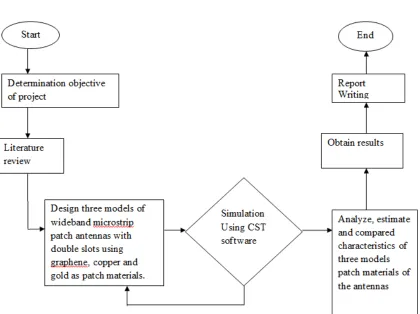
estimation of the characteristic of the antennas will be carried out. All experimental result will be included in the final report.

[image:19.612.119.539.167.481.2]

Figure 1.1: Flow chart of project

1.6 Chapter Review

(20)

5

Chapter II describes the introductions to the antenna and microstrip antenna is presented. This chapter will explain the basic concept of the antenna. Then the introduction of the microstrip patched antenna concept and design will be introduced. This chapter also gives the information about comparison of chemical properties among graphene, copper and gold materials. Besides, the issues of the materials uses will be discusss on this project.

Chapter III presents the methodology used or the design process in this project. The methodology involves the procedures of gathering information data regarding to the antenna design. This section also explains about the optimization process involved in this project.

Chapter IV presents the results achieved in this project. This results involve the parametric study of antenna, the comparison between graphene, copper and gold of patch antenna, the theoretical and simulated result are also shown in this chapter.

(21)

6

CHAPTER II

LITERATURE REVIEW

2.1 Introduction

This chapter will briefly explain the basic concept of the antenna. Then the introduction of the microstrip patched antenna concept and design will be introduced. This chapter also gives the information about graphene, copper and gold material’s properties which to compare among them to use as patch antenna in this antenna design project.

(22)

7

An antenna is to encourage electrical signals to reach large distances from the antenna which means by to radiate. The IEEE standard defines an antenna as “that part of a transmitting or receiving system that is designed to radiate or to receive electromagnetic”[1].

Antenna also as a receiver of electromagnetic energy which look as the transition region between free-space and a guiding structure as transmission line. The guiding structure transports electromagnetic energy to or from the antenna [2].

An antenna is transducer, an impedance matching device, a radiator and a sensor of electromagnetic waves. It is an essential device/element in all types of communication and radar systems. It can be considered as a source of electromagnetic waves[3].

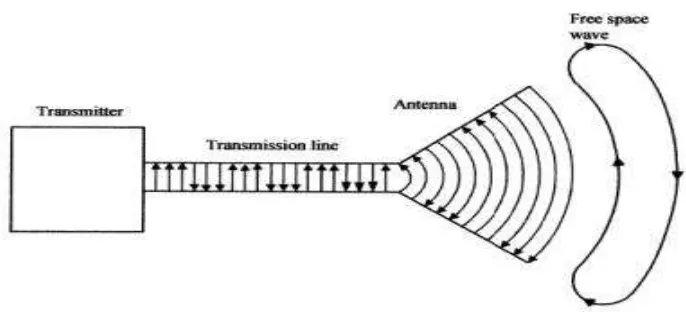
The transmission line in the wireless communication is not wiring transformation line, but free space. The flow of charge through a conductor represent as the electrical signal is transmitted through the antenna. The charge cannot pass through a non-conductor (free-space). However, the electromagnetic wave cannot pass through a conductor and proceeds by forming the magnetic field on a non-conductor.

(23)
[image:23.612.156.499.97.253.2]

8

Figure 2.1: Antenna Basic Operation

Antenna is important in communication nowadays. Antenna is important device for transmitting and receiving the signal. The signal cannot pass through free-space just like that but must have a device to done the task which is antenna.

Antenna widely used in wireless communication. Wireless local area network (WLAN) is one of application that used antenna. WLAN used in wireless communication for home settings and in commercial. For example, in airports, coffee shops, other public spaces and many companies offer WLAN access [4].

Antenna consists of various types. The types of antenna are wire antennas, aperture antennas, microstrip antennas, array antennas, reflector antennas and lens antenna. For WLAN application, microstrip antenna is more preferable.

2.3 Microstrip Patch Antennas Basic

(24)

9

Grieg and Englemann [5]. The earliest known realization of a microstrip like antenna integrated with microstrip transmission line was developed in 1953 by Deschamps [6].

[image:24.612.194.424.247.412.2]

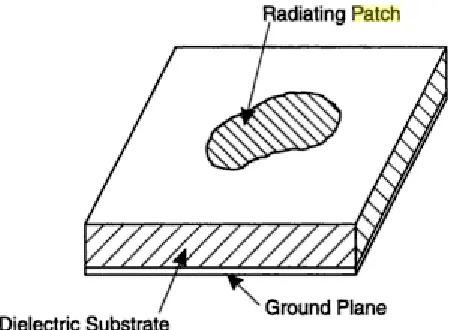
As shown figure 2.2, a microstrip antenna in its simplest configuration consists of a radiating patch on one side of a dielectric substrate ( which has a ground plane on the other side. This is to enhance the fringe fileds that account for the radiation. However, other performance requirements may dictate the use of substrate materials whose dielectric constants can be greater than[7].

Figure 2.2: Microstrip Antenna Configuration

Gambar

Figure 1.1: Flow chart of project
Figure 2.1: Antenna Basic Operation
Figure 2.2: Microstrip Antenna Configuration

Referensi

Dokumen terkait

Masalah yang diajukan dalam penelitian ini adalah pertama, adanya kegiatan supervisi di SMKN 2 Padangsidimpuan yang dilakukan oleh pengawas sekolah, kepala sckolah

Sistem pembakaran pada ketel uap ini menggunakan silinder api yang dilengkapi dengan chain grate, kegunaan dari chain grate itu sendiri adalah untuk tempat pembakaran

untuk secara aktif menyumbang pada proses belajar dirinya, dan secara aktif rnembantu siswa dalam menafsirkan persoalan riil' dan- guru tidak terpancang pada materi

[r]

Nursal, S., 2005, Kandungan Senyawa Kimia Ekstrak Daun Lengkuas (Lactura indica Linn), Toksisitas dan Pengaruh Subletalnya terhadap Mortalitas Larva Nyamuk Aedes aegypti L.,

Pancasila dikatakan sebagi filsafat, karena pancasila merupakan hasil perenungan jiwa yang mendalam yang dilakukan oleh the founding father kita, yang dituangkan dalam suatu

Karena kandungan xanthone pada kulit Manggis yang berpotensi untuk melindungi ginjal maka peneliti tertarik melakukan penelitian untuk melihat apakah pemberian

Puji syukur penulis panjatkan atas kehadirat Allah SWT atas segala rahmat dan hidayah-Nya serta shalawat dan salam kepada nabi besar Muhammad SAW atas segala panutan yang