Proceedings Book
The 2
ndKhon Kean University International Conference on Public Administration
Editors
Asst. Prof. Sataporn Roengtam, Ph.D.
Imron Sohsan
Kiraphat Khianthongkul
Department of Public Administration
Globalization & New Public Services
Proceedings BookFor the 2nd Khon Kean University International Conference on Public Administration
By Department of Public Administration, Faculty of Humanities and Social Sciences, Khon Kaen University
Editors
Asst. Prof. Sataporn Roengtam, Ph.D. Imron Sohsan
Kiraphat Khianthongkul
Cover & Layout
Kiraphat KhianthongkulSpecial Edition, July 2015
ISBN: 978-616-223-530-6
Published By:
Khon Kaen University Printing House
Editorial Preface
The globalization are causing debated on various issues about states problems at the present time and in the future. For example, good governance, international collaborations, social and economic inequalities, human capitals, local governance etc. There situations do unavoidably impact to the public administration thoughts. So, public administration approaches will have to make adjustments. There are several ideas proposed to develop its academic matters for responding that situations better. For example, Good Governance and Collaborative Governance, Civil Society and Social Movement, Public Finance and Budgeting, Public Law and Legal Enforcement, Cross-Cultural Management etc. And these ones have been applied in countries worldwide.
In order to show the cases of applying, this proceedings will present selected papers of the 2nd Khon Kane University International Conference on Public Administration (KKU-ICPA) in the main theme “Globalization & New Public Services”. They are presented by 2 languages, English and Thai language. All of them will attain to propose the fruitful theoretical framework for solving problems in several issue including national and international areas. All of these paper would like to show the problems and solving methods by insights of the presenters. They hope that their ideas will be useful for enhancing academic knowledge on public administration which will have much appropriate for resolving the current and future situations of public administration so on.
We hope contents of the proceedings will make more or less benefits to audients who are interested. Thank you very much.
List of Peer Review
1. Prof. Yukio Ikemoto University of Tokyo Japan
2. Prof. Dr. Achmad Nurmandi Universitas Muhamadiya Indonesia 3. Assoc. Prof. Dr. Prasit Kunurat Khon Kaen University Thailand 4. Assoc. Prof. Dr. Sekson Yongvanit Khon Kaen University Thailand 5. Assoc. Prof. Somnuek Panyasing Khon Kaen University Thailand 6. Assoc. Prof. Dr. Somsak Srisontisuk Khon Kaen University Thailand
7. Dr. Weerakul Chaiphar Khon Kaen University Thailand
Table of Contents
Page
Editorial Preface I
List of Peer Review III
Table of Contents V
Schedule & List of Papers IX
Keynote Speaker:
• From Dipterocarpus Forest to Rubber Plantation (Sekson Yongvanit)
XVII
English Language Papers
• Empowering Civil Society in Urban Development: The Best Practices in Udon Thani, Thailand (Thanadorn Phuttharak)
1
• Process of Building Confidence in The Preparation of The Infrastructure of The Local Government Organizations in The Northeast Region
(Jariya Chatasuwatchananon)
9
• Globalization and the Enforcement of Local Administrative Regulations (Damorn Kumtrai)
16
• People Participation in the Audit of Public Procurement of Local Government in Kalasin Province (Phimlikid Kaewhanam, Kathanyoo Kaewhanam)
26
• Education Reform Policy to Area-based Education (Sirikanya Khainongsung) 37
• The Management of Fiscal Risk of local government (Konarpha Wongkasem) 45
• Discussion on the Issue of the Tide Embankments Construction in Miyagi Prefecture, Tohoku Region, Japan (Yuka Matsumoto, Yukio Ikemoto)
54
• The Current Practice of Citizen Participation in Indonesia Netizen and Selected Cases of Local Democracy in Indonesia
(Eko Priyo Purnomo, Achmad Nurmandi, Andi Luhur Prianto, Solahudin, Moch Jaenuri)
65
• The Concept on Power Structure of Thailand: Case Study, A Province in Northeast Province (Sataporn Roengtam)
95
• The Policy Implementation of National Health Insurance in Bantul Regency - Yogyakarta Province, Indonesia (A Case Study of Premium Payment Assistance and Non Premium Payment Assistance)
(Dyah Mutiarin, Andri Putra Kesmawan, Nur Khaerah, Ummi Zakiyah)
110
• Factors Determining the Implementation of National Health Insurance in Bantul Regency - Yogyakarta Province, Indonesia
(Dyah Mutiarin, Andri Putra Kesmawan, Suranto, Herman Rante, Sakir)
Page
• Potential Analysis of Nakhon Phanom for Special Economic Zone Establishment (Jarukanya Udanont)
141
Thai Language Papers
• Role of Non Profit Association (NPA) to develop country in Lao PDR (Chanajai Muenthaisong, Sukanya Aimimtham)
153
• Fiscal Autonomy: Reviewing on Origin and Important (Arthit Phadungdech) 166
• Strategic Planning Model: Case Study of Bueng Kan Province (Suwannee Varreesri)
181
• Deliberative Approach in the Environmental Public Policy’s Decision-Making (Punyavee Nooprakob)
196
• Influenced Factors to the Successfulness of Improvement of Promoting Exercise Project; Getting Abdomen and Illness Reduction to Stay Healthy, Embodying in Community Health Care Strategy: A Case Study in Naimuang Sub-District, Wiangkao District, Khon Kaen Province (Yutasat Norkaew)
204
• The Study on a Performance of a Project on Promoting the Potentiality of a Family at a Parish Level Case Study: Nonyang Sub-district, Nongsung District, Mukdahan Province (Anongrit Phromson, Weerakul Chaiphar)
216
• The Political Context of Public Administration in Perspective (Bancha Bhutwanakul)
225
• The Implementation Process of Ban Mankhong Project at a Micro Level: A Case Study of the Northeastern Region (Rungarun Boonsayun)
235
• Collaborative Public Management: Concept and Application (Chettha Sapyen, Pornsak Thumnimit)
250
• Comparative Modernism Public Administration to Postmodernism Public Administration (Charturon Tongwan)
263
• Thai Knowledge and Public Organization Management (Khemnut Pookongchai) 272
• Independent Regulatory Agency: An Analysis of Key Features and Relations to the Political System (Waranyoo Senasu)
279
• Signs of State’s Power in the Borderlands: Case Studies in the Boundaries of Thailand (Suriyanon Pholsim)
292
• The Roles of Local Administrations in Promoting People’s Ways of Life by Adopting the Philosophy of Sufficiency Economy: Case Studies of Five Local Administrations in Wiang Sa District, Surat Thani (Pasuvadee Polpichai)
• History of Thailand Decentralization and Local government on 1932 - 2015: Problems and relationship between Central, Regional government servants and Local administrative organization (Kiraphat Khianthongkul)
318
• The Discourse on Good Governance in Local Administrative Organizations: Myth or Truth (Thanapha Jaiyen)
334
• The Development of 2D cartoon animation, to promote moral integrity issues The Din boy Story For Grade 6 students of elementary school
(Yongyuth Mungmai, Wirat Pongsiri, Pongpipat Saitong)
350
• The Strategic Management of Production throughout One Tambon, One Product Policy from Hand Craft Arts, Utompornpisai District, Sisaket Province (Panaikorn Bounkob)
364
• Modernism & Oligarchy in Globalization (Jintana Kampaengsirichai) 376
• Bureaucracy Theory and Globalization in 21st century (Rongrat Wirotepetch) 385
• The 21st Century of Public Administration Teaching in Thailand (Chaimongkol Siriwarin)
Schedule
The 2nd Khon Kaen University International Conference on Public Administration
“Globalization & New Public Services” August 6 - 7, 2015
HS.05 Building, Faculty of Humanities and Social Sciences, Khon Kaen University, Khon Kaen, Thailand
August 6, 2015
08.00 - 09.00 Registration (HS.05 Building)
09.00 - 09.30 Opening Ceremony (Conference Room No. 3, the 2nd floor) Welcoming Remarks by Assoc. Prof. Dr. Kulthida Tuamsuk
Dean, Faculty of Humanities and Social Sciences, Khon Kaen University Reporting Remarks by Asst. Prof. Dr. Sataporn Roengtam
Secretary of ICPA Steering Committee
Opening Remarks by Assoc. Prof. Dr. Lampang Manmart Vice President for Strategic Planning, Khon Kaen University
09.30 - 10.30 Keynote Address: “From Dipterocarpus Forest to Rubber Plantation” By Assoc. Prof. Dr. Sekson Yongvanit
Department of Public Administration,
Faculty of Humanities and Social Sciences, Khon Kaen University 10.30 - 10.40 Coffee Break
10.40 - 12.00 English Session I (Conference Room No. 1, the 1st floor)
Theme: Globalization and Public Management
Thai Session I (Conference Room No. 2, the 1st floor)
Theme: Public Policy and Organizations 12.00 - 13.00 Lunch Break
13.00 - 14.20 English Session II (Conference Room No. 1, the 1st floor)
Theme: Regional and Local Governance
Thai Session II (Conference Room No. 2, the 1st floor)
Theme: Project Management 14.20 - 14.30 Coffee Break
14.30 - 15.50 English Session III (Conference Room No. 1, the 1st floor)
Theme: Public Services Development
Thai Session III (Conference Room No. 2, the 1st floor)
Theme: Public Administration Theories
August 7, 2015
08.00 - 09.00 Registration (HS.05 Building)
09.00 - 10.00 Keynote Address: “Viewing Thai Politics through Literature” By Professor Dr. Gilles Delouche
Former president of the Institut National des Langues et Civilisations Orientales (INALCO), Paris, France
(At Conference Room No. 3, the 2nd floor) 10.00 - 10.10 Coffee Break
10.10 - 12.00 Thai Session IV (Conference Room No. 1, the 1st floor)
Theme: Decentralization and Local Governance
Thai Session V (Conference Room No. 2, the 1st floor)
Theme: Public Services and Public Management 12.00 - 13.00 Lunch Break
13.00 - 14.00 Thai Session VI (Conference Room No. 2, the 1st floor)
Theme: Globalization Management
14.00 - 14.30 Closing Ceremony & Coffee Break (Conference Room No. 3, the 2nd floor) Closing Address by Assoc. Prof. Dr. Sukanya Aimimtham
Head, Department of Public Administration,
List of Papers (English Session)
The 2nd Khon Kaen University International Conference on Public Administration
“Globalization & New Public Services” English Session I (Conference Room No. 1, the 1st floor)
Theme: Globalization and Public Management Presented Day: August 6, 2015
Time 10.40 - 12.00
Chair/Discussant: Prof. Yukio Ikemoto
Moderator: Asst. Prof. Dr. Sataporn Roengtam
Titles/ Presenters
10.40 - 11.00 Empowering Civil Society in Urban Development: The Best Practices in Udon Thani, Thailand (Thanadorn Phuttharak)
11.00 - 11.20 Process of Building Confidence in The Preparation of The Infrastructure of The Local Government Organizations in The Northeast Region
(Jariya Chatasuwatchananon)
11.20 - 11.40 Globalization and the Enforcement of Local Administrative Regulations (Damorn Kumtrai)
11.40 - 12.00 People Participation in the Audit of Public Procurement of Local Government in Kalasin Province (Phimlikid Kaewhanam, Kathanyoo Kaewhanam)
English Session II (Conference Room No. 1, the 1st floor)
Theme: Public Services Development Presented Day: August 6, 2015
Time 13.00 - 14.20
Chair/Discussant: Asst. Prof. Dr. Viyouth Chamruspanth
Moderator: Mr. Jackrit Kamudhamas
Titles/ Presenters
13.00 - 13.20 Education Reform Policy to Area-based Education (Sirikanya Khainongsung)
13.20 - 13.40 The Management of Fiscal Risk of local government (Konarpha Wongkasem)
English Session III (Conference Room No. 1, the 1st floor)
Theme: Regional and Local Governance Presented Day: August 6, 2015
Time 14.30 - 16.10
Chair/Discussant: Assoc. Prof. Dr. Sukanya Aimimtham
Moderator: Mr. Imron Sohsan
Titles/Presenters
14.30 - 14.50 Discussion on the Issue of the Tide Embankments Construction in Miyagi Prefecture, Tohoku Region, Japan
(Yuka Matsumoto, Yukio Ikemoto)
14.50 - 15.10 The Current Practice of Citizen Participation in Indonesia Netizen and Selected Cases of Local Democracy in Indonesia
(Eko Priyo Purnomo, Achmad Nurmandi, Andi Luhur Prianto, Solahudin, Moch Jaenuri) 15.10 - 15.30 The Concept on Power Structure of Thailand: Case Study, A Province in Northeast Province
(Sataporn Roengtam)
15.30 - 15.50 The Policy Implementation of National Health Insurance in Bantul Regency - Yogyakarta Province, Indonesia (A Case Study of Premium Payment Assistance and Non Premium Payment Assistance) (Dyah Mutiarin, Andri Putra Kesmawan, Nur Khaerah, Ummi Zakiyah)
15.50 - 16.10 Factors Determining the Implementation of National Health Insurance in Bantul Regency - Yogyakarta Province, Indonesia
List of Papers (Thai Session)
The 2nd Khon Kaen University International Conference on Public Administration
“Globalization & New Public Services” Thai Session I (Conference Room No. 2, the 1st floor)
Theme: Public Policy and Organizations Presented Day: August 6, 2015
Time 10.40 - 12.00
Chair/Discussant: Assoc. Prof. Somnuek Panyasing
Moderator: Mr. Jackrit Kamudhamas
Titles/Presenters
10.40 - 11.00 Role of Non Profit Association (NPA) to develop country in Lao PDR (Chanajai Muenthaisong, Sukanya Aimimtham)
11.00 - 11.20 Fiscal Autonomy: Reviewing on Origin and Important (Arthit Phadungdech)
11.20 - 11.40 Strategic Planning Model: Case Study of Bueng Kan Province (Suwannee Varreesri)
11.40 - 12.00 Deliberative Approach in the Environmental Public Policy’s Decision-Making (Punyavee Nooprakob)
Thai Session II (Conference Room No. 2, the 1st floor)
Theme: Project Management Presented Day: August 6, 2015 Time
13.00 - 14.20
Chair/Discussant: Assoc. Prof. Dr. Prasit Kunurat
Moderator: Mr. Narongpol Changsuwan
Titles/Presenters
13.00 - 13.20 Influenced Factors to the Successfulness of Improvement of Promoting Exercise Project; Getting Abdomen and Illness Reduction to Stay Healthy, Embodying in Community Health Care Strategy: A Case Study in Naimuang Sub-District, Wiangkao District, Khon Kaen Province
(Yutasat Norkaew)
13.20 - 13.40 The Study on a Performance of a Project on Promoting the Potentiality of a Family at a Parish Level Case Study: Nonyang Sub-district, Nongsung District, Mukdahan Province
(Anongrit Phromson, Weerakul Chaiphar)
13.40 - 14.00 The Political Context of Public Administration in Perspective (Bancha Bhutwanakul)
14.00 - 14.20 The Implementation Process of Ban Mankhong Project at a Micro Level: A Case Study of the Northeastern Region
Thai Session III (Conference Room No. 2, the 1st floor)
Theme: Public Administration Theories Presented Day: August 6, 2015
Time 14.30 - 15.50
Chair/Discussant: Asst. Prof. Dr. Pornamarin Promkerd
Moderator: Mr. Kiraphat Khianthongkul
Titles/ Presenters
14.30 - 14.50 Collaborative Public Management: Concept and Application (Chettha Sapyen, Pornsak Thumnimit)
14.50 - 15.10 Comparative Modernism Public Administration to Postmodernism Public Administration (Charturon Tongwan)
15.10 - 15.30 Thai Knowledge and Public Organization Management (Khemnut Pookongchai)
15.30 - 15.50 Independent Regulatory Agency: An Analysis of Key Features and Relations to the Political System (Waranyoo Senasu)
Thai Session IV (Conference Room No. 1, the 1st floor)
Theme: Decentralization and Local Governance Presented Day: August 7, 2015
Time 10.10 - 11.50
Chair/Discussant: Assoc. Prof. Dr. Somsak Srisontisuk
Moderator: Dr. Rungarun Boonsayun
Titles/Presenters
10.10 – 10.30 Signs of State’s Power in the Borderlands: Case Studies in the Boundaries of Thailand (Suriyanon Pholsim)
10.30 – 10.50 The Roles of Local Administrations in Promoting People’s Ways of Life by Adopting the Philosophy of Sufficiency Economy: Case Studies of Five Local Administrations in Wiang Sa District, Surat Thani (Pasuvadee Polpichai)
10.50 – 11.10 History of Thailand Decentralization and Local government on 1932 – 2015: Problems and relationship between Central, Regional government servants and Local administrative organization (Kiraphat Khianthongkul)
11.10 - 11.30 The Discourse on Good Governance in Local Administrative Organizations: Myth or Truth (Thanapha Jaiyen)
Thai Session V (Conference Room No. 2, the 1st floor)
Theme: Public Services and Public Management Presented Day: August 7, 2015
Time 10.10 - 11.30
Chair/Discussant: Dr. Weerakul Chaiphar
Moderator: Ms. Anchana Saengkaew
Titles/Presenters
10.10 - 10.30 Conditions in Public Services Reform after 2014 Coup: Case of Khon Kaen (Sukanya Aimimtham)
10.30 - 10.50 The Development of 2D cartoon animation, to promote moral integrity issues The Din boy Story For Grade 6 students of elementary school
(Yongyuth Mungmai, Wirat Pongsiri, Pongpipat Saitong)
10.50 - 11.10 The Strategic Management of Production throughout One Tambon, One Product Policy from Hand Craft Arts, Utompornpisai District, Sisaket Province
(Panaikorn Bounkob)
11.10 - 11.30 Management Under Digital Economic and Social Dimension (Awuth Ruenpakpoj, Sukanya Aimimtham)
Thai Session VI (Conference Room No. 2, the 1st floor)
Theme: Globalization Management Presented Day: August 7, 2015 Time
13.00 - 14.00
Chair/Discussant: Asst. Prof. Dr. Sataporn Roengtam
Moderator: Mr. Tanarach kongkarax
Titles/Presenters
13.00 - 13.20 Modernism & Oligarchy in Globalization (Jintana Kampaengsirichai)
13.20 - 13.40 Bureaucracy Theory and Globalization in 21st century
(Rongrat Wirotepetch)
13.40 - 14.00 The 21st Century of Public Administration Teaching in Thailand
From Dipterocarpus Forest to Rubber Plantation
Sekson Yongvanit, Dr. rer. nat
Associate Professor, Department of Public Administration, Faculty of Humanities and Social Sciences, Khon Kaen University
Abstract
This study will describe the change of land use from dipterocarpus forest to rubber plantation of Dong Mun National Reserved Forest (DMNRF), Kalasin Province, northeast Thailand. It will attempt to understand the social and environmental changes including migration, cash crops, government policy and globalization.
DMNRF was mostly a very dense dipterocarpus forest with a small area covered by tropical rain forest. Around 1830, the first group of people migrated to DMNRF because it was a very dense forest with fertile soil. At that time, there were many animals such as; wild pigs, deer, monkeys and so on. Moreover, due to population growth, drought and flooding in other provinces, many more continuously migrated to this area.
In 1952, a forestry company got a concession from the government to cut trees at DMNRF. In 1963, Lam Pao dam was constructed and the people living in this lowland area, migrated to DMNRF. To protect the forest land from illegal migrants, the government provided land for farmers and set up land rights programs.
In 1967, cassava was introduced as a new cash crop while sugar cane was introduced in 1971. The traditional crops of; rice, upland rice, chili, tobacco and cotton were still planted but jute and corn cultivation was decreased.
Nowadays, the forest merely covers the mountain and 30 % has been reforested with eucalyptus and teak. Rubber plantation is dominant on the hill and slope areas, covering more than 70 %. Due to increasing prices, sugar cane expanded on the lower slope while cassava is constantly reduced. These are the changes so far.
Keyword: Land use, Dipterocarpus Forest, Rubber Plantation, Forest Conservation
Introduction
In the past, Thailand had natural forest areas spread right across the country. However, many natural forest areas faced a similar problem, with forest land being settled and converted to agriculture before the government could declare the area as a national reservation forest. One reason for this is due to the rapid increase in population and the demands for food production and the growing of crops, people just expanded their agriculture land into the forest areas. At the same time, the government announced a concession for logging within the national forest, leading to the construction of roads, within the forest, to transport the timber. The farmers followed these roads into the dense forest in order to establish a community and expand their arable area. The issues arising from this reached the national awareness and the government tried to find a solution by declaring the National Reserved Forest Act in 1968. The government also allocated land for the farmers by setting up the Forest Village Project, an agricultural land reform program to allocate arable land to people, such as poor farmers, etc. In practice, these projects built infrastructure, provided Ownership Certificates and promoted integration within the community. The forestry Department supported many reforestation projects and villagers also created many conservation activities. Dong Mun Forest is the subject of this case study of a natural forest area.
Result of the Study
Dong Mun Forest Area is located 50 km from Khon Kaen Province. I first started my research in Social Forestry, within this area, in 1988, in 1990 I studied the ethnobotany aspect with the University of Hawaii, in 2004 I examined migration and lastly, in 2008, the Impact of Globalization on the Dong Mun area.
Dong Mun Forest Area is located in Kalasin Province, Northeastern Thailand, near to PDR Laos. Northeastern Thailand is covered with sediment stone that was formed during the Jurassic period, the soil is sandy and has low fertility. The average rainfall is 1,200 mm/year with a 4 month dry season. Vegetation formation consists of tropical savanna and dipterocapaceae forest. Dong Mun forest was very dense and one of the best dipterocapaceae forests in Thailand. At that time, there were many animals such as; wild pigs, deer, monkeys and so on. The area is recognized as the poorest in Thailand.
products. Moreover, due to the pressure of population growth, drought and flooding in many other provinces, more people migrated continuously to the area.
In terms of a subsistence economy, people planted rice, chilies, cotton, tobacco and eggplant. They also gathered; honey, mushrooms, bamboo, wild vegetables, firewood and hunted for deer and wild pigs for their own self-consumption or for exchange-trade. On the lower land, it was possible to plant wet rice. Some families tended cattle in the forest area with some owning more than 100 cows or buffalo. Nai Hoi was a professional cattle trader who sold cows and buffaloes to central Thailand.
By 1942, more and more people were migrating to the area and occupying land. They planted jute and corn because the soil was fertile and the crop yield was very high. The farmers expanded their land into the forest, planting jute and corn to sell at the markets. This was the first step towards the planting of cash-crops, which was a big change to the traditional ways of the area. Although the jute and corn prices were not very high, farmers were still satisfied because it was their only source of cash-income.
There were not many farmers who were able to obtain a large-scale farm; just a few had large areas of land, most planted jute and corn at the corners of their rice plot. Regarding agricultural activities, the main crops were still upland rice, cotton, chilies, tobacco, and eggplant. Gathering and hunting continued to be very important economic activities in the area.
In 1952, a forestry company got a concession from the government to cut down trees in the northern part of the Dong Mun Forest. Between 1961 and 1963, a company from Nam Pong got a 30 year concession to cut down trees in the southern and eastern parts of the forest. As a result, the Nam Pong company constructed a road into the center of the forest in order to transport the timber out. Thereafter the Dong Mun forest area was divided into three parts. Villagers migrated into the forest by using the timber transport road and occupied more of the land for agriculture. In 1963, Lam Pao dam was constructed and people living in this lowland area migrated to the Dong Mun Forest area. Due to the increasing population growth, drought and poverty, more people migrated to the center of the forest area to occupy land beside the newly constructed road, for agriculture purposes.
Between 1960 and1970, the company cut trees for trade and constructed the road. Farmers cut trees for housing and for sale, moving them by using the forest road. The farmers expanded their agricultural lands by ‘cutting and burning’ forest land in order to plant cash crops. During that period more and more people migrated to the Dong Mun Forest area, causing it to become constantly decreased and depleted.
the farmer program, Land development program and Co-operative village. The land program provided 2-8 hectare plots for the farmers, but most of them occupied larger land areas than the government provided. To protect the forest land from illegal migrants, the Royal Forestry Department established a forest protection office; Dong Mun Forest Development 1 and 2; two stations for fire-protection and a forest guard station.
From 1971 to 1981, the Communist Party of Thailand controlled this area, so the forestry company was unable to operate. However, during this time the number of settlements in Dong Mun National Reserved Forest area increased to 50 villages because of the migration of people who lived in other provinces, even those from far away, who heard that the government provided land for landless people at Dong Mun Forest. As word spread from village to village, more and more landless people migrated to the Dong Mun Forest. From that time on, it took about 10 years to complete the allocation of the available land. When the later groups arrived, there was no more land available, so they invaded the forest area to occupy it for agricultural use.
In 1967, cassava was introduced as a new cash crop. This was a very important development. Cassava was planted in the southern part of Dong Mun forest and sold in Nam pong District. Cassava grows very well and gives a higher yield than jute. It is also easier to tend than jute or corn. So, this may explain why farmers expanded their planting areas, as the two-hectare plots from the land rights program were not enough to provide them with a living.
This is a comparison of the planting process for jute, corn and cassava. For jute, it has to be planted, harvested and placed underwater for three to four weeks, peeled and packed before offering it for sale. As for corn, this is also not so good because it is easily damaged by pests and its yields are decreased. During the 70’s and 80’s, cassava was the most popular crop in the area.
Sugar cane was introduced in 1971. It required high investment and involved high costs in harvesting and transportation to the sugar factory. Many farmers could not afford to invest in sugar cane plantation.
So the traditional crops, rice, upland rice, chili, tobacco, cotton were still planted but jute and corn were seen to decrease, being replaced in the area by cassava and sugar cane. Cassava planting expanded because its yield and price were higher than for other crops. Sugar cane must be planted near to the main road and remained small scale due to the high investment and transportation costs.
At that time, Dong Mun Forest Office 1 and 2 were responsible for reforestation with eucalyptus trees, but in the dry season they burnt. In 1987, the Green Isan Policy was introduced to protect the forests in Northeastern Thailand. What was the government strategy? The government removed concessions and banned logging in Thailand in 1989.
Cassava covered mostly the slopes of the hilly areas and the price, 20 to 30 years ago, was much lower than one baht per kilo. In 2009, the cassava price was around 20% higher. Regarding sugar cane, the farmer received financial support from the sugar factory, so the planting of sugar cane was increasing. Twenty to thirty years ago, the sugar cane price was 300-400 baht per ton, but the price in 2009 rose to 700 baht, a doubling of the price. The reason for the increase was because the EU removed their subsidy for sugar beet production. Rice was planted in the lowland, southern part of Dong Mun Forest area. They also planted chilies, tobacco and rattan. Rattan shoots are not only grown for food but they are also sold in the market as material for making chairs or furniture. There were also people cultivating silk worms and weaving. They built houses that were always under construction, so called “never finished houses” because they carried timber down from the mountain, supposedly to build a house, but then waited for people from city to come and buy the wood. The villagers were also dependent on forest products. They were happy to go to the forest to gather; wild vegetables for food, herbal plants, plywood, timber, some went hunting while some joined in community forest activities. Overall the farmers earned their main income from cash crops. Nevertheless, more and more people went to work in big cities during the dry season. In fact, they had started to emigrate from the Dong Mun Forest area since 1980.
In 1995, the rubber tree was newly introduced by the Agricultural Extension Division. Later, in 2003, the Royal Forest Department closed four Forest Protection Offices, only the mountain area remained under protection. The government cut all the budgets, there were no longer any activities. Only one station, at Phu Phra, remained active. What is the situation now? The forest merely covers the mountain and 30 % is reforestation of eucalyptus and teak. Phu Phra Forest Protection Station is still operating. Rubber plantation is dominant in the hill and slope areas, covering more than 60 % of the area. Sugar cane, on the lower slope, expanded because of the increasing price. Cassava is reducing more and more. These are the changes so far.
planted more than 80,000 trees. They have to spend a lot of effort and money to plant trees and protect the forest from wildfires. Moreover, the villages have also established a community forest group to conserve 400-hectares of forest land for food gathering, to provide firewood for cremations, for cattle husbandry and so on. There are 25 villages around Dong Mun Forest supporting the community forestry groups who participate with the forest temples to set regulations such as not allowing trees to be cut and allowing the gathering of bamboo or mushrooms for self consumption. The important thing is the prevention and control of wildfires.
Nowadays, the younger generation when finishing high school, go to Bangkok or Chonburi to find work. When walking in the village, you will meet mostly old people and children, the middle aged having gone to work in the big cities. From our study of 31 villages, we found that there were 25 people who worked abroad and 70 women had married foreigners. This is a new social phenomenon as they moved to live in; USA, England, Germany, Sweden, Japan, Norway, Italy and so on. We interviewed a farmer. She owns cattle and has three daughters. One lives in Japan, married to a Japanese person, one lives in Sweden and the last one lives in England. She had been to England but prefers to live here, tending her cattle.
Conclusion
References
Yongvanit Sekson, Thongjan Homnetr. (1991). The changes of Land use in National reserve Forest: A Case Study of Villages Settlement in Dong Mun National Reserve Forest. Khon Kaen: Social Forestry Research Project, Khon Kaen University.
Yongvanit Sekson, Methee Rungsaeng. (2000). The study of forest management in Dong Mun National Reserve Forest, Kalasin Province. Khon Kaen: Khon Kaen University.
Empowering Civil Society in Urban Development: The Best Practices in Udon Thani, Thailand
Thanadorn Phuttharak
Ph.D. in Development Science, Udon Thani International Cooperation and Development Office, Thailand
Abstract
The research paper investigated a suitable guideline of city development in Udon Thani, Thailand. The study was conducted by qualitative approach. In-depth interview, group interview, and focus group discussion were used as research tools to collect data. Qualitative data was collected from 12 key participants who were city-related stakeholders and 45 citizens who were from communities within Udon Thani Municipality. Content analysis was used to analyze research findings. Research results found that public sector lacked of participation in city development planning. Government and business agencies played important role to lead the city. Therefore, empowering public sector was necessary to develop their own community. In addition, social cohesion should be generated to exchange and share knowledge, activity, and experiences in issues related to the city and some problems related to the urbanization phenomenon. Social media was also introduced as a new channel of communication among
Introduction
The phenomenon of urbanization in developing countries, especially in the Southeast Asia region, has been growing rapidly in the last decades. Urbanization caused many changes, particularly in the cities located in strategic areas and easily linked to neighboring cities in the region. The changes caused by urbanization could be divided into various perspectives such as social, cultural, environmental, economic, etc. However, lack of knowledge on urbanization and the coordination between local and government agencies were obstacles that slowed down city growth. In addition, urbanization has taken place without appropriate direction, and combined cities surrounded other obstacles for urbanization management from an administrative perspective. City management and urban planning between the cities did not run in the same direction and lacked an integration plan. This resulted in the inconsistency of budget management of the city and did not support the expansion of the city.
Another issue is the decentralization of authority from central government to local government. In the past, policy or implemented development plans were issued by the central government with no place for participation by locals. This resulted in an inappropriate development plan which was issued by the central government. Therefore, participation of city agencies in developing plans is essential for locals, especially in three main sectors related to the city that have to cooperate with each other, including the following: 1) the government sector in terms of central government and local government, 2) the private sector, especially business enterprises, and 3) the public sector.
A study of Prompakping et al. (2013) found that participation in city management in Southeast Asia has run as a cooperation between the government sector and private sector to issue guidelines for urban expansion, for instance, providing public infrastructure, community facilities, and related services. However, it was interesting that there was no participation by the public sector in guiding some developing plans. The issuing of management guidelines is currently generated by representatives from local government and central government, but still lacks participation from the public sector, such as local citizens.
There are at least five approaches or modalities in engaging local governments to commit to sustainable practices. They are as follows: 1) national government policies, programs, and support 2) donor-funded or donor-initiated programs and projects 3) civil society-led initiatives 4) peer-to-peer learning that is often generated by networks of city governments and communities 5) visionary and innovative local leaders supported by capable local bureaucracy (Sarosa & Anggriani Arifin, 2012)
Objective
1. Explored the best practices issued by city stakeholders for developing Udon Thani 2. Explored conditions influenced the best practices of city development by public sector Research Methodology
A qualitative approach was implemented in this study to find guidelines of city development by public sector and practices of urban development. Research findings could be applied to policy issuing. In-depth interviews were used as a research tool to collect data from key informants, who were representatives of city stakeholders. Twelve key informants were selected from persons related to urban development in the past and in the present. Group interview and focus group discussion were also used to find the best guidelines and practices for city development. Participants of group interview and focus group discussion totaled 45 person, who were from communities within Udon Thani Municipality. Data then would be validated by the triangulation method, and analyzed by the content analysis.
Research Results
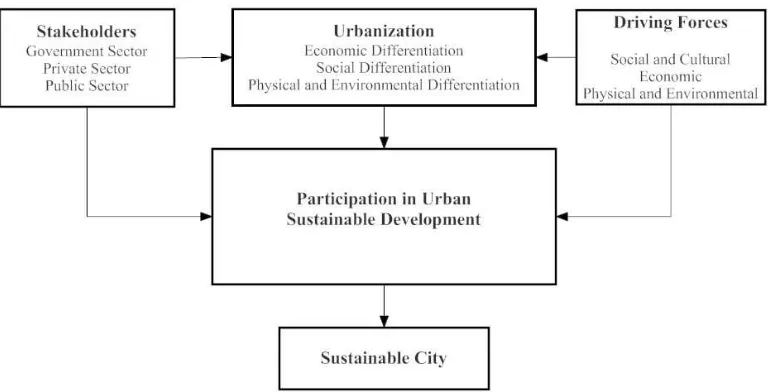
1. The best practices issued by city stakeholders for developing Udon Thani
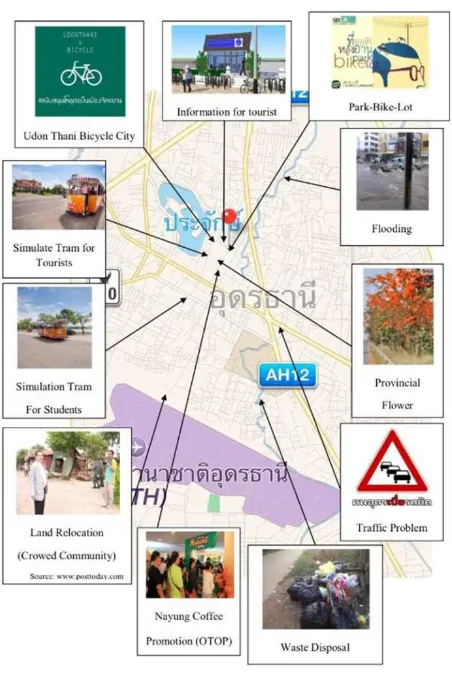
1.1 Social and cultural The solution for the slum dealing with drugs and criminal problems was cooperated with by city development-related agencies, including the government sector and the local community. The slum was moved to a new place, namely Ban Mun Kong, where it was supported by the government budget, which built infrastructure and houses. Public agencies also cooperated with the government to conduct activities such as a rescue group to help citizens in case of emergency, or the cross-national couple group that conducted voluntary works for the local community such as teaching English to young people and police assistants. The cross-national couple group was dealing with the local government also to ask for good support from the government on social security.
reducing traffic congestion by persuading persons to use the tram, especially during the prime times. To achieve the projects, the governor has established a foundation of strategic development to study the possibilities for the projects. However, the projects are in the process of project feasibility studies.
From the abovementioned activities, the key to the activities is the cooperation between government sector, private sector, and public sector in city management by focusing on the collective benefits of Udon Thani.
1.3. Physical and environmental Regarding the growth of the city which took place rapidly, the growth caused impacts on and significant changes to the physical environment of the city. Residents who live within the city center and suburbs started taking interest in the issues and expressing their feedback on social networks. In addition, some residents or NGOs tried to group persons concerned with the same issues and set small stages to discuss the issues. Physical and environmental issues were key issues that have affected the city significantly. Issues that Udon Thani is dealing with include traffic congestion, waste disposal, and flooding. However, it was found that activities that were conducted by the public sector were not of as much interest to the government or private sectors
Figure 1 Framework of Udon Thani urban development
2. Conditions influenced the best practices of city development by public sector
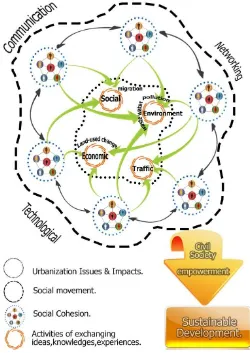
2.2. Communication technology. Communication technology currently is considered a crucial tool to group the city societies. Technology could help local people access information related to city planning, especially via social networking, which is popular at present. Social networks are a tool to access information and could exchange information between persons rapidly. This is another factor which boosted social cohesion in Udon Thani city.
Figure 2 The Best Practices from City Stakeholders for Developing Udon Thani
stage. 3) Participants would be equal. 4) Output of the discussion generated by the collective should benefit the city.
The two conditions reflected a view of social groups appearing in Udon Thani to participate in city management. City management should be conducted based on the participation of city stakeholders, including the public sector, which was directly affected by city policy. Social cohesion for exchanging knowledge, experiences, and ideas about the city issues related to urbanization and urban development was an interesting alternative choice. The activity was conducted by persons who got direct effect from urban development, while the social network would be used as a tool to share information with the public. During the discussion process, urban issues would be raised up by participants and discussed. There were 4 points that participants had to realize, including the following: 1) the group would raise clear issues or impacts. 2) No group leader or formal organization would be present during this discussion stage. 3) Participants would be equal. 4) Output of the discussion generated by the collective should benefit the city.
The results of the discussion would be summarized and applied to the next discussion until a conclusion was reached and presented to the public and government agencies related to city development.
Discussion
An interesting point from social cohesion which occurs in the present found that most of the discussion participants were middle class people with easy access to technological tools. Although there are more channels to access communication technology, people who have low incomes are still struggling to earn more income for living in the city. Although this group realizes they are directly affected and are concerned with the city problems, they still lack access to information. Due to their working conditions, it is quite difficult to see a group established by lower-income people. This topic should be of concern to the government and private sectors, and these sectors should be concerned with providing proper tools for accessing information, and with allowing more opportunity for participation.
sector and the private sector should be allowed to participate in policy issuance to lead the city to develop with a good balance in economic, social, and environmental perspectives.
Figure 3 Social cohesion of city development by public sector
Acknowledgements
References
Ban Lee, G. (2012). Governance and Accountability in Southeast Asian Cities. In Kioe Sheng, Y. & Thuzar, M. (Eds.). Urbanization in Southeast Asia ISSUES & IMPACTS (pp. 341 - 358). Singapore: Mainland Press.
Brillantes, Jr., A. B. & Flores, H. P. (2012). Decentralization and Good Governance in Southeast Asia: Focus on the Philippines, Indonesia, and Thailand. In Kioe Sheng, Y. & Thuzar, M. (Eds.). Urbanization in Southeast Asia ISSUES & IMPACTS (pp. 293 - 319). Singapore: Mainland Press.
Chaloemtiarana, T. (2009). Thailand: The Politics of Despotic Paternalism. Bangkok: The Foundation for the Promotion of Social Science and Humanities Textbooks Project, Chulalongkorn University. Chareonsin-orarn, C. (2011). Development Discourse (5th ed). Bangkok: Vibhasa Publishing.
Dhiravisit, A. (2010). Principle of Community Development. Khon Kaen: Khon Kaen University.
Kioe Sheng, Y. & Thuzar, M. (2012). Urbanization in Southeast Asia ISSUES & IMPACTS. Singapore: Mainland Press.
MunHeng, T. (2012). Competitive Cities and Urban Economic Development in Southeast Asia. In Kioe Sheng, Y. & Thuzar, M. (Eds.). Urbanization in Southeast Asia ISSUES & IMPACTS (pp. 115 - 138). Singapore: Mainland Press.
Permtunjit, K. (1993). Theories and concepts of urbanization. Bangkok: Creative Publishing Company Limited.
Pongsiri, N. (2012). Public-Private Partnerships and Urban Infrastructure Development in Southeast Asia. In Kioe Sheng, Y. & Thuzar, M. (Eds.). Urbanization in Southeast Asia ISSUES & IMPACTS (pp. 139 - 153). Singapore: Mainland Press.
Prompakping, B., et al. (2013). The Land-use Changes and Social Vulnerability of Udon Thani City. Khon Kaen Research Group on Wellbeing and Sustainable Development Khon Kaen University. Sarosa, W. & Anggriani Arifin, F.P. (2012). Contexts and Challenges in Engaging Local Governments for
Sustainable Urban Development in Southeast Asia. In Kioe Sheng, Y. & Thuzar, M. (Eds.).
Urbanization in Southeast Asia ISSUES & IMPACTS (pp. 320 - 340). Singapore: Mainland Press. Thant, M. (2012). Regional Cooperation and the Changing Urban Landscape of Southeast Asia. In Kioe
Sheng, Y. & Thuzar, M. (Eds.). Urbanization in Southeast Asia ISSUES & IMPACTS (pp. 154 - 171). Singapore: Mainland Press.
Process of Building Confidence in The Prepartion of The Infastructure of The Local Government Organzations in The Northeast Region
Jariya Chatasuwatchananon
Ph.D. student, Department of Public Administration, Faculty of Humanities and Social Sciences, Khon Kaen University
Lecturer, Department of Public Administration, Faculty of Political Science and Law, Kalasin Rajabhat University
Abstract
The local government organization is a part of the government administration which is based on the principle of decentralization. According to the Act of Parliament in the plan and the process of decentralization given to the local government organizations in 1999, the government section transferred its mission to the organization which has been referred to the task that the local government organizations obtained from the central government and the provincial government section. In particular, the development of infrastructure has to decentralized to the public who have to take action and respond to the needs of the community. According to the sayings, “The water flows, Bright light, Good roads” which indicate the quality of life in the community and indicate the importance of infrastructure system of the community.
From the mentioned issues, every local government organization realizes and is aware of the needs in infrastructure of the community as well. Therefore, this article is part of the research “Process of Building Confidence in the Preparation of the Infastructure of the Local Government Organzations in the Northeast Region” the objective is 1) To study the level of confidence of the public on the local government organizations in the preparation of the infrastructure. 2) To study the causal factors affect the confidence of the public in the preparation of the infrastructure of the local government organizations.
The study found that: 1) Currently the community or local organization has been strengthened quite a few. and 2) Some government officials are accustomed to the state as a key player in managing the affairs of society. The results from this study will be used to effectively develop the infrastructure of the local government organizations and respond the community’s needs.
Introduction
The local government organization is a part of the government administration, which is based on the principle of decentralization. According to the Act of Parliament in the plan and the process of decentralization given to the local government organizations in 1999, the government section transferred its mission to the organization which has been referred to the task that the local government organizations obtained from the central government and the provincial government section. The mission has been classified into six aspects of public services namely: 1. Infrastructure 2. the promotion of quality of life 3. community organizing and maintaining peace and order 4. planning of investment promotion, commerce and tourism 5. Management and conservation of natural resources and environment, and 6. culture, custom and local wisdoms.
In particular, the development of infrastructure has to decentralize to the public who take action and respond to the needs of the community. According to the sayings, “The water flows, Bright light, Good roads” which indicate the quality of life in the community for a long time and also indicate the importance of infrastructure system of the community. Today, the local government organizations survey the people’s needs of public services or their complaint data about the public services, it can be found that the urgent priority demands are building and maintenance of public utilities such as roads, bridges, footpaths, drainage sewer, water supply, lighting, public parks, canals and ditches.
Currently, there are several constraints in doing the infrastructure such as budget limitation because the construction and maintenance of public utilities requires a lot of money, whereas the local government organizations have limited annual budget. Furthermore, these organizations are controlled in terms of loaning or borrowing money to invest and are banned to set on long-termed budget in several consecutive years of investment.
Most of the localities have to wrest supported money from the government grant-in-aid money projects. This aspect requires major political party lines or connections so this is a much challenging limitation for local administrators. Another limitation is the limitation of management, especially the sevice of public utilities that has various types of them which can be administrated and managed by using the market mechanism; many private sectors can bid to run the projects and keep of manage the service fees from the people. However, most of the local government organizations lack of the knowledge and experience in the management and administration their public utilities in commercial fields so the local government organizations dare not start to run the projects. The last limitation in not having transparency; corruptions and hidden benefits in the construction, improvement, maintenance of local and central government public utility system. There were plenty of corruptions which occurred widely; therefore, people distrust and oppose to invest in these projects though there is a huge demand for them.
may be different. This issue can how often challenge the local administrators’ abilities. Therefore, the researcher is interested in studying the process of building confidence in the preparation of the infrastructure of the local government organizations in the northeast area. The results from this study will be used to effectively develop the infrastructure of the local government organizations and respond the community’s needs.
Objectives
1. To study the level of confidence of the public on the local government organizations in the preparation of the infrastructure.
2. To study the causal factors affect the confidence of the public in the preparation of the infrastructure of the local government organizations.
Literature Review
The research: “Process of Building Confidence in the Preparation of the Infrastructure of the Local Government Organizations in the Northeast Region” uses concepts theories and researches as guidelines as follows:
1. Concepts and theories of confidence 2. Concepts of decentralization
3. Concepts of infrastructure
Level if confidence of public in the preparation of the infrastructure
Causal factors affecting to confidence
Infrastructure - Roads - Water system - Electricity system - Canals, Ditches - Footpaths - Public parks
Guidelines to build confidence in the Preparation of the infrastructure of the local government organizations
Conceptual Framework
Methodology
This research is a quantitative and qualitative research and is determined by the following procedures:
1. The population samples and sampling methods 2. Data collection
3. The research instruments used in the study Population Samples and Sampling Methods
The population of this study was individuals who live in the area of responsibility of the local government organizations in the northeast. The study was defined the study population into 4 groups.
1. The board of administrators including the Mayor, the Deputy Mayor. By using the purposive sampling which were qualified to relate to the position, duty and role management and have the support in the infrastructure.
3. Community leaders including the President, the Vice-president of the community. By using purposive sampling which were qualified to have a supervisory role, responsibility of maintenance the roads, bridges, public parks, setting locations and electrical services.
4. People who live in the area. The study areas will be divided by the population of the area into 2 districts and select 2 areas from each district as follows:
- Upper Northeast Region, including
Ban Phai Town Municipality, Amphoe Ban Phai, Khon KaenProvince Nonsamrong Town Municipality, Amphoe Muang, Udon Thani Province - Lower Northeast Region, including
Sikhiu Town Municipality, Amphoe Sikhiu, Nakhonratchasima Province.
Phibun Mangsahan Town Municipality, Amphoe Phibun Mangsahan, Ubon Ratchathani Province
Data Collection
1. Document Research: This study explores the various documents involving in both Primary and secondary documents in order to bring to discuss and analyze in conjunction with the information obtained from in-depth-interview and focus group
2. Questionnaire: The questionnaire was used to measure the level of confidence of the public towards the local government organizations in the preparation of the infrastructure and find out the causal factors that affect the confidence of the public in the preparation of the infrastructure of the organizations.
3. In-depth Interview: This method was used to interview the Mayor, Deputy Mayor, Municipal Clerk, Director of Engineering Department, Officers of Engineering Department, Civil Engineering Sector, Department of Utility and community leaders in the community. The population samples were selected by using purposive sampling which is a consideration of the objectives of the study.
4. Focus Group Discussion: This method was to talk to the people, brainstorm together in order to obtain the information for analyzing. The group discussion was divided into 8 groups. Each group consists of 6 members.
Research Instruments
The instruments used in this study were as follows:
Qualitative: Tools used to collect data collection, namely semi-structured interview.
Quantitative: Questionnaires were used to collect data. The statistics was used to analyze data was Path Analysis.
Finding
The First objective was to study the level of confidence of the public on the local government organizations in the preparation of the infrastructure.
1. The nature of the involvement of the public in the preparation of the infrastructure. Due to the urging of thought or consciousness. By institutions or organizations Presents workshops and seminars for community leaders and citizens, both formal and informal. By nature of its continuous years. With funding from several sources. So when the municipality carried out various projects. The public suspicion or doubt in the transparency of such abuse. Or the amount spent perhaps too much so.
2. It is evident that the form of participation of the public in the preparation of the infrastructure of the organization. By implementing the public itself is possible. And effective form Therefore, the role of the municipality is exploring the potential of local communities. And allows them to express themselves Do not interrupt or a community in a negative light that is hostile to the state in order. People will be able to develop a strong and monitoring local authorities more effectively.
The Section objective was to study the causal factors affect the confidence of the public in the preparation of the infrastructure of the local government organizations.
3. In the public sector took part in the preparation of the infrastructure of the municipality. The province There are some limitations and some issues to keep in mind is.
Firstly, local Currently, the community or public organization has strengthened quite a few. In proportion to the number of local government units across the country. This may be due to the complexity of social and everyday tasks that much easier. As well as attracting the attention of the people to spend more time with their matter, such as leisure activities and hobbies, which has attracted over. Thailand has made people more individualistic.
Third, government officials, some still accustomed to the state as a key player in managing the various aspects of society, officials may look at the expression of the people in a negative way and behaviors that hinder the growth of the role of the public sector. At the same time the expression of the self, it might be motivated by a reward. Or get the wrong information. The political interests of any party.
References
Kitti Cumpeera. (1997). Resolving Conflict in environmental infrastructure. Documents academic year 1997 EIT Nationals 20 to 23 November 1997. The Queen Sirikit National Convention Center: The Engineering Institute of Thailand.
Kawsun Atipoti. (1 9 9 6 ). Citizens to participate in the drafting of the new constitution: the key to Thailand's political development. Bangkok: Institute for Local Community Development. Kanungnit Sibuwaim and others. (2 0 0 2 ). Study Report Guidelines for strengthening participatory
democracy by the Constitution of the Kingdom of Thailand BE 2 0 0 4 : Problems and Solutions. Nonthaburi: KPI.
Tawil Bureekul. (2009). Dynamic participation of the people from the past to the Constitution of the Kingdom of Thailand BE 2007. Nonthaburi: King Prajadhipok Institute.
Pacharee Siroros. (2003). Guide to the participation of the public. Bangkok: Thammasat University. Prayun YaKanong. (1 9 9 5 ). The attitude of the public towards the public services of the Local
Government: A Case Study of Chachoengsao. Public Master Thesis Branches of government Chulalongkorn University.
Pruchaya Vasaruch. (1 9 9 6 ). Transforming public: the Future: Strategies for Development. Bangkok: Foundation.
Globalization and the Enforcement of Local Administrative Regulations on Open Air Burning
Damorn Kumtrai
Lecturer, Law Program, Faculty of Integrated Social Science, Khon Kaen University, Nong Khai Campus
Abstract
The transboundary haze pollution problem is one of the important issues in the international society. The globalization concept has been brought to deal with the problem through the international laws providing common standards. Such international law, however, has a limitation on the enforcement and the monitoring system. The local administration organizations play an important role on the haze pollution management. The operation of local administration organizations shows the interaction between the local community and the impact of globalization which has driven the enforcement of the legal instruments in the global and local levels. This paper explores how the transboundary haze pollution problem has been tackled by the power of the globalization with the shared consciousness of the people rather than relying only on the legal instruments.
Introduction
Globalization is generally interpreted in the context of the liberalization of the economic, culture and the cyber network, while the environmental concern related to the globalization has received less attention from the public society. To some extent, the environmental concern in a global trend has been transformed to the campaign of quality of the city life for instance, cycling to save the gasoline, or the use of fabric bag to reduce the emission. In the aspect of the international relations, the environmental concern at the global level is the consequence of the globalization since it draws a common consciousness of global citizens to share the same concern.
The features of globalization in term of the global ecology include the causes of environmental change from the manifestation and the globalizing activity, which was driven by the political policy through the role of media and advertising. (Newel, 2012: 7-8) It is undeniable that in the modern society our perception on environmental concern has been shared by people around the world. The media which unify the whole world as a same unit takes a leading role in the spreading the information.
Although the transboundary pollution was primary known in the 1930s (Halvorssen, 2013, p. 29) the environmental concern was concrete appeared in the early twenty-first-century with the concerns about the world energy consumption and the climate change. (Newel, 2012, p. 22) Since then the world politics on environmental policy has been operated through the international environmental law to create the global standards and the international binding instruments among the states. Unlike the domestic laws, the international law is a globalization instrument, it does not come from the national legislative organizations nor have the same enforcement’s levels. The international relations principles and the international politics are the key factors in the enforcement of the international law. Both the international law and the regional law will be effectively enforced by the support of the government policy. At this stage, the notion of the state’s sovereignty has been challenged. Nevertheless, in the modern concept of international relations, non-state actor is recognized as one of the alternative choices for the transnational network development including the transnational problem for the environment. The movement of the civil society and the sub-organization of government have paved the way for the unification of the member of global society. (Keck and Sikkink, 2012, pp. 221 - 224)
have been legislated and issued for the enforcement in the country. Even though these tools have never been achieved in resolving the transboundary air pollution problem mainly because of the territorial principle of domestic laws and policies, this paper aims to explore the role of the local government organizations in addressing the international environmental problem with the driving force of the globalization.
Thai government has decentralized the power to the local administrative organization for the enactment of the local regulations to control the open air burning in their specific control areas. This situation has shown how to address the global environmental concern through the local laws channel. Even though there is no direct linkage between the international law and the local laws, these local regulations have been unintentionally issued in parallel with the trend of international and regional controlling regulations. The situation somehow shows the power of globalization which mainly based on the international law to the local governmental organizations in the country. The study of this likeness can explain the impact of the globalization that supports the law enforcement at the global and the local level. To explain the impact of globalization to the enforcement of local administrative regulations in particular, I divide the impact of globalization in three aspects, firstly on the transboundary haze pollution problems as a global concern, secondly on the Southeast Asia Management on Transboundary Haze Pollution as a regional concern and finally on the local administrative laws as a local concern.
1. Globalization and Transboundary Haze Pollution Problem
The Globalization concept has been explained in many aspects and with definitions. Some scholar defines the globalization with the terms of deterritorialization or supraterritorialism (Scholte, 2002, p. 26) which perceives a common humanity. (Chirico, 2014, p. 13) While some scholar defines the globalization as "a concept refers both to the compression of the world and the intensification of the consciousness of the world as a whole...both concrete global interdependence and consciousness of the global whole." (Robertson, 1992, p. 8) or "...the intensification of world-wide social relations which link distant localities in such a way that local happenings are shaped by events occurring many miles away and vice versa..." (Giddens, 1990, p. 64) In summary, the globalization concerns the interconnection of the global society while the activities across boundary are interdependence; it also involves the making of global consciousness. (Holton, 2005 in Martell, 2010, p. 12)
The environmental concern occurred in the period of transnational politics and culture, before the cyber space era. The transboundary haze pollution draws attention from the international society and the international lawyer in the land mark case called "Trail Smelter Case". In 1938, Canada established the smelting plant in Trail, British Colombia where nearby the Washington State of United States. The activities of the smelting plant produce the Sulphur Dioxide fumes which widespread to the air and cause the damage of the farm area in Washington. The United States requested for the dispute solutions from the International Arbitration. (Halvorssen, 2013, p. 29) This issue has grown due to the globalization in the context of the international relations.
In 1979, the international relations addressed the environment issue by the presentation of the first international legal binding instrument concerning the transboundary air pollution, the Geneva Convention on Long-range Transboundary Air Pollution. This instrument was accepted by United Nations Economic Commission for Europe. Based on the diplomatic method of fundamental principles of this international instrument, the contracting parties need to the exchange of information, consultation, research, the co-operation for research development and monitoring, in order to eradicate the air pollution as well as the effort in both national and international level.1 This instrument is limitedly accepted by the European countries2 and the dispute settlement channel covers negotiation or by any other method dispute settlement accepted by the contracting parties.
In 2001, the United Nations International Law Commission published the Draft Article on Prevention of Transboundary Harm from Hazardous Activities3 to standardized the control of transboundary pollution supported by the globalization. The prospects of globalization as defined as "relating to the whole world" differ from the internationalization and the international. (as "two or more nations") (Gopinath, 2008, p. 9) Therefore, the making of global consciousness on transnational haze pollution need to process in a large scale as the global standard by the international law. Then the international law on transnational haze pollution needs to work towards the establishment of the global environmental concern rather than the concern for limited state parties.
In term of postmodern approach, the popularity of environmental concern is the symbol or consciousness of the world society. (Martell, 2010, pp. 36 - 37) Even the territorialism still prevails in the world of nation-state concept (Anderson, 2009, pp. 9 - 10), the environment policy was processed through the homogenization concept of Globalists. (Martell, 2010, p. 24) If the global instrument as the
1 Article 3 of The 1979 Geneva Convention on Long-range Transboundary Air Pollution. 2 Article 9 of The 1979 Geneva Convention on Long-range Transboundary Air Pollution. 3 International Law Commission (http://www.un.org/law/ilc/)