ISSN 1450-216X Vol.49 No.3 (2011), pp.354-376 © EuroJournals Publishing, Inc. 2011
http://www .eurojournals.com/ejsr.htm
"'
Sales Efficiency of the Indonesian Retail Bond (ORI) and Its
Implications on Marketing Strategy
Susy Liestiowaty ..)
Graduate School of Management and Business, Bogor Agricultural University, Indonesia
E-mail: [email protected] Ujang Sumarwan
Department of Family and Consumer Sciences and Graduate School of Management and Business Bogor Agricultural University, Indonesia
E-mail: sumarwan @mma.ipb.ac.id Noer Azam Achsani
Department of Economics and Graduate School of Management and Business Bogor Agricultural University, Indonesia
E-mail: [email protected] and [email protected] Nunung Nuryartono
Department of Economics and Graduate School of Business Management Bogor Agricultural University, Indonesia
·E-mail: [email protected]
Abstract
This study aims to assess the efficiency of the Indonesian Government Retail Bond known as ORI (Indonesian Retail Bonds) at every branch of BRI (Bank Rakyat Indonesia, an Indonesian commercial bank) in order to obtain a comprehensive study on marketing strategy of ORI that is applicable for the Bank. The method used to analyze the efficiency is SFA (Stochastic Frontier Analysis) method, using number of marketers and marketing costs (marketing promotion cost plus overhead costs) as inputs, while the output is selling fee income of each branch.
The five branches of BRI, namely: Jakarta Pasar Minggu, Jakarta Hayam Wuruk, Kramat Jakarta, Medan Iskandar Muda and Jayapura become the five most efficient branches in conducting sales of ORIOOl-005. Those branches have average cost per marketers ranges from Rp.533.750 to Rp.1.036.173 while their ORI sales target ranging from Rp.220.000.000 to Rp.7.921.666.667.
Based on the research results, the effective marketing strategy that can be applied to all branches of BRI is to set the sales target of Rp.l.494.000.000 and marketing cost of Rp.1.036.173 (which consists of marketing/promotion cost and marketers' overhead cost) in order to obtain a profit of Rp.5.754.736 per-marketer.
1. Introduction
The threats of a global economic recession, rising oil prices on world markets and the volatility of financial markets are serious. Moreover, inflation and food security are also at risk for macroeconomic stability. One of the Indonesian government's efforts to anticipate the negative impact of U.S. recession is by securing the state budget as the anchor of the national economy.
Anticipation of the structure of the national budget (APBN) is an instrument to manage expenditure and income in order to finance the implementation of government's actions and development, achieve economic growth, increase national income, achieve economic stability, and determine the direction and priorities of the country's development in general. In this case, the APBN has the function of authorization, planning, monitoring, allocation, distribution, and stabilization. All entitled revenue and expenditure of the state in a fiscal year must be included in the budget. Surplus state revenue could be used to finance state spending in the next fiscal year.
APBN's financing instruments include, among others (Warta BI, 2006): First, taxes CQnsisted of income tax (PPh), Value Added Tax (PPN), Customs, and Regional Taxes. Custom tax and import duty is not merely an instrument of revenue, but also an instrument for development which means to improve competitiveness, and facilitate the flow of goods. Second, money printing associated with setting up the seigniorage profit from printing new money and how seigniorage can benefit the people. Seigniorage is the difference between the face value of money with the cost of printing the money, therefore, it is categorized as income.
Third, privatization of BUMN (State Owned Enterprises), Fourth, foreign financing, which includes withdrawal of foreign loans, consisting of program loans and project loans, and foreign debt principal repayments, consisting of Maturity and Moratorium.
Fifth, the Government Securities which covers the State Islamic Securities (Sukuk SBSN or State), SPBN (Treasury Bills), ORI (Retail Government Bonds) and Global Bond. The Government has issued various bonds, including Government Securities (SUN) for corporate investors, the Indonesian Retail Bonds (ORI) for individual investors, and will also publish Treasury Bills (NES), which is short term (tenor) and have no interest(zero coupon) and Sukuk (Islamic bonds) that are based on underlying transactions and underlying assets (collateral). The issuance of these bonds serves as the government's commitment to rely on domestic financing sources, aiming to expand the domestic investor base and also to reduce the risk of exchange rates. In addition, to finance the deficit spending, rupiah is generally used.
Bonds is one of the extremely imp01tant financial instrument or portfolio investment vehicle in a capitalist economy in addition to stocks and other securities. At a country level, particularly developed countries, the issuance of government bonds has been a common practice for their budget shortfalls. The U.S. economy crisis triggers investors pouring into the bond markets of developing countries. Each of the bonds being offered is always oversubcribed or getting excess demand. Injection of positive sentiment to the emerging market countries is actually growing since the U.S. subprime mortgage crisis which caused the Fed continues to cut rates.
This is evident from the Asian bonds that still give up to 5.4 % profit in the third quarter of 2007 despite the volatility in world markets. Throughout 2006, Asian bonds were capable of generating profits up 13.6%. Improved performance of Asian bonds was supported by the increase in macroeconomic fundamentals, improvement in credit quality, government policies that create economic growth and market stability. In addition, the Asian bond ratings also continue to rise (Inilah.com, 2007).
2. Literature
Review
2.1. Changes in Financing Patterns in Developing Countries
Since the monetary crisis in 1997, government and companies' securities were increasingly prevalent in the issuance and trading in the secondary market. The interesting th\ng with the development of these bonds is the existence of substitute placement money from traditional debt securities as time deposits in banking institutions. In governmental and legislative circles, government bonds is currently discussed frequently because it becomes an important debt instrument used as a source of financing for government budget.
There is a lot of debentures' issuance in the developing countries category (emerging markets). For example for Asian countries amounted to 11.95%, Europe amounted to 9.98%, and the Middle East and Africa amounted to 5.65%, while Latin America amounted to 72.42% (Medialndonesia.com, 2006).
The transition from bank loans' crisis into bonds crisis begins with a process of bank loan securitization to debt securities (Brady bonds); therefore, the role of Brady bonds is significant for emerging markets. In Indonesia case, the monetary crisis in 1997 led to a greater issuance of bonds than the issuance of stocks. Factors that drive bond issuance, among others are: interest rate cuts since 1999, difficulties in launching a national banking credit, thereby encouraging companies to issue bonds to meet its funding needs, and lack of confidence of foreign investors to Indonesia. Generally, the bond issuance proceeds are used to cover part of the due obligation (debt restructuring), company's expansion needs, and working capital requirements.
Research by the International Organization of Securities Commissions (IOSC) (May 2002) which examines the development of bond markets in the domestic market for ASEAN members have concluded that the main reason for the issuance of bonds is as an alternative to domestic debt financing, second, it has a lower cost capital than borrowing from banks, third, it reduces the risks associated with debt maturity mismatches (eg, banks tend to do short-term) and the dominance of corporate earnings in local currency (currency). Fourth, expand the role of capital markets, fifth, credit risk pricing efficiency, sixth, financial stability (which during the charging of credit risk at banks).
However, the World Bank study (1995) argued that changes in corporate finance from bank loans into bonds in emerging markets generally summarized as follows: since 1990, the growth in the number of bonds in domestic and international markets will reduce dependence on bank financing. These financing changes happened due to the importance of investments in infrastructure and capital-intensive projects that require long-term capital debt and fixed costs (fixed rate). In terms of funding requirements with a fixed cost in the long term, the risk of interest rates' fluctuations in the future is not major.
Particularly in Indonesia, the number of corporate bond issuance is much smaller compared to the government's issuance. The government used the funds from bond issuance's proceeds to cover the shortage government spending and to repay the debt, therefore, the issuance of bonds does not directly improve the domestic investment is thus will not trigger higher inflation.
Looking at the experience of developed countries, the issuance of public debt (bonds) is not only for single issuance. Along with time and economic development, debt issuance tends to be continuous (on-the-run issues) and reflects the need for funding in future. Moreover, it is larger compared with the level of savings. Thus it can be predicted to reduce the uncertainty of rising inflation.
But in terms of interests, which may affect the public more, (especially with the current large unemployment rate); a policy should be made between the issuance by the corporate government bonds. Issuance of corporate bonds that are used in business purposes will be more rapid expansion of the public felt in terms of labor absorption.
(
Government Retail Bonds (ORI) and Sukuk Retail (SR). Nowadays, the aim of ORI issuance is to recapitalize banks and credit financing program. State debt portfolio management aims to minimize debt interest costs at a tolerable level of risk. For that, portfolio debt must be done in an efficiently, based on the practices generally accepted in various countries. These portfolio management includes the issuance, redemption prior to maturity (the buyback), and exchange (swap bond) portion of the outstanding state bonds.
The issuance of ORI is also designated as fiscal instruments, investment instruments, and financial market instruments. For Fiscal Instruments, ORI is expected to explore the potential sources of financing a larger budget from capital market investors. As an Investment Instruments, ORI is expected to provide investment alternatives that are relatively free of default risk and provide opportunities for investors and market participants to diversify their portfolios in order to minimize investment risk. As Instruments of Financial Markets, ORI expected to strengthen the stability of the financial system also can be used as a reference (benchmark) for determining the value of other financial instruments.
Based on data obtained from www.humas.depkeu.go.id, ORI has a significant contribution in reducing the budget deficit (Table 1).
Table 1: ORI Data Penjualan ORI dan defisit APBN Sales and the State Budget Deficit
ORI Publication Year Total Sales State Budget Deficit % to State Budget
(RpTrillion) (RpTrillion) Deficit
001 2006 3.283 32.1 7.74
002 2007 6.233 46.9 15.39
003 2007 9.367 46.9 15.11
004 2008 13.455 4.2 24 .20
005 2008 2.714 4.2 2.87
Source: Processed data
In Table 1 we can see that the issuance of ORI001 gave a significant contribution to the estimated budget deficit in 2006 which was announced at the beginning of the year that is equal to 7.74%. Similarly on the issuance of ORI003 ORI002 are able to contribute by approximately 15%. The highest contribution occurred in the issuance ORI004 that can cover nearly a quarter (24.2%) of the estimated budget deficit early in the year 2008.
In addition to being popular, ORI is also successful due to the yield offered to attract capital owners. Although ORI002 coupon interest (9.28 percent), ORI003 (9.4 percent), ORI004 (9 .5 percent) and ORI005 (11.45 percent) are lower than ORI001 by 12.05 percent, the funds flowing into the ORI is actually increased. This is due to the trend of declining market interest rates. Deposit interest rate which is usually used as a reference to individual investors, fell from 9.1 percent in mid-2006, and in early 2008 only reached 6.4 percent (Danareksa.com, 2008)
2.2. ORI Comparison with Japanese Retail Bonds
institutions, including the post office, in RGB sales. In Japan, the dealer incentive is 0, 5% of the RGB sales, therefore, in Indonesia, the selling incentive for ORI is recommended to be 1.0 to 1.5% and can be lowered in the next stages, it can be lowered gradually. Sixth, because the RGB in Japan is designed for investors to hold until maturity, the RGB in the secondary trading market is not active. A specific trading system is not necessary for all dealers and each dealer can build their own trading systems.
The existence of Government Retail Bond (RGB) in Indonesia is very important. It can be seen from: (i) the role of Government Securities (SUN) as a financing instrumer.t in the policy of increasing state finance , (ii) the need to enhance the credibility of government securities as a benchmark for investments in Indonesia through the expansion of SUN ownership among its residents .
Some banks are exploiting recapitalization funds, through the issuance of investment products based on the recap bonds . In general, banks will also enter the bond market, both corporate bonds and government bonds, either for placement of funds and also for the issuance of investment products based on bonds.
The breakthrough by these recap banks is something that has not been regulated by the government, therefore, a deviation that may reduce the credibility of the government is feared. But on the other side, the initiative is in line with the interests of the government to strengthen SUN as a more attractive alternative investment instrument in the long term.
Credibility of a government is a very important element in making government bonds as a benchmark for long-term investment activities in Indonesia. To achieve the required benchmark, an appropriate debt portfolio management is needed, so that the risk-free value inherent in government bonds can be recognized by investors. Therefore, the government is supporting the existence of retail bonds in Indonesia by expanding the ownership of government bonds.
The recent gap between government spending and tax revenues in Japan led to an increased issuance of government bonds. The Gap increased sharply from¥ 9.2 trillion Yen (1990) to¥ 40.1 trillion (in 2003). The highest tax revenue amounted to ¥ 60 trillion (in 1990) dropped drastically to ¥
41.8 trillion (in 2003). This condition causes a stagnate economy. Meanwhile, Japan's total government expenditure rose from ¥ 69.3 trillion (in 1990) to ¥ 81.9 trillion (in 2003). Therefore the Japanese government increased the issuance of Japanese Government Bonds (JOBs) from¥ 3.7 trillion (in 1990) to¥ 36.4 trillion (in 2003).
Figure 1: The Gap Between Tax Receipts and Total Expenditures and The Issuance of Government Bond
( 1990-2003)
r - -
c
.!5 -.:o .
セセ@
MQQQQjjN{INLNセ@
I
25 '
20 '
2J 26 7 i
21 2?6 _ _ / ... ..:H/
_ _ _. . ...--2
· ·1
7...-- £.
)5
1•1
Zセ@セui Gゥ@
Ill!
lij
J18
Z_NセQ@ セ@ JO I
,,. J.6 セ@..
MM セ LNLNN@ ... ') 13
·D
1m 1!191 ャAヲNャセ@ セAQYセ@ 1!1\lJ セセセ@ !\V£1E, セセセ W@ QsYセ@ ivL[セ@ 20:JO :1001 20:l2 2003
F•sc:JI Ye.lr
1-
セM MMM M MMMMMMMMMMMMMMMM
Gap セセAAAAAZZAGNセ@ Gov BondᄋᄋMᄋMMセMMMMMMMMMMMM
--...-ャョ\ャ・セウ@ Gap j..
MMMセ@
Source: Retail bond in Japan, Finance Bureau, Ministry of Finance, Japm ., October 7, 2004 T •; c
t J !)
r
J o セ@ 3.:.' 30 j HAw。エセ@
l
gセウエA@ ·, w! 2 5
' 2 0
T i セ@
1()
セ@
Along with the increased accumulation of the issuance of JGBs, this condition pushed the Japanese government to implement a good debt management strategy. The rationale of this debt management strategy is to stabilize the financing and to reduce costs in the long term. In Japan the majority of JGBs are held by institutional investors, where they are less stable than individual investors in the long term. Thus, increasing the portion of JGBs for individual investors is one way to achieve debt management strategy.
Generally, in long-term, individual investors tend to be relatively more stable in holding bonds . Thus, diversifying the composition of ownership of bonds (bondholder) with the emphasis on the individual will make the market more stable. This condition is the reason for the Japanese government to issue special JGBs for individual investors in March 2003. The retail bonds only for the individual circles are designed to be more attractive in various ways.
RGB has some characteristics, namely: First, the RGB target is only for individual investors. Second, the term is 10 years. Third, bond interest is variable (floating rate bond), which is determined based on interest bearing fixed interest rate JGBs term of 10 years and is paid every six months with a minimum guarantee interest rate 0.05%. Fourth, the fraction of bonds is a minimum purchase of 100 yen and¥ 10,000 (par). Fifth Interest is paid every half year (semiannually) and tax on interest at 20%. Sixth, after being held for one year, they may be sold back (redeemed).
Until2000, the Japanese government has issued as many as 17 times RGB (three times a year). For the first time RGB issued in March 2003 amounted to¥ 383.6 billion or 0.27% of total JGBs and in October 2004 increased to¥ 1,865.2 billion or 1.15% of total JGBs (Figure 4) Total accumulated RGB published from March 2003 until October 2004 had reached ¥ 8,406.9 billion or 1.46% of total JGBs. More than 50% RGB held by the retirees and housewives.
Figure 2: Tingkat Penjualan RGB (rnilyar Yen) RGB Sales (billion yen)
2000
/I1500
1000
1st
2nd
3rd
4th
5th
6th
7th
8th
Source: Retail bond in Japan, Finance Bureau, Ministry of Finance, Japan, October 7, 2004
In the retail distribution channel of government bonds, there is a primary market and a secondary market. In reality, the RGB trading in the secondary market is inactive due to the RGB design destined to be attractive to investors to hold RGB until maturity.
.---Along with the inactive trading in the secondary market, the Japanese government did not specifically design the RGB-trade system; therefore, the RGB dealers design their own RGB its trading system. For example, Nikko Cordial Securities in collaboration with Lawson, supermarket chains in Japan, in the design of its RGB trading system. Bank of Yokohama and the post office also have their own design that is completely different than the Nikko system.
In the secondary market, RGB involves three main things: processing and settlement, the incentive for dealers, and promotions. In the processing and settlement, investors can buy the RGB from banks, non-banking institutions, and the post office that own a lice11se to sell RGB. Before making reservations, individual investors must first open an account with the dealer. This account serves as a place to record cash flows from coupon payments and interest. Investors will be given a passbook such as the recording of accounting transactions related to RGB.
For the RGB trade, investors are given incentives by government in the form of 0.5% of its RGB sales. For the case of Bank of Yokohama, an investment of¥ 50 million for the construction trade system has paid for itself just from the sale of its inaugural RGB.
In terms of promotion, both the Ministry of Finance of Japan and the dealers are involved. Ministry of Finance of Japan promotes RGB by putting up advertising posters to the public. The dealers promote through: TV ads showing their baseball star, Ichiro Suzuki; TV shopping shows, the Internet, a special page or banner on Yahoo sites and sites for women, as well as links to Nikko Cordial website; seminar on Money Management; and opening an account at a dealer especially for RGB.
2.3. The Market Potential of Indonesian Retail Bonds
The Indonesian retail bonds potential can be predicted from the number of third party funds collected by banks and savings made by households. This type of investment is very liquid and can easily be moved into the retail bonds. In 2001, total public savings in the banking institutions reached Rp169, 35 billion as of April 2004 and increased to Rp247, 10 billion.
Table 2: GDP Ratio of Banking Savings and Deposits
Savings Savings Ratio Deposits Deposits Ratio
toGDP toGDP
2001 169.346 24,2% 250.759 16,7%
2002 189.421 21,7% 252.090 15,7%
2003 238.742 19,4% 243.621 13,8%
2004 {April) 247.103 MセM lセMセ@ - - - -- - - -231.865 Source: Bank of Indonesia
At the same time the total third party deposits in banking institutions declined from Rp. 250.76 billion (2001) to Rp 231.87 billion (April 2004). Although the savings volume of banking institutions increased, the total savings to GDP ratio in the period of 2001-2004 (April) fell from 24% to 19.4%, and the ratio of deposits to GDP fell from 16.7% to 13.8%.
Looking at the large potential of ORI's market, the government recommends two alternative designs for retail bonds: first is to be conservative two, is to be more attractive. Conservative retail bonds will be designed with an aim to expand the retail bond ownership among individual investors or households. In this case the volume of retail sales of bonds does not become the main target. The retail bonds design is not only intended to broaden ownership of the bonds among individual investors or households, but is also intended to achieve sales targets retail bonds.
low in cost and is safer. Furthermore, the people of Indonesia are already familiar with script less forms, such as savings accounts. Third, the short term i.e. 2-4 years was made. It is based on the consideration that these bonds are newly introduced to the public; therefore, it was designed with the short term. Besides, Indonesian people in general are used to investing in deposits with a maturity of 12 months or 24 months. Fourth, fractional retail bonds are Rp 250,000 or Rp 500,000. Analysis results as shown in table 4 can be used as a reference. The analysis result shows that the average surplus income in the lowest class households is 4.2 million per year. Assuming that 61% of the surplus will be invested in illiquid investments, the potential of liquid investments is 2.5 million. Assuming 10% of this potential will be invested in retail bonds, then the fraction is close to USD 250 000, -. However, if we assume 20% of potential retail will be invested in bonds, then the fraction is close to USD 500 000, -.Fifth, the maximum purchase is USD 50 million,- or USD 100 million,- To avoid the ownership of the retail bonds to a group of individuals or households, the purchase of retail bonds should be limited. Sixth, the interest rate. Most individual investors do not pay attention to changes in interest rates. However to encourage individual investors, or households that want to invest in retail bonds, a floating rate based on the SBI or SBI
+
1% is designed. The interest rate is far greater than the rate of savings or deposits. Moreover, it is also open to a fixed interest rate. If interest rates are fixed, the rate should be based on government bonds rates rather than with the issued retail bonds minus 1.5%. The reduction is very important considering the retail bonds shorter term, therefore; interest rates should be lower.2.4. The Role of Banks in Socializing ORI
One objective of the Government issued ORI is to provide education about long-term investment to the community in addition to involving society in developing the nation through the state budget financing. In order to make the ORI popular, the role of the banking industry is as a necessary as marketing media. Banking is expected to be the vanguard in penetrating ORI to the general public since the Indonesian economy is a bank-based economy, an economy that still relies on the existence of banks as a source of financing. Therefore, efforts to strengthen the banking system that are healthy, efficient and beneficial to the economy become the key to success in maintaining the sustainability of national economic development. It requires active participation of banking and one of them is by involving banks to contribute to the mobilization of public funds through the state budget financing instrument that is pointed to state-owned banks and private capital markets and financial institutions (securities companies) as the ORI agencies which allows sellers to collect funding from public sources in country.
BRI as one of the leading banks in Indonesia is participating as an ORI seller. As an agent there are two objectives to be achieved. First, is to assist the government in socializing ORI as one of the profitable investment instruments and to help finance the deficit of state revenue. ·
r- Second, a considerable source of revenue despite selling fee earned is still very small when compared to income from credit. However, if BRI was able to find the right strategy in terms of marketing it is possible for ORI's selling fees to become a source of considerable revenue in the near future.
However, it the risks should also be considered, which is when the cannibalism of ORI towards BRI' s deposit fund. It could be possible if the size of the financial market is not expanding, so the man who had been saving money in the bank then took the money to be placed in the ORI, unless the purchase was indeed from "new investors".
In a business environment where change is inevitable, successful companies are the ones that are able to effectively manage change and continuously improve the management, systems, strategy and organizational culture in order to continue to withstand the tight competition (David, 2002).
Bank which sells ORIOOl X-005, in order to obtain a comprehensive study on ORI marketing strategies that can be implemented by the next BRI.
2.5. The Analysis of Efficiency
In analyzing a comprehensive review of the ORI marketing strategy at BRI, then a calculation of efficiency needs to be conducted. Efficiency is the ratio between output and input, or the amount generated from an input that is used. So a bank is using efficiency when it is using smaller number of units when compared to the number of input units that are used with other banks to produce the same output, or when using the same input unit, can produce a larger amount of output (Permono and Darmawan, 2000).
Efficiency can also be interpreted as the ratio of output to input. There are three factors leading to efficiency, namely (a) if the same input can produce a larger output, (2) smaller inputs can produce the same output, and (3 ) with a greater input can result in even greater output (Atmawardhana, 2006).
Viewed from economic theory, there are two terms of efficiency, i.e. technical efficiency and economic efficiency. Economic efficiency has a macro point of view where its scope is more extensive than technical efficiency. Efficiency measurement techniques tend to be limited to technical and operational relationships in converting inputs into outputs. Consequently, efforts to improve efficiency only require internal micro policy, consisting of control and optimal resource allocation (Atmawardhana, 2006).
Tobin said there are four factors that lead to efficiency in financial institutions . The main factor is efficiency due to arbitration information. Second, efficiency due to accuracy of the asset-valuation. Third is efficiency for bank financial institutions ability to anticipate emerging risks. Fourth is the functional efficiency, which is related to the administration and the mechanism of payments made by a financial institution. Included in the functional efficiency of this are risk pooling, general insurance, administration, and mobilization of public funds (Atmawardhana, 2006).
Bank efficiency is one important indicator in analyzing the performance of a bank and also as means to further enhance the effectiveness of monetary policy. Efficiency can be viewed from two sides, namely in terms of costs (cost efficiency) and profitability (profit efficiency). Profit efficiency itself is divided into two, Standard Alternative profit efficiency and profit efficiency.
In general there are three basic concepts of the financial sector efficiency (banking), namely Cost Efficiency, Standard Profit Efficiency, and Alternative Profit Efficiency (Berger and semester in Siti Astiyah and Jardine A. Husman, 2006).
Cost Efficiency basically measures the cost of a bank compared with other banks that have the best operating costs (best practice the bank's cost) that produce the same output with the same technology.
Standard Profit Efficiency basically measures the efficiency of a bank based on the bank's ability to generate maximum profit at a certain price level of output compared with other banks' best operating profit level (best practice banks). This model is often associated with a competitive market condition in which the input and output prices are determined by the market. In other words, no banks can determine the prices of input and output prices; therefore, banks act as price-taking agent.
Standard profit efficiency is the ratio of profit that can be obtained from a bank, such as Bank N compared to a profit in the most efficient banks. For instance, from the above calculation, the profit efficiency standard is 80%, this means that bank N lost 20% of the profits that would otherwise be obtained if operate efficiently. Or in other words there is an inefficiency of 20%.
r
,.-.
At first, evaluation of the efficiency and productivity performance is measured using financial ratios. But according to some experts (Oral and Yolalan, 1990, Berger and Humphrey, 1992),
assessment of efficiency cannot be done partially, it has to take into account all output and all input. Based on the opinion of the performance measurement of efficiency and productivity, a parametric analysis, one example is the Stochastic Frontier Analysis (SPA).
In the SPA, it is assumed that inefficiencies follow an asymmetric distribution curve, in which random fluctuations followed by a normal distribution curve. Efficiency results are based on the scenes of the data. Each component of inefficiency that is more or less distributed symmetrically will be counted as random error, and each random error that is more or less distributed asymmetrically is calculated as inefficiency.
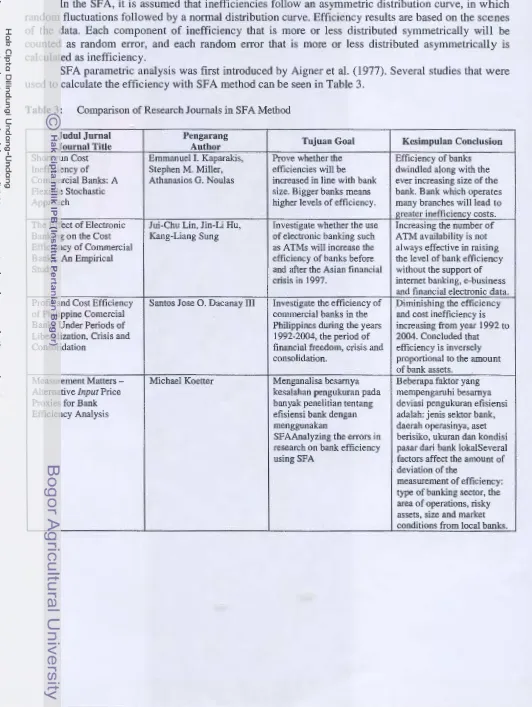
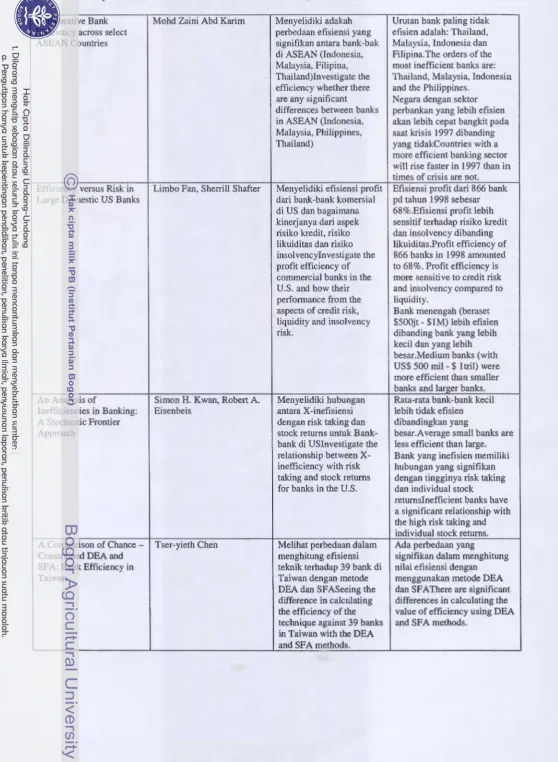
[image:10.611.56.588.76.783.2]SPA parametric analysis was first introduced by Aigner et al. (1977). Several studies that were used to calculate the efficiency with SF A method can be seen in Table 3.
Table 3: Comparison of Research Journals in SFA Method
Judul Jurnal Pengarang
Tujuan Goal Kesimpulan Conclusion
Journal Title Author
Short-run Cost Emmanuel I. Kaparakis, Prove whether the Efficiency of banks Inefficiency of Stephen M. Miller, efficiencies will be dwindled along with the Commercial Banks: A Athanasios G. Noulas increased in line with bank ever increasing size of the
Flexible Stochastic size. Bigger banks means bank. Bank which operates
Approach higher levels of efficiency. many branches will lead to
greater inefficiency costs . The Effect of Electronic Jui-Chu Lin, Jin-Li Hu, Investigate whether the use Increasing the number of Banking on the Cost Kang-Liang Sung of electronic banking such ATM availability is not Efficiency of Commercial as A TMs will increase the always effective in raising Banks: An Empirical efficiency of banks before the level of bank efficiency
Study and after the Asian financial without the support of
crisis in 1997. internet banking, e-business and financial electronic data. Profit and Cost Efficiency Santos Jose 0. Dacanay III Investigate the efficiency of Diminishing the efficiency of Philippine Co mercia! commercial banks in the and cost inefficiency is Banks Under Periods of Philippines during the years increasing from year 1992 to Liberalization, Crisis and 1992-2004, the period of 2004. Concluded that
Consolidation financial freedom, crisis and efficiency is inversely
consolidation. proportional to the amount of bank assets.
Measurement Matters - Michael Koetter Menganalisa besarnya Beberapa faktor yang
Alternative Input Price kesalahan pengukuran pada mempengaruhi besamya
Proxies for Bank banyak penelitian tentang deviasi pengukuran efisiensi
Efficiency Analysis efisiensi bank dengan adalah: jenis sektor bank,
menggunakan daerah operasinya, aset SFAAnalyzing the errors in berisiko, ukuran dan kondisi research on bank efficiency pasar dari bank lokaiSeveral using SFA factors affect the amount of
deviation of the
Table 3: Comparison of Research Journals in SPA Method.- (Continued)
Comparative Bank Mohd Zaini Abd Karim Menyelidiki adakah Urutan bank paling tidak Efficiency across select perbedaan efisiensi yang efisien adalah: Thailand,
ASEAN Countries signifikan antara bank-bak Malaysia, Indonesia dan
di ASEAN (Indonesia, Filipina.The orders of the Malaysia, Filipina, most inefficient banks are: Thailand)Investigate the Thailand, Malaysia, Indonesia efficiency whether there and the Philippines.
are any significant Negara dengan sektor differences between banks perbankan yang lebih efisien in ASEAN (Indonesia, akan lebih cepat bangkit pada Malaysia, Philippines, saat krisis 1997 dibanding Thailand) yang tidakCountries with a
more efficient banking sector will rise faster in 1997 than in times of crisis are not. Efficiency versus Risk in Limbo Fan, Sherrill Shafter Menyelidiki efisiensi profit Efisiensi profit dari 866 bank Large Domestic US Banks dari bank-bank komersial pd tahun 1998 sebesar
di US dan bagaimana 68%.Efisiensi profit lebih kinerjanya dari aspek sensitif terhadap risiko kredit risiko kredit, risiko dan insolvency dibanding likuiditas dan risiko likuiditas.Profit efficiency of insolvencyinvestigate the 866 banks in 1998 amounted profit efficiency of to 68%. Profit efficiency is commercial banks in the more sensitive to credit risk U.S . and how their and insolvency compared to performance from the liquidity.
aspects of credit risk, Bank menengah (beraset liquidity and insolvency $500jt- $1M) lebih efisien
risk. dibanding bank yang lebih
keci1 dan yang lebih besar.Medium banks (with US$ 500 mil - $ ltril) were more efficient than smaller banks and larger banks. An Analysis of Simon H. Kwan, Robert A. Menyelidiki hubungan Rata-rata bank-bank kecil Inefficiencies in Banking: Eisenbeis antara X-inefisiensi lebih tidak efisien
A Stochastic Frontier dengan risk taking dan dibandingkan yang
Approach stock returns untuk Bank- besar.A verage small banks are
bank di US Investigate the less efficient than large. relationship between X- Bank yang inefisien memiliki inefficiency with risk hubungan yang signifikan taking and stock returns dengan tingginya risk taking for banks in the U.S. dan individual stock
returnsinefficient banks have a significant relationship with the high risk taking and individual stock returns. A Comparison of Chance - Tser-yieth Chen Melihat perbedaan dalam Ada perbedaan yang
Constrained DEA and menghitung efisiensi signifikan dalam menghitung
SF A: Bank Efficiency in teknik terhadap 39 bank di nilai efisiensi dengan
Taiwan Taiwan dengan metode menggunakan metode DEA
DEA dan SF ASeeing the dan SF A There are significant difference in calculating differences in calculating the the efficiency of the value of efficiency using DEA technique against 39 banks and SF A methods.
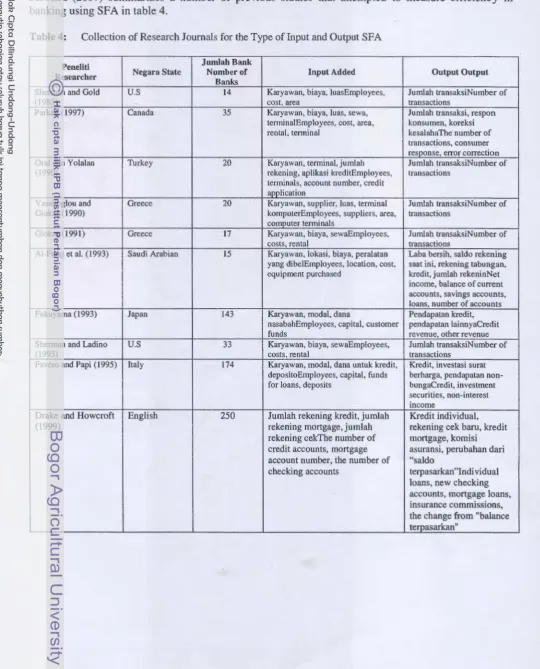
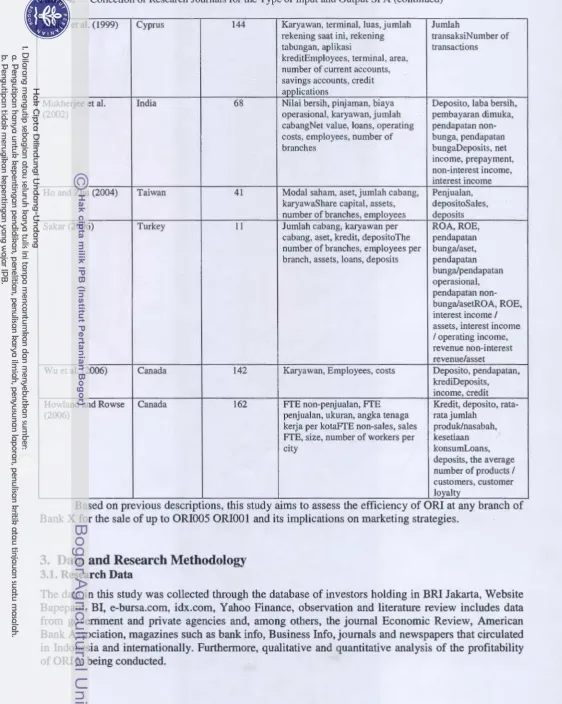
SFA method also relies on input and output values that are entered into the equation. Several previous studies are mostly conducted to calculate the efficiency in banking. Pastor et.al, (1995), Berger and Humphrey (1997) and Casu and Molyneux (2002) include loans and deposits as outputs. Hughes et.al (2001) began using cash flow function and then derives a function which will be minimized in order to determine the economic scale, productivity, and results of other technical measures. The study by Espitia-Escuer and Garcia-Cebrian (2004) use credit as output and used the number of employees, number of branches, deposits, and physical capital for input. Meanwhile, Mostafa (2007) summarizes a number of previous studies that attempted to measure efficiency in banking using SFA in table 4.
Table 4: Collection of Research Journals for the Type of Input and Output SFA
Peneliti Jumlah Bank
Researcher Negara State Number of Input Added Output Output
Banks
Sherman and Gold
u.s
14 Karyawan, biaya, luasEmployees, Jumlah transaksiNumber of(1985) cost, area transactions
Parkan (1997) Canada 35 Karyawan, biaya, luas, sewa, Jum1ah transaksi, respon
terminalEmployees, cost, area, konsumen, koreksi
rental, terminal kesalahaThe number of
transactions, consumer response, error correction
Oral dan Y olalan Turkey 20 Karyawan, terminal, jum1ah Jumlah transaksiNumber of
(1990) rekening, aplikasi kreditEmployees, transactions
terminals, account number, credit application
Vassilog1ou and Greece 20 Karyawan , supplier, luas, terminal Jumlah transaksiNumber of
Giokas (1990) komputerEmployees, suppliers, area, transactions
computer terminals
Giokas (1991) Greece 17 Karyawan, biaya, sewaEmployees, Jumlah transaksiNumber of
costs, rental transactions
AI-Faraj et al. (1993) Saudi Arabian 15 Karyawan, lokasi, biaya, peralatan Laba bersih, saldo rekening
yang dibelEmployees, location, cost, saat ini, rekening tabungan,
equipment purchased kredit, jumlah rekeninNet
income, balance of current accounts, savings accounts, loans, number of accounts
Fukuyama (1993) Japan 143 Karyawan, modal, dana Pendapatan kredit,
nasabahEmployees, capital, customer pendapatan lainnyaCredit
funds revenue, other revenue
Sherman and Ladino
u.s
33 Karyawan, biaya, sewaEmployees, Jumlah transaksiNumber of(1995) costs, rental transactions
Favero and Papi (1995) Italy 174 Karyawan, modal, dana untuk kredit, Kredit, investasi sural
depositoEmployees, capital, funds berharga, pendapatan
non-for loans, deposits bungaCredit, investment
securities, non-interest income
Drake and Howcroft English 250 Jumlah rekening kredit, jumlah Kredit individual,
(1999) rekening mortgage, jumlah rekening cek baru, kredit
rekening cekThe number of mortgage, komisi
credit accounts, mortgage asuransi, perubahan dari
account number, the number of "sal do
checking accounts terpasarkan''Individual
,r--.
Table 4: Collection of Research Journals for the Type of Input and Output SFA (continued)
Zenios eta!. (1999) Cyprus 144 Karyawan, terminal, luas, jumlah Jumlah
rekening saat ini, rekening transaksiNumber of tabungan, aplikasi transactions kreditEmployees, terminal , area,
number of current accounts, savings accounts, credit applications
Mukherjee et al. India 68 Nilai bersih, pinjaman, biaya Deposito, laba bersih, (2002) operasional, karyawan, jumlah
-
pembayaran dimuka,cabangNet value, loans, operating pendapatan non-costs, employees, number of bunga, pendapatan branches bungaDeposits, net
income, prepayment, non-interest income, interest income Ho and Zhu (2004) Taiwan 41 Modal saham, aset, jumlah cabang, Penjualan,
karyawaShare capital, assets, depositoSales, number of branches, employees deposits Sakar (2006) Turkey II Jumlah cabang, karyawan per ROA,ROE,
cabang, aset, kredit, depositoThe pendapatan number of branches, employees per bungalaset, branch, assets, loans, deposits pendapatan
bungalpendapatan operasional, pendapatan non-bungalasetROA, ROE, interest income I
assets, interest income
I operating income, revenue non-interest revenue/asset
Wu eta!. (2006) Canada 142 Karyawan, Employees, costs Deposito, pendapatan, krediDeposits, income, credit Howland and Rowse Canada 162 FI'E non-penjualan, FI'E Kredit, deposito, rata-(2006) penjualan, ukuran, angka tenaga ratajumlah
kerja per kotaFI'E non-sales, sales produk/nasabah, FI'E, size, number of workers per kesetiaan
city konsumLoans,
deposits, the average number of products I
customers, customer loyalty
Based on previous descriptions, this study aims to assess the efficiency of ORI at any branch of Bank X for the sale of up to ORI005 ORIOOl and its implications on marketing strategies.
3. Data and Research Methodology
3.1. Research Data
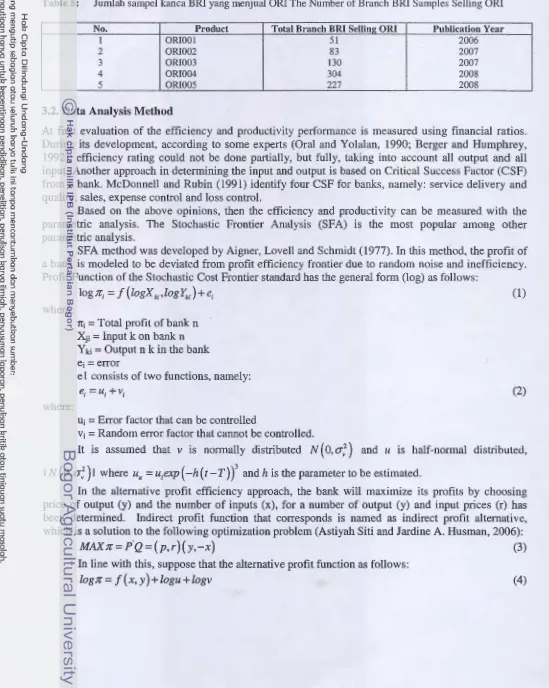
This study focuses on the research efficiency of ORI for a period of 2006-2008. Samples used in this study are data of ORI001 from 2006, ORI002-003 in 2007 and ORI004-005 in 2008. To calculate the efficiency of ORI in each branch of BRI, we will use ORI sales report data on each branch that sell ORI BRI. The number of samples used in the branch is different for each ORI product. List of BRI branch offices that sell ORI can be seen in table 5.
Table 5: Jurnlah sampel kanca BRI yang menjual ORI The Number of Branch BRI Samples Selling ORI
No. Product Total Branch BRI Selling ORI Publication Year
1 ORIOOl 51 2006
2 ORI002 83 2007
3 ORI003 130 2007
4 ORI004 304 2008
5 ORI005 227 2008
3.2. Data Analysis Method
At first evaluation of the efficiency and productivity performance is measured using financial ratios. During its development, according to some experts (Oral and Yolalan, 1990; Berger and Humphrey, 1992), efficiency rating could not be done partially, but fully, taking into account all output and all input. Another approach in determining the input and output is based on Critical Success Factor (CSF) from a bank. McDonnell and Rubin (1991) identify four CSF for banks, namely : service delivery and quality, sales, expense control and loss control.
Based on the above opinions, then the efficiency and productivity can be measured with the parametric analysis. The Stochastic Frontier Analysis (SFA) is the most popular among other parametric analysis.
SFA method was developed by Aigner, Lovell and Schmidt (1977). In this method, the profit of a bank is modeled to be deviated from profit efficiency frontier due to random noise and inefficiency. Profit Function of the Stochastic Cost Frontier standard has the general form (log) as follows:
where:
where:
logll";
=
J(logXki'logYk;)+e; (1)1ti = Total profit of bank n Xji = Input k on bank n Y ki = Output n k in the bank ei =error
e1 consists of two functions, namely:
e; =u; +v;
ui = Error factor that can be controlled
vi = Random error factor that cannot be controlled.
(2)
It is assumed that v is normally distributed N ( 0,
CJ';)
and u is half-normal distributed, I N ( 0,CJ';)
I where uu=
u;exp ( -h ( t-T)f
and h is the parameter to be estimated.In the alternative profit efficiency approach, the bank will maximize its profits by choosing price of output (y) and the number of inputs (x), for a number of output (y) and input prices (r) has been determined. Indirect profit function that corresponds is named as indirect profit alternative, which is a solution to the following optimization problem (Astiyah Siti and Jardine A. Husman, 2006):
MAXJZ"=P'Q=(p,r)(y,-x) (3)
In line with this, suppose that the alternative profit function as follows:
r
where:
n = profit or efficiency x
=
number of inputsy
=
number of output u and v=
errorSo the alternative profit efficiency can be written as follows:
7!
EFF
= ft" =exp
[
l,
(
x"'
y")
+log
(
u""
)]
=u""
Alt /l A [ A ( ) ( ) ] A
J!max
exp
fnx"'
y" +log u"mat
u"=x
(5)
Research variables used in this study for data input is the number of marketer's power and marketing costs representing the sum of the cost of marketer's power and promotion costs, while output is the fee for sales of ORI.
4. Results and Discussion
Studies on the efficiency of ORI sales at branches of BRI will serve as input to determine appropriate marketing strategies for the subsequent issuance of ORI, particularly the strategies associated with the CSF used as an input and output. The results of this study indicate what variables should be optimized by each branch for more efficient sales of ORI. The efficiency rate is based on benchmarking against the most efficient BRI branch in marketing ORI; therefore, the other branch can adopt the same efficient strategy.
The obtained result of the efficiency calculation is divided into several sections according to the type of ORI trading. Each section will have different efficiency results, however, it still be used to make a conclusion about a comprehensive for the next ORI marketing strategy.
In using the software Frontier 1.4 to calculate the efficiency based on the SFA method ,only one output and two inputs are required. Based on the assumption that the sales fee is proportional to the nominal ORI sold, and then one of them can be selected as the output. In this case, the ORI sales fee is selected as output, while the cost of marketing and promotion are combined into one input of marketing costs and another input is the cost of the marketer. In total there are two inputs used.
4.1. Efficiency of BRI Branch that Sells ORIOOl
Total incoming data from all branches of BRI that are selling ORIOOl is 33. Branch offices are spread across seven areas, namely: Bandung, Jakarta, Medan, Palembang, Semarang, Surabaya and Y ogyakarta.
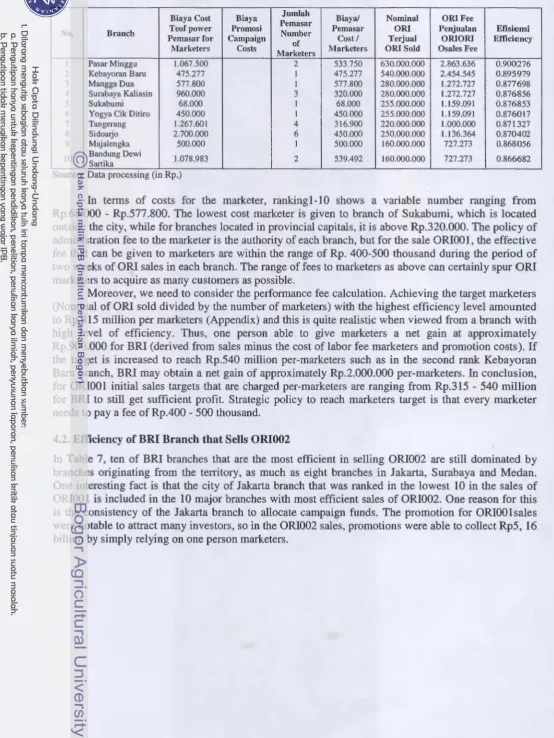
Table 6: Nilai efisiensi 10 cabang Bank X tertinggi yang menjual ORIOOIBRI Branch Efficiency Score of 10 Highest Selling ORIOOI
Biaya Cost Biaya Jumlah Biaya/ Nominal ORI Fee
Pemasar
No. Branch Teofpower Promosi Number Pemasar ORI Penjualan Efisiensi
Pemasar for Campaign
of Cost/ Terjual ORIORI Efficiency
Marketers Costs
Marketers Marketers ORISold Osales Fee
I Pasar Minggu 1.067 .500 2 533 .750 630.000.000 2.863.636 0.900276
2 Kebayoran Baru 475.277 I 475 .277 540.000.000 2.454.545 0.895979
3 Mangga Dua 577.800 I 577.800 280.000.000 1.272.727 0.877698
4 Surabaya Kali asin 960.000 3 320.000 280.000.000 1.272.727 0.876856
5 Sukabumi 68.000 I 68.000 255 .000.000 1.159.091 0.876853
6 Yogya Cik Ditiro 450.000 I 450.000 255.000.000 1.159.091 0.876017
7 Tangerang 1.267.601 4 316.900 220.000.000 1.000.000 0.871327
8 Sidoarjo 2.700.000 6 450.000 250.000.000 1.136.364 0.870402
9 Majalengka 500.000 I 500.000 160.000.000 727.273 0.868056
10 Bandung Dewi 1.078.983 2 539.492 160.000.000 727.273 0.866682
Sartika
Source: Data processing (in Rp .)
In terms of costs for the marketer, ranking1-10 shows a variable number ranging from Rp.68 .000 - Rp.577.800. The lowest cost marketer is given to branch of Sukabumi, which is located outside the city, while for branches located in provincial capitals, it is above Rp.320.000. The policy of administration fee to the marketer is the authority of each branch, but for the sale ORIOOl, the effective fee that can be given to marketers are within the range of Rp. 400-500 thousand during the period of two weeks of ORI sales in each branch. The range of fees to marketers as above can certainly spur ORI marketers to acquire as many customers as possible.
Moreover, we need to consider the performance fee calculation. Achieving the target marketers (Nominal of ORI sold divided by the number of marketers) with the highest efficiency level amounted to Rp.315 million per marketers (Appendix) and this is quite realistic when viewed from a branch with high level of efficiency. Thus, one person able to give marketers a net gain at approximately Rp.900.000 for BRI (derived from sales minus the cost of labor fee marketers and promotion costs). If the target is increased to reach Rp.540 million per-marketers such as in the second rank Kebayoran Baru branch, BRI may obtain a net gain of approximately Rp.2.000.000 per-marketers. In conclusion, for ORI001 initial sales targets that are charged per-marketers are ranging from Rp.315 - 540 million for BRI to still get sufficient profit. Strategic policy to reach marketers target is that every marketer needs to pay a fee of Rp.400- 500 thousand.
4.2. Efficiency of BRI Branch that Sells ORI002
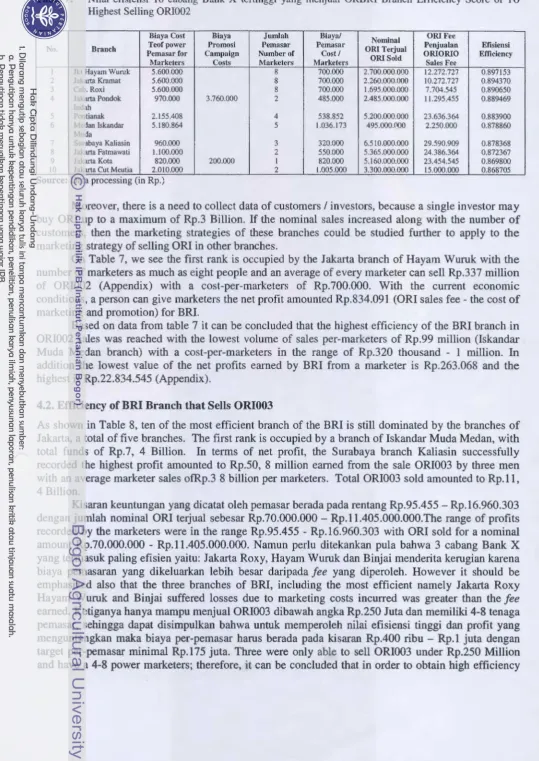
Table 7: Nilai efisiensi 10 cabang Bank X tertinggi yang menjual ORBRI Branch Efficiency Score of I 0 Highest Selling ORI002
Biaya Cost Biaya Jumlah Biaya/
Nominal ORI Fee
No. Branch Teofpower Promosi Pemasar Pemasar ORI Terjual Penjualan Efisiensi Pemasar for Campaign Number of Cost I
ORISold ORIORIO Efficiency Marketers Costs Marketers Marketers Sales Fee
I Jkt Hayam Wuruk 5.600.000 8 700.000 2.700.000.000 12.272.727 0.897153 2 Jakarta Kramat 5.600.000 8 700.000 2.260.000.000 10.272.727 0.894370 3 Cab. Roxi 5.600.000 8 700.000 1.695.000.000 7.704.545 0.890650 4 Jakarta Pondok 970.000 3.760.000 2 485.000 2.485.000.000 11.295.455 0.889469
Indah
5 Pontianak 2.155.408 4 538.852 5.200.000.000 23.636.364 0.883900 6 Medan Iskandar 5.180.864 5 1.036.173 495.000.000 2.250.000 0.878860
Muda
7 Surabaya Ka1i asin 960.000 3 320.000 6.510.000.000 29.590.909 0.878368 8 Jakarta Fatmawati l.lOO.OOO 2 550.000 5.365.000.000 24.386.364 0.872367 9 Jakarta Kota 820.000 200.000 I 820.000 5.160.000.000 23.454.545 0.869800
10 Jakarta Cut Meutia 2.010.000 2 1.005.000 3.300.000.000 15.000.000 0.868705
Source: Data processing (in Rp.)
Moreover, there is a need to collect data of customers I investors, because a single investor may buy ORI up to a maximum of Rp.3 Billion. If the nominal sales increased along with the number of customers, then the marketing strategies of these branches could be studied further to apply to the marketing strategy of selling ORI in other branches.
On Table 7, we see the first rank is occupied by the Jakarta branch of Hayam Wuruk with the number of marketers as much as eight people and an average of every marketer can sell Rp.337 million of ORI002 (Appendix) with a cost-per-marketers of Rp.700.000. With the current economic conditions, a person can give marketers the net profit amounted Rp.834.091 (ORI sales fee- the cost of marketing and promotion) for BRI.
Based on data from table 7 it can be concluded that the highest efficiency of the BRI branch in ORI002 sales was reached with the lowest volume of sales per-marketers of Rp.99 million (Iskandar Muda Medan branch) with a cost-per-marketers in the range of Rp.320 thousand - I million. In addition the lowest value of the net profits earned by BRI from a marketer is Rp.263.068 and the highest is Rp.22.834.545 (Appendix).
4.2. Efficiency of BRI Branch that Sells ORI003
As shown in Table 8, ten of the most efficient branch of the BRI is still dominated by the branches of Jakarta, a total of five branches. The first rank is occupied by a branch of Iskandar Muda Medan, with total funds of Rp.7, 4 Billion. In terms of net profit, the Surabaya branch Kaliasin successfully recorded the highest profit amounted to Rp.50, 8 million earned from the sale ORI003 by three men with an average marketer sales ofRp.3 8 billion per marketers. Total ORI003 sold amounted to Rp.ll, 4 Billion.
Kisaran keuntungan yang dicatat oleh pemasar berada pada rentang Rp.95.455- Rp.16.960.303 dengan jumlah nominal ORI terjual sebesar Rp.70.000.000- Rp.11.405.000.000.The range of profits recorded by the marketers were in the range Rp.95.455- Rp.l6.960.303 with ORI sold for a nominal amount Rp.70.000.000 - Rp.ll.405.000.000. Namun perlu ditekankan pula bahwa 3 cabang Bank X yang termasuk paling efisien yaitu: Jakarta Roxy, Hayam Wuruk dan Binjai menderita kerugian karena biaya pemasaran yang dikeluarkan lebih besar daripada fee yang diperoleh. However it should be emphasized also that the three branches of BRI, including the most efficient namely Jakarta Roxy Hayam Wuruk and Binjai suffered losses due to marketing costs incurred was greater than the fee
and high profit, then the cost-per-marketers should be in the range Rp.400 thousand- Rpl million with a minimum target per-marketers Rp.175 million.
Table 8: Nilai efisiensi 10 cabang Bank X tertinggi yang menjual ORI003 BRI Branch Efficiency Score of 10 Highest Selling ORI003
Biaya Cost Biaya Jumlah Biaya/
NominaiORI ORI Fee
No. Branch Teofpower Promosi Pemasar Pemasar Terjual ORI Penjualan EfisiensiEfficiency Pemasar Campaign Number of Cost I ORIORIOSales
for Marketers Costs Marketers Marketers Sold Fee
I Medan 5.180.864 5 1.036.173 7.470.000.000 33.954.545 0.914329 Iskandar Muda
2 Jakarta Kramat 5.600.000 8 700.000 1.400.000.000 6.363.636 0.892650 3 Cab. Roxi 5.600.000 8 700.000 240.000.000 1.090.909 0.886614
4 JktHayam 5.600.000 8 700.000 70.000.000 318.182 0.885694
Wuruk
5 Cab. Jayapura 2.566.000 3 855.333 7.865 .000.000 35.750.000 0.878207
6 Binjai 4.015.999 4 1.004.000 225.000.000 1.022.727 0.863157
7 Cab. Jatinegara 2.560.000 6 426.667 3.440.000.000 15.636.364 0.852478 8 Surabaya 960;000 3 320.000 11.405.000.000 51.840.909 0.850517
Kaliasin
9 Pontianak 2.155.408 4 538.852 3.450.000.000 15.681.818 0.841141 10 Jakarta Otista 2.500.000 3 833.333 1.335.000.000 6.068.182 0.835917
Source: Data processing (in Rp.)
This can also indicate that the potential investors in the eastern part of Indonesia are quite large. Jika peluang ini dapat dibaca oleh pihak manajemen Bank X, maka bukan tidak mungkin, akan terjadi peningkatan dalam jumlah ORI yang terjual dan secara langsung akan berpengaruh pada pendapatan yang diterima Bank X. If these opportunities can be seen by the management of the BRI, then an increase in the number of ORI sold is possible and it will directly affect the revenues received by BRI. Selain itu secara cakupan geografis, jaringan kerja Bank X merupakan yang terbesar di wilayah timor Indonesia sehingga dengan pemasaran ORI yang lebih agresif dan terencana, keuntungan dari fee penjualan ORI akan semakin menjanjikan. In addition, looking at the geographic coverage, BRI's network is the largest in Eastern Indonesia so with a more aggressive marketing ORI and planned, the profits from sales fee ORI will be more promising.
4.3. Efficiency of BRI Branch that Sells ORI004
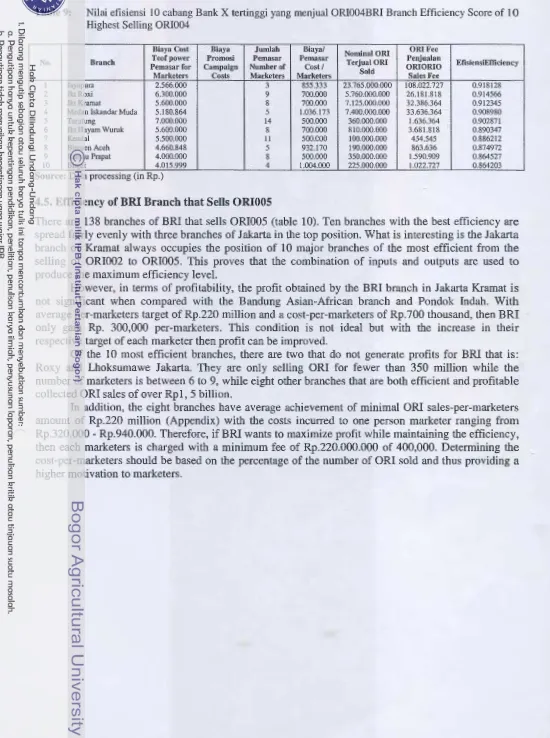
It showed that the top 10 branches with the best efficiency is no longer dominated by the branches from Jakarta (table 9), but from a field of four branches, namely: Iskandar Muda, Tarutung, Rantau Prapat and Binjai.
Disamping itu cabang Jayapura berhasil naik peringkat menjadi kanca paling efisien setelah sebelumnya pada penjualan ORI003 berada di urutan kelima.In addition Jayapura branch Branch successfully rose to become the most efficient after being in the fifth position in the sales of ORI003. This is also supported by the largest sales of ORI, amounted to Rp. 23.76 Billion. From the data, we see that tJika ditarik angka rata-rata maka dengan 3 orang pemasar, masing-masing mampu menjual ORI sebesar 7,9 MilTThe average marketer with three people, each was able to sell ORI for 7.9 Billion. Keuntungan bersih yang diterima Bank X Rp.l05.456.727 atau dengan kata lain 1 orang pemasar mampu memberikan keuntungan Rp.35.152.242 (Lampiran). A net profit received by Bank X
is Rp.105.456.727 or in other words a person can give advantage Rp.35.152.242 marketers (Appendix). However, it should also be observed also that there are only four branches that can provide profit for the BRI, namely: Jayapura, Jakarta, Roxy, Jakarta and Medan Kramat Iskandar Muda. This is due to the large costs incurred by marketers is not comparable with the fee earned. Condition of geographic or location that is relatively far from the city could lead to the low number of ORI investors and showed more intensive needs to be disseminated to the public area.
capable of achieving its sales target of at least Rp.640 million. While the gains by the BRI from one person marketer ranges in Rp.2 Million - Rp.35 million.
Table 9: Nilai efisiensi 10 cabang Bank X tertinggi yang menjual ORI004BRI Branch Efficiency Score of 10
Highest Selling ORI004
Biaya Cost Biaya Jwnlah Biaya/ NominaiORI ORI Fee
No. Branch Teofpower Promosi Pemasar Pemasar Terjual ORI Penjualan EfisiensiEfficiency
Pemasar for Campaign Number of Cost I ORIORIO
Marketers Costs Marketers Marketers Sold Sales Fee
I Jayapura 2.566.000 3 855.333 23.765.000.000 108.022.727 0.918128 2 Jkt Roxi 6.300.000 9 700.000 5.760.000.000 26.181.818 0.914566 3 Jkt Kramat 5.600.000 8 700.000 7.125.000.000 32.386.364 0.912345 4 Medan Iskandar Muda 5.180.864 5 1.036.173 7.400.000.000 33.636.364 0.908980 5 Tarutung 7.000.000 14 500.000 360.000.000 1.636.364 0.902871 6 Jkt Hayam Wuruk 5.600.000 8 700.000 810.000.000 3.681.818 0.890347
7 Kendal 5.500.000 II 500.COO 100.000.000 454.545 0.886212
8 Bireuen Aceh 4.660.848 5 932.170 190.000.000 863.636 0.874972 9 Rantau Prapat 4.000.000 8 500.000 350.000.000 1.590.909 0.864527 10 13_injai - - - 4.015.999 4 1.004.000 225.000.000 1.022.727 0.864203 Source: Data processing (in Rp.)
4.5. Efficiency of BRI Branch that Sells ORIOOS
There are 138 branches of BRI that sells ORI005 (table 10). Ten branches with the best efficiency are spread fairly evenly with three branches of Jakarta in the top position. What is interesting is the Jakarta branch of Kramat always occupies the position of 10 major branches of the most efficient from the selling of ORI002 to ORI005. This proves that the combination of inputs and outputs are used to produce the maximum efficiency level.
However, in terms of profitability, the profit obtained by the BRI branch in Jakarta Kramat is not significant when compared with the Bandung Asian-African branch and Pondok Indah. With average per-marketers target of Rp.220 million and a cost-per-marketers of Rp.700 thousand, then BRI only gain Rp. 300,000 per-marketers. This condition is not ideal but with the increase in their respective target of each marketer then profit can be improved.
Of the 10 most efficient branches, there are two that do not generate profits for BRI that is: Roxy and Lhoksumawe Jakarta. They are only selling ORI for fewer than 350 million while the number of marketers is between 6 to 9, while eight other branches that are both efficient and profitable collected ORI sales of over Rpl, 5 billion.
r--.
Table 10: Nilai efisiensi I 0 cabang Bank X tertinggi yang menjual ORIOOS BRI Branch Efficiency Score of
10 Highest Selling ORI005
Biaya Cost Teof Promosi Biaya Pemasar Jumlah Pemasar Biaya/ Nominal Penjualan ORI Fee No. Branch power Pemasar Campaign
Number of Cost I ORI Terjual ORIORIOSales EfisiensiEfficiency for Marketers
Costs Marketers Marketers ORISold Fee
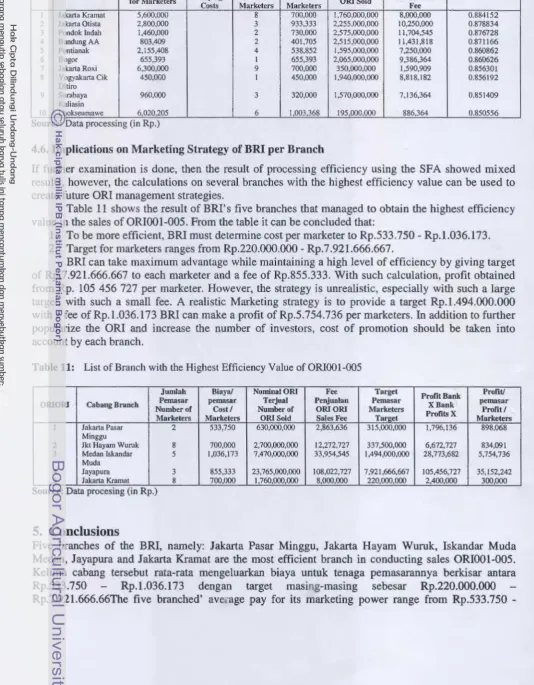
I Jakarta Kramat 5,600,000 8 700,000 1,760,000,000 8,000,000 0.884152 2 Jakarta Otista 2,800,000 3 933,333 2,255,000,000 10,250,000 0 .878834 3 Pondok lndah 1,460,000 2 730,000 2,575,000,000 11 ,704,545 0.876728 4 Bandung AA 803,409 2 401,705 2,515,000,000 11,431,818 0.871166 5 Pontianak 2,155,408 4 538,852 I ,595,000,000 7,250,000 0.860862
6 Bogor 655,393 1 655,393 2,065,000,000 9,386,364 0.860626
7 Jakarta Roxi 6,300,000 9 700,000 350,000,000 1,590,909 0.856301 8 Yogyakarta Cik 450,000 I 450,000 I ,940,000,000 8,818,182 0.856192
Ditiro
9 Surabaya 960,000 3 320,000 I ,570,000,000 7,136,364 0.851409 Kaliasin
10 Lhokseumawe 6,020,205 6 1,003,368 195,000,000 886,364 0.850556
Source: Data processing (in Rp.)
4.6. Implications on Marketing Strategy of BRI per Branch
If further examination is done, then the result of processing efficiency using the SF A showed mixed results, however, the calculations on several branches with the highest efficiency value can be used to create future ORI management strategies.
Table 11 shows the result of BRI's five branches that managed to obtain the highest efficiency value in the sales of ORI001-005. From the table it can be concluded that:
1. To be more efficient, BRI must determine cost per marketer to Rp.533.750- Rp.1.036.173. 2. Target for marketers ranges from Rp.220.000.000- Rp.7.921.666.667.
BRI can take maximum advantage while maintaining a high level of efficiency by giving target of Rp.7.921.666.667 to each marketer and a fee of Rp.855.333. With such calculation, profit obtained from Rp. 105 456 727 per marketer. However, the strategy is unrealistic, especially with such a large target, with such a small fee . A realistic Marketing strategy is to provide a target Rp.1.494.000.000 with a fee of Rp.1.036.173 BRI can make a profit of Rp.5.754.736 per marketers. In addition to further popularize the ORI and increase the number of investors, cost of promotion should be taken into account by each branch.
Table 11: List of Branch with the Highest Efficiency Value of ORIOOl-005
Jumlah Biaya/ NominalORI Fee Target
Profit Bank Profit/ ORIORI Cabang Branch Number of Pemasar pemasar Terjual Penjualan Pemasar X Bank pemasar
Cost/ Number of ORIORI Marketers Profit I セ@
Marketers Marketers ORISold Sales Fee Target Profits X Marketers 1 Jakarta Pasar 2 533,750 630,000,000 2,863,636 315,000,000 1,796,136 898,068
Minggu
2 Jkt Hayam Wuruk 8 700,000 2,700,000,000 12,272,727 337,500,000 6,672,727 834,091 3 Medan Iskandar 5 1,036,173 7,470,000,000 33,954,545 1,494,000,000 28,773,682 5,754,736
Muda
4 Jayapura 3 855,333 23,765,000,000 108,022,727 7,921,666,667 105,456,727 35,152,242 5 Jakarta Kramat 8 700,000 1,760,000,000 8,000,000 220,000,000 2,400,000 300,000
Source: Data procesing (in Rp.)
5. Conclusions
Five branches of the BRI, namely: Jakarta Pasar Minggu, Jakarta Hayam Wuruk, Iskandar Muda Medan, Jayapura and Jakarta Kramat are the most efficient branch in conducting sales ORIOOl-005. Kelima cabang tersebut rata-rata mengeluarkan biaya untuk tenaga pemasarannya berkisar antara
Rp.533.750 - Rp.1.036.173 dengan target masi ng-masing sebesar Rp.220.000.000
[image:20.611.51.586.80.766.2]-Rp.1.036.173 with their respective targets for Rp.220.000.000 - Rp .7 .921.666.667. Dari hasil terse but, strategi pemasaran yang cukup realistis dan dapat diterapkan pada seluruh cabang Bank X yang menjual ORI adalah dengan memberikan target sebesar Rp.1.494.000.000 dan biaya per-pemasar sebesar Rp.1.036.173 sehingga dapat diperoleh keuntungan Rp.5.754.736 per-pemasar From these results, the marketing strategy is realistic and can be applied to all branches of BRI in selling ORI is to provide a target for Rp.1.494.000.000 and cost-per-order marketer of Rp.l.036.173 to get Rp.5.754.736 profits per-marketers.
6. Recommendations
The research data was collected up to December 2008 with the assumption that the period is the most appropriate in measuring efficiency. Due to the world economy crisis, the investment instruments, ORI in particular, can be tested for resistance. Moreover, how the strategy of each branch can be observed in crisis conditions. However, further research must be done with a longer span of time, then return to see whether the subsequent issuance of ORI can still be the best investment options in term of efficiency.
References
[1] Aigner D.J., Lovell, C.A.K., and Schmidt, P., (1977), "Formulation and Estimation of Stochastic Frontier Production Function Models", Journal of Econometrics, 6, pp.21-37.
[2] Al-Faraj, T.N., et al., (1993). Evaluation of bank branches by means of Data Envelopment Analysis. International Journal of Operations and Production Management 13, 45-52.
[3] Astiyah, Siti dan Jardine A. Husman.(2006). "Fungsi Intermediasi Dalam Efisiensi Perbankan di Indonesia: Deviasi Fungsi Provit", Buletin Ekonomi Moneter dan Perbankan. Volume 8, No. 4, pp.529-543, Bank Indonesia, Jakarta.
[4] Atmawardhana, Angga (2006), Analisis Efisiensi Bank Umum Syariah dan Bank Konvensional yang Memiliki Unit Usaha Syariah di Indonesia, setelah pemberlakuan Undang-Undang No. /0 Tahun 1998 tentang Perbankan (Pendekatan Data Envelopment Analysis), Skripsi Sarjana (tidak dipublikasikan) Fakultas Ekonomi, Universitas Islam Indonesia, Yogyakarta.
[5] Berger and D.B Humphrey (1997) "Efficiency of Financial Institutions". Wharton School working paper.
[6] Casu, Barbara, Girardone, Claudia. (2002). "A Comparative Study of the Efficiency of Italian Bank Conglomerates". Journal of Managerial Finance Vol. 28 No.9.
[7] Chen, Tser-yieth. A Comparison of Chance- Constrained DEA and SFA: Bank Efficiency in Taiwan
[8] Dacanay III, Santos Jose 0. Profit and Cost Efficiency of Philippine Comercial Banks Under Periods of Liberalization, Crisis and Consolidation.
[9] · David, F.R. 2002. Manajemen Strategis Konsep (Terjemahan). PT Prehallindci, Jakarta.
[10] Drake, L., and Howcroft, B.(1994). Relative efficiency in the branch network of a UK bank: An empirical study. OMEGA 22 83 - 90.
[11] Espitia-Escuer, Manuel, Garcia-Cebrian, Lusia Isabel. 2004. "Determinants of the Productive Efficiency for the Banks System in the European Union Countries". International Journal of Productivity and Performance Management Vol. 53, No.3.
[12] Fan, Limbo and Sherrill Shafter. Efficiency versus Risk in Large Domestic US Banks.
[13] Giokas, D.I., 1991. Bank branch operating efficiency: A comparative application of DEA and the loglinear model. Omega 19, no. 6 . .
[14] Kaparakis, Emmanuel I. Stephen M. Miller, Athanasios G. Noulas. Short-run Cost Inefficiency of Commercial Banks: A Flexible Stochastic Approach.
[16] [17] [18] [19] [20] [21] [22] [23] [24]
r·
[25]
[26] [27] [28]
[29]
[30] [31] [32] [33] [34]
Koetter, Michael. Measurement Matters- Alternative Input Price Proxies for Bank Efficiency Analysis.
Kwan, Simon H. and Eisenbeis, Robert A. An Analysis of Inefficiencies in Banking: A Stochastic Frontier Approach.
Lin, Jui-Chum, Jin-Li Hu, Kang-Liang Sung. The Effect of Electronic Banking on the Cost Efficiency of Commercial Banks: An Empirical Study.
Makmun and Setiawan, Sigit. 2004. Be/ajar dari Pengalaman Jepang dalam Menerbitkan Obligasi Rite/. Bunga Rampai Hasil Penelitian 2004.
McDonell, E.D. and Rubin, M.J. 1991. "A Scorecard for Branch Performance", Financial Manager's Statement, Vol.l3, No.3, pp.46-56.
Mostafa, Mohamed. 2004. "Benchmarking Top Arab Banks' Efficiency through Efficient Frontier Analysis". International Management & Data System Vol. I 07 No.6.
Oral, M and R.Yolalan. I990."An Emperical Study on Measurement Operating Efficiency and Profitability of Bank Branches". European Journal of Operational Research, 46, 282-94.
Parkan, C. 1997. Measuring the performance of hotel operations. Socio-Economic Planning Sciences 30 (257 - 292).
Pastor, J.M. 1995. Eficiencia, cambia producavo y cambia tecnico en los bancos y cajas de Ahorros Espana/as: Un ana/isis frontera no parametrico (in Spanish). Revista Espanola de Economia 12 (35- 73).
Permono, I.S. and Darmawan. 2000. "Ana/isis Efisiensi Industri perbankan di Indon