Effect of Climate Change on Livestock Production in Pakistan
Muhammad Younas 1,*, Kashif Ishaq 1 & Iftikhar Ali 2
1Department of Livestock Management, University of Agriculture, Faisalabad-38040, Pakistan
2 Dept of Livestock and Dairy Development, Lahore, Pakistan *e-mail: [email protected]
Abstract
The climate change is affecting the animal productivity especially in resource poor localities in the region. While most of the areas suffer from the insufficiencies of the data, a few scientific measurements in some areas have proved that the effect of climate changes are adversely affecting the livestock production directly due to heat stress or indirectly due to changes incorporated in the ecosystem. Some of these may include reduced agricultural productivity, deteriorated health due to shortage of feed resources, water quality, global warming, shrinking glaciers, erratic weathers, river floods, disease prevalence, disrupted ecosystem and increase in the frequency of natural hazards and disasters. Pakistan still suffers more than 30 % Crude Protein and TDN deficiency for large and small ruminants in its feed balance. The exact Information on the losses are very much undermined and not realized by many or sometimes sorely lacking. A detailed understanding is warranted to anticipate the future impacts of the climate change in different areas on the productivity of the ruminants. Unless these losses are realized and scientifically proved, the measures needed or taken will attain less significance. Our studies revealed that there is a drastic effect on temperature change on water buffaloes and their calves. When ambient temperature reached to 32-47º C with a mean relative humidity of 33-75%, the physiological norms of the buffalo calves were significantly affected and their weekly body weight decreased as 43 kg as compared to 46 kg under open air tree shade than inside a shed with showers plus ceiling fans, body temperature was higher 101.6ºF that 101.0ºF, respiration rate was higher 28 to 26 per minute, and the pulse rate increased to 53-54 per minute under treatment with open air tree shade as compared to inside with ceiling fans and showers. This paper will delineate in length some of the effects on livestock production due to climate change in a country like Pakistan where 35-40 million rural people derive their livelihood from livestock rearing. Mitigation measures will also be suggested to save productivity losses to ensure the food supply from animal origin for the exploding population.
Introducton
Pakstan has experenced the worst drought of ts hstory n the last decade of the last mllennum whch lasted untl 2004. She has been ranked 16 regardng countres most vulnerable to envronment change (Maplecroft, 2010). Out of total 79.6 mllon hectares (MH), 27 % s cultvated area .e. about 21 (MH), contanng 19.12 (MH) are rrgated and 3.67 (MH) are ranfed. The rrgated area consumes about 80% of the country’s freshwater. Fgure 1 shows ths dstrbuton along wth 62% of the country areas are rangelands (Qurash et al. 1993). Agrculture sector beng the back bone of the economy wll be more probable stake holder of aftermaths of envronmental changes. The clmate change affected the lvestock n two ways () by affectng the forage producton, () drectly affectng the lvestock kept under dfferent producton systems. The losses suffered by the anmals not only due to heat stress but also n the form of dsasters n the prevous years. Ths thematc paper explans the possble problems faced by the lvestock due to heat stress, mpact of clmate change and the dfferent ways and means to mtgate the effect of envronment on lvestock productvty.
&/.67&2 -&6 *;4*5.*2(*)7-* :3567 )538,-7 3+ .76 -.6735< .2 7-* 0&67 )*(&)* 3+ 7-* 0&67 1.00*22.81 :-.(-0&67*)827.0 #-*-&6'**2 5&2/*)5*,&5).2,(38275.*613679802*5&'0*73*29.5321*27(-&2,* (0.1&7* (-&2,* &2) 7-* ).++*5*27 :&<6 &2) 1*&26 73 1.7.,&7* 7-* *++*(7 3+ *29.5321*27 32 0.9*673(/ 453)8(7.9.7< 32 7-* &228&0 45*(.4.7&7.32 6.; ,53(303,.(&0 %32*6 % -&6 '**2 )*+.2*) '< !85&.6-. *7 &0 -&8)-5<&2)"&680 .66811&5.=*).27-*$&'0* 29.5321*27(-&2,*6&5*&++*(7.2,7-*,0&(.*56.2 7-* 2357-*52 4&57 3+ 7-* (38275< &2) &++*(7.2, 7-* 2)86 &6.2 6<67*1 '&)0< 2 (31'.2&7.32 :.7- 7-* 45*).(7*) -*&9< 5&.2+&00 .7 0./*0< 73 *;&(*5'&7* 7-* &05*&)< 6*5.386 453'0*16 3+ +033).2, &2) )5&.2.2,
Fgure 1. Showng the dfferent classfcaton of the areas of Pakstan
The Clmatc Zones and Water Resources of Pakstan
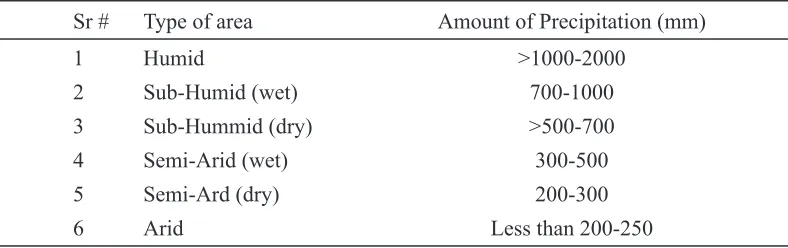
The envronment and lvestock producton systems are closely related (Nardone and Gbon, 2000). The agrculture sector depends on the avalablty of the water for rrgaton and annual precptaton. Based on the annual precptaton sx
Agro-Ecologcal Zones (AEZ) has been defned by Qurash et al. (1993), Chaudhry and
Rasul (2004)s summarzed n the Table 1. Envronment changes are affectng the
Table 1. Classfcaton of the areas accordng to precptaton
Sr # Type of area Amount of Precptaton (mm)
1 Humd >1000-2000
2 Sub-Humd (wet) 700-1000
3 Sub-Hummd (dry) >500-700
4 Sem-Ard (wet) 300-500
5 Sem-Ard (dry) 200-300
6 Ard Less than 200-250
Source: Adopted from Qurash et al. (1993)
Envronmental Temperature and Ran Pattern
Farooq et al. (2005) have further analyzed the clmate change perspectve n
Pakstan and concluded that annual mean surface temperature s on consstent rsng
trend snce the begnnng of 20th century. Charlotte (2011) further added that the
major rsk from the clmate change n South Asa s ncreased summer precptaton, ntensty n temperate regons, ncrease flash-flood prone areas and further added that the ard and sem-ard regons would be drer n summer, whch could lead to severe droughts.
Effect of Droughts and Floods
Pakstan had the fully operatonal rrgaton system and enough water from the rvers flowng through t. But qute recently the water was seldom enough to meet the requrement of end users. The populaton growth had started puttng unprecedented pressure on the rrgaton system (UN, 2001). Lvestock populaton s affected greatly by the droughts and ther growth has been declned n last decade especally durng 2003-04 (SBP, 2003-04). The researchers of Balochstan have also reported that drought has affected whole of the country; Balochstan provnce beng the worst-ht and resulted n the loss of lfe (Shafq and Kakar, 2007). Durng the recent years, due to the change of precptaton, the floods have adversely affected the country especally Punjab and Sndh. A latest report by FAO (2012) confrmed these notons by explanng that 116,000 heads of lvestock ded by the flood ht n the Sndh provnce.
Effect of Heat Stress on Dary Anmals
mlk producton response. There s 20-30% ncrease n the mantenance energy re-qurement and heat stress combned wth the DMI decrease by 10-20% n the com-mercal dary herds (Chase, 2006). Formulaton for adequate nutrent ntake chal-lengng for heat stress cow depends on optmzng then rumen undegradable proten to mprove mlk producton response. The forage level must decrease due to hgh heat of ncrement (West, 1999). De Rensn and Scaramuzz (2003) found that ap-pette and dry matter ntake are reduced so by ths way t prolonged the postpartum
negatve energy phase n dary cows. Tao et al. (2011) found that coolng of heat
stress can ncrease mlk producton (28.9 vs 33.9 kg/day) and lower mlk proten (3.01 vs 2.87%). The physologcal change regardng mlk synthess durng heat stress may be due to hepatc glucose preferentally used for process other than mlk
synthess (Baumgard et al., 2011). Clmatc factors for example temperature,
pre-cptaton frequency and severty of extreme events affects the lvestock and crop
yeld (Thornton et al., 2008). Temperature Humdty Index (THI) has been used as
ndcator of heat stress. The crtcal values of THI s 72 (Igono et al. 1992) whle the studes of Dkeman and Hanson, 2009 showed that dry bulb temperature could also be used to predct the rectal temperature of lactatng Holsten cows n sub-tropcal envronment. The ncrease n thermal load above the thermal neutral zone affects the anmal performance. The anmal fals to dsspate excess heat to mantan homeo-thermy (West, 1999). Mukherjee et al. 2011 found that the decrease n lymphocytes n heat stress cows. Physologcally there wll be ncrease n rectal temperature and respraton rate due to ncrease n ambent temperature beyond the thermoneutral zone (Chase, 2006). Gwazdauskas (1985) found that estrous hormones were found lower durng heat stress and resulted n shortenng of estrus duraton. He further nvestgated that lower fertlty n heat stressed male cattle are due to the mpared spermatogeness and testosterone durng exposure to hypertherma. Baumgard and Rhoads (2007) sad that there s negatve effect of heat stress on a varety of dary parameters, ncludng mlk yeld and reproducton causng a sgnfcance of fnan-cal burden. Increase n thermal load decreases the reproductve effcency (Fuquay,
1981, Imtaz Hussan et al., 1992). Most of the reproductve problems are decrease
duraton and ntensty of estrus (Her et al., 1988), lower concepton rate (Stott et al.,
1972) and hgh embryo mortalty (Wse et al., 1988).
The change n envronmental temperature affects the anmal body. Many scentsts have nvestgated the dynamcs of anmal body changes due to heat stress. The earler studes on heat stress n Pakstan were conducted at the Unversty
of Agrculture, Fasalabad, under PL-480 schemes (Quresh et al., 1978). They
concluded that there s drastc effect of temperature change on Buffalo (Bos Bubalus
combned use of fans and showers. Smlar observatons were recorded n the follow up studes (Younas et al. 1979) ndcated that under the envronmental temperatures of 32-47ºC wth a mean relatve humdty of 33-75 %, the physologcal norms of the buffalo calves were sgnfcantly affected and ther weekly body weght decreased as 43 kg as compared to 46 kg under open ar tree shade than nsde a shed wth showers plus celng fans, body temperature was hgher 101.6 ºF than 101.0 ºF, respraton rate was hgher 28 to 26 per mnute, and the pulse rate hgh whch was 53 to 54 per mnute under treatment wth open ar tree shade as compared to nsde wth celng fans and showers. The fnal concluson from these studes was that declnng effect of thermal stress on certan components of mlk and blood, however, could not be solely ascrbed due to heat stress. The growth of buffalo calves as determned from ncrease n ther body weghts manfested an nterestng contrast n the effect of varous treatments used. The hghest average body weght was observed n group of calves provded celng fans alone as thermal relef whereas n trals wth adult buffaloes, combned use of fans showered proved better. The nfluence of thermal stress on blood pcture of buffalo-calves was also seen. Blood glucose, total lpds and phospholpds content were found to consstently ncrease whereas, cholesterol levels decreased n the entre group wth excepton of group 1 n whch a slght ncrease was observed (Younas et al. 1982).
In a follow up study, the lactatng and cyclng Holstens n each of two summers were assgned randomly to pens n a free-stall barn ether wth or wthout overhead fans to study the effect of fan coolng on certan endocrne and behavoral responses
durng the estrous cycle (Younas et al., 1993). Rectal temperatures were lower n the
group cooled by fans than n the control group each summer. Luteal progesterone secreton tended to be greater n the fan group each summer; area under the luteal phase curve was sgnfcantly hgher than for controls durng the second summer. There was tendency for more pre-ovulatory surges of LH and hgher estrous responses rates n the fan group durng the second summer. Thus, fan coolng of lactatng dary cows for several weeks before antcpated breedng provdes potental for more effcent reproductve performance durng the summer.
Conclusons
of monsoon; protecton from ran and sun; feedng management lke grazng durng cool hours, offerng succulent varetes, decreased DMI, use of slage and hay, nutrent densty, avodng excess wth normal rumen functon; provson of fresh and clean water; genetc selecton; housng management lke forced/tunnel ventlaton, sprnklng, showerng, mstng; use of ecologcal modelng and nnovatons wth approprate strategc management decsons; rsk analyses and devsng some nnovatve methods to provde comfort to the anmals can help n mnmzng the effect of heat stress on dary anmals.
References
Baumgard, L.H. and R.P. Rhoads. 2007. The effect of heat stress on nutrtonal and management decsons. Proc. Southwest Nutrton Conference. pp:191-199. Baumgard, L.H., J.B. Wheelock, S.R. Sander, C.E. Moore, H.B. Green, M.R.
Waldron and R.P. Rhoads. 2011. Post absorptve carbohydrate adaptatons to heat stress and monensn supplementaton n lactatng Holsten cows. J. Dary Sc. 94(11):5620-33.
Charlotte, S. 2011. Revew of clmate change adaptaton practces n South Asa.
Oxfam Res. Reports.
http://www.oxfam.org/stes/www.oxfam.org/fles/rr-clmate-change-adaptaton-south-asa-161111-en.pdf
Chase, L.E. 2006. Clmate change mpacts on dary cattle. Dept of Anm. Sc. Cornell Unv, Ithaca, NY 14853, USA.
Chaudhry, Q.Z. and G. Rasul. 2004. Agro-clmatc classfcaton of Pakstan. Quarterly Scence Vson. Vol 9: No.1-2. Dept Anm. Sc., Cornell Unversty, Ithaca, NY, USA.
De Renss, F. and R.J. Scaramuzz. 2003. Heat stress and seasonal effects on reproducton n the dary cow-A revew. Therogenology. 60(6):1139-51. Dkmen, S. and P.J. Hansen. 2009. Is the temperature-humdty ndex the best
ndcator of heat stress n lactatng dary cows n a subtropcal envronment? J Dary Sc. 92(1):109-116.
FAO. 2012. Executve Bref; Pakstan Flood 2011. http://www.fao.org/fleadmn/templates/
tc/tce/pdf/Executve_Brefs/24.01.12 Pakstan_Floods_FAOEB.pdf
Farooq, A.B., A.H. Khan and M. Hazrat. 2005. Clmate change perspectve n Pakstan. Pak. J. Meteor. 2(3):11-21.
Fuquay, J.W. 1981. Heat stress as t affects anmal producton. J. Anm. Sc. 52:164.
Gwazdauskas, F.C. 1985. Effects of clmate on reproducton n cattle. J. Dary Sc. 68(6): 1568-78.
Her, E., D. Wolfenson, I. Flamenbaum, Y. Folman, M. Kam and A. Berman. 1988. Thermal productve and reproductve responses of hgh yeldng cows exposed to short term coolng n summer. J. Dary Sc. 71:1085.
and crtcal temperature effects on mlk producton of Holsten cows n desert clmate. Int. J. Bometeorol. 36(2): 77-87.
Imtaz Hussan, S.M., J.W. Fuquay and M. Younas. 1992. Estrous cyclcty n non-lactatng and non-lactatng Holstens and Jerseys durng a Pakstan summer. J. Dary Sc. 75(11):2968-2975.
Maplecroft. 2010. Bg economes of the future. http://maplecroft-/;989.com/about/ news/ccv.html
Mukherjee, J., S. Pandta, R. Huozha and M. Ashutosh. 2011. In-vtro mmune
competence of Buffaloes (Bubalus bubalis) of dfferent producton potental:
Effect of heat stress and cortsol. Vet. Med. Int. pp:2011:869252 (E-pub). Nardone, A. and A. Gbon. 2000. Lvestock Farmng Systems, Research and
Development Issues. Proc. Symp. Techncal and socal systems approaches for sustanable rural development. pp:71-92.
Qurash, M.M.A., G.S. Khan and M.S. Yaqoob. 1993. Range Management n Pakstan. Kaz Publcatons, 121-Zulqarnan Chambers, Ganpat Road, Lahore.
Quresh, M.J., Bakht B. Khan, M. Ahmad and J.M. Akbar. 1978. Fnal report of the Research Project “Effect of heat stress on the effcency of mlk producton n Buffaloes”. Project No. A-17-AH-7 (FG-Pa-192), USDA PL-480 Program, Dept of Lvestock Management, Unversty of Agrculture, Fasalabad, Pakstan. SBP. 2003-04. Annual Report. State Bank of Pakstan, Islamabad.
Shafq, M. and M.A. Kakar. 2007. Revew: Effects of drought on lvestock sector n Balochstan Provnce of Pakstan. Int. J. Agr. & Bol. 9(4):657–665.
Stott, G., H.F. Wersma and J.M. Woods. 1972. Reproductve health program for cattle subjected to hgh envronmental temperatures. J. Am. Vet. Med. Assoc. 161:1339.
Tao, S., J.W. Bubolz, B.C. do Amaral, I.M. Thompson, M.J. Hayen, S.E. Johnson and G.E. Dahl. 2011. Effect of heat stress durng the dry perod on mammary gland development. J. Dary Sc. 94(12):5976-86.
Thornton, P., M. Herrero, A. Freeman, O. Mwa, E. Rege, P. Jones and J. McDermott. 2008. Vulnerablty, clmate change and lvestock – Research Opportuntes and Challenges for Poverty Allevaton. ILRI, Kenya.
UN. 2001. Resdent Coordnator of the UN Systems’ Operatonal Actvtes for Development n Pakstan. Drought update # 13.
West, J.W. 1999. Nutrtonal strateges for managng the heat-stressed dary cow. J. Anm. Sc. 77 (Suppl 2): 21-35.
Wse, M.E., D.V. Armstrong, J.T. Huber, R. Homer and F. Wersma. 1988. Hormonal alteratons n the lactatng dary cows n response to thermal stress. J. Dary Sc. 71:2480.
Younas, M., J.W. Fuquay, A.E. Smth and A.B. Moore. 1993. Estrous and endocrne responses of lactatng Holstens to forced ventlaton durng summer. J. Dary Sc. 76(2):430-436.
Younas, M., N.A. Chaudhry and B.B. Khan. 1979. Effect of heat stress on respraton rate, pulse rate, body temperature and body weght of buffalo calves. Pak. J. Sc. Res. 31(3-4):181-186.