A Thesis
Submitted to Faculty of Literature and Humanities In Partial Fulfillment of the Requirements
for the Degree of Bachelor of Literature
NOVIA FAJRIANI
1110026000147
ENGLISH LANGUAGE AND LITERATURE
FACULTY OF LITERATURE AND HUMANITIES
SYARIF HIDAYATULLAH STATE ISLAMIC UNIVERSITY
JAKARTA
iii
knowledge and belief, it contains no material previously published or written by
another person nor material which to a substantial extent has been accepted for the
award of any other degree or diploma of the university or other institutes of higher
learning, except where due acknowledgement has been made in this text.
Jakarta, March 2015
iv
and Humanities Faculty, State Islamic University Syarif Hidayatullah Jakarta, 2015.
The research analyzes the process of word formation to the selected words which are found in The Jakarta Post‘s articles. It also classifies the types of word formation. Moreover, it is aimed to make people understand word formation and know how to guess a meaning of new words without look up into dictionary. This research is analyzed by qualitative descriptive method. The research is focused and limited to word formation in e-news The Jakarta Post‘s Sci-Tech articles in January - March 2014. The data are analyzed using Structural Morphology Processes by Eugene A. Nida. The analysis in this research has four steps based on the structural morphology processes. They are, Morpheme, Word Formation, Morphophonological Processes, and Dictionary. Then, the data are also classified to the types of word formation, they are inflection, derivation, compounding, blending, clipping, creation de novo, back-formation, acronyms, initialisms, and eponyms. The result finds that almost all of word formation occurs in the analysis. There are 27 words that is analyzed. The 25 words pass the four steps of structural morphology processes. There are two words that do not pass the four structural morphology processes; WhatsApp and DSLR. Also there are two types of word formation that do not occur; creation de novo and back-formation.
v
May peace and blessing of Allah be upon all of us
All praises be to Allah SWT, the Lord of the Universe, on the overflow of
graces and mercies to mankind, who remarkably guides me in the process of
writing the thesis. Peace and Salutation be upon the greatest prophet Muhammad
SAW, his family, companions and adherents, who had civilized the world from
the darkness to the lightness.
In this occasion, I would like to express my gratitude to my family,
especially my beloved parents, H. Ahadul Basyari and Hj. Munifah, my family,
and my aunt Hj. Jamilah Hosen for all the support. They have never forced me to
do anything in order to give me the liberation of choosing, yet they have never
forgotten to guide me to be positive person.
I also would like to convey my deepest gratitude to the following amazing
people:
1. Prof. Dr. Sukron Kamil, M.Ag., the Dean of Letters and Humanities
Faculty.
2. Drs. Asep Saefudin, M.Pd., the Head of English Letters Department, who
is also one of the writer‘s advisor, for sacrificing his precious time to guide
me in completing my thesis.
vi thesis.
5. All lecturers in English Letters Department who have taught and inspired
me during my study.
6. My beloved family, brothers, sisters, aunties, who have given so much
moral and material support to me during the time until the final of the
study, may Allah always protect and bless them.
7. My friends in English Letters Department 2010 especially Sazali
Muhamad, S.S., Siti Fauziah, S.S,, Sarah Lizara Sevida S.S., Fakhri Fauzi,
S.S., Putri Rosdiana for their help and experience.
8. Rumah Kardus Foundation (RKF), a bestfriend, a family who support me.
9. My college friends Rana Meisara, S.S, Ilham Putra, S.S, and Fahmi
Fahrurroji, S.S who helped my thesis.
10.The lovely one Meirin Setianti, Muhamad Ryan Fauzi, and Fathya
Maulidya for support and prayer.
11.My A class of 2010 and Linguistics A class 2013 classmates and seniors
and juniors for the support.
12. Everyone I met and spent time together in sharing their insights,
knowledge, spirit, experiences, reasons of life and motivations which have
motivated me to be beneficial person.
Jakarta, March 2015
vii
LEGALIZATION ... ii
DECLARATION ... iii
ABSTRACT ... iv
ACKNOWLEDGMENT ... v
TABLE OF CONTENTS ... vii
CHAPTER I INTRODUCTION ... 1
A. Background of the Study ... 1
B. Focus of the Study ... 5
C. Research Question ... 5
D. Objective of the Study ... 5
E. Significance of the Study ... 5
F. Research Methodology ... 6
1. Method of The Research ... 6
2. The Technique of Collecting and Data Analysis ... 6
3. Instrument of the Research ... 6
4. Unit of Analysis ... 7
CHAPTER II THEORETICAL FRAMEWORK ... 8
viii
2. Types of English Word Formation ... 18
a. Inflection and Derivation ... 19
b. Compounding ... 22
c. Creation de novo ... 24
d. Blending ... 25
e. Clipping ... 26
f. Back-formation ... 27
g. Abbreviations: acronyms and initialisms ... 27
h. Eponyms ... 29
3. Structural Morphology ... 30
4. Technology ... 32
CHAPTER III RESEARCH FINDINGS ... 34
A. Data Description ... 34
B. Data Analysis ... 36
CHAPTER IV CONCLUSIONS AND SUGGESTIONS ... 80
A. Conclusions ... 80
B. Suggestions ... 81
1
CHAPTER I
INTRODUCTION
A. Background of the Study
Morphology generally focuses on the study of word formation. Word
formation is all about how a word builds or changes by adding or omitting some
morphemes or affixes, also how a new word created from combining some old
words into new words that listed on dictionary. There are three things that word
formation can do. It can change the part of speech of a word for example amuse as
a verb and amusement as a noun, the other rules of word formation cannot change
the part of speech, but they do add substantial new meaning for example happy
and unhappy, and another rules of word formation both change the part of speech
and add substantial new meaning for example wash and washable.1
Word formation has several types. The linguists have a various number of
word formation. Word formation is divided into seven types such as Derivations,
Compounds, Acronyms, Back-Formations, Abbreviations, Eponyms, and Blends.2
On the other hand, The Linguistics Encyclopedia distinguishes word formation
into six, there are Derivation, Composition (Compounding), Back-formation,
Clipping, Acronyms, and Word Manufacture.3 Others book also describing about
1
Rochelle Lieber, Introducing Morphology, (Cambridge University Press, 2009), p. 6 2
Victoria Fromkin et. al., An Introduction to Language Seventh Edition, (Heinle, Thomson, 2003),pp. 83-98
3
types of word formation which is similar. The examples of types of word
formation are the words NASA (National Aeronautics and Space Administration)
and CPU (Central Processing Unit). People who do not know about word
formation may think that they are similar because they take the first sound of
group of words, but in fact they are typically different. NASA is an acronym word
formation and CPU is an abbreviation word formation.
Word formation does not always discuss about a new word that is newly
invented. From the types of word formation, there are some new words which are
created by combine the old words into a one word and become a new word with a
new meaning. For example, heliport is a new word which is combined from the
old words helicopter and airport. The definition of heliport itself is an airport or
landing place for helicopters.4 The type of heliport is a blending word formation.
This kind of word formation is important because people will see that language
evolve continuously. Besides inventing a new word by people‘s own letter and
idea, they can also create new words with a new meaning by the words that have
been existed.
Word is not the only basic part of language which can be analyzed.
Morpheme which is the smallest part in language becomes an interesting part to
be discussed. This research can discuss about word deeper by describing the
process of how morphemes can be a new word. For example, the word unhappy is
formed by the morphemes un- + happy which has base happy and added a prefix
4
Oxford Dictionaries Online,
http://www.oxforddictionaries.com/definition/english/heliport accessed on May 17,
un- which has a meaning ‗not‘. As we can see, only by adding prefix which
consists of two letters, it can change the meaning of the word. Another example is
a word with technology term from a sentence in The Jakarta Post‘s Sci-Tech
article; I wasn’t familiar with the iPhone when people went crazy about smartphones, from the first version to the iPhone 4.5 The word smartphones is
compounding word formation which is a noun and has a meaning a mobile phone
that has software like the software on a small computer, and that connects to the
internet.6 It is formed by the morphemes smart + phone + -s. Smart from the base
smart (adj), phone which is clipped from the word telephone (n), and –s as a
suffix. By describing the morpheme in detail, people can be easily know the
process of word formation and also can guess the meaning by discovering of each
morpheme.
In describing the process of word formation in the last paragraph, the
Structural Morphology Theory is used to explain it step by step. The structural
morphology theory discusses about the process of the morphemes which create a
word and the changes of each morpheme when they merge into a word. This
theory also has the featured step which is dictionary step. Dictionary step is to
explain the meaning of a word. In addition, it also uses to prove a word is a real
word or not because if it is a real word that has been agreed by world then it will
registered in the dictionary.
5
The Jakarta Post,
http://www.thejakartapost.com/news/2014/03/01/my-gadget-nonita-respati-capturing-great-and-inspiring-things.html accessed on April 30, 2014
6
Cambridge Dictionaries Online,
Related to word formation, if people want to find a new word or term which
frequently uses today, online media is the right option to choose. Online media is
the easiest way to know what happen today worldwide. Online media is the
easiest way to get update because there are so many things that we can find in it
such as from electronic newspaper. Same as printed newspaper, electronic
newspaper or e-news also containing news on current events that is accessed via
the internet.7
Nowadays, there are so many e-news that can be accessed worldwide easily,
for example Time, The Jakarta Post, CNBC, and The Hindu. An e-news usually
has a category for the articles such as sport, entertainment, technology, science,
and politics and economy. Technology article is one of the most interesting
categories because the researcher can find new words or terms to express new
things related to technology such as the word smartphones. Smartphones is a new
word that currently appears and becomes a trending word in recently 2013s.
Technology term is more interesting to analyze the process of word formation
because it is mostly formed by more than one morpheme and sometimes it clips
off the other part of the old words to create a new term. So, this research will use
Sci-Tech articles from The Jakarta Post as the data in hope that the researcher can
find many terms related to technology that can be analyzed.
Therefore, the research will discuss about word formation in electronic
newspaper The Jakarta Post‘s Sci-Tech articles by applying the Structural
Morphology Theory to analyze the process.
7
B. Focus of the Study
The research focuses on words related to technology term in e-news The
Jakarta Post‘s Sci-Tech articles in January - March 2014. This research also
focuses on finding the types of English word formation and describing the process
of word formation using the Structural Morphology Theory.
C. Research Question
Based on the background of study, the research questions are formulated as
follows:
1. What types of word formation appears in The Jakarta Post‘s Sci-Tech
articles?
2. How are such words formed?
D. Objective of the Study
Based on the research question above, the research has several objectives of
the study:
1. To identify and classify the types of word formation that appears in The
Jakarta Post‘s Sci-Tech articles.
2. To analyze how words that related to technology in The Jakarta Post‘s
Sci-Tech article formed.
E. Significance of the Study
It is hoped that this research can give more benefits for the readers who are
especially concerning English word formation, also can be a good reference to
other researchers especially for English students.
F. Research Methodology 1. Method of the Research
The research uses qualitative descriptive method. Qualitative
descriptive method aim to reveal the facts, circumstances, phenomena,
variables and conditions that occurred while working on the research and
presenting what it is. Qualitative descriptive study interpreting the current
situation, attitude and outlook that occur in society, the relation between
variables and the difference between facts.8 This method is suitable to
analyze the content of the research. The researcher will describe the
phenomena of how each word is formed.
2. The Technique of Data Analysis
This research will be examined by reading the articles, identifying the
words related to technology term and contains word formation, classifying
the types of word formation, and the last is describing and analyzing the
data using Structural Morphology Theory.
3. Instrument of the Research
The instrument of this research is the researcher herself who classifying
the words from the articles, writing down the words into the data card,
describing and analyzing the data found in the Sci-Tech articles.
8
Penelitian Deskriptif Kualitatif,
http://www.informasi-pendidikan.com/2013/08/penelitian-deskriptif-kualitatif.html?m=1 accessed on August 1,
4. Unit of Analysis
Unit of this research is online newspaper The Jakarta Post‘s Sci-Tech
article in January - March 2014.
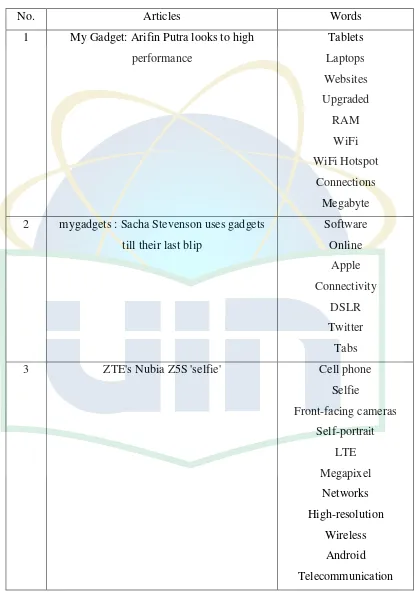
Article 1 (MY GADGET: Arifin Putra looks to high performance)
January 13, 2014.
Article 2 (mygadgets: Sacha Stevenson uses gadgets till their last blip)
January 20, 2014.
Article 3 (ZTE‘s Nubia Z5S ‗selfie‘ lovers) January 27, 2014.
Article 4 (MY GADGET: Tanta Ginting: Cannot stay away from his
iPhone) February 03, 2014.
Article 5 (Daniel Mananta: only use gadgets when necessary) February
15, 2014.
Article 6 (MY GADGET: Nonita Respati: Capturing great and
inspiring things) March 01, 2014.
Article 7 (Google redesigns Android to power smart watches) March
19, 2014.
Article 8 (A heads-on look at Sony's virtual reality goggles) March 20, 2014.
Article 9 (Facebook launches lab to bring Internet everywhere) March
8
CHAPTER II
THEORETICAL FRAMEWORK
A. Previous Study
This section describes few studies that have been done about word
formation in order to avoid the same discussion. The first research was done by
Mursyid Kasmir Naserly (2010) entitled An Analysis on the Word Formation of
the Advertisements Lexicon. The research focuses on the process of
word-formation in advertisements which have 8 kinds of word word-formation based on
Matthew (1997) and Rodman & Fromkin (1998) they are word coinage, back
formation, reduplication, acronym, abbreviation, clipping, compounding, and
blending.17
The researcher used 15 advertisements as his data analysis. All the data
analysis has a word which contained word formation process. The researcher
identified the word by making a table to classify what word formation that he
found based on the definition and the characteristic of each word formation. This
research have found 13 blending and 2 compounding words such as Magnifisound
from Magnificent and Sound (blending), and Sureprice from Sure and Price
(compounding).
The next research was done by Mega Arisanty (2014) entitled An Analysis
Processes In Instagram Simple Plan, One Direction, Maroon 5 and The Jonas
Brothers Band. The research was focused to analyze the types and the process of
17
word formation which applied on Instagram. The researcher used American group
singer‘s Instagram account as the data analysis and has selected 75 words to be
analyzed. The data are analyzed using the theory of morphology that contained the
types and the process of word formation. The types of word formation that the
writer used in the theory are derivation, compounding, creation de novo, blending,
clipping, back-formation, acronyms, initialisms, eponyms, and inflections. The
researcher made a tree diagram by classified the word classes then categorized it
into the type of word formation which suitable. The research have found 8 word
formation which are derivation, compounding, creation de novo, blending,
clipping, acronyms, initialisms, and inflection.18
The third research which has been done earlier is Proses Morfologis Dalam
Bahasa Indonesia: Analisis Bahasa Karya Samsuri by Tatang Suparman (2008).
This research‘s purpose is to get a clear description about morphology processes
in Samsuri‘s works. The main study in this research is word formation processes.
In his theoretical framework he stated five word formation components, they are,
affixation, reduplication, internal changes, and zero modification. He found that
only two components of word formation which can analyze Bahasa Indonesia,
they are affixation ad reduplication.19
The fourth research entitled Pembentukan Kata Benda Istilah Sepak Bola
Dalam Reader Total Football Rusia 2012 by Eko Bawono (2012). This paper
discussed about the formation of the noun terms football in Russian language. The
18
Mega Arisanty, ―An Analysis Processes In Instagram Simple Plan, One Direction, Maroon 5 and The Jonas Brothers Band‖, (Jakarta: State Islamic University, 2014)
19Tatang Suparman, ―Proses Morfologis Dalam Bahasa Indonesia: An
alisis Bahasa
analysis in this paper used the method of exposition which describe and analyze
the formation of noun. The theory that he used to analyze is the theory of word
formation by Popov and Kalinina (writers of Russian books about word
formation). The writer describes the process of affixation that forms a new word
with a new meaning. As for affixes that discussed in his paper are suffix, prefix,
flexion, interfix, and postfix. He also mentioned abbreviation in his theory but
only focused on affixation processes.20
The previous researches mainly were done by graduate and post-graduate
students on behalf of their theses. In UIN Syarif Hidayatullah Jakarta, specifically
in English Language and Literature department, this is the third research
discussing about English Word Formation. Based on the previous researches
above, this research uses a different theory which makes it different from those
four previous researches. So, it can be said that this research is something new
especially in English Language and Literature Department, UIN Syarif
Hidayatullah Jakarta.
B. Concept
1. English Word Formation
Morphology can be described as a grammatical study about words which
also contain the structure of word, the change of word, the grammatical meaning
and word formation. By learning morphology, the learners can know about how a
word is formed and changed, also what is the meaning of the word. Originally
20
morphology meant the study of biological forms. But 19th century students of
language borrowed the term and applied it to the study of word-structure.21
Morphology is an area of grammar concerned with the structure of words
and with relationships between words that involve the morphemes that compose
them.22 Morphology is one of the main subjects in linguistics besides phonology
and syntax. So, that is why there are some definitions of morphology that we can
find in linguistics introduction books easily. Based on Spencer & Zwicky (2007)
Morphology is at the conceptual center of linguistics. This is not because it is the
dominant sub discipline, but because morphology is the study of word structure,
and words is at the interface between phonology, syntax, and semantics.23
Although morphology not only mention about the formation of word, but also
includes the formation of a group of words or phrases.24
From the definition of morphology above, word formation is the main topic
of morphology. Word formation is a traditional label, and one which is useful, but
it does not generally cover all possible ways of forming everything that can be
called a word.25 Word formation rules is the one whose functions to specify how
the morphemes are to be arranged in sequence to form actual words.26 Word
21
Francis Katamba, English Words, (Routledge, 2005), p19 22
Andrew Carstairs-McCarthy, An Introduction to English Morphology: Words and Their Structure, (Edinburgh University Press Ltd, 2002a), p. 144
23
Andrew Spencer & Arnold M. Zwicky, The Handbook of Morphology, (Blackwell Reference Online, 2007), p. 1
24
Djoko Kentjono, Dasar-dasar Linguistik Umum, (Fakultas Sastra Universitas Indonesia, 1984), p. 39
25
Laurie Bauer, English Word-Formation, (New York: Cambridge University Press, 1983), p. 9
26
formation‘s task is to characterize the kinds of things that speakers need to know
about the structure of the words of their language in order to be able to use them
to produce and to understand speech. Word formation is dealing with the
formation of words, the process of how a word builds and the structure of the
words. A simple example of word formation, the word frogs is not just a simple
word. It separates into smaller parts. Frogs contains of frog + -s for plural.
Another example is nutcracker that it is made up of two words, namely the noun
nut and the noun cracker. Cracker is divisible into the verb crack + -er.
From the examples above, word formation have some types which
categorize them in groups. Such as for the word frogs is an inflection word
formation. The writer will not explain deeply about the inflection word formation
because it will discuss in the types of word formation subtopic. But, before the
writer give explanation of types of word formation; take a look back to the
examples. Word frogs can separate into smaller parts frog and -s. Those smaller
parts are called morphemes. From the first chapter of this research, the writer have
mentioned about morphemes. Morpheme and word cannot be separated. So, the
writer will discuss about morpheme and word deeply in the next subtopic.
a. Morpheme and Word
Word is the main thing in morphology discussion. As the definition of
morphology that have described before, morphology is a study about word. So,
the research will also explain and describe about word. But, before the researcher
morpheme first. As we used to know, word is the smallest part in language. But
there is a new name for the smallest part in language which is called morpheme.
The traditional grammar does not recognize the concept and the term of
morpheme. The concept of morpheme was introduced by the structuralists in the
early 20th century.27
smaller unit of meanings or grammatical function. The term morpheme is used to
refer to the smallest unit that has meaning or serves a grammatical function in
language.30 Morpheme described as the minimal linguistic sign which means that
the morpheme is the smallest component of a word which contributes to its
meaning.31
Every single morpheme has a meaning. Morphemes tend to have a fairly
stable meaning which they bring to any word in which they appear. If we take un-,
for example, they mean ‗not‘ respectively—not just in the word that have listed in
27
Abdul Chaer, Linguistik Umum 4rd edition, (Jakarta: PT Rineka Cipta, 2012), p. 147 28
Ingo Plag, Word-formation in English, (Cambridge University Press, 2002), p25 29
Ibid, p. 27 30
Francis Katamba, op.cit., p. 20 31
the example before, but also in thousands of other words. Usually morphemes are
used again and again to form different words.32
The linguists have divided morpheme into two basic parts, free morpheme
and bound morpheme. A morpheme which can also stand as a word is called a
free morpheme.33 Some morphemes can occur only if attached to some other
morpheme. Such morphemes are called bound morphemes.34 Bound morpheme
unable to function as a free-standing words, it cannot stand alone. There is also a
book which has two types of morphemes they are roots and affixes.
1) Roots
Any sound identified as a word by a speaker has at least one root. Roots are
the center of word-derivational processes. They carry the basic meaning from
which the rest of the sense of the word can be derived.35 Morpheme such as fair is
root; its meaning carry over into unfair. Root like fair also happens to be free
form with identifiable word-class properties or called free root morphemes (the
one that are also independent words); the one that cannot stand alone as words are
called bound root morphemes.36
Donka Minkova & Robert Stockwell, English Words History and Structure, (Cambridge University Press, 2009), p. 69
36
affixes be attached.37 In English, affixes which attached at the end of the base
called suffixes, or at the front of the base called prefixes.38 The examples of
prefixes are re+turn means ‗turn back‘, or un+filled means ‗not filled‘, and the
examples of suffixes act+or means ‗person who acts‘, and another example
child+ish means ‗like a child‘.
Affixes have two quite different functions. The first is derivational affixes
and the second is inflectional affixes. Derivational affixes are to participate in the
For example of a word in derivational affixes such as treat+ment which have
changed the word classes by added the suffix –ment from treat V(verb) into
treatment N(noun), and for inflectional affixes such as play+ed which describe the
tense without change the word class.
The next discussion is about word. As we can see in the beginning
paragraph of this subtopic, word is the main thing in this discussion. As we all
think that words are a basic unit of language and also the important one. We
cannot imagine how a language without words. We all know thousands of word
that we always use while speaking or making interaction with others. But people
sometimes hard to describe the meaning of the term word. Leonard Bloomfield,
one of the greatest linguists of the twentieth century, in 1926 has stated that ‗a
minimum free form is a word‘.41
By this he meant that the word is the smallest
meaningful linguistic unit that can be used on its own. It is a form that cannot be
divided into any smaller units that can be used independently to convey
meaning.42
As the definition above, however, it seems that Bloomfield‘s statement have
been disputed by the structuralists with the term morpheme. Therefore, the
linguists try to fix the definition of the term word by explaining it into several
types of word to avoid the ambiguity. First, a word-form (i.e. a particular physical
manifestation of one or more lexemes in speech or writing); second, a vocabulary
41
Francis Katamba, op.cit., p. 6 42
item (i.e. lexeme); third, a unit of grammatical structure that has certain
morphological and syntactic properties.43
We can also simply conclude the definition of word from the previous
subtopic ‗Morpheme‘ that word can build by adding a root and affixes, or only a
root, or two/three roots which will be a one word with meaning or new meaning
with grammatical function or word class. That also can be said words are a
fundamental unit out of which phrases and sentences are composed.44 For
example, help consist of one root. Then, helpful consist of two roots help as the
free root morpheme and –ful is the bound root morpheme or suffix. Another example is the word helpfulness which consist of three roots help, -ful, and –ness.
Help as the free root morpheme or free morpheme, -ful and –ness as the bound
root morpheme/bound morpheme/suffix.
It is sometimes not easy to decide whether a given string of sounds (or
letters) should be regarded as a word or not. To help us recognize what the term
word is, also to avoid the ambiguity of the meaning of words, Ingo Plag (2002)
have given a summary the properties of words. First, words are the syntactic
atoms, the smallest elements in a sentence. Second, words (usually) have one
main stress. Spoken in isolation, every word can have only one main stress.45 The
main stressed syllable is the syllable which is the most prominent one in a word.
Prominence of a syllable is a function of loudness, pitch and duration, with
43Ibid, p. 17 44
Andrew Carstairs-McCarthy, op.cit. 2002a, p. 146 45
stressed syllables being pronounced louder, with higher pitch, or with longer
duration than the neighboring syllable(s).46
Third, words are (usually) indivisible units (no intervening material
possible).
If some modificational element is added to a word, it must be done at the edges, but never inside the word. For example, plural ending –s in girls, or negative elements such as un- in uncommon or endings that create verbs out of adjectives such as -ize in colonialize never occur inside the word they modify, but are added either before or after the word. However, there are some cases in which word integrity is violated. For example, the plural of
son-in-law is not son-in-laws but sons-in-law.47
The last, words are entities having a part of speech specification. Words
belong to certain syntactic classes (nouns, verbs, adjectives, prepositions, etc)
which are called part of speech, word classes, or syntactic categories.48 The
position in which a given word may occur in a sentence is determined by the
syntactic rules of a language. These rules make reference to words and the class
they belong to.49 We can therefore test whether something is a word by checking
whether it belongs to such a word class.
2. Types of English Word Formation
There is broad, but not complete, agreement as to how the field of word
formation should be divided up. The linguists have divided word formation into
five until six kinds of word formation, but Donka Minkova and Robert Stockwell
have stated more complete kinds of word formation. There are at least eight word
formations which have divided by them. They also categorize the word formation
into two groups: regular word formation and new word creation.
There are two kinds of regular word formation based on Minkova and
Stockwell, they are derivation and compounding. But the writer also adds
inflection into this group. Another group has six kinds of word formation which
are creation de novo, blending, clipping, back-formation, abbreviations:
acronyms and initialisms, and eponyms.
a. Inflection and Derivation
Bloomfield (1933/1935) as quoted by Malmkjaer, referred to
inflection as the outer layer of the morphology of word forms, and
derivation as the inner layer.50 In other words, inflection is added when all
derivational and compositional processes are already complete.51 For the
clear example of that explanation is the plural form of motorbike is
motorbikes, not motorsbike.
Aronoff (1976) and Corbin (1987) explicitly omit inflectional
morphology from consideration, so they do not address the issue of whether
any or all inflected word-forms should be lexically listed.52 But Halle (1973)
saw no reason not to list inflected forms as well as derivatives; the only
difference between them was that inflected forms were grouped in the
50
Kirsten Malmkajaer, op.cit., p. 358 51Ibid
52
dictionary into paradigms.53 The notion of inflection rests on the more basic
notion of lexeme.
A lexeme is a unit of linguistic analysis which belongs to a particular
syntactic category, has a particular meaning or grammatical function and
ordinarily enters into syntactic combinations as a single word; in many
instances, the identity of the word which realizes a particular lexeme varies
systematically according to the syntactic context in which it is to be used.54
Since inflected forms are just variants of one and the same word,
inflecting a word should not cause it to change its category.55 Typically
inflection contributes a morpheme that is required in order to ensure that the
word has a form that is appropriate for the grammatical context in which it
is used.56 English is a language which has less number of inflections.
Fromkin have described eight inflection affixes in English with the
examples:
-s third-person singular present She wait-s at home.
-ed past tense She wait-ed at home.
-ing progressive She is eat-ing the donut.
-en past participle Mary has eat-en the donuts.
Andrew Spencer & Arnold M. Zwicky, loc.cit.
55
Andrew Spencer, Morphological Theory, (Blackwell Publishers Ltd, 1991), p. 9 56
-er comparative Disa has short-er hair than
Karin.
-est superlative Disa has the short-est hair.57
As can be seen from the inflection affixes above, if we have a third person
subject, a present tense verb agreeing with it must take the –s ending; anything else is forbidden.58 The application of an inflectional process is
automatically triggered if the right syntactic conditions obtain.
Inflection cannot cause a word to change its syntactic category, but
derivation does. Derivation is the reverse of the coin of inflection. Same as
inflection, it consists of affixes. Derivational affixes function not to express
morphosyntactic categories but to make new words. 59 Derivation is
motivated by the desire to create new lexical items using pre-existing
morphemes and words.60 It is possible to create a new lexical item by
recycling pre-existing material. This is derivation; it takes one of three
forms: affixation, conversion, or compounding.
Derivation by affixation consists in making up new words by adding
affixes, or endings, to more basic forms of the word.61 These derivations
require no special definition or explanation because they follow regular
rules. For example, the word active in Chambers Dictionary have derived
words: activate, activation, actively, activeness, activity, activism, activist.
But sometimes different dictionaries make different decisions.
Derivation enables us to add new lexical items to the open
word-classes of noun, adjective, verb, and adverb.62 Consider the following pairs
of sentences in which the same words appear in different functions such as a
noun but also an adjective/adverb/verb, for example:
It‘s no trouble at all. Don‘t trouble yourself.
In these cases the verb or adjective and noun look alike and sound alike.
There is reason to believe that the verb is derived from the noun, it derived
without affixation. They are said to be derived by a process of conversion – the noun is converted into a verb.63 Conversion that have been around long
enough are normally shown with a single entry in many dictionaries, with
the identification n., a., v., meaning that the form occurs as noun, adjective,
and verb all three.64
b. Compounding
Derivation is not the only way of forming new words, of course. In
many languages, compounding is the most frequently used way of making
new words. Its defining property is that it consists of the combination of
62
Francis Katamba, loc.cit.
63
Donka Minkova & Robert Stockwell, op.cit., p. 8 64
lexemes into larger words.65 In simple cases, compounding consist of the
combination of two words, in which one word modifies the meaning of the
other, the head. This is a very large, and therefore very important, source of
new words. To produce a new word by compounding, what we do is put
together two words in a perfectly transparent way, and then various changes
take place which may cause the compound to lose its transparency.66
When a new compound is formed, we already know the meaning of its
constituents, and the only task we face is to find out about the semantic
relation between the two parts. The right constituent of a compound is
normally the head. The left constituent of such compounds functions to
modify the meaning of the head constituent.67 The head is the element that
serves to determine both the part of speech and the semantic kind denoted
by the compound as a whole.68 For example, greenhouse is a noun, as house
is, and skyblue is adjective, as blue is. Similarly, the second base determines
the semantic category of the compound – in the former case a type of
building, and in the latter a color.
Minkova and Stockwell distinguish compounding into two types,
syntactic compounds and lexical compounds. Syntactic compound is
compounds are formed by regular rules of grammar, like sentences, and they
65
Geert Booij, The Grammar of Words, (United States: Oxford University Press In. New York, 2005), p. 75
66
Donka Minkova & Robert Stockwell, loc.cit.
67
Geert Booij, op.cit., p. 76 68
are no, therefore, listed in a dictionary.69 For example, birthplace (a place of
birth), washing machine (we wash things with the machine), sunrise (the
rising of the sun). Another type of compound is lexical compound which (if
we do not know the meaning already) has to be looked up in a dictionary
like a totally novel word.70 For example, crybaby is not refers to babies that
cry but to people who act like babies that cry. Similarly, girl friend is not
just a girl who is a friend, nor is boy friend just a boy who is a friend. These
compounds actually can mean what they appear to mean on the surface, but
usually they mean more than that.
c. Creation de novo
Though one might think it an easy matter to create a new word
(without basing it on some pre-existing word or part of a word) for some
new idea or new artifact, such creations are rare. The invention of
completely new morphs is rare in comparison to the kinds of word
formation described above (inflection, derivation, and compounding). Word
formation processes are variably productive but constantly in operation to
expand the lexicon as new meanings emerge, social and technological
change takes place, and individuals create new forms.71
69
Donka Minkova & Robert Stockwell, op.cit., p. 10 70Ibid
71
Creation de novo or de novo itself refers to words created entirely
from scratch, a process known also as word-manufacture.72 Completely new
words often start as trade-marks. Kodak was created and registered as a
proprietary name in 1888 by George Eastman, founder of the camera
company that bears his name. The word Kodak itself is reported to have said
that it was ―a purely arbitrary combination of letters, not derived in whole or
in part from any existing word.‖73
In the world of marketing, such creations are generally the result of
massive commercial research efforts to find a combination of sounds, words
that have a pleasant ring to them and that are easy to pronounce. But most of
the new words that even advertising experts come up with are derived from
old words.74 So, it can be concluded that creation de novo is mostly formed
from a brand which used and known worldwide.
d. Blending
In blending, parts of two familiar words are yoked together (usually
the first part of one word and the second part of the other) to produce a word
which combines the meanings and sound of the old ones.75 Most treatments
converge on a definition of blends as words that combine two words into
one, deleting material from one or both of the source words.76 Successful
72
examples are smog a blend of smoke and fog, motel from motor and hotel,
heliport from helicopter and airport, and brunch from breakfast and lunch.
The examples of blending can be assigned to two classes such as
blend of motel; the meaning of this form is one where the first element
modifies the second element.77 Another example is mocamp from motor and
camp is a kind of camp, not a kind of motor. A brunch is both breakfast and
lunch. The blends in that example denote entities that share properties of the
referents of both elements.78
e. Clipping
One of the many ways in which speakers shorten their words or
phrases is by clipping off some part of word, and throwing away the rest.79
Clipping which can involve deletion of initial morphemes or final
word-segments, such as lab(oratory), or (tele)phone.80 Plag (2002) have also
stated about clipping in addition to Minkova and Stockwell (2009) that
clipping is the processes involving the deletion of material, yet another case
of non-concatenative morphology. The process also occasionally
encountered with words that are not personal names.81
The examples of clipping are phone from telephone, plane from
airplane, flu from influenza. Ad and British advert are transparently based
Donka Minkova & Robert Stockwell, op.cit., p. 14 80
Kirsten Malmkjær, loc.cit.
81
on advertisement. In many cases it is apparent that they are deliberate
shortenings to save time and space; such clipping are, technically speaking,
not ―new‖ words, but stylistic variants of existing words.82
f. Back-formation
Quite often, words are analogically derived by deleting a suffix, a
process called back-formation.83 Back-formation occurs when a suffix is
removed from a complex word.84 An example of such a back-formation is
the verb edit which was derived from the word editor by deleting –or on the basis of a proportional analogy with word pairs such as actor – act.85
Another example of back-formation is the verb escalate, which occurs
with two meanings, each of which is derived from a different model word.
The first meaning can be paraphrased as ‗to climb or reach by means of an
escalator ... to travel on an escalator‘ (OED), and is modeled on escalator.
The second meaning is escalate is roughly synonymous with ‗increase in
intensity‘ which is back-formed from escalation which can be paraphrased
as ‗increase of development by successive stages‘.86
82
Donka Minkova & Robert Stockwell, op.cit., p. 15 83
Ingo Plag, op.cit., p. 48 84
Kirsten Malmkjær, op.cit., p. 360 85
Ingo Plag, loc.cit.
86
g. Abbreviations: acronyms and initialisms
Abbreviation is most commonly formed by taking initial letters of
multi-word sequences to make up a new word. For example, FAQ for
frequently asked question. One can also find abbreviations that incorporate
non-initial letters. As an example, ASAP stands for as soon as possible.87 If
we take a look into abbreviation, it will give differences of abbreviation by
its spelling and pronunciation. So, abbreviations can be grouped into two
part, abbreviation non-initial called acronyms and abbreviation by taking initial named initialisms.
g.1 Acronyms
Acronyms (acr-o ‗tip, point‘ + onym ‗name‘) are a special type of
shortening. A typical acronym takes the first sound from each of several
words and makes a new word from those initial sounds and resulting initials
that pronounced like any other word.88 The spelling of acronyms may differ
with regard to the use of capital letters. Usually capital letters are used,
which can be interpreted as a formal device that clearly links the acronym to
its base word. 89 The acronyms are, for example: NASA (National
Aeronautics and Space Administration), NATO (North Atlantic Treaty
Organization). Often, however, to make an acronym pronounceable, we
87Ibid
, p. 161 88
Donka Minkova & Robert Stockwell, op.cit., p. 16 89
take not just the initial sounds but, for example, the first consonant and the
first vowel together such as radar from radio detecting and ranging.90
g.2 Initialisms
If the letters which make up the acronyms are individually
pronounced, like COD, such acronyms are called initialisms. The word
initialisms based on Oxford English Dictionary means ‗a significative group
of initial letters‘. 91
The examples of initialisms, NBC (National
Broadcasting Company), BBC (British Broadcasting Company, FBI
(Federal Bureau of Investigation). Classifying a new form as either an
acronym or initialism is not always easy or possible. The words CD-ROM
(compact disk read-only memory) or JPEG (Joint Photographic Experts
Group) are initialism-acronym hybrids. Sometimes one and the same word
can be pronounced either as initialism or as acronym such as FAQ
(Frequently Asked Question).92
h. Eponyms
There are new words based on names (epi- ‗upon‘ onym ‗name‘). So,
eponym is a new word that is formed from a name of an inventor or
discoverer. Eponym mostly appear in fields like biology, physics, chemistry,
etc. quite often eponym come from an individual name, a character familiar
90
Donka Minkova & Robert Stockwell, loc.cit.
91Ibid 92
from mythology, history, a place name, a brand name, etc.93 It is like turning
a proper noun into a common noun. For example: boycott (Charles Boycott,
an English land agent in Ireland), cheddar (a village in Somerset when the
cheese first came), atlas (he was condoned by Zeus, the leader of the Greek
gods, to support the earth and heavens on his shoulders), Google was an
internet search engine registered and launched in 1998; the verb to google
has been in use since 1999.
3. Structural Morphology Theory
Modern linguistics has three approaches in twentieth-century: structuralism,
functionalism and generativism.94 Ferdinand de Saussure known as the Founding
Father of modern linguistics has an important role in structural linguistics
followed by Franz Boas, Leonard Bloomfield and Edward Sapir.95 Structuralism
focuses on the description of languages. Eugene A. Nida releases Morphology:
The Descriptive Analysis of Words in 1946 which talk about the description of
words structure. Yet, Nida uses the term morpheme in his book to explain and
describe about word formation. In his book, Nida explains and describes about the
meaning of morpheme, kinds of morpheme, how morphemes merger to form a
word, morphological structure, also identify the meaning of morphemes.96
93
Ibid, p. 19 94
Kirsten Malmkjaer, op.cit., p. xxxiii 95
Ibid
96
Ba‘dulu & Herman in their book Morfosintaksis have summarized Nida‘s
work. They also describe the structural morphology processes to describe word
formation. They write the point to analyze and describe words from Nida‘s book
into four processes:
Figure 2.2 The Organization of Structural Morphology97
The first task for the analyst is to identify all the morpheme, both free and
bound morpheme from the data that have been collected. The second component
is word formation which explains about how morphemes in a language arranged
in groups to form real words in that language. The third is morphophonology
processes, a mechanism of morphophonology processes which show the changes
that occur in the merger of morpheme. The last component is dictionary. All the
word that passed those three processes will be or must be listed in a dictionary.98
An example of the process of structural morphology theory is the word
helpfulness. First thing to do is separates the word helpfulness into smaller parts,
make a list of morpheme which contain in the word. helpfulness is consist of three
97
Ibid,p. 16 98
Ibid, pp. 16-17
List of Morphemes
Word Formation
Morphophonology Processes
morphemes help, -ful, and –ness. Help is the base which is free morpheme because it is also an independent word. Then, -ful and –ness are the bound morphemes or suffixes because it cannot stand alone as a word and it attached at
the end of the base. But, in morphology, helpfulness can be sonsist of two
morphemes. They are helpful and –ness. Helpful is as the root which is a free morpheme and –ness as the suffix.
Second is the process of word formation. Helpfulness is a derivation word
formation because it creates new lexical items using pre-existing morphemes and
words and changes the syntactic category from helpful (adj) into helpfulness (n).
Helpfulness is the type of derivation by affixation because it creates new word by
adding affix –ness. Third is the morphophonology processes. Helpfulness does not have any special morphophonological process in changing or omitting the letters
to form it into a new word. It only added a suffix –ness. The last step is dictionary.
Helpfulness is listed in Cambridge Dictionary with a meaning ―willing to help, or
useful‖.99
It means that the word helpfulness is a real word and agreed by people
in the world.
4. Technology
Technology becomes a main part in human life today. They need
technology items and use it to help them doing their job and daily activity. The
term technology itself is a combination of the Greek techne for art, craft, with
logos which means word, speech. At first, technology is the term for discussion of
99
Cambridge Dictionaries Online,
the applied arts only. In the early 20th century, it embraces a growing range of
means, processes, and ideas in addition to tools and machines.100―Technology is
the application of scientific knowledge for practical purposes, especially in
industry‖ that is how Oxford Dictionaries have a definition of technology.101 The
example of current technology that is highly developed is communication devices
such as smartphones and tablets.
100
http://www.britannica.com/technology/history-of-technology accessed on October 1,
2015 101
Oxford Dictionaries Online,
http://www.oxforddictionaries.com/definition/english/technology accessed on October 1,
34 CHAPTER III
RESEARCH FINDINGS
A. Data Description
In data description, the data are collected from The Jakarta Post‘s Sci-tech
articles on January – March 2014. The data that will be analyzed are the words
related to technology term which is directly related to technology, technology
development, technology items and terms associated with technology items. There
are nine headlines that have been chosen and there are 54 different words related
to technology term and contain word formations that have been found without
repetition occurring in the nine articles. The researcher also uses four main
dictionaries to check every word that has been analyzed whether the word is listed
in the dictionaries or not. The four dictionaries are Oxford Dictionaries Online,
Cambridge Dictionaries Online, Merriam-Webster Dictionaries Online and
Longman Dictionary of Contemporary English Online.
The words that have been found are written into a piece of paper. Then, the
researcher chooses the half number of 54 words from the articles to analyze. The
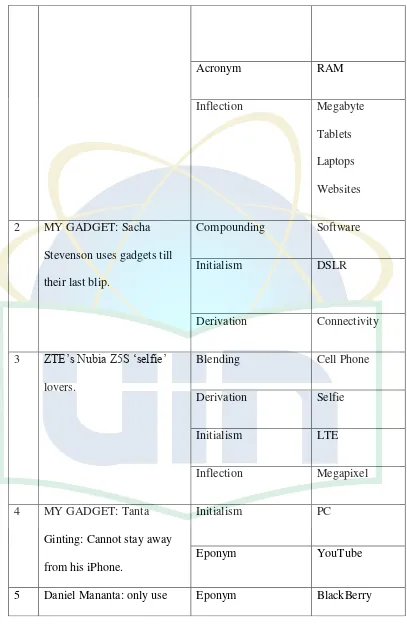
researcher gets 27 words that have been chosen and describe into the table below:
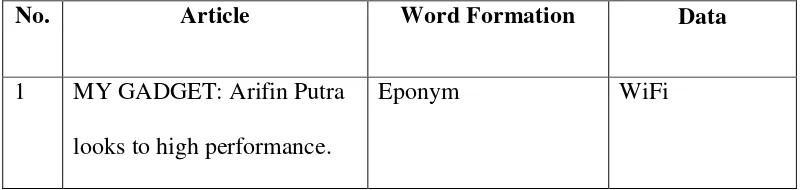
Table of Data Collected from The Jakarta Post‘s Sci-Tech Article January –
March 2014
No. Article Word Formation Data
1 MY GADGET: Arifin Putra
looks to high performance.
Acronym RAM
Inflection Megabyte
Tablets
Laptops
Websites
2 MY GADGET: Sacha
Stevenson uses gadgets till
their last blip.
Compounding Software
Initialism DSLR
Derivation Connectivity
3 ZTE‘s Nubia Z5S ‗selfie‘
lovers.
Blending Cell Phone
Derivation Selfie
Initialism LTE
Inflection Megapixel
4 MY GADGET: Tanta
Ginting: Cannot stay away
from his iPhone.
Initialism PC
Eponym YouTube
B. Data Analysis
1. Article 1: MY GADGET: Arifin Putra looks to high performance.
1) WiFi
a. Morpheme
The word WiFi consists of one morpheme. WiFi is a free morpheme
because it can stand alone as a word. Based on the types of gadgets when necessary.
Derivation Communication
6 MY GADGET: Nonita
Respati: Capturing great and
inspiring things.
Eponym WhatsApp
Inflection Gadgets
7 Google redesigns Android to
power smart watches.
Clipping Tech
App
Eponym Google
8 A heads-on look at Sony‘s
virtual reality goggles.
Compounding Headphone
Initialism 3D
VR
9 Facebook launches lab to
bring internet everywhere.
Eponym Facebook
morpheme, WiFi can be called as a free root morpheme because it
happens as a free form with identifiable word class properties.
b. Word Formation
WiFi can be classified as an eponym word formation. Eponym is a
new word that is formed from a name. There are so many eponym
comes from a brand name, individual name, company name and
place name. Eponym is like turning a proper noun into a common
noun. WiFi belongs to eponym on an organization‘s name WiFi
Alliance. WiFi is a trademark of WiFi Alliance. It is a word that has
been use since most of people use WiFi to connect the device such
as Smartphone and laptop to the internet.
c. Morphophonological Processes
WiFi has no special change in omitting or adding any letters to
create the word. WiFi is a completely new word which is taken
from an organization‘s name. It does not use any pre-existing words.
It is taken from the developer name WiFi Alliance.
d. Dictionary
WiFi is listed in Oxford Learner‘s Dictionaries Online in the
technology topic related to computer hardware. It is also listed in
Cambridge Dictionaries Online and Merriam-Webster Dictionaries
Online. But, WiFi is not listed in Longman Dictionary of
Thus, WiFi has passed the four processes of word formation which
use the structural morphology processes of identifying the word. WiFi
has one morpheme as a free morpheme. WiFi has been classified as an
eponym word formation and do not have any special processes in
morphophonological because it is completely a scratch. WiFi is also
listed in Oxford Learner‘s Dictionaries Online, Cambridge Dictionaries
Online and Merriam-Webster Dictionaries Online. Then, WiFi is
structurally perfect as a word.
2) RAM
a. Morpheme
RAM is short from Random Access Memory. RAM is only has one
morpheme which is a free morpheme. It can stand alone as a word
and has word class property that can be identified. But, if we also
identify Random Access Memory, it has three free morphemes. They
can stand independently as a word with identifiable word class
properties.
b. Word Formation
RAM is a kind of abbreviation. But, abbreviation is grouped into two
parts, abbreviation non-initial called acronym, and abbreviation by
taking initial named initialism. RAM is belong to acronym because it
takes the first sound from each of several words Random Access
Memory and makes a new word from those initial sounds R, A, and
Usually capital letters are used, which can be interpreted as a formal
device that clearly links the acronym to its base word.
c. Morphophonological Processes
In this process, there is no special change to create the word RAM.
They only shorten the base words Random Access Memory by taking
the first letters R, A, and M, and omitting the others letter.
d. Dictionary
RAM is listed in Oxford Learner‘s Dictionaries Online in the
technology topic related to computer hardware. It is also listed in
Cambridge Dictionaries Online and Longman Dictionary of
Contemporary English Online. It is not listed in Merriam-Webster
Dictionaries Online.
Thus, RAM has passed the fourth processes of word formation which
use the structural morphology processes of identifying the word. RAM is
a single free morpheme. RAM has been classified as an acronym in word
formation. The process in morphophonological is taking the initials R, A,
and M of the words Random Access Memory. RAM also listed in
Cambridge Dictionaries Online, Oxford Dictionaries Online, and
Longman Dictionary of Contemporary English Online. Then, RAM is
structurally perfect as a word.
3) Megabyte
The word megabyte consists of two morphemes. They are mega- and
byte. Based on the concept of morpheme, mega- can be described as
an affix. This affix is attached at the beginning of the word. The
affix that is attached in the beginning of the word called prefix. This
prefix is an inflectional affixes because it does not change the
syntactic category. It only changes the amount of byte. A prefix is
part of bound morpheme because it is attached to the morpheme byte
and it cannot stand alone as a word. Byte is the main part of this
word because it can be predicted to find the meaning of the word.
Byte is a free morpheme because it can stand alone as a word even
without the morpheme mega-. Based on the types of morpheme; byte
is a free root morpheme because it happens as a free form with
identifiable word class properties.
b. Word Formation
Megabyte can be classified as an inflection. It forms a variant of one
and the same word without cause it to change its category. Based on
the concept of inflection, it cannot cause a word to change its
syntactic category. It can be proved that the word byte has a
syntactic category as a noun. Then, the word megabyte has the same
syntactic category and does not change anything both the meaning
and the syntactic category. So, it can be classified that megabyte is
an inflection.
The word megabyte does not have any special morphophonological
process in changing or omitting the letters and morphemes to form it
into a new word. It only added the prefix mega- to state a big amount
of byte.
d. Dictionary
Megabyte is listed in Oxford Learner‘s Dictionaries in the
technology topic related to computer hardware. It is also listed in
Cambridge Dictionaries Online, Merriam-Webster Dictionaries
Online, and Longman Dictionary of Contemporary English Online.
Thus, megabyte has passed the fourth processes of word formation
which use the structural morphology processes of identifying the word.
Megabyte has two morphemes, the first is mega- as a bound morpheme
and the second is byte as a free morpheme. Megabyte has been classified
as an inflection word formation and do not have any special processes in
morphophonological because it only added a prefix mega-. Megabyte is
also listed in Oxford Dictionaries Online, Cambridge Dictionaries
Online, Merriam-Webster Dictionaries Online, and Longman Dictionary
of Contemporary English Online. Then, Megabyte is structurally perfect
as a word.
4) Tablets
a. Morpheme
The word tablets consist of two different kinds of morpheme. They
morpheme because it can stand alone as a word. Based on the types
of morpheme, tablet can be called as a free root morpheme because
it happens as a free form with identifiable word class properties.
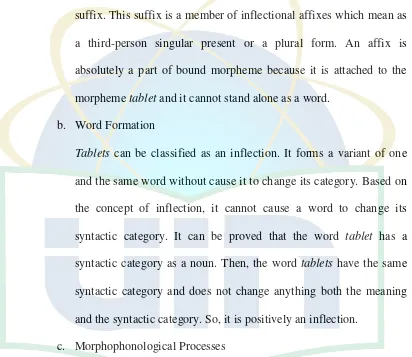
Move to another morpheme which is –s. Based on the theory, -s is an affix. In English, affix which attach at the end of the base is called
suffix. This suffix is a member of inflectional affixes which mean as
a third-person singular present or a plural form. An affix is
absolutely a part of bound morpheme because it is attached to the
morpheme tablet and it cannot stand alone as a word.
b. Word Formation
Tablets can be classified as an inflection. It forms a variant of one
and the same word without cause it to change its category. Based on
the concept of inflection, it cannot cause a word to change its
syntactic category. It can be proved that the word tablet has a
syntactic category as a noun. Then, the word tablets have the same
syntactic category and does not change anything both the meaning
and the syntactic category. So, it is positively an inflection.
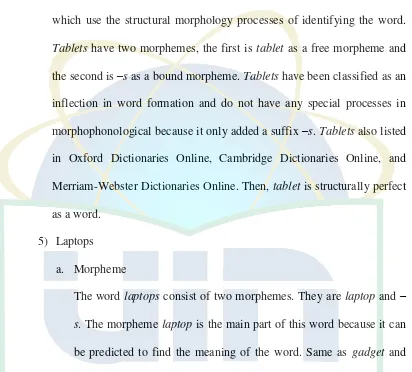
c. Morphophonological Processes
Tablets do not have any special morphophonological process in
changing or omitting the letters to form it into a new word. It only