Tree Pruning for Output Coded Ensembles
T. Windeatt and G. Ardeshir
Centre for Vision, Speech and Signal Processing,
School of Electronics, Computing and Mathematics,
University of Surrey, Guildford, Surrey, GU2 7XH, UK
[email protected]
Abstract
Output Coding is a method of converting a multiclass problem into several binary subproblems and gives an en-semble of binary classifiers. Like other enen-semble methods, its performance depends on the accuracy and diversity of base classifiers. If a decision tree is chosen as base classi-fier, the issue of tree pruning needs to be addressed. In this paper we investigate the effect of six methods of pruning on ensembles of trees generated by Error-Correcting Output Code (ECOC). Our results show that Error-Based Pruning outperforms on most datasets but it is better not to prune than to select a single pruning strategy for all datasets.
1. Introduction
In the output coding method of learning, several binary classifiers are trained on two class sub-problems and their outputs are combined to solve the original multiclass
prob-lem. To decompose a class problem these methods use
a✂✁☎✄
binary (typically 0-1) code matrix where✄
is the number of binary classifiers. One-Per-Class and Distributed Output Code [5] are examples of this kind of
decomposi-tion technique. In One-Per-Class a -dimensional binary
target vector represents each one of classes using a
sin-gle binary value at the corresponding position, for exam-ple ✆✝✟✞✡✠☛✠☞✠✝✌✞✎✍✏✞✑✝✟✞✡✠☛✠☞✠✝✓✒. This leads to a code matrix that has
1’s along the diagonal and 0 elsewhere. Distributed
Out-put Code is different in that the rows are binary strings
that are assigned on the basis of meaningful features corre-sponding to each bit position. For this to provide a suitable decomposition some domain knowledge is required so that each classifier output can be interpreted as a binary feature. The strings are treated as code words, one for each class, and a test pattern is assigned to the class corresponding to the closest code word.
Error-Correcting Output Code (ECOC) uses a method of assigning similar to Distributed Output Code but the code
matrix is problem-independent. The motivation for using an error-correcting code comes from the assumption that the learning task can be modelled as a communication problem, in which class information is transmitted over a channel [5]. In this model, errors introduced into the process arise from various sources including the learning algorithm, features and finite training sample. From the transmission channel viewpoint, it is expected that One-Per-Class and Distributed Output Coding matrices would not perform as well as the ECOC matrix, because of inferior error-correcting capabil-ity. The output coding concept has been successfully ap-plied to problems in several domains such as cloud classi-fication, text classiclassi-fication, text to speech and face recogni-tion [9]. It has also been shown to improve performance with different kinds of base classifier including decision tree, multi-layer perceptron, SVM and k-nearest-neighbour. If a decision tree is chosen as base classifier, the issue of tree pruning needs to be addressed. In the past, effort has been directed toward developing effective tree pruning methods (for a review see [6]) in the context of a single tree. The goal of single tree pruning in an ensemble is to produce a simpler tree base classifier which gives improved ensemble performance. The methods used in this study are Error-based Pruning (EBP), Minimum Error Pruning (MEP), Reduced-Error Pruning (REP), Critical Value Prun-ing (CVP) and Cost-Complexity PrunPrun-ing (CCP). It is worth noting that tree pruning is an art rather than a science. For example consider EBP, which is the default pruning strat-egy for C4.5, in which the author emphasises its heuristic nature by noting that the reasoning behind it (Section 3.1) should be taken with a ”grain of salt” [11].
C4.5. In [13], five pruning methods were compared and EBP performed best for both Bagging and Boosting. The empirical comparison of ensemble classifiers in [2] did not use C4.5, but did compare size of bagged pruned and un-pruned trees, and concluded that pruning reduces bias while increasing variance.
2. Output Coded Ensembles
The binary
✔✁✕✄
output coding matrix ✖ defines the
problem decomposition. A training pattern with target class
✗✙✘
(✚✜✛✢✍✏✠☛✠☛✠ ) is re-labelled either as class✣✥✤ or as class✣✙✦
depending on the value of✖
✘★✧
. One way of looking at this
re-labelling is to consider that for each column the classes
are arranged into two super-classes ✣✥✤ and✣✙✦ . A pattern
is presented to the ✄
trained binary classifiers and thereby
mapped into vector✩✢✛✪✆✫ ✤ ✞✑✫ ✦ ✞✡✠☛✠☛✠✫✭✬✜✒, in which✫
✧
is the
real-valued output of✮ th base classifier. The output vector
represents super-class probabilities and a pattern is assigned to the class corresponding to the closest row (code word)
in ✖ . Hamming Distance was originally chosen to
mea-sure closeness, since the code was based on error-correcting principles. However when it was shown that the method produced good probability estimates the decision strategy
was modified to the✯
✤
✤ norm or Minkowski distance given
by✯
. The decision strategy assigns class
✗✙✘
When the ECOC technique was developed it was be-lieved that the code matrix should be chosen to satisfy cer-tain properties, including high Hamming Distance between pairs of rows and between pairs of columns [5]. Various output coded ensembles have been proposed, but most code matrices that have been investigated previously are binary and problem-independent, that is pre-designed. Exhaustive codes were proposed when number of classes is between 3 and 7, column selection from exhaustive codes when num-ber is between 8 and 11 and randomised hill climbing and Bose, Ray-Chaudhuri & Hocquenhem (BCH Code) when there are more than 11 classes [5]. Random codes were in-vestigated in [12] for combining Boosting with ECOC, and it was shown that a random code with a near equal column split of labels was theoretically better. Random codes were also shown in [8] to give Bayesian performance if pairs of code words are equidistant. In [14] a random assignment of class to codeword was suggested in order to reduce sensi-tivity to code word selection.
Overall there is little evidence that any particular binary problem-independent code is superior, and random codes appear to perform as well as others providing
✄
is large enough. Recent developments include proposal of a three-valued code [1] which allows specified classes to be omit-ted from consideration and [3] in which problem-dependent
discrete and continuous codes are investigated.
Attempts have been made to develop theories for ensem-ble classifiers. The margin concept is useful for finding bounds on generalisation error [1]. In [10] a modified defi-nition for bias and variance from regression theory was pro-posed and it was shown that ECOC reduces both variance and bias according to their definition. However, different definitions for bias and variance with 0-1 loss function have been suggested, and there are recognised shortcomings with the approach [7].
3. Experiments
3.1. Pruning Techniques
Decision tree pruning is a process in which one or more subtrees of a decision tree are removed to reduce its com-plexity and make it more comprehensible. There are differ-ent types of pruning but post-pruning is more usual. The disadvantage of pruning is that tree growth can be pre-maturely stopped, since it is based on a difficult estimation of when to stop constructing the tree. A way around this problem is to use a post-pruning method since then the full tree is grown before being retro-spectively pruned. Post-pruning methods remove one or more subtrees and replace them by a leaf or a branch. One class of these algorithms divides the training set into a growing set and a pruning set, which is used to select the best tree. In the case of short-age of training set cross-validation can be used. Another class of post-pruning algorithm uses all the training set for both growing and pruning. However it is then necessary to define an estimate of the true error rate using the training set alone. In this study, the comparison is limited to post-pruning methods and they are briefly discussed in this sec-tion, more details and equations for pruning criteria avail-able in [6, 13]. The distinction between the work described here and that in [6] is that pruning methods are compared in the context of tree ensembles rather than single trees.
EBP was developed for use with C4.5 and uses predic-tion of error rate (earlier version known as Pessimistic Error Pruning) [11]. The assumption is that the error in the set of patterns covered by a leaf of a tree follows a binomial distri-bution. The upper limit of confidence of the probability of mis-classification can then be calculated from an assumed confidence level (default 25%). The predicted error rate comes from multiplying the upper limit of confidence by the number of patterns covered by the leaf. If the number of predicted errors is less than that for the subtree containing the leaf, then the subtree is replaced with the leaf.
MEP was first introduced using Laplace probability
es-timates, and later modified to what was referred to as
m-probability estimation. The parameter❁ is varied in an
learning domain such as noise. To prune a tree at a node, the expected error rates of its children are first determined,
and this is calledstatic error.Dynamic error, defined as the
weighted sum of the static error of its children, is then cal-culated and if static error is greater than dynamic error the node is replaced by the leaf.
REP requires a separate pruning set, and simply replaces each non-leaf node by the best possible branch with respect to error rate over the pruning set. Branch pruning is re-peated until there is an increase in the pruning set error rate. The procedure is guaranteed to find the smallest, most ac-curate subtree with respect to the pruning set.
CVP operates with a variety of node selection measures.
The idea is to set a threshold, thecritical value, which
de-fines the level at which pruning takes place. A non-leaf node is only pruned if the associated selection measures for the
node and all its children do not exceed thecritical value.
The full tree is pruned for increasing critical values giving a sequence of trees, and then the best tree is selected on the basis of predictive ability. A number of suggestions were made for finding the best tree in the sequence, the obvious one being to use a separate pruning set as in REP.
CCP produces a sequence of trees by pruning those branches that give lowest increase in error rate per leaf over the training set. The error rate calculation is based on the number of training patterns, the number of leaves in the subtree and the additional number of misclassified exam-ples when the leaf is removed. In order to select the best tree in the sequence, either cross-validation on the training set or a separate pruning set is employed. The selected tree is either the smallest tree with error rate less than minimum observed error rate (CCP0) or less than minimum observed error rate plus one standard error (CCP1).
3.2. Results
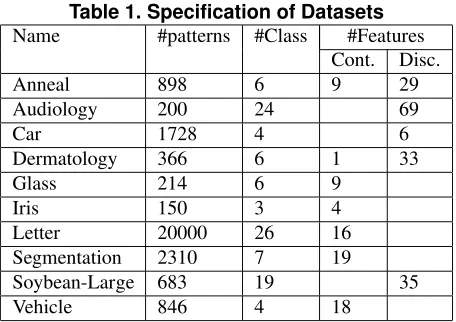
Datasets from UCI are used in these experiments and have been randomly split into training set (70%) and test set (30%). The numbers of patterns, classes and features are shown in table 1. We have used C4.5 as base classifier with six methods of pruning given in Section 3.1, plus the unpruned (UNP) case. To generate the ECOC code matrix
with 31 columns (✄
✛❃❂✌✍ ) we have used exhaustive and
BCH codes as explained in Section 2.
For datasets described in table 1, table 2 shows the mean test error over ten independent runs normalised with respect to the minimum test error over all pruning methods for the specified dataset. Each error rate has been divided by the respective minimum error rate so that the mean effect over all datasets can be assessed. The minimum test errors (%) for the datasets are as follows Anneal/7.5, Audiology/31.3, Car/13.0, Dermatology/3.8, Glass/26.9, Iris/5.1, Letter/9.9, Segmentation/2.1, Soybean-large/11.3, Vehicle/28.4. Also
shown in table 2, after the normalised error for each pruning method, is the number of times that the pruning method is significantly different (McNemar’s test 5%) from UNP.
In table 2, the mean normalised error (last row) over the ten datasets shows that MEP on average has higher error and UNP has lower error compared with all other pruning methods. However for MEP we used the default value of
❁❄✛❆❅ and it is likely that the error would improve if❁ was
allowed to vary. There is little difference in the mean nor-malised error and mean number of significant differences for EBP, CVP, REP, CCP0, CCP1. We can see that UNP performs best for five datasets, EBP for 3 datasets and CVP and CCP0 for one dataset. Ignoring UNP, EBP outperforms other pruning methods for seven data sets (Glass, Iris, Ve-hicle, Car, Letter, Dermatology, Segmentation), CCP0 for two data sets (Soybean-large, audiology) and CVP for one (audiology).
Overall it appears that if a single problem-independent strategy is to be selected then UNP is likely to give lowest error rate. If pruning is required to simplify the ensemble, any one of EBP, CVP, REP, CCP0, CCP1 should give simi-lar error rate. However, since EBP performs better on seven out of ten datasets it may be that problem-dependent prun-ing should be considered. From table 2 and from specifica-tion of datasets table 1 we can see that EBP performs well with those datasets that have only continuous features. For example, if EBP was selected for datasets with no discrete features (glass, iris, letter, segmentation, vehicle) and UNP was selected for the other datasets the mean normalised er-ror over ten datasets would be 1.025. This suggests that a larger study should be carried out to test the hypothesis that problem-dependent pruning is worthwhile.
4. Conclusion
In this paper we have compared six pruning strategies for an output coded ensemble method that uses error-correcting codes. For the ten datasets tested, it is shown that it is better not to prune rather than select a single problem-independent pruning strategy for all datasets. However there was was some evidence that problem-dependent pruning might be beneficial.
AcknowledgementGholamreza Ardeshir is grateful to the Ministry of Culture and Higher Education of Iran for its financial support during his Ph.D studies.
References
[1] E.L. Allwein, R.E. Schapire, and Y. Singer. Reducing multi-class to binary: A unifying approach for
mar-gin classifiers.Machine learning research, 1:113–141,
Dataset EBP MEP CVP REP CCP0 CCP1 UNP
Anneal 2.55/10 3.19/10 1.00/2 1.19/1 1.09/1 1.26/1 1.04
Audiology 1.31/1 1.31/1 1.02/2 1.10/3 1.00/0 1.01/0 1.17
Car 1.19/5 2.32/10 1.34/10 1.26/6 1.25/7 1.28/7 1.00
Dermatology 1.00/0 1.68/1 1.52/2 1.33/0 1.23/0 1.24/2 1.17
Glass 1.00/0 1.34/2 1.16/3 1.19/3 1.17/4 1.19/2 1.02
Iris 1.00/0 1.13/0 1.52/0 1.52/0 1.48/0 1.48/0 1.22
Letter 1.01/1 5.78/10 1.11/8 1.09/7 1.09/7 1.10/8 1.00
Segmentation 1.01/0 6.88/10 1.70/3 1.59/3 1.62/1 1.58/2 1.00
Soybean-large 1.40/8 3.22/10 1.23/0 1.31/2 1.19/2 1.22/2 1.00
Vehicle 1.02/0 1.22/5 1.07/1 1.05/0 1.06/1 1.04/0 1.00
(Mean) 1.25/2.5 2.80/5.9 1.27/3.1 1.26/2.5 1.23/2.3 1.24/2.4 1.06
Table 2. Mean test error normalised with respect to minimum error over all pruning methods followed by number of significant differences from unpruned (UNP)
Table 1. Specification of Datasets
Name #patterns #Class #Features
Cont. Disc.
Anneal 898 6 9 29
Audiology 200 24 69
Car 1728 4 6
Dermatology 366 6 1 33
Glass 214 6 9
Iris 150 3 4
Letter 20000 26 16
Segmentation 2310 7 19
Soybean-Large 683 19 35
Vehicle 846 4 18
[2] E. Bauer and R. Kohavi. An empirical comparison of voting classification algorithms: Bagging,
boost-ing, and variants. Maching Learning, 36(1):105–142,
1999.
[3] K. Crammer and Y. Singer. On the learnability and
de-sign of output codes for multiclass problems.Machine
Learning, to appear.
[4] T. G. Dietterich. An experimental comparison of
three methods for constructing ensembles of decision
trees: Bagging, boosting, and randomization.
Ma-chine Learning, 40(2):139–158, 2000.
[5] T.G. Dietterich and G Bakiri. Solving multi-class
learning problems via error-correcting output codes.
Journal of Artificial Intelligence Research, 2:263–286, 1995.
[6] F. Esposito, D. Malerba, and G. Semeraro. A compar-ative analysis of methods for pruning decision trees.
IEEE Transactions on Pattern Analysis and Machine Intelligence, 19(5):476–491, May 1997.
[7] G. M. James. Variance and bias for general loss
func-tions.Machine Learning, to appear.
[8] G. M. James and T. Hastie. The error coding method andPICT’s. Computational and Graphical Statistics, 7:377–387, 1998.
[9] J. Kittler, R. Ghaderi, T. Windeatt, and G. Matas. Face verification using error correcting output codes. In
Computer Vision and Pattern Recognition CVPR01, Hawaii, December 2001. IEEE Press.
[10] E.B. Kong and T.G. Diettrich. Error-correcting output
coding corrects bias and variance. In12th Int. Conf.
of Machine Learning, pages 313–321, San Fransisco, 1995. Morgan Kaufmann.
[11] R. Quinlan. C4.5: Programs for Machine Learning.
Morgan Kaufmann, San Mateo,California, 1993.
[12] R.E. Schapire. Using output codes to boost
multi-class learning problems. In14th International Conf.
on Machine Learning, pages 313–321. Morgan Kauf-man, 1997.
[13] T. Windeatt and G. Ardeshir. An empirical compar-ison of pruning methods for ensemble classifiers. In
IDA 2001. Springer-Verlag, Lecture notes in computer science, 2001.
[14] T. Windeatt and R. Ghaderi. Binary labelling and
deci-sion level fudeci-sion. Information Fusion, 2(2):103–112,
2001.