VOL. 10, NO. 2, FEBRUARY 2015 I SSN 1819- 6608
ARPN Jour nal of Engineering and Applied Sciences
© 2006- 2015 Asian Resear ch Publishing Net w or k ( ARPN) . All right s reser ved.
www.arpnjournals.com
415
TELEMEDICINE SUPPORTED BY DATA WAREHOUSE ARCHITECTURE
Mohd Khanapi Abd Ghani, Mustafa Musa Jaber and Nanna Suryana
Biomedical Computing and Engineering Technologies (BIOCORE) Applied Research Group, Faculty of Information and Communication Technology, Universiti Teknikal Malaysia Melaka, Malaysia
ABSTRACT
Telemedicine is the new way of delivering health services to patients and can be defined as the provision of medical services by using information technology and communication systems. Moreover, it emphasizes the interaction and collaboration with the increase of sharing information and knowledge between healthcare provider and patient. Healthcare information systems contain large volumes of information that include demographic and medical history of patients such as medication, lab test results, radiology information and procedures that are constantly growing. Thus, the need of complete medical data which supports video, audio and images has to be accomplished before implementing the telemedicine system. The aim of this research is to propose an integrated telemedicine framework supported by data warehouse technique. The proposed framework is evaluated using test case technique and the result showed that data warehouse provide important elements of information to telemedicine system especially during consultation
Keywords: telemedicine, data warehouse, data warehouse architecture, medical data.
INTRODUCTION
Health informatics is a rapidly growing field that applies computer science and information technology to medical and health data [1].
Data warehouse is the heart of the architected environment, and is a fundamental for all decision support system (DSS). The work of the DSS analyst in the data warehouse environment is much easier compared to traditional database. This is because data warehouse is a single integrated source of data and is easy to be accessed seamlessly [2].
The data warehouse contains a source of valuable data mining. The data contained in the data warehouse is comprehensive, integrated, and structured according to transaction date and time. It should be noted that although the data warehouse is an excellent source of data for the minor and the explorer, the data warehouse is often the only source of reference. External data from different application data can be freely mixed with data warehouse as part of their exploration and mining [3].
METHODS
ARCHITECTURE DESIGN
The proposed telemedicine-data warehouse architecture has been modeled and customized based on requirement collected from user (doctor and medical assistant) through open ended interview and discussion. The requirements were modeled and recorded using use case model.
Once the telemedicine-data warehouse architecture was developed, the proposed architecture was tested using electronic medical data source adopted from University of California, Irvine (UCI).
The evaluation of the proposed telemedicine-data warehouse architecture was conducted based on test case technique where the system functionalities, test case, expected test result and actual test result was designed and used during the evaluation.
Microsoft Visual Studio application MySQL were used as a development tools to design and test the system and storage for processing the sample dataset.
The architecture evaluation is conducted by the intention of providing more flexible and enhanced method of managing and classifying the dataset tables into Object Linking and Embedding (OLE) database. This approach is to provide alternatives and better services to database administrator in managing and retrieving the dataset. Hence, it would improve the integration of telemedicine-data warehouse system.
PROPOSED TELEMEDICINE- DATAWAREHOUSE ARCHITECTURE
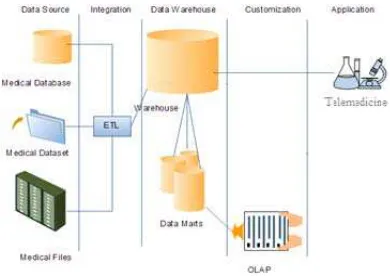
The proposed telemedicine-data warehouse architecture consist of five layers including data source layer, integration layer, data warehouse layer customization layer, and application layer as shown in Figure-1. The next section will explain the role and function of each layer for further understanding.
Figure-1. The Proposed Telemedicine Data Warehouse Architecture.
Data Sources Layer
VOL. 10, NO. 2, FEBRUARY 2015 I SSN 1819- 6608
ARPN Jour nal of Engineering and Applied Sciences
© 2006- 2015 Asian Resear ch Publishing Net w or k ( ARPN) . All right s reser ved.
www.arpnjournals.com
416
breast cancer is used as a data source. Data staging area is a preparation to build a data warehouse which limited to the combine, cleaning, alignment and prepare the data to Extraction-Transformation-Load (ETL) tool.
Integration Layer
The integration layer provides mechanism on how to map the attributes of the datasets into a clean, simple view of the enterprise. ETL is an integration tool and a preparation process of the data into data warehouse. Extraction is a process of reading the data from data sources, transformation is transforming data to common form that able to include quality and load is loading the moving data into data marts. Integration layer helped to integrate the various source of data to common data warehouse [4] as shown in Figure-2.
Figure-2. Creating ETL tool connection.
Data Warehouse Layer
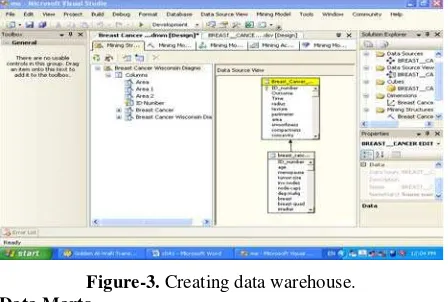
The data warehouse layer concerns on data storage for any type of medical data in terms of data mart relation. In addition, this layer has been reported as a source of reality for all common medical data and a place where the medical data warehouse is created [5]. Figure-3 shows the creation of data warehouse.
Figure-3. Creating data warehouse.
Data Marts
A data mart is a storage of data that comes from various database or/and other sources of data that could
support the business needs of the healthcare services. The data may be derived from various source of information such as dedicated database, other data warehouse and specific database. Data marts are able to provide a conceptual view of dataset elements through different data ports [6].
Metadata and the Metadata Repository
Saving the database that contains the complete glossary of all components databases, fields, and objects, owners, and access codes platforms. Provide a method to the users of data warehouse to view what information is available and where it is kept the conversion was made to the data, other data are related to the selected data [7].
Customization Layer
Customization layer enables the user to modify and expand the application of data warehouse and online analytical processing (OLAP) cube. OLAP enables business users to slice and dice the data according their needs. Typically, the data in the organization is distributed in several data sources and incompatible with each other. For example, point-of-sales data and sales through the call center or on the Internet are stored in another location and format. Implementing OLAP involves the process of extracting data from various data repositories and making them compatible to be used. An example of conflicting data is the age of the client can be saved as a birth date for purchases made via the Internet and stored in the age categories for sale in the store [8, 9, 10, 11].
Application Layer
Based on study done by [12], it was highlighted that the telemedicine data can be stored in smartphones and it would be sent to medical doctor for further analysis through telecommunication network. However, this method might face technical problems of limited storage space and execution capability. Hence, the data warehouse system would overcome this problem by storing the data into data warehouse server where the doctor can view and analyze the data at a convenient time and location. In addition, data warehouse also stores multimedia information such as images and audio. As such, the integration between data warehouse and telemedicine system is important for seamless access to patient medical history of patient.
This application layer could be used to enhance the integration between data warehouse and telemedicine system and, other health information system attached with medical devices or sensors [13].
RESULTS AND DISCUSSIONS
VOL. 10, NO. 2, FEBRUARY 2015 I SSN 1819- 6608
ARPN Jour nal of Engineering and Applied Sciences
© 2006- 2015 Asian Resear ch Publishing Net w or k ( ARPN) . All right s reser ved.
www.arpnjournals.com
417
performing the Object Linking and Embedding (OLE) database operations. The study shows how the admin of telemedicine services can use the medical dataset and create new OLE based on the selected dataset. SQL has been used to make the database that stores the necessary medical dataset information for the admin. The architecture has been evaluated and the minor improvement needs to be incorporated into proposed architecture. The integration between telemedicine system and data warehouse would be improved especially for data storing and fast accessibility [14].
CONCLUSIONS
This research has been involved the issues of generating the medical dataset operations into data warehouse structure based on Microsoft Visual Studio to be combined with telemedicine system. The integration of the data warehouse into the form of telemedicine is a contribution of this research. In order to make sure the requirements easily to understand, the system has been tested and evaluated using existing test cases techniques for telemedicine system.
REFERENCES
[1] Gheorghe M. and Petre R. 2014. Integrating Data
Mining Techniques into Telemedicine Systems, Informatica Economica Journal. 18(1): 120-130.
[2] Abd Ghani, M.K., Bali, R.K., Naguib, R.N.G., I.M.
Marshalland ShibghatullahA.S. 2007. The Design of
Flexible Front End Framework for Accessing Patient Health Records through Short Message Service. IEEE-Asia Pacific Conference on Applied Electromagnetics, Melaka.
[3] Marban O., Segovia, J., Menasalvas E. and Baizan
C.F. 2009. Toward data mining engineering: A software engineering approach, Information Systems. 34: 87-107.
[4] D. Wegener and S. Ruping. 2010. On Integrating Data
Mining into Business Processes, Business Information Systems. 47: 183-194.
[5] M. Holsheimer. 1999. Data mining by business users:
integrating data mining in business processes.
[6] S. Sharma and K. Osei-Bryson. 2009. Framework for
formal implementation of the business understanding phase of data mining projects. Expert Systems with Applications. 36: 4114-4124.
[7] Mailvaganam H. 2007. Design Methodologies of
Kimball and Inmon Plus a Third Way, Data Warehousing Review, Available at http://www.dwreview.com/ Articles/
KimballInmon.html, Downloaded on 15/11/2014.
[8] Miller D. R., Safford M. M. and Pogach L. M. 2004.
Who has diabetes? Best estimates of diabetes prevalence in the Department of Veterans Affairs based on computerized patient data. Diabetes Care, 27(suppl 2), b10-b21.
[9] Fang M., Zhang Y., Zhao H., Wu N. and Yu J. 2007.
Integration of hospital information systems in china, New Mathematics and Natural Computation. 3(01): 135-151.
[10]Rashkovska A., Tomasic I. and Trobec R. 2011. A
telemedicine application: ECG data from wireless body sensors on a smartphone. IEEE MIPRO Proceedings of the 34th International Convention.
[11]Brindha G. 2013. Emerging Trends of Telemedicine
in India. Indian Journal of Science and Technology. Vol. 6, sup. 5.
[12]Fang M., Zhang Y., Zhao H., Wu N. and Yu J. 2007.
Integration of hospital information systems in china, New Mathematics and Natural Computation. 3(01): 135-151.
[13]Singh D. 2014. Mobility and energy efficient
mechanism for lowpan devices to support global healthcare system, Journal of Theoretical and Applied Information Technology. 66(1): 315-329.
[14]Abd Ghani M. K., Bali R. K., Naguib R. N. G.,