Advances in the practice of microsurgery: focusing on free anterolateral thigh
perforator flap
Theddeus O.H. Prasetyono
Abstrak
Makalah ini bertujuan untuk meninjau kemajuan aplikasi teknik bedah mikro secara klinis melalui pemanfaatan free anterolateral thigh perforator flap (ALT flap) sebagai salah satu flap terbanyak yang digunakan di dalam bedah rekonstruksi. Sebuah tinjauan dilakukan terhadap publikasi dalam bahasa Inggris yang dapat diakses melalui Pubmed dari tahun 1997 sampai 2006 dengan menggunakan kata kunci “anterolateral thigh perforator flap.”Jenis penelitian yang diambil berupa seri kasus teknik bedah mikro yang menggunakan hanya free anterolateral thigh flap tanpa melibatkan komponen otot. Evaluasi dilakukan untuk mencari indikasi, kontraindikasi, daerah atau organ yang dilakukan rekonstruksi, penyebab defek, morbiditas, hasil akhir secara fungsional dan estetik, teknik dalam penggunaan materi jahit, dan peralatan. Dua ratus tiga puluh abstrak dikumpulkan melalui program EndNote versi 7. Terdapat 56 artikel dari berbagai jurnal sesuai dengan kriteria. Karena keterbatasan dana, penulis mengalami kesulitan dalam mengakses semua makalah lengkap tersebut; dengan demikian hanya didapatkan 8 artikel dari Plastic and Reconstructive Surgery yang digunakan sebagai sumber makalah ini. Hasil penelusuran adalah sebagai berikut: angka keberhasilan viabilitas flap sebesar 98% (525 dari 535 flap) dengan nekrosis parsial 2,2% (12 dari 535 flap). Penipisan flap dilakukan sesuai kebutuhan. Daerah resipien flap bervariasi meliputi wajah, leher, faring dan esophagus, payudara, ekstremitas atas dan ekstremitas bawah. Empat dari 8 makalah menyebutkan hasil secara fungsional memuaskan sampai sangat memuaskan, serta evaluasi estetik baik sampai sangat memuaskan. Disimpulkan bahwa Free anterolateral thigh perforatorflap adalah pilihan yang populer dalam rekonstruksi jaringan lunak. Daerah resipien sesuai indikasi terutama meliputi kepala dan wajah, ekstremitas, dan bahkan payudara. Hasil yang baik pula diperoleh dalam rekonstruksi faring dan esophagus. (Med J Indones 2007; 16:245-50)
Abstract
The purpose of this paper was to discuss an overview of the current clinical practice of microsurgery with a specific use of free anterolateral flap as one of the commonest flaps used in reconstructive surgery. A systematic review was performed through all English publication that goes to Pubmed during the period of 1997 to 2006 using keywords: “anterolateral thigh perforator flap.” The studies involved were retrospective case reviews on using microsurgical technique and involves free anterolateral thigh flap only without muscle involvement. Evaluation was done to search the indications, contraindications, area or organ to reconstruct, the cause of defects need reconstructive surgery, morbidities, functional and aesthetic results, techniques in regard of suture material, and instruments. Using 7thedition EndNote program, 230 abstracts were successfully retrieved in term of “anterolateral thigh perforator flap” of ANY FIELD and Boolean logic OR. Fifty six abstracts from many journals matched the criteria. Due to our limitation to get all of those articles, finally, 8 articles from Plastic and Reconstructive Surgery became the resources of this paper. The overall success rate in terms of flap viability is 98% (525 from 535 flaps) with partial necrosis is as low as 2.2% (12 from 535 flaps). Thinning procedure is commonly applied with regards of the thin flap needed. The recipient sites from 8 articles varies and can be any part of the body includes facial, neck, pharyngoesophagus, breast, upper and lower extremity. Four out of 8 papers mentioned functional evaluation and all stated satisfactory to excellent outcome. There are also 4 papers mentioning the aesthetic evaluation. Overall evaluation was mentioned as good to excellent. It is concluded that free anterolateral thigh perforator flap is a well established choice in most soft tissue reconstruction. It can be indicated to any area needed reconstruction especially head and neck, extremity, and go beyond conventional for breast reconstruction. It has also superior result in pharyngoesophageal reconstruction. (Med J Indones 2007; 16:245-50)
Keywords: anterolateral thigh flap, reconstructive microsurgery, perforator flap, supermicrosurgery
Free tissue transfer always involves microsurgical technique and is on the top of reconstructive ladder. It
is indicated when local and regional tissue is unavailable to cover any defect or replacing missing structures or complex tissue. Such situations might be due to un-acceptable donor morbidity on that location, inflammation, infection, insufficient volume or surface area of local and regional tissue, insufficient pedicle length of local and regional potential flaps, bad vascularization of Division of Plastic Surgery, Department of Surgery, Faculty of
recipient site as a result of prior radiation, long standing chronic wound, and localized distal vascular problem.
Historically, the practice of microsurgery has been started in the clinical situation since 1968 when Komatsu and Tamai had successfully replanted a thumb following the first replantation of upper arm by Malt and McKhann in 1962.1 But it seems to be not fair without mentioning Harry Buncke who is recognized as the father of microsurgery since his pioneering work on replanting a rabbit ear in 1966 with anastomosis of approximately 1 mm diameter of vessels. His success was then followed with subsequent tremendous clinical experiences of organ and tissue replantation, and free tissue transfer. The works of his team has been well documented in the book titled “Microsurgery: transplantation-replantation.2
Recently the practice of microsurgery has been growing very fast performed by microsurgeons all over the world which can be seen in the world congresses of surgical fields, especially plastic surgery, reconstructive microsurgery, and hand surgery. We can have a sample of illustration from the 10th Triennial Congress of IFSSH (International Federation of Societies for Surgery of the Hand) and 7th Triennial Congress of IFSHT (International Federation of Societies for Hand Therapy) in Sydney March 11th -15th 2007 which we can find at least 400 papers presented in regards of microsurgery among more than 1117 papers.3 Since one of the most flaps used is ALT (anterolateral thigh) flap,4,5 beside radial forearm flap, the purpose of this paper is to discuss an overview of the current clinical practice of microsurgery with special attention to this ALT flap.
METHODS
This study was designed to answer the question of whether the practice of microsurgery with its growing of perforator flap and supermicrosurgery is changing the indication and giving significant improvement of the result in the case of anterolateral thigh perforator flaps during the periode of 1997 – 2006. Basically this study is a systematic review.
Review was performed through all English publication that goes to Pubmed during the period of 1997 to 2006 using 7th edition EndNote program under
keywords “anterolateral thigh perforator flap”, ANY
FIELD categorization, and Boolean logic OR. The studies involved were retrospective case reviews on using microsurgical technique on anterolateral thigh cutaneous and or fasciocutaneous flap only. Exclusion criteria include multiple tissue components in the flap e.g. musculocutaneous flap, cadaver dissection and other experimental study; case review of the use of multiple type of free flaps; letter to the editor, comment and discussion.
Evaluation was done to search the indications, age, and sex of the patients, area or organ to be reconstructed, the cause of defects need reconstructive surgery, morbidities and mortalities, functional and aesthetic results, techniques in regard of suture material, and instruments.
RESULTS
There were 230 tittles published during 1997 to 2006 that could be retrieved from PubMed. Among that number 27 are non English publication. From the 203 English publications, 56 meet the criteria. These articles come from 17 peer reviewed journals which all but one needed us to pay 20-30 USD per each to download. Since the financial budget is not provided by any party, the author decided to take only articles published in PRS (Plastic and Reconstructive Surgery) which is the main journal of Plastic Surgery. This journal is in the first rank of among surgery journals pertinent to Plastic and Reconstructive Surgery Specialty with impact factor of 1.872 in 2003.6 Meanwhile, to increase the number of evidences that can be evaluated, the author is keeping the effort in getting all the other journals to update this paper soon later. This effort addresses communication to librarians abroad.
Among all the articles retrieved during 1997 to 2006, there are 4162 patients treated with the use of 3327 ALT perforator free flaps during the period. Whatsoever, those numbers are subject to bias in regards of duplication of patients counted by the authors who have some publications using the same subjects reported in accumulation of patient counting, either in the same or different journals.
Table 1. Distribution of patients, flaps, indications of the use of anterolateral thigh perforator cutaneous and or fasciocutaneous free flaps published in Plastic and Reconstructive Surgery from 1997 to 2006
No Authors Year of
439 5-16x8-25cm Soft tissue defect
4 Yang JY
et al10
2002 7 3 4 22-45;
ave 32.7
7 11x5-26x8cm Contracture
5 Wei FC
41 9.4cm in width Pharyngoesophageal
defect
8 Yang WG
et al14
2006 18 13 5 12-77;
ave 53
18 3x3-16x8 cm Soft tissue defect
Total 533 535
NA= not available
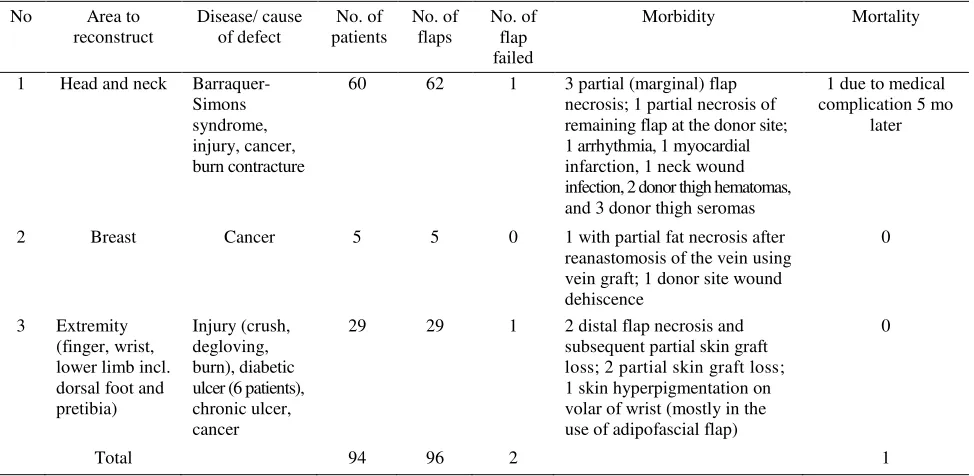
Tabel 2. Distribution of the cause of defect, flap failure, morbidity, and mortality according to the reconstructed area in the use of anterolateral thigh perforator cutaneous and or fasciocutaneous free flaps published in Plastic and Reconstructive Surgery from 1997 to 2006
1 Head and neck
Barraquer-Simons syndrome, injury, cancer, burn contracture
60 62 1 3 partial (marginal) flap
necrosis; 1 partial necrosis of remaining flap at the donor site; 1 arrhythmia, 1 myocardial infarction, 1 neck wound infection, 2 donor thigh hematomas, and 3 donor thigh seromas
1 due to medical complication 5 mo
later
2 Breast Cancer 5 5 0 1 with partial fat necrosis after
reanastomosis of the vein using vein graft; 1 donor site wound dehiscence loss; 2 partial skin graft loss; 1 skin hyperpigmentation on volar of wrist (mostly in the use of adipofascial flap)
0
Total 94 96 2 1
The number of patients does not include the patients in the study of Celik et al which didn’t clarify the reconstructed area of the 439
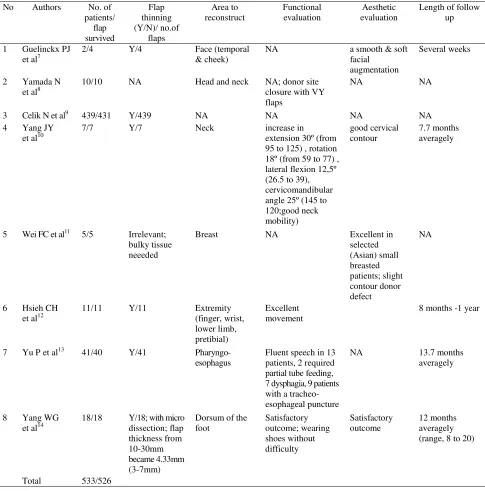
Table 3. Distribution of functional and aesthetic evaluation according to author muscular involvement are well established in reconstructive microsurgery as evidenced by the 8 articles retrieved from Plastic and Reconstructive Surgery. This fascio-cutaneous flap was firstly introduced by Song et al15
Indication and reconstructed area
According to the data shown in table 2, 62 out of 96 (65%) ALT perforator flaps were used to reconstruct defects in head and neck. It is obvious that this flap has become the standard flap for soft-tissue reconstruction in head and neck reconstruction besides its use for the upper and lower extremities (29 of 92 or 30%). The overall success rate through this study is 525 of 535 or 98% (with regards of 8 flaps underwent complete necrosis from the 439 flaps reported by Celik et al.9).
One of the very aggressive progresses made by plastic surgeons in terms of ALT perforator flap is its use to reconstruct pharyngoesophageal defects. It seemed previously that free jejunal flap is the first choice for this type of reconstruction,16 but Yu et al gave a good alternative in choosing a reliable flap as the ALT perforator flap was proven as safe and mature procedure;13,17 although there is another choice of using free radial forearm flap.18,19
Wei et al11 has actually an innovation of using free ALT perforator flap for breast reconstruction. Four out of 5 patients in their series were indicated to have thin lower abdomens and plans for future pregnancy. One patient received a DIEP flap for secondary breast reconstruction but developed partial necrosis, necessitating another reconstructive operation. The aesthetic results were excellent in those selected (Asian) women with small breasts. The advantages of ALT flap include the quality of the skin and fat which is said to be superior to those in gluteal flaps and are similar to those in lower abdominal flaps. It also allows a two-team approach without changing the position of the patient. This ALT is usually bulky in women and gives relatively enough tissue needed for small breasted patients. More subcutaneous fat can be harvested by undermining the skin flap. The only disadvantage of the anterolateral thigh flap seems to be the scar and slight contour defect at the donor site.
Functional and aesthetic evaluation
Four from 8 papers mentioned functional evaluation and all stated satisfactory to excellent outcome. This is to be critically further evaluated since we need some standard parameters for different reconstructed area. Overall, the 4 groups of author have already tried to clearly show the objective evaluation. This means that ALT perforator flap is the current choice to reconstruct defects on the neck, pharyngoesophagus, and extremity.
As the functional evaluation discussed above, there are also 4 papers mentioning the aesthetic evaluation.
Overall evaluation is mentioned as good to excellent. ALT perforator flap is a good choice for reconstruction of defects on the face, neck, dorsum of the foot as well as the selected cases of breast. Hsieh et al12 didn’t mention the aesthetic evaluation of the use of this flap for fingers and wrist. In regards of excellent movement as functional result, it seems to be in good aesthetic quality for the dorsal side of the hand but not the palmar one.
Morbidity and mortality
We can see some morbidities in the use of this ALT perforator flap. The donor coverage with skin graft might be categorized as morbidity but we should not generalize this as we may see some good or acceptable result of the grafted donor area. The overall rate of the flaps underwent partial (or marginal) necrosis is 2,2% (12 from 535 flaps) with regards of 7 flaps underwent partial necrosis from the 439 flaps reported by Celik et al.9 Other local morbidities seems to be also not significant in number.
The practice of microsurgery is suitable to a wide range of age from 11 to 94 year-old with overall mortality rate is as low as 1 in 533 patients. The only 1 mortality was not an operative death. The patient died 5 months after the surgery.
The length of surgery reported by some author as follows: harvesting time averaged 85 minutes (range, 45 to 120), reconstruction of the pharyngoesophageal defect averaged 4.5 hours (range 3.5 to 5.5), 13 while other mentioned 2 hours was needed to elevate the flap and donor covering. 8
Technical aspects
the flap, we may harvest the lateral half of the thigh, and a flap measuring 25 cm long and 18 cm wide can survive with only one perforator.20
The technique of thinning done by most authors in these series was not an important issue except in the study of Yang et al. Thinning technique was established in 520/535 flaps (97,2 %); special proposal with microdissection technique. The flap, based on a single perforator, can be harvested with a 2-mm-thick to 3-mm-thick layer of fat over the deep fascia.12
While performing the defatting before dividing the pedicle, they specifically mentioned to stop the defatting with tissue scissors at 1cm from the location where the perforator enter the fat layer. The perforator entry was dissected microscopically under tension. Those fat lobules intertwined with the perforator branches are then meticulously peeled off with microforceps. During microdissection, irrigation with a heparin-containing solution was continued to prevent dessication. Flap thickness originally 10-30 mm became averagely 4.33 mm (range, 3 to 7 mm).10 It is concluded that free ALT perforator flap is a well established choice in most soft tissue reconstruction. It can be indicated to any area needed reconstruction especially head and neck, extremity, and go beyond conventional for breast reconstruction. It has also superior result in pharyngoesophageal reconstruction.
Thinning procedure is commonly applied with regards of the thin flap needed. The overall success rate in terms of flap viability is 98% with partial necrosis is as low as 2.2%.
Acknowledgement
This is to express gratefulness to Dr. Louise O.Wijaya for her assistance in preparing the manuscript.
REFERENCES
1. Jones NF. Replantation in the upper extremity. Thorne CH, Beasley RW, Aston SJ, Bartlett SP, Gurtner GC, Spear SL,
editors. Grabb and Smith’s plastic surgery. 6th
ed. Philadelphia: Lippincott, Williams and Wilkins; 2007.p. 868-83. 2. Buncke HJ, editor. Microsurgery: transplantation-replantation.
An atlas-text. Philadelphia: Lea & Febiger; 1991.
3. Tonkin M, Coleman S, Beard T, Edmunds I, Gumley G, Isaacs I, et al, editors. Abstract book of 10th Triennial
Congress of International Federation of Societies for Surgery of the Hand (IFSSH) and 7th Triennial Congress of International Federation of Societies for Hand Therapy (IFSHT). Sydney Australia; 11-15 March 2007.
4. Wei FC, Jain V, Celik N, Chen HC, Chuang DC, Lin CH. Plast Chir 2002; 34(4): 239-44. (Abstract)
6. Rohrich RJ, Sullivan D. The role of the journal impact factor: choosing the optimal source of peer-reviewed plastic surgery information (editorial). Plast Reconstr Surg 2006; 117(7): 2495-8.
7. Guelinckx PJ, Sinsel NK. Facial contour restoration in Barraquer-Simmons syndrome using two free anterolateral thigh flaps. Plast Reconstr Surg 2000; 105(5): 1730-6. 8. Yamada N, Kakibuchi M, Kitayoshi H, Matsuda K, Yano
K, Hosokawa K. A new way of elevating the anterolateral thigh flap. Plast Reconstr Surg 2001; 108(6): 1677-82. 9. Celik N, Wei FC, Lin CH, Cheng MH, Chen HC, Jeng SF,
et al. Technique and strategy in anterolateral thigh perforator flap surgery, based on an analysis of 15 complete and partial failures in 439 cases. Plast Reconstr Surg 2002; 109(7): 2211-6.
10. Yang JY, Tsai FC, Chana J, Chuang SS, Chang SY, Huang WC. Use of free thin anterolateral thigh flaps combined with cervicoplasty for reconstruction of postburn anterior cervical contractures. Plast Reconstr Surg 2002; 110(1): 39-46.
11. Wei FC, Suominen S, Cheng MH, Celik N, Lai YL. Anterolateral thigh flap for postmastectomy breast re-construction. Plast Reconstr Surg 2002; 110(1): 82-8. 12. Hsieh CH, Yang CC, Kuo YR, Tsai HH, Jeng SF. Free
anterolateral thigh adipofascial perforator flap. Plast Reconstr Surg 2003; 112(4): 976-82.
13. Yu P, Robb GL. Pharyngoesophageal reconstruction with the anterolateral thigh flap: a clinical and functional out-comes study. Plast Reconstr Surg 2005; 116(7): 1845-55. 14. Yang WG, Chiang YG, Wei FC, Feng GM, Chen KT. Thin
anterolateral thigh perforator flap using a modified perforator microdissection technique and its clinical application for foot resurfacing. Plast Reconstr Surg 2006; 117(3): 1004-8. 15. Song YG, Chen GZ, Song YL. The free thigh flap: a new free flap concept based on the septocutaneous artery. Br J Plast Surg 1984; 37: 149-59.
16. Chang DW, Hussussian C, Lewin JS, Youssef AA, Robb GL, Reece GP. Analysis of pharyngocutaneous fistula following free jejunal transfer for total laryngopharyngectomy. Plast Reconstr Surg 2002; 109(5): 1522-7.
17. Yu P, Lewin JS, Reece GP, Robb GL. Comparison of clinical and functional outcomes and hospital costs following pharyngoesophageal reconstruction with anterolateral thigh free flap versus the jejunal flap. Plast Reconstr Surg 2006;117(3): 968-74.
18. Anthony JP, Singer MI, Mathes SJ. Pharyngoesophageal reconstruction using the tubed free radial forearm flap. Clin Plast Surg 1994; 21(1): 137-47.
19. Scharpf J, Esclamado, RM. Reconstruction with radial forearm flaps after ablative surgery for hypopharyngeal cancer. Head Neck 2003; 25(4): 261-6.