PREGNANCY RATE AND SURVIVAL IN CULTURE OF IN VITRO FERTILIZED
BOVINE EMBRYOS FROZEN IN VARIOUS CRYOPROTECTANTS
AND THAWED USING A ONE-STEP SYSTEM
T. Suzuki, M. Takagi, M. Yamamoto, A. Boediono,
S. Saha, H. Sakakibara and M. Oe
United Graduate School of Veterinary Sciences
Yamaguchi University, 753
yセ。ァオ」ィゥL@Japan
Received for publication:
November 24, 1992Accepted:
May 10, 1993ABSTRACT
Bovine oocytes surrounded with compact cumulus cells
were cultured for 20 to 22 hours (38.5°C, 5% C02) in modified
TCM-199 medium supplemented with 5% superovulated cow serum
(SCS) and inseminated by in vitro capacitated spermatozoa.
Day 7 to 8 embryos were equilibrated for 10 minutes in 1.3 M
methyl cellosolve (MC), 1.1 M diethylene glycol (DEG), 1.8 M
ethylene glycol (EG), 1.6 M propylene glycol (PG)
and 1.1 M
1, 3-butylene glycol (BG) solutions.
They were then loaded
into 0.25-ml straws,
placed into an alcohol bath freezer at
0°C, cooled from 0°C to -6°C at -l°C/minute, seeded, held for
10 minutes,
and cooled again at -0.3°C or -0.5°C/minute to
-30°C. Straws were then plunged and stored in liquid nitrogen
After thawing in 30°C water,
the embryos were rehydrated in
TCM-199 medium and then cultured for 48 hours in TCM-199 plus
5% SCS.
Embryos were considered viable if they progressed
to later developmental stages with good morphology.
Some of
the embryos frozen
in each
cryoprotectant were thawed
and
transferred
nonsurgically
without
removing
the
cryoprotectant.
Hatched embryos
survived freezing and
one-step dilution as follows:
EG
(50.0 %), MC
(53.6%), DEG
(56.9%),
PG (58.0%)
and
BG (11.5%).
The survival rate of
embryos
cooled
at
-0.3°C
vs
-0.5°C/minute was
not
significantly different(P>0.05), however, blastocysts hatched
most often (P< 0.01) in vitro when cooled at a rate of -0.3°C
/minute (64.6%, 31/48) than at -0.5°C/minute (22.6%, 12/53).
Pregnancy
rates
resulting from embryos
frozen
in the
different cryoprotectants were as follows:
MC (48%,
10/21);
DEG (30%, 3/10); EG (74%, 20/27);
and PG (40%, 4/10).
These
results indicate that MC, DEG, EG and PG
have utility as
cryoprotectants for the freezing and thawing of IVF bovine
embryos.
Key words: cryoprotectants, IVF, bovine embryo,
direct transfer
INTRODUCTION
A method of cryopreservation permitting direct transfer
of bovine embryos to recipients after thawing would be a
valuable adjunct to commercial embryo transfer procedures,
and would present advantages aver conventional freezing
procedures that require step - wise removal of the
cryoprotectant after thawing. Interest in direct transfer
systems for embryo marketing programs prompted additional
investigation of the problem of rehydrating embryos after
freezing and thawing. The primary problem addressed by
previous methods of direct traDsfer is the lack of
permeability of bovine embryos to common cryoprotectants.
Identifying effective cryoprotectants to which bovine embryos
are highly permeable is an alternative approach for
developing direct transfer procedures. Several methods for
direct transfer of bovine embryos have been previously
descrived, and one of the techniques has been a one-step
method (1-4). Other method has employed 1.5 M glycerol with
0.25 M sucrose as a cryoprotectant (5). In the above
experiments, sucrose was used as an osmotic buffer to
maintain osmotic equilibrium. However, these procedures have
not been widely accepted within the embryo transfer industry
because of the complexity of the process or failure to yield
consistently acceptable results. Recently we reported (6)
that 1.6 M propylene glycerol can be used effectively as a
cryoprotectant for bovine embryos. It permitted thawed
embryos to be rehydrated directly in holding medium. A
pregnancy rate of 61% was obtained after direct transfer to
recipients. Later, Voelkel and Hu (7, 8) reported a pregnancy
rate of 50% after direct transfer of frozen-thawed bovine
embryos using ethylene glycol. Permiability of sheep and
cattle embryos to ethylene glycol and propylene glycol was
greater than permiability to glycerol (9), suggesting that
these agents may have value in a direct transfer procedure.
However, little research on the various cryoprotectants of
IVF bovine embryos has been reported. The following
experiments were thus conducted to reduce or eliminate the
problems caused by removing cryoprotectants from frozen
bovine embryos derived by IVF.
The objectives of this study were 1) to determine the
optimal cooling rate of MPNSセc@ vs -0.5°C/minute; 2) to define
the optimal concentration of EG, MC, DEG and PG for freezing
IVF bovine embryos; 3) to define the degree of damage to
embryos by direct rehydration in holding medium after
freezing and thawing in a variety of cryoprotectants; and 4)
to compare the pregnancy rates following nonsurgical transfer
of frozen - thawed bovine embryos without removal of the
cryoprotectants.
MATERIALS AND METHODS
Embryos
Ovaries were obtained from a local slaughterhouse. Only
oacytes surrounded with a compact cumulus were cultured
supplemented per 100 ml with plucose (55 mg); Na-pyruvate(lO
mg); 7.5% NaHCO (1.3 ml) and Insulin (0.5 mg) (10, 11). The
medium was also supplemented with 5% superovulated cow serum
(SCS) collected on Day 7 from superovulated donors which
produced good - quality embryos according to criteria of
previous reports (12-14). Frozen- thawed spermatozoa were
centrifuged twice in Brackett and Oliphant (BO) media (15)
containing 5
mM
caffeine and 10 mg/ml heparin and were thenincubated for 5 hours at 38.5°C in 5% 」ッセ@ in air (16, 17).
Oocytes were cultured for 8 days in TCM-199 supplemented with
5% SCS and Insulin (0.5 mg/ml). On Day 8, we achieved up to
40% blastocysts, for our experiment we use only good quality
balstocysts.
Embryo Freezing
Cryoprotectant solutions were prepared in modified-PBS
(M-PBS) containing 3 mg/ml (v/w) bovine serum albumin (BSA;
fraction V; Sigma, St. Louis, MO, USA). Embryos were exposed
to various cryoprotectant solutions at room temperature
(25°C). After 10 to 20 minutes of equilibration, the embryos
were loaded into 0.25 ml plastic straws. The straws were
placed directly into a cooling chamber (NTB - 211,
Tokyo-rikakikai, Tokyo, Japan) and kept for 2 minutes, and cooled
from 0°C to -6°C at -l°C/minute, seeded, held for 10 minutes,
and cooled again at -0.3°C or -0.5°C /minute to -30°C. The
straws were then plunged and stored in liquid nitrogen.
In Vitro Viability Assessments
After storage in liquid nitrogen for 2 to 3 weeks, the
cryopreserved straws were placed in air for 5 seconds and
plunged into a 30°C water bath for 30 seconds for thawing,
after which the contents were added to TCM-199 supplemented
with 5% SCS and washed several times. Embryos were
transferred to a cumulus cell layer in a culture dish
containing TCM-199 supplemented with 5% SCS, 5 セァOュャ@ insulin
under paraffin oil. All cultures were incubated in a 5% C02
in air atmosphere at 38.5°C in an incubation chamber (Sanyo,
Tokyo, Japan). After 24 and 48 hours of culture, the number
of viable blastocysts and hatched blastocysts, respectively,
were recorded. The embyros were considered viable if they
progressed to later developmental stages with good morphology
Experiment 1
Blastocysts were placed directly into 1.8 M ethylene
glycol (EG) in PBS supplemented with 3 mg/ml(v/w) BSA, 10%
SCS and antibiotics to determine the optimal cooling rate
of at -0.3°C or -0.5°C/minute after seeding.
Experiment 2
To define the optimal concentration of methyl cellosolve
embryos, blastocysts were placed directly into the final
3 concentrations of 1.0 M, 1.3 M, 1.5 M MC, 0.8 M, l . l M,
1.2 M DEG or 1.5 M, 1.8 M, 2.1 M EG in PBS supplemented with 3 mg/ml BSA, 10% SCS and antibiotics.
Experiment 3
Blastocysts were placed directly into 1.3 M MC, l . l M
DEG, 1.8 M EG, 1.6 M PG or l . l M l, Sセ「オエケャ・ョ・@ glycol(BG) in
PBS supplemented with 3 mg/ml BSA, 10% SCS and antibiotics,
respectively, to define the degree of damage inflicted to
embryos by direct rehydration in holding medium after
freezing and thawing.
Experiment 4
Each of 10 to 20 IVF embryos were suspended directly
in 1.3 M MC, 1.1 M DEG, 1.8 M EG, or 1.6 M PG in PBS
supplemented with 10% SCS and antibiotics. After 10 minutes
of equilibration, each embryo was loaded into a 0.25-ml
plastic straw and then frozen. After 15 to 30 days of storage in liquid nitrogen, the straws were placed in air 5 seconds
and plunged into a 30°C water for thawing. Nonsurgical
transfers to synchronous recipients were performed without
removing the cryoprotectant. All the freezing and thawing
procedures in the experiment were performed by 3 technicians.
The success rate of the embryo transfers was estimated by
using ultrasonography at 30 and 60 days after transfer.
Statistical Analysis
A statistical evaluation of the differences between treatment groups was made by Chi-square test.
RESULTS
Experiment 1
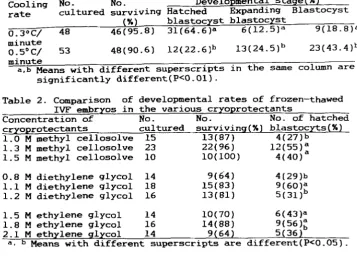
The effects of blastocyst suspension in 1.8 M EG
followed by cooling at -0.3°C and -0.5°C
I
minute aresummarized (Table 1). The survival rate of embryos cooled at
-0.3°C vs -0.5°C/minute was not significantly different
(P>0.05); However, blastocysts hatched more often (P<O.Ol)
when cooled at a rate of -0.3°C/minute(64.6%, 31/48) with
compared to -0.5°C/minute (22.6%, 12/53).
Experiment 2
As shown in Table 2, the concentration of 1.8 M EG
Table 1. Comparison of developmental rates of frozen - thawed
IVF
embryos
cooled at -0.3aC or -0.5°C/minute in
Cooling
rate
ethylene glycol
No.
No.
Developmental stage(%)
cultured surviving
(%)
Hatched
Expanding Blastocyst
blastocyst blastocyst
48
46(95.8)
31{64.6)a
6(12.5)a
9(18.8)d
0.3°C/
minute
o.5°C/
53
48(90.6)
12(22.6)b
13(24.5)b
23(43.4)b
minute
a,b Means with different superscripts in the same column are
significantly different(P<O.Ol).
Table 2. Comparison
of
IVF embryos in
developmental rates of frozen-thawed
the various cryoprotectants
Concentration of
cryoprotectants
No.
No.
No. of hatched
cultured surviving(%) blastocyts(%)
1.0 M methyl cellosolve
1.3 M methyl cellosolve
1.5 M methyl cellosolve
15
13{87)
4(27)b
23
22(96)
12{55)a
10
10(100)
4(40)a
0.8 M diethylene glycol 14
9(64)
4 (29 )b
1.1 M diethylene glycol
18
15{83)
9(6Q)d
1.2 M diethylene glycol
16
13(81)
5(3l)b
l.SM ethylene glycol
14
10(70)
6( 43)a
l.8M ethylene glycol
16
14(88)
9(56):
2.1 Methylene glycol
14
9(64)
5(36)
a, b Means with different superscripts are different(P<0.05).
Table 3. Comparison of survival rates of frozen-thawed bovine
embryos in vitro using various cryoprotectants
Cryoprotectants
No.
No.
No. of hatched
cultured surviving{%)
blastocyts(%)
1.3 M methyl cellosolve
69
64(92.8)a
37(53.6)c
1,1 M diethylene glycol
51
47(92.2)a
29(56.9)c
1.8
M
ethylene glycol
88
79(89.8)a
44(50.0)c
1.6 M propylene glycol
50
43(86.0)a
29(58.0)c
1.1 M butylene glycol
52
34(65.4)h
6(11.5)d
a, b,c,
dValues within columuns with different superscripts
are significantly different(P<0.05);(P<O.Ol).
Table 4. Pregnancy rates after nonsurgical transfer of
frozen-thawed bovine embryos that were suspended in 4
different cryoprotectants
Cryoprotectant
No. of recipients
transferred
1.3
M methyl cellosolve
21
1.1 M diethylene glycol
10
1.8
M ethylene glycol
27
1.6 M propylene glycol
10
a, bValues within columuns with different
significantly different(P<O.OS).
No. of
pregnancies(%)
10(48)a
3(30)a
20(74)b
[image:5.440.40.397.129.392.2] [image:5.440.48.399.373.611.2]Experiment 3
Viability (Table 3) of bovine embryos froze in MC, DEG,
PG, or EG and rehydrated directly in the holding medium was
not significantly different ( 64/69, 92.8%; 47/51, 92.2%;
43/50, 86%; and 79/BB, 89.8%, respectively). All were better
(P<0.05) than those froze in BG (65.4%). Hatched blastocyst
formation was also not significantly different in MC, DEG,
PG or EG (37/69, 53.6%; 29/51, 56.9%; 29/50, 58.0%; and
44/BB, 50.0%, respectively), but i t was poorest (P<0.05) in
BG (11. 5%).
Experiment 4
Pregnancy rates (Table 4) resulting from embryos frozen
in different cryoprotectants were as follows: MC(4B%, 10/21); DEG(30%, 3/10); EG(74% 20/27); PG(40%, 4/10).
DISCUSSION
The survival rate of embryos cooled at -0.3°C vs -0.5°C/
minute was not significantly different. However, blastocysts
hatched most often in vitro when cooled at a rate of -0.3°C/
minute than at -0.5°C/minute. These results indicate that
adjustments in the freezing protocol such as seeding
temperature, cooling rate, and/or plunge temperature might
optimize conditions for using l.B Methylene glycol. Embryos
frozen in 1.3 M methyl cellosolve, 1.1 M diethylene glycol,
1.6 M propylene glycol and l.B Methylene glycol tolerated
direct rehydration into holding medium in a one-step system,
and there was not a significant difference in the survival
rate among them. This might be due in part to the high degree
of permeability which bovine embryos had to these
cryoprotectants. Szell et al.(9) have shown that bovine
embryos were more permeable to ethylene glycol than to
glycerol. Renard et al. (18) have used propylene glycol
effectively for cryopreservation of bovine embryos at a
concentration of 2.0 M with sucrose mediated rehydration and
for freezing mouse embryos with direct rehydration (19).
However, the viability of murine embryos is qreater when
u:.L.·:l :_II l}:._.L_,.-jCii(: yJ /'-:-ul セ⦅スjLNセA@ __ ,, !;J iL·!•L GZゥMIGセMM」セM ャᄋMMセM[jN@
is not clear why other authors were not able to use propylene
glycol successfully for freezing and direct rehydration of
bovine embryos (6). In the report by Voelkel and Hu (7, B)
propylene glycol was used at a concentration of 1.5 M, ice
crystals were seeded at -7°C, the cooling rate was -0.5°C/
minute, and a cooler plunge temperature (-35°C) was used.
These differences may have contributed to the variation in
results. To our knowledge comparative data for use of methyl
cellosolve and diethylene glycol as a cryoprotectant for
mammalian embryos have not yet been reported. Embryos
were frozen in each cryoprotectant and packaged in 0.25-ml
straws containing a central column of each cryoprotectant,
with the embryo and a column at each end of the straw
cryoprotectant were transferred directly to recipients. When
data were pooled across individuals trials, the pregnancy
rate of bovine embryos frozen in 1.8 M ethylene glycol (74%,
20/27) was significantly higher HpセoN「UI@ than those were
1.3 M methyl cellosolve (48%, 10/21), 1.1 M diethylene glycol
(30%, 3/10) and 1.6 M propylene glycol (40%, 4/10),
respectively. Therefore, 1.8 M ethylene glycol has utility
as a cryoprotectant for the direct rehydration of thawed
bovine embryos. Although methyl cellosolve and diethylene
glycol produced similar results, our study has shown that
1.8 M ethylene glycol was a more effective cryoprotectant
for improving the pregnancy than the others studied. We
suggest that 1.8 M ethylene glycol may reduce the toxic
effects of cryopreservation in vivo. Ethylene glycol may have potential in direct transfer procedures, in which rehydration
occurs in the reproductive tract of the recipient. Previous
efforts to develop direct transfer procedures have focused on circumventing the relatively low permeability of bovine
embryos to glycerol. It is apparent from the findings
reported here that identifying cryoprotectants to which
bovine embryos are highly permeable, is another viable
strategy for developing direct transfer methods. In this regard, methyl cellosolve and diethylene glycol also appear
to be very promising. However, transferable embryos were
produced from frozen-thawed bovine oocytes using a low
concentration of sucrose and propylene glycol (21). This
indicates that such a low concentration of sucrose or
trehalose may be necessary for the protection of frozen
embryos, even if highly permeable cryoprotectants are
employed. Therefore, further refinement and testing of these
techniques will be necessary to establish confidence in the
direct transfer system.
REFERENCES
l. Leiba, S.P. A one-step method for direct nonsurgical
transfer of frozen-thawed bovine embryos. Theriogenology
21:767-790 (1984).
2. Renard, J-P., Heyman, Y. and Ozil, J-P. Congelation d e l '
embron bovin:une nouvelle methode de decongelation pour le
transfert cervical des embryons conditionnes une seule
fois en paillettes.
Am.
Med. Vet. 126:23-32 (1982).3. Leiba, S.P. Commercial production of pregnancies from
one-step diluted frozen-thawed bovine embryos. Theriogenology
25:166 abstr. (1986).
4. Suzuki, T., Shimohira, I. and Fujiyama, M. Transfer of
bovine frozen embryos by one-step straw method. Jpn. J.
Anim. Reprod. 29:112-113 (1983).
5. Massip, A. and Van Der Zwalmen, P. Direct transfer of
6 . Suzuki, T. , Yamamoto, M. , Doe, M. , Sakata, A. , Matsuoka,
M., Nishikata, Y. and Okamoto, K. Effect of sucrose
concentration used for one-step dilution upon in vitro
and in vivo survival of bovine embryo refrigerated in
glycerol and 1,2-propanediol. Theriogenology 34:1051-1057 (1990).
7. Voelkel, S.A. and Hu, Y.X. Direct transfer of
frozen-thawed bovine embryos. Theriogenology 37:23-37 (1992).
8. Voelkel, S.A. and Hu, Y.X. Use of ethylene glycol as
a cryoprotectant for bovine embryos allowing direct
transfer of frozen - thawed embryos to recipient females.
Theriogenology 37:687-697 (1992).
9. Szell, A., Shelton, J.N. and Szell, K. Osmotic
characterristics of sheep and cattle embryos. Cryobiology 26:297-301 (1989).
10. Goto, K., Kajihara, Y., Kosaka, S., Koba, M., Nakanishi,
Y. and Ogawa, K. Pregnancies after co-culture of cumulus
cells with bovine embryos derieved from in vitro
fertilization of in vitro matured follicular oocytes. J.
Reprod. Fertil. 83:753-758 (1988).
11. Hanada, A., Shioya, Y. and Suzuki, T. Birth of calves
from non- surgical transfer of blastocyst originated from
in vitro fertilized oocytes matured in vitro. Pro. 78th
Ann. Meet. Jpn. Soci. Zootech. Sci. p 18 abstr. (1986).
12. Matsuoka, M., Sakata, A. and Suzuki, T. Effect of
superovulated cow serum for culture of bovine oocytes to the blastocyst stage. Theriogenology 37:254 abstr.(l992).
13. Suzuki, T., Takahashi, Y., Shimohira, I., Oketani, R. and
Saito, N. Nonsurgically transfer and culture of bovine
embryos in vitro in the medium supplemented with bovine
serum collected from superovulated heifers 7 to 8 days
after estrus. Jpn. J. Anim. Reprod. 28:119-123 (1982).
14. Suzuki, T. and Shimohira, I. Cultivation in vitro of
bovine embryos in a medium supplemented with bovine serum collected 7 to 8 days after superovulation. Jpn. J. Anim. Reprod. 31:1-3 (1985).
15. Brackett, B. and Oliphant, G. Capacitation of rabbit
spermatozoa in vitro. Biol. Reprod. 12:260-274 (1975).
16. Parrish, J.J.' Susco-Parrish, J.L. and First, N.L. Effect
of heparin and chondroitin sulfate on the acrosome
reaction and fertility of bovine sperm in vitro.
17. Niwa, K. and Ohgoda, 0. Synergistic effect of caffeine
and heparin on in vitro fertilization of cattle oocytes
matured in culture. Theriogenology .30:733-741 (1988).
18. Renard, J-P., Heyman, Y. and Ozi1, J-P. Freezing bovine
blastocysts with 1, 2-propanediol as cryoprotectant.
Theriogeno1ogy 15:113 abstr. (1981).
19. Hernabdez-ledezma, J.J., Selgrath, J.P. and Wright, R.W., Jr. One-step sucrose dilution of a cryoprotectant mixture
(CPM) of glycerol and 1, 2-propanediol. Theriogenology 29: 259 abstr. (1988).
20. Miyamoto, H. and Ishibashi, T. Survival of frozen-thawed
mouse and rat embryos in the presence of ethylene glycol.
J. Reprod. Fertil. 50:373-375(1977).
21. Suzuki, T. and Nishikata, Y. Fertilization and cleavage
of frozen thawed bovine oocytes by one-step dilution