PROSPECTS AND CHALLENGES OF THE CREATIVE ECONOMY FACING
"ASEAN ECONOMIC COMMUNITY"
Muhammad Sholahuddin1), Muhammad Wahyuddin2) 1
Fakultas Ekonomi & Bisnis, Universitas Muhammadiyah Surakarta email: [email protected]
2
Program Pascasarjana, Universitas Muhammadiyah Surakarta email: [email protected]
Abstract
Trade liberalization in Southeast Asian countries that are part of Asean Economic Community (Asean Economic Community / AEC) cooperation will be effective on December 31, 2015. Local players seem to be forced to compete with the big players from abroad in the domestic market without any further protection from the government. Of course this should be anticipated gradually and sustainably. The purpose of this study is identifying strengths, weaknesses, opportunities and challenges of SMEs in 14 creative industry sectors in Surakarta. Primary data was collected by interviewing the actors creative economy and secondary data collected through the study of literature which was confirmed through interviews with actors of creative economy in that city. The strengths factors of creative economy in that city includes having special characteristics that are not shared by other regions, such as traditional dances, batik, culinary and various annual art shows as well as a variety of historic buildings and places. While the weakness of creative economy in that city are unable to do a marketing and promotion broadly, still using manual tools, manufacturing process takes a long time, less skilled employees, lack of capital to be able to meet the export demand and good raw materials are difficult to find and the price is getting expensive, standard of quality, some are still rather difficult licensing, management and accounting are still very simple. Prospects creative industries both domestically and abroad are enormous. Market share promise to creative industries is still open very wide, and will have a tendency to increase. Challenges Creative Economy in Surakarta, including at the international level of position bargaining of Indonesia for labour issues still need to be improved, high product standardization, as well as competition with foreign players.
Keywords: Trade Liberalisation, ASEAN Economic Community, Small-Medium Enterprises, SWOT
1. INTRODUCTION
The era of the global economic today makes the products of Surakarta society are supposedly able to compete with similar products from other cities, regions and even countries; both local and international market. Moreover, trade liberalization Southeast Asian countries that are part of cooperation Asean Economic Community (AEC) will be effective on December 31, 2015 (Das, Menon, Severino, & Shrestha, 2013). The society seems to be forced to compete with the big players from abroad in the domestic market without any further protection from the government (Dipta,
2012). Of course this will have an impact on their life.
is not maximized, skills of human resources remains limited in the amount or level of expertise, including the lack of competitiveness of SMEs in Surakarta (Bappeda, 2013). Local governments do a taxation that aims to increase revenue (PAD), contributing to weaken the competitiveness of SMEs. Under these conditions, the creative economy emerged as one of the efforts to reduce these weaknesses.
Creative Economy is a way to build a competitive economic climate and has reserves of renewable resources. In other words, the creative economy is the manifestation of the spirit of a survival; it is very important for developing countries and also offers the same opportunities for those countries. A big message offered by creative economy is the utilization of backup resources that are not only renewable but also unlimited; they are ideas, talents and creativities that have never been imagined before (Mari Elka Pangestu, 2008).
Bappeda Kota Surakarta (2013) and strengths, weaknesses, opportunities and challenges of the creative economy in Surakarta (Sholahuddin & Wahyuddin, 2014) .
Urgency study analyzes the strengths, weaknesses, opportunities and challenges of the creative economy in Surakarta are as a foundation for a strategic plan to accelerate the development and growth of the creative economy in Surakarta. Departing from these conditions, this study took a major theme of the Creative Economy SMEs. The formulation of the question is how the strength, weaknesses, opportunities and challenges of the 14 creative industry sectors in Surakarta.
The purpose of this study is to identify the strengths, weaknesses, opportunities and challenges of SMEs engaged in 14 sectors of the creative economy in Surakarta.
2. LITERATURE REVIEW
Encouragement of economic development and the creation of economic growth (good of economy growth) based welfare mainly driven by science and technology. That is the basic foundation of the creative economy (Bappeda, 2013).
Human capital investment and creative business become a program and policy in creating economic growth. It has changed the paradigm of global economic development that embraces the principle of natural resources as the key to the economic development and growth of a nation to compete in the global development. Evidently, this time, countries with minimal natural resources such as Singapore, Switzerland, Filandia and some other countries become the world's economic tiger.
From the concept of the creative economy that is adopted by the industry become the creative industries. Where the definition of the creative industries that currently widely used by parties involved in the creative industries is the definition based on the UK DCMS Task Force in 1998, then revised by the UK DCMS 2004: “Businesses in areas that are commonly thought of as being quite distinct from each other, this includes: advertising, architecture, the art and antiques market, craft, design, designer fashion, film, interactive leisure software, music, the performing arts, publishing,
software, and television and radio”
(Departemen Perdagangan Republik Indonesia, 2007). Dr Tan Chin Nam from the Permanent Secretary, Ministry of Information and Communications stated that the creative economy as leverage against the integration of the arts, business and technology (Departemen Perdagangan Republik Indonesia, 2007).
among governments of European countries (Howkins, 2013).
By Howkins definition, Creative Economy is the economic activity in which the input and the output is the idea (Simatupang, 1999). True enough, the essence of creativity is the idea. Imagine only with a capital idea, creative person can earn a very decent. What idea means? That is an original idea and may be protected by IPRs. The examples are a singer, movie star, songwriter, or micro-biology researchers who are researching superior rice variety that has never been created before (Nenny, 2008).
Schumpeter, in his thesis about the creative destruction theory provides an understanding of the necessary innovations in driving productivity, both in micro scale enterprise level and a macro scale in the context of the country. This innovation will encourage the economic growth (Schumpeter, 1934).
Florida (2002) introduced on the creative industries and the creative class in a society (Creative Class). Florida had received criticism; if there is a certain group of a social environment that has a class of its own, whether it impressed the elite and exclusive class? Precisely, according to Florida, he avoids the impression because the symptoms of previous terms as Knowledge Society are considered elitist. (Florida, 2002)
The driving force of economic growth and development of cities or regions can be seen from the level of productivity of the cluster of the talented and creative people who rely on the ability of the existing science on themselves (Departemen Perdagangan Republik Indonesia, 2009).
In this study, the creative industries can be defined as the industry that comes from the use of creativity, skill and talent of individuals to create wealth and work field by producing and exploitating creativity and inventiveness of the individual.
Sub Sector Creative of Economy
Indonesian government, in this case is the Ministry of Trade closer to the classification used by Howkins (2001). We have already successfully mapped 14 creative industry sectors (Pangestu, 2008a), ), among others: (1) advertising, (2) architecture (3) art and antiques market, (4) crafts, (5) design, (6) fashion, (7) video, film, and photography, (8) interactive games, (9) music, (10) performing arts, (11) publishing and printing, (12) computer services and software, (13) television and radio, and (14) research and development..
3. METHODOLOGY a. Design Research
This study takes the form of a qualitative research approach to the study of literature which is confirmed by the entrepreneurs of SMEs creative economy in Surakarta.
b. Types and Data Collection Techniques
The data used in this study is primary data and secondary data. Primary data was taken from in-depth interviews of key actors 14 creative industry sectors in Surakarta. Secondary data was taken from the Internet data from the site BAPPEDA, literatures of creative economy and other secondary sources.
c. Technical Implementation Research This study is divided into three stages of implementations, namely: (1) The planning stage (2) Preparation of proposals, research design and approval requirements. (3) Establishment of a team working and run down timings along with the job description. (4) Mapping the distribution of entrepreneurs and determine the amount of sampling. (5) Designing questionnaires and conducting initial research / questionnaire design introduction related legibility item questions illustrate the ability of the facts.
interviews. (3) Collecting and overcoming various technical problems of collecting the questionnaires.
Tabulation and reporting stages: (1) organizing, filtering, tabulation and analysis of data. (2) Collecting archive strategic plan and related regulations. (3) Analysis of the text. (4) Preparation of study reports.
d. Data Analysis Techniques
The purpose of the second year of this study is to identify the strengths, weaknesses, opportunities and challenges of SMEs engaged in the creative economy in Surakarta, the techniques of the data analysis is the study of the text of the results of in-depth interviews with leaders and key players in the 14 sub-sector SMEs creative economy.
e. Roadmap Research
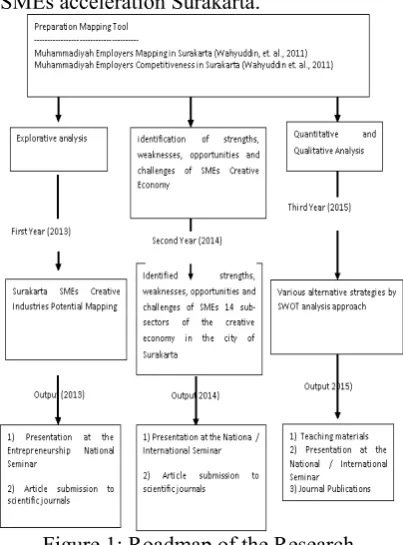
In general, this study is divided into three main stages: (1) mapping SME creative entrepreneurs in Surakarta industries (mapping), (2) analyzing of strengths, weaknesses, opportunities and challenges of the creative economy SMEs (analyzing), and (3) analyzing of policies and alternative strategies increasing the competitiveness of SMEs creative economy (applying). Each of these stages represent the periodic research conducted and can be described in Figure 1.
The first stage is an important step because it serves as the main provider of specific characteristics data industry creative SMEs Surakarta. From this data, it will be able to do a further analysis in the form of quantitative research genre (empirical descriptive. The first stage is the first concern in considering a run down timing and technical field time consuming. Methodology to technical aspects is described further in research methods.
The second step is to identify the strengths, weaknesses, opportunities and challenges of the creative economy in Surakarta which consists of 14 sub-sectors.
The third stage is a SWOT analysis that resulted in the proposal of alternative strategies in order to increase strength, reduce weaknesses, exploit the opportunities and address the challenges. The results of the third year serve as recommendation for the government city of Surakarta and relevant
agencies in developing strategic plans and regulations to support the creative industries SMEs acceleration Surakarta.
Figure 1: Roadmap of the Research
4. RESULTS AND DISCUSSION a. a. The strength of the Creative Economy
Results of the research on the advantages possessed by the creative economy in Surakarta in line with research conducted by BAPPEDA Surakarta (2013), some of them are having special characteristics that are not shared by other regions. Solo has some dances, batik, batik shopping center and souvenirs, several annual arts festival, the 24 hours typical Solo culinary and historical old buildings.
The typical Solo sacred dance includes Bedhaya (Ketawang, Dorodasih, Sukoharjo, etc.) and Srimpi (Gandakusuma and Sangupati). This dance is still preserved in the Solo palace.
While Solo Batik is a fabric with certain patterns or motifs produced from a special wax that is written or stamped on the fabric. Although now many batik fabrics are made by molding process, Solo has many typical batik patterns, such as Sidomukti and Sidoluhur.
such as Batik Keris, Batik Danarhadi, and Batik Semar are not in those two batik centers. As for the middle class, they may visit batik trade center in the city that is located in Solo Wholesale Center (PGS) and Beteng Trade Center (BTC).
Solo also often have an annual arts festival, as Grebeg 1st Suro (early of Java calendar) with washing heritage Solo palace. And Sekaten festival is held in every Maulud month to commemorate the birth of the Prophet Muhammad by a party of the people in the square, in front of the Grand Mosque of Surakarta. The new festival including Solo Batik Carnival (Suratmi & Santosa, 2013), Grebeg Sudiro held to commemorate the China New Year with a mix of Chinese-Javanese culture. SIPA (Solo International Performing Arts) is an International scale cultural performance with the material in the form of performing arts, dance, music and theater. The implementations of SIPA is once a year. Implementation SIPA followed by some countries which displays art and culture from the participating countries.
Culinary tourism is centered in the village Keprabon Solo, Solo Galabo (Gladag Langen Bogan), and on the field Kota Barat.
The historical buildings in Solo still exist among religious building, public buildings, palaces, to military buildings. Besides Keraton Surakarta (built in 1675) and Pura Mangkunagaran (built in 1757), there are also the Fort Vastenburg Dutch heritage and Gandrung Loji of colonial heritage building that is still intact condition and it is only used as a place of residence of the Dutch government officials, also often used to dance European style and nobility of Java, so it is called as "Gandrung". While the details of the excess 14 subsectors creative economy is in the attached table.
b. The weakness of the creative economy The results of this study regarding the manual tools so the production is rather long; (2) The making process takes a long time; (3) Unable to meet domestic demand due to the limited production capacity (4) Lack of skilled employees (5) Lack of capital to be able to meet the demand for exports (6) Constrained promotion (7) Products marketing is less than the maximum (8) Raw materials are either difficult to find and the price is more expensive. Some of the weaknesses are in accordance with previous studies (Seventi, Supreme, Rahmawati, Sarah, & Riani, 2012)
While the performing arts in the Surakarta still has weaknesses: (1). Lack of
the Solo society’s awareness towards
preserving the cultural dance; (2) There is no a good coordination with the organizers of the event or run erratically (3) Classical dances are less interesting when it is shown publicly because the society is no longer preserving the Javanese culture. Javanese dance is difficult to accept by public; (4) Art musicians received less attention from the public; (5) There is no place for the colossal training; (6) Support from the government is still small.
In the field of music, there are still obstacles: (1) It is difficult to have an event because Solo does not have an adequate place; (2) The cost of the tool maintenance is expensive. In the field of video, film and
Employees’ turnover is in high frequency so
In the field of publishing and printing, (1) Competitors are with more powerful machine; (2) Marketing is less effective. Computer services and software: (1) lack of knowledge of consumers; (2). Competition in the same business; (3). Consumers are not familiar with the offered services.
In the field of television and radio: (1) The limited number of disciplined and creative human resources; (2). the needed capital for the production is still very high price. In the field of architecture: (1) the permission management is rather difficult (2) Need additional capital.
In the field of design still requires skilled personnel to design. In the field of fashion, have the weaknesses: (1) Constrained by the lack of skilled personnel to design; (2) Raw materials increasingly hard to get and expensive; (3) Lack of an exhibition as a promotional event. Culinary efforts have the weaknesses: (1) Business management, (2). Lack of promotion (3). Limited time of production ; (4). The public perception of bitter herbs; (5) Marketing is not maximized; (6) Sales constrained due to the weather. The details of weakness 14 subsectors creative economy is in the attached table.
c. Prospects of Creative Economy Prospects of creative economic results of this study are similar to the result BAPPEDA (2013). While the detail prospect of 14 subsectors of creative economy is in the attached table. Market share promised to creative industries is still open very wide, and will have a tendency to increase. (1) Changes of the consumer behavior. In the context of trade, in longer time today people increasingly like goods that are not only able to satisfy the functional requirements, but also look for a product that could give them an identity and make themselves more appreciated by the other people around them. (2) Non-Mass Production Era. The more critical consumers ultimately make consumers more selective about the goods to consume. Consumers are less motivated to buy generic goods; otherwise consumers are excited to buy unique items and can make them wear it proudly. (3) The potential of the
creative economy product consumption are large. (4) The amount of Potential Domestic Market. From the domestic market, the population of Indonesia which is ranked 4th largest in the world is a very large market potential if it can absorb the results of domestic production. (5) Socio-cultural diversity of Indonesia. Utilization efforts of wisdom and cultural heritages need an attention and cooperation between the government and the creative industry players, so the traditional cultural heritage of Indonesia can be preserved and become the pride of Indonesia (Pangestu, 2008b).
d. d. Creative Economy Challenges
Among the challenges of the creative economy in Surakarta are: (1) the competition between local and foreign human resources (2) foreign institutions come into Indonesia (3) unpreparedness State Devices cause at the international level, the bargaining power (bargaining position) Indonesia for IPR issues is still very needed to be improved. Often, effort to fight for IPR original copyrighted works Indonesia aground in the middle of the road because of the lack of ability of state diplomacy. The government should be more understanding of international conventions under the auspices of the World Trade Organization (WTO) and the World Intellectual Property Organization (WIPO) and actually embody into conditions in the country.
e. Facing Free Trade
Creative industries in the modern definition have previously been developed by the western world. By it, foreign individuals have first to understand the ways (know-how) to build a creative industry where they were and to raise it is relatively cheaper. The number of natural resources that are still untouched and abundant cultural assets of local tradition has invited foreign players to come and work in Indonesia. Often the arrival of foreign players in Indonesia is not accompanied by a commitment to build a more sustainable industry, just purely exploitative.
So to make improve the local people able to compete with foreign players, the Indonesian creative workers should be well-prepared to immediately create training institutions of formal, non-formal and organic able to train managerial ability, though creativity, foreign languages, marketing and business negotiation.
5. CONCLUSION
SMEs creative economy of Surakarta has been identified for the strengths, weaknesses, opportunities and challenges. These results have been verified by experts or practitioners 14 areas of creative economy in Surakarta.
This research can be a contributor and a
trigger for researchers’ curiosity of SMEs
potential to do the creative industries and accelerate development through a variety of regulatory and strategic plans set out in the relevant agencies.
In the future, research needs to be done to produce a model of the strategy, direction and target SME success creative economy. The model can be used as consideration in making regulatory agencies and strategic plan to accelerate the progress of the creative industries in Surakarta.
ACKNOWLEDGEMENTS
Our gratitude to the participants of the 1st University Research Colloquium 2015 Institute for Research and Community Service (LPPM) Muhammadiyah University of Surakarta who have given advice in this research article. Thanks also go to fellow
students Student Research Institute (LEPMA) FEB UMS who have assisted in completing this study.
REFFERENCES
Bappeda. (2013). Profil Ekonomi Kreatif Kota Surakarta. Surakarta.
Das, S. B., Menon, J., Severino, Ro., & Shrestha, O. L. (Eds.). (2013). The Asean Economic community A Work in Progress. Singapore: Institute of Southeast Asien Studies.
Departemen Perdagangan Republik Indonesia. (2009). Studi Indonesia Kreatif Indonesia 2009. Jakarta.
Departemen Perdagangan Republik Indonesia, . (2007). Buku 1 Studi Industri Kreatif Indonesia 2007 Bagian 1. Jakarta.
Dipta, I. (2012). MEMPERKUAT UKM
MENGHADAPI MASYARAKAT
EKONOMI ASEAN TAHUN 2015*). DAFTAR ISI, 21(021). Retrieved from http://www.smecda.com/deputi7/file_In fokop/VOL_21_2012/Infokop
21.pdf#page=7
Florida, R. (2002). The Rise Of The Creative Class: And How It’s Transforming Work, Leisure, Community And Everyday Life (First Edit.). Basic Books.
Howkins, J. (2013). Creative Economy: How People Make Money From Ideas (2nd ed.). Penguin Publisher.
Mari Elka Pangestu. (2008). Pengembangan Industri Kreatif Menuju Visi Ekonomi Kreatif Indonesia 2025: Rencana Pengembangan 14 Subsektor Industri Kreatif Indonesia (2009-2015). Jakarta. Pangestu, M. E. (2008a). Pengembangan
Ekonomi Kreatif Indonesia 2025: Hasil Konvensi Pengembangan Ekonomi Kreatif 2009-2015 (pp. 4–8). Jakarta. Pangestu, M. E. (2008b). Pengembangan
Ekonomi Kreatif Indonesia 2025: Rencana Pengembangan Ekonomi Kreatif Indonesia 2009-2015. Jakarta. Schumpeter, J. A. (1934). The Theory of
and the Business Cycle (Reprint an.). Transaction Publisher.
Seventi, S., Agung, M., Rahmawati, Sarah, R. H., & Riani, A. (2012). Strategi peningkatan produktivitas industri kreatif handycraft upaya pengelolaan sumber daya berbasis masyarakat. In conference in business, accounting, and management (pp. 1–14). Semarang: Unissula.
Sholahuddin, M., & Wahyuddin, M. (2014). Natural Pattern and Durability of Local Wisdom-Based Creative Industries in Indonesia (Case in Surakarta, Central Java). In Global Economic Climate:
Issues and Challenging (p. 289). Bangi: MIICEMA 2014, Universiti Kebangsaan Malaysia.
Simatupang, T. M. (1999). Perkembangan Industri Kreatif (pp. 1–9).
Suratmi, & Santosa, S. (2013). Strategi pemerintah kota surakarta dalam melakukan City Branding Sebagai Kota Budaya. Manajemen Bisnis Syariah, (36), 1359–1373.