Informasi Dokumen
- Penulis:
- Andi Saputra Tanjung
- Pengajar:
- Drs. A.M. Zainuri, M. Pd.
- Sekolah: Syarif Hidayatullah State Islamic University
- Mata Pelajaran: English Language Education
- Topik: Reinforcing Students' Vocabulary Through Scrabble Game (A Classroom Action Research at the First Grade Students of MTs Nurussalam Pondok Pinang)
- Tipe: skripsi
- Tahun: 2011
- Kota: Jakarta
Ringkasan Dokumen
I. INTRODUCTION
This section introduces the study on reinforcing students' vocabulary through the Scrabble game at MTs Nurussalam Pondok Pinang. It highlights the significance of vocabulary in language learning, particularly in mastering English as a global language. The background emphasizes the need for effective teaching strategies to engage students actively in learning, moving away from traditional rote memorization methods. The introduction sets the stage for the research questions, objectives, and significance of the study, aiming to demonstrate how interactive games can enhance vocabulary acquisition.
II. THEORETICAL FRAMEWORK
This chapter discusses key theories related to vocabulary and the Scrabble game. It begins with the definition of vocabulary, outlining its importance in language proficiency and communication. The section categorizes vocabulary into various types, such as high-frequency and low-frequency words, as well as active and passive vocabulary. The principles of teaching vocabulary are also addressed, emphasizing the need for effective instructional strategies. The chapter concludes by defining Scrabble and explaining its rules, establishing a link between the game and vocabulary reinforcement.
2.1. VOCABULARY
Vocabulary is defined as the total number of words that make up a language, critical for effective communication. The chapter explores various definitions and classifications of vocabulary, including high-frequency and low-frequency words, and active versus passive vocabulary. Understanding these distinctions is essential for developing effective teaching strategies that cater to different learning needs.
2.2. SCRABBLE GAME
Scrabble is introduced as a board game that enhances vocabulary through word formation. The rules of Scrabble are detailed, emphasizing how players create words from given letters. This section establishes the educational value of Scrabble in promoting vocabulary learning, encouraging engagement and interaction among students.
III. RESEARCH METHODOLOGY
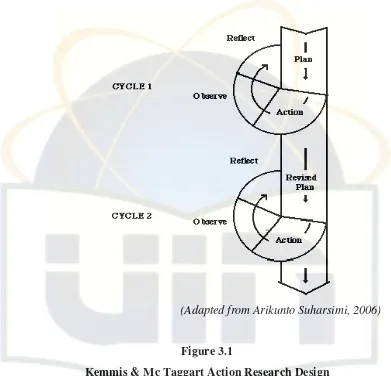
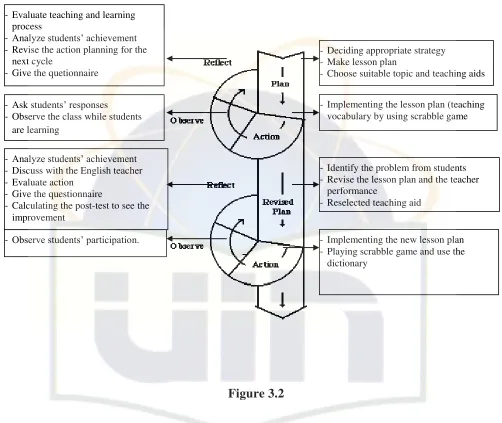
This section outlines the research design and methodology employed in the study. It describes the subject of the study, the research instruments, and the techniques used for data collection, including observation, tests, and interviews. The writer's role is clarified, highlighting the dual function as both researcher and teacher. The action research procedure is explained, detailing the cyclical process of planning, acting, observing, and reflecting, which is fundamental to the Classroom Action Research (CAR) approach.
3.1. SUBJECT OF STUDY
The study focuses on first-grade students of MTs Nurussalam Pondok Pinang, detailing the selection of one class out of two for the implementation of the Scrabble game. This targeted approach allows for a concentrated examination of the game's effectiveness in enhancing vocabulary.
3.2. DATA COLLECTION TECHNIQUES
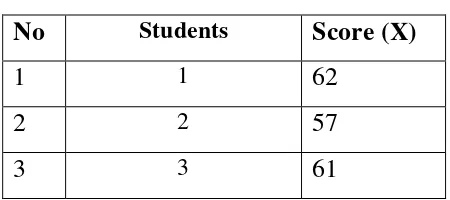
Data collection methods include qualitative and quantitative approaches. Qualitative data are gathered through observations and interviews, while quantitative data are obtained from pre-tests and post-tests to measure vocabulary improvement. This mixed-methods approach ensures a comprehensive analysis of the research findings.
IV. RESEARCH FINDINGS
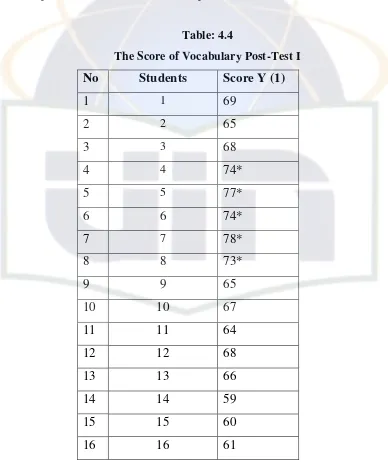
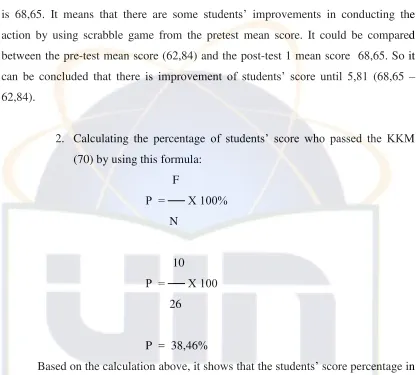
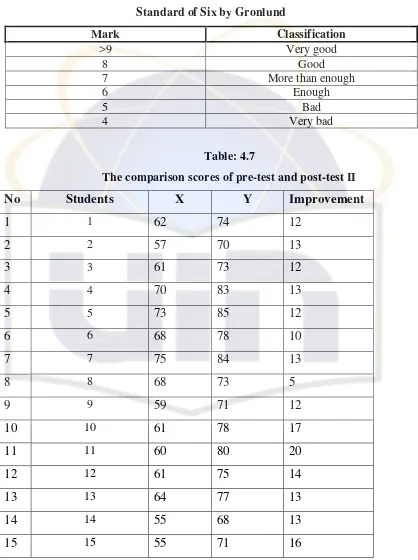
This chapter presents the findings from the research, analyzing both qualitative and quantitative data. It discusses the implementation of the Scrabble game in teaching vocabulary and assesses its impact on students' vocabulary achievement. The findings indicate a significant improvement in students' vocabulary scores from pre-test to post-test, demonstrating the effectiveness of the game as a teaching tool. Additionally, students' responses to the Scrabble activities reveal increased motivation and engagement in learning English vocabulary.
4.1. DATA DESCRIPTION
The data collected from observations and interviews provide insights into students' engagement and interest in learning vocabulary through the Scrabble game. This qualitative analysis complements the quantitative test results, offering a holistic view of the teaching and learning process.
4.2. STUDENTS' RESPONSES
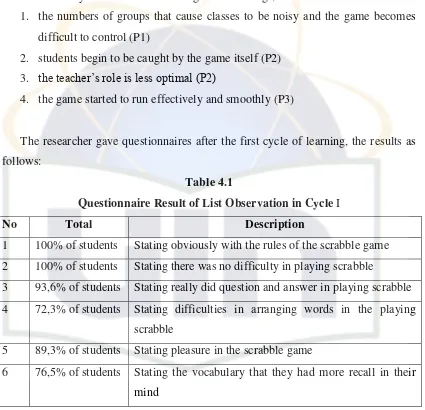
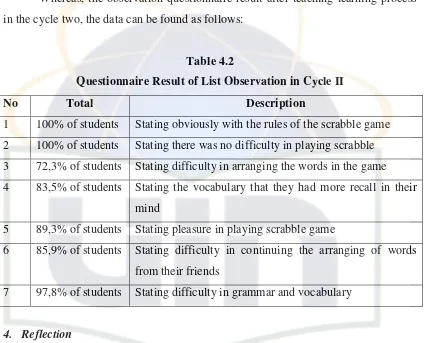
Students expressed positive feedback regarding the use of Scrabble in vocabulary lessons, indicating that the game made learning enjoyable and effective. Their enthusiasm for participating in the game correlates with improved vocabulary retention and application.
V. CONCLUSION AND SUGGESTION
The final chapter summarizes the research findings and concludes that using the Scrabble game is an effective strategy for reinforcing students' vocabulary. It emphasizes the importance of incorporating interactive and engaging methods in language teaching to enhance learning outcomes. Suggestions for future research include exploring other games and strategies that can further improve vocabulary acquisition in different educational contexts.