Domain Knowledge Model for Embodied Conversation Agent
1
Goh Ong Sing,
2Chun Che Fung,
3Arnold Depickere,
4Kok Wai Wong,
5Wilson Wong
School
of Information Technology, Murdoch University, Perth, Western Australia
{
1os.goh,
2l.fung,
3a.depickere,
4k.wong} @murdoch.edu.au
Faculty of Information and Communication Technology, Kolej Universiti Teknikal Kebangsaan
Malaysia, Melaka, Malaysia
5
[email protected]
Abstract
This paper presents and discusses several technical issues in implementing the conversation intelligent agent. In this work, we focus on domain knowledge models that enable structured queries on the field of epidemic crisis. We will simulate this system with sample conversation taken from our target Domain-Specific knowledge on the recent world epidemic crisis, Severe Acute Respiratory Syndrome (SARS). A solution would be to incorporate the conversation system embodied intelligent agent which will allow a more user-friendly interaction. The system does not only match a query against a database of keywords from our domain knowledge model but also help the user navigate through the document space until the appropriate information are found using the “URLs push” technique.
1
Introduction
The turn of the millennium has brought with it the wind of change to the community of conversation system based on World Wide Web online information. According to Google Inc [1], the size of the static web has reached 8.058 billion pages in the year 2005 thus, making the World Wide Web one of the most populous sources of information ever encountered. Researchers in the field are slowly seeing a shift in approach, a shift towards the adoption of knowledge-base, higher level of natural language processing and advanced reasoning for development of the conversation system. Several related research on embodied conversation agent are investigating the construction of domain knowledge models. There has been some pioneering work on conversational interfaces for simple tasks in limited domains such as [2] [3] [4]. The REA [5] uses an approach on discourse modeling and the conversations are story-related. In the DIVA II project [6], the conversation is modeled implicitly within the video and audio data annotations. P. Tarau and E. Figa[7] used the
Prolog-based conversational agent which integrates more than a GigaByte of knowledge base data from Open-Domain knowledge base such as WordNet, FrameNet and Open Mind
.
InCA [8] is a personal coach agent equipped with pedagogical models as well as specific domain knowledge.2 Conversation Engine
This research project involves the establishment of a domain knowledge model with an architecture aiming for the possibility of practical applications in nearer future conversation robot or chatterbot, called Artificial Intelligent Neural-network Identity (AINI) [9]. Our real-time prototype relies on distributed agent architecture specifically at the Web. A software agent, such as the conversation engine, multi-domain knowledge model, multi-modal human-computer communication interface, etc, communicates with one another via TCP/IP. AINI is a conversation agent that is capable of involvement in a fairly meaningful conversation with users who interact with her. AINI is a software conversation robot, which uses human-computer communication system, a combination of natural language processing and multi-modal communication. A human user can communicate with the developed system using typed natural language conversation. The system embodied conversation agent system will reply text-prompts or Text-to-Speech Synthesisand with appropriate facial-expressions.
For the purposes of this research, the application area of designing the conversation agent is primarily grounded in an ability to communicate based upon scripting and/or artificial intelligence programming on the field of epidemic crisis. A sample of the communication interface between a user and AINI in the CCNet portal [10] is depicted in Figure 1.
Figure 1: Natural language interface in CCNet Portal
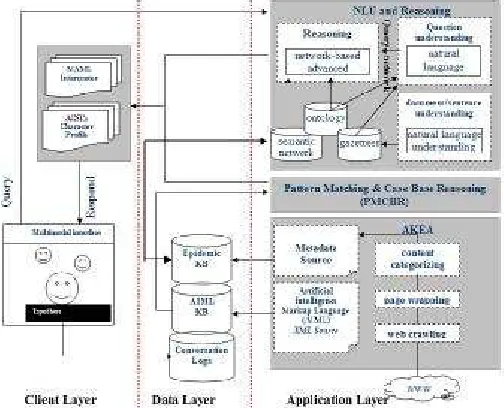
AINI employs an Internet three-tier, thin-client architecture (Figure 2) that may be configured to work with any web application. Composed of a data server, application and client layers, this Internet specific architecture offers a flexible solution to the unique implementation requirements of the AINI system. The data server layer serves as storage for permanent data required by the system, where the knowledge bases (epidemic Domain-Specific extracted by the Automated Knowledge Extraction Agent (AKEA) [11] and Open-Domain from existing Artificial Intelligence Markup Language (AIML) Loebner prize knowledge base [12]) and the conversation logs reside. These web-enabled databases are accessible via the SQL query standard for database connectivity using MySQL database.
Figure 2: AINI’s Architecture
The application server layer handles the processing of logic and information requests. Here, one or more application servers are configured to compute the dialogue logic through the hybrid approach by implementing Natural Language Understanding and Reasoning (NLUR) or Pattern Matching and Case Base Reasoning (PMCBR) algorithm. The user interface resides in the thin-client layer and is completely browser based, employing Multi-modal Agent Markup Language (MAML) interpreter and Microsoft SAPI to handle the users interface. MAML is a prototype multi-modal markup language based on XML that enables animated presentation agents or avatars. It involves a talking virtual lifelike 3D agent character that is capable of involvement in a fairly meaningful conversation
.
The conversation engine is based on the Web-based and towards an architectural open-source practice by employing PHP, Perl scripting language, Apache Server and knowledge base stored in a MySQL server.2.1 Pattern Matching and Case-Based
Reasoning (PMCBR)
Our approach to handling conversations with the embodied intelligent agent is to have case-based rules that run on top of reasoning rules. The case-based rules, which do simple pattern matching, have the advantage of being quick and thus, being able to return near instantaneous responses to the users. This is the ultimate goal in maintaining believability in the interaction. The Conversation Engine handles this reactive component. The PMCBR Conversation Engine is based on the ALICE [13] engine. The ALICE chat engine implements the AIML, which allows dialogs between the user and agent to be easily acknowledged. Judging from the specification based on XML, we believe AIML to be the perfect markup language to our system.