Abstract – The role of maintenance in manufacturing has become more crucial and important in today’s competitive environment. It is estimated that maintenance cost contributed approximately 10-30 percent of total operation cost. In order to stay competitive, manufacturing companies are forced to introduce production improvement programs to increase both quality and productivity. Total productive maintenance (TPM) is a well-known and very useful methodology which allows manufacturing firms to attain near ideal conditions with zero downtime, zero defects and zero accident. The objective of this paper is to study the effectiveness of
TPM implementation in a multinationalsemiconductor
manufacturer. In this study a bottleneck processfrom
the production line was chosen and continuous improvements were implemented to improve equipment effectiveness. The results achieved are very encouraging in the reduction of equipment downtime, improvement in overall equipment effectiveness, employee motivation and reduction in number of accidence rate at the shop-floor.
Keywords – Total productive maintenance, Semiconductor industry, OEE, Kobetsu Kaizan
I. INTRODUCTION
The increase of operations and maintenance costs from year to year are of great concerns for most manufacturing firm today [1]. In an effort to optimize production and reduce costs, these manufacturers have implemented TPM programs. TPM programs are essential to increase equipment availability and hence reduce the need for further investments [2]. TPM is an aggressive production program to improve overall equipment effectiveness by reducing machine downtime [3]. In today’s competitive environment, manufacturing firm’s success is very much dependent on its capability to incorporate cost reduction and productivity improvement in its operations[4]. Productivity can be expressed as physical measurement of the rate at which outputs of goods or services are produced per unit of input [4]. If a manufacturing company is able to produce the desired output with a given input, then higher productivity efficiency is achieved [4].
II. LITERATURE REVIEW
TPM approach focuses upon the entire organization for the systematic elimination and identification of equipment scheduled and unscheduled downtime [1, 5]. It is a world class manufacturing methodology that has been adopted by many manufacturing firm to improve operation and maintenance cost [6]. Overall equipment effectiveness (OEE) is used to measure the effectiveness of the TPM implementation. The case study done by William et al [6], demonstrated an improvement in Overall Equipment Effectiveness after the implementing TPM in a company.
According to the father of TPM Nakajima [7], the concept is widely used to improve equipment utilization by reducing six big production losses. The implementation process is based on the TPM eight pillars suggested by Japan Institute of Plant Maintenance (JIPM). Some TPM implementers will implement all eight pillars, and some of the practitioners only adopted a few pillars depending on the company’s needs and capabilities [7].
Manu Dogra, Visha S. Sharma,Anish Sachdeva and Dureja [2] revealed that TPM is able to enhance overall organization profitability growth by changing the employee mindset in involving and leading to continues improvement in the organization. Furthermore, it has been proven that TPM is a positive strategic and maintenance program that works perfectly with Total Quality Management (TQM) and lean manufacturing in develop both the company and its employees individually [2]. With the acceptance ‘changed’ mindset embrace within the whole organization, it will be increase the successful rate of TPM implementation in the organization [8].
Based on the case study carried out by Chan et al. [9], there was about 83% improvement in equipment productivity improvement after TPM implementation. The number of equipment stoppages has improved from 517 to 89 times. It also demonstrated a tremendous improvement in product quality produced [9]. Beside of this, after the TPM implementation, it had improved the shop floor technical skill and promote a good cross functional team work culture and created a high performance workforce to enhance organization in both competitive power and total image [1, 9].
The tangible contribution of TPM to production performance includes increasing in overall equipment effectiveness [1, 10]. Equipment effectiveness is a measure of the value added to production through the equipment used. The number of mean units between assists increases tremendously after TPM implementation 1
Infineon Technologies, Melaka, Malaysia 2
Faculty of Manufacturing Engineering, Technical University Malaysia, Melaka 3
Faculty of Business, Multimedia University, Melaka, Malaysia
[1, 11]. This is because the equipment became stable and had fewer breakdowns, contributed mainly by autonomous maintenance after TPM implementation[11].
TPM focuses on actual functional improvement and design of manufacturing equipment [1, 10]. The purpose of TPM is to increase equipment availability by reducing or minimizing equipment down time and hence further reducing capital investment [10, 11]. It is also considered as a quality system to improve product quality as well as productivity [1, 10]. Measurement is critical requirement of continuous improvement of Kobetsu Kaizan processes [1, 9]. The appropriate measurement is essential to gauge the effectiveness of and continuous improvement. Based on many researchers such as Nakajima [12], Suzuki [13], Waeyenbergh and Pintelon [14] and Lungberg [12-15], OEE is seen to be the most appropriate and standard for the measurement of equipment performance after TPM implementation.
III. METHODOLOGY
In this section, the TPM implementation is demonstrated through a case study in a multinational semiconductor Manufacturer located in Melaka, Malaysia. This case company has successfully implemented TPM plant wide for the past few years[1, 11]
All equipment invested by the manufacturer for its production operation is expensive. In order to achieve maximum profit, the company must maximize all purchased equipment performance in order to produce high throughput[1, 11]. The case company takes the initiative to implement total productive maintenance in order to monitor all equipment performance and allow management to review and take immediate improvement actions in order to maximize equipment effectiveness[16].
In accordance with I-Fab Semiconductor1’s strategic plan, the company has decided to emphasize and focus on TPM practices in the first quarter of 2009. Due to the limited resources, experience and the need to eliminate bottlenecks, I-Fab Semiconductor chose the test equipment as the pilot group for its TPM implementation. There is a total number of twenty eight tester I-Fab Semiconductor’s TSLP package production line.
In order to provide on time data, the company employed powerful software to provide valuable equipment data for improvement. This software is called the Total Factory Monitoring (TFM) system allows for Equipment Performance Tracking (EPT) combined with online equipment monitoring. This means that it can be used to measure and evaluate the system in all areas of production and offers users a comprehensive overview of the efficiency of production equipment at any time. In addition to the main applications for the semiconductor industry, electronics manufacturing and micro-systems technology standard (SEMI E10 and SEMI E58 Standards), the TFM is also ideal for a variety of other
1
‘I -Fab Semiconductor’ is a pseudonym given to preserve the anonymity and confidentiality of the case study organization.
industry sectors where it can assist manufacturing to monitor machines and automatically determine availability indicators [17].
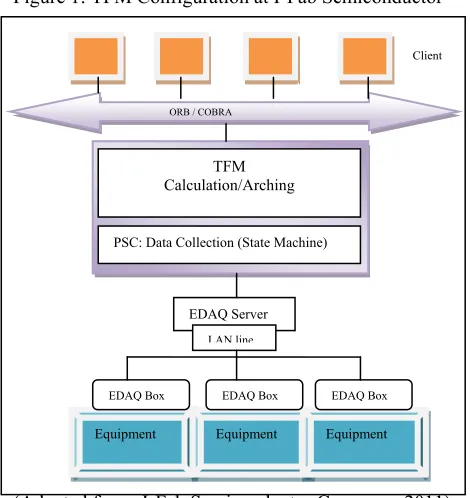
At the beginning of the project, the Overall Equipment Effectiveness (OEE) was at 65% compared the world-class standard of 85%. Figure 1 describes the architecture and integration between the TFM system and I-Fab Semiconductor’s test equipment. It has an import filter (XML, OCI and CORBA) that is responsible for connection to the equipment and importing data into the system. The servers process the imported data and store them into the database (ORACLE DB). For data visualization and TFM configuration/administration the clients are used. The clients are connected to the servers and the database commonly via the network. Figure 1 presents the TFM configuration at I-Fab Semiconductor.
Figure 1: TFM Configuration at I-Fab Semiconductor
(Adapted from: I-Fab Semiconductor Company, 2011)
While most companies adopted all of TPM’s eight pillars, I-Fab Semiconductor only concentrated on 5S, autonomous maintenance (AM), planned maintenance (PM), equipment improvement (EI) and skill training (ST) which are four out of TPM’s eight pillars. The uniqueness of the TPM implementation at I-Fab Semiconductor is that the company established self managing teams (SMT) for whole plant. SMT is an approach and culture where operators are self-organized in a cell structure within small groups where members will plan and manage their day-to-day activities with minimum supervision. With this additional positive element, it will increase the success rate and speed up the implementation process as TPM requires a high degree of human involvement.
I-Fab Semiconductor’s equipment downtime is collected weekly and analyzed using quality control circle (QCC) tools such as the PCDA cycle, Pareto chart, why-why analysis, cause and effect diagram (fish bone
PSC: Data Collection (State Machine)
ORB / COBRA
TFM Calculation/Arching
EDAQ Server
LAN line
Equipment Equipment Equipment
EDAQ Box EDAQ Box EDAQ Box Client
diagram), histogram, bar chart and chart sheet to prioritize the improvement activities. As a result of the widely-used OEE as a measure for equipment performance, I-Fab Semiconductor had introduced OEE as the main indicator for TPM tracking progress purposes. The team has regular weekly OEE reviews in order to identify the root causes of low equipment performance and immediate actions must take in order to improve the production losses.
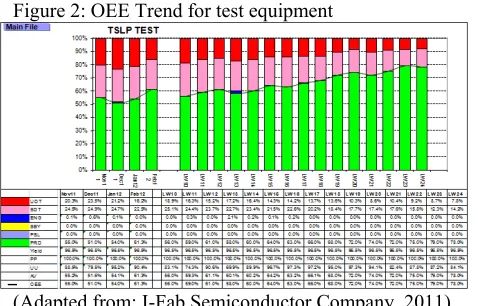
[image:3.595.306.539.200.363.2]The equipment scheduled and unscheduled downtime was collected and review by management weekly. Activities such as changed lot, changed frame, perform part calibration, test probe cleaning, package conversion and perform autonomous maintenance for all equipment are classified as scheduled downtime. Whereas, test head problem, electrical problem, electronic problem, data matrix code not able to scan, L-mark failure are grouped under equipment unscheduled downtime. The OEE data was presented and review daily in order to track and continuous improvement solutions was implemented in order to improve overall equipment effectiveness. Figure 2 shown the standard report presented for focus team to improve equipment downtime.
Figure 2: OEE Trend for test equipment
(Adapted from: I-Fab Semiconductor Company, 2011)
[image:3.595.51.290.337.490.2]The focus team started to map out the Kaizen plan (continuous improvement) for test equipment’s scheduled and unscheduled losses. A Pareto chart for the test equipment stoppages was plotted for improvement prioritization. Figure 3 revealed the test equipment downtime Pareto chart.
Figure 3: Equipment Downtime Pareto Chart
0 5 10 15 20
Pe
rc
e
n
ta
g
e
Equipment Downtime Equipment Downtime Pareto
Changed Lot Test head problem Electronic Problem Test Probe Cleaning Change frame Calibration
C i JHAM
(Adapted from: I-Fab Semiconductor Company, 2011)
The top five failure modes for the tester downtime were selected as improvement target in order to bring down the overall equipment breakdown. After the goal setting and improvement actions were planned, the improvement actions with several options by considering elements such as cost effectiveness, delivery lead-time, supplied quality; supplied selection and material selection were compared. Figure 4 provides the list of proposed improvement actions brainstormed by the focus team. Figure 4: List of improvement actions to improve tester downtime
(Adapted from: I-Fab Semiconductor Company, 2011)
IV RESULTS AND DISCUSSION
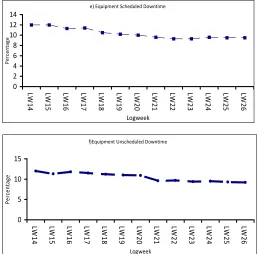
Effectiveness of TPM implementation is determined by indicators such as OEE, equipment mean time between assist, number of improvement idea generated and equipment throughput, equipment scheduled and unscheduled downtime [9, 18-21]. The ultimate goal of TPM was to increase equipment overall effectiveness. Figure 5 revealed consistent improvements in the mentioned indicators for 3 months period time.
OEE improved from 67% to 74% since the equipment downtime and unscheduled down time improved significantly after TPM implementation. Equipment mean time between assist also improved from 25 minutes to 80 minutes in three months time period. This is a great achievement of TPM implementation. The equipment minor stoppage had improved from the test equipment kaizen team members. The number of idea generated weekly increased from 13 to 60 ideas. This is the outcome of TPM implementation because it increased employee participation in idea suggestion submission towards equipment improvement. TPM is the maintenance approach that involved all level of employee in the organization to improve equipment effectiveness through continuous improvement activities.
[image:3.595.50.285.593.729.2]Figure 5a –f: TSXP line performance for the 3-month study 67 68 68 69 70 70 71 73 75 74 76 74 75 62 64 66 68 70 72 74 76 Pe rc e n ta g e LW 1 4 LW 1 5 LW 1 6 LW 1 7 LW 1 8 LW 1 9 LW 2 0 LW 2 1 LW 2 2 LW 2 3 LW 2 4 LW 2 5 LW 2 6 Logweek
a) OEE
B)Mean time between assist
0 20 40 60 80 100 LW 1 4 LW 1 5 LW 1 6 LW 1 7 LW 1 8 LW 1 9 LW 2 0 LW 2 1 LW 2 2 LW 2 3 LW 2 4 LW 2 5 LW 2 6 Logweek M inut es
c) Number of Improvement Idea Generated
0 20 40 60 80 100
LW14 LW16 LW18 LW20 LW22 LW24 LW26 Logwe e k Number 5.2 5.4 5.6 5.8 6 6.2 6.4 M illion
LW14 LW15 LW16 LW17 LW18 LW19 LW20 LW21 LW22 LW23 LW24 LW25 LW26
Logweek
d) Equipment Throughput
e) Equipment Scheduled Downtime
0 2 4 6 8 10 12 14 LW 1 4 LW 1 5 LW 1 6 LW 1 7 LW 1 8 LW 1 9 LW 2 0 LW 2 1 LW 2 2 LW 2 3 LW 2 4 LW 2 5 LW 2 6 Logweek Per ce n ta ge
f)Equipment Unscheduled Downtime
0 5 10 15 LW 14 LW 15 LW 16 LW 17 LW 18 LW 19 LW 20 LW 21 LW 22 LW 23 LW 24 LW 25 LW 26 Logweek Per cen ta ge
(Adapted from: I-Fab Semiconductor Company, 2011)
It was clearly shown that the OEE of the tester improved consistent after TPM implemented at TSLP production line at I-Fab Semiconductor. The main contributions to the improvement of OEE and other production performances were the reduction of scheduled and un-scheduled down time. The shop-floor operators performed autonomous maintenance which will reduce equipment breakdown rate.
V. CONCLUSION
REFERENCES
[1] K.-C. Ng, G. G. G. Goh, and U. C. Eze, "Total productive maintenance in a semiconductor manufacturing firm: an empirical analysis," in The IEEE International Conference on Industrial Engineering and Engineering Management (IEEM) Singapore, 2011, pp. 829-833.
[2] Manu Dogra, Vsiha S. Sharma, Anish Sachdeva, and J .S.Dureja, "TPM- A key Strategy For Productivity Improvement in Process Industry," Journal of ENgineering Science and Technology, vol. 6, pp. 1-16, 2011.
[3] S. H. Huang, J. P. Dismukes, S. Su, G. Wang, M. A. Razzak, and D. E. Robinson, "Manufacturing System Modelling for Productivity Improvement," Journal of Manufacturing Systems, vol. 21, pp. 249-259, 2002.
[4] Ashok Kumar Sharma, "Manufacturing Performance and Evolution of TPM," International Journal of Engineering Science and Technology (IJEST), vol. 4, pp. 854-866, 2012. [5] I. P. S. Ahuja and J. S. Khamba, "An evaluation
of TPM initiatives in Indian industry for enhanced manufacturing performance " Journal of Quality & Reliability Management, vol. 25, pp. 147-172 2009.
[6] William M. Goriwondo, Samson Mhlanga, and T. Kazembe, "Optimizing a Production System Using tools of Total Productive Maintenance: Datlads Pharmaceuticals as a Case Study," in International Conference on Industrial Engineering and Operations Management, Kuala Lumpur, Malaysia, 2011.
[7] S. Nakajima, "Introduction to Total Productive Maintenance (TPM)." Productivity Press, Cambridge (translated into English from the original text published by the Japan Institute for Plant Maintenance, Tokyo, Japan., 1988.
[8] M. C. Eti, S. O. T. Ogaji, and S. D. Probert, "Implementing TPM in Nigerian Manufacturing Industries," Journal of Applied Energy, vol. 79, pp. 385-401, 2004.
[9] F. T. S. Chan, H. C. W. Lau, R. W. LIP, H. K. Chan, and S. Kong, "Implementation of Total Productive Maintenance: A case study," International Journal of Production Economics, vol. 1, pp. 71-94, 2005.
[10] F. T. S. Chan, H. C. W. Lau, R. W. LIP, H. K. Chan, and S. kong, "Implementation of Total Productive Maintenance: A case study," International Journal of Production Economics, vol. 1, pp. 71-94, 2003.
[11] K.-C. Ng, G. G. G. Goh, and U. C. Eze, "Critical success factors of total productive maintenance implementation: A review," in The IEEE International Conference on Industrial Engineering and Engineering Management (IEEM) Singapore, 2011, pp. 269-273.
[12] S. Nakajima, TPM Development Program: Implementing Total Productive Maintenance. United States of America, 1989.
[13] T. Suzuki, "New Directions for TPM. Portland, Oregon, Productivity Press," 1992.
[14] Waeyenbergh and G. Pintelon, "A framework for maintenance concept development " International Journal of Production Economics, vol. 77, pp. 299-313, 2002.
[15] Lungberg, "Measurement of Overall Equipment Effectiveness as a Basic for TPM Activities," Journal of Operations and Production Management, vol. 18, pp. 495-507, 1998.
[16] IFMY Semiconductor, "2012 Annual Report," 2012.
[17] SEMI E10, "Semiconductor Equipment and Materials International (1992), SEMI Standards: Equipment Automation/Hardware Volume, Semiconductor Equipment and Materials International, Mountain View,CA," 1992.
[18] G. Chand and B. Shirvani, "Implementation of TPM in Cellular Manufacturing," Journal of Materials Processing Technology, vol. 103, pp. 149-154, 2000.
[19] Japan Institute of Plant Maintenance, Autonomous maintenance for operators. Portland,Oregon, 1996.
[20] S. L. Fore and Zuze, "Improvement of Overall Equipment Effectiveness through Total Productive Maintenance," in World Academy of Science, Engineering and Technology, Cape Town, Zimbabwe, January 2010., pp. 402-410. [21] L. Gardner, "Continuous Improvement Through