REAL-TIME OPTIMIZATION FOR ESTERIFICATION
OLEIC ACID WITH GLYCEROL USING ADAPTIVE
INFRARED SENSORS SELECTION
IWAN AANG SOENANDI
DECLARATION OF ORIGINALITY
AND COPYRIGHT TRANSFER
Hereby, I declare that the dissertation entitled Real-Time Optimization for Esterification Oleic Acid With Glycerol Using Adaptive Infrared Sensors Selection is my own work, under the supervision of Dr. Eng.Ir. Taufik Djatna, MSi, Prof. Dr. Ir. Ani Suryani, DEA and Dr.Ir.Irzaman, MSi. It has never previously been published in any university. All of incorporated originated references from other published as well as unpublished papers are stated clearly in the text as well as in the reference list.
Hereby, I assign my copyright of the written work to Bogor Agricultural University.
Bogor, February 2017
Iwan Aang Soenandi
dengan Gliserol Menggunakan Seleksi Sensor Inframerah Secara Adaptif. Dibimbing oleh TAUFIK DJATNA, ANI SURYANI dan IRZAMAN.
Monogliserida sebagai salah satu produk esterifikasi yang antara lain adalah gliserol monooleat diperlukan sebagai bahan baku dengan jumlah yang meningkat sepanjang tahun dalam industri obat-obatan, kosmetik dan perawatan tubuh lainnya. Berdasarkan peningkatan tersebut maka produksi dari gliserol monooleat dengan menggunakan bahan baku asam lemak menengah atau rantai panjang memberikan peluang untuk dioptimasi lebih lanjut.
Untuk mengoptimalkan produksi Gliserol MonoOleat (GMO) dengan proses esterifikasi yang memiliki gangguan dan ketidakpastian dalam proses reaksi yang berlangsung di dalam reaktor akan digunakan metode optimasi secara real-time (RTO). Dari penelaahan pada penelitian sebelumnya, ditemukan bahwa aplikasi RTO dapat digunakan pada proses yang berlangsung untuk mengevaluasi variabel dalam operasi, dan dalam perkembangan selanjutnya beberapa penelitan menerapkan aplikasi RTO untuk proses kimia berdasarkan pengamatan dari komposisi produk.
Berdasarkan motivasi utama penelitian ini, dirumuskan lima tujuan besar yaitu: (1) untuk membuat model simulasi proses esterifikasi secara real-time
dengan dukungan metode Self-Optimization (SO), (2) untuk membangun sistem monitoring secara real-time dengan menggunakan metode klasifikasi, (3) untuk mengembangkan model optimasi menggunakan RTO pada proses esterifikasi menggunakan kontrol cluster secara adaptif, (4) untuk meningkatkan metode RTO dengan sistem seleksi gradien sensor yang adaptif, dikombinasikan dengan metode
classification pada proses batch dan (5) untuk mendesain model scaling-up
menggunakan metode RTO untuk proses batch. Untuk memenuhi tujuan tersebut, sebagai langkah pertama adalah pembuatan analisis sistem awal dengan diagram
Business Process Modelling and Notation (BPMN 2.0) untuk mendeskripsikan fungsi SO dari alur kerja yang bekerja sama dan berkorelasi sebagai hasil abstraksi pada fase konseptual. Selanjutnya, pemodelan sistem kontrol, yang dibuat menggunakan simulasi Stateflow, untuk mensimulasikan tiga kelompok dari
control state menggunakan klasifikasi dengan metode SVM dan pada akhirnya divalidasi dalam skala laboratorium untuk pengukuran kinerja pada sistem baru yang dikembangkan ini.
SUMMARY
IWAN AANG SOENANDI. Real-Time Optimization for Oleic Acid Esterification With Glycerol Using Adaptive Infrared Sensors Selection. Supervised by TAUFIK DJATNA, ANI SURYANI and IRZAMAN.
The esterification product such as monoglyceride and diglyceride are representing high needs as modifying agents and showing steadily incremental for consumption in the future, as they have various industrial application. This product as a raw material required in pharmaceutical, cosmetics, and personal care industries. Several constraints occur in the production of derivatives of glycerol by esterification process, particularly on the yield of target production which is unstable and lacking of efficiency.
In order to optimize esterification process with glycerol to produced glycerol monooleate which has to cover various disturbance and uncertainty in real-time mode, a Real-Time Optimization (RTO) with adaptively selection sensors was proposed as a new development to the solution. Developed since 1995, RTO has been used to indicate the continuous re-evaluation of selecting variables in operation; furthermore, RTO was used for the current chemical process based on product composition.
According to its main motivation, five research objectives were formulated are (1) to deploy a simulation model of esterification with real-time simulation to support Self-Optimization (SO), (2) to build real-time monitoring system using classification method, (3) to develop a model of optimization in RTO for esterification process using real-time clustering adaptive control, (4) to improve RTO method with adaptive sensors selection system, supported by classification method measured in a batch process and (5) to design scaling-up model using RTO method in a batch process..
To fulfill those objectives first, a Business Process Modelling and Notation (BPMN 2.0) was built to describe the tasks of SO workflow in collaboration with NCO as an abstraction for conceptual phase. Next, to use the model, its implementation with Stateflow package was deployed to simulate the three states of control using SVM classification. Finally, validation was run for this proposed system.
In validation, the result of RTO with adaptive sensors selection showed an increase of the yield up to 14%, process duration reduction by 20 minutes, with the effective stirrer rotation was 300rpm to 450rpm and final temperature between 200°C to 210°C. This improvement, hopefully this new system will be applied for industrial sector. For scaling up recommendation, it is necessary to improve the quality of the sensor component materials especially for high temperature and pressure. Also needed the improvement of control system integration, to make it faster and more precision.
© Copyright 2017 by IPB
All Rights Reserved
REAL-TIME OPTIMIZATION FOR ESTERIFICATION
OLEIC ACID WITH GLYCEROL USING ADAPTIVE
INFRARED SENSORS SELECTION
IWAN AANG SOENANDI
POST GRADUATE SCHOOL
BOGOR AGRICULTURAL UNIVERSITY BOGOR
2017 Dissertation
Submitted partial fulfillment of the requirements for the degree of Doctor of Philosophy in Post Graduate Program
Examiner in dissertation closed examination: Prof Dr Eng Khairurrijal
(Faculty of Mathematics and Natural Sciences. Institute of Technology Bandung)
Dr Dwi Setyaningsih STP, MSi
(Department of Agroindustrial Technology.Bogor Agricultural University Date/Time of Examine: Thurday, 5th January 2017 at 10.00-12.00
Place : Seminar Room R 303. Post Graduate Program. Bogor Agricultural University
Examiner in dissertation defense: Prof Dr Eng Khairurrijal
(Faculty of Mathematics and Natural Sciences. Institute of Technology Bandung)
Dr Dwi Setyaningsih STP, MSi
iii
Dissertation Title : Real-Time Optimization for Esterification Oleic Acid With Glycerol Using Adaptive Infrared Sensors Selection Name : Iwan Aang Soenandi
Student ID : F361130041
Approved by
Acknowledged by
Dissertation closed examination date: 5th January 2017
Dissertation defense date:
Passed date:
8th February 2017
Dr Eng Ir Taufik Djatna, MSi Supervisor
Prof Dr Ir Ani Suryani, DEA Co-Supervisor
Dr Ir Irzaman, MSi Co-Supervisor
Head of Agroindustrial Technology Program
Prof Dr Ir Machfud, MS
Dean of Post Graduate School
iv
PREFACE
I would like to thank Almighty God for all His gifts so that this research was finally successfully completed. The theme chosen for the research, which conducted, starting June 2014 up to May 2016 is Real-Time Optimization using sensor supported with computational intelligence, with entitled Real-Time Optimization for Esterification Oleic Acid With Glycerol Using Adaptive Infrared Sensors Selection.
Especially, I would like to express my sincere gratitude to Dr Eng Ir Taufik Djatna as Supervisor for his support and encouragement during my study in Bogor Agricultural University, to Prof Dr Ir Ani Suryani as First Co-Supervisor for her advice and supervision during the dissertation work, Dr Ir Irzaman as Second Co-Supervisor for his support during the dissertation work, to Prof Dr Ir Machfud, MS as head of Graduate and Post Graduate Program in Agroindustrial Technology Study Program, to Prof Dr Eng Khairurrijal and Dr Dwi Setyaningsih STP, MSi as external examiners for their advices during examination. Additionally, I would like to thank Ministry of Research, Technology and Higher Education of the Republic of Indonesia as a sponsorship of my doctoral study and research.
I would like to say many thanks to my family, my father Henky Bambang Soenandi, my mother Netty Suryadi, and my wife Karina for their true and endless love for never failing patience and encouragement. I would like to thank all lecturers and staff of Agroindustrial Technology Department, all of my colleagues, especially my Phd student mates in Agro-industrial Technology particularly Rahmawati, Gunawan and Azrifirwan, colleagues in Computer Laboratory of Agro-industrial Technology Department particularly Hadi, Yoga, Denny, Rino and Imam, all of my student colleagues in Agro-industrial Technology 2013 and 2014, and also special thanks to my colleagues in Krida Wacana Christian University such as Meriastuti Ginting, Oki Sunardi, Budi Marpaung, Johansah Liman and Budi Harsono for their support. It has been a pleasure to work and share with you all.
Hopefully, this dissertation is useful.
Bogor, February 2017
TABLE OF CONTENT
TABLE LIST vii
FIGURE LIST viii
APPENDIX LIST x
GLOSSARY xi
1 INTRODUCTION 1
Background 1
Problem Statement 2
Objectives 2
Benefits 2
Boundaries 2
Novelty of Research 3
2 METHODS
Simulation and Laboratory Experiments 4
Research Framework 5
Location of Research and Time 6
Method of Collecting Data 6
3 A REAL-TIME SIMULATION MODEL OF PRODUCTION SYSTEM OF GLYCEROL ESTER WITH SELF OPTIMIZATION
Abstract 7
Introduction 7
Materials and Methods 8
Experimental Results 12
Discussion 16
Conclusion 17
4 REAL-TIME MONITORING GLYCEROL ESTERIFICATION PROCESS WITH MID-IR SENSORS USING SUPPORT VECTOR MACHINE
CLASSIFICATION
Abstract 18
Introduction 18
Materials and Methods 19
Experimental Results 25
Discussion 28
vi
5 OPTIMIZATION MODEL OF GLYCEROL ESTERIFICATION PROCESS USING REAL-TIME ADAPTIVE CONTROL
Abstract 30
Introduction 30
Materials and Methods 33
Experimental Results 39
Discussion 42
Conclusion 43
6 REAL-TIME OPTIMIZATION USING GRADIENT ADAPTIVE
SELECTION OF INFRA RED SENSOR FOR GLYCEROL ESTERIFICATION
Abstract 44
Introduction 44
Methods 45
Experimental Results 48
Discussion 54
Conclusion 57
7 A PROPOSAL FOR SCALING UP MODELING FOR A BATCH ESTERIFICATION PROCESS WITH REAL-TIME OPTIMIZATION
Abstract 58
Introduction 58
Methods 59
Conclusion 65
8 CONCLUSION AND RECOMMENDING REMARKS Conclusion
Recommending Remarks
66 66
REFERENCE LIST
APPENDIX
TABLE LIST
1 List of data type for SQL database 11
2 List of attribute of parameter for quality control 13 3 Comparison of existing and real-time simulation with SO 16
4 Specification of mid-IR LED34Sr 21
5 Specification of mid-IR LED55Sr 21
6 Specification of mid-IR OPLED70 21
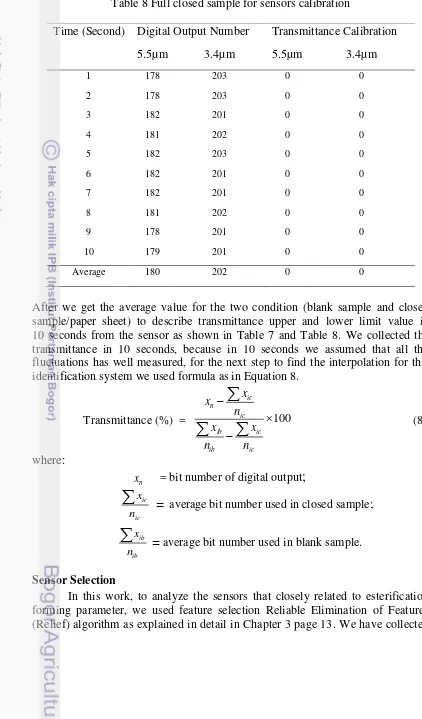
7 Blank sample for sensor calibration 22
8 Full closed sample for sensor calibration 23
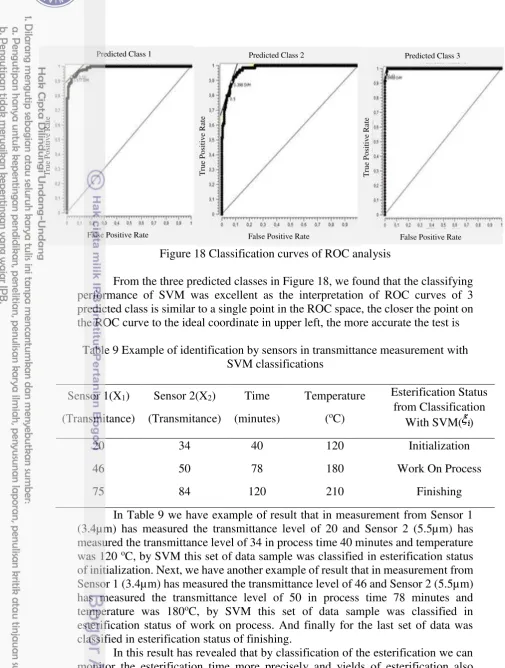
9 Example of identification by sensors in transmittance measurement with
SVM classifications 27
10 Example of esterification status dataset 35
11 Selected mid-IR sensor 39
12 Cluster set for K=5 with Silhouette score of 0.536 39 13 Cluster set for K=4 with Silhouette score of 0.489 40 14 Cluster set for K=3 raw material type 1 with Silhouette score of 0.604 40 15 Cluster set for K=3 raw material type 2 with Silhouette score of 0.601 41
16 Control set with cluster 41
17 Comparison result of existing and adaptive methods 42
18 List of sensor model 52
19 Yield regression for adaptive sensor selected in each state 52 20 Comparison yield from non-adaptive and gradient adaptive selection 53 21 Some sampling time for SVM in state control variable 54 22 Comparison result of existing and adaptive selection sensors 54
23 Comparison of optimization indicators 55
viii
FIGURE LIST
1 Esterification reaction 4
2 Esterification process diagram 4
3 General research framework 5
4 Mid-IR optical source 9
5 Self-optimization conceptual diagram 9
6 Real-time simulation model of GE production using discrete simulation 11 7 System block diagram for real-time data acquisition 11 8 Attribute weight for esterification parameter from training of feature
selection based on 30 synthetic data 13
9 BPMN of esterification process detailed for (A) simulation event generator
and (B) production 14
10 Output of simulation result for 6 parameters of QC 15 11 Output of simulation result for 3 parameters of QC 14
12 Part of apparatus set in laboratory experiment 20
13 Mid-IR setting position 20
14 Proposed system block diagram for sensors and microcontroller 22
15 Attribute weight of sensors from Relief method 25
16 Real-time transmittance measurement from 5.5µm(▲) and 3.4µm(■)
sensors 25
17 A knowledge flow scheme of SVM method 26
18 Classification curves of ROC analysis 27
19 Monitoring and optimization in real time concept 32 20 Real-time data from mid-IR sensor as 3.4µm(◊), 5.4µm(□) and 7µm(Δ) 34 21 Weight average from Relief method of each sensors type in 90-120 minutes
period 35
22 Flowchart of initial centroid optimization of Pilllar k-means method 36 23 Peripheral block diagram of the integration real-time control system 38
24 Nested relationship between SO and NCO in RTO 46
25 Connection diagram of NCO and control 47
26 BPMN diagram for SO and NCO 49
27 Spectrum FTIR before esterification ( ) and after esterification ( ) 49 28 GCMS spectrum for product testing from sample with the treatment of
200°C and 120 minutes 50
29 Control model of self-optimization in Stateflow 50
30 Control state model in Stateflow 51
31 Control model of reactor in Stateflow 51
32 Control model of esterification in Stateflow 51
33 Comparison of yield measurement from mid-IR sensors with adaptive ( )
and non-adaptive ( ) 53
36 Barchart of real-time optimization mode indicator vs average temperature
in reactor 56
37 Basic stages in analysis and design for scaling up 60
38 Knowledge flow for scaling up 61
39 Scale-up measurement planning model 62
40 Proposed diagram of physical scale-up conversion apparatus for pilot plant 63 41 Stateflow model for controlling the reactor heater in pilot scale 63
x
APPENDIX LIST
1 Photo of reactor with sensor attached2 Photo of Arduino microcontroller 3 Photo of real-time optimization system 4 Photo of existing scale-up controller
5 Datasets of attribute parameter for quality control 6 Sample of data using 3 sensors in real-time 7 Sample of data using 2 sensors in real-time 8
9
10
Arduino code
GCMS test for esterified glycerol with temperature 2100C-90 minutes
process time
GCMS test for esterified glycerol with temperature 2100C-120 minutes process time
GLOSSARY
Adaptive
:
readily capable of adapting or of being adapted.Arduino
:
an open-source project that created microcontroller-based kits for building digital devices and interactive objects that can sense and control physical devices.BPMN
:
Business Process Modelling and Notation is a graphical representation for specifying business processes in a business process model.Computational intelligence
:
the ability of a computer to learn a specific task from data or experimental observation.Esterification
:
conversion of an acid into an ester by combination with a n alcohol and removal of a molecule of water.Event-based simulation
:
simulation that operate by taking events, one at a time, and propagating them through a design until a steady state condition is achieved.FFA
:
Free Fatty Acid, when fatty acids circulating in the plasma (plasma fatty acids) are not in their glycerol ester form (glycerides), they are known as non-esterified fatty acids (NEFAs) or free fatty acids (FFAs).FTIR
:
Fourier Transform Infrared Spectroscopy is a technique which is used to obtain an infrared spectrum of absorption or emission of a solid, liquid or gas.GCMS
:
Gas Chromatography–Mass Spectrometry is an analytical method that combines the features of gas-chromatography and mass spectrometry to identify different substances within a test sample.Glycerol
:
also called glycerine or glycerin (C3H8O3) is a simplepolyol compound. It is a colorless, odorless, viscous liquid that is sweet-tasting and non-toxic.
GMO
:
Glycerol Monooleic are used as emulsifiers or oiling agents for foods, spin finishes and textiles; antifoaming and antistatic agents for plastics; and lubricants, water treatment, metal working fluids, and dispersing agents. End applications include cosmetics, foods, personal care products, medicine, pesticides, paper making, plastics and paints.Gradient
:
the degree of inclination, or the rate of ascent or descent. Infrared:
producing or using rays of light that cannot be seen andthat are longer than rays that produce red light.
xii
Laplace transform
:
an integral transform named after its discoverer Pierre-Simon Laplace. It takes a function of a positive real variable t (often time) to a function of a complex variables (frequency).
Measurement
:
the act or process of measuring something.Microcontroller
:
is a small computer on a single integrated circuit containing a processor core, memory, and programmable input/output peripherals.Modelling
:
graphical, mathematical (symbolic), physical, or verbal representation or simplified version of a concept, phenomenon, relationship, structure, system, or an aspect of the real world.Oleic Acid
:
a colorless, odorless, liquid, water insoluble , unsaturated acid C18 H34O2 obtained from animal tallow and naturalvegetable oil.
Optimization
:
an act, process, or methodology of making something (as a design, system, or decision) as fully perfect, functional, or effective as possiblePID Controller
:
a proportional–integral–derivative (PID) controller is a control loop feedback mechanism (controller) commonly used in industrial control systems.Pillar K-means
:
an algorithm that has a new approach to optimizing the designation of initial centroids for K-means clustering. Real-time:
relating to applications in which the computer mustrespond as rapidly as required by the user or necessitated by the process being controlled.
RELIEF
:
Reliable Elimination of Features is a feature selection algorithm used in binary classification (generalizable to polynomial classification by decomposition into a number of binary problems) proposed by Kira and Rendell in 1992 ROC:
Receiver Operating Characteristic or ROC curve, is a graphical plot that illustrates the performance of a binary classifier system as its discrimination threshold is varied. RTO:
Real-Time Optimization the optimum values of the setpoints are re-calculated on a regular basis (e.g., every minutes, hour or every day).
RTS
:
Real Time Simulation refers to a computer model of a physical system that can execute at the same rate as actual "wall clock" time. In other words, the computer model runs at the same rate as the actual physical system.Selection
:
the act of choosing something from a group.Sensor
:
a device that detects and responds to some type of input from the physical environment.Simulation
:
imitation or representation, as of a potential situation or in experimental testing.State
:
the system's modes of operation, represent the logic for switching between modes using transitions and junctions Stateflow®:
an environment for modeling and simulatingcombinatorial and sequential decision logic based on state machines and flow charts.
SO
:
Self-Optimization is a process in which settings are autonomously and continuously adapted for optimizing the system.SVM
:
Support vector machine are supervised learning models with associated learning algorithms that analyze data for classification and regression analysis.GLOSSARY
Adaptive
:
readily capable of adapting or of being adaptedArduino
:
an open-source project that created microcontroller-based kits for building digital devices and interactive objects that can sense and control physical devicesBPMN
:
Business Process Modelling and Notation is a graphical representation for specifying business processes in a business process model.Computational intelligence
:
the ability of a computer to learn a specific task from data or experimental observationEsterification
:
conversion of an acid into an ester by combination with a n alcohol and removal of a molecule of waterEvent-based simulation
:
simulation that operate by taking events, one at a time, and propagating them through a design until a steady state condition is achievedFFA
:
Free Fatty Acid, when fatty acids circulating in the plasma (plasma fatty acids) are not in their glycerol ester form (glycerides), they are known as non-esterified fatty acids (NEFAs) or free fatty acids (FFAs)FTIR
:
Fourier Transform Infrared Spectroscopy is a technique which is used to obtain an infrared spectrum of absorption or emission of a solid, liquid or gasGCMS
:
Gas Chromatography–Mass Spectrometry is an analytical method that combines the features of gas-chromatography and mass spectrometry to identify different substances within a test sample.Glycerol
:
also called glycerine or glycerin (C3H8O3) is a simplepolyol compound. It is a colorless, odorless, viscous liquid that is sweet-tasting and non-toxic.
GMO
:
Glycerol MonoOleate are used as emulsifiers or oiling agents for foods, spin finishes and textiles; antifoaming and antistatic agents for plastics; and lubricants, water treatment, metal working fluids, and dispersing agents. End applications include cosmetics, foods, personal care products, medicine, pesticides, paper making, plastics and paints.Gradient
:
the degree of inclination, or the rate of ascent or descent Infrared:
producing or using rays of light that cannot be seen andthat are longer than rays that produce red light
transform Simon Laplace. It takes a function of a positive real variable t (often time) to a function of a complex variable
s (frequency).
Measurement
:
the act or process of measuring somethingMicrocontroller
:
is a small computer on a single integrated circuit containing a processor core, memory, and programmable input/output peripheralsModelling
:
graphical, mathematical (symbolic), physical, or verbal representation or simplified version of a concept, phenomenon, relationship, structure, system, or an aspect of the real worldOleic Acid
:
a colorless, odorless, liquid, water insoluble , unsaturated acid C18 H34O2 obtained from animal tallow and naturalvegetable oil
Optimization
:
an act, process, or methodology of making something (as a design, system, or decision) as fully perfect, functional, or effective as possiblePID Controller
:
a proportional–integral–derivative (PID) controller is a control loop feedback mechanism (controller) commonly used in industrial control systems.Pillar K-means
:
an algorithm that has a new approach to optimizing the designation of initial centroids for K-means clustering Real-time:
relating to applications in which the computer mustrespond as rapidly as required by the user or necessitated by the process being controlled
RELIEF
:
Reliable Elimination of Features is a feature selection algorithm used in binary classification (generalizable to polynomial classification by decomposition into a number of binary problems) proposed by Kira and Rendell in 1992 ROC:
Receiver Operating Characteristic or ROC curve, is a graphical plot that illustrates the performance of a binary classifier system as its discrimination threshold is varied RTO:
Real-Time Optimization the optimum values of the setpoints are re-calculated on a regular basis (e.g., every minutes, hour or every day)
RTS
:
Real Time Simulation refers to a computer model of a physical system that can execute at the same rate as actual "wall clock" time. In other words, the computer model runs at the same rate as the actual physical systemSimulation
:
imitation or representation, as of a potential situation or in experimental testingState
:
the system's modes of operation, represent the logic for switching between modes using transitions and junctions Stateflow®:
an environment for modeling and simulatingcombinatorial and sequential decision logic based on state machines and flow charts
SO
:
Self-Optimization is a process in which settings are autonomously and continuously adapted for optimizing the systemSVM
:
Support vector machine are supervised learning models with associated learning algorithms that analyze data for classification and regression analysisTABLE OF CONTENT
TABLE LIST vii
FIGURE LIST viii
APPENDIX LIST x
GLOSSARY xi
1 INTRODUCTION 1
Background 1
Problem Statement 2
Objectives 2
Benefits 2
Boundaries 2
Novelty of Research 3
2 METHODS
Simulation and Laboratory Experiments 4
Research Framework 5
Location of Research and Time 6
Method of Collecting Data 6
3 A REAL-TIME SIMULATION MODEL OF PRODUCTION SYSTEM OF GLYCEROL ESTER WITH SELF OPTIMIZATION
Abstract 7
Introduction 7
Materials and Methods 8
Experimental Results 12
Discussion 16
Conclusion 17
4 REAL-TIME MONITORING GLYCEROL ESTERIFICATION PROCESS WITH MID-IR SENSORS USING SUPPORT VECTOR MACHINE
CLASSIFICATION
Abstract 18
Introduction 18
Materials and Methods 19
Experimental Results 25
Discussion 28
vi
5 OPTIMIZATION MODEL OF GLYCEROL ESTERIFICATION PROCESS USING REAL-TIME ADAPTIVE CONTROL
Abstract 30
Introduction 30
Materials and Methods 33
Experimental Results 39
Discussion 42
Conclusion 43
6 REAL-TIME OPTIMIZATION USING GRADIENT ADAPTIVE
SELECTION OF INFRA RED SENSOR FOR GLYCEROL ESTERIFICATION
Abstract 44
Introduction 44
Methods 45
Experimental Results 48
Discussion 54
Conclusion 57
7 A PROPOSAL FOR SCALING UP MODELING FOR A BATCH ESTERIFICATION PROCESS WITH REAL-TIME OPTIMIZATION
Abstract 58
Introduction 58
Methods 59
Conclusion 65
8 CONCLUSION AND RECOMMENDING REMARKS Conclusion
Recommending Remarks
66 66
REFERENCE LIST
APPENDIX
TABLE LIST
1 List of data type for SQL database 11
2 List of attribute of parameter for quality control 13 3 Comparison of existing and real-time simulation with SO 16
4 Specification of mid-IR LED34Sr 21
5 Specification of mid-IR LED55Sr 21
6 Specification of mid-IR OPLED70 21
7 Blank sample for sensor calibration 22
8 Full closed sample for sensor calibration 23
9 Example of identification by sensors in transmittance measurement with
SVM classifications 27
10 Example of esterification status dataset 35
11 Selected mid-IR sensor 39
12 Cluster set for K=5 with Silhouette score of 0.536 39 13 Cluster set for K=4 with Silhouette score of 0.489 40 14 Cluster set for K=3 raw material type 1 with Silhouette score of 0.604 40 15 Cluster set for K=3 raw material type 2 with Silhouette score of 0.601 41
16 Control set with cluster 41
17 Comparison result of existing and adaptive methods 42
18 List of sensor model 52
19 Yield regression for adaptive sensor selected in each state 52 20 Comparison yield from non-adaptive and gradient adaptive selection 53 21 Some sampling time for SVM in state control variable 54 22 Comparison result of existing and adaptive selection sensors 54
23 Comparison of optimization indicators 55
viii
FIGURE LIST
1 Esterification reaction 4
2 Esterification process diagram 4
3 General research framework 5
4 Mid-IR optical source 9
5 Self-optimization conceptual diagram 9
6 Real-time simulation model of GE production using discrete simulation 11 7 System block diagram for real-time data acquisition 11 8 Attribute weight for esterification parameter from training of feature
selection based on 30 synthetic data 13
9 BPMN of esterification process detailed for (A) simulation event generator
and (B) production 14
10 Output of simulation result for 6 parameters of QC 15 11 Output of simulation result for 3 parameters of QC 14
12 Part of apparatus set in laboratory experiment 20
13 Mid-IR setting position 20
14 Proposed system block diagram for sensors and microcontroller 22
15 Attribute weight of sensors from Relief method 25
16 Real-time transmittance measurement from 5.5µm(▲) and 3.4µm(■)
sensors 25
17 A knowledge flow scheme of SVM method 26
18 Classification curves of ROC analysis 27
19 Monitoring and optimization in real time concept 32 20 Real-time data from mid-IR sensor as 3.4µm(◊), 5.4µm(□) and 7µm(Δ) 34 21 Weight average from Relief method of each sensors type in 90-120 minutes
period 35
22 Flowchart of initial centroid optimization of Pilllar k-means method 36 23 Peripheral block diagram of the integration real-time control system 38
24 Nested relationship between SO and NCO in RTO 46
25 Connection diagram of NCO and control 47
26 BPMN diagram for SO and NCO 49
27 Spectrum FTIR before esterification ( ) and after esterification ( ) 49 28 GCMS spectrum for product testing from sample with the treatment of
200°C and 120 minutes 50
29 Control model of self-optimization in Stateflow 50
30 Control state model in Stateflow 51
31 Control model of reactor in Stateflow 51
32 Control model of esterification in Stateflow 51
33 Comparison of yield measurement from mid-IR sensors with adaptive ( )
and non-adaptive ( ) 53
36 Barchart of real-time optimization mode indicator vs average temperature
in reactor 56
37 Basic stages in analysis and design for scaling up 60
38 Knowledge flow for scaling up 61
39 Scale-up measurement planning model 62
40 Proposed diagram of physical scale-up conversion apparatus for pilot plant 63 41 Stateflow model for controlling the reactor heater in pilot scale 63
x
APPENDIX LIST
1 Photo of reactor with sensor attached2 Photo of Arduino microcontroller 3 Photo of real-time optimization system 4 Photo of existing scale-up controller
5 Datasets of attribute parameter for quality control 6 Sample of data using 3 sensors in real-time 7 Sample of data using 2 sensors in real-time 8
9
10
Arduino code
GCMS test for esterified glycerol with temperature 2100C-90 minutes
process time
GCMS test for esterified glycerol with temperature 2100C-120 minutes process time
GLOSSARY
Adaptive
:
readily capable of adapting or of being adapted.Arduino
:
an open-source project that created microcontroller-based kits for building digital devices and interactive objects that can sense and control physical devices.BPMN
:
Business Process Modelling and Notation is a graphical representation for specifying business processes in a business process model.Computational intelligence
:
the ability of a computer to learn a specific task from data or experimental observation.Esterification
:
conversion of an acid into an ester by combination with a n alcohol and removal of a molecule of water.Event-based simulation
:
simulation that operate by taking events, one at a time, and propagating them through a design until a steady state condition is achieved.FFA
:
Free Fatty Acid, when fatty acids circulating in the plasma (plasma fatty acids) are not in their glycerol ester form (glycerides), they are known as non-esterified fatty acids (NEFAs) or free fatty acids (FFAs).FTIR
:
Fourier Transform Infrared Spectroscopy is a technique which is used to obtain an infrared spectrum of absorption or emission of a solid, liquid or gas.GCMS
:
Gas Chromatography–Mass Spectrometry is an analytical method that combines the features of gas-chromatography and mass spectrometry to identify different substances within a test sample.Glycerol
:
also called glycerine or glycerin (C3H8O3) is a simplepolyol compound. It is a colorless, odorless, viscous liquid that is sweet-tasting and non-toxic.
GMO
:
Glycerol Monooleic are used as emulsifiers or oiling agents for foods, spin finishes and textiles; antifoaming and antistatic agents for plastics; and lubricants, water treatment, metal working fluids, and dispersing agents. End applications include cosmetics, foods, personal care products, medicine, pesticides, paper making, plastics and paints.Gradient
:
the degree of inclination, or the rate of ascent or descent. Infrared:
producing or using rays of light that cannot be seen andthat are longer than rays that produce red light.
xii
Laplace transform
:
an integral transform named after its discoverer Pierre-Simon Laplace. It takes a function of a positive real variable t (often time) to a function of a complex variables (frequency).
Measurement
:
the act or process of measuring something.Microcontroller
:
is a small computer on a single integrated circuit containing a processor core, memory, and programmable input/output peripherals.Modelling
:
graphical, mathematical (symbolic), physical, or verbal representation or simplified version of a concept, phenomenon, relationship, structure, system, or an aspect of the real world.Oleic Acid
:
a colorless, odorless, liquid, water insoluble , unsaturated acid C18 H34O2 obtained from animal tallow and naturalvegetable oil.
Optimization
:
an act, process, or methodology of making something (as a design, system, or decision) as fully perfect, functional, or effective as possiblePID Controller
:
a proportional–integral–derivative (PID) controller is a control loop feedback mechanism (controller) commonly used in industrial control systems.Pillar K-means
:
an algorithm that has a new approach to optimizing the designation of initial centroids for K-means clustering. Real-time:
relating to applications in which the computer mustrespond as rapidly as required by the user or necessitated by the process being controlled.
RELIEF
:
Reliable Elimination of Features is a feature selection algorithm used in binary classification (generalizable to polynomial classification by decomposition into a number of binary problems) proposed by Kira and Rendell in 1992 ROC:
Receiver Operating Characteristic or ROC curve, is a graphical plot that illustrates the performance of a binary classifier system as its discrimination threshold is varied. RTO:
Real-Time Optimization the optimum values of the setpoints are re-calculated on a regular basis (e.g., every minutes, hour or every day).
RTS
:
Real Time Simulation refers to a computer model of a physical system that can execute at the same rate as actual "wall clock" time. In other words, the computer model runs at the same rate as the actual physical system.Selection
:
the act of choosing something from a group.Sensor
:
a device that detects and responds to some type of input from the physical environment.Simulation
:
imitation or representation, as of a potential situation or in experimental testing.State
:
the system's modes of operation, represent the logic for switching between modes using transitions and junctions Stateflow®:
an environment for modeling and simulatingcombinatorial and sequential decision logic based on state machines and flow charts.
SO
:
Self-Optimization is a process in which settings are autonomously and continuously adapted for optimizing the system.SVM
:
Support vector machine are supervised learning models with associated learning algorithms that analyze data for classification and regression analysis.1 INTRODUCTION
BackgroundEsterification product such as monoglyceride and diglyceride are representing high demand as modifying agents and showing steadily incremental demand for consumption in the future, as they have various industrial application, particularly as the main raw material in pharmaceutical, cosmetics and personal care, as well as in ink manufacturing (Pagliaro and Rossi 2008; Prasetyo et al. 2012; Fernandez et al. 2005). Another use for derivative products of glycerol is for mixing substances to produce OBM (Oil Based Mud) and WBM (Water Based Mud) in oil mining industries in Indonesia. Production of Monoglyceride from esterification of glycerol and synthesis of middle or long-chain fatty acids offers promising industrial opportunities (Mostafa 2013). Then, to optimize the esterification reaction, it is essential to conduct it in real-time mode, which has to cover various disturbance and uncertainty. In recent years, spectroscopic methods using infrared has gained popularity to be chosen for industrial process control in real-time, especially for esterification process (Blanco et al. 2004).
In esterification, as previously researched (Hui 1996) there is some influence of process variables, such as temperature and time requirement in reactor that affected their efficiency. In esterification process has several constraints, such as inconstant yield of production target and lack of efficiency as there is a synthesizing reaction that requires high-energy use in the reactor to achieve desired temperature and time for the process (Mostafa 2013).
As the stage in these dissertation, in order to optimize the esterification process in real-time mode, this research started with challenges are to model a Self-Optimization in real-time simulation of esterification, to build a real-time classifying system of esterification, to develop an optimized model for esterification process using real-time clustering adaptive control, to improve esterification process with real time adaptive sensors selection system, and to design a scale-up esterification process in proposed model for batch production.
For the purpose to solve those objectives, we used RTO concept that was developed based on SO, which is defined in Skogestad (2000) as an achievement for an acceptable loss with constant set point values for the controlled variables, without has to re-optimize when has disturbances. This method was combined with Necessary Condition Optimum (NCO) (Srinivasan and Bonvin 2007). However, according to Ye et al. (2012), it is necessary to measure all of the NCO components in real-time using sensors. For this research, we claimed of this new optimization method, supported with measurement using sensors with several types in medium wavelengths in IR spectrum named mid-IR and a real-time data acquisition system supported with computational intelligence was new. This new method also useful for chemical industry application that has dynamic condition such as in esterification process.
adaptive clustering (Barakbah 2010). Next, to determine the state group in control the proposed system consists of several variables such as temperature and stirring speed of the reactor. Finally, by finding optimization parameters that have to be fulfilled, which consisted of process time and yield, focuses on the production of Glycerol Monooleate (GMO) with 130 minutes observation time.
Problem Statement
It has always been a big challenge for chemical industries to develop the production system as regard to its complexity. In order to optimize esterification process in real-time mode, RTO was chosen as a development method which involves control variable in its process. Thus, there were several problems related to the optimization of esterification based on RTO, as follows:
1. How to model a self-optimization in real-time simulation of esterification? 2. How to build a real-time classifying system of esterification?
3. How to develop an optimized model for esterification process using real-time clustering adaptive control?
4. How to improve esterification process with real time adaptive sensors selection system?
5. How to design a scale-up esterification process in proposed model for batch production?
Objectives
Based on the problem statement above, there are five main objectives formulated in this research as follows:
1. to model a self-optimization in real-time simulation of esterification, 2. to build a real-time classifying system of esterification,
3. to develop an optimized model for esterification process using real-time clustering adaptive control,
4. to improve esterification process with real time adaptive sensors selection system,
5. to design a scale-up esterification process in proposed model for batch production.
Benefits
The most accomplished result in integration method RTO with adaptive selection for future implementation was contributed to support a prediction of production volume with real-time simulation, improving identification of esterification stage in real time mode, deploying states control model precisely with adaptive selection sensor and operating more efficient in a batch process.
3
of glycerol 80% and 90% purity, mixed with oleic acid in 1:1 ratio and focused on the target production of Glycerol Monooleate. The process was observed in range between 90 to 130 minutes using catalyst Methyl Ester Sulfonic Acid (MESA) 0.5% and the performance of apparatus was in normal and standard condition. The product of esterification was tested with FTIR and GCMS to measure the yield of Glycerol Monooleate.
Novelty of Research
Glycerol Monooleate
[image:35.595.42.472.24.553.2]In simulation stages, a group of synthetic data for quality target that found from literature was used to simulate the process of esterification to measure the performance of the system using real-time discrete simulation and found the related parameter of quality using feature selection method.
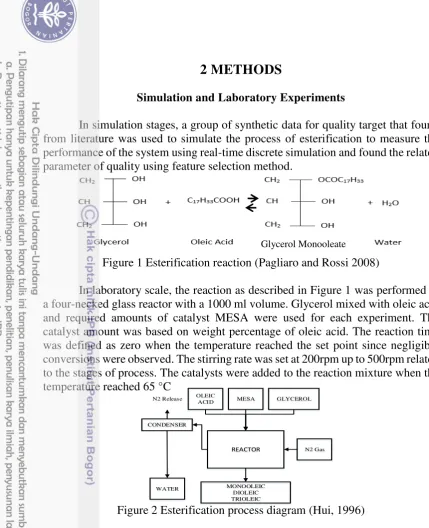
Figure 1 Esterification reaction (Pagliaro and Rossi 2008)
In laboratory scale, the reaction as described in Figure 1 was performed in a four-necked glass reactor with a 1000 ml volume. Glycerol mixed with oleic acid and required amounts of catalyst MESA were used for each experiment. The catalyst amount was based on weight percentage of oleic acid. The reaction time was defined as zero when the temperature reached the set point since negligible conversions were observed. The stirring rate was set at 200rpm up to 500rpm related to the stages of process. The catalysts were added to the reaction mixture when the temperature reached 65 °C
Figure 2 Esterification process diagram (Hui, 1996)
In esterification process as described in Figure 2 has several constraints, such as inconstant yield of production target and lack of efficiency as there is a synthesizing reaction that requires high-energy use in the reactor to achieve desired temperature and time for the process (Mostafa 2013). In this process also has several disturbance that involved in the reaction such as variance of purity level of glycerol and oleic acid as a raw material. Another disturbance was from environment of the system such as outside temperature variance of the reactor. The photo of reactor in laboratory experiments was shown in Appendix 1.
The yield of esterification process as focused in this research was measured by the transmittance of infrared sensors with several wavelength based on Planck theorem that the transmittance level in each frequency has related in energy
REACTOR OLEIC
ACID MESA GLYCEROL
CONDENSER
N2 Gas
MONOOLEIC DIOLEIC TRIOLEIC WATER
5
Modeling and Simulation
1.Analyzing esterification production system with BPMN diagram
2. Appliedreal- time simulationto optimize production of esterified glycerol
1. Design formulation using Infrared sensors for real- time measurement
2. Develop computational Intelligence forclassificationmethods
1.Analyze and designthe dynamic condition process of oleic acid esterification with glycerol in detail
2.Develop gradient measurementfor selection the sensors followed by Support Vector Machine (SVM) for data to determine the classification state condition in control combined with adaptive
selectionmethod applied in the microcontroller. Integration of real-time monitoringand control with state,
supported with Pillar k-means adaptiveclustering
Transform Infrared Spectroscopy (FTIR) and Gas Chromatography–Mass Spectrometry (GCMS) (Kartnaller et al. 2016).
Research Framework
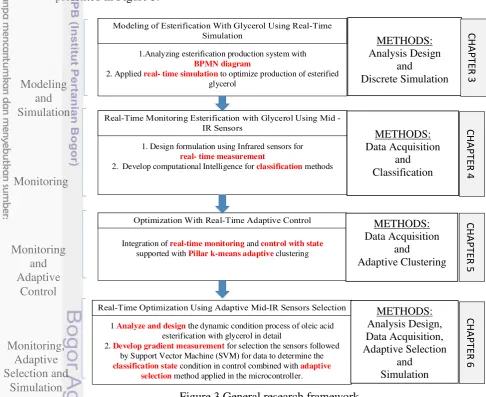
The research framework was designed in a parallel form to solve the problem which begins from a real-time simulation model of self-optimization and then developing in real-time monitoring. Finally, optimization in real-time with an adaptive sensor selection to determine the control state. In this research, microcontroller ATmega8535 (Atmel 2005) and Arduino (Ivrea 2005) were used as a hardware of data acquisition. For the tools such as BPMN 2.0 (SAP 2013), Sigmaplot 12.5 (Cranes 2011), Arena (Rockwell 2011), Orange Python (Biolab 2015) and Stateflow (Mathworks 2014) were used in software for process modeling, create exact graphs, discrete simulation and data processing.
[image:36.595.58.545.344.741.2]In this research, generally, experimental data from laboratory scale practices of reaction were used to generate several real-time optimization models of esterification production using clustering, classification, and adaptive selection sensor. The detail of general research framework and method in each chapter are presented in Figure 3.
Figure 3 General research framework
Location of Research and Time
This research was started fromJune 2014 up to May 2016. The sensors and detectors were tested and assembled in Laboratory of Electronic Material and Physics in Department of Physics Bogor Agricultural University. For data analysis and computational process was run in Laboratory of Computational Research Department of Agroindustrial Technology Bogor Agricultural University. We run several reactions and variation conditions for esterification process that were tested in laboratories of Surfactant Bioenergy Research Center (SBRC) at Bogor Agricultural University.
Method of Collecting Data
3 A REAL-TIME SIMULATION MODEL OF PRODUCTION
OF GLYCEROL ESTERIFICATION WITH SELF-
OPTIMIZATION
Abstract
The quality and capacity of Glycerol Monooleate (GMO) production are the factors that need to monitor and control. In this model of Real-Time Simulation (RTS), we deployed BPMN diagram to analyze and design the requirement and used data acquisition system with the real-time sensor. We used real-time data acquisition by optical sensors to acquire several quality parameters such as viscosity, pH, purity and density which was interfaced to an SQL database. The model of self-optimization for quality surveillance was based on previous work. As a result of RTS, showed that the evaluation of the system performance was worked to optimize a range of parameter esterification glycerol with oleic acid in producing Glycerol Monooleate (GMO) such as optimized process time to 2.888 hours and volume at 28L for each batch. Compared to the traditional works was set to a fixed value 24L output only and 3.4 hours process time, that was increased about 16% volume of production for each batch and quality parameters that has closely related are density, viscosity and purity. In future work, it is recommended to accelerate the data processing including to re-structure the real-time monitoring sensor system.
Introduction
used conventional process and has many customer requirements to make Glycerol Monooleate (GMO).
One of motivational point in optimization in GMO production is the quality of product may vary from the customer requirement. That condition would affect the unstable volume of production as this requirement observed and controlled manually. Our research for the optimization and simulation in a real-time mode to monitor the flow of production and find the best production parameter with SO.
The objective of these chapter is to construct a model that applied the RTS method supported with SO in implementation for Quality Control (QC). This method was explained with BPMN diagrams, using sensors and data acquisition system and finding the parameter of production that closely related to the quality target of the product and the volume of production GMO.
Materials and Methods
Production of Glycerol Monooleate
The complexity of GMO production using reactor which is charged with materials glycerol that was explained in Chapter 1 at introduction, and reactor that put in a heater apparatus with working temperature maximum at 260°C were used.
Business Process Modelling
This stage is important because with this modeling we can analyze all the activities taken in production, especially in esterification process. We referred a Business Process (BP) as a collection of related and structured activities undertaken by one or more organizations or process in order to pursue some particular goal. Within an organization, a BP results in the provisioning of services or in the production of goods for internal or external stakeholders. Moreover, BPs are often interrelated since the execution of a BP often results in the activation of related BPs within the same or other organizations (Grooskopf et al. 2009). The primary goal of BPMN is to provide a standard notation readily understandable by all business stakeholders (Ryan et al. 2009), this modeling notation method has become an highly attractive topic both for industries and for the academy such as: the BPMN 2.0 (Stephen and Conrad 2011).
Quality Control (QC)
9
Self-Optimization
In order to design a esterification process with optimum parameters. A combination of SO and simulation with real-time data acquisition method was proposed with IR sensors as shown in Figure 4, this illustration refer to specification of mid-IR sensor from Boston Electronics (Boston 2014) such as casing, optical lens and power wiring. The behavior of this optimization algorithms is random, so we had to perform many optimization experiments to identify the pure nature of. By considering the number of simulation experiments we can divide the number of simulation experiments as simulation experiment that simulation run of simulation model, Optimization experiment that performed with concrete optimization method setting to find the optimum of objective function and series that replication of optimization experiments with concrete optimization method setting. In this chapter the simulation and optimization experiment was used to find the optimum of the objective function.
We specified the same conditions to satisfy each criteria in optimization such as termination criteria, search space for the global optimum. Optimization experiment method has the same parameters as another optimization method.
The optimization algorithms doing it by automatically as diagram in Figure 5 that described the SO was operate as controller and process to set the controlled parameter adaptation of esterification to achieve the requirements of quality goal
Figure 5 Self-optimization conceptual diagram (modified from Adelt 2009)
Figure 4 Mid-IR optical source
Power Wiring
Optical Lens Casing
ACTUAL DATA TARGET
DATA CONTROLLED DATA
Self-optimizing systems are defined as the interaction of contained elements and the recurring execution of the actions (Adelt et al. 2009), that has continuous analysis of the current situation, in this case is parameter selected of pure glycerol, determination of quality targets of GMO, production capacity, and adaptation of the
system’s behavior to achieve these targets like temperature setting and the stirring speed of reactor.
In this chapter we concerned for the SO formulation in general to find the minimization of process time with selected parameter as in Equation 1
min (t)↔(P) (1) Where t∈ � T is time needed in process and P is process with selected parameter
of quality. For the more detailed formulation we described in Equation 3. The development of a simulation of an actual system involves the creation
of a conceptual model of the actual system to be simulated, which may be based on a set of rules, or a set of mathematical equations, or some other method of defining the state of the simulation and the way in which it changes with time. A simulation based on a discrete model establishes an initial state of the system and a future event queue with event timings. Thus, an event-based simulation in which time advances from event to event in a single software thread has been the basis of many popular discrete simulation languages, but, as parallel computing options increase, process -based simulation using parallel processors and multiple software threads has become the most popular approach.
Real-Time Simulation
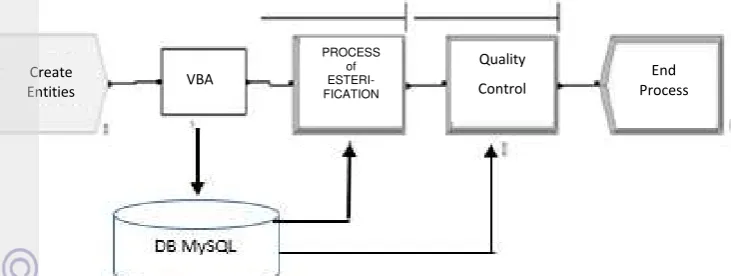
Real time simulation is based on real-time systems that differ from traditional data processing systems, they are constrained by certain nonfunctional requirements (e.g. dependability and timing constraints or requirements). An efficient simulation of the real-time system requires a model that satisfies both simulation objectives and timing constraints (Bergero and Kofman 2010). There were several previous research developed in a structure and architecture for automatic simulation model generation. Theirs very detailed simulation models intended to be used for real-time simulation based shop floor control (Lee and Fishwick 2001). They identified two essential stages to be automated for automatic simulation model generation: System specification and the associated model construction (Law and Kelton 2000). In this work, a proposed methodology for building an Arena simulation model from a resource model as seen in Figure 6. This was made possible, the Arena simulation software is supported by Visual Basic Application (VBA) coding,
With this application which enables application integration and automation we deploy the simulation model. Then, undertook the development of efficiently model real-time systems to satisfy given simulation objectives and to achieve arbitrary timing requirements and used SQL for running the simulation.
11
End Process
Figure 6 Real-time simulation model of GMO production using discrete simulation
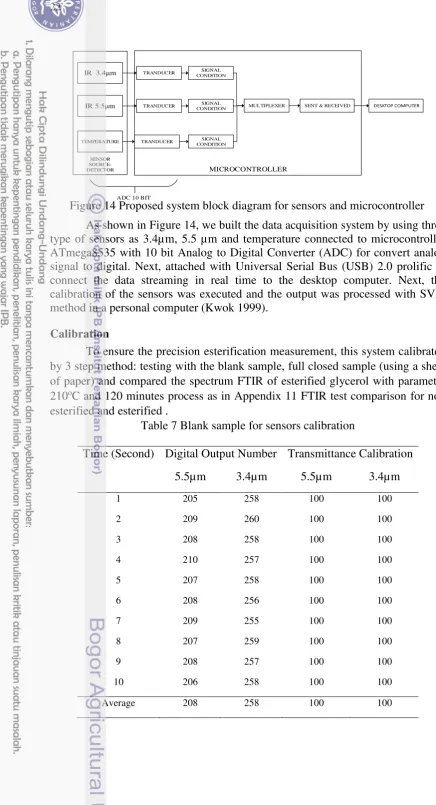
As seen in above simulation diagram. To provide data transmission smoothness, a new system has several block function such as front end, database, microcontroller and sensors to operate the system. We designed the system block for processing signal from control panel that arrange the flow of data from sensors to interface with an SQL connection for database building. In this work we deployed MySQL (Oracle 2014) as data access and repository media by using microcontroller.
In this chapter as shown in Figure 7, we implemented a real time simulation that need to support by sensors block to do the simulation with little time delay with theirs respectively as special function of microcontroller and front end to built the database in real time that needed in simulation.
[image:42.595.86.504.85.707.2]Next, we provided relevant tables designed in SQL engine and it is related to simulation as in Table 1.
Table 1 List of data type for SQL database
Field Data Type Related to
simulation
Time Time Parameter
Sensor 1.2 µm Numeric Esterification Sensor 3.4 µm Numeric Esterification Sensor 5.5 µm Numeric Esterification
pH Sensor Numeric Quality
Viscosity Sensor Numeric Quality
Temperature Numeric Variable
Stirring speed Numeric Variable
Figure 7 System block diagram for real-time data acquisition MICRO
CONTROLLER SENSORS
DATABASE
FRONT END
Create
Entities VBA
PROCESS of ESTERI-FICATION
Quality
[image:42.595.122.488.105.243.2]In this new concept, analog signal from sensors was converted to digital as interfaced to database using microcontroller in less than 2 seconds for each data stream and RTS works based on simulation running in discrete simulation software using the data from database.
Feature Selection
Feature selection was used in this research because there is many attributes to measure for controlled the quality. To select the parameter that closely related we used Relief (Reliable Elimination of Features) method. This experiment used two class which are good and not good measurement. The result of weights of design elements of Relief a weight of the ith feature is then updated, the mathematical model was stated by Kira and Rendell in 1992 is:
�� = �� + � − � − �− �� (2)
where ��= Weighted vector of ith attributes, �= ith feature vector, � = ith the closest different-class instance called as near miss where the later class (ith+1)in the record is differed from the from the ith record, �� = ith the closest same-class instancecalled as near hit where the later class (ith+1) is similar from the ith record. That formulation we used is to find the parameter closely related to determined quality of GMO (Equation 2). We used them to reduce unimportant features that result for a more efficient computation and sensor task.
Optimization formula
We concerned for isthe SO formulation for optimization that implemented Relief algorithm for attribute selection and search the minimization of time process
to increase the volume of production, which is topR→R<<N, N is number of all
attribute. We defined formulated completely as:
arg �
� → � � = {�|� ∈ � ∧ ∧ � ≪ ∧ � � < � } 3
where T={t1,t2,...tN}
Next, in this research we found the minimum of process time by doing several of replications in real time discrete simulation. To increase the precision of simulation result, 20 times of replications was run in the real time simulation.
Verification
For the verification stages we set the logical boundaries as acceptance test and bias allowable for the parameter of time which is between 2.5 to 3.5 hours and for volume of production which is between 23-30L.
Experimental Results
Parameter Selection
13
[image:44.595.105.507.69.821.2]datasets as listed in Appendix 5 completely. And some sample was tested by the set of quality condition of GMO as shown partially in Table 2.
Table 2 List of attribute of parameter for quality control %
Water (x1)
Viscosity (poise)
(x2)
Free Glycerin
(%) (x3)
pH (x4)
Purity (%) (x5)
Rel. Density
(x6)
Quality Pass
0.5 0.0548 3 4 72 1.01 NO
0.1 0.0543 1 4 63 0.98 NO
0.4 0.0549 3 3 88 1 YES
0.4 0.0543 2 3 71 1.01 NO
0.2 0.0526 3 4 83 0.96 YES
0.2 0.0519 2 4 62 1.02 NO
0.1 0.0513 3 5 78 0.96 YES
Source: (Pardi 2005;Prasetyo 2012)
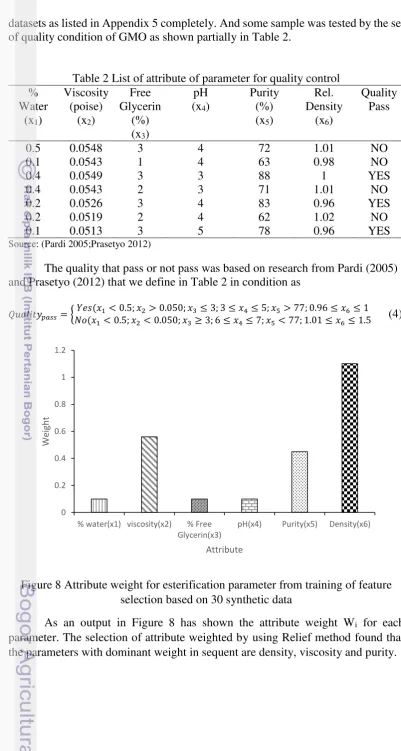
The quality that pass or not pass was based on research from Pardi (2005) and Prasetyo (2012) that we define in Table 2 in condition as
� �� ����= { � < . ;< . ; < .> . ;; 3;3; 3 ;; <> ; 1. 1; .9 1. 1 (4)
Figure 8 Attribute weight for esterification parameter from training of feature selection based on 30 synthetic data
As an output in Figure 8 has shown the attribute weight Wi for each
parameter. The selection of attribute weighted by using Relief method found that the parameters with dominant weight in sequent are density, viscosity and purity.
0 0.2 0.4 0.6 0.8 1 1.2
% water(x1) viscosity(x2) % Free Glycerin(x3)
pH(x4) Purity(x5) Density(x6)
Wei
gh
t
Business Process Modeling of Esterification with Glycerol
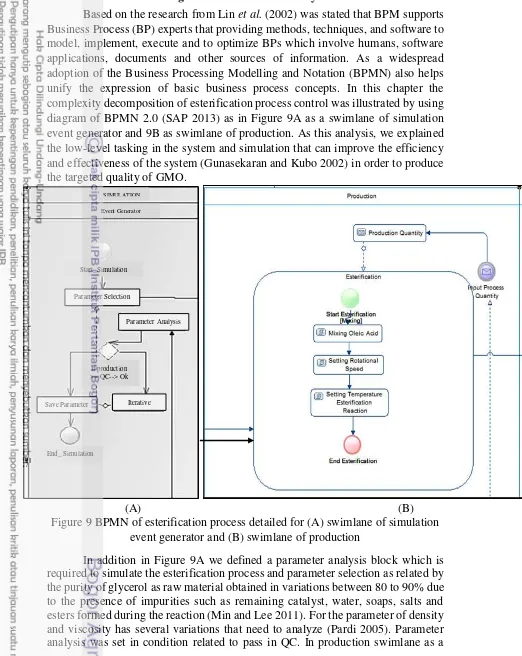
Based on the research from Lin et al. (2002) was stated that BPM supports Business Process (BP) experts that providing methods, techniques, and software to model, implement, execute and to optimize BPs which involve humans, software applications, documents and other sources of information. As a widespread adoption of the Business Processing Modelling and Notation (BPMN) also helps unify the expression of basic business process concepts. In this chapter the complexity decomposition of esterification process control was illustrated by using diagram of BPMN 2.0 (SAP 2013) as in Figure 9A as a swimlane of simulation event generator and 9B as swimlane of production. As this analysis, we explained the low-level tasking in the system and simulation that can improve the efficiency and effectiveness of the system (Gunasekaran and Kubo 2002) in order to produce the targeted quality of GMO.
[image:45.595.38.560.96.752.2](A) (B) Figure 9 BPMN of esterification process detailed for (A) swimlane of simulation
event generator and (B) swimlane of production
In addition in Figure 9A we defined a parameter analysis block which is required to simulate the esterification process and parameter selection as related by the purity of glycerol as raw material obtained in variations between 80 to 90% due to the presence of impurities such as remaining catalyst, water, soaps, salts and
End_ Simulation
SIMULATION
Event Generator
Parameter Selection
Parameter Analysis
Save Parameter Iterative Start_Simulation
15
connection from event generator that appointed where esterification process has several task such as mixing, setting of stirrer speed and setting temperature that was illustrated in Figure 9B. Finally, with BPMN diagrams we was deployed all the process of production by reaction of esterification that involving many parameters affected quality of the end product clearly. as well as advanced process concepts (e.g., exception handling, transaction compensation).
Output of Real Time Discrete Simulation
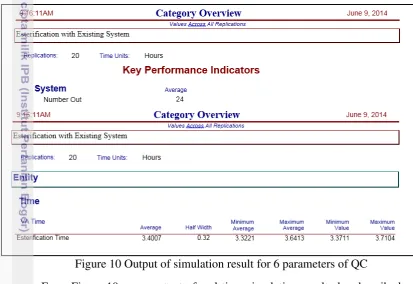
For data acquisition, a data measurement was interfaced with MySQL and inputs from optical sensors that collected after achieving steady state condition in process production. Then, in Figure 10 the performance in existing system was run in 20 replications and shown the result in Key Performance Indicator (KPI) as number out as represented the volume of production in 24L and average esterification time in 3.4007 hours.
[image:46.595.108.522.278.562.2]
Figure 10 Output of simulation result for 6 parameters of QC
From Figure 10 as an output of real time simulation result also described another parameter such as time unit, half width, minimum average, maximum average, minimum value and maximum value. Those output was important to measure the performance of the system.
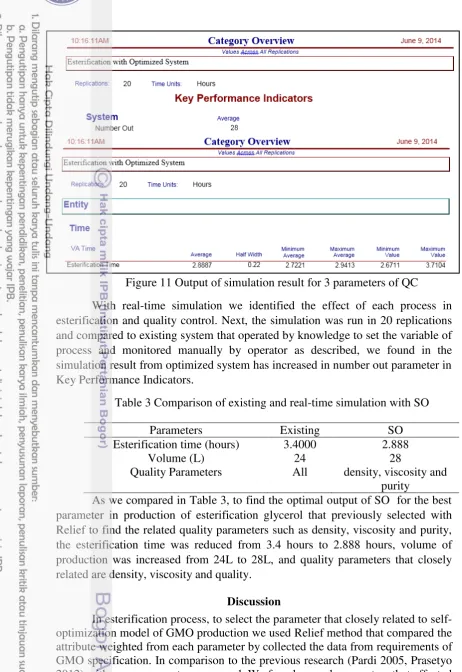
In addition in Figure 11 we showed the optimized proposed system using SO compared to existing system, that the KPI represented volume of production was increased to 28L and decreased in average esterification process time to 2.887 hours with the differences 0.6 hours as equal to 36 minutes. And also described also described another parameter such as time unit, half width, minimum average, maximum average, minimum value and maximum value. Those output was important to measure the performance of the system.
Figure 11 Output of simulation result for 3 parameters of QC
With real-time simulation we identified the effect of each process in esterification and quality control. Next, the simulation was run in 20 replications and compared to existing system that operated by knowledge to set the variable of process and monitored manually by operator as described, we found in the simulation result from optimized system has increased in number out parameter in Key Performance Indicators.
Table 3 Comparison of existing and real-time simulation with SO
As we compared in Table 3, to find the optimal output of SO for the best parameter in production of esterification glycerol that previously selected with Relief to find the related quality parameters such as density, viscosity and purity, the esterification time was reduced from 3.4 hours to 2.888 hours, volume of production was increased from 24L to 28L, and quality parameters that closely related are density, viscosity and quality.
Discussion
In esterification process, to select the parameter that closely related to self-optimization model of GMO production we used Relief method that compared the attribute weighted from each parameter by collected the data from requirements of
Parameters Existing SO
Esterification time (hours) 3.4000 2.888
Volume (L) 24 28
17
not run the experiments for R (selected attribute) more than 3 because as in training result of weighted attribute the weight number for the others than 3 that we have selected their weight are very small. As implementation of SO those three parameters were identified with sensors.
In comparison to previous research from Wagels and Schmitt (2012), that SO had increased the productivity of shaft production within range of 4.64-7.23%. This current real-time discrete simulation was to evaluate the implementation of proposed system. As the result in simulation report in Figure 10 and Figure 11, we found that a difference in time for processing, output of production had been proven and increased the volume of production up to 16% or from 24L to 28L as a simulation overview output results.
According to the result of this chapter, the difference was related to the parameter that involved in QC for esterification. The advantages of this chapter by optimizing these three parameters which was defined with SO. And by real-time discrete simulation, we can simulate the efficiency improvement of esterification process and increase the volume of production compared to the existing system as shown in Table 3.
As a result of successfully implementation SO in esterification process, in the next chapter presented the development of time optimization based on real-time monitoring system and computational intelligence. This new optimization also used data acquisition and sensors system to increase measurement of the paramet