LOCAL SCOUR DOWNSTREAM OF DOUBLE-CRESTED WEIR
G
ERUSANL
OKALD
IH
ILIRD
UAM
ERCUB
ENDUNGBambang Yulistiyanto
Civil and Environmental Engineering Department, Gadjah Mada University, Indonesia Jl. Grafika No. 2 Yogyakarta, Indonesia.
Email: [email protected]
ABSTRACT
Weirs are constructed in a river to raise water elevation and measure the discharge. Downstream the crest of the weir, the hy-draulic jump is established and the energy is consequently dissipated. This head loss may produce scour if the bed is granular. Many efforts have been done to diminish the scour hole by using a stilling basin, baffle block, endsill or the combination of that. The use of double-crested weir is also applied to reduce the scour as a consequence of the energy dissipation by multiple steps of head loss. In this study, scour behind double-crested weir is performed and compared to the one for single crest. Lo-cal scour data are collected from measurement results in Hydraulic Laboratory. Influence of the flow discharge and head loss to the development of local scour hole behind single and double-crested weirs are discussed. Results of experiments show the process of local scour behind the weir that is time dependent. When both of crests produce free hydraulic jump, a less scour hole behind the structure was occurred reached 43 % to the scour depth behind the weir with single crest. When submerged hydraulic jump developed behind the weir, shown results for both types are not significantly different. For both types of the weir, an increase of flow discharge produces larger of developed scour hole behind the weir, except for condition where the submerged hydraulic jump developed. It is also shown, with increasing the dissipated energy produce larger scour hole be-hind the weir.
Keywords: local scour, double-crested weir, discharge
ABSTRAK
Bendung dibangun di sungai berfungsi untuk meningkatkan elevasi air dan mengukur debit. Pada hilir mercu bendung terjadi loncatan hidrolik dan kehilangan energi. Kehilangan energi dapat menimbulkan gerusan di hilir bangunan bila dasar saluran berupa granular. Berbagai upaya telah dilakukan untuk mengurangi lubang gerusan dengan menggunakan kolam olakan, blok penghalang, endsill atau kombinasi dari itu. Penggunaan mercu ganda pada bendung secara bertangga juga diterapkan untuk mengurangi gerusan akibat disipasi energi dengan beberapa tahap kehilangan energi. Pada studi ini, penelitian gerusan di be-lakang mercu ganda bendung dilakukan dan dibandingkan dengan bendung yang menggunakan satu mercu. Kemudian data gerusan lokal dikumpulkan dari hasil pengukuran di Laboratorium Hidrolik. Kemudian pengaruh debit aliran dan kehilangan energi untuk membangun lubang gerusan di belakang mercu tunggal dan mercu ganda dibandingkan dan didiskusikan. Hasil percobaan menunjukkan proses gerusan lokal di hilir bendung tergantung pada waktu. Ketika kedua tipe mercu itu mengha-silkan loncatan hidraulik bebas (free hydraulic jump), terjadi lubang gerusan di hilir bendung itu hingga mencapai 43 % untuk kedalaman gerusan di belakang bendung dengan mercu tunggal.Ketika terjadi loncatan hidrolik dalam kondisi tenggelam (submerged hydraulic jump) di belakang bendung, menunjukkan hasil untuk kedua tipe itu tidak begitu berbeda. Untuk kedua tipe bendung tersebut, dengan meningkatnya debit aliran menghasilkan lebih besar lagi lubang gerusan di hilir bendung, ke-cuali untuk kondisi pada loncatan hidrolik tenggelam. Hal ini juga ditampilkan dengan meningkatnya kehilangan energi dapat menghasilkan lebih besar lubang gerusan di hilir bendung.
Kata-kata kunci: gerusan local, bendung mercu ganda, debit
INTRODUCTION
A weir is commonly used to raise water level of a river. Weirs are also functioned byhydraulic engineers to measure the flow discharge in the streams. Water flows over the top of the weir, appears in form of jets and develops a hydraulic jump. One of the most important engineering applications of the hydraulic jump is to dissipate energy in channels, dam spillways, and simi-lar structures so that the excess kinetic energy does not damage these structures. The rate of energy dissipation or head loss a-cross a hydraulic jump is a function of the hydraulic jump inflow Froude number. In the design of the weir, the energy must be par-tially dissipated to prevent scour may occur downstream of the weir. To limit damage due to a local scour of a mobile bed chan-nel downstream from the structure, a stilling basin is needed (Yulistiyanto, 2009). The use of cascade weir or multiple crest weir is also often used, notably for high energy difference which is dissipated. Figure 1 presents a weir located at Gadjah Wong River, Yogyakarta, shown location of the weir (left picture, pre-sented with Google-Earth), and the right picture shows the weir composed by 3 steps of energy dissipation. Although the weir is not equipped by stilling basin, scour hole developed behind the weir is not too deep.
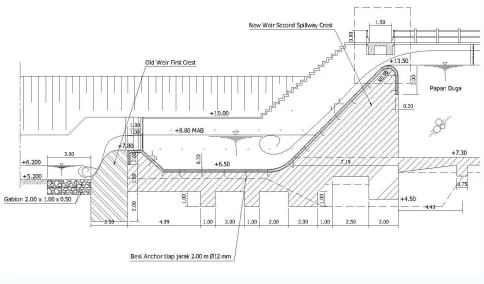
The used of double-crested weir is applied for the spillway at Pakembinangun small-dam, at Pelang River, Yogyakarta. The storage is located upstream from an existing weir. The spillway structure is designed just upstream from the old (existing) weir, formed double-crested weir. The upstream crest is the new-spill-way, and the rear crest is the old weir, as shown in Figure 2. By using this type of double crests, the presence of the old weir is maintained, and the developed scour hole behind the structure is only a function of the rear crest, not depend on the high energy of the new spillway. Consequently, the scour hole depth behind the old weir after construction of the new spillway, will not increased and the structure will be saved from damage due to local scour.
SCOUR FORMULAS
Figure 1. Cascade Weir at Gadjah Wong River, Yogyakarta (The right picture was documented on 11 April 2010)
Figure 2. Design of New Spillway just Upstream from the Old Weir, formed double-Crested Weir
Table 1. Formulas for predicting Scour Depth behind the Weir
No
Formula Equation Explanation
1 Demle and Khatsuaria ds = A (q ho)0.5 – h2
Demle: A = 0.65 Khatsuaria: A = 0.9
2 Mason (1989) 0.3 0.06
16 . 0 2 3 . 0 6 . 0
(
1
)
39
.
3
m s
d
g
h
q
3 Veronese (1976) ds = Kr q0.54 h20.225 Kr = 0.25 – 2.5
4 Chatakii ds = k hon1.qn2.d90n3 – h2
k = 1.6 ; n1= 0.2 ;
n2 = 0.6 ; n3 = -0.1
5 Vendijh ds = 2.4 hkr + 0.4 dm ds = scour depth (m)
q = unit discharge (m2/dt) ho = flow depth upstream (m)
h2 = tail water depth (m)
d90= grain size diameter (mm) 6
Hacker&Hsu (1984)
ds +h2= 1.5 q0.509∆H0.265 450.05 dm-0.15
7 USBR (1973) d
s +h2= 1.32 q0.54∆Η0.225
RESEARCH METHOD
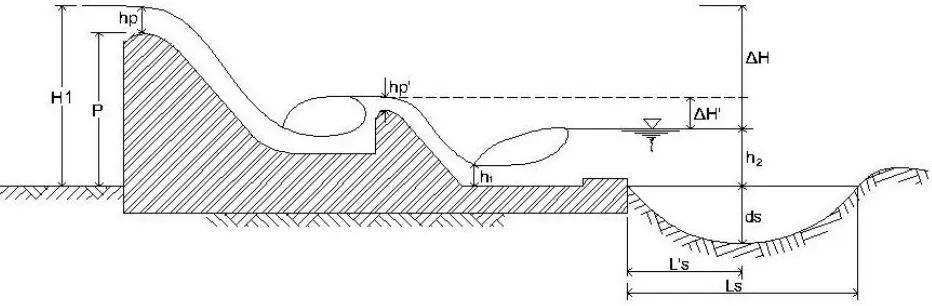
Data of local scour downstream from two types of weir are used to study scour characteristic for single and double crested weir. The data were collected from some experiments conducted at Hydraulic Laboratory, Gadjah Mada University. Experiments were done using recirculation tilting flume, with 6 m long and 0.075 m width. Figure 3 schematize flow structures through the double-crested weir and developed scour hole behind the weir. Scour depth, ds, length of scour hole, Ls and the position of maxi-mum scour depth behind the weir, L’s, were measured by using point gauge, and the characteristic of scour hole were discussed.
The experiment data of local scour depth behind the weir are compared with the ones predicted by empirical formulas for sing-le crest weir (Tabsing-le 1).
DATA ANALIZED AND DISCUSSION
Figures 4 show schemes of flow for two cases of developed flow structure behind the weir, consist of free and submerged hydraulic jump. The first picture shows the hydraulic jumps de-veloped behind both the front and the rear crests of the weir. If flow depth at tail water is sufficiently high, the hydraulic jump behind the rear crest is submerged, as presented in the second picture.
Figure 3. Flow Structure and Developed Scour Hole behind Double-Crested Weir
Figure 4. Free and submerged hydraulic jump behind the weir
Interaction between Scour depth and time
The process of local scour behind the hydraulic structure is time dependent. It is often represented in graphical form by plott-ing the maximum scour depth against the time, as shown in Figu-res 5, given the local scour downstream of the weir normalized by depth of weir, ds/P, as a function of time, for variation of dis-sipated energy (∆H). Scour depth was measured until equilibrium was reached. The process of local scour behind a weir is
relative-ly rapid in the initial minutes, and then continues to increase gra-dually reached an equilibrium depth.
second pictures of Figures 5). The scour depth behind double-crested weir reached 43 % to the scour depth behind the weir with single crest. Figure 5c presents scour depth as a function of time for ∆H/P= 0.76 (submerged hydraulic jump behind the rear crest), shown results for both types are not significantly different. With rising of the tail water influences to less function of the rear crest to dissipate the energy, consequently the developed scour hole is similar with the one of weir with single crest.
Figure 5a. Scour Depth vs. Time for ∆H/P=1.0 (Novirwan, 2002)
Figure 5b. Scour Depth vs. Time for ∆H/P=0.82 (Novirwan, 2002)
Figure 5c. Scour Depth vs. Time for ∆H /P=0.76 (Novirwan, 2002)
Interaction between Flow Discharge and Size of Scour Hole
Three parameters are measured and discussed; they are ur depth, length of scour hole, and the position of maximum sco-ur depth. These are discussed as the following.
a. Scour Depth
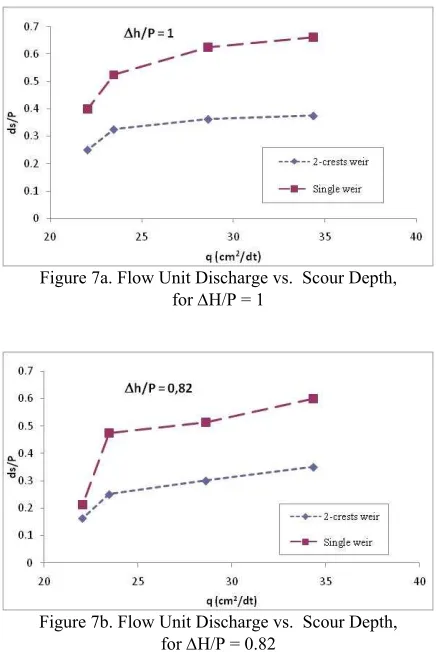
Figure 6 presents influences of flow discharge with deve-lopped scour depth behind weir structure. It gives relation bet-ween scour depth, normalized by the weir height, and the unit flow discharge, for two types of weir with single and double-crested. For both types of the weir, and for all values of dissipate-ed energy, an increase of flow discharge produces deeper scour depth behind the weir. Scour depth behind double-crested weir are shallower significantly compared to the one for single-crested weir, except for ∆H/P =0.76 with high discharge (see Figures 7). This exception is due to the occurrence of submerged hydraulic jump behind the rear crest of the weir. The submerged hydraulic jump is formed if the tail water is higher than the conjugate depth of the hydraulic jump, consequently it pushes the hydraulic jump to the upstream direction. The submerged hydraulic jump effect less function of the rear crest to dissipate energy.
Figure 6. Scour depths as a function of Unit Discharge
Figure 7a. Flow Unit Discharge vs. Scour Depth, for ∆H/P = 1
Figure 7c. Flow Unit Discharge vs. Scour Depth, for ∆H/P = 0.76
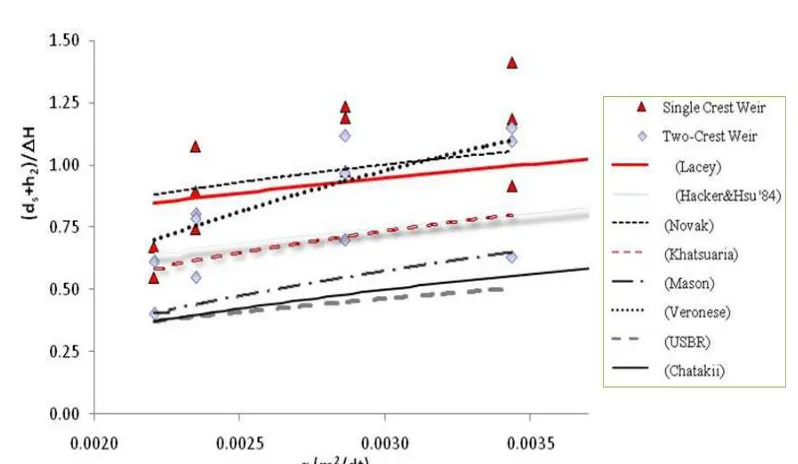
Figure 8 presents maximum scour depth from the water surface,
ds+h2, developed behind both types of the weir, normalized by
H, as a function of unit discharge, shown an increasing of scour depth as higher unit discharge. As mention in above, scour depth behind double-crested weir develops lower value compared with the single crested weir. In that figure, some formulas of local sco-ur depth proposed by some researcher for single-crested weir are also plotted. It is shown that scour depth data collected from ex-periments done at Hydraulic Laboratory, Gadjah Mada Universi-ty, are quietly comparable with the scour depth predicted by the existing formulas.
Figure 8. Comparison data with Existing Formulas
b. Positions of Maximum Scour Depth
Figure 9 presents position of maximum scour depth in the scour hole behind the weir, L’s. The position of maximum scour depth, normalized by the head loss ( H), is further with increas-ing the unit discharge. The position of maximum scour depth for weir with double-crested is closer to the endsill, compared to the one for single-crested.
Figure 9. Position of the Maximum Scour Depth
c. Length of Scour Hole
Figure 10 describes the length of scour hole behind the we-ir, as a function of the unit discharge. It is shown an increase of the length of the scour hole for higher unit discharge. The length of scour hole for weir with double-crested is about one half from the one of single-crested.
Figure 10. Length of Scour Hole
crests develops smaller size of scour hole behind the hydraulic structure.
Interaction between Dissipated Energy and Size of Scour Hole
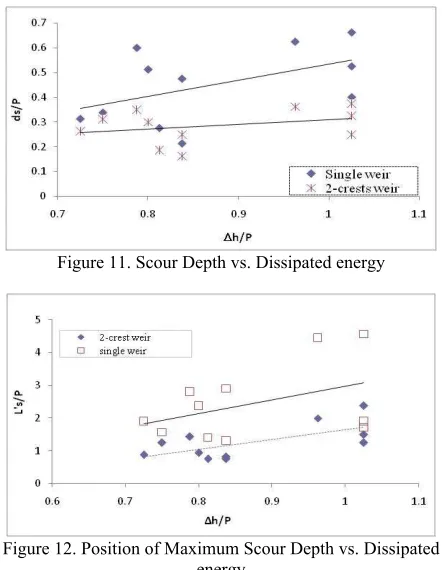
The amount of energy released by the weir, interpreted by different elevation between upstream and downstream of the we-ir, have considerable effect on scour hole development behind the weir. These are presented in Figures 11 - 13. It can be seen from these graphs the relationship of dissipated energy with three para-meters of scour hole, namely scour depth, length of scour hole and the position of maximum scour depth measured from the endsill. On variations of high water on the upstream and down-stream of these turned out to provide significant changes of these three parameters of scour hole. As mention above, the weir is functioned to dissipate energy. The energy released by the weir induces scour behind the weir, consequently structure stability may decreased.
Figure 11. Scour Depth vs. Dissipated energy
Figure 12. Position of Maximum Scour Depth vs. Dissipated energy
Figure 13. Length of Scour Hole vs. Dissipated energy
CONCLUDING REMARKS
Study of Local Scour behind single and double-crested weir is done. The following are remarked:
• The process of local scour behind the weir is time depen-dent. The scour depth increase rapidly in the initial minutes, then continue to increase gradually reached an equilibrium depth
• Scour data behind two types of weir is analyzed. It is pre-sented that when all crests of weir produce free hydraulic jump, a less scour hole behind the structure was occurred, compared with the one for scour behind single-crested weir.
• The scour depth behind double-crested weir reached 43 % to the scour depth behind the weir with single crest.
• When submerged hydraulic jump developed behind the we-ir, shown results for both types are not significantly di-fferent. With rising of the tail water influences to less func-tion of the rear crest to dissipate the energy, consequently the developed scour hole is similar with the one of weir with single crest.
• For both types of the weir, and for all values of dissipated e-nergy, an increase of flow discharge produces larger of de-veloped scour hole behind the weir.
• With increasing the dissipated energy produce larger scour hole behind the weir, for both types of the weir.
ACKNOWLEDGEMENT
The author acknowledges the contribution from Novirwan, Mirza, and Jimmy Charles for their collected measurements data.
REFFERENCES
Novirwan. (2002). “Experimental study of scour downstream of a weir.” Final Project Rep., Civil and Environmental Engineer-ing Department, Faculty of EngineerEngineer-ing, Gadjah Mada Uni-versity, Yogyakarta (in Indonesia).
Provorova, T. P. (1999). Hydrotechnical Construction. Kluwer Academic Publisher.
Peterka, A. J. (1974). Hydraulics Design of Stilling Basin and Energy Dissipators. United States Department of Interior, Bureau of Reclamation, Denver, Colorado.
USBR. (1973). Design of Small Dams. Second Edition, United States Government Printing Office, Washington DC.