Proceedings of The 7th ACSA Conference 2011 387
Deforestation rate in Indonesia is 1,8 million ha per year. This is due to low productivity of natural forest which is just 0,25 m3 ha-1 year-1 (compared with teak plantation forest: 8-10 m3 ha-1 year-1). Decrease in natural
regeneration and forest plantation were caused by stand competition and limited of light in the forest floor. Efforts to improve production-natural forest productivity was by applying the Selective Cutting and Strip Planting (SCSP) system. This system made optimum open area (strip) which is suitable to maximize the growth of Dipterocarp species, especially Shorea spp as the most commercial trees in the natural tropical forest. This research aimed to analyze and created modeling of growth and yield of Shorea leprosula plantation in the SCSP system. The research was conducted on research plots of SCS in logged over – production natural forest of PT Gunung Meranti forest concession, Central Kalimantan Province. Analysis of data used growth modeling for even-aged forest. The result showed that mean annual increment of Shorea leprosula plantation at 2, 11 and 16 year olds were 1,06 cm year-1; 1,22 cm year-1 and 1,31 cm year-1 in diameters, respectively. Based on
even-aged forest modeling, the first cycles of Shorea leprosula plantations was 32 year in the 125,14 m3 ha-1 of logs (40 cm up of diameters), therefore Shorea leprosula plantations in the SCSP system could improve the natural forest productivity until 262,72 times. The SCSP system with Shorea leprosula plants is very applicable in the logged over-production natural forest to improve forest productivity.
Keyword: Selective cutting and strip planting system, Shorea leprosula, growth and yield, productivity
Introduction
Indonesia is third in the world after Brazil and Zaire in wide of tropical forest regions and has the highest biodiversity too (Whitmore, 1975; Mac Kinnon, et al., 2000). However, the condition of natural forest resources in Indonesia tends to face degradation in the quality and quantity along with environmental changes nationally and also globally (Ministry of Forestry, 2008). Deforestation and degraded forest in Indonesia are caused by increasing of resident and wood requirement (Singh, et al. 1995) illegal logging, shifting cultivation, illegal mining, illegal occupation of land, forest fire (Indrawan, 2008) conversion of forest (Saharjo, 2008), and poor forest management (Wahjono and Anwar, 2008).
388 Proceedings of The 7th ACSA Conference 2011
Based on the forest function, forests in Indonesia are divided into three regions i.e. conservation forest, protection forest and production forest. Production forest can be divided into some forest regions, in the form of virgin forest, logged over forest, low potential forest, bushes-scrub, grassland and critical land. Logged over forest and low potential forest can be managed by Selected Cutting and Strips Planting silvicultural system using Shorea spp, especially Shorea leprosula.
This Research aimed to compile growth and yield modeling of Shorea leprosula that is developed in the strips area. Research was expected to be used by stakeholders, specially for user of SCSP system.
Methods
Research was conducted in the Permanent Sample Plots of Selective Cutting and Strips Planting in the District of Mandau Talawang, Central Kalimantan Province that was planted in 2008 (age of 2 years), 1999 (age of 11 years), and 1994 (age of 16 years). Data were collected in 2010.
Measured parameters were diameters and high of Shorea leprosula at the aged 2 years, 11 years, and 16 years. Growth and yield of Shorea leprosula pattern was formed according to to the increment and time (years) functions through polynomial equation (Brown, 1997; Burkhart, 2003) that was:
y = c1 + c2x + c3x2
Where: y : diameter (average) x : time (years) c1,c2,c3 : coefficient
Results and Discussion
The research results of Shorea leprosula plantation in the Permanent Sample Plots of Selective Cutting and Strips Planting that is planted in 2008 (age of 2 years), 1999 (age of 11 years), and 1994 (age of 16 years) which were collected in 2010 were shown in Table 1.
Table 1. Mean annual increment of Shorea leprosula in the PSP of SCSP at 2, 11, and 16 years old
Age (year) Live (%) MAI
Diameter (cm) High (m)
0 100 0 0
2 84.22 1.06 1.40
11 61.87 1.22 0.94
16 61.21 1.31 0.82
Table 1 showed that diameter mean annual increment (MAI) of Shorea leprosula since the first time until 16 years old was always inreasing. MAI of Shorea leprosula was 1,36 cm/year at 16 years old with 61,21% of live. At the 16 years old, diameter and high of Shorea leprosula plants were 21,22 cm and 13,1 m respectively. Growth and yield of Shorea leprosula was always increasing until it achieved 30 to 40 cm in diameters (Wahyudi et.al. 2011).
Proceedings of The 7th ACSA Conference 2011 389
Growth of plants can be assumed from time function. Diameter of plants will be getting bigger progressively, but periodically growth must be mentioned in the model, so it needs the time series of data to create modeling of growth and yield. Therefore, sigmoid curve to draw the growth of yield of Shorea leprosula also needed the time series data. Modeling must accommodate all information about species, environment, tending, increment and so on, which was made available and trustworthy of growht and yield to create the justified modeling (Grant et al. 1997; Porte & Bartelink 2001; Vanclay 2001). Modeling can simplify the complicated calculation composed of several equations at the same time with some simulation expected.
A B C
Figure 1. Shorea leprosula plantation in the Selective Cutting and Strips Planting system at 2 years old (A), 11 years old (B) and 16 years old (C).
Modeling using polynomial equation based on increment of Shorea leprosula and time functions (Brown 1997; Burkhart 2003) is as the following:
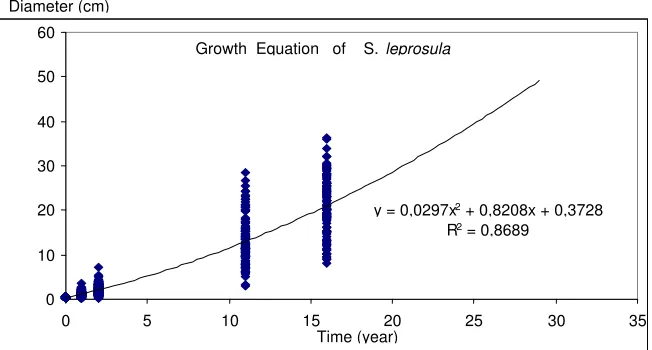
Y =0,0297x2 + 0,8208x + 0,3728 ... R2= 86,89%
y : final diameter ; x : time (year) .
This model predicted that to achieve 50 cm up of diameter average, the time needed was 32 years as shown in Figure 2. Correlation coefficient of this equations was 86,89%, accordingly, it indicated that this equation can be used to predict growth and yield of Shorea leprosula plantation on the Selective Cutting and Strips Planting system.
Figure 2. Growth and yield of Shorea leprosula plantation using modeling of polynomial equation. Growth Equation of S. leprosula
y = 0,0297x2 + 0,8208x + 0,3728
R2 = 0,8689
0 10 20 30 40 50 60
0 5 10 15 20 25 30 35
390 Proceedings of The 7th ACSA Conference 2011
Mean production of logs in PT Gunung Meranti (forest concession ) for 4 years (2007 to 2010) was 22,3 m3 ha-1 of logs. Whereas, based on even-aged forest modeling, the first cycles of Shorea leprosula plantations for 32 years, the production was 125,14 m3 ha-1 of logs (40 cm up of diameters), therefore Shorea leprosula plantations in the SCSP system could improve the natural forest productivity until 262,72 times. The SCSP system of Shorea leprosula is very applicable in the logged over-production natural forest to improve forest productivity. So, Shorea leprosula is most commercial trees to improve ―Production ζatural Forest‖ productivity in the tropical forest.
Conclusion
Shorea leprosula plantation in the Selective Cutting and Strips Planting silvicultural system can improve Production Natural Forest productivity in the tropical forest with applying the cutting cycles as long as 32 years and predicted to produce 125,14 m3 ha-1 of logs.
References
Brown S. 1997. Estimating biomass change of tropical forest a primer. FAO Forestry Paper No.134. FAO USA. Burkhart HE. 2003. Suggestion for choosing an appropriate level for modelling forest stand. In Amaro A, Reed
D, Soares P, editors. Modelling Forest System. CABI Publishing.
Coates KD, Philip JB. 1997. A gap-based approach for development of silvicultural system to address ecosystem management objectives. Journal Forest Ecology and Management 99 (1997) 337-35. Finkeldey R. 1989. An Introduction to Tropical Forest Genetic. Institute of Forest Genetics and Forest Tree
Breeding, Goettingen, Germany.
Fyllas NM, Politi PI, Galanidis A, Dimitrakopoulo PG, Arianoutsou M. 2010. Simulating regeneration and vegetation dynamics in Mediterranean Coniferous Forest. Ecology Modelling Journal. 34.
Gadow KV, Hui G. 1999. Modelling Forest Development. Kluwer Academic Publishers.
Grant WE, Pedersen EK, Marin SL. 1997. Ecology and Natural Resource Management. Systems Analysis and Simulation. John Wiley & Sons, Inc.
Kozlowski TT, Pallardy SG. 1997. Physiology of Woody Plants. Academic Press.
Porte A, Bartelink HH. 2001. Modelling mixed forest growth: a review of models for forest management. Eco. Model. Journal.
Radonsa PJ, Koprivica MJ, Lavadinovic VS. 2003. Modelling current annual height increment of young Douglas-fir stands at different site. In Amaro A, Reed D, Soares P, editors. Modelling Forest System. CABI Publishing.
Rodriguez F, De La Rosa JA, Aunos A. 2003. Modelling the diameter at breast height growht of Populus euramericana plantation timber in Spain. In Amaro A, Reed D, Soares P, editors. Modelling Forest System. CABI Publishing.
Vanclay JK. 2001. Modelling Forest Growth and Yield. Applications to Mixed Tropical Forest. CABI Publishing. Wahyudi. 2009. Selective cutting and line enrichment planting silvicultural system development on Indonesian
tropical rain forest. In: GAFORN-International Summer School, Geor-August Universität Göttingen and Universität Dresden, Germany.
Wahyudi, Indrawan, Mansur, and Pamoengkas. 2011. Growth and Yield of Plantation and Residual Trees in the Intensified Indonesian Selective Cutting and Strips Planting System. Case Study on Kapuas District, Central Kalimantan Province. Post-Graduate Program – Bogor Agricultural University, Bogor.