ISSN: 1992-8645 www.jatit.org E-ISSN: 1817-3195
APPLICATION OF GREEN ENERGY FOR BATIK
PRODUCTION PROCESS
RAMADONI SYAHPUTRA1, INDAH SOESANTI2
1
Department of Electrical Engineering, Faculty of Engineering,
Universitas Muhammadiyah Yogyakarta, Yogyakarta, INDONESIA
E-mail: [email protected]
2
Department of Electrical Engineering and Information Technology, Faculty of Engineering,
Universitas Gadjah Mada, Yogyakarta, INDONESIA
E-mail: [email protected]; [email protected]
ABSTRACT
Batik is a piece of cloth applied by means of a dye-resist technique using "batik-wax" as the resisting medium. Batik has been named as the cultural heritage of Indonesia, which has been recognized by the world. As generally in Indonesia, batik industry is currently still a class of small and medium enterprises (SMEs). One of the quite popular in Indonesia is Yogyakarta batik. There are some Batik SMEs in Yogyakarta. The issue of the SMEs is that the production process is still using kerosene stoves, while the price of kerosene is very expensive. In addition, the use of kerosene means using fossil fuels that produce environmental pollution. Therefore, in this paper described the application of environmentally friendly green energy sources for the production process of batik. The energy source is the installation of solar home system. The system is used to distribute electrical power to the batik electric stove. The use of solar home system and batik electric stoves is more practical and economical than kerosene stove. Another advantage is to reduce dependence on fossil fuels and help preserve the environment with the use of green technology. Applications of green technology in Yogyakarta Batik SMEs help continuity of batik production. This is in accordance with the needs of both SMEs who have often experienced a power outage that disrupts batik production process, especially if using an electric stove for batik. Solar home systems installation and procurement of electric stoves for batik has managed to increase both production capacity and gross profit of the SMEs.
Keywords: Green Energy, Solar Home Systems, Smes Batik, Batik Electric Stove, Community Development.
1. INTRODUCTION
The use of renewable energy and energy efficiency, which is a part of the green energy technologies, is very important to reduce global warming and protect the ecosystem. Green technology will be able to reduce carbon emissions [1]-[6]. Green energy technologies by utilizing alternative energy sources such as wind, solar,
hydroelectric, and others reduce CO2 emissions by
improving energy efficiency [7]-[10]. Climate change is now occurring due to uncontrolled carbon emissions that affect the world economy. Because of temperature increases, agricultural products will fall, damage from floods and storms will increase, tropical diseases will become more common and
access to water will become more of a problem for more and more people. Costs incurred for our environment is greater and the loss could not be changed. Earth's flora and fauna will suffer both directly from the higher temperatures and indirectly through the destruction of their habitat. Even a small increase in temperature will lead to coral bleaching and threatening some amphibians. Temperature rises of 3°C or 4°C and more will lead to major extinctions around the globe [11]-[13].
ISSN: 1992-8645 www.jatit.org E-ISSN: 1817-3195 power grid. Technology costs have fallen
substantially over the last 30 years [14]-[17]. The rapid expansion of the solar energy market is the result of government policies that support
instruments, increased price volatility and
environmental externalities of fossil fuels,
especially greenhouse gas emissions.
Basically the solar energy resource potential that far exceed the entire global energy demand [18]-[19]. Although the technical potential is very large and the recent growth of the market, the contribution of solar energy for the global energy supply mix is still negligible. Numerous studies, have been discussing various issues related to solar energy [20]-[24]. The study provides an overview of the synthesis of existing literature and presents an economic analysis to look at the competitiveness of solar energy compared with fossil energy [25]-[26]. Although the presence of the clean development mechanism of the Kyoto Protocol has been contributed to assist the implementation of several projects of solar energy, its role in promoting solar energy is very small compared to that of other renewable energy technologies as cost competitiveness [27]-[28]. An existing study has shown that the share of solar energy in the world energy supply mix could exceed 10% in 2050 [29]-[34]. This share would still be a small part of the total world energy supply. This share is also a small fraction of renewable supply.
In this study, application of green energy and eco-friendly batik production process is described. The green energy is the use of solar home system in batik industry for processing of batik production. The solar home system is used to supply the electric batik stove for batik processing. In this work, the testing of electric batik stove as a burden of solar home system is done. Also, the analysis of loading of solar home system is described, whether the
Batik is a fabric sheet made by drawing designs on fabric using dots and lines of hot wax. This wax is used to reject dye by soaking a cloth in one color. Once the color is applied, the wax is removed using boiling water and repeat if some of the desired color. Batik has been known to the world community that comes from Java [35]. Custom pattern often have a symbolic meaning that is used
in certain ceremonies, while the coastal pattern draws inspiration from various cultures. Batik has been used as everyday clothing since ancient times, and is still used and very loved by many Indonesian people today in events ranging from formal to casual. In October 2009, UNESCO has set Indonesian batik as a Masterpiece of the Oral and Intangible Heritage of Man. As part of the recognition, UNESCO asserted that Indonesia preserve their cultural heritage [36].
In this study, to test the application of solar home systems are burdened with an electric stove in two SMEs batik industries. The existing conditions of the two SMEs are described as follows:
1) The Batik SMEs capable of producing batik from 200 to 400 pieces of batik cloth per month. Low productivity in the SMEs is not on the ability of the human resources and the difficulty of obtaining raw materials and wax batik cloth, but rather:
a. A number of constraints in producing batik is because only rely on kerosene stoves and firewood and even use
coconut fiber burnt. Since the
government of Indonesia has
implemented a program for kerosene to gas in 2008, then one of the sectors that are directly affected by the program is batik industry. In Yogyakarta, kerosene prices trending up from time to time (i.e. current prices in April 2015 reached Rp 11,000 per litre), and often there is a shortage of kerosene.
ISSN: 1992-8645 www.jatit.org E-ISSN: 1817-3195 2) Both SMEs uses electrical energy derived
from the PLN. The SMEs subscription with a power capacity of 450 VA and Batik Arjo Munir subscription with the same power capacity. However, during the frequent power outages that at times can not be estimated, in the rain and sunny weather at the time either day or night. This situation will be very difficult if they want to use an electric stove in the process of batik production.
3. METHODOLOGY
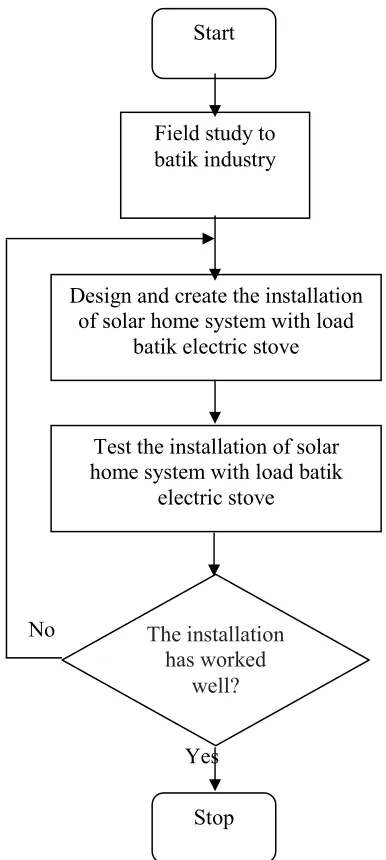
The problem-solving step in the batik industry in this research is shown in Fig. 1.
Fig. 1. The Problem-Solving Steps In The Batik Industry In This Research
In order to increase production capacity, market expansion, and capacity building activities in The Yogyakarta Batik SMEs, then in the programs carried out the following activities:
1) Batik production capacity of the SMEs can be improved:
a. Provide an electric stove specifically for batik SMEs.
b. Provide and install solar cell home systems to ensure continuity of the flow of electrical power to distribute electrical power to the stove and also home lighting batik production. Provision the solar cell home system is also useful to overcome the problems in both SMEs because it has a low power capacity installed and frequent power outages, while each
SMEs will use electrical power
continuously for 2 pieces of 125 watts electric stoves.
2) Improving human resource capacity in the respective SMEs.
4. TEST RESULTS
The geographical condition of Indonesia which is located in the tropical region is traversed equator particular gift for the people of Indonesia if it is associated with potential sources of electrical energy derived from sunlight [6]. On the bright
midday sun radiation is able to reach 1000 Watt/m2.
If a semiconductor device with area of 1m2 has an efficiency of 10 % then the solar cell module is capable of delivering 100 watts of power [7]. Currently commercial module efficiency solar cells ranged from 5 to 15% depending on the constituent materials [8]. On a national scale, the government of Indonesia has a serious program in renewable energy, one of which is the solar energy [8]-[9]. The government of Indonesia has targeted that power generator from renewable energy resources will be on-grid for up to 5% by the year 2025 [5].
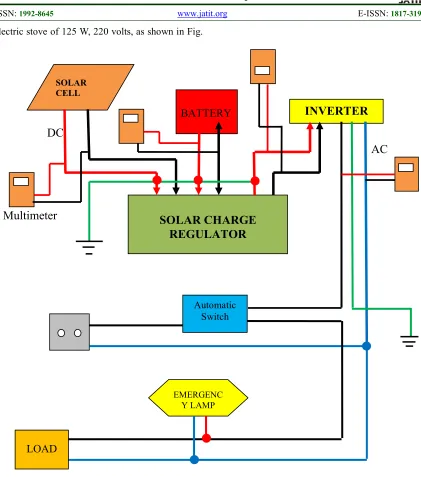
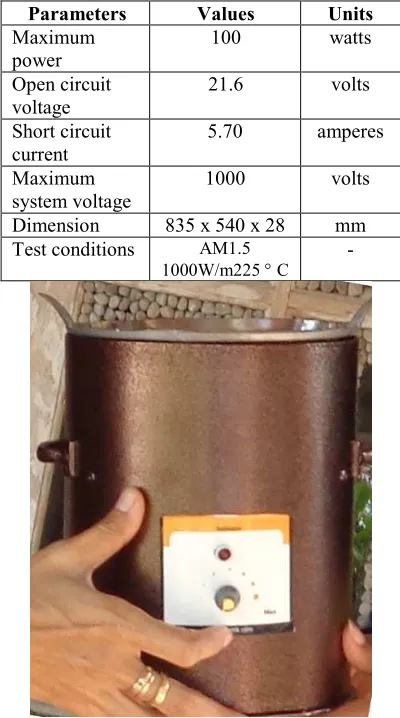
In this work, the create-design of solar home system with loading of batik electric stove is done. The scheme of solar home system in this work is shown in Fig. 2. Solar cell home systems installation for each SME to ensure the availability of electric current for batik electric stove and lighting the batik production houses. The power capacity of solar cell in the installation is 100 Wp. The technical specifications of 100 Wp solar cell panel for batik industry has described in Table 1. The main burden of solar home systems is batik
Start
Field study to
batik industry
Design and create the installation
of solar home system with load
batik electric stove
Test the installation of solar
home system with load batik
electric stove
The installation
has worked
well?
ISSN: 1992-8645 www.jatit.org E-ISSN: 1817-3195 electric stove of 125 W, 220 volts, as shown in Fig.
3
Fig. 2. The Scheme Of Solar Home System In Our Work
The main function of solar home systems are the electrical power supply to the load on the batik electric stove with a power capacity of 125 watts each burner. Production of electric energy solar home systems is highly dependent on sunlight. In one day, the most effective sunlight to generate electrical energy in just over 5 hours, as shown in Fig. 4.
Solar insulation (Fig. 4) can be determined as follows:
1) Insulation sunlight can be estimated from that of predicted weather conditions.
2) Weather forecast data in the form of long sun emits rays can be obtained from meteorological and geophysics agency.
3) The length of time the sun radiates its light is converted into the peak sun hours
INVERTER
BATTERY
SOLARCELL
SOLAR CHARGE
REGULATOR
Automatic Switch
LOAD
EMERGENC Y LAMP
Multimeter
DC
ISSN: 1992-8645 www.jatit.org E-ISSN: 1817-3195
Table 1. Technical Specifications Of 100 Wp Solar Cell Panel For Batik Industry
Parameters Values Units
Maximum power
100 watts
Open circuit voltage
21.6 volts
Short circuit current
5.70 amperes
Maximum system voltage
1000 volts
Dimension 835 x 540 x 28 mm
Test conditions AM1.5
1000W/m225 ° C -
Fig. 3. Batik Electric Stove Of 125 W, 220 Volts
Fig. 4. Daily Solar Insulation Characteristics [2]
Testing of solar home systems with a single load electric stove for batik described as shown in Table 2 and Table 3.
Table 2. Technical Specifications Of Solar Home System Load
Parameters Values Units
Maximum power
125 watts
Nominal voltage 220 volts
Nominal current 0.60 amperes
Frequency 50 Hz
Load type : Electric stove for batik Place of Testing : Yogyakarta batik SMEs
After the sunlit solar cells for 5 hours, then the solar cells can be used with a load power of 125 watts for 2 hours, which is described in Table 3.
Table 3. Test Results Of Solar Home System Installation.
Parameters Values Units
Maximum power 100 watts
Nominal voltage 220 volts
Maximum drying time
5 hours
Frequency 50 Hz
Energy produced 100 x 5 = 500
watt-hours
Long duration usage load
500/125 = 4 hours
ISSN: 1992-8645 www.jatit.org E-ISSN: 1817-3195 (a)
(b)
Fig. 5. (A) Solar Cell Output Voltage, (B) Solar Cell Output Currents.
Fig. 5(a) and Fig. 5(b) show the output voltages and the output currents of solar cell under study, respectively. Testing of the solar cell with loading of 125 W batik electric stove is start from 7.00 AM to 17.00 PM. As shown in Fig. 5(a) that output voltage of solar cell has varied from 14.45 volts to 19.88 volts. Magnitude of the voltage dependent on sunlight, where the maximum voltage occurs at 12.00 AM and the minimum voltage occurs at 7.00 PM.
Thus, applications of solar home systems in Yogyakarta Batik SMEs help continuity of batik production. This is in accordance with the needs of both SMEs who have often experienced a power outage that disrupts batik production process, especially if using an electric stove for batik.
In this research, application of green technology in the production process of batik. The green technology is a solar home system. The novelty of this research is the application of green technology specific to the batik industry, where solar home systems used to distribute electrical power to the load of the batik electric stove. The author's knowledge there is no article that discusses this issue.
The impact and benefits have been felt through service activities are:
1) Batik production capacity of Yogyakarta Batik SMEs has increased with the following details: The Yogyakarta Batik SMEs, if prior to the work only capable of producing combination stamp and write batik and pure batik with a total capacity of approximately 200 pieces of cloth batik per month, then after our activity is able to increase its production up to 250 pieces of cloth batik per month. The increase in productivity
has been accompanied by an increase in gross profit of an average SME Rp 5 million per month to an average of Rp 6 million per month.
2) Expansion of each SME market has increased. Both SME market has dared not only to supply the batik cloth batik shops around Malioboro street and Beringharjo mart, Yogyakarta, but also through exhibitions in several cities such as Jakarta and Bandung are often sponsored by the Department of Industry and Local Government of Yogakarta.
3) Human resources capacity in each SME has increased in quality, mastery of which operating and maintenance of solar home systems installation and electric stoves for batik.
5. CONCLUSION
This work has proved to be very beneficial for Yogyakarta Batik SMEs. Applications of solar home systems in Yogyakarta Batik SMEs help continuity of batik production. This is in accordance with the needs of both SMEs who have often experienced a power outage that disrupts batik production process, especially if using an electric stove for batik. Solar home systems installation and procurement of electric stoves for batik has managed to increase both production capacity and gross profit of the SMEs. In a period of ten months the Yogyakarta Batik SMEs productivity increased from an average of 200 pieces of batik cloth to an average of 250 pieces per month. The increase in productivity has been accompanied by an increase in gross profit of the SMEs.
ACKNOWLEDGEMENTS
The authors gratefully acknowledge the
contributions of The Ministry of Research, Technology and High Education, Republic of Indonesia, for funding this research.
REFRENCES:
[1] Syahputra, R., (2012), “Fuzzy Multi-Objective
ISSN: 1992-8645 www.jatit.org E-ISSN: 1817-3195
[2] Syahputra, R., (2012), “Distributed Generation:
State of the Arts dalam Penyediaan Energi Listrik”, LP3M UMY, Yogyakarta, 2012.
[3] Syahputra, R., Robandi, I., Ashari, M. (2014).
“Optimal Distribution Network
Reconfiguration with Penetration of
Distributed Energy Resources”, Proceeding of
2014 1st International Conference on
Information Technology, Computer, and
Electrical Engineering (ICITACEE) 2014, UNDIP Semarang, pp. 388 - 393.
[4] Soedibyo, Ashari, M., Syahputra, R. (2014),
Power loss reduction strategy of distribution network with distributed generator integration. 1st International Conference on Information
Technology, Computer, and Electrical
Engineering (ICITACEE) 2014, UNDIP
Semarang, pp. 404 – 408.
[5] Syahputra, R., Robandi, I., Ashari, M. (2014).
Optimization of Distribution Network
Configuration with Integration of Distributed Energy Resources Using Extended Fuzzy Multi-objective Method. International Review of Electrical Engineering (IREE), 9(3), pp. 629-639.
[6] Syahputra, R., Soesanti, I., Ashari, M. (2016).
Performance Enhancement of Distribution Network with DG Integration Using Modified PSO Algorithm. Journal of Electrical Systems (JES), 12(1), pp. 1-19.
[7] Syahputra, R. (2016). Application of
Neuro-Fuzzy Method for Prediction of Vehicle Fuel Consumption. Journal of Theoretical and Applied Information Technology (JATIT), 86(1), pp. 138-149.
[8] Syahputra, R., Robandi, I., Ashari, M. (2015).
Performance Improvement of Radial
Distribution Network with Distributed
Generation Integration Using Extended Particle Swarm Optimization Algorithm. International Review of Electrical Engineering (IREE), 10(2). pp. 293-304.
[9] Syahputra, R., Robandi, I., Ashari, M., (2012),
“Reconfiguration of Distribution Network with DG Using Fuzzy Multi-objective Method”,
International Conference on Innovation,
Management and Technology Research
(ICIMTR), May 21-22, 2012, Melacca, Malaysia.
[10] Syahputra, R., Robandi, I., Ashari, M., (2011),
“Modeling and Simulation of Wind Energy Conversion System in Distributed Generation Units”. International Seminar on Applied
Technology, Science and Arts (APTECS). 2011; pp. 290-296.
[11] Syahputra, R., Robandi, I., Ashari, M., (2011),
“Control of Doubly-Fed Induction Generator in Distributed Generation Units Using Adaptive
Neuro-Fuzzy Approach”. International
Seminar on Applied Technology, Science and Arts (APTECS). 2011; pp. 493-501.
[12] Jamal, A., Syahputra, R., (2011), “Design of
Power System Stabilizer Based on Adaptive Neuro-Fuzzy Method”. International Seminar on Applied Technology, Science and Arts (APTECS). 2011; pp. 14-21.
[13] Syahputra, R., (2016), “Transmisi dan
Distribusi Tenaga Listrik”, LP3M UMY, Yogyakarta, 2016.
[14] Jamal, A., Syahputra, R. (2012), “Adaptive
Neuro-Fuzzy Approach for the Power System Stabilizer Model in Multi-machine Power System”, International Journal of Electrical & Computer Sciences (IJECS), Vol. 12, No. 2, 2012.
[15] Syahputra, R., Robandi, I., Ashari, M. (2014).
Performance Analysis of Wind Turbine as a Distributed Generation Unit in Distribution System. International Journal of Computer Science & Information Technology (IJCSIT), Vol. 6, No. 3, pp. 39-56.
[16] Syahputra, R., Robandi, I., Ashari, M., (2014),
“Distribution Network Efficiency Improvement Based on Fuzzy Multi-objective Method”. IPTEK Journal of Proceedings Series. 2014; 1(1): pp. 224-229.
[17] Jamal, A., Suripto, S., Syahputra, R. (2015).
Multi-Band Power System Stabilizer Model for Power Flow Optimization in Order to Improve Power System Stability. Journal of Theoretical and Applied Information Technology, 80(1), pp. 116-123.
[18] Syahputra, R., Robandi, I., Ashari, M. (2015).
Reconfiguration of Distribution Network with DER Integration Using PSO Algorithm. TELKOMNIKA, 13(3). pp. 759-766.
[19] Syahputra, R., (2015), “Teknologi dan Aplikasi
Elektromagnetik”, LP3M UMY, Yogyakarta, 2016.
[20] Utomo, A.T., Syahputra, R., Iswanto, (2011),
“Implementasi Mikrokontroller Sebagai
Pengukur Suhu Delapan Ruangan”, Jurnal Teknologi, 4(2).
[21] Syahputra, R., Robandi, I., Ashari, M., (2013),
ISSN: 1992-8645 www.jatit.org E-ISSN: 1817-3195 International Seminar on Applied Technology,
Science and Arts (APTECS). 2013; pp. 224-229.
[22] Riyadi, S., Azra, R.A., Syahputra, R., Hariadi,
T.K., (2014), “Deteksi Retak Permukaan Jalan Raya Berbasis Pengolahan Citra dengan
Menggunakan Kombinasi Teknik
Thresholding, Median Filter dan
Morphological Closing”, Simposium Nasional Teknologi Terapan (SNTT)2 2014, UMS Surakarta, pp. 46-53.
[23] Syahputra, R., Soesanti, I. (2015). “Control of
Synchronous Generator in Wind Power
Systems Using Neuro-Fuzzy Approach”,
Proceeding of International Conference on
Vocational Education and Electrical
Engineering (ICVEE) 2015, UNESA Surabaya, pp. 187-193.
[24] Syahputra, R. (2015). Characteristic Test of
Current Transformer Based EMTP Shoftware. Jurnal Teknik Elektro, 1(1), pp. 11-15.
[25] Syahputra, R., (2013), “A Neuro-Fuzzy
Approach For the Fault Location Estimation of Unsynchronized Two-Terminal Transmission Lines”, IJCSIT, Vol. 5, No. 1, pp. 23-37.
[26] Jamal, A., Syahputra, R. (2013). UPFC Based
on Adaptive Neuro-Fuzzy for Power Flow Control of Multimachine Power Systems. International Journal of Engineering Science Invention (IJESI), 2(10), pp. 05-14.
[27] Jamal, A., Syahputra, R. (2011), “Model Power
System Stabilizer Berbasis Neuro-Fuzzy
Adaptif”, Semesta Teknika, Vol. 14, No. 2, 2011, pp. 139-149.
[28] Syahputra, R., (2010), “Aplikasi Deteksi Tepi
Citra Termografi untuk Pendeteksian
Keretakan Permukaan Material”, Forum
Teknik, Vol. 33, 2010.
[29] Syahputra, R. (2010). Fault Distance
Estimation of Two-Terminal Transmission Lines. Proceedings of International Seminar on Applied Technology, Science, and Arts (2nd APTECS), Surabaya, 21-22 Dec. 2010, pp. 419-423.
[30] Jamal, A., Syahputra, R. (2014). Power Flow
Control of Power Systems Using UPFC Based on Adaptive Neuro Fuzzy. IPTEK Journal of Proceedings Series. 2014; 1(1): pp. 218-223.
[31] Syahputra, R., Robandi, I., Ashari, M. (2015).
PSO Based Multi-objective Optimization for
Reconfiguration of Radial Distribution
Network. International Journal of Applied Engineering Research (IJAER), 10(6), pp. 14573-14586.
[32] Syahputra, R. (2015). Simulasi Pengendalian
Temperatur Pada Heat Exchanger
Menggunakan Teknik Neuro-Fuzzy Adaptif. Jurnal Teknologi, 8(2), pp. 161-168.
[33] Syahputra, R., Soesanti, I. (2016). DFIG
Control Scheme of Wind Power Using ANFIS Method in Electrical Power Grid System. International Journal of Applied Engineering Research (IJAER), 11(7), pp. 5256-5262.
[34] Jamal, A., Suripto, S., Syahputra, R. (2016).
Performance Evaluation of Wind Turbine with Doubly-Fed Induction Generator. International Journal of Applied Engineering Research (IJAER), 11(7), pp. 4999-5004.
[35] Syahputra, R., Soesanti, I. (2016). Design of
Automatic Electric Batik Stove for Batik Industry. Journal of Theoretical and Applied Information Technology (JATIT), 87(1), pp. 167-175.
[36] Soesanti, I., Syahputra, R. (2016). Batik
Production Process Optimization Using