Double
Blind
Short
Course
38
Nelwan et aI- MedJ Univ IndonRandomized
Controlled
Study of Once
Daily
400 mg Pefloxacin
in
Typhoid
and
Paratyphoid
Fever
R.H.H.
Nelwan,*
A. Widjanarko,*
Hendarwanto,* r.
Zulkarnain,* J.
Gunawan
--Abstrak
Uji klinik tersamar ganda membandingknn 4OO ng peflokxnciry'hari selatna 7 hari dengan kloramfenikol dosis standard 5O mgkg BB/hari selama 14 hari pada demam tifoid/paratifoid telah dilakukan dengan menggunakan "double dunmy techniqueu secara acak Tujuan studi adalahuntukmenilai efikasi klinikmaupunbakteriologikpada pengobatanjangka pendekdenganjenis obat baru golongan fluorokuinolon untuk demarn
tifoid. Kasus yang dievaluasi meliputi
2O penderita yang diobati dengan pefloksasin, menghasilkan penurunan panas rata-rata dalatn 3,8 hari (SD + 1,6). Tidak tercatat ketnatian, kotnp.likasi, relaps maupun pembawa kunan sekretoir dalam kelompok pefloksasin. Semua kasus yang dievaluasi memenuhi kriteria positif untuk S. typhy'S. paratyphi dalatn darah dan patuh mengikuti seluruh penilaian pasca pengobatan satnpai selesai. Pada2I
orang penderita yang diobati dengan kloramfenikol tercatat kematian pada satu kasus, kornpliknsi pada 2 kasus lainnya masing-tnasing seorang dengan toksemia dan lainnya dengan perdarahan rektal. Panas turun rata-rata dalatn 4,5 hari (SD + 1,5). Dalatn kelotnpok ini, pembawa kuman sekretoir pasca terapi (caruier) tercatat pada 2 orang penderita. Pada penilaian pasca terapi ternyata tiga kasus lainnya mengalami infeksi Salmonella spp. asitntomatik pasca perawatan, masing-tnasing 2 kasus dalatn kelompok pefloksasin dan seorang dalatn kelonpok kloramfenikol. Pada studi terbatas tetapi cukup objektifini dapat disimpulkan bahwa penggunaan pefloksasin dosis tunggal
selana satu minggu sangat nernuasknn untuk penderita dematn tifoid setempat.Abstract
A
7 - day short course ofottce daily 4OO ng pefloxacin (PEF) was contpared by a double blitrd dwntny technique against a standard 14 days course of 50 ng chloranphenicol (CAP) /kgBflday
itrfour
divided dosagesfor
treat,nent of typhoid and paratyphoid fever. The purpose of the study was to evaluate objectively clitrical and bacteriological eficacy. A total of 79 patients were enrolled. Ottly S.typhi and S. paratyphi positive cases were included in thefnal
analysis. Both groups were co,nparablefor
durationof
iilness, sex, age, body weight and height. Microorganisms were all sensitive to both PEF and CAP. Treatment results were significantly better in the PEF group (N:20), fever cleared in an average of 3,8 days (SD + 1,6). In the CAP group (N:21) it was 4,5 days (SD + 1,5). In the CAP group one patient died and two other cases sufferedfrotn complications, rectal bleeding and toxaetnia respectively. None was seen'
in the PEF group. There were also no secretod carriers or relapses seen in the PEF group while 2 cases became secretory carriers in the CAP group.A
sytrtptotnatic newly acquired post treat,nent Salmonella spp. infections were noted in both groups (two in the PEF group and one in'Ihe CAP group). It nay be concluded that in this limited but very objective study, a short 7-day once daily peJlomcin treatrnent course in our local population yielded superior results cotnpared to standard chloratnphenicol teatrnent.Keywords
: Typhoidfever, PeJloxacin, Chloramphenicol, Short Course Treat,ilent, Double Blind
Study.INTRODUCTION
Information on the
use
of pefloxacin
for
intestinal
infections
wasnot available yet in
the mid-80s.1In
thelater parts
of
the
80s
it
was
suggestedthat
a 14 days
course
of
pefloxacin was useful
in
typhoid
fever.2A
studywith thrice daily
400 mgpefloxacin
for
14 daysgave
excellent results.3
A
comparative study by
Hajji
et al favored pefloxacin
above
the control drug used
cotrirnoxazole.a
In
the early
90s a short courseof one
week
twice daily
400
mg pefloxacin
in typhoid
fever
cured94,6
%of
the patients.)Serum levels
of
pefloxacin
aspublished
by
theinternational literature
aswell
as in healthy IndoneJianVol 3, No 1, January - March 1994
volunteers was still many times higher
than theMICs
for
Salmonella
at
12hour post
oraL dosing.6'7'8A
pilot
studywith
asingle
daily
dosage of 400mg
pefloxacin for
7 days inourpopulation
group gavevery
promising
results,eA
double
blind
study was designedto
compare a one
week
course
of
400
mg pefloxacin
against standard chloramphenicol treatment,
the
present
drug
of
choice
usedin
Indonesia.
PATIENTS AND METHODS
All
patients presenting
with
signs
andsymptoms
sug-gestiveof
typhoid
fever
were screenedfor
inclusion
in
this
double
blind
randomized study
of
treatment.
Patients received
either
400
mg pefloxacin daily for
one
week
or
50
mg
chloramphenicol
/kg BW for two
weeks.
Placeboswere given
in
the
sameform
andfor
the same
length
of
time.
Patients
of both
sexes between the agesof
16 and65
years
without complications like
perforations,
in-testinal
bleeding or
coma were admitted
to
the study
except
:1.
when fever already
lastedfor
more than
3 weeks,2.
females
thatwere pregnant or lactating,
3.
when there was
severeimpairment
of
kidney
andliver
functions,
4.
patients
with
known hypersensitivity
againts
quinolones or chloramphenicol.
5.
patients
in
need
of
receiving other antimicrobial
agents.
Before
initiating
specific therapy
with pefloxacin
or
chloramphenicol
thefollowing
investigations
wereperformed
:
blood, stool and urine cultures, blood
counts, renal
andliver function
tests aswell
asWidal
agglutination titres. Bacterial
susceptibility
wasdeter-mined
by
adisc diffusion
procedure.lo'll'12
Th"
"on-dition
of
the patients were
assesseddaily.
Passiverecordings were done
for
adverse
reactions. Blood
culture
was repeated onday
15in
the positivecases andrepeated
weekly
until negative.
Stool
and
urine
cul-tures
were all performed
onday 15,22
and 28 aswell.
Patients
were
assessedfor
clinical
relapse
up
to
aperiod of two
months.
Blood chemistry
was
repeated onday
15.All
patients entered wereincluded
in thetolerance
andsafety evaluation
while
thosewho
weredefinitely
shown
to
be
initially
positive
for
Salmonella
wereincluded
in
theefficacy
analysis.All
patients were
askedto give
informed
consent infull
accordancewith
theHelsinki
declaration.
Statis-tics were performed where applicable.
Pefloxacin in Typhoid and Paratyphoid
Fever
39RESULTS
Seventy
nine patients
passinginclusion
andexclusion
criteria
consistedof
39 patientsin
thepefloxacin group
and
40 patients
in
the chloramphenicol group
,
From
the 39 patients in the
pefloxacin
group22were positive
for
Salmonella and
from the chloramphenicol
group
also 22of
the 40 patients werepositive
for
Salmonella.
One patient
in
the pefloxacin
group was
dropped
because
of
unattendance
during
the post-treatment
period
andtwo
patients, onerespectively in
eachgroup
because
oftransfer to
anotherhospital.
Characteristics
of
thetwo
evaluated
groups weresimilar (Table
l).
Table
l.
Basic data of patients included in the efficacy analysis Pefloxacin (PEg vs. Chloramphenicol (CAP) Paramaters PEF (N = 20) CAP (N = 21;Male
:
FemaleAge (years) * Body Height (cm) Body Weight (kg) Duration of fever (Pre treatment) *
14: 6 22,5 (SD+5,4) 160,5 (sD+6,0) 50,3 (sD+8,5) 10,0
(sDi4,5)
13:8
24
(SD+6,4) 157,3 (SD+7,6) 46,4 (SD+6,2) 8,5 (SDa4,1) P > 0,05Table2. Clinical efficacy Pefloxacin vs. Chloramphenicol
Pefloxacin
Chloramphenicol Defervescence (days)Side effects Complications
Mortality
3,8 (SD +
1,6)
4,5 (SD + 1,3)None
None
None
Yes
(2)None
Yes
(l)
Clinical efficacy is
shown
in
Table
2.There
was nostatistical difference
in
the averagenumber
of
daysbefore
total
resolution
of
fever occured. The daily
follow-up
showed
that
in the
chloramphenicol
group
one
patient
(female
128y)
deteriorated
anddied
evenafter
corticosteroids were
given. Another
patient
(male/3Oy) developed
rectal bleeding
on the 4th dayof
study.
This
occurence lastedfor
4 days but did not needto
be corrected
by
blood
transfusion
or
change
of
treatment .
Another
casegot
worse on the 3rd day
of
treatment
with
chloramphenicol, developed
a
toxic
state and
was
treatedaccordingly. No
deathsor
com-plications were
recorded
in
the pefloxâcin group
of
patients.
No
clinical
adversereaction were
registered40
Nelwan et al.Table
3.
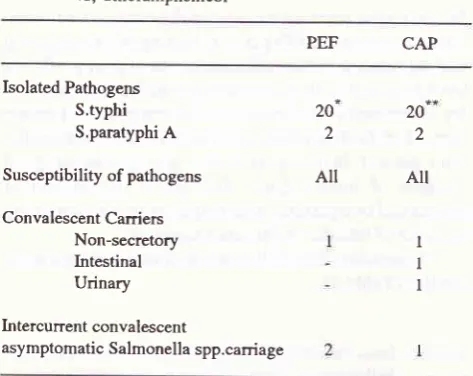
Bacteriological efficacy in Typhoid Fever: pefloxacin vs, ChloramphenicolPEF CAP
Isolated Pathogens S.typhi S,paratyphi
A
Susceptibility of pathogens
Convalescent Carriers Non-secretory Intestinal Urinary
In tercurrent convalescent
asymptomatic Salmonella spp.carriage
I
I
I
One case defaulted on post treâtment follow up and another was transferred on the 4th day oftreatment
in
afebrilecon-**
dition
to another hospital (no follow up possible).One case was transferred to another hospital on the 4th day of treatment still in febrile condition.
Bacteriological efficacy
In
both groups
pathogens
isolated before
treatmentwere identified,
asS.typhi
in
20 andS.paratyphi
A
in2
patients.
All
strains were sensitive
in
vitro
to
both
pefloxacin as
well
as chloramphenicol. During
theconvalescence
period
samples
were taken
from
theblood (after treatment)
and 3 timesfrom
the faeces andurine up to
onemonth.
It
could
beshown
that there was no convalescentexcretory carrier
in
the pefloxacin group, but
in
onebacteriologically
severe casewhere
S.typhi could
beisolated
from
theblood, urine
aswell
as faecesbefore
treatment the microorganisms
persisted
on the
posttreatment
m.o. blood
check.
This patient's condition
already returned to normal,
andhis
blood
was clearedon
a subsequentblood
test. There were non-secreting
aswell
assecreting carriers both
urinary
andfaecal
in
the
chloramphenicol group.
This
has been
a
well
known observation
in themajority
of
studies donewith
chloramphenicol. Besides
that during the
con-valenscence
period isolation of other Salmonella
(spp)from the stools were noted
in
3
patients,
two
in
thepefloxacin group and one
in
the
chloramphenicol
group.
However
there were
no
signs
or
symptoms
of
clinical illnes
(Table 3). Laboratory results
showedthat there were leucopenic patients
in
the
chloram-phenicol group
after treatment compared to nonein
thepefloxacin
group. There were no
relapse seenin
both
groups.
Med
J
Univ IndonDISCUSSION
The
development of
short term treatment schedulesfor
typhoid
fever wasinitiated
in the 80s when more Dotentbactericidal antimicrobials
became
available.l3i
14, lsNot only for typhoid fever but
for
many other
infec-tions
short
term
courses were developed and applied
with
some
form
of
success.'o The
essenceof
ashort
course
is
that the duration
of
treatment
given is
not
longer
than
half
the
time
of
the
universally
acceptedduration
of
treatment
for
theparticular infection.
This
study was carried
out
in
a
double blind
fashion
with
double dummies using
a
randomized
method
to
securethe most objective results, avoiding
bias
or doubt
in
evaluating new
waysof
treatment, As
could be
seen
in
this study we
did
not
encounter
asingle
adversereaction
in
contrast to previous
reports when higherdaily
dosing schedules ofpefloxacin
were used.Clinical efficacy
wasfaultless
in
thepefloxacin
group compared
to
one demise and
two
caseswith
complications
in thechloramphenicol
group.Bacterio-logical efficacy favored the pefloxacin group
whereone non-secreting convalescent
canier
was noted,
in
contrast to the
chloramphenicol
group where besides anon-secreting carrier, faecal
andurinary
carriers
were also noted.If
we consider theindividual
casesin
both groupswhere
S.typhi could
still
be
found in
the
blood
after
the treatment period, the patient
in
the pefloxacin
group
onadmission
had S.typhi
not only in
theblood,
but
also
in
the
stool
andurine
denoting
a severetype
of
overwhelming infection.
This
patient
had
abody
weight
of
65 kg,
while the
averagein
the group
was50,3 kg
andprobably
this daily
dose/BW
ratio of
400mg pefloxacin
/
65 kg
against
the
average
400
mg
pefloxacin
|
50,3
kg
may have
caused
this
delayedclearance.
On
the other hand the
body weight of
thepatient
thatstill
hadSlypht
in theblood
in thechloram-phenicol group was
4l
kg,
which
was
below
the averageof
47,3 kg
for
thewhole
group
andthus may
be
assumed
that the drug levels
in
the blood
were adequate.It
could be
suggestedthat
patients
with
abody weight
of
50
kg or
more may
need
BID
pefloxacin
dosing
or higher single daily
dosing
with
pefloxacin especially when
encountering
caseswith
overwhelming infections
in
order
to
obtain
faster
clearance
of
bâcteremia.An
interesting point
for
discussion should
be thenewly
contractedSalmonella
spp.infection
that didnot
cause anycomplaint in
both groups.Usually
salmonel-losis
is
associated
with a
clinical
synclrome
of
enteritis.
The patients were sparedprobably by way
of
cross-immunity
due to theprevious
infection with
Sal-monella
typhi
andS.paratyphi
A.20 2 20
2
[image:3.595.82.319.108.296.2]Vol -1, No I ,
J(utuur\
Mrtrt lt 1994Short treatment courses
for
typhoid fever
other
thanpefloxacin
at the moment have bèen recordedwith
ciprofloxacinlT'18
with ofloxacinle
andfleroxacin.rit'-CONCLUSION
A
7
days
single 400 mg pefloxacin (8 mg/kg BW)
course gave
superior
resultsin
terms ofclinical
aswell
as
bacteriological efficacy
comparedto
afull
14 daysstandard
course
of
50
mg/kg
BW
chloramphenicol
daily
and may be regarded
asan excellent substitute
for
standard treatment
with
chloramphenicol used
atpresent.
REFERENCES
l.
Bergan T. Quinolones. In:petersen pK and VerhoefI.
An_timicrobial Agents Annual.
lst
ed Amsterdam ElsevierScience Publ.BV, 1986; 174
2. Auvergnat JC. Present epidemiological and therapeutic
âspects of enteric fever. Med Mal Infect 19g6;16:344
3. Criatiano P. Morelli G, Briante V, Lovene MR, Simioli T,
Altucci P. Clinical experience with pefloxacin in
the
treat_ment oftyphoid fever. Infecrion l9g9;17g6
4. Hajji H, EI Mdaghri N, Benbachir M, El Filali KM, Himmich
H.
Prospective randomized comparative trial of pefloxacinversus contrimoxazole in the treatment of typhoid fever is
aduls.
Eur J Clin Micob 1988; 7 : 3615.
Ait
KhaledA,
Zidane L, Amrane A,Aklil
R. The efficasyand safety
ofpefloxacin
in the treatment oftyphoid fever in Algeria. J Antimicrob Chemorh l99O;26 (suppl B) :l8l
6. Setiabudi R, Kunardi
L.
pharmacokineticsof
fefloxacin. Proceedings
of
thelst
Asian Symposium on Èefloxacin,April
I,
1989 Jakarta, Excepta Medica Asia pacific Con_gress Series No.95; 6
7. Auckenthaler R, Michea-Hamzehpour
M,
pechere JC,In-vitro activity of newer quinolones againts aerobic bacteria.
Antimicrob Chemoth 1986; t7 (Suppl B) : 29
8. Clarke AM, Zemcov SJV, Campbell ME. In vitro activity
of
pefloxacin compared to enoxacin, norfloxacin, gentamicin
and the new betalactams. J Antimicrob Chemoth l9g5; 15 :
39
Pefloxacin inTyphoid and paratyphoid
Fever
4l
9.
lkarnainL
Open Clinical acin (400 mg) in typhoid992;24:25
10. Isenberg HD, Washington JA, Balows
A,
Sonnerwith AC.Collection, hardling and processing ofspecimens. In: Len_
cy.
ll.
3otr'of
Clinical Microbiology. Washington DC:
Am
Soc Microb,1985;978
12. Diagnostics Pasteur: Antibiotic sensitibivity testing proce_
dures for pefloxacin
13. I-an CK, Cheng DL, Lassere R. Two to three Days Treatment
of
Typhoid Fever with Ceftriaxone. SEAJ Trop Med publ Hlth 1986; 17 :lt9
14. Ranoa C, Santiago
L,
Sangla Rp, I-assere R. Randomized study of 3 days treatment of typhoid fever with Ceftriaxone16. Goldstein FW. Short term treatment of bacterial infection.
Western
Pacific
Societyfor
Chemotherapy. AbstractWPCCID; 1989; Kuala Lumpur;
pL
117. Chew SK, Monteiro EHA, Lim yS, Wong Sy, Lam MS and
Allen
DM.
in Enteric Fever.trial
(Abst
for Advanced Stof Malaya.
fic Symposium ol99l;
Kua18. Nelwan RHH, Zulkarnain I, Hendarwanto, Widodo D, Her_
diman and Soemarsono
H.
Short course treatment with Ciprofloxacinin
Typhoid Fever.A
preliminary Report.JAMA SEA t992;8
(suppl)
: 5919. Tanpaichitra D, Srimuang S,. Invitro and Clinical Evaluation of Ofloxacin in Urinary Tarct Infections and Enteric Fever.
Rev Inf Dis 1989,
II
(suppl S) : 17520. Nelwan RHH, de Garis S, Herzog Ch. One and Two Weeks
Oral
Fleroxacin vs Standard Chloramphenicol Treatmentfor
Typhoid Fever (Abstract).Infect
Disease Assocof
Thailand and Western pacific Society of Chemothera py.2nd