DOI: 10.12928/TELKOMNIKA.v14i4.3181 1362
Interleaved Reception Method for Restored Vector
Quantization Image
Iman Elawady*1, Abdelmounaim Moulay Lakhdar2, Mustapha Khelifi3
1
Department of Electrical Engineering, Tahri Mohammed University, Bechar, Algeria / lab: CAOSEE
2,3Department of Electrical Engineering, Tahri Mohammed University, Bechar, Algeria
BP 417 Route Kenadsa, Béchar 08000, Algeria, +213 49 23 89 93 *Corresponding author, e-mail: [email protected]
Abstract
The transmission of image compressed by vector quantization produce wrong blocks in received image which are completely different to the original one which makes the restoration process too difficult because we don’t have any information about the original block. As a solution we propose a transmission technique that save the majority of pixels in the original block by building new blocks doesn't contain neighborhood pixels from the original block which increase the probability of restoration. Our proposition is based on decomposition and interleaving. For the simulation we use a binary symmetric channel with different BER and in the restoration process we use simple median filter just to check the efficiency of proposed approach.
Keywords: Decomposition, Interleaving, BSC Channel, Median Filter, Vector Quantization
Copyright © 2016 Universitas Ahmad Dahlan. All rights reserved.
1. Introduction
The reduction of bit rate recently gets lot of attention especially with the big amount of data that consume the bandwidth usage and computation resources. Many techniques have been proposed to solve this problem as shown in the articles [1-3].
In image compression, quantization is used to reduce the number of symbols and hence less the amount of information (compression) needs to be encoded. In data transmission, a serious problem faced the image encoded with vector quantization. Since the degradation will be in form of blocks. Many of published papers try to solve this problem by combination between the VQ and different transforms as shown in articles [4-6]. These combinations of those relatively basic methods utilize the favorable characteristics of each method [7].
As proposition to solve this problem, we are going to make some modification in original image by constructing new blocks that doesn't contain any neighborhood pixels this modification give us a chance to keep some pixels in the original block which make the restoration process easier because we decrease the probability of getting wrong block.
Our paper is organized as follows. In Section 2 an overview of vector quantization compression. In section 3 representation of digital channel model which is binary symmetric channel. Sections 4 to 5 describe the main steps of our proposition using the decomposition and interleaving. Section 6 then combines the results using different BER with three images Lena, boat and Goldhill. Finally, Section 7 presents our conclusions and some propositions.
2. Vector Quantization
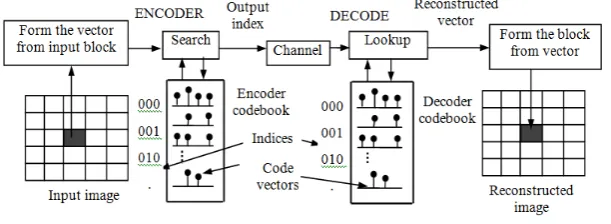
Shannon first suggested that encoding a sequence of samples from a source can provide better result than encoding individual samples in terms of compression efficiency [8].Image data compression using vector quantization (VQ) has received a lot of attention. Since VQ has a high coding efficiency and simple decoder architecture, it is very suitable for low-bit rate applications. The general VQ algorithm has three main steps [9]:
1. First the image is partitioned into blocks which are usually 2×2, 4×4, 8×8, and 16×16.
3. Finally, the image blocks are substituted by an index of best estimation code from the codebook.
Figure 1. Vector quantization
The basic principle of vector quantization based image compression techniques is to match each input vector with a code-vector in the codebook. The distortion between the input vector and the chosen code-vector is minimum [8]. Quantization is an irreversible process (there is no way to find the original value from the quantized value) [10]. The difference between the input and output signals of the quantizer becomes the quantizing error, or quantizing noise [11].
3. Transmission Channel
The binary symmetric channel (BSC) is defined by the channel diagram shown in Figure 2, and its channel matrix is given by Equation (1):
P Y X⁄ 1 pp 1 p p (1)
The channel has two inputs (x1 = 0, x2 = 1) and two outputs (y1 = 0, y2 = 1). The channel
is symmetric because the probability of receiving a 1 if a 0 is sent is the same as the probability of receiving a 0 if a 1 is sent. This common transition probability is denoted by p [12]. The error events are also independent of the data bits [13]. This is the simplest model of a channel with errors, yet it captures most of the complexity of the general problem [14]. The capacity of this channel given by Equation (2):
C 1 H p in (2)
With the binary entropy function given by Equation (3):
H p p log p 1 p log 1 p (3)
4. Decomposition
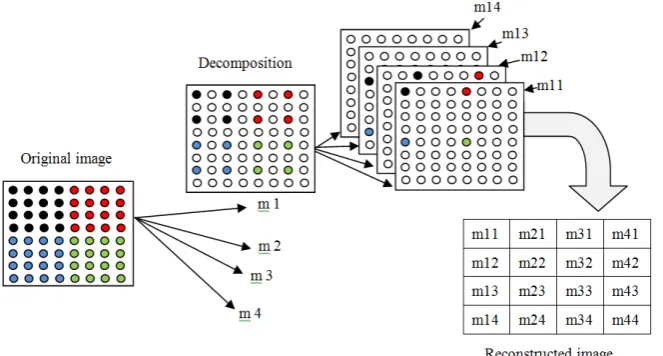
We suggest decomposing the original image into 16 images and reconstructing a new image with those images as it is illustrated in Figure 3. Which make the pixels in the reconstructed image not neighborhood pixels.
Figure 3. Decomposition of image
As shown on Figure 3 we take an example of 4 blocks size 4×4 (16 pixels for each block). The first step of decomposition will produce a new block size 4×4 contains 4 pixels from each original block. The next step of decomposition produce a new block size 4×4 contains 1 pixel from original block.
5. Interleaving
In general the interleaving is one of the most interesting techniques used in lot of applications like storage, error correction, and multidimensional data structure. We use interleaving in columns here to enhance the quality of the image after decomposition as shown in the Figure 4:
Figure 4. Interleaved image
Figure 5. Proposed flowchart
After applying the decomposition and interleaving (4,128) a codebook will be generated to encode the 16 images after transmission the decoded will reconstruct the 16 images then we invert the interleaving and compose the data finally we make a restoration using simple median filter the obtained results are presented in the next section
6. Results and Analysis
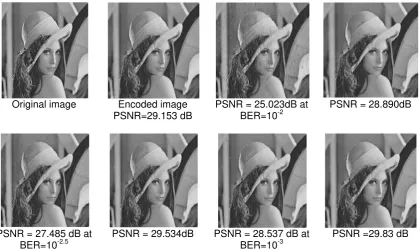
For simulation we use gray level images, size 512×512, coded in 8 bits, transmitted in binary symmetric channel, compressed by vector quantization with block size 4×4 and codebook generated by LBG algorithm. For the restoration we use a standard median filter.
Original image Encoded image PSNR=29.153 dB
PSNR = 25.023dB at BER=10-2
PSNR = 28.890dB
PSNR = 27.485 dB at BER=10-2.5
PSNR = 29.534dB PSNR = 28.537 dB at BER=10-3
PSNR =29.83 dB
Original image Encoded image
PSNR = 27.373 dB PSNR = 24.036 dB at BER=10-2
PSNR =27.025 dB
PSNR = 25.912dB at BER=10-2.5
PSNR = 27.524 dB PSNR = 26.819 dB at BER=10-3
PSNR = 27.710 dB
Figure 7. Restored boat image at different BER using median filter (Left: Degraded. Right: Restored)
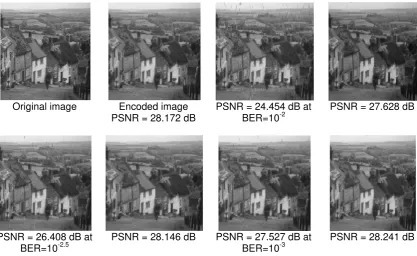
Original image Encoded image PSNR = 28.172 dB
PSNR = 24.454 dB at BER=10-2
PSNR = 27.628 dB
PSNR = 26.408 dB at BER=10-2.5
PSNR = 28.146 dB PSNR = 27.527 dB at BER=10-3
PSNR = 28.241 dB
Figure 8. Restored Goldhill image at different BER using median filter (Left: Degraded. Right: Restored)
The simulation results show received images (Lena, boat and Goldhill) in different BER (10-2, 10-2.5 and 10-3).
this case, the pixel recovery will be easy. The efficiency of restoration shows a good results especially with BER=10-2 by using simple median filter. Due to quality of reconstructed image using vector quantization compression we can’t get the same improvement at BER=10^-2.5 and BER=10-3.The vector quantization compression depends on the similarity of the regions it takes some samples to represents each region (codebook). In case of changing this similarity of regions the selection of samples will be more difficult and not perfect which make the reconstructed image degraded, however the restoration becomes easier because we have some information about the nature of original block, so we should balance between the quality of reconstructed image and the efficiency of the restoration, however our approach is still simple and doesn’t consume lot of processing resources compared with other researcher [15-16]. Some propositions is going to be provided in conclusion that can make our proposition more efficient.
7. Conclusion
The proposed solution is not perfect as shown from the simulation results so we must take our choice between the quality of image and the efficiency of restoration (we must use the approach wisely). As proposition maybe we can optimize in the decomposition by using artificial intelligence also very sophisticated filters can be used in the data receiver to enhance the quality of image or may be by changing the way of compression.
References
[1] Suqing Zhang, Aiqiang Wang. An Image Compression Method Based on Wavelet Transform and Neural Network. TELKOMNIKA Telecommunication Computing Electronics and Control. 2015; 13(2): 587-596.
[2] Bo Wang, Yubin Gao.An Image Compression Scheme Based on Fuzzy Neural Network.
TELKOMNIKA Telecommunication Computing Electronics and Control. 2015; 13(1): 137-145.
[3] M Masudur Rahman, Mohammad Motiur Rahman.Efficient Image Compression Technique using JPEG2000 with Adaptive Threshold. International Journal of Image Processing (IJIP). 2015; 9(3): 166-174.
[4] Juanli Hu, Jiabin Deng, Juebo Wu. Image Compression Based on Improved FFT Algorithm. Journal of Networks. 2011; 6(7): 1041-1048.
[5] Tejas S Patel, Ravindra Modi, Keyur J Patel. Image Compression Using DWT and Vector
Quantization. International Journal of Innovative Research in Computer and Communication
Engineering. 2013; 1(3).
[6] Mohamed El Zorkany. A Hybrid Image Compression Technique Using Neural Network and Vector Quantization With DCT. Springer International Publishing. 2014: 233-244.
[7] HR Wu, KR Rao. Digital Video Image Quality and Perceptual Coding. Taylor & Francis Group. 2006. [8] Ajol Kumar Ray, Tinku Acharya. Information Technology Principles and Applications. Prentice Hall of
India. 2004.
[9] NM Nasrabadi, RA King. Image coding using vector quantization: a review. IEEE Trans, on Communications. 1988; 36(8): 957-971.
[10] Y Yun, Q Shi, Huifang Sun. Image and Video Compression for Multimedia Engineering. Second edition. CRC Press. 2008.
[11] Zhou Wang, Alan C Bovik. Mean squared error love it or leave it. IEEE signal processing magazine. 2009; 26(1): 98-117.
[12] Hwei Hsu. Analog and digital communications.schaum’s. Second edition. McGraw-Hill Education.
2003.
[13] Milan Sonka, Vaclav Hlavac, Roger Boyle. Image Processing Analysis and Machine Vision. Third edition. THOMSON. 2008.
[14] John Miano. Compressed Image File Formats. Addison Wesley. 1999.
[15] Junping Wang, Dapeng Zhang. Image Denoising Based on Artificial Bee Colony and BP Neural
Network. TELKOMNIKA Telecommunication Computing Electronics and Control. 2015; 13(2):
614-623.