Spectral Test via Discrete Tchebichef Transform for Randomness
1
Nur Azman Abu and 1,2Shahrin Sahib 1
Faculty of Information and Communication Technology,
Universiti Teknikal Malaysia Melaka (UTeM),
Hang Tuah Jaya, 76100 Durian Tunggal, Melaka, Malaysia
Email: 1[email protected] 2[email protected]
ABSTRACT
Random key plays essential roles in cryptography. NIST statistical test suite for randomness is the most comprehensive set of random tests. It has been popular and used as a benchmark test for randomness. One of the random tests is spectral test. There has been some serious problem in spectral test as pointed out by few researchers. In this paper, an alternative test shall be proposed to replace the spectral test. The distribution of discrete orthonormal Tchebichef transform has been obtained based on computational observation being made on random noise. A recommendation on the new random test setting for short cryptographic keys shall also be made.
INTRODUCTION
Spectral test is one of the random test of random NIST test suite. As recommended in
Rukhin
et al
. (2001), it is only suitable test for long
binary sequence. At the same time, the first author found it so difficult to produce a sample input that gives fail result on spectral test for short practical cryptographic keys. The authors are interested in using the random tests for short cryptographic keys. A recommendation in the NIST statistical test suite is only for 1024-bit and above for spectral test based on discrete Fourier transform. Since the practical cryptographic keys are 128, 256, 1024-bit keys and so on, closer attention has been made on the spectral test(Kim
et al
. (2004)).
computationally complex and it is not suitable for short cryptographic keys of size 128 and 256-bit. It has been observed that spectral test may easily give a wrong result for short linear binary sequence (Abu
et al
. (2010)). At
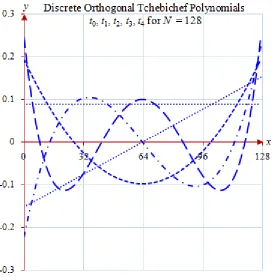
the same time, discrete Fourier transform is computationally extensive involving complex numbers.Figure 1: The graphs of the first few Tchebichef polynomials.
DISCRETE ORTHONORMAL TCHEBICHEF
POLYNOMIALS
Let a one-dimensional discrete orthonormal Tchebichef functions (Mukundan
et al
. (2006)) be given by the following recurrence relations in
polynomials tn(x) of degree n defined on a discrete domain x = 0, 1,…, N−1This set of discrete orthonormal Tchebichef polynomials satisfies the following properties of orthogonality and completeness.
1
NUMERICAL INSTABILITY OF RECURRENCE RELATIONS
Numerical instability can easily occur in evaluating the polynomials above if the recurrence relations are being used directly for large N. A closer look at recurrence relations above will tell us than none of the coefficients α1, α2, α3 is large and the only factor that contributes to large magnitude
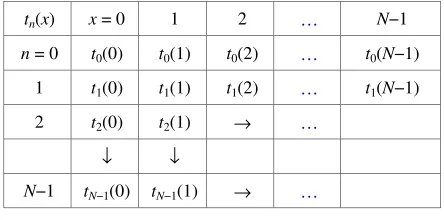
variations is the repeated multiplication by x. We will use this recurrence relation only to compute the polynomial values for and then fill each row of Table 1 using the recursion given in (Mukundan (2004)).
TABLE 1: Set of orthonormal polynomialsis represented by row vector of polynomials, with dotted arrows denoting n recursion and x recursion respectively.
tn(x) x = 0 1 2 … N−1
Let us start with the scale factor. The above equations (1)-(5) use the following scale factor for the polynomial of degree n, ( ,β n N)=Nn.
This scale factor was introduced to counteract the asymptotic growth in magnitude of the discrete orthonormal Tchebichef polynomial values with the degree n. Then initial value shall be computed as,
At the same time, we need also the initial value for domain x. Next, the first and second columns in Table 1 may be computed as,
1 right according recurrence relation below.
1 2
Then the binary sequence shall be expressed as a linear combination of the discrete orthonormal Tchebichef polynomials.
So that the expression may be simplified as matrix equation,
Thus, the discrete Tchebichef transform may be computed as
1 c=A− ε
Figure 3a: The frequency distribution of the discrete orthonormal Tchebichef transform coefficients with normal distribution for N = 128.
AN EXPERIMENT ON DISCRETE TCHEBICHEF
TRANSFORM ON BINARY SEQUENCE
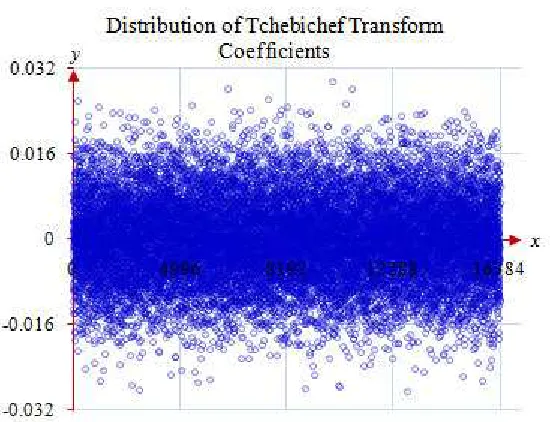
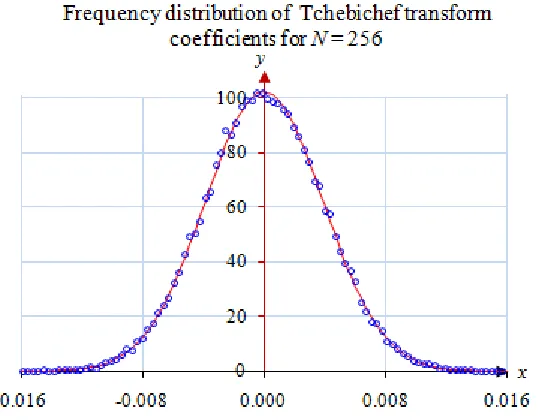
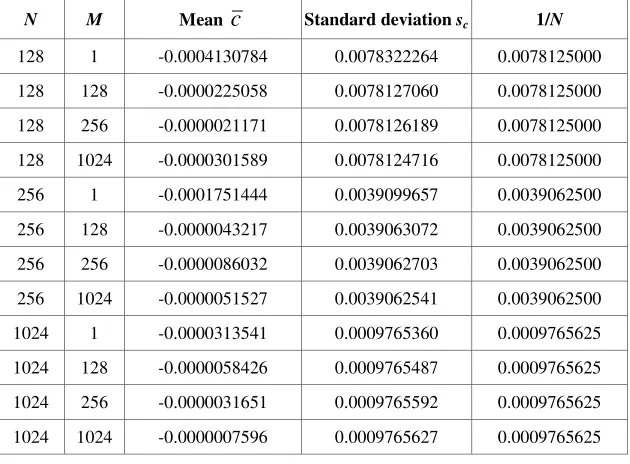
An experiment has been done earlier for N = 128, 256 and 1024-bit binary random ambience sequence (Abu and Sahib (2010)). For M = 1, 128, 256, 1024 blocks, the coefficients of the discrete orthonormal Tchebichef transform have been computed. For N = 128, M = 128, the discrete orthonormal Tchebichef transform coefficients have been plot in Figure 2. The distribution of the coefficients has been plotted with the normal distribution in Figure 3a for N = 128-bit sequence of M = 128 blocks and Figure 3b for N = 256-bit sequence of M = 256 blocks.
TABLE 2: The mean and standard deviation of discrete orthonormal Tchebichef transform coefficients based on random ambience for M blocks of N-bit binary sequence.
N M Mean c Standard deviation sc 1/N
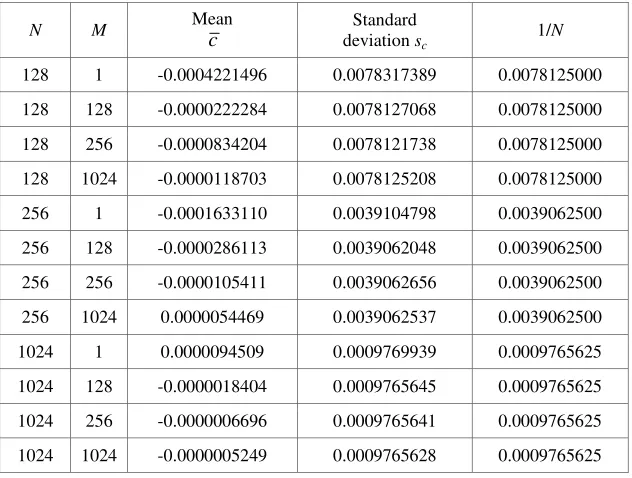
TABLE 3: The sample mean and standard deviation of discrete orthonormal Tchebichef transform coefficients based on e for M blocks of N-bit binary sequence.
N M Mean
c
Standard deviation sc
1/N 128 1 -0.0004221496 0.0078317389 0.0078125000 128 128 -0.0000222284 0.0078127068 0.0078125000 128 256 -0.0000834204 0.0078121738 0.0078125000 128 1024 -0.0000118703 0.0078125208 0.0078125000 256 1 -0.0001633110 0.0039104798 0.0039062500 256 128 -0.0000286113 0.0039062048 0.0039062500 256 256 -0.0000105411 0.0039062656 0.0039062500 256 1024 0.0000054469 0.0039062537 0.0039062500 1024 1 0.0000094509 0.0009769939 0.0009765625 1024 128 -0.0000018404 0.0009765645 0.0009765625 1024 256 -0.0000006696 0.0009765641 0.0009765625 1024 1024 -0.0000005249 0.0009765628 0.0009765625
In this experiment, it is found that the random variable of discrete orthonormal Tchebichef transform coefficients follows normal distribution
with mean µ zero and standard deviation 1. N
σ = The sample mean moves
toward zero and the standard deviation moves towards 1
N as the number of
DISCRETE TCHEBICHEF TRANSFORM RANDOM TEST
PROCEDURE
This spectral test is suitable for short cryptographic keys of size 128, 256, 1024-bit and so on. This test shall perform a chi-square test of the null hypothesis the binary sequence input comes from a normal distribution with specified variance against the alternative that it comes from a normal distribution with a different variance. The step by step procedure is as follows;
(i) Let us define the random variables in hypothesis testing. Let εεεε=ε0, ε2,
…, εN−1 the binary sequence to be tested for randomness. Convert the
input binary sequence εεεε into values of –1 and +1 to create the sequence Y = y1, y2, …, y N−1,where yi = 2εi– 1.
(ii) Let p1 = P( M < L ) and p2 = P( M > R ) then set the hypothesis
testing as H0 : p1 = 0.05 versus H1 : p1 0.05 and H0 : p2= 0.05
versus H2 : p2 0.05, or equivalently let a random variable y follows
Bernoulli distribution with probability p, then 1 1
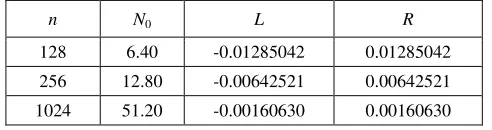
the actual observed percentage of number of coefficients in C that are larger than R. The lower L and upper R 0.05 tails are displayed in Table 4 below.
(iv) Apply a discrete Tchebichef transform (DTT) on Y to produce: C = DTT(X). The coefficient sequence C represents periodic components of the sequence of bits at different frequencies.
(vii) Compute
P value1 = 2[1 φ(|d1|)] and P value2 = 2[1 φ(|d2|)].
(viii) The null hypothesis shall be rejected if any one of the two P values < 0.05.
TABLE 4: The lower and upper 0.05 tails for respective n-bit cryptographic key
n N0 L R
128 6.40 -0.01285042 0.01285042 256 12.80 -0.00642521 0.00642521 1024 51.20 -0.00160630 0.00160630
Let eN be the first N-bit decimal. For instance, take N = 1024, then eN =
B7 E1 51 62 8A ED 2A 6A BF 71 58 80 9C F4 F3 C7
62 E7 16 0F 38 B4 DA 56 A7 84 D9 04 51 90 CF EF
32 4E 77 38 92 6C FB E5 F4 BF 8D 8D 8C 31 D7 63
DA 06 C8 0A BB 11 85 EB 4F 7C 7B 57 57 F5 95 84
90 CF D4 7D 7C 19 BB 42 15 8D 95 54 F7 B4 6B CD
D5 5C 4D 79 FD 5F 24 D6 61 3C 31 C3 83 9A 2D DF
8A 9A 27 6B CF BF A1 C8 77 C5 62 84 DA B7 9C D4
C2 B3 29 3D 20 E9 E5 EA F0 2A C6 0A CC 93 ED 87
written in hexadecimal.
Let a counter example εN be an increment byte counter from zero to 1 8 N
− . For instance, for N = 1024, then ε1024 =
00 01 02 03 04 05 06 07 08 09 0A 0B 0C 0D 0E 0F
10 11 12 13 14 15 16 17 18 19 1A 1B 1C 1D 1E 1F
20 21 22 23 24 25 26 27 28 29 2A 2B 2C 2D 2E 2F
40 41 42 43 44 45 46 47 48 49 4A 4B 4C 4D 4E 4F
50 51 52 53 54 55 56 57 58 59 5A 5B 5C 5D 5E 5F
60 61 62 63 64 65 66 67 68 69 6A 6B 6C 6D 6E 6F
70 71 72 73 74 75 76 77 78 79 7A 7B 7C 7D 7E 7F
written in hexadecimals.
DISCUSSION
It has been shown in
(Abu
et al. (2010)) that the traditional spectral random test using FFT gave the wrong conclusion which was unable to reject the increment byte counter εN above for N=128 and N=256 as randombinary sequence. The authors proposed a spectral test based on both lower left-hand-side and the upper right-hand-side 0.05 tails. Similarly, here the new spectral test should make full use of the symmetric normal distribution of the DTT coefficients.
TABLE 5: The upper 0.05 tails give consistent passing result on randomness for the first N -bit exponent eΝ.
n N0 R N2 d2 P-value2
128 6.4 0.01285042 9 1.054439 0.291682 256 12.8 0.00642521 16 0.917663 0.358795 1024 51.2 0.00160630 52 0.114708 0.908677
TABLE 6: The upper right 0.05 tail gives consistent failing result on randomness for the first N-bit byte counter sequence εΝ.
n N0 R N2 d2 P-value2
128 6.4 0.01285042 1 -2.189989 0.028525 256 12.8 0.00642521 2 -3.097112 0.001954 1024 51.2 0.00160630 30 -3.039758 0.002368
consistently give correct failing results on the randomness of short n-bit byte counter sequence for as short as 128-bit numbers.
CONCLUSION
Two-dimensional Tchebichef discrete orthonormal transform is well-known to provide a compact support for image analysis especially compression via sub-block reconstruction. In this paper, a clear statistical distribution on one-dimensional DTT coefficients has been explored. A recommendation on a new spectral random test setting for short cryptographic keys has also been made. The random variable of DTT coefficients follows normal distribution.
This paper has proposed a more accurate and simpler spectral test based on DTT coefficients than original proposal in NIST test suite based on FFT. This test consistently gives failing result on randomness for short n-bit byte counter sequence for as short as 128-bit numbers. Tchebichef discrete orthonormal transform provides more efficient and accurate spectral statistical test for randomness.
REFERENCES
Andrew Rukhin, Juan Soto, James Nechvatal, Miles Smid, Elaine Barker, Stefan Leigh, Mark Levenson, Mark Vangel, David Banks, Alan Heckert, James Dray, and San Vo. (2001). A Statistical Test Suite for Random and Pseudorandom Number Generators for Cryptographic Applications. NIST Special Publication. 800-22, 15 May 2001.
Nur Azman Abu, Nanna Suryana Herman and Shahrin Sahib. (2010). An Enhancement of the Spectral Statistical Test for Randomness. International Conference on Computational and Statistical Science (ICCSS 2010): 521-525.
Nur Azman Abu and Shahrin Sahib. (2010). Random Ambience Key Generation Live on Demand. Proceedings 2nd International Conference on Signal Processing Systems (ICSPS 2010). 1: 110-114.
Ramakrishnan Mukundan. (2004). Some Computational Aspects Of Discrete Orthonormal Moments. IEEE Transactions On Image Processing. 13(8): 1055-1059, August 2004.
Ramakrishnan Mukundan. (2006). Transform Coding Using Discrete Tchebichef Polynomials. Proceedings IASTED International Conference on Visualization Imaging and Image Processing VIIP 2006: 270-275.
Song-Ju Kim, Ken Umeno, and Akio Hasegawa. (2004). Corrections of the NIST Statistical Test Suite for Randomness, Cryptology ePrint
Archive: Report 2004/018, 26 Jan 2004,
http://eprint.iacr.org/2004/018.pdf.