'{
')':..&. -strMalaysian Joumai olNlicroscopy 7 : 132 - 136 (2011) ISSN: 1823-7010
Effect
of Heat
Treatment
on
the
Grain Orientation of
Bi3.2sNdo.75Ti3O12
Ceramic
A.
UmarAl-Amanir,
S.Srimala.r, M.N. Ahmad
Fauzir,A.R.
Khairunisakl,
S. Tanaka2 and
K.
UematsuTtschool of Materials and
Mineral
Resou'ce's Engineering'tJniversiti
sains lulalaysia, 14300Niltong
Tebal, Penang, MALAYSIA2Department of Materials Science and Engineering, Faculty of Engineering Nagaoka [Jniversity of Technology,
1603-1 KamitorniokQ, Nagaoka,
Niigata
940-2188' JAPANNeodymium substituted-bismgth titanate, Bir.25Ndo.7iTirOL (BNT075) ceramic was prepared using soft combustion technique. The dependence ofheat treatment on the grain orientation ofceraniic r'vas
observed. With increasing temperature, the BNT075 ceramic tumed from offc-axis-preferential-oriented to c-axis-oriented. The result also corresponded to the change from equiaxed structure to plate-1ike structure, indicating that the grain orientation had a significance influence on grain grorvth,
Keyrvords: c-axis, heat treatment, grain orientation
INTRODUCTIOI\
Over the last decade, much attention has been
paid
to
lanthanide substituted-bismuth titanatefor
their potential applications
in
nonvolatile
ferroelectric random
accessmemories [1,2].
N eodymium-sdbstituted'uismuth trtanate ts one
of
the most popular materials investigatedfor
this purpose
[3].
The outstanding fenoelectricity such ashigh
remanentpolarization
(2P,),low
coercive
fleld
(2E"), good fatigue
enduranceand
low
leakagecurrent
are essentialin
this application[4].
As
reported, the 2P. ishighly
dependent on
their grain orientation
[5].
The2P.
value
of
the c-axis-orientedBNT films
is-100
pC/cm2 whereas theoff
c-axis
orientedthin
films
hasthe
2P.
of
51
pC/cm2
16,71.
Based on this resutt,
it
would
be expected thatthe 2P. value of c-axis-oriented
BNT
thinfilms
is much higher than thatof off
c-axis-orientedfilms.
In the case to enhance the c-axis-oriented,several works have been reported over the last
10
years,
Bae and co-workers have reported afabrication of c-axis-oriented lanthanurn-dopt; bismuth titanate resulting
from
the increasei:
annealing temperature[8].
The other way is i.,use
template-grain growth
(TGG)
method t,-'orient
the textured Nb-dopedbismuth titana;t
in. t'a.y,is r.91.,. Ta.nak-a. a-nrl a.nd- ,itJ-wacks,.-s h&l.: fabricated c-axis-oriented
ZtO with
a rotati::ghigh magnetic
field
[10].
In this work, weh::;
prepared the grain orientation in c-axis-orieni,;,,and
off-c-axis-oriented BNT075
ceratnic*.ii::
various
heat-treatments,whereby the
resul::rwere presented
in X-ray
stnrctural, Lotgeri:i,.degree of c-oriented and grain morphologies
E XP ERI1VI E N
TAL
PRO CE DURE
Materials
and ReagentsThe
following
materials and reagents rverettsci
bismuth nitrate penthahydrate
(Bi
(NO3)r.5FI:i,i.98%, Sigma
Aldrich),
neodymium
nitr::r
hexahydrate
(Nd
(NO3)3.6H2O, 99.9olo, Sigr:r',Aldrich), titanium
(IV)
isopropoxide
iT
'Corresponding author. Tel: + 6{04)-5995255; Fax: + 6(04)-5941011
Eltbct of Heat Treatment on the Crain Orientation of Bi::.Ndo::Ti3O,2 Ceramic
f
OCH
(CH.).11, 97o/o.Merck),
acetylacetone(C.HsOr, Merck) and 2-Methaoxyethanol
( C H.OCHTCH,OH, Merck).
Preparation
ofBNT075
The required amounts of Bi (NO,)r.sHrO and Nd
(NO.h.6lir0
were sirnultaneously dissolvedin
CH.OCH:CHTOH by stirring at 40oC and 25oC,
respectively,
tor
30min.
Separately,Ti
IOCH (CH:):],r r,vas also dissolvedin
themixture
of
CH.OCHTCH,OH
and C5HsO2with
constantstiring
at 25"Cfor
30min.
Then,Nd
solutionrvas
slowly
addedinto
Bi
solutionwhile
being constantiystirred.
It
was thenfollowed by Ti
solution
rvas addeddrop-by-drop
into Bi-Nd
solution
andcontinuously stirred
at40"C
for
alloaher 2
h.
Aflow
chart is illustrated inFig.
l.
Fig.
L
Sirtrple.flou, chart r;f tlte preparution d' B NT1 7 -5 v'i t h vo r i ous h eo t - I reelnzen tsMalaysian Jor.rmal ol lvlicroscopy Vol. 7 201 I
Stages
of heat-treatment
Various heat-treatments were used to investigate
their effect on grain orientation and
grain
morphoiogies
of BNT07-s,
The correspondrnssamples HT 1,
HTI
and HT3 u.ere ob:aineda;er
calcination.
pre-sinlerin-e andposl-silterr::.
respectivel),. HT4
ri'as obiained
t-,'' a.mosisame samples as HT3. excepi iha[ pre-s1i:eni1:
was skipped in the processing
route. I: car le
simplified
as listed in Table 1.TABLE 1
List of parameter of heat-treatment rvith heating rate of 5'C/rnin
Sample
Heattreatment
Temperature SoakingHTi
Calcination
800"CHT2 Pre-sintering
700"CHT3
Post-sintering
1 100'CHT4
Directsintering
1100"C3h
2h
3h
3h
Characterization
X-ray diffraction (XRD,
Bruker D8 Advanced)analysis was carried out to determine the grain
orientation as a result of different heaGtreatment.
The
grain
morphologies
were
displayed by
fleld-ernission
scanningelectron
microscopy(FE-SEM, Zeiss Supra 55VP PGT/HKL).
The Lotgering degree
of
grain orientation wascalculated according to the
following
equationflll:
u(c-axis)
:
Itool)
Iruon
*
Irrrl
(l)
(2) Irrrzt
a(otf
' c-axts)110u11 + I1l1z1
RESULTS
AND DISCUSSIONS
XRD Analysis
Frg
2 showsXRD
patterns of the BNT075with
various heat-treatments. The
XRD
analysisconfirmed that various heat treatments can be used
to
form
single phaseof
bismuth-layeredstnlcture.
For the sample producedfrom
HTl
and HT2, the most intense peak was dominated
133
Rtu'ruatelia ls
('onrpIcration
Er rr prlrirtion
Pr c-sirrterirrg
Pri
[image:3.595.68.585.21.804.2]A. Umar Al-Arnani, S. Srinrala, M.N. Ahmad Fauzi, A.R. Khairunisak, s. Tanaka and K' l]ematsu
by
(117),
suggestingthe formation
of
highly
off-c-axis
orientation.
On
the other hand, theindexed peak was
found to
decreascin
thesample
produced
from HT3
andHT4.
Theincrease
in
intensity
of (000
plane
is
clearly
seen in
XRD
pattern,implying
that significance shifted to c-axis-orientation.It
is reasonable to suggest thatdifferent
axisin
grain orientationis produced
with
various type of heat treatment'In
addition
to
that,
the degreeorientation
(u)of
c-axis
and
off-c-axis
was calculated
for
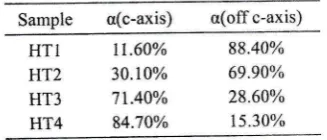
respective sample. As calculated, o.-u";. for
HTl,
HT2, HT3
andHT4
was aboutll.60/0,30.1oh,
7
l.4Yo
and 84.7o/o, respectively,indicating
theincrease in c-axis-orientation and decreasing
in
off-c-axis-orientation.
The calculated value isshown in Table 2.
TABLE 2
Degree oforientation for c-axis and offc-axis
Sample a(c-axis)
a(off c-axis)HT1 HT2 HT3 HT4
1r.60% 30.10% 71.40% 84.'70%
88.40% 69.90% 78.60% 15.30%
SEM Analysis
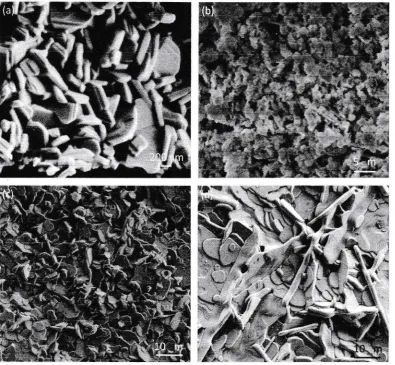
Fig.
j
showsthe grain morphologies
of
thcBNT075
ceramicwith
various heat-treatmeuts.In Frg.
3(a),the
HT1
grainsmostly
consistof
equiaxed-like strucrure
with
average grain sizeof
100 nmto
600nm,
As
the porvderis
pre-heated, theHT2
grain
sizeis
almostunifornr
due to grain growth of equiaxed-like grain (Flg.
.c
{!
'a
o
C
60
5B
40 ?fl
10
I l+
2o {,,)
Fig. 2 : X-ray dffi'actian patterns o.f BNT07 5 at
dffirent
heat tteatment$l
sl
I
sB
t
i?
"H
Ipti?iil
A4: direct sinte ringll
A3: post-sintering
,l
A2: pre-sinlering
I
A1: calcination I
[image:4.595.279.443.99.169.2] [image:4.595.11.578.277.834.2] [image:4.595.127.416.306.639.2]I
Eltcct ol Hcat Treatment on thc Grain
-116l). This particular grain growth occurs very ertensive during post-sintering resulted in HT3 plate-like stmctr.rre (Fig.
3(c)).
The platey grain rs moreunifonn
with average grain sizeof2
pmto 8
prn,
The laryestHT4 plate-like
structureis clearly seen resuiting from direct sintering as
shor,vn
in
FiS
3(cl). The morphoiogy results areconsistcnt rvith the results of
XRD
and degreeof orientation as reported earlier.
CONCLUSION
In
summary, the grain orientationof
BNT075cerarnic is
highly
dependent on heat treatment.Orientation of Bi,,,Nd, rr1i.Or: Ccramic
Similar
observation wasfound
in
the sampleproduced from
HTI
and HT2, whereby theoff-c-axis became a dominant orientation. However,
it
did not occur in the sample produced from HT3 and
HT4.
The
increasein
c-axis-orientation
was also confirmed by degree
orientation.
Thechange
in
grain orientation
r,vasclearly
seenin
grain morphology, whereby
highly-c-axis-orientation corresponds to plate-like structure.
ACKNOWLEDGMENT
The
authors appreciatethe technical
supportfrom School ofMaterials and Mineral Resources
Istr"W
[image:5.595.37.433.259.624.2]I
Fig. 3: Grain morphologies of'BNT075
tith
vorious heot-teottilents. (a) HTl,(h) IIT2, (c) H7'3 und (d) HT4
A. UmarAl-Amani, S. Srimala, M.N' Ahmad Fauzi, A.R. Khairunisak, S. Tanaka and K. Uematstt
Engineering,
Universiti
SainsMalaysia'
Thisresearch was supported
by
the E-science Fund305/Pbahan/ 6013357,
USM-RU grant
1 001/Pbahanl80420 1 8 and 8 1 1069.
REFERENCES
[1]
Park, B.H., Kang, B.S., Bu, S.D', Noh, T.W., Lee, J., Jo, W. (1999). Nahrre (401) 682'[2]
Giridharan, N.V., Subramanian,M',
Jayavel, R. (2006). Appl. Phys. A (83) 123.[3]
Chen, X.Q., Qi, H.Y., Qi, Y.J., Lu,C'i'
(2005). Phys. Lett. A (346) 204.[4]
Noh, T.W, Kang, B.S., Seo, S., So, Y.W., Park' 8.H., Bu, S.D.. Yoon, J.G. (2002) Ferroelectrics' 267 (1) r21.[5]
Uong, C., Jeong, S.S., HyLrn' M.l. (2003)' J' Appl'Phys.93 (8) 4769.
[6]
Chon, U., Jang, H.M., Kirn, M'G', Chang' C'H' (2002). Phys. Rev. Lett. (89) 087601'[7]
Yang, B.,Zhang, D.M., Zhou, 8., Huang, L H', Zheng, C.D., Wu, Y.Y. Guo, D'Y., Yu, J' (2008)' J. Cryst Grov'th (3 10) 45 I 1 '[8]
Bae, J.C., Kim, S.S., Choi, E.K., Song, T'K., Kim, WJ., Lee, Y.I. (2005). Thin Solid Filns (4'12)90[9]
Hong, S.H., Susan, T.M., Gary,L'M'
(2000)..r. Am. Ceratn.,loc.83 (1) 1i3.l10l
Satoshi, T., Atsushi,M.,
Zenji'K.,
Keizo, U(2009).J. Eur. Cerarn. Soc. (29) 955.
tl1l
Ni,2.,
Tadashi, S. (2007). Mat' Lett, (61) 2935.