te
a
m95
KPT.AKEPT. 680-3/1/49THE ROLES OF PREMIER POLYTECHNIC:
TRANSFERRING MINDSET FOR INNOVATION
UNIT
8
:
REFLECTION ON STRATEGY OF
INNOVATION
Prof. Madya Dr.Hanipah Hussin
Learning Outcomes:
At the end of this unit, participants will be able to:
i. Reflect on the main roles for strategy of innovation ii. Answer the questionnaire for strategy of innovation
te
a
m95
KPT.AKEPT. 680-3/1/49REFLECTION ON THE KEY CHALLENGES AND ROLE OF
INNOVATION AMONG ACADEMIA IN POLYTECHNICS
1.0 Introduction
An innovation mindset is an issued for all members in polytechnic’s academia now days. It is become a role and responsibility in every department in polytechnics since PSPTN Phase 11 launched. Head of department need to be actively involved in setting the mindset, direction, and environment for innovation. They also instill a confidence in their member of faculties.
In their role as strategy leader, they need to cast innovation as the central character in their department scenario of future growth. It is states under MOHE Transformation Plan 2009, and innovation is polytechnics Critical Agenda in New Economic Model 2008-2015. Innovation matters have to scrutinize even in the classroom. On the top of that, besides teaching, the academia in polytechnic, have to read, think, and do some relevant research with industries and companies.
Smart partnership with industry and community encourage them to look out of the box, looking for new ideas and formula. Academia also needs to have develop an article journal and book publication and play a role as speakers to the community outside campus. Last but not least, they also need to reflect their innovation experiences; no matter it is a failure or success portfolio.
Some head of department in faculty espouse a belief that innovation is a major factor in creating competitive advantage for their learning organizations and can serve as the fuel for future growth. Faculty or department need also to win gold medal at least one’s a year for any conferences, exhibition or innovation showcase that they involved. In Malaysia it
is a part of academia role’s, it is a culture.
In this case, it is clearly possible to implement innovation effectively in Malaysian Polytechnics. There are Polytechnics in Malaysia doing it systematically well, and here in, we examine how they achieve this. The aim is to observe closely the managerial factors at Premier Polytechnics (Politeknik Ungku Omar, Politekni Ibrahim Sultan and Politeknik Salahuddin Aziz Shah) that make up systematic innovation in these successful Polytechnics then to work out from these current successes a set of generic elements, which they term as principles, of managerial practice that can be valuable and instructive to other polytechnics which aspire to such success.
te
a
m95
KPT.AKEPT. 680-3/1/49Beyond that, they are uncomfortable with the very concept of innovation. Many view new product development as a necessary evil. They (industries or firms) think of innovation as a profit-eating monster rather than a growth- and earnings-yielding investment. For most senior lecturers, risk aversion is the sand that slows the wheels of innovation. The importance of innovation has not, however, dwindled away.
On the contrary, its role of polytechnic’s staff in providing companies with a competitive edge in the marketplace is increasingly recognized. The need for innovation leadership has arrived. In doing it, it is pleasure to have your comment or feedback about the strategies that your leader takes action
2.0 Reflection on Strategy of innovation
This section is going to conduct closely examine and think deeply the factors that are associated with successful innovation at the academia level. Firstly we want to find polytechnic that have consciously adopted a competitive strategy that is at least partly if not significantly based on their innovation capability. Second we want to find some polytechnics which have different approaches to innovation.
te
a
m95
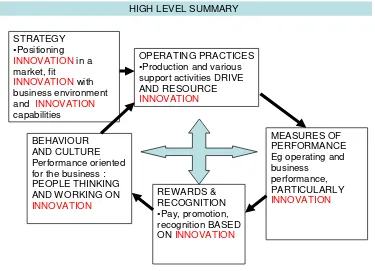
KPT.AKEPT. 680-3/1/49Figure 1: Systematic innovation capability requires a focus on innovation in every one of the key building blocks and the connections between them
First let us define each of the building blocks in Figure 1 and comment on some of the
connections in this organizational ‘system’.
A precursor for a systematic innovation capability is to consciously and purposively engage in such as a strategy. Then and only then, will it achieve enough resources, priorities and company-wide attention. Strategy is usually best made plain and explicit so that staff and indeed all stakeholders can understand and align with it, hence we
would expect to see systematically innovative companies ‘talking the talk’ of innovation
at all levels of the organization, on the way to ‘walking the walk’ of innovation. This is certainly the case in 3M in terms of product and service innovation that leads to revenue growth, and similarly in PROTON in terms of process innovation that brings increased productivity and quality.
In this aspect of strategy and ‘mindset’, some companies especially Proton have the
dynamism of innovation ‘in their DNA’, and some simply don’t, with all shades of grey
existing in between these extremes.
In summary, it is possible to recognize the extent to which innovation is central to a
business’ competitive strategy. If it is not a key part of its stated competitive strategy, then that is the first building block to work on, assuming that systematic innovation is a desired outcome. Please look at this variable when you want to do some research under this category.
te
a
m95
KPT.AKEPT. 680-3/1/49REFERENCE
Samson, D. (2010).
Innovation for business success: Achieving a systematic
innovation capability.
Department of Innovation, Industry, Science and
Research.
Grinstein, A., 2008. The effect of market orientation and its components on innovation consequences: a meta analysis. Journal of the Academy of Marketing Science 36, 166-173.
Manso, G., 2009, Pay-For-Performance Compensation Limits Innovation;
InformationWeek, May 8, 2009.
McGregor, J., 2006, Take Courage, Imagination, and Mix for Innovation,
The Weekend Australian Financial Review, June 9-12 2006, pg 46.
Stood, A., Tellis, G., 2009, Innovation Does Pay Off – If You Measure Correctly,
Research Technology Management, July-August 2009, pg 13-15.
Timmerman, J., 2009, A Systematic Approach for Making Innovation a Core Competency, The Journal for Quality and Participation, January 2009, pg 4-10.
Vella, M., 2008, Innovation Through Acquisition, Businessweek Online, 3rd March 2008.
Skarzynski, P., Gibson, R., 2008, “Innovation To The Core”, Harvard Business Press.
Shen, H., Wang, L., Qiang, X., Li, Y., Xunfeng, L., “Toward a Framework of
Innovation Management in Logistics Firms: A Systems Perspective”, Systems Research and Behavioural Science, 2009, pg 297-309).
Higgins, K, “Manufacturing idea bazaar”, Food Engineering, Jun2009, Vol. 81 Issue 6, p73-78.
Buxton, B. “Innovation calls for I-shaped people”, BusinessWeek Online, 15/7/2009 Aizcorbe, A., Moylan, C., Robbins, C., 2009, Toward better measurement of innovation and intangibles, BEA Briefing (Bureau of Economic Analysis) January 2009.
te
a
m95
KPT.AKEPT. 680-3/1/49Below is a list of behavior to show your level of agreement on all variable given. Please Choose 1 for totally not agree and 5 for totally agree. (Hanipah Hussin 2012)
Bil. Mindset For Innovation A. Innovation Strategy Factors
A1. Does your leader commit to innovation issues in your
workplace? 1 2 3 4 5
A2. As a lecturer, do you have specific/unique innovation
strategy? 1 2 3 4 5
A3. Does your innovation product is customer
focus/obsession? 1 2 3 4 5
A4. Do you implement innovation as radical and
incremental in your strategy? 1 2 3 4 5
A5. Do you allocate dedicated resources for innovation? 1 2 3 4 5
A6. Do you establish the innovation risk appetite? 1 2 3 4 5
B. Innovation Processes/Resources
B1. Does innovation change your management
capability/readiness? 1 2 3 4 5
B2. Does your innovation is sustainable development
oriented? 1 2 3 4 5
B3.
As a lecturer, do you have an external
partnership/open innovation approach that influencing throughout supply chain?
1 2 3 4 5
B4. How strength an innovation in the DNA of system and
process at your workplace? 1 2 3 4 5
B5. Do you have a solid foundation of quality
management/stability? 1 2 3 4 5
B6.
Have you practice innovation skill in your
products/services process technologies/business model?
1 2 3 4 5
C. Innovation Measures/Payoff
C1.
Have you evaluate your innovation work in term of growth, price premiums, and innovation overcoming cost disadvantages?
1 2 3 4 5
C2. Does your innovation work invent a new initiatives
products and services? 1 2 3 4 5
C3. Does your innovation work contribute to profitability
value? 1 2 3 4 5
D. Innovation Rewards and Recognition
D1. How priority the innovation orientation in labor market
and HR systems at your workplace? 1 2 3 4 5
D2.
Does your innovation contribution at workplace attract you by retaining staff, promoting, rewarding and recognizing?
1 2 3 4 5
E. Innovation Behaviors and Culture
E1. Is it innovation “buzz” in your mindset? 1 2 3 4 5
E2. Do innovation windspread the staff value? 1 2 3 4 5
E3. Do the culture of innovation implement as