xiv ABSTRACT
NILAKANDHI, BRIGITA STEVANY DYAH. The Grammatical Features on the Yorkshire Dialect as Seen in Hodgson Burnett’s The Secret Garden. Yogyakarta: Department of English Letters, Faculty of Letters, Sanata Dharma University, 2015.
English as a language has a variety that is called dialect. Yorkshire is one example of English dialects. In The Secret Garden novel, the characters who live in Misselthwaite Manor such as Martha and Ben speak the Yorkshire dialect.
There are two problems formulated in this study. Those problems are the grammatical features on the dialect used by Martha and Ben in their utterances to the children and Martha’s and Ben’s reasons of speaking Standard English and the Yorkshire dialect to the children.
The Yorkshire dialect spoken by Martha and Ben is compared with the theory of Standard English made by linguistics experts. The grammatical features are divided into nouns and pronouns; verb and auxiliaries; word order; article; prepositions, conjunctions, and adverb; negatives; and vocabulary. On the other sides, Martha’s and Ben’s reasons of speaking Standard English and the Yorkshire dialect to Mary and Colin are shown by showing Martha’s and Ben’s relationship with Mary and Colin.
xv ABSTRAK
NILAKANDHI, BRIGITA STEVANY DYAH. The Grammatical Features on the Yorkshire Dialect as Seen in Hodgson Burnett’s The Secret Garden. Yogyakarta: Program Studi Sastra Inggris, Fakultas Sastra, Universitas Sanata Dharma, 2015.
Bahasa inggris sebagai bahasa memiliki variasi yang disebut dialek. Yorkshire merupakan salah satu dialek Inggris. Di novel The Secret Garden, karakter yang tinggal di Misselthwaite Manor seperti Martha dan Ben menggunakan dialek Yorkshire.
Dalam studi ini terdapat dua rumusan masalah. Dua rumusan masalah tersebut adalah fitur tata bahasa dialek Yorkshire yang dipakai oleh Martha dan Ben dalam semua ucapan mereka pada anak-anak serta alasan Martha dan Ben dalam menggunakan dialek Inggris standar dan dialek Yorkshire pada anak-anak.
Dialek Yorkshire yang digunakan Martha dan Ben akan dibandingkan dengan teori bahasa inggris standar dari para ahli bahasa. Fitur tata bahasa dibagi menjadi 7 seperti kata benda dan kata ganti orang; kata kerja dan kata kerja bantu; susunan kata; artikel; preposisi, kata hubung, kata keterangan; kata negatif, dan kosakata. Di sisi lain, alasan Martha dan Ben dalam menggunakan dialek Inggris standar dan dialek Yorkshire pada Mary and Colin ditunjukkan dengan melihat hubungan Martha dan Ben dengan Mary dan Colin.
THE GRAMMATICAL FEATURES ON THE YORKSHIRE
DIALECT AS SEEN IN HODGSON
BURNETT’S
THE SECRET
GARDEN
AN UNDERGRADUATE THESIS
Presented as Partial Fulfillment of the Requirements For the Degree ofSarjana Sastra
In English Letters
By
BRIGITA STEVANY DYAH NILAKANDHI Student Number: 104214071
ENGLISH LETTERS STUDY PROGRAM DEPARTMENT OF ENGLISH LETTERS
FACULTY OF LETTERS SANATA DHARMA UNIVERSITY
ii
THE GRAMMATICAL FEATURES ON THE YORKSHIRE
DIALECT AS SEEN IN HODGSON
BURNETT’S
THE SECRET
GARDEN
AN UNDERGRADUATE THESIS
Presented as Partial Fulfillment of the Requirements For the Degree ofSarjana Sastra
In English Letters
By
BRIGITA STEVANY DYAH NILAKANDHI Student Number: 104214071
ENGLISH LETTERS STUDY PROGRAM DEPARTMENT OF ENGLISH LETTERS
FACULTY OF LETTERS SANATA DHARMA UNIVERSITY
A Sarjana Sastra Undergraduate Thesis
THE GRAMMATICAL
FEATURES O1\ THE YORKSHIREDIALBCT
ASSEEi\
IN
HODGSONBURNETT'S
THE SECRET GARDENJune 19,2015
r{'p
June 19,2015 Anna Fitriati. S.Pd.. M.Hum.
Co-Advisor
lll
A Sarjana Sastra Undergraduate Thesis
THE GRAMMATICAL
FEATURESOI{
THE YORKSHIRE
DIALECT
AS SEENIN
HODGSONBURNETT'S
THE SECRET GARDENBy
BRIGITA STEVANY DYAH NILAKANDHI Student Number: 1 0421 407 1
Defended before the Board of Examiners On 28 July 201 5
and Declared Accentable
BOARD OF EXAMINERS
Name Chairperson Secretary Member i Member 2
Member 3 Anna Fitriati. S.Pd.. M. Hum.
Yogyakarla, 31 July 2015
Facultv of Letters
LEMBAR PERNYATAAN PERSETUJUAN PUBLIKASI KARYA ILMIAH LNTUK KEPENTINGAN AKADEMIS
Yang bertanda tangan di bawah ini, saya mahasiswa Universitas Sanata Dharma
Nama
: Brigita Stevany Dyah Nilakandhi Nomor Mahasiswa : 104214071Demi pengembangan ilmu pengetahuan, saya memberikan kepada Perpustakaan
Universitas Sanata Dharma karya ilmiah saya yang berjudul
THE GRAMMATICAL
FEATURES ONTHE
YORKSHIRE
DIALECT
AS SEENIN
HODGSONBURNETT'S
THE SECRET GARDENbeserta perangkat yang diperlukan (bila ada). Dengan demikian saya memberikan kepada Perpustakaan Universitas Sanata Dharma hak untuk menyimpan, mengalihkan dalam bentuk
media lain,
mengelolanya dalam bentuk pangkalan data,mendistribusikannya secara terbatas, dan mempublikasikannya di intemet atau media lain untuk kepentingan akademis tanpa perlu meminta
ijin
kepada saya maupunmemberikan royalti kepada saya selama tetap mencantumkan nama saya sebagai penulis.
Demikian pernyataan ini saya br-rat dengan sebenarnya.
Dibuat di Yogyakarta, Pada tanssal l9 Juni 2015
Yang menyatakan,
tl
I[/[A '
l/
STATEMENT OF ORIGINALITY
I
certify that this undergraduate thesis contains no material which has beenpreviously submitted for the award of any other degree at any university, and that, to the best
of
my knowledge, this undergraduate thesis contains no materialpreviously written by any other person except where due reference is made in the
text ofthe undergraduate thesis.
Yogyakarta, June 19, 2015
\H l^
\wz
Brigita
r*In,
Dyah Nilakandhivii
"
Expect nothing and you’ll be surprised
by
something."
~unknown
"Keep your face to the sunshine and
you cannot see the shadow. It's what
sunflowers do."
~ Helen Keller
"If I were a flower I would be a sunflower. To
always follow the sun, turn my back to
darkness, stand proud, tall and straight even
with my head full of seeds."
viii
Dedicated to
My Beloved Parents,
ix
ACKNOWLEDGEMENTS
First of all, I want to thank God for all blessings that He gives me, so I can finish my undergraduate thesis. I also would like to say my gratitude to my thesis advisor, Dr. B. Ria Lestari, M.S. who had patiently guided me in writing my thesis, supported me, and given her time to improve my thesis. I thank my co-advisor, Anna Fitriati, S.Pd., M.Hum. for all suggestions that are given to me so I can improve my analysis. I thank my examiner Dr. Fr. B. Alip, M.Pd., M.A. for giving me a lot of suggestions in my thesis defense. I thank all lecturers in English Letters Department of Sanata Dharma University, especially to my academic advisor, Adventina Putranti, S.S who always helps me as a student in English Letters Department.
My big thanks are also dedicated to my beloved parents, Petrus Pras Anggono and Atik Purwaningsih who always pray for me and give me big supports to finish my study. I also want to thank my sisters, Monica Claudia Debby Indira and Regina Gracia Sonyaruri, and my brother, Andreas Kevin Anggriawan, who also always give me a lot of supports and cheer me up. I hope that this thesis can make them proud to have me as their family. I also want to dedicate my big thank to my dearest Iwan Stefanus Sanjaya for always loving me, giving me a lot of supports, accompanying me, cheering me up when I am down, and patiently hearing all my emotions and problems. Thanks for the togetherness that we share.
The last but not least, I also would like to thank my friends who help me during my study. First of all, I thank my friends ofyou C 2010, especially Atika, Tya, Iche, Winda, Dea, Kory, and Ray who always accompany me for these five years. Thanks for comforting me when I am sad and always beside me when I am happy. I also would like to thank mbak Kika and mbak Ursula, who had been my partners when I worked at library of Sanata Dharma University. Thanks for always giving me a lot of supports.
x
TABLE OF CONTENTS
TITLE PAGE………..ii
APPROVAL PAGE………... iii
ACCEPTANCE PAGE………..iv
LEMBAR PERNYATAAN PERSETUJUAN PUBLIKASI KARYA ILMIAH…….v
STATEMENT OF ORIGINALITY………..vi
MOTTO PAGE……….vii
DEDICATION PAGE……….. viii
ACKNOWLEDGEMENTS………... ix
TABLE OF CONTENTS………x
LIST OF TABLES………... xiii
ABSTRACT……….. xiv
ABSTRAK………... xv
CHAPTER I: INTRODUCTION………..1
A. Background of the Study……….1
B. Problem Formulation………...4
C. Objectives of the Study………...4
D. Definition of Terms……….4
CHAPTER II: REVIEW OF LITERATURE………..6
A. Review of Related Studies………..6
B. Review of Related Theories………... 9
1. Theory of Sociolinguistics………9
a. Language, dialect, and Standard………... 9
b. Regional Dialect and Social Dialect………..10
i. Regional Dialect ………10
ii. Social Dialect ………11
c. Ethnographyof Communication ………... 11
i. Settingand Scene ……….. 12
ii. Participants ………12
iii. Ends ………... 12
xi
v. Key ………12
vi. Instrumentalities ………12
vii. Norms of interaction and interpretation ………12
viii. Genre……….12
d. Language Variation ………... 13
e. Solidarityand Politeness ………... 13
i. TuandVous………... 14
ii. Address Terms ………... 15
2. Theory of Syntax……….15
a. Partof Speech ………15
i. Pronouns ………15
ii. Adjective ………... 16
iii. Inflection of Verbs ………16
iv. Adverbs ……….20
b. Agreement between subject and predicate ………20
The use of suffix–s or–es………. 21
c. Emphatic Tags ………... 21
d. Noandnone………... 22
e. Possessive’s ………... 22
f. Article ………22
g. There………..23
h. Sentence ……….23
i. ParallelStructure ………... 24
ii. Question ………25
C. Theoretical Framework……….25
CHAPTER III: METHODOLOGY………27
A. Object of the Study………27
B. Approach of the Study………...29
C. Method of the Study………..29
1. Data Collection………29
2. Data Analysis………..31
CHAPTER IV: ANALYSIS (RESULTS AND DISCUSSION)……… 36
A. Analysis of the Grammatical Features on the Yorkshire dialect used by Martha and Ben in their utterances to the children………...36
B. Martha’s and Ben’s reasons of speaking Standard English and the Yorkshire dialect to the children……….………..57
CHAPTER V: CONCLUSION………66
xii
APPENDICES………... 74
xiii
LIST OF TABLES
Table 1. List of Pronoun……….. 15
Table 2. Tenses………. 17
Table 3. The Simple Tenses………. 18
Table 4. The Progressive Tenses………. 18
Table 5. The Perfect Tenses……….... 19
Table 6. The Perfect Progressive Tenses………... 19
Table 7. Conditional Sentence………... 20
Table 8.Number of Martha’s and Ben’s Utterances…………... 28
Table 9. Number of Utterances of Standard and Non Standard Used by Martha and Ben………... 29
Table 10. Utterances Spoken by Martha and Ben to Mary and Colin………... 31
Table 11.The Example of Martha’s Utterances………...31
Table 12.The Example of Ben’s Utterances………..31
Table 13. The Example of the Grammatical Features on the Yorkshire Dialect Used by Martha and Ben in Their utterances to the Children………33
Table 14. The Example of List of the Common Grammatical Features on the Yorkshire Dialect Spoken by Martha and Ben……….34
Table 15. The Grammatical Features on the Yorkshire Dialect Used by Martha and Ben in Their Utterances to the Children……….... 36
xiv ABSTRACT
NILAKANDHI, BRIGITA STEVANY DYAH. The Grammatical Features on the Yorkshire Dialect as Seen in Hodgson Burnett’s The Secret Garden.Yogyakarta: Department of English Letters, Faculty of Letters, Sanata Dharma University, 2015.
English as a language has a variety that is called dialect. Yorkshire is one example of English dialects. In The Secret Garden novel, the characters who live in Misselthwaite Manor such as Martha and Ben speak the Yorkshire dialect.
There are two problems formulated in this study. Those problems are the grammatical features on the dialect used by Martha and Ben in their utterances to the children and Martha’s and Ben’s reasons of speaking Standard English and the Yorkshire dialect to the children.
The Yorkshire dialect spoken by Martha and Ben is compared with the theory of Standard English made by linguistics experts. The grammatical features are divided into nouns and pronouns; verb and auxiliaries; word order; article; prepositions, conjunctions, and adverb; negatives; and vocabulary. On the other sides, Martha’s and Ben’s reasons of speaking Standard English and the Yorkshire dialect to Mary and Colin are shownby showing Martha’s and Ben’s relationship with Mary and Colin.
xv ABSTRAK
NILAKANDHI, BRIGITA STEVANY DYAH. The Grammatical Features on the Yorkshire Dialect as Seen in Hodgson Burnett’s The Secret Garden.Yogyakarta: Program Studi Sastra Inggris, Fakultas Sastra, Universitas Sanata Dharma, 2015.
Bahasa inggris sebagai bahasa memiliki variasi yang disebut dialek. Yorkshire merupakan salah satu dialek Inggris. Di novel The Secret Garden, karakter yang tinggal di Misselthwaite Manor seperti Martha dan Ben menggunakan dialek Yorkshire.
Dalam studi ini terdapat dua rumusan masalah. Dua rumusan masalah tersebut adalah fitur tata bahasa dialek Yorkshire yang dipakai oleh Martha dan Ben dalam semua ucapan mereka pada anak-anak serta alasan Martha dan Ben dalam menggunakan dialek Inggris standar dan dialek Yorkshire pada anak-anak.
Dialek Yorkshire yang digunakan Martha dan Ben akan dibandingkan dengan teori bahasa inggris standar dari para ahli bahasa. Fitur tata bahasa dibagi menjadi 7 seperti kata benda dan kata ganti orang; kata kerja dan kata kerja bantu; susunan kata; artikel; preposisi, kata hubung, kata keterangan; kata negatif, dan kosakata. Di sisi lain, alasan Martha dan Ben dalam menggunakan dialek Inggris standar dan dialek Yorkshire pada Mary and Colin ditunjukkan dengan melihat hubungan Martha dan Ben dengan Mary dan Colin.
1 CHAPTER I
INTRODUCTION
A. Background of the Study
Every country in this world has a variety of language that is usually called as dialect. Dialect can be used both for local varieties of English and for various types of informal, lower class, or rural speech. Dialect can also contain the speech of people from different regions (Wardhaugh, 2010: 25). England, for instance, as a big country also has many regional dialects such as Northern, Scotland, North-East, South-East and Yorkshire.
People from the South of England may speak of the Yorkshire dialect (as Frances Hodgson-Burnett does inThe Secret Garden). Yorkshire is a dialect that has a number of sub-dialects (www.universalteacher.org.uk/lang/britishisles, March 12, 2014).
The Secret Garden novel by Frances Hodgson Burnett has a setting in a town named Misselthwaite Manor. In The Secret Garden, it is stated that the characters who live in Misselthwaite Manor speak the Yorkshire dialect.
Based onAn Introduction to Language and Linguistics, it is stated that dialect does not have negative connotations. Dialect is just a variety of language among people to communicate. Sometimes dialect can be said as nonstandard dialect but it has different meaning with substandard. (Fasold and Connor-Linton, 2006: 312)
The pattern of the dialect can be described from the lexical variation, phonological variation, syntax variation, and also discourse variation (Fasold and Connor-Linton, 2006: 310). This study will focus more on discussing syntax variation and will show the grammar pattern on the Yorkshire dialect.
The writer chooses to explain Martha’s and Ben’s utterances to the children. The characters of children inThe Secret Gardenare Mary, Colin, and Dickon. In fact, Martha and Ben do not talk directly to Dickon. In the novel, Martha and Ben are stated as lower class people.
Martha is a Yorkshire girl who works as a housemaid in Mr. Archibald Craven’shouse.
“I'm Mrs. Medlock's servant. An' she's Mr. Craven's—but I'm to do the housemaid's work up here an' wait on you a bit. But you won't need much waitin’ on.”(Burnett, 1998: 27)
Besides, Ben is an old Yorkshire man who works as a gardener in Mr. Archibald Craven’shouse.
Presently an old man with a spade over his shoulder walked through the door leading from the second garden. He looked startled when he saw Mary, and then touched his cap. He had a surly old face, anddid not seem at all pleased to see her—but then she was displeased with his garden and wore her "quite contrary" expression, and certainly did not seem at all pleased to see him. (Burnett, 1998:36)
In their utterances, both Martha and Ben as main characters share both Non Standard and Standard dialect. For example, in chapter IV of the novel, Martha said to Mary Why doesn’t tha’ put on your own shoes. That utterance is an example of Non Standard. In Standard English, the word tha or you does not take the word
doesn’t.
It will be interesting to discuss the Yorkshire dialect due to the fact that there are still many people who do not know Yorkshire which is included in British dialect. Based on Martha’sand Ben’sutterances to the children, the writer wants to show that they are as Yorkshire people have pattern on their grammar that will distinguish the Yorkshire dialect from other dialects.
novel, Martha and Ben use both Standard English and Yorkshire dialect to talk to the children.
B. Problem Formulation
In order to make this study better organized, the writer has set up some questions that will be answered. The questions are:
1. What grammatical features on the Yorkshire dialect are used by Martha and Ben to the children?
2. What are Martha’s and Ben’s reasons of speaking Standard English and the Yorkshire dialect to the children?
C. Objectives of The Study
Based on two problems formulation above, there are two objectives of this thesis. The first objective is to identify grammar’s features on the Yorkshire dialect based on Martha’s and Ben’s utterances to the children and to find out the common grammatical features on the Yorkshire dialect spoken by Martha and Ben. The second objective is to explain Martha’s and Ben’s reasons by using both Standard English and the Yorkshire dialect to talk to the children.
D. Definition of Terms
Dialect is used both for local varieties of English, e.g. Yorkshire dialect, and for various types of informal, lower class, or rural speech. (Wardaugh, 2010: 25)
Based on Finch, grammar has of a set of rules of well-formed constructions which will be followed by native speakers. Grammar can be applied in number of different uses and interpretations. Grammar is known as principles when the language operates. (Finch, 2000: 20)
6 CHAPTER II
THEORETICAL REVIEW
This chapter will be divided into three parts. There are review of related studies, review of related theories, and theoretical framework. In the first part, the studies that have been done on the same topic or the same literary work are given. The studies similar to this thesis are taken from Widyatmoko’s and Anthony Fox’s ones. In the second part, some related theories that help to answer the questions mentioned in the previous chapter are presented. In the last chapter, how the theories are applied to answer the questions is explained.
A. Review of related Studies
1. Widyatmoko’s undergraduate thesis “English Negation as a Dialect Feature in Tom Sawyer’s Speech in Mark Twain’s The Adventure of Huckleberry
Finn”
The undergraduate thesis discusses the dialect features in negative construction of Tom Sawyer, one of the characters of Mark Twain’s novel The Adventure of Huckleberry Finn. In his daily life, Tom Sawyer uses Non Standard English to talk to others. Yet, he knows Standard English by reading books.
Widyatmoko finds four negative constructions that are used by Tom Sawyer. They areain’t,hain’t, warn’t, and double negation.Ain’tis a negative construction of
is a negative construction of was + not or were + not. Tom Sawyer uses those negative constructions in every negative sentence. Besides, he also uses Standard
English’s negative constructionsdoes notanddo notto make double negative.
Widyatmoko also analyzes Tom Sawyer’s purpose to use language choice by viewing the use of Tom Sawyer’s dialect feature in negative construction.
Widyatmoko finds out two purposes, feeling solidarity and showing power. It shows that Tom Sawyer uses Non Standard English to build solidarity. In other case, Tom Sawyer uses Standard English to influence people that have lower social class than him.
It can be seen that although this present thesis and Widyatmoko look alike, they are still different. This present thesis wants to analyze all of grammatical patterns that are used by Martha and Ben Weathestaff, as characters in The Secret Garden novel whereas Widyatmoko only analyze the pattern on negatives construction that are used by Tom Sawyer. Another difference also lies on novels that are used. This present thesis uses Hodgson Burnett’s The Secret Garden whereas Widyatmoko uses Twain’s The Adventure of Huckleberry Finn. However, in third problem in this present thesis has the same topic with Widyatmoko’s. This present
2. Anthony Mary Fox research’s “The Controversy Goes On: Standard vs.
Black Dialect”
The research discusses the black dialect that is used by black students in American school. In their school, black students have to speak with General American dialect. It is shown that black students sometimes have big fear since teachers in their school always state that their language is incorrect. The writer says
that the child’s black dialect should be accepted since it has a complete grammatical system related to the American dialect. The writer also gives patterns of black dialect based on Ralph W. Fasold and Walt Wolfram such as “s” or “es” suffix that is not a
part of the grammar of black dialect (he do, we do, you do, they do), black children usually sayaksforaskdue to the fact that blacks learn originally from the supervisor in the field who speak a non-standard English and the use of the archaic English form ofaksforask.
It is said that the teacher should teach black students about what Standard English is and also how and where it differs from non-standard English. The writer says that even though black dialect and American dialect are different, it cannot be
stated that one dialect is “right” or “wrong”.
present thesis is still different from Mary Fox’s research. Lord analyses black dialect that is used by black children in American school whereas this present thesis analyzes the Yorkshire dialect onThe Secret Gardennovel by Hodgson Burnett.
B. Review of Related Theories
The writer will explain some related theories to make her able to solve the three problems mentioned in the problem formulation above. The theories that are related to the problems are sociolinguistics and syntax.
1. Theory of Sociolinguistics
a. Language, dialects, and Standards
The term “language” is sometimes stated that it is equal with the standard language. Standard is called as a correct language in grammar books and used in education, workplace, and government. Since the Standard is related to education, other varieties are called as lesser versions of the language. In fact, all varieties of language, including those that are different from “standard” are equally complex,
patterned, and also can be used to communicate to each other. (Fasold, Ralph and Jeff Connor-Linton, 2006: 312)
Based on Ralph Fasold and Jeff Connor-Linton, labeling varieties as
‘language’ or ’dialect’ is usually complicated. The term of ‘language’ and ‘dialect’ is
different from one another and also cannot be easy to understand (especially in spoken form). Yet they consider speaking one language. On the other hand, Swedish and Norwegian are considered two separate languages although they are really similar in linguistics aspect. Many of their speakers also easily understand one another. (Fasold, Ralph and Jeff Connor-Linton, 2006: 313)
Wardhaugh also adds that dialect is used for local varieties of English, for example, a Yorkshire dialect, and for a various types of informal, lower-class, or rural speech. Dialect is often related tonon-standard orsub-standardwhen such terms are applied to language and can imply various degrees of inferiority. That term of inferiority is continued to exist to those who speak dialect. (Wardhaugh, 2010: 25) b. Regional Dialect and Social Dialect
Dialect is divided into two kinds, social dialect and regional dialect, which can show differences in speech associated with various social group or classes.
i. Regional Dialect
distribution of linguistic feature and to show their geographical provenance. (Wardhaugh, 2010: 41-43)
ii. Social Dialect
Social dialect is used among social groups or classes. To determine a social
group or social class is by giving to many factors that determines someone’s social position. Those factors are occupation, place of residence, education, ‘new’ versus
‘old’ money, income, racial or ethnic origin, cultural background, caste, and religion. Those factors can influence how people speak. (Wardhaugh, 2010: 46)
Wardhaugh also states that there are different scales of classifying people in social systems. An occupational scale divides people from a number of categories such as major professionals and executives of large businesses, technicians and owners of small businesses, skilled workers, semi-skilled workers, and unskilled workers. Income scale focuses on how much money people have. It has also to see the place where people live; the type of housing and the location. (Wardhaugh, 2010: 150)
c. Ethnography of Communication
i. Setting and Scene
Setting refers to the time and place whereas scene refers to the psychological setting and the cultural setting.
ii. Participants
Participant includes speaker-listener, addressor-addressee, or sender-receiver. iii. Ends
Ends arethe speaker’s and addressee’s goals in their practice in communication and the outcomes that attained. The outcomes whether intended or not may be different from the goal that have been planned.
iv. Act Sequence
Act sequence refers to the actual form and content of what is said. v. Key
Key refers to the tone, manner, and spirit when the message is conveyed. vi. Instrumentalities
The choice of channel (oral or written) and the forms of speech, such as the language, dialect, code, register that is chosen.
vii. Norms of interaction and interpretation
It refers to the specific behaviors and properties in speaking. viii. Genre
d. Language Variation
Based on Ralph Fasold and Jeff Connor-Linton, people use nonstandard dialect for important social reasons. A nonstandard dialect is related to home and their local neighborhood. A nonstandard dialect is sometimes also used to carry connotations of coolness and toughness. (Fasold, Ralph and Jeff Connor-Linton, 2006: 315)
In some communities, speakers in lower-social-class groups that are seen from their income, occupation, and education use more non standard dialect than the standard one. The inherent variability of dialects also seen from the individual level: the formality of the situation or who they’re talking to. (Fasold, Ralph and Jeff Connor-Linton, 2006: 316)
e. Solidarity and Politeness
i. TuandVous
Many languages have a distinction corresponding to the tu-vousdistinction in French. Both tu and vous mean you. The grammatical difference is tu (T) is a
‘singular you’ and vous (V) is a ‘plural you’. Wardhaugh says that T form is described as the ‘familiar’ form and the V form as the ‘polite’ one. Other languages also usetu andvousdistinction. Those languages are Latin (tu/vous), Russian (ty/vy), Italian (tu/lei), German (du/sie), Swedish (du/ni), greek (esi/esis), and English (thou/you). (Wardhaugh, 2010: 274)
Wardhaugh says that tu and vous are based on someone’s social class. In medieval times, the upper classes use T forms to show solidarity. The upper classes treat lower classes with T but received V. That condition symbolizes a ‘power’ relationship. It happens to such situations such as people to animals, master or mistress to servants, parents to children, and priest to penitent. (Wardhaugh, 2010: 275)
ii. Address Terms
In An Introduction to Sociolinguistics, Wardhaugh states Brown and Ford’s study about naming practices in English that is based on modern plays. It is stated that the use of unequal title, last name, and first name (TLN/FN) shows inequality in power whereas the use of mutual TLN shows inequality and unfamiliarity, and the use of mutual FN shows equality and familiarity. (Wardhaugh, 2010: 282)
Address someone by title alone is the least intimate form address. Knowing and using someone’s first name, a sign of intimacy. For example: Doctor Smith is more intimate thanDoctoralone. (Wardhaugh, 2010: 282-283)
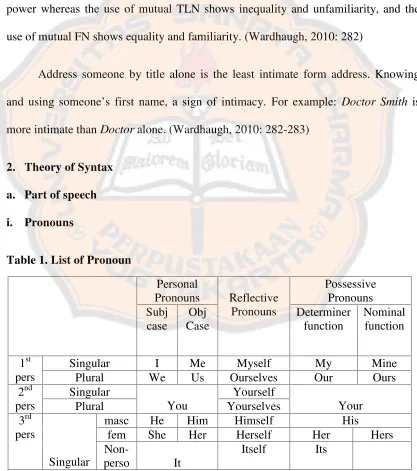
[image:32.612.107.524.232.703.2]2. Theory of Syntax a. Part of speech i. Pronouns
Table 1. List of Pronoun
Personal
Pronouns Reflective Pronouns
Possessive Pronouns Subj
case
Obj Case
Determiner function
Nominal function
1st pers
Singular I Me Myself My Mine
Plural We Us Ourselves Our Ours
2nd pers
Singular
You
Yourself
Your
Plural Yourselves
3rd pers
Singular
masc He Him Himself His
fem She Her Herself Her Hers
Non-perso It
nal
Plural They Them Themselves Their Theirs
(Quirk, 102: 1973)
ii. Adjective
An adjective is used with a pronoun or pronoun to describe the living being or lifeless thing. For example: a little boy, that boy, this boy, a little house. (Curme, 1966: 18) Most adjectives can go in two main places in a sentence. It can be placed
before a noun or after be, seem, look, become and other ‘copular’ verbs. (Swan, 1981: 9)
iii. Inflection of Verbs
Based on Curme, the English verb has forms called voices, moods, tenses, aspects, numbers, and persons that represent the action suggested by the verb as limited in various ways, such as in person, number, time, manner of conception, etc. (Curme, 1966: 52)
English has two voices, the active and the passive. Active voice is indicating that subject doing something. For example: Mary makes good bread. In other case, passive voice is showing that the subject is affected the action from the verb. For example: Johnwas punishedfor disobeying his mother. (Curme, 1966: 52-53)
person indicative in both the present and the past tense. For example are I am, he is, I was, he was,andwe were. In other hand, English has three person that are 1stperson, 2ndperson, and 3rdperson. (Curme, 1966: 56)
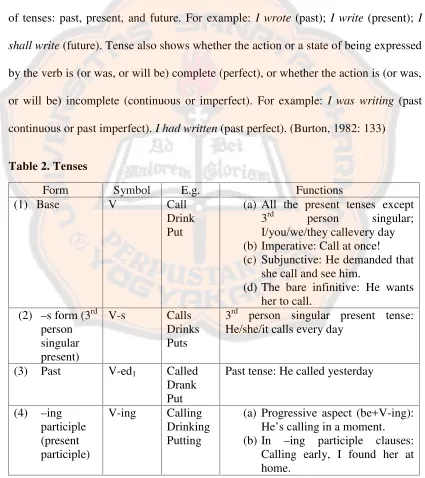
[image:34.612.105.530.223.701.2]Tense is a category to indicate the time of some actions. There are three types of tenses: past, present, and future. For example: I wrote (past); I write (present); I shall write(future). Tense also shows whether the action or a state of being expressed by the verb is (or was, or will be) complete (perfect), or whether the action is (or was, or will be) incomplete (continuous or imperfect). For example: I was writing (past continuous or past imperfect).I had written(past perfect). (Burton, 1982: 133)
Table 2. Tenses
Form Symbol E.g. Functions
(1) Base V Call
Drink Put
(a) All the present tenses except 3rd person singular; I/you/we/they callevery day (b) Imperative: Call at once! (c) Subjunctive: He demanded that
she call and see him.
(d) The bare infinitive: He wants her to call.
(2) –s form (3rd person singular present)
V-s Calls
Drinks Puts
3rd person singular present tense: He/she/it calls every day
(3) Past V-ed1 Called
Drank Put
Past tense: He called yesterday
(4) –ing participle (present participle)
V-ing Calling Drinking Putting
(a) Progressive aspect (be+V-ing):
He’s calling in a moment. (b) In –ing participle clauses:
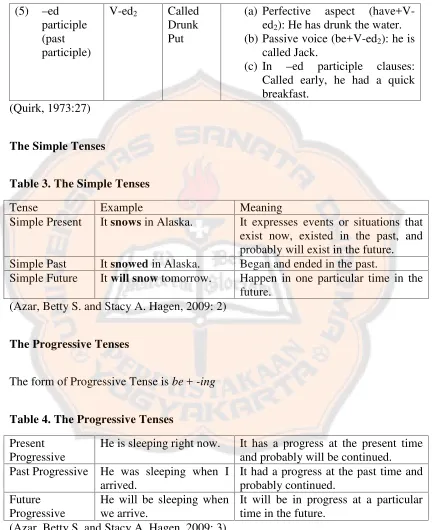
(5) –ed participle (past participle)
V-ed2 Called Drunk Put
(a) Perfective aspect (have+V-ed2): He has drunk the water. (b) Passive voice (be+V-ed2): he is
called Jack.
(c) In –ed participle clauses: Called early, he had a quick breakfast.
(Quirk, 1973:27)
[image:35.612.104.536.110.640.2]The Simple Tenses
Table 3. The Simple Tenses
Tense Example Meaning
Simple Present Itsnowsin Alaska. It expresses events or situations that exist now, existed in the past, and probably will exist in the future. Simple Past Itsnowedin Alaska. Began and ended in the past.
Simple Future Itwill snowtomorrow. Happen in one particular time in the future.
(Azar, Betty S. and Stacy A. Hagen, 2009: 2)
The Progressive Tenses
The form of Progressive Tense isbe+-ing
Table 4. The Progressive Tenses Present
Progressive
He is sleeping right now. It has a progress at the present time and probably will be continued. Past Progressive He was sleeping when I
arrived.
It had a progress at the past time and probably continued.
Future Progressive
He will be sleeping when we arrive.
It will be in progress at a particular time in the future.
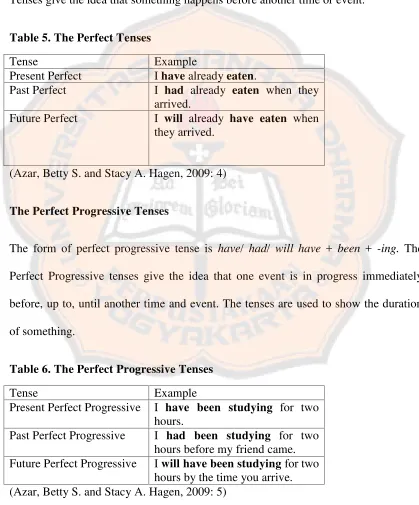
The Perfect Tenses
[image:36.612.104.523.186.691.2]The form of perfect tense is have/ had / will have + Past participle. The Perfect Tenses give the idea that something happens before another time or event.
Table 5. The Perfect Tenses
Tense Example
Present Perfect Ihavealreadyeaten.
Past Perfect I had already eaten when they arrived.
Future Perfect I will already have eaten when they arrived.
(Azar, Betty S. and Stacy A. Hagen, 2009: 4)
The Perfect Progressive Tenses
The form of perfect progressive tense is have/ had/ will have + been + -ing. The Perfect Progressive tenses give the idea that one event is in progress immediately before, up to, until another time and event. The tenses are used to show the duration of something.
Table 6. The Perfect Progressive Tenses
Tense Example
Present Perfect Progressive I have been studying for two hours.
Past Perfect Progressive I had been studying for two hours before my friend came. Future Perfect Progressive Iwill have been studyingfor two
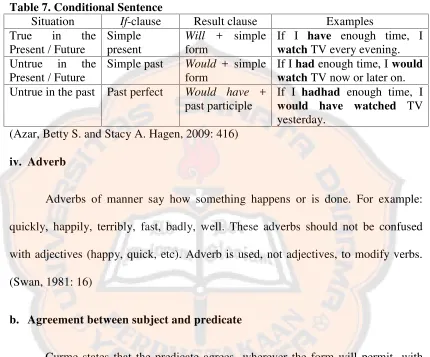
Conditional Sentence
Table 7. Conditional Sentence
Situation If-clause Result clause Examples
True in the Present / Future
Simple present
Will + simple form
If I have enough time, I watchTV every evening. Untrue in the
Present / Future
Simple past Would + simple form
If Ihadenough time, Iwould watchTV now or later on. Untrue in the past Past perfect Would have +
past participle
If I hadhad enough time, I would have watched TV yesterday.
(Azar, Betty S. and Stacy A. Hagen, 2009: 416) iv. Adverb
Adverbs of manner say how something happens or is done. For example: quickly, happily, terribly, fast, badly, well. These adverbs should not be confused with adjectives (happy, quick, etc). Adverb is used, not adjectives, to modify verbs. (Swan, 1981: 16)
b. Agreement between subject and predicate
Curme states that the predicate agrees- wherever the form will permit- with the subject in number, person, gender, and case. In number, if the subject is singular, the verb is also singular. If the subject is plural, or if there are several subjects, the verb is plural. (Curme, 1966: 115)
subject of a sentence is the name of a book, drama, or newspaper, the verb is singular. (Curme, 1966: 115-118)
If the subject is plural, or of there are many subjects, the verb is also plural. In some cases, nouns that are plural in form are singular in meaning. For example are
gallows, news, andmumps. They take a singular verb in the English usage. The verb is also plural when the there are two subjects and connected by conjunction and. (Curme, 1966: 116-117)
The use of suffix–s or–es
A suffix –s or –es is given to a simple present verb when the subject is a singular noun (such as Mary, my father, the machine) or third person singular pronoun (she,he, it). In other sides, if a suffix–s or–es is not given, the subject must be a plural noun (such as the students work). (Azar, Betty S. and Stacy A. Hagen, 2009: 85)
c. Emphatic tags
Tags used to change statements into questions, such as isn’t it andcan’t you. The use of tags withsois typical of speech in Northern Ireland, while in the north of England one frequently hears constructions with an inverted verb phrase, such as
she’s a good dancer, is Katy or simply an emphatic pronoun tagged onto the end of a statement, such as I play football, me. (http://www.bl.uk/learning/langlit/sounds/text-only/ni/lissummon, October 27, 2014)
d. NoandNone
No is used before a singular or plural noun. For example; we’ve got no plans for the summer. In other side, none of is used before a determiner (e.g.the, my, this) and also before pronoun. For example: none of the keys would open the door. (Swan, 1981: 370)
e. Possessive’s
Definite articles are usually dropped when possessives are used. For example: the car that is John’s= John’s car (NOT the John’s car or John’s the car) But a possessive word may have its own article. For example: the car that is the boss’s =
the boss’scar.
When a noun with a/an or this/that are wanted to be used, ‘of mine’ construction is used. For example: she’s a cousin of John’s (NOT …. A John’s cousin). (Swan, 1981: 433)
Articlea/an is used with singular countable nouns since the original meaning of a/an is ‘one’. Before plural and uncountable nouns, some/any or no article are normally used. For example: we metsome nice French girlson holiday. (NOT ….A nice French girls…. (Swan, 1981: 60)
The articleachanges to anif it comes before a vowel. For example:arabbit, a lemon, an elephant, and an orange. The choice between a and an depends on pronunciation, not spelling. An article an is used before a vowel sound, even if it written as a consonant. For example:an hour. (Swan, 1981: 61)
g. There
The uses of there are as an adverb of place and as an introductory subject. When thereis used as an adverb of place,there has a meaning of ‘in that place’. For example: what’s that green thing over there? When there is used as an introductory subject, there is placed in the beginning of sentences. For example: there’s a book under the piano. (Swan, 1981: 591)
h. Sentence
shows strong feeling. It uses an exclamation point. (Brewton, John E. et al, 1962: 250)
A sentence also can be classified based on its number and kinds of clauses. A clause is a group of some words that has a subject and predicate. Some clauses can be used alone as complete sentence, whereas others are used as a part of sentence. There are two kinds of clauses such as independent or principal clause and dependent or subordinate clause. (Brewton, John E. et al, 1962: 250)
An independent clause is a clause that shows a complete thought and can stand alone as a sentence whereas a dependent clause is a clause that depends on the rest of the sentence for its meaning. (Brewton, John E. et al, 1962: 251)
A simple sentence is made up of one independent clause. A compound sentence is made up of two or more independent clause. The independent clauses in a compound sentence can be linked by and, but, or, or nor preceded by a comma. A complex sentence is made up of one independent clause and one or more dependent clause. A compound-complex sentence is made up of two or more independent clauses and one or more dependent clauses. (Brewton, John E. et al, 1962: 251)
i. Parallel structure
such as and or or are used. (https://owl.english.purdue.edu/owl/resource/623/01/, April 30, 2015)
The use of conjunctions and,but, or, and norare to connect words or phrases that have same grammatical function in a sentence and this use of conjunctions is called parallel structure. The examples are given such as:
Susanraisedandsnappedher fingers. (Verb +and+ verb)
Heis waving his armsand(is)shoutingat us. (Verb +and+ verb)
(Azar, Betty S. and Stacy A. Hagen, 2009: 91)
i. Question
In a question, an auxiliary verb normally comes before the subject. For example: why are you laughing? In question, only the auxiliary verb that comes before the subject, not whole of the verb. For example: when was your reservation made? (Swan, 1981: 474-475)
C. Theoretical Framework
dialect to the children. Theory of dialect and grammar are needed to help analyzing those main points.
In the first point, the theory of grammar is needed because this thesis wants to analyze further about the grammatical features used by Martha and Ben, two characters inThe Secret Gardennovel who use the Yorkshire dialect.
27 CHAPTER III
METHODOLOGY
A. Object of the Study
knows that Mary knows the existence of Colin. Martha is required by Mrs. Medlock not to tell Mary about Colin. Martha feels afraid that she will be fired. In fact, Colin as her employer does not fire her. Colin asks Martha that he wants to go outside. He wants to play with Mary in the garden. For the first time, Colin meets Ben. Ben really
shocks of what he sees since Colin has eyes like her mother. When Colin’s mother lives,Ben is Colin mother’s gardener. He loves Colin’s mother and always takes care of her roses.
As stated inThe Secret Garden, Martha and Ben are the Yorkshire lower class people who use the Yorkshire dialect. Even though there are many characters using the Yorkshire dialect in The Secret Garden such as Mrs. Medlock, Dickon, Mr. Archibald Craven, and Colin, Martha and Ben are chosen to represent the grammar feature on the Yorkshire dialect based on their utterances to the children.
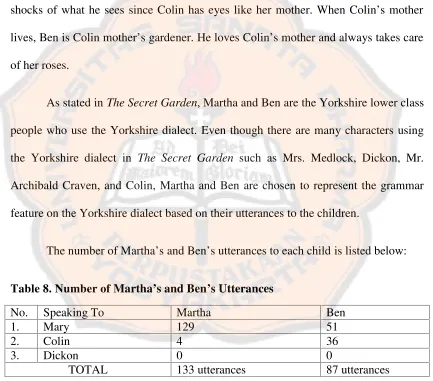
[image:45.612.103.536.221.602.2]The number of Martha’s and Ben’s utterances to each child is listed below:
Table 8. Number ofMartha’s and Ben’s Utterances
No. Speaking To Martha Ben
1. Mary 129 51
2. Colin 4 36
3. Dickon 0 0
TOTAL 133 utterances 87 utterances
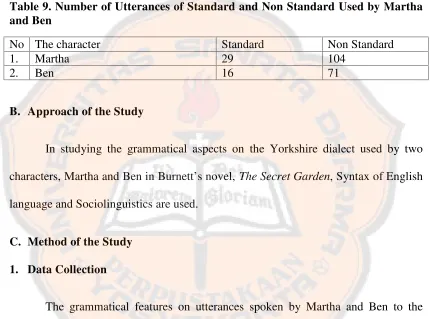
sentence, or even more than one sentence. In their utterances, Martha and Ben use Standard and Non Standard dialect. The table of utterances of Standard and Non Standard dialect is as follow.
Table 9. Number of Utterances of Standard and Non Standard Used by Martha and Ben
No The character Standard Non Standard
1. Martha 29 104
2. Ben 16 71
B. Approach of the Study
In studying the grammatical aspects on the Yorkshire dialect used by two
characters, Martha and Ben in Burnett’s novel, The Secret Garden, Syntax of English language and Sociolinguistics are used.
C. Method of the Study 1. Data Collection
The grammatical features on utterances spoken by Martha and Ben to the children are explained in this study. Martha’s and Ben’s utterances to the children (Mary and Colin) are given in the appendix of this research.
After reading the novel by Frances Hodgson Burnett, all utterances of Martha and Ben to Mary and Colin as children are written. The utterances are presented in the appendix. Then, the writer finds sources that are related to this study including books, undergraduate thesis, journals, and websites that will help to answer problems mentioned before. Next, there are two tables thatare made. The first table is Martha’s utterances whereas the second one is Ben’s utterances.
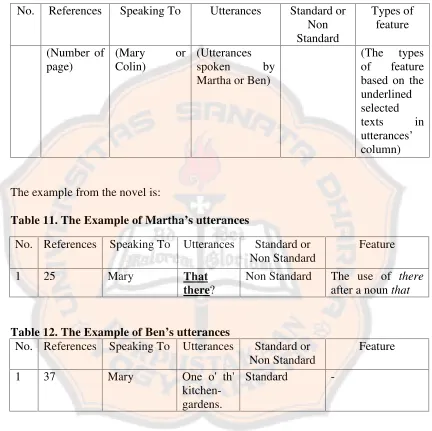
Table 10. Utterances Spoken by Martha and Ben to Mary and Colin No. References Speaking To Utterances Standard or
Non Standard
Types of feature (Number of
page)
(Mary or
Colin)
(Utterances spoken by Martha or Ben)
(The types of feature based on the underlined selected texts in
utterances’ column)
[image:48.612.103.535.134.565.2]The example from the novel is:
Table 11. The Example ofMartha’s utterances
No. References Speaking To Utterances Standard or Non Standard
Feature
1 25 Mary That
there?
Non Standard The use of there
after a nounthat
Table 12. The Example ofBen’s utterances
No. References Speaking To Utterances Standard or Non Standard
Feature
1 37 Mary One o' th'
kitchen-gardens.
Standard
-2. Data Analysis
Martha’s and Ben’s reasons of speaking Standard and the Yorkshire dialect to the children. To be able to answer those questions, the analysis is done in some steps.
The first problem contains the features used by Martha and Ben in talking to the children. Based on Fasold and Connor-Linton, the pattern of the dialect can be described from the lexical, phonological, syntax, and also discourse variation (Fasold and Connor-Linton, 2006: 310). In fact, the writer only focuses on syntax variation.
InThe Secret Garden novel, Martha and Ben sometimes speak the Yorkshire dialect and sometimes speak Standard English to the children. In this research, the writer wants to determine what the grammatical features used by Martha and Ben in the Yorkshire dialect only. The writer will compare the Yorkshire dialect spoken by Martha and Ben with the theory of Standard English made by linguistics experts.
In this explanation of the grammatical features, the writer divides the types of features into seven such as pronouns and nouns, verbs and auxiliaries, word order, article, prepositions; conjunctions; and adverbs, negatives, and Non Standard vocabulary. For example, in pronoun feature, Martha and Ben often use pronoun tha
in their utterances. It compares with Standard English. In Standard English, pronoun
youis used.
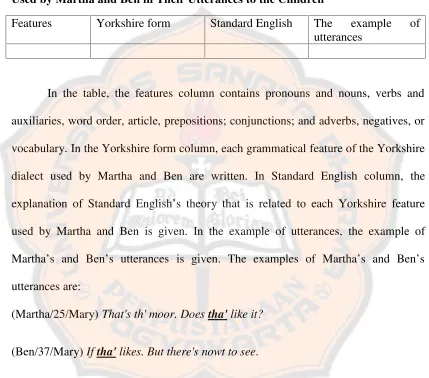
The example of the table is:
Table 13. The Example of the Grammatical Features on the Yorkshire Dialect Used by Martha and Ben in Their Utterances to the Children
Features Yorkshire form Standard English The example of utterances
In the table, the features column contains pronouns and nouns, verbs and auxiliaries, word order, article, prepositions; conjunctions; and adverbs, negatives, or vocabulary. In the Yorkshire form column, each grammatical feature of the Yorkshire dialect used by Martha and Ben are written. In Standard English column, the explanation of Standard English’s theory that is related to each Yorkshire feature used by Martha and Ben is given. In the example of utterances, the example of Martha’s and Ben’s utterances is given. The examples of Martha’s and Ben’s utterances are:
(Martha/25/Mary)That's th' moor. Doestha'like it?
(Ben/37/Mary)Iftha'likes. But there's nowt to see.
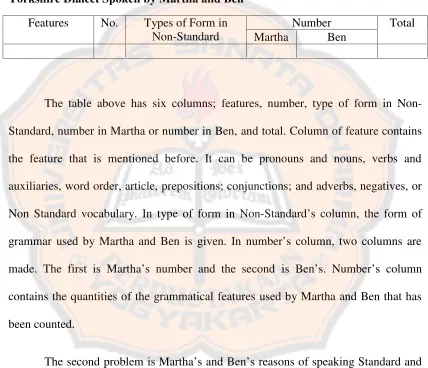
[image:50.612.102.531.173.551.2]Then, the common grammatical feature of the Yorkshire dialect spoken by Martha and Ben is given. The table is made.
Table 14. The Example of List of the Common Grammatical Features on the Yorkshire Dialect Spoken by Martha and Ben
Features No. Types of Form in Non-Standard
Number Total
Martha Ben
The table above has six columns; features, number, type of form in Non-Standard, number in Martha or number in Ben, and total. Column of feature contains the feature that is mentioned before. It can be pronouns and nouns, verbs and auxiliaries, word order, article, prepositions; conjunctions; and adverbs, negatives, or Non Standard vocabulary. In type of form in Non-Standard’s column, the form of grammar used by Martha and Ben is given. In number’s column, two columns are made. The first is Martha’s number and the second is Ben’s. Number’s column contains the quantities of the grammatical features used by Martha and Ben that has been counted.
The second problem is Martha’sand Ben’sreasons of speaking Standard and the Yorkshire dialect to the children. In The Secret Garden novel, Martha and Ben speak both standard and the Yorkshire dialect to the children; Mary and Colin.
[image:51.612.105.533.201.569.2]raisan (resultat), locale, agents (instrumentalities), norms, to (key), and types (genres) (Hymes, 1974:62). One of those factors above is ends. Ends is divided into two
things. The first is the speaker’s and addressee’s goals in their practice in communication. The second is the outcomes that attained. The outcomes whether intended or not may be different from the goal that has been planned. (Hymes, 1974: 57)
The theory of tu and vous by Wardhaugh is also used to help answering the second problem. Wardhaugh says that tu and vous are used based on someone’s social class. In medieval times, the upper classes use V forms with each other to show politeness whereas the lower classes use T forms to show solidarity. The upper classes treat lower classes with T but received V. that condition symbolizes a ‘power’
relationship. It happens to situations such as people to animals, master or mistress to servants, parents to children, and priest to penitent. (Wardhaugh, 1992: 259)
36
CHAPTER IV
ANALYSIS RESULTS AND DISCUSSION
In this chapter, there will be two analyses. The first one is the grammatical features in Non-Standard form used by Martha and Ben in talking to the children. The second is Martha’s and Ben’sreasons of speaking Standard and the Yorkshire dialect to the children.
Based on What is Sociolinguistics, standard is the rule or law of a language. Standard English is often taught in school, used in formal writing, and often be heard from newscasters, and other media figures who are trying to project authority or ability. In other side, non-Standard is described as varieties of language that is out of the standard. (Herk, 2012: 12)
[image:53.612.102.534.218.698.2]A. Analysis of the grammatical features on the Yorkshire dialect used by Martha and Ben in their utterances to the children
Table 15. The Grammatical Features on the Yorkshire Dialect Used by Martha and Ben in Their Utterances to the Children
Features The
Yorkshire Form
Standard English The example of utterances
Nouns and pronouns
Pronountha You
Tha means you. (www.urbandictionary .com/define.php?term =Tha,Oct 16, 2014)
Features The Yorkshire
Form
Standard English The example of utterances
Nouns and pronouns
Pronounthee You
Thee is an old English form of object pronoun thouand now replaced by you (The Oxford American Dictionary and Thesaurus, 2003: 1585)
(Martha/86/Mary) Two pieceso’ meat an’ two helps o’ rice puddin’! Eh! Mother will be pleased when I tell her what th’ skippin’-rope’s done forthee.
(Ben/39/Mary) There was nothin’ to preventthee. Pronounthy Your
Thy is a possessive pronoun and now replaced by your
except in some formal, liturgical, dialect, and poetic uses (The Oxford American Dictionary and Thesaurus, 2003: 1597)
(Martha/30/Mary) I’ll help thee on with thy clothes if tha’ll get out o’ bed.
(Ben/79/Mary) Well! Upon my word! P’raps tha’ art a young ‘un, after all, an’ p’raps tha’s got child’s blood inthyveins instead of sour buttermilk.
Reflective pronoun
thysen,thyself
Yourself
Thysen and thyself are the archaic form of
yourself
(http://www.merriam-webster.com/dictionar y/thyself, October 16, 2014)
(Martha/28/Mary) Well, it's time tha' should learn. Tha' cannot begin younger. It'll do thee good to wait on
thysena bit.
(Ben/246/Colin) What did tha’ shutthysel’up for?
The adding of
that in answering yes/no interrogative sentence
Yes/no + subject + auxiliary (+ n’t)
(http://www.englisch-hilfen.de/en/grammar/ frage4.htm, October 8, 2014)
(Martha/26/Mary) Aye, that I do. I just love it. It's none bare. …
Features The Yorkshire
Form
Standard English The example of utterances
Nouns and pronouns
Subject
pronoun used as a redundant element
Redundant means repeating something else and therefore unnecessary
(http://www.merriam-webster.com/dictionar y/redundant Oct 20, 2014)
(Martha/30/Mary) He said,
‘I won’t have a child dressed in black wanderin’ about like a lost soul,’ he said. ‘It’d make the place
sadder that it is. Put color
on her.’ Mother she said she knew what he meant. Mother always knows what
a body means. She doesn’t hold with black hersel’.
3rd person singular subject
pronoun him
andher
He,she
(Quirk, 102: 1973)
(Martha/51-52/Mary) Him
an’ her used to go in an’
shut th’ door an’ stay three hours an’ hours, readin’ and talkin’.
(Ben/239-240/Mary) Him
showin' thee th' way!Him!
Zero plural marker
Nouns such as week, month, year, pound, stone and mile are unmarked for plural in many varieties of non-standard English, but Standard English requires the plural suffix <-s>
(http://www.bl.uk/lear ning/langlit/sounds/cas
e-studies/geordie/gramm ar/, Sept 30, 2014)
(Martha/65/Mary) Tha’ couldn’t walk five mile. It’s
five mileto our cottage.
(Ben/292/Colin) I was
thinkin’ as I’d warrant tha’s
gone up three or four pound this week. I was
Features The Yorkshire
Form
Standard English The example of utterances
Nouns and pronouns
Subject
pronoun them
andus
They,we
(Quirk, 102: 1973)
(Martha/88-89/Mary) Them
was the very words she said.
(Martha/120/Mary) Well, he's th' best lad as ever was born, but us never thought he was handsome.
Anticipatory pronoun
Much of the North of England speakers frequently use a pronoun as an emphatic tag in expressions, such as I play football, me or he's a madman, him (http://www.bl.uk/lear ning/langlit/sounds/cas
e-studies/geordie/gramm ar/, Sept 30, 2014)
(Martha/30/Mary) She
doesn’t hold with black
hersel’.
(Ben/42/Mary) I’m lonely
mysel’ except when he’s
with me.
Reflective pronoun
hisself
Himself
(Quirk, 102: 1973)
(Ben/41/Mary)He knows all th' things Mester Craven never troubleshissel'to find out.
Verbs and Auxiliaries
The use of –s on non-third person
singular present-tense verb
-s on third person singular present-tense verb
Agreement between subject and verb (Curme, 1966: 115)
(Martha/25/Mary) That's th' moor.Does tha'like it?
(Ben/44/Mary) … Th' very blackberries an' heatherbells knows him. I warrant th' foxes shows
him where their cubs lies
an' th'skylarks doesn't hide
Features The Yorkshire
Form
Standard English The example of utterances
Verbs and auxiliaries
Pronoun tha + archaic to be
or tha +
archaic modal verb (tha’rt
andtha’lt)
You are,you will Archaic is commonly used in an earlier time but rare in present-day usage except to suggest the older time, as in religious rituals or historical novels (http://dictionary.refer ence.com/browse/arch aic, April 20, 2015)
(Martha/26/Mary) That’s
because tha’rt not used to
it. Tha thinks it’s too big an’ bare now. But tha’ will like
it.
(Ben/42/Mary) Then no wonder tha’rtlonely. Tha’lt
be lonelier before tha’s
done.
Present Progressive Tense and Past
Progressive Tense be + to + simple verb
Subject + be + V–ing
(Azar, Betty S and Stacy A. Hagen, 2009: 3)
(Martha/27/Mary) I'm Mrs. Medlock's servant. An' she's Mr. Craven's—butI'm to do
the housemaid's work up here an' wait on you a bit. But you won't need much waitin' on.
3rd person and 2nd person pluralwas/is
Were,are
Agreement between subject and verb (Curme, 1966: 115)
(Martha/28/Mary) When I heard you was comin' from India I thought you was a black too.
(Ben/96/Mary) Tha's beginnin' to do Misselthwaite credit. Tha's
a bit fatter thantha' wasan'
Features The Yorkshire
Form
Standard English The example of utterances
Verbs and auxiliaries
Unequal verb tenses with coordinating conjunction
and
Parallel structure The use of conjunction and, but, or, and nor are to connect words or phrases that have same grammatical function in a sentence (Azar, Stacy A. Hagen, 2009: 91)
(Martha/32/Mary) He found it on th' moor with its mother when it was a little one an' he began to make friends with it an' give it bits o' bread an' pluck young grass for it. And it got to like him so it follows him about an' it lets him get on its back. Dickon's a kind lad an' animals likes him.
(Ben/41/Mary) When he went over th' wall again th' rest of th' brood was gone an' he was lonely an' he come back to me.
Verb +about (Martha/32/Mary) They
tumble about on th' moor an' play there all day an' mother says th' air of th' moor fattens 'em.
(Ben/99/Mary) Once or twice a year I'd go an' work at 'em a bit—prune 'em an'
dig aboutth' roots.
3rd person singular + simple verb
A final –s or –es is given to a simple present verb when the subject is a singular noun
(Azar, Betty S. and Stacy A. Hagen, 2009: 85)
Features The Yorkshire
Form
Standard English The example of utterances
Verbs and auxiliaries
Would have + simple verb in conditional sentence type 3
[past perfect (if -clause)] + [would have
+ past participle (result clause)]
(Azar, Betty S. and Stacy A. Hagen, 2009: 416)
(Martha/78/Mary) If tha’d been our ‘Lizabeth Ellen
tha’d have giveme a kiss.
Had + simple past in Past Perfect
Had + past participle is used in past perfect (Azar, Betty S., Stacy A. Hagen, 2009: 4)
(Martha/122/Mary) She’d never spoke to him before, but Mrs. Craven had been to our cottage two or three times. He’d forgot, but mother hadn’t an’ she made
bold to stop him.
The use of auxiliary verb afternone as
None of
None ofis used before a determiner (the, my,
this) and also before pronoun. (Swan, 1988: 370)
(Ben/45/Mary) None as any one can find, an' none as is
anyone's business.
Seed as a past tense ofsee
Saw (Ben/246/Colin) When I
seedthee put tha' legs on th' ground in such a hurry I knowed tha' was all right.
The use of present tense to describe past event
Past tense (Ben/247/Colin) I'm no one. An' I didn't come through th' door. I come over th' wall. Th' rheumatics held
me back th' last two year'.
3rd person and 1st person singularwere
Was (Ben/247/Colin) Aye, it was
Features The Yorkshire
Form
Standard English The example of utterances
Word order To be comes after subject in
interrogative sentence
Are you
Auxiliary verb is placed before subject. For example: why are you laughing? (Swan, 1988: 474)
(Ben/241/Colin) Who tha' art?
Little + there isformation
There + be formation introduces the idea that something exists in a particular place and there + be
formation have to be
followed by the subject (Azar, Betty S. and Stacy A. Hagen, 2009: 91)
(Martha/34/Mary) However little there is to eat, he always saves a bit o' his bread to coax his pets.
The absence of subject in interrogative sentence
Are you
Auxiliary + Subject + Verb is used in interrogative sentence (Kruisinga, 1915: 461)
(Ben/245/Mary) What art _
sayin'?
Article The adding of article a after possessive
Defines articles are usually dropped when possessives are used. For example: the car that isJohn’s= John’s
car (notthe John’s car
or John’s the car) (Swan, 1988: 440 -441)
(Martha/28-29/Mary) You
always read as a black’s a
man an’abrother.
Article a on third person plural
Article a/an is used
with singular
countable nouns since the original meaning
of a/an is ‘one’.
(Swan, 1988: 60)
(Martha/120/Mary) Though
Features The Yorkshire
Form
Standard English The example of utterances
Article Article a
comes before a vowel
An
The article a changes to an if it comes before a vowel. (Swan, 1988: 61)
(Martha/150/Mary) Th’ world’s comin’ toa end!
Preposition s, conjunction s, adverbs Zero adverbial marker
Adverbs of manner say how something happens or is done. Adverbs should not be
confused with
adjectives. Adverb is used, not adjectives, to modify verbs. (Swan, 1988: 16)
(Martha/28-29/Mary) When I come in to light your fire
this mornin’ I crep’ up to
your bed an’ pulled th’
cover back careful to look at you.
There used as an adjective
There used as an
adjective for
emphasis, usually placed after a demonstrative
adjective but before the noun modified. This function of there
is used in nonstandard form
(http://www.merriam-webster.com/dictionar y/there, April 28, 2015)
In Standard English, the uses of there are as an adverb of place and an introductory subject. (Swan, 1988: 589)
(Martha/93/Mary) Mr. Craven would be that there
Features The Yorkshire
Form
Standard English The example of utterances
Preposition s,
conjunction s, adverbs
Unequal clause level with
coordinating conjunction and
Conjunctions and, but,
or, andnor are used to connect words or phrases that have same grammatical function in a sentence and this use of conjunctions is called parallel structure. (Azar, Betty S., Stacy A. Hagen, 2009: 91)
(Martha/151/Mary) He'd been out of his head an' she was talkin' to th' nurse, thinkin' he didn't know nothin', an'