chapter 1
1.1 BACKGROUND
Coasts and the world’s oceans are crucial to life on Earth, they support livelihoods, and are vital to the global economy in many ways. Coastal ecosystems exist at the interface between terrestrial and marine environments. hey include some of the most diverse and dynamic environments on earth. his narrow band of the earth’s surface attracts human populations because it is a focal point for economic growth—accounting for a majority share of humanity’s infrastructure, transportation and trade, energy processing, tourism, and recreation. Coastal ecosystems provide a myriad of ecological goods and services. hey provide habitat and nurseries for the majority of commercially important marine ish and shellish species, and provide food security and livelihoods for over 1 billion people. hey ofer storm surge protection, erosion control, and lood mitigation. hey also help retain nutrients and sediments and ilter pollutants. hus, the socioeconomic and ecological importance of the coastal zone is virtually unparalleled.
Considering that the majority of humans reside along coasts, coastal regions have become uniquely impor tant to the well-being of society and the need for proactive action to adapt to climate changes is ever more pressing.
Global climate change already impacts and will continue to impact coastal communities, ecosystems, and many facets of people’s lives in the coastal zone where approximately 2.7 billion people—over 40% of the world's population—live. Even without climate change, coastal areas face a litany of problems associated with population growth, habitat change, resource over-exploitation and degradation, water pollution, and changes in freshwater lows. Climate change is expected to amplify many of these and other stresses on coastal areas. his in turn increases the need and urgency to include coastal adaptation as part of efective coastal management. As a consequence of these realities, climate change is considered by many to be one of the most important challenges of the 21st century and a priority for immediate action for coastal areas.
In 2007, the Global Climate Change Team in the United States Agency for International Development (USAID) Bureau for Economic Growth, Agriculture
and Trade developed guidance to help USAID Missions and partners account for and address vulnerabilities to climate variability and change in their projects and programs. he document, Adapting to Climate Variability and Change – A Guidance Manual for Development Planning (USAID, 2008), is structured around a six-step vulnerability and adaptation (V&A) process1. his process helps planners and stakeholders
to assess vulnerability to climate variability and change, and to identify, assess, select, implement, and evaluate adaptation options that reduce climate impacts.
he V&A Manual was intended as general guidance on the full range of climate concerns and impacted sectors. It provides links to important sources of information and tools and ofers a broad overview of methods and best practices for conducting vulnerability assessments and evaluating adaptation measures. he V&A Manual includes case studies illustrating some of these best practices.
his coastal adaptation Guidebook is a companion document to the V&A Manual and provides the practitioner with more detailed and sector-speciic
guidance for responding to climate variability and change impacts on coastal areas. he emphasis is on developing country contexts.
he Guidebook’s primary goals are to:
• Advance understanding of climate change impacts along coasts, vulnerability, and approaches for mainstreaming coastal adaptation measures into development policies, plans, and programs
• Provide practical adaptation options for responding to the impacts of climate variability and change on the coast
• Draw lessons from experience on how to overcome implementation barriers and utilize an adaptive management approach to coastal climate adaptation
TERMINOLOGY
Adaptation: Adjustment in natural or human systems in response to actual or expected climatic changes or their impacts, so as to reduce harm or exploit beneicial opportunities.
Climate change: Any change in weather averaged over time due to natural variability or because of human activity.
Climate variability: Variations in the mean state and other statistics (such as standard deviations, the occurrence of extremes, etc.) of the climate on all temporal and spatial scales beyond that of individual weather events. Examples of climate variability include extended droughts, loods, and conditions that result from periodic El Niño and La Niña events.
Hazard Mitigation: Sustained action taken to reduce or eliminate long-term risk to life and property from a hazard event. Considered as one of four phases of emergency management, together with preparedness, response, and recovery.
Mitigation: Within a climate change context, mitigation is a human intervention to actively reduce the production of greenhouse gas emissions (reducing energy consumption in transport, construction, at home, at work etc.), or to remove the gases from the atmosphere (sequestration)
Vulnerability: The degree to which a human or natural system is susceptible to, or unable to cope with, adverse effects of climate change. Vulnerability is a function of the character, magnitude, and rate of climate variation to which a system is exposed, its sensitivity, and its adaptive capacity. by coastal practitioners and includes the following steps: vulnerability assessment (Step 1), planning and selection of a course of action (Step 2), formal adoption or mainstreaming of adaptation actions (Step 3), implementation (Step 4), and evaluation (Step 5). his highlights a central message of the Guidebook: the process of coastal planning and action is not radically changed by applying a climate lens. While the process and good practices of planning and program management apply equally to climate change as they do to other coastal issues, the Guidebook will show that some of the strategies of coastal management are inluenced by climate change considerations. For example, there will be greater emphasis on nature-based adaptations and a longer planning horizon must be taken into account.
Each chapter of the Guidebook refers to one of the ive steps of the program cycle. Chapter 2 focuses on diagnosis of coastal climate change impacts, trends, and vulnerability. Chapter 2 also summarizes current stresses and threats to coastal areas from development pressures and weaknesses in management.
Coastal communities are likely to face a number of climate-impacted issues and challenges—some in the near term and others within the next several
Coastal adaptation requires a mandate and funding. Chapter 4 describes how coastal V&A can be mainstreamed into public planning and budgeting processes and policies at national, sub-national, and local scales. ICM experience has taught us that the list of potential obstacles to successful mainstreaming is long. his chapter presents lessons learned on overcoming these obstacles and ofers strategies and preconditions for sustained mainstreaming of coastal adaptation.
After the adaptation options have been evaluated and selected and once there is a formal mandate and funding
to proceed, you are ready to take action. Chapter 5 focuses on making adaptation plans operational and overcoming typical obstacles to successful implementation.
Coastal adaptation is not a one-time event. It is an adaptive and iterative process. Chapter 6 focuses on evaluating the progress of the actions that are undertaken and adapting to changing conditions based on valid reasons and circumstances.
Step 1
Assess vulnerability
Chapter 2
Assess climate change impacts, trends and vulnerability
Step 2
Select course of action
Chapter 3
Prioritize issues and deine adaptation goals Analyze and select adaptation measures
Step 3
Mainstream coastal adaptation
Chapter 4
Mainstream coastal adaptation in policy, plans, and programs Secure mandate and funding
Step 4
Implement Adaptation
Chapter 5
Implement adaptations Take actions to build capacity and avoid implemenntation barriers
Step 5
Evaluate for adaptive management
Chapter 6
Evaluate adaptations Take adaptive actions
Each chapter of the Guidebook refers to one of the ive steps of the program cycle. Chapter 2 focuses on diagnosis of coastal climate change impacts, trends, and vulnerability. Chapter 2 also summarizes current stresses and threats to coastal areas from development pressures and weaknesses in management.
Coastal communities are likely to face a number of climate-impacted issues and challenges—some in the near term and others within the next several years or decades. Chapter 3 provides guidance on setting priorities and formulating adaptation goals. It also provides a list of 17 adaptation measures and summarizes the criteria for evaluating and selecting adaptations.
Coastal adaptation requires a mandate and funding.
Chapter 4 describes how coastal V&A can be mainstreamed into public planning and budgeting
processes and policies at national, sub-national, and local scales. ICM experience has taught us that the list of potential obstacles to successful mainstreaming is long. his chapter presents lessons learned on overcoming these obstacles and ofers strategies and preconditions for sustained mainstreaming of coastal adaptation.
After the adaptation options have been evaluated and selected and once there is a formal mandate and funding to proceed, you are ready to take action. Chapter 5 focuses on making adaptation plans operational and overcoming typical obstacles to successful implementation.
chapter 2
This chapter first provides an overview of climate change observations and trends in the coastal zone, their impacts on coastal sectors, and the panoply of existing threats to human and natural ecosystems in the coastal zone. Climate change only amplifies these threats and further increases the challenges of strategically managing the coasts and seas and their extraordinary but shrinking resources. he chapter then explores four critical factors: climate change projections, exposure to climate change, sensitivity to climate change, and the capacity of society to cope with actual or expected climate changes (adaptive capacity and resiliency of coastal ecosystems). Coastal vulnerability hot-spots are also highlighted.
2.1
GLOBAL CLIMATE
CHANGE AND THREATS TO
THE WORLD’S COASTS
here is scientiic consensus that increases in greenhouse gases in the atmosphere drive the warming of air and sea temperatures and cause the world’s oceans to acidify from the carbon dioxide they absorb. Even if greenhouse gases were capped today, air and sea temperatures will continue to rise as a result of past emissions—as greenhouse gases in the atmosphere have a lifetime of between 10 and several thousand years. Warming of air and sea induces precipitation change, sea level rise, and more extreme weather events (e.g., storms and sea surge). he most signiicant and immediate consequences of these climate changes for the world’s coasts include coastal erosion, flooding, drought, saltwater intrusion, and ecosystem change. here are also other health, economic and social impacts.
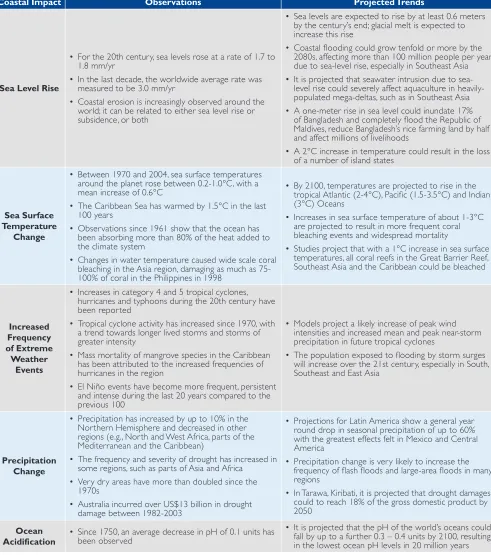
hese climate changes and impacts are already afecting coastal areas and ecosystems and projections for the coming decades paint a somber picture. Table 2.1 summarizes observations and trends of the effects of increased greenhouse gases on coastal and ocean systems.
Rising sea-level poses a severe threat to countries where their coastal regions have heavy concentrations
of population and economic activity. hrough the 20th century, global rise of sea level contributed to increased coastal inundation, erosion and ecosystem loss (IPCC, 2007a). Until recently, studies of sea level rise typically predicted a 0-1 meter rise during the 21st century. For example, the Intergovernmental Panel on Climate Change (IPCC) anticipates that sea level will rise by 0.6 m or more by 2100 (IPCC, 2007c). Ocean thermal expansion was expected to be the dominating factor behind this rise. However, new data on rates of deglaciation (the uncovering of land previously covered by a glacier) in Greenland and Antarctica suggest that glacial melt may play a signiicant role in creating an even greater rise in sea level—i.e., 1-3 meters in this century (Dasgupta et al., 2007). A rise of this amount would displace hundreds of millions of people in the developing world.
Sea level rise and other changes brought on by climate change can afect land-based activities (see Figure 2.1) and coastal ecosystems, especially wetlands and coral reefs, and have serious implications for the well-being of societies dependent on coastal ecosystems for goods and services. Rises in marine/coastal water surface temperatures lead to the bleaching and widespread mortality of coral reefs. Further, saltwater will displace or at least intrude coastal aquifers; and estuarine systems will likely become more brackish. Alterations to estuarine and marine ecosystems will have potentially severe impacts on isheries and the goods and services provided by marine and coastal biodiversity.
As more carbon dioxide (CO2) dissolves in the oceans, they become more acidic (decreased seawater pH). his creates the potential for widespread efects on marine ecosystems. It may inhibit calciication, which will threaten the survival of coral-reef ecosystems. It will inhibit the growth of calcareous algae at the base of the food web and of shell-forming marine organisms (such
VULNERABILITY ASSESSMENT
Assess climate change projections
Assess exposure to climate change
Assess sensitivity to climate change
Assess health of coastal habitats and ecosystems
Assess adaptive capacity
Table 2.1 A Summary of climate change observations and trends in the coastal zone
Coastal Impact Observations Projected Trends
•
For the 20th century, sea levels rose at a rate of 1.7 to 1.8 mm/yr
In the last decade, the worldwide average rate was measured to be 3.0 mm/yr
Coastal erosion is increasingly observed around the world; it can be related to either sea level rise or subsidence, or both
Sea levels are expected to rise by at least 0.6 meters by the century’s end; glacial melt is expected to increase this rise
Coastal looding could grow tenfold or more by the 2080s, affecting more than 100 million people per year due to sea-level rise, especially in Southeast Asia It is projected that seawater intrusion due to sea-level rise could severely affect aquaculture in heavily-populated mega-deltas, such as in Southeast Asia A one-meter rise in sea level could inundate 17% of Bangladesh and completely lood the Republic of Maldives, reduce Bangladesh’s rice farming land by half and affect millions of livelihoods
A 2°C increase in temperature could result in the loss of a number of island states
Sea Surface
Between 1970 and 2004, sea surface temperatures around the planet rose between 0.2-1.0°C, with a mean increase of 0.6°C
The Caribbean Sea has warmed by 1.5°C in the last 100 years
Observations since 1961 show that the ocean has been absorbing more than 80% of the heat added to the climate system
Changes in water temperature caused wide scale coral bleaching in the Asia region, damaging as much as 75-100% of coral in the Philippines in 1998
By 2100, temperatures are projected to rise in the tropical Atlantic (2-4°C), Paciic (1.5-3.5°C) and Indian (3°C) Oceans
Increases in sea surface temperature of about 1-3°C are projected to result in more frequent coral bleaching events and widespread mortality
Studies project that with a 1°C increase in sea surface temperatures, all coral reefs in the Great Barrier Reef, Southeast Asia and the Caribbean could be bleached
Increased
Increases in category 4 and 5 tropical cyclones, hurricanes and typhoons during the 20th century have been reported
Tropical cyclone activity has increased since 1970, with a trend towards longer lived storms and storms of greater intensity
Mass mortality of mangrove species in the Caribbean has been attributed to the increased frequencies of hurricanes in the region
El Niño events have become more frequent, persistent and intense during the last 20 years compared to the previous 100
Models project a likely increase of peak wind intensities and increased mean and peak near-storm precipitation in future tropical cyclones
The population exposed to looding by storm surges will increase over the 21st century, especially in South, Southeast and East Asia
Precipitation has increased by up to 10% in the Northern Hemisphere and decreased in other regions (e.g., North and West Africa, parts of the Mediterranean and the Caribbean)
The frequency and severity of drought has increased in some regions, such as parts of Asia and Africa
Very dry areas have more than doubled since the 1970s
Australia incurred over US$13 billion in drought damage between 1982-2003
Projections for Latin America show a general year round drop in seasonal precipitation of up to 60% with the greatest effects felt in Mexico and Central America
Precipitation change is very likely to increase the frequency of lash loods and large-area loods in many regions
In Tarawa, Kiribati, it is projected that drought damages could to reach 18% of the gross domestic product by 2050
Ocean Acidification
• Since 1750, an average decrease in pH of 0.1 units has been observed
It is projected that the pH of the world’s oceans could fall by up to a further 0.3 – 0.4 units by 2100, resulting in the lowest ocean pH levels in 20 million years
as scallops), and it will stunt the growth of calciied skeletons in many other marine organisms, including commercial ish species.
Rising sea-level coupled with increased sea surface temperatures is expected to contribute to more frequent and severe extreme weather events, such as coastal storms. hese, in turn, will generate larger waves, storm surges, and increased coastal erosion. Annually, about 120 million people are exposed to tropical cyclone hazards alone; storms killed 250,000 people between 1980 and 2000 (IPCC, 2007a).
he recent human tragedies of the December 2004 Indian Ocean
tsunami, Hurricane Katrina (United States, August 2005), Cyclone Sidr (Bangladesh, November 2007) and the Cyclone Nargis (Myanmar, May 2008) prove that coastal calamities can overwhelm resources and disaster responses of developed and less developed nations alike. Each coastal disaster provides tangible examples of the potential impacts that may unfold during the next century as a result of global warming and associated sea-level rise. As real disasters unfold around us, the need for global action today becomes ever more obvious and pressing.
Rainfall patterns are also changing and the efects of El Niño and La Niña episodes have worsened. his has resulted in increased cyclones, looding and drought cycles. Runof from more intense precipitation
and changes in seasonal freshwater lows in many coastal environments can result in broad ecosystem changes. his includes changes in coastal erosion and sedimentation to which mangroves, estuaries, and coral reefs are particularly vulnerable. Meanwhile, nutrient-rich runof under conditions of higher sea surface temperature will likely promote coastal hypoxia or seasonal hypoxic events. Changing weather patterns afect the distribution and range of species and disrupt the natural balance of many ecosystems and this has potential impacts on isheries. When bacteria, viruses, mosquitoes or other disease vectors change their geographical range as a result of global warming, diseases also spread.
Figure 2.1 Vulnerability to sea level rise and storm surge
Source: Maryland Commission on Climate Change, Adaptation & Response Working Group. 2008
Erosion impacts both public and private investments which are often built too close to the shore or do not consider appropriate building techniques for dynamic shorelines.
CORAL REEFS AND SEA
SURFACE TEMPERATURE RISE
Scientists estimate the world has already lost 30% of its coral reefs, mostly from the effects of overishing, nutrient pollution, and habitat conversion, but coral bleaching and increasingly acidic seas—both associated with climate change—are exacerbating these effects and pushing many coral reefs over the edge. With climate change, more than 80% of the world’s coral reefs may die within decades.
• severe extreme weather events; increased flooding; and the degradation of freshwater, isheries and other coastal resources could impact hundreds of millions of people. he socioeconomic costs on coasts will escalate (IPCC, 2007a). his occurs at a time when there is an ever increasing human dependence on coastal resources and growing populations in the coastal zone. In some regions already stressed with overpopulation, poverty, internal conlict, resource overuse and the spread of disease, these impacts from climate change can be devastating.
Table 2.2 lists the many impacts of climate change on coastal sectors and concerns. It highlights that the world’s coastal regions are already under assault as a result of coastal development patterns and habitat loss, over-ishing, pollution, and other environmentally-damaging activities. Climatic changes combine with
and amplify existing non-climate stressors to make such coastal communities even more vulnerable.
Mangroves, coral reefs, estuaries, seagrass beds, dune communities—and the rich biodiversity provided by these and other systems on or near shorelines— serve critical ecological functions that are important to human society in the face of climate change. For example, they serve as vital nurseries and habitat for isheries, and provide food security and livelihoods for over one billion people; provide protection from storms and wave surges; reduce impacts from looding; provide shoreline natural defenses; control erosion; provide water storage and groundwater recharge; retain nutrients and sediments; and ilter pollutants. When these critical resources are compromised, coastal ecosystems become weakened and unhealthy and are less resilient to the efects of climate change and variability. Hence, an important element of any adaptation strategy is to identify and reduce those human-based stresses on coastal ecosystems that can be controlled. By doing this, we can work with nature to increase ecosystem resilience and thereby increase the ability of coasts to cope with climate change.
Table 2.2 hreats to the coastal environment
Sector Climate Change Threats Other Human Threats
Coral Reefs, Coastal Wetlands and
Ecosystems
Loss of coral reefs from coral bleaching and ocean acidification
Loss or migration of coastal wetland ecosystems,
including salt marshes and mangroves
Runoff from more intense precipitation causing coastal erosion, and sedimentation adversely affecting estuaries and coral reefs
Nutrient rich runoff under conditions of higher sea surface temperature promoting coastal hypoxia and marine dead zones
Change in the distribution and abundance of commercially valuable marine species
Increased spread of exotic and invasive species
30 percent of the world’s coral reefs have been lost as a consequence of overishing, pollution, and habitat destruction
Intense coastal development and habitat loss
Pollution and marine dead zones
Conversion of mangroves and wetlands for mariculture
Disruption of the quantity, quality, and timing of
freshwater inflows to estuaries
Damage to seagrass beds from sedimentation, recreational boating, ishing and tourism
Coral mining for construction and lime making
Oil spills from shipping Spread of invasive species
Coastal reinforcement disrupts natural shoreline processes
Sand and gravel mining of riverbeds and beaches
Capture Fisheries
Overall decline in ocean productivity
Eutrophication and coral mortality leading to reduced ish catch
Loss or shifts in critical fish habitat
Temperature shifts causing migration of ishes Extreme events, temperature increases and oxygen depletion reducing spawning areas in some regions
Temperature changes affecting the abundance and distribution of marine pathogens
Ocean acidification and increases in temperature damaging coral reefs
Over-harvesting
Destructive fishing practices (e.g., bottom trawling, dynamite ishing, beach seining)
Land-based sources of pollution (sewage, industrial waste, nutrient runoff, etc.)
•
Sector Climate Change Threats Other Human Threats
Mariculture
Increases in water temperature could result in
unpredictable changes in culture productivity Environmental changes could increase stress and vulnerability to pathogens and parasites in cultured organisms
Overall decline in ocean productivity reduces supplies of wild ish used for ish meal for mariculture sector Changes in weather patterns and extreme weather events reduce productivity and damage operations (loss of infrastructure and stock)
Overexploitation of juveniles and larvae seed stock for ish farms
Release of chemicals, nutrients and sediment in pond efluents
Spreading of pathogens and disease to local ecosystems and neighboring culture operations
Loss of protective habitats from improper siting of mariculture facilities
Recreation and Tourism
Storms, erosion, and precipitation damaging infrastructure and causing losses to beaches Compromised water quality and increasing beach closures
Increases in tourism insurance costs on high-risk coasts
Improper siting of tourist facilities
Alteration of the shoreline, coastal processes and habitat
Strain on freshwater resources for tourist facilities
Marine pollution and habitat disruption from recreational boating
Freshwater Resources
Saltwater intrusion of freshwater sources
Encroachment of saltwater into estuaries and coastal rivers
Waves and storm surges reaching further inland, increasing coastal inundation and flooding
Decreased precipitation, enhancing saltwater intrusion, and exacerbating water supply problems
Discharge of untreated sewage and chemical
contamination of coastal waters
Unregulated freshwater extraction and withdrawal of groundwater
Upstream dams
Enlargement and dredging of waterways
Human Settlements
Coastal inundation causing relocation inland Building and infrastructure damage from increasing coastal storm intensity and lood exposure
Sea level rise raising water levels during storm surge Reduced clearance under bridges
Overtopping of coastal defense structures
Sea level rise, erosion, and extreme weather events leading to degradation of natural coastal defense structures
Rapid increase in coastal development projected to impact 91% of all inhabited coasts by 2050
Inappropriate siting of infrastructure Shoreline armoring
Habitat conversion and biodiversity loss
Human Health
Heat stress from extremely hot periods Injuries, illness, and loss of lives due to extreme weather events
Malnutrition and food shortages during extreme events
Increased spread of vector-borne disease (dengue fever and malaria), waterborne diseases (diarrhea) and toxic algae (ciguatera)
Pollution and water contamination
Conflict
Coastal land loss leading to coastal land and resource scarcity or loss, and human migration
Water use conlicts due to scarcity
Population migration to urban areas as ocean productivity and food availability declines and ishers are displaced
Displacement and loss of shore access resulting from tourism and coastal development
Sources: IPCC, 2007a, b; IUCN, 2007
2.2 VULNERABILITY ASSESSMENT
Assessing a coastal area’s vulnerability to the impacts of climate change involves understanding: 1) the climate projections for a given region or locale, 2) what is at risk (climate change exposure and sensitivity), and 3)
Figure 2.2 Vulnerability framework
Source: Adapted from Allison, 2007.
2.2.1 ASSESSING CLIMATE
PROJECTIONS FOR A COASTAL AREA
Tailoring adaptation measures to climate change requires information on climate processes and impacts for speciic coastal areas over a timeframe much longer than the typical 5-10 years used for planning and policy. When assessing vulnerability and what to do about it, it is reasonable to use a 100 year timeframe—since we know climate change impacts will grow stronger with time.Successful adaptation requires setting clear geographic boundaries within which to focus the assessment and actions. his is especially diicult in coastal areas, but it is important. Here, the interconnectedness of issues is ampliied by the lows of water from rivers and ocean currents. A tendency is to incorporate too many adaptation elements. Good practices in coastal climate change adaptation include:
• •
•
Match boundaries to issues of concern
If issues are rooted in the larger watershed, the analysis and possibly the implementation must be broader, but avoid overextending the scope of the efort
Diferentiate between boundaries for analysis and those for policymaking and action (the latter must remain focused and is narrower) and work across example, an analysis of biological vulnerability includes consideration of the dispersal patterns of important larvae in the assessment areas and actions
Recognize the temporal and spatial scope of populations—e.g., coastal populations frequently engage in seasonal employment as ishers, farmers, crew on ships; and the number of people in seaside resorts changes dramatically between high and low seasons
Recognize the inherent dynamics of the natural environment, such as seasonal and inter-annual variations in beach sand movement, and ish stock abundance and structure
Larger scale climate change models and projections, such as those of the IPCC, as well as on-line regional mapping tools and downscaling models (e.g., the SERVIR Climate Mapper http://www.iagt.org/ downloads.aspx#sv orhttp://www.servir.net/ and the PRECIS Regional Climate Modeling System http:// precis.metoffice.com/) provide a starting point to understand an overall context, but lack the resolution and speciicity needed to assess the vulnerability of speciic coastal areas.
the frequency, magnitude, or timing of precipitation, extreme weather events and other climate impacts changed in the last several decades?” A review of historic records for climate variability and hazard events in a speciic area can also help validate the projections. Spatial data and maps to visualize biophysical impacts (e.g., shoreline, storm surge, and looding maps) also aid in this exercise.
To develop climate change projections for a coastal area, assess available information and formulate assumptions to create scenarios that relect a range of low to high degrees of change. Stakeholders can use these scenarios to assess vulnerabilities and identify issues and adaptation measures. Scenarios can also help move dialogue from a debate about exactly how the climate will change to a discussion among key stakeholders, experts and project staf on the implications of the diferent scenarios (high, medium, low change). Projections should include changes in temperature, precipitation, sea level rise and severe storm events along the coastal watershed (bays, estuaries, nearshore currents and rivers).
At the end of this assessment phase, there should be two or more projections of climate change and the potential impacts of each to the environment. here should also be a constituency of stakeholders who understand the context of the place relative to climate change.
At this point, it is useful to prepare an issue statement
that provides a concise and factual description of the
climate change challenges that afect the community. All stakeholders should contribute to the statement to ensure there is shared understanding of the problem. An example might look like:
“Greater frequency and intensity of storms on the island of Antigua puts at risk the health and safety of the population and infrastructure. It is in the long-term interest of the community to take measures to increase storm hazard preparedness and resilience.”
•
USE BEST AVAILABLE
INFORMATION AND
TRADITIONAL KNOWLEDGE
By integrating the best available knowledge and involving local communities, it is possible to take responsible action in situations where there are uncertainties and imperfect information. Following the precautionary approach, actions should not be impeded by an absence of full scientiic certainty. A skillful adaptation approach is to look at the trends suggested by existing models along with the trends that are beginning to show themselves in the region in question and to plan accordingly. Trends will continue to change and emerge for generations to come—even should mitigation efforts greatly reduce global greenhouse gas emissions.
2.2.2 ASSESSING EXPOSURE
TO CLIMATE CHANGES
Exposure is deined as the types of valued assets that are at risk of being impacted by changes in the climate system as well as by ocean acidiication. hese assets include social assets (people, health, education), economic assets (property, infrastructure, and income), and ecological assets (natural resources and ecological services).
To select a course of action for adapting to climate change, communities need to answer several questions, such as: “What are the most important assets that are at risk?” “What is the threshold at which impacts will occur?” For example, in Tamboko, the Solomon Islands—where coastal communities are exposed to seasonal flooding—community-level assessments identiied drinking water as the most valued asset (IFRC, 2005).
When determining the most important assets exposed to climate change risks consider:
Impact to critical systems: Is a vital food (e.g., ishery), safety or economic asset at risk?
SPATIAL DATA
Maps and measurements of coastal areas are invaluable to understand how climate impacts will play out.
•
•
Shoreline mapping—coastal elevation, sea
level rise projections, erosion rates, storm surge inundation, land use and land cover
Socioeconomic context—coastal resource
•
•
•
Attitudes towards risk: What is the community’s level of risk perception and tolerance—e.g., coastal communities with tourism may perceive eroding beaches as a higher risk than those without tourism.
Impacts on current government/stakeholder priorities:
Does the potential impact put a major economic development priority at risk? Will there be an impact on a social problem for which signiicant resources have already been allocated?
Level of certainty about the projected consequence of climate change: If there is high uncertainty about the
likelihood of a potential risk, exposure to the risk may be considered a low priority.
Reversibility of changes that may occur in the absence of effective management response: Can the asset be recovered after being impacted? If not, the issue might be a high priority. An example is a coral reef ecosystem. Once the coral animals die, the reef structure breaks down with no easy way to regain the ecological goods and services of habitat, isheries, tourism, and storm protection.
•
2.2.3 ASSESSING SENSITIVITY
TO CLIMATE CHANGE
he potential impact of climate change is determined by an asset’s level of exposure and its sensitivity—i.e., the degree of likely damage—if exposed to climate change. For example, 100 houses along the coast may be exposed to looding. However, the 60% that are built on raised foundations are less sensitive to damage from lood waters. Table 2.3 highlights assets and factors that can make them sensitive to the impacts of climate change.
Healthy ecosystems and social groups have signiicant ability to absorb impacts. An example of this is Vietnam, which experiences eight to 10 major coastal storms annually. Tidal looding associated with these storms usually leads to the breaching of sea dykes and economic losses to the local population. To protect coastal assets and improve livelihoods, the Vietnam Red Cross has been planting and protecting thousands of hectares of mangrove forests along the northeast coast
Table 2.3 Examples of exposed coastal assets and factors of sensitivity
Groupings Coastal Assets Exposed Dimensions of Sensitivity
Social People, health, education, sanitation, historic
and cultural assets, social capital
Material assets and savings, secure land tenure, community cohesiveness, the state of public health, sanitation conditions in the community
Built environment Property and coastal infrastructure, ports and shipping
Siting of buildings and coastal infrastructure and construction methods, availability of insurance systems and emergency funds
Ecological infrastructure
Natural resources, wildlife, coastal watersheds, ecological values, protected areas, unique ecosystems and landscape/seascape amenities
Existing condition and health of coastal ecosystems and natural barriers to coastal looding, abundance
and variety of natural resources and unique ecosystems, quality of coastal stewardship efforts
Source: Adapted from Kaiser, 2006 SERVIR can integrate and downscale global information, assess
of Vietnam since 1994. he mangroves have reduced the cost of dyke maintenance by millions of dollars annually and reduced damages from coastal storms. Similarly, after the Indian Ocean Tsunami, a regional efort was initiated to create coastal “Green Zones” and protect mangrove forests as bufers.
To assess the sensitivity of coastal assets exposed to climate change, it is useful to answer the following questions:
•
•
•
How and to what degree were social, economic and ecological assets afected by past climate conditions and coastal hazard events?
What speciic characteristics make groups or systems sensitive?
Was everyone equally impacted? If not, what were the diferences between various individuals and groups?
• What is the sensitivity of “non-exposed” assets? For example, agriculture activities that take place away from the coast may rely on a highly exposed and sensitive coastal road or port for export. Losing this transportation asset could result in a loss in the value of the agricultural assets.
Answers to these types of questions help in estimating the likelihood and degree of potential impacts to systems and assets. hey also help in identifying speciic characteristics that make coastal assets vulnerable/ sensitive and the thresholds at which impacts will likely occur. For each projection, assess what is exposed and its sensitivity to various degrees of climate change. You can then estimate the impacts by collecting data on the costs of the assets, number of people or infrastructure that will be exposed.
• •
Resilience to coastal hazards and adaptive capacity are linked. High levels of adaptive capacity lead to an increased likelihood of being able to absorb impacts of climate change and rebound. The Coastal Community Resilience Guidebook provides benchmarks and a methodology for conducting resilience assessments in the coastal context. (USAID, 2007)
Swimming lessons for women in Zanzibar is impor tant for their new mariculture livelihood venture. This also builds their adaptive capacity to survive if their community were to be hit by a large storm surge or tsunami.
2.2.4 ASSESSING
ADAPTIVE CAPACITY
Adaptive capacity refers to the ability of society to change in a way that makes it better equipped to manage its exposure and/or sensitivity to climatic inluences. A community with the capacities to adapt is likely to be more resilient or able to recover from stressful events and conditions (see text box). Referring back to Figure 2.1, it is the irst two factors, exposure and sensitivity, that dictate the gross vulnerability of a coastal community and its potential susceptibility to adverse impacts. he third factor, adaptive capacity, relects a community’s ability to manage, and thereby reduce, gross vulnerability.
When you look at a community’s exposure, sensitivity, and adaptive capacity as a whole, the result is net vulnerability. Net vulnerability is the ability of a community to manage risk and thus minimize or prevent potential impacts. For example, a coastal region could have high gross vulnerability, but relatively moderate net vulnerability as a result of its high adaptive capacity. he reverse is also possible—i.e., a coastal area with low gross vulnerability may be compromised by its limited degree of adaptive capacity, thereby increasing its net vulnerability.
A broad range of factors relect adaptive capacity:
Political leadership and commitment
•
• •
•
Institutional and governance networks and competence
Social capital and equity
Information technologies and communication systems
Health of environment
There are many studies with lists of determinants of adaptive capacity. Most indicators are focused on national scale factors such as gross domestic product, poverty indices and demographics. hese indicators are helpful for comparative purposes, but not very useful for local decision-making. On a practical level, the aim
of assessing adaptive capacity is to answer questions on coastal development planning and coastal management, including coastal hazards?
What practices are currently employed to cope with natural hazards? Who is responsible for developing and implementing such measures? How efective are they?
Are the public and decision-makers informed and engaged?
Do most people rely on the same activity for their livelihoods? For example, does everyone rely on ishing or agriculture, such that a single event could destroy the livelihoods of many in the community or country?
In an emergency, are there multiple means of communicating or transporting people and supplies? Or will damage to a single road, bridge, or telecommunications hub isolate a community?
How healthy are the ecosystems and how well are natural resources managed?
Adaptive capacity is not evenly distributed across and within societies. Also, wealthy countries have greater adaptive capacity than poorer countries (Nichols et al., 2007). his reality of adaptive capacity has been termed the “climate divide” (see text box to the left). In this sense, climate change is very much a development issue. Also within countries, it is the case that women and poor socioeconomic groups have less adaptive capacity and are the most vulnerable (see text box on next page).
Assessing the adaptive capacity of a place or sector helps in understanding why vulnerability exists in the irst place. To reduce vulnerability, stakeholders must understand its root causes. hese are much deeper societal issues than, for example, poorly constructed houses being located in areas of coastal erosion. Root causes might include poverty, insecure property rights, natural resource dependency, degraded resources, and weaknesses in institutions and political assets (Adger, 1999). Adaptive capacity can be strengthened through policies that enhance social and economic equity, reduce poverty, improve natural resources and coastal management, increase public participation, generate useful and actionable information, and strengthen institutions.
In 2004 many communities in the Indian Ocean revealed a weakness in adaptive capacity due to the strong dependence on isheries livelihoods, which was severely impacted by the tsunami.
THE “CLIMATE DIVIDE”…
WHAT IS IT?
GENDER DIMENSIONS OF VULNERABILITY TO COASTAL CLIMATE
CHANGE
Men and women are affected differently by the impacts of climate change and climate vulnerability. Women tend to be poorer, more marginalized and much more likely to be aflicted by natural disasters. World-wide, women are more vulnerable because of their social roles, inequalities in the access and control of resources, lower education, poorer health, and their low participation in decision-making. Climate change magniies existing inequities.
Women are not only the primary victims of climate change, but they can also be effective change agents, managing both mitigation and adaptation. Women have extensive knowledge and expertise that can be applied in assessing community risk, selecting adaptation measures and mobilizing communities to manage risk.
To mainstream gender into climate change adaptation, we need the following types of information:
Women’s and men’s resource use patterns, access, and responsibilities (to include a discussion on how might these change with climate change, and how they would adapt)
Women’s and men’s roles in decision-making
Women’s and men’s vulnerability—the gender dimensions of different climate change impacts (e.g. droughts and looding) and how they would affect women and men
Understanding how men’s and women’s roles change and may complement each other when coping with climate change
Gender inequalities are deeply ingrained and dificult to change, but you can overcome obstacles by:
Ensuring that participatory planning methods are inclusive and motivate, support, and encourage women and men to engage in the process
Understanding practical barriers to women’s participation in discussions, planning and decision-making, and in micro-enterprise
Ensuring that issues identiied and analyzed are relevant and of interest to both men and women— this will help both genders formulate ideas and engage in the adaptation process
Learning to recognize and handle conlict—personal attitudes and feelings about equal participation and gender mainstreaming will vary and some may work against it
Establishing gender focused and disaggregated monitoring
For more information see: Gender Equality and Adaptation, WEDO and IUCN (http://www. genderandenvironment.org/admin/admin_biblioteca/documentos/Factsheet%20Adaptation.pdf)
2.3 COASTAL VULNERABILITY
HOT SPOTS
Low-lying coastal areas, deltas and countries—many of which are small island developing states—and less developed countries are especially vulnerable to climate change impacts. Each has social, economic and physical vulnerabilities that combine to increase likely impacts even further. Other vulnerability hot spots include
areas with poor and insecure land tenure, and dense or urbanized populations that will have to migrate with sea level rise.
concerns for SIDS are exposure to sea level rise and more intense or frequent cyclones/hurricanes. Low-lying SIDS have even fewer options for adaptation and are particularly vulnerable. However, even in SIDS there are steps you can take to help reduce vulnerability. Examples include relocating buildings and infrastructure; using diferent styles of housing; and preserving coral reefs, mangroves, and wetlands that ofer protection by bufering against storm surges.
SIDS and less developed countries share the same economic challenges—high dependency on climate-sensitive industries like tourism, agriculture and isheries; a degraded natural resource base; rapid population growth; weak administration and infrastructure; and poor transportation and communication systems. hese socioeconomic stressors tend to further increase
the vulnerability of a place by compromising ecosystem functionality. An example of this is the case of the Cuvu and Tuva villages in Fiji where unsustainable ishing practices destroyed the coral reefs (UNFCCC, 2008).
Some of the deltas most vulnerable to climate change include the heavily populated Yangtze (China), Ganges (Bangladesh), Mekong (Cambodia), Niger (Nigeria), Irrawaddy (Myanmar), Nile (Egypt) and Mississippi (USA). Even in the absence of a changing climate, most deltas are deteriorating as a result of human activities (e.g., extraction of groundwater and construction of upriver dams, levees and channels, and destruction of coastal vegetation). hese and other such activities have afected the deltas’ natural lood pulses and sedimentary processes (Day et al., 1997). Climate change has the potential to amplify the further decline of deltaic systems through sea level rise, increased storm intensity, and changes in rainfall and runof to the coast.
However, these diiculties can be overcome. In cyclone-prone Mauritius, precautionary measures have proved remarkably successful in reducing injuries and loss of life. hese measure include creating a network of shelters, public education initiatives, early warning systems and the mandatory closing of schools and businesses in the case of a storm. Similarly, the result of Bangladesh’s investment in warning systems, shelters, coastal housing standards and evacuation plans for its delta areas is a dramatic decline in deaths over the past 40 years—from a high of a million people in 1970 to 4,000 in 2007 (Revkin, 2008).
SOURCES FOR MORE INFORMATION
Intergovernmental Panel on Climate Change (IPCC) 2007, Working Group II Group “Impacts, Adaptation and Vulnerability”. IPCC Four th Assessment Repor t.
http://www.ipcc.ch/ipccrepor ts/ar4-wg2.htm
Nellemann, C., Hain, S., and Alder, J. 2008, In Dead Water : Merging of Climate Change with Pollution, Over-har vest and Infestations in the World’s Fishing Grounds, United Nations Environment Programme (UNEP).
http://www.unep.org/pdf/InDeadWater_LR.pdf
South Paciic Regional Environment Programme (SPREP) 2006, CV&A: A Guide to Community Vulnerability and Adaptation Assessment and Action. South Paciic Regional Environment Programme.
http://www.paciicrisa.org/cms/images/Nakalevu%202006%20CVA%20A%20Guide%20to%20 community%20vulnerability%20and%20adpatation%20assessment%20and%20action%20(3).pdf
Tompkins, E.L. et.al 2005. Sur viving Climate Change in Small Islands: A Guidebook. Tyndall Centre for Climate Change Research.
http://www.tyndall.ac.uk/publications/surviving.pdf
United States Agency for International Development (USAID) 2008, Adapting to Climate Variability and Change: A Guidance Manual for Development Planning.
http://www.usaid.gov/our_work/environment/climate/docs/repor ts/cc_vamanual.pdf
USAID 2007, How Resilient is your Coastal Community? A Guide for Evaluating Coastal Community Resilience to Tsunamis and other Hazards. U.S. Indian Ocean Tsunami Warning System Program: Bangkok, Thailand.
http://www.crc.uri.edu/download/CCRGuide_lowres.pdf
Woman’s Environment & Development Organization (WEDO) and International Union for Conservation of Nature (IUCN), 2007, Gender Equality and Adaptation. Fact Sheet.
http://www.genderandenvironment.org/admin/admin_biblioteca/documentos/Factsheet%20Adaptation.pdf
WEBSITES
Computer-based Decision Tools
Adaptation Wizard: Risk based analysis and decision-making, UK Climate Impacts Programme.
www.ukcip.org.uk
Assessment and Design for Adaptation to Climate Change (ADAPT): A Tool to Screen for Climate Risk, World Bank.
http://go.worldbank.org/AWJKT60300
Community-based Risk Screening Tool - Adaptation & Livelihoods (CRISTAL), International Institute for Sustainable Development.
www.iisd.org/security/es/resilience/climate_phase2.asp
Mapping and Modeling
Providing Regional Climates for Impact Studies (PRECIS) Regional Climate Modeling System. UK Met Ofice.
http://precis.metofice.com
SERVIR Regional Modeling and Visualization System
http://www.servir.net
http://www.iagt.org/downloads.aspx#sv
Vulnerability Assessment Tutorial. U.S. National Oceanic and Atmospheric Administration
chapter 3
Vulnerability assessment provides the basis for deining a strategic plan of action. his includes the selection of speciic adaptation issues, management goals and objectives, and bundles of measures. his chapter ofers guidance on these topics and Annex A provides guidance briefs for practitioners on 17 coastal adaptation measures.
3.1 IDENTIFY PRIORITIES
The vulnerability assessment identifies numerous climate change risks and potential impacts to diferent sectors. here will likely be more climate change risks than can be acted upon based on resource availability or institutional and technical capacity. Therefore, adaptation to climate change must be strategic. he irst step is to clearly identify the priority climate change risks upon which to focus eforts and resources. hese priorities then determine the choice of adaptation measures selected.
he information needed to set priorities comes from the vulnerability assessment: what assets are most sensitive
and exposed to climate change, and what are the adaptive capacities to address climate change impacts?
Priorities should be selected through an inclusive and ongoing process that involves the major stakeholder groups and decision-makers. It is their perspectives and interests that will inluence the criteria used for judging risk and prioritizing concerns. Encouraging broad collaboration and cooperation in the process ensures the salience and public and political support for coastal adaptation that are necessary for efective implementation in the short and long-term. his was the conclusion of Paciic Island countries (see text box
below). While there is no formula for determining the most important climate change risks for a speciic coastal area, it is possible to draw from the experience of integrated coastal management best practices.
•
•
•
•
Identify and involve governmental agencies and other formal institutions—such as universities and user groups—that have an interest in the condition and use of the coastal ecosystems being considered
Solicit the views of major stakeholder and other groups and, to the extent possible, the general public (e.g., through focus groups and surveys)
Identify potential leaders and the stakeholder groups who will be involved in the implementation of the adaptation measures
Ensure the scope and complexity of the climate change issues selected as priorities for adaptation measures are appropriate to the capacity of the
Identify priorities. Given the scope and multi-faceted effects of climate change, coastal adaptation efforts need to choose an initial focus on a limited set of key climate threats and adaptation issues that capture the interest, imagination and commitment of local residents and the government departments most directly involved. A limited number of climate change issues should be selected strategically with attention to the complexity of the problems, political realities, and available resources to achieve goals.
SELECT A COURSE OF ACTION
dentify priorities
Deine adaptation goals and objectives
Assess adaptation measures
Select measure or bundle of measures
LESSON FROM THE
“Implementation of climate change adaptation should utilize an open, transparent and highly-participatory process that engages the community in the exploration of options to reduce vulnerability and effectively balances the needs and interests of a variety of stakeholders.”
3.2 DEFINE ADAPTATION
GOALS AND OBJECTIVES
he goal for addressing a climate change issue should state the desired changes in or the quality of ecological, economic and social conditions you hope to achieve. Ensure the goal reflects the principles that guide resolution of the issue. For instance, the goal to maintain a natural and functioning shoreline may be highly appropriate for a majority of coastal settings where a natural, functioning shoreline represents the most cost-efective and best option to simultaneously meet several objectives. Conversely, this goal eliminates adaptation measures that involve hard engineering practices such as seawalls and groins. Table 3.1 lists some of the major categories of management goals common to adaptation programs in coastal areas.
Goals identify the desired endpoint you want to reach. Objectives provide the speciic achievements that must be met in order to reach the goals. he most successful long-term coastal management programs teach us the importance of setting objectives that are unambiguous and time-bounded for each issue the program chooses to address. Such objectives are best when they specify in quantitative terms what will be achieved by a specified date.
KEY TERMS THAT DEFINE A
HIERARCHY OF OBJECTIVES
Goal: A general statement of the desired long-term outcome or impact of the coastal management project. A goal statement does not imply that the project, by itself, will be suficient to attain this goal. Rather, coastal management may contribute to reaching goals such as sustainable forms of development, the improved adaptation capacity to climate change, or improved quality of life, in coastal communities.
Illustrative Goals and Objectives for Coastal Adaptation to Climate Change
1. Functioning and healthy coastal ecosystems
The natural shoreline is ecologically sound and functioning as a dynamic system. Strengthened natural defenses protect people and nature from future hazards. Sand dunes, sea grass, mangroves and beaches are physical buffers.
•
•
•
•
•
•
Mangrove forest area is expanded by 30% within 5 years in any given coastal lagoon through community-based replanting efforts
Extraction and use of natural resources do not compromise the sustainability of vital coastal ecosystems.
Reducing or eliminating non-climate stresses and unfavorable trends helps achieve functional ecosystems that are more resilient to climate change and variability. Resilient, healthy systems can better withstand all types of perturbations than can systems that are unbalanced or at the edge of their survival.
Illegal sand and gravel mining in coastal riverbeds and beaches is stopped in one year’s time
Marine fisheries are healthy and resilient to climate change. Reducing overfishing and destructive fishing will reduce or eliminate non-climate stresses and non-climate trends helps strengthen ish populations and restore ish habitat.
Use of destructive small-mesh nets is eliminated in a given marine protected area within 2 years
Coastal and marine ecosystems are functioning and healthy. Functional ecosystems provide goods and services that are important to human society in the face of climate change (storm protection, lood mitigation, shoreline stabilization, erosion control, water storage, groundwater recharge, and retention of nutrients, sediments and pollutants).
Mangrove replanting increases mangrove habitat by 30% in a given coastal district in 2 years
Key climatic refugia that will likely experience less change are reserved to “bank” ecosystem services
for future climate changes. Identifying locations that are more stable during periods of global climate change can be useful for conservation. In the marine environment, for example, these sites may have strong currents, upwelling or other oceanographic features that make them less prone to thermal luxes.
Coral reef areas that are more resilient to climate changes are identiied within 1 year and management plans are completed within 2 years to protect climate change resilient reef systems
Freshwater supplies and access to freshwater for human uses continue to be available. Proactive
adaptation measures can reduce or avoid the undesirable impacts of climate change on access to freshwater supplies for meeting both growing human demand and environmental low requirements.
Water User Associations in three Districts prepare water management plans and approve the plans within 2 years
2. The built environment is less exposed and less vulnerable to damages from natural hazards. Reduce human injury, loss of life, and damage and loss to public and private infrastructure with measures that protect, accommodate or avoid the impacts of climate change on the built environment.
A District management plan in a given District that deines coastal development setback rules is completed and formally adopted by local government in a two year timeframe
3. Livelihood opportunities are maintained or strengthened in the face of climate change impacts.
Community savings and loan mechanisms are established in three coastal districts within 15 months to increase community resilience and opportunities for ishing households to diversify their livelihoods
4. Impacts of climate change to human health and safety are minimized. Disaster risk management and preparedness reduce the risks to human health and safety from natural hazards.
Flood hazard maps for all coastal provinces are completed in 1 year and at the same time pilot disaster risk management plans completed in 5 communities
5. Governance, policy and planning capacities for planned adaptation are strengthened. Vigilance, planning, and continually renewed political commitment improve adaptive capacity and reduce society’s vulnerability to climate change impacts.
National Adaptation Plan of Action prepared by national working group within 12 months and recommended implementation actions initiated within 2 years
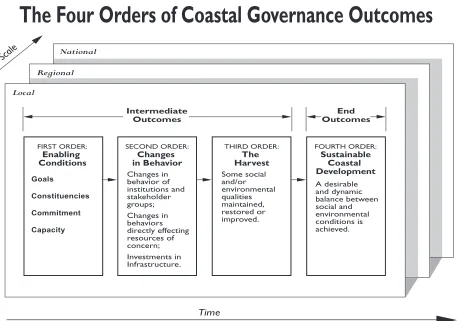
Orders of Outcome framework helps to sort adaptation outcome goals and think strategically over the long term (see Figure 3.1). he First Order
is achieved by assembling key enabling conditions for coastal adaptation including clear goals, engaged constituencies, formal commitment, and adequate institutional capacity. he third goal listed in Table 3.1 above (governance, policy, and planning capacities) is a First Order outcome. he Second Order marks changes in the behavior of institutions and relevant user groups. Change in coastal construction practices is a Second Order outcome. he hird Order marks the achievement of the speciic societal and environmental quality goals such as healthy coastal ecosystems, improved human safety, sustainable isheries, and food security. he Fourth Order adds the dimension of balance and asks whether the conditions achieved are suicient to sustain a healthy, just, and equitable human society that is sustaining the qualities of the ecosystem of which it is a part.
Figure 3.1 Ordering coastal adaptation outcomes
Goals
Constituencies
Commitment
Capacity
Source: Adapted from Oslen et al. 1998
3.3 ADAPTATION MEASURES
In general, there are two types of adaptation— “reactive” and “planned.” Reactive adaptations are the changes in policy and behavior that people and organizations adopt after changes in climate and coastal risks are observed. For example, as the spatial and temporal distribution of ish stocks change with ocean warming, ishers will automatically change ishing practices. As property losses from coastal storms and sea-level rise increase, insurance companies will increase insurance rates, creating a disincentive to locate in hazard zones.
This Guidebook focuses on “planned adaptation.” Planned adaptation is intentional, proactive, and occurs at the societal level. It is strategic and aims to address the full range of coastal climate change hazards in ways that meet societal objectives.
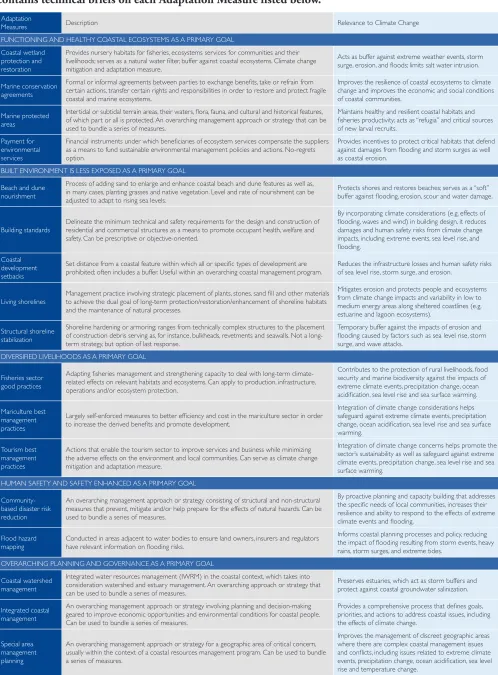
Seventeen practitioner briefs on coastal adaptation measures and strategies were developed with the assistance of coastal practitioners and are included in this Guidebook. he 17 briefs were chosen by coastal practitioners from an initial list of 50 adaptation measures. he term “measure” is used broadly and includes speciic actions (e.g., a development setback) and management approaches (e.g., special area management planning) to address climate change adaptation. Table 3.2 lists these 17 measures and their relationship to the adaptation goals presented above, while Table 3.3 provides deinitions. Annex A contains technical briefs on each measure, including infor on:
mation
• • •
Relevance to climate change
purpose/application
Information and data requirements
• •
•
Design considerations for developing the measure
Improving the likelihood of success in applying the measure as a climate change adaptation
Sources for more information
Many of these adaptation measures are not “new” to those involved in managing coastal systems. They include strategies and actions familiar to coastal practitioners as part of responding to episodes of natural hazards and shocks. hey are also familiar as part of everyday efforts to implement sustainable
USAID's Global Conservation Program is supporting the development and application of nature-based adaptation strategies to climate change in four large marine ecoregions—the Meso-American Reef in Central America, Wakatobi National Park and Raja Ampat in Indonesia, and Kimbe Bay in Papua New Guinea. Nature-based adaptation strategies can help people and communities deal with climate change impacts by protecting natural systems and the beneits they provide— shoreline protection, erosion control, as well as food from isheries, jobs, and income. Solutions to address climate change impacts to the marine ecosystems rely on marine protected networks speciically designed for resilience (i.e. the ability to resist shock or recover quickly from stress) to climate change. Building resilience in coastal and marine ecosystems depends upon: (1) Spreading risk to manage for uncertainty by protecting replicates of critical habitats (i.e. mangrove forests) over a large geographic range; (2) Identifying and securing sources of "seed" or marine larvae which are critical for maintaining and restoring healthy populations; (3) Maintaining connectivity between habitats by creating refugia from other stresses, such as overishing; and (4) Managing resources effectively by controlling other threats and pressures (i.e. sedimentation from land-based sources).
For more information: "Scientiic Design of a Resilient Network of Marine Protected Areas: Kimbe Bay, West New Britain, Papua New Guinea." Source: http://conserveonline.org/ workspaces/paciic.island.countries.publications
development—including sound environmental management, planned development, wise resource use, and poverty reduction. Adopting these measures with a climate lens provides an opportunity to be strategic in the face of future changes.
There are also new approaches and tools being developed, such as nature-based approaches to coastal adaptation (see text box). Nature-based approaches include new tools for managing seascapes and approaches to conserve biodiversity in the face of shifting geographies. hey focus on helping people and communities deal with climate change impacts by protecting mangroves, coral reefs, estuaries, seagrass beds, dune communities, and other systems on or near shorelines and the beneits they provide. As noted earlier in section 2.1, these beneits include protection from storms; mitigating loods; controlling erosion; providing water storage and groundwater recharge; and retaining and assimilating nutrients, sediments, and pollutants. In addition to these beneits, functional ecosystems are critical to maintaining biodiversity and to ishers
and other resource users whose livelihoods rely on the condition of natural systems. hese approaches provide a departure for the next generation of adaptation briefs, with subsequent versions of this Guidebook and associated tools.