AT THE EIGTH GRADERS OF MTs GUPPI PISANG BARU WAY KANAN IN THE ACADEMIC YEAR OF 2015/2016
By: ALI HARYADI
STUDENT NUMBER. 1175447
Teacher Training Tarbiyah and Faculty English Education Department
STATE INSTITUTE FOR ISLAMIC STUDIES (IAIN) METRO
ii Presented as a Partial Fulfillment of the Requirements
for the Degree of SarjanaPendidikan (S.Pd) in English Education Department
By: AliHaryadi
Student Number. 1175447
Teacher Training Tarbiyah and Faculty English Education Department
Sponsor: Dra. UmiYawisah, M.Hum Co-Sponsor: Ahmad SubhanRoza, M.Pd
STATE INSTITUTE FOR ISLAMIC STUDIES (IAIN) METRO
1439 H / 2018 M
iii
iv
v
vi
vii
AT THE EIGTH GRADERS OF MTS GUPPI PISANG BARU WAY KANANIN THE ACADEMIC YEAR OF 2015/2016
By: ALI HARYADI
The objective of this study was to know and explain the most frequent errors made by the eigth graders of MTs GuppiPisangBaru Way Kanan in writing narrative text focused on simple past tense. The classification of errors in this study was divided into four categories; they are omission, addition, misformation, and misordering. The subject of this study consists of 20 students of the eigth graders junior high school.
This research was used qualitative approach.The method used in this study was descriptive analysis method to describestudents’ errors and analyze the data by using formula: P = !
" x 100%, P=Percentage, F=Frequency of errors made, N=Total
of students’ errors. The data was taken from the test; it was written test.
The result of this research shows that there are 183 errors made by the students. The most frequent errors made by the students in their narrative writing focused on the use of simple past tense is misformation which consists of 130 errors or 71%, it is followed by omission with 35 errors or 19%. The next is misordering which consists of 12 errors or 7%. And the last is addition with 6 errors or 3%.
viii
PADA KELAS DELAPAN MTS GUPPI PISANG BARU WAY KANAN TAHUN AJARAN 2015/2016
Oleh: ALI HARYADI
Penelitian ini bertujuan mengetahui dan menjelaskan kesalahan yang dilakukan oleh siswa kelas delapan Mts Guppi Pisang Baru Way Kanan dalam menulis teks narasi yang difokuskan pada Simple Past Tense. Kategori kesalahan yang digunakan terbagi menjadi empat yaitu omission, addition, misformation, dan misordering. Sumber data dalam penelitian ini adalah 20 siswa Mts kelas dua.
Penelitian ini menggunakan pendekatan kualitatif. Metode yang digunakan dalam penelitian ini adalah Analisa deskriptif untuk menggambarkan kesalahan siswa serta menganalisis data dengan menggunakan rumus: P = !
" x 100% ,P=Presentase, F=Banyaknya kesalahan yang dibuat, N=Jumlah keseluruhan kesalahan siswa. Data diambil dari tes. Tes tersebut merupakan tes tertulis.
Hasil penelitian ini menunjukkan bahwa ada 182 kesalahan yang dibuat oleh siswa. Jenis kesalahan yang paling banyak dilakukan oleh siswa dalam menulis narasi yang difokuskan pada penggunaan simple past tense adalah misformation yang terdiri dari 130 kesalahan atau 71%. Diikuti pula oleh omission yang terdiri dari 35 kesalahan atau 19%. Kemudian kesalahan pada misordering yang terdiri dari 12 kesalahan atau 7%. Dan terakhir adalah addition yang terdiri dari 6 kesalahan atau 3%.
Kata kunci: Analisa kesalahan, simple past tense, teks penulisan narasi
ix
x
xi
ﻢْﻠِﻌْﻟا
ٌﺪْﯿَﺻ
ُﺔَﺑﺎَﺘِﻜْﻟَو
ْﺪﱢﯿَﻗ, ُهُﺪْﯿَﻗ
َكَد ْﻮُﯿُﺻ
ِلﺎَﺒِﺤْﻟﺎِﺑ
ْﮫَﻘِﺛاَﻮْﻟا
َﻦِﻤَﻓ
ِﺔَﻗﺎَﻤَﺤﻟْا
ْنَأ
َﺪْﯿِﺼَﺗ
ﺔَﻟاَﺰَﻏ
,
ﺎَﮭُﻛُﺮْﺘَﺗَو
ﻦْﯿَﺑ
ِﻖِﺋَﻼَﺨﻟْا
ًﺔَﻘِﻟﺎَط
“Knowledge like a hunted animal and writing is a tool to bind it. So, bind your hunted animal with a strong rope, tie by writing. That was fools if you hunt deer, after that you just leave it alone” (Al-Imam Asy-Syafi'IRahimahullah)
“Writing is the painting of the voice”(Voltaire)
xii
v My greatest and most beloved parents my father and my mother (Darta and Maesaroh). The deepest thanks for both of you.
v My beloved brothers and sisters (Ujang Supriyana, Ade Muhlisin, Eva Hayati, Ulya Tika Rohmah).
v My beloved Engagement (Fitri Yana Putri)
v My beloved friends and lectures of English education Department (TBI) Of State Institute for Islamic Studies Metro.
xiii
xiv
TITLE ... ii
APPROVAL PAGE ... iii
NOTA DINAS ... iv
ABSTRACT ... vii
STATEMENT OF RESEARCH ORIGINALITY ... ix
MOTTOS ... xi
DEDICATION PAGE ... xii
ACKNOWLEDGEMENTS ... xiii
TABLE OF CONTENTS ... xiv
LIST OF TABLES ... xvi
LIST OF FIGURES ………. ... xvii
LIST OF APPENDICES ... xviii
I. INTRODUCTION ... 1
A. Background of Study ... 1
B. Focus of the study ... … 6
1.Problem Identification………... 7
2. Problem Limitation ……….. 7
3. Problem Formulation………... 7
C. Objective and Benefits of the Study ... 7
1. Objectives of the Study ... 7
2. Benefits of the Study ... 8
II. REVIEW OF THE RELATED THEORIES ... 9
A. Writing ... 9
1. The Concept of Writing ... 9
2. Proses of Writing ... 12
3. The Assessment of Writing ... 13
B. Error Analysis ... 15
1. Concept Between Error and Mistake ... 15
2. The Concept of Error Analysis ... 17
3. Type of Error……….... 18
C. Simple Past Tense ... 20
xv
E. Narrative Text……….. 27
1. The Definition of Narrative Text………... 27
2. The Purpose of Narration ... 29
3. The Generic Structure of Narrative Text ... 30
4. The Kind of Narrative ... 31
III. RESEARCH METHODOLOGY ... 34
A. Type and Characteristic of the study ... 34
B. Data Source ... 35
C. Collecting Data Technique ... 36
1. Qualitative Observation ... 36
2. Qualitative Interview ... 36
3. Qualitative Documentation ... 36
D. Data Analysis Technique ... 37
1. Gathering the Data ... 37
2. Grouping the Data ... 37
3. Selecting/ Displaying ... 37
4. Interpretation ... 38
IV. RESULT OF THE RESEARCH ... 39
A. Result of The Research ... 39
1. Research setting ... 39
2. Error Identification ... 40
3. The Analysis Description of the Students’ Error ... 42
B. Data Interpretation ... 55
C. Data of The Scores of The Student………... 57
V. CONCLUSIONS AND SUGGESTIONS ... 52
A. Conclusion ... 52
B. Suggestion ... 52
BIBLIOGRAPHY APPENDIX
xvi
3.Examples of Irregular Verbs ... 22
4.Form of The Simple Past: regular verbs ... 23
5.Form of The Simple past : be ... 23
6.The Simple Past Ending’ Rules ... 24
7.Types of Text ... 26
8.Recapitulation of Types of Error in Narrative Writing Focused on Simple Past Tense………... ... 41
9.The Result of student’s writing narrative text……….. ... 57
10 Percentage of the students’ scores……….... 58
xviii 3. Kartu Bimbingan Skripsi
4. Surat Keterangan Bebas Pustaka 5. Surat Tugas
6. Surat Izin Research 7. RPP dan SILABUS 8. Denah Lokasi 9. Curriculum Vitae
1
A. Background of the Study
Nowadays, many people want to learn English for many reasons. For instance, the students want to learn English because it is in the school curriculum. They have to learn it whether they like it or not. In different case, some people want to study English because it offers a chance for advancement in their professional lives. In addition, many people want to learn it because they live in target language community; so they have to learn it in order they can communicate with the others.1
English is a language that is used by almost everyone in the world. Because English is an international language to communicate with other country. In Indonesia, English is the first foreign language and it’s as a compulsory subject that is learned in schools. Nowadays, not only as a foreign language but also learn from secondary till university level.
Since English is used as a foreign language in Indonesia, many efforts are need in teaching and learning process, it’s not only from the teacher but also from the student. In learning English, there are four basic skills such as listening, speaking, reading, and writing.2 Writing is one of the components in
1 Jeremy Harmer, The Practice of English Language Teaching New edition, (New York: Longman Publishing, 1991), p. 1.
2 H. Douglas Brown, Teaching by Principles , Addison Wesley Longman Inc., San Francisco, 2001, p. 232.
learning language process. Writing is used to make a communication with other people in the world and to express our idea.
According to Gorrell and Laird, writing requires thinking, and thinking is always complicated and hard. Writing is complicated also because the writer needs to do everything at once. The writer produces words, sentences, paragraphs, and extended compositions all at the same time; words must be spelled, sentences punctuated, and paragraphs unified.3 Writing is a complete
skill among Listening, Speaking, and Reading. Writing is the most difficult skill to learn because it needs hard thinking and produces words, sentences, paragraphs at the same time. That’s why writing is the highest order thinking.
Writing is different from learning other skills because writing is thinking process and need much ability. It can help us to make the sense of the information. The process of discovering and shaping meaning in writing is a process of learning ‘how to mean’.4
Based on my experience, one of the language skills which is very difficult to learn is writing. English writing is a subject that learns about how to express our ideas in writing form. In writing, there are so many components that should be mastered by students in order they are able to write well. The difficulty in writing starts when the students have to establish the subject, verb , object, tense, active and passive voice, also logical thinking. This statement is
3 Robert M. Gorrell and Charlton Laird, Modern English Handbook, (New Jersey: Prentice Hall, Inc., 1964), p. 1.
supported by James C. Raymond in his book, Writing is more than a medium of communication. It is a way of remembering and a way of thinking as well.5
Narrative is one of the types in writing ability. Narrative was telling of some true or fact event or connected sequence of events. That’s recounted by a narrator. A narrative will consist of a set of events recounted in a process of narration, in which the events are selected and arranged in a particular order. According to Sanggam Siahaan, It can be about biographies, autobiographies, historical events, instructions, and processes. In this case as a product of writing, the text functions to recount what is being narrated to the readers.6
English is different from Indonesian in its structure, phonology, and lexical meaning. That is why, the students of Junior High School who learn English may produce many error in their writing such as tense. Many students are confused in using tense in their writing.
Simple past tense is used in narrative writing, because the narration is writing about a succession of event in the past. The simple past tense is used to report a state or activities which can be ascribed to definite past time.7
Learning English tenses is not simple a process to understand the sentence pattern, but also a process of grammar application to make grammatically correct sentences and to know where and when the sentences will be used. Even though the students have studied English for many years and have mastered the
5 James C. Raymond, Writing is an Unnatural Act, (New York: Harper & Row Publisher, 1980), p. 2.
6 Sanggam Siahaan, The English Paragraph, (Yogyakarta: Graha Ilmu, 2008), p10 7 George E. and Julia M. Burks, Let Write English, (Litton education publishing, inc:1980),p.195
grammar, they still make many errors when they write. It means grammatical knowledge is necessary for writing ability.
In this case, the writer tries to research and analyze about how is the students’ ability in writing narrative text especially in using simple past tense in the Mts Guppi Pisang Baru Way Kanan. The writer conducted a pre survey on October 16, 2015 Mts Guppi Pisang Baru Way Kanan and asking the English teacher about the process of teaching and learning and also about the students’ writing narrative text. The writing instruction process in Mts Guppi Pisang Baru especially in Eight Graders has problems that influence on student’s learning activity that is about writing narrative because they have not enough ability in grammar rule especially in using simple past tense. It was found that some students of the Eighth Grades of Mts Guppi Pisang Baru, Bumi Agung, Way Kanan still had low in English tenses mastery. The students still had difficulties in mastering grammar, especially in mastering Simple Past Tense. It was found that some students did not understand in using simple past tense, for example:
Where do you go yesterday? It should be Where did you go yesterday? Mostly
the students can’t arrange good enough sentences based on grammatical usage. The students still confused in differentiate between simple present tense and simple past tense rule.
All errors above arise since some students got difficult to understand about correct rule of Simple Past Tense. This can be seen on the score data of Simple Past Tense of the students in class VIII of Mts Guppi Pisang Baru taken on October 16, 2015. It is still low as it is shown in the following table:
Table 1
Simple Past Tense Mastery at the Eight Graders
No. Score Explanation Frequency Percentage
1. ≥ 65 Passed 2 10 %
2. < 64 Failed 18 90 %
Total 20 100%
Source: The English teacher’s archives
From the table above taken on October 16 2015, the writer found that some students have low writing ability, especially in mastering simple past tense although the teacher has been giving the material and teach them. It can be seen that just two students passed the Completeness Standard Criteria (KKM). The KKM in Mts Guppi Pisang Baru, Bumi Agung, Way Kanan especially in English is ≥ 65. Meanwhile, there is still some students have not reach Completeness Standard Criteria yet.
In fact, although some students have learned grammar completely such as the data above in writing narrative text, they still find the difficulty to distinguish the usage in every type of tenses. As a result, it will lead them to produce many errors.
Therefore, an error analysis has an important role to reveal what kinds of error the students do most, to know the causes of the error and how the students can learn from their mistakes in writing by themselves. Then, the students will not do the same error or make same errors repeatedly. Those are the reasons
why the writer is interested in analyzing student’s writing. In this case, the writer wants to find out the grammatical error that’s made by the eighth grade of junior high school of Mts Guppi Pisang Baru Way Kanan in their writing narrative text especially in using simple past tense. And, by knowing the student’s errors which are obtained from the test of their narrative writing focuses in their grammar, we will know what kind of grammar errors that commonly made by the students especially in using simple past tense.
Based on the reason above, the writer is interested in analyzing the students’ writing product that is about the error in writing narrative text focused on using simple past tense, so this research titled is “An Analysis of The Students’ Error On Using Simple Past Tense In Writing Narrtive Text At The Eighth Graders Of Mts GUPPI Pisang Baru Way Kanan In The Academic Year of 2015/2016”.
B. Focus of The Study 1. Problem Identification
Based on the background explained above, the writer can identify some problems:
a. Some students of the Eighth Grades of Mts Guppi Pisang Baru, Bumi Agung, Way Kanan still had low in English tenses mastery.
b. The students still had difficulties in mastering grammar, especially in mastering Simple Past Tense.
c. Some students got difficult to understand the correct rule of Simple Past Tense
d. Mostly the students can’t arrange good enough sentences based on grammatical usage. The students still confused in simple past tense rule.
2. Problem Limitation
In this study, the writer limits the study in analyzing errors that are made by students in the narative writing product focused on simple past tensse. This study is focused on the eight grade of junior high school of Mts Guppi Pisang Baru Way Kanan.
3. Problem Formulation
To make this research more focuse, the writer would like to formulate the problem as follows:
a. What kind of error that students make in writing simple past tense in narrative text?
b. What is the most frequent error that students make in writing simple past tense in narrative text?
C. Objectives and Benefits of Study 1. Objectives of the Study
Based on the formulation above, the reseacher is aimed:
a. To know the kind of errors that students of Mts Guppi Pisang Baru Way Kanan make in writing narrative text, especially in using simple past tense.
b. To describe the most error that student of Mts Guppi Pisang Baru, Way Kanan make in writing narrative text in using simple past tense.
After doing this reaserch and finding the results, the researcher hopes it will be useful:
a. For the student
This research can give the definition about simple past tense to the students of Mts Guppi Pisang Baru at the eighth graders and motivating them to understand simple past tense deeply and the researcher hopes students will not make the same errors when they study.
b. For the teacher
Through this research, it is hoped that the English teacher can increase and teach the grammar Subject especially in using simple past tense deeply of teaching and learning process.
c. For the institution
This research can be used as the information to improve the teaching and learning English in the future after doing many exercises about it. d. For other researchers
The researcher hopes this present research can give a valuable experience to other researcher which can be used for doing a better research in the future. As a consideration for other researcher to conduct further studies.
CHAPTER II
REVIEW OF THE RELATED THEORIES
A. Writing
1. The Nature of Writing
Writing is one of four language skills. Writing is perhaps the most demanding skill of English. Unlike listening and speaking, it is not something which is natural to human.
Etymologically, writing is derived from the word ‘write’. According to Oxford Advanced Learner’s Dictionary the word ‘write’ is defined as make letters or numbers on a surface, especially with a pen or pencil, produce something in written form so that people can read, perform or use it, etc.8 It
means that writing is the activities of communication between reader and writer through a letter. In a letter and send it to somebody, to produce something in written form so that people can read, perform and use it.
Terminologically, many experts that have different definition of writing. Nevertheless, the researcher will take several definitions from them.
Sanggam Siahaan states, writing is a psychological activity of the language user to put information in the written text9. It means that writing is producing something in written form by determining what to write first so the people can read or use it.
8 A S Hornby, Oxford Advanced Learner’s Dictionary, Eighth Edition, (New York: Oxford University Press, 2010), P. 1722.
According to Barnet and Stubbs writing as a physical act, it requires material and energy. And like most physical act, to be performed fully, to bring pleasure, to both performer and audience, it requires practice.10 In writing, writers are asked to present their works powerfully. They have to make the readers satisfy with their writing. It is important for writers doing practice to improve their writing skill, not only that they also have to expand their knowledge to develop their skill in writing because more knowledge is for better writing.
Axelrod and Chooper states that writing makes a special contribution to the way people think. When we write, we compose meanings, we put together facts and ideas and make something new.11 It means that writing can make people reconstruct their thought, and then they will make new thoughts through facts and ideas that have occurred they try to combine and compare both of them until they are getting new conclusion as a new thought.
In addition, Raymond said that writing is more than a medium of communication. It is a way of remembering and a way of thinking as well. Writing is a way of finding out what we know and what we need to learn. Writing is also a way of learning. None of us can write much of interest without thinking, probing, observing, asking questions, experimenting, and reading.12
10 Barnet and Stubbs’s, Practical Guide to Writing, (Canada: Brown company, 4th edition 1983), p. 3.
11 Rise B. Axelrod and Charles R. Chooper, The ST. Marline's Guide to Writing, (Boston: Houghton Mifflin Company, 1986), p. 1.
12 James C. Raymond, Writing is an Unnatural Act, (New York: Harper & Row Publisher 1980), p. 2.
Writing is an activity that can usefully be prepared for by work in the other skills of listening, speaking, and reading.13 It means that writing has the
prominent role in improving other skill of language.
From the quotations above, the researcher can conclude that writing is the activity of transfer the information to the others in written form. Writing also is the act or art of forming letter and characters in a place or something for the purpose of recording the ideas which characters and word express, communicating them to others by visible signs. To sum up, writing can be said as a media for students to develop their language skill because from writing they can use their knowledge of the target language that they have been learnt. Writing is the most difficult skill because it combines receptive skills and productive skills. Writing is also the way to make spoken language permanently.
Furthermore, Brown argues that written products are often the result of thinking, drafting, and revising procedures that require specialized skills, skills are not every speaker develops naturally.14 At other times we write because we want to express something about ourselves, about what we've experienced or how we feel.15
Based on the definition above, the writer made the conclusion that writing is making letters to expressing the ideas, make a good written, and then sender
13 I.S.P. Nation, Teaching ESL/EFL Reading and Writing, (New York: Routledge, 2009), p. 113.
14 H. Douglas Brown, Teaching by Principles An Interactive Approach to Language Pedagogy 2nd Ed, (New York: Addison Wesley Longman, 2001), p. 335.
15 Thomas S.Kane, The Oxford Essential Guide to writing, (New York: Berkley Books, 2000), p.19.
with particular purpose to someone. It means that if we know the language and then, we arrange the graphic symbols or graphic representation includes the letter, words, sentences and punctuation into written form which both the writer and reader understand. As one of the four basic skill of language, writing is important because it constitutes the clarification of someone’s thoughts and feeling. The students, through this skill, can explore their own thinking, various feeling and also the concepts by using words on papers.
2. Process of Writing
According to Graves, there are five-step process writing approach, that is:16 a. Prewriting
The goal of this step is to produce ideas. Listing, brainstorming, outlining, silent thinking, conversation with a neighbor are all way to produce ideas.
b. Drafting
Drafting is the first attempt of writer to catch ideas on paper. Drafting is a way to organize and develop a sustained piece of writing or procedure for determining whether the information you discovered during prewriting can be shaped into a successful piece of writing.
c. Editing
This is the step where students’ correct grammar, spelling, and punctuation errors. The fastest way to fail a good writing project or damage
16 Andrew P. Johnson, Teaching Reading and Writing A Guidebook for Tutoring and Remediating Students, (New York: Rowman and Littlefield Education, 2008), p.179.
a writer is to demand that step 4 be included in step 1, 2, or 3. If writers are editing about mechanics at the prewriting, drafting, and revising stages, the flow of ideas and the quality of writing are bad.
d. Publishing and Sharing
In this step, students share their writing with audience. At this stage, writing becomes real and alive. Publishing can implicate putting together class books, collections of writing, school or class newspapers, school or class magazines, or displaying short sample of writing in the hall or out in the community.
3. The Assessment of Writing
Moreover, there are assessment in writing ability, it explained that the components of assessment can be formulated as follows:17
17 Sara Cushing Wiggle, Assessing Writing, (New York: Cambridge University Press, 2002), p. 116.
Table 2
Assessment of Writing
Aspect Score Levels Standardize
content
30 – 27 Excell
ent Students really understand and they are able to express knowledge which matching of the title in content widely and completely.
26 – 22 Good Students are able to understand express
knowledge which matching of the title in content completely although it is not effective.
21 – 17 Fair Students are able to understand the content limitedly.
16 – 13 Poor Students are not able to understand the content effectively.
organiz
ation 20 – 18 Excellent Students are really able to organize the generic structure of writing clearly and effectively. 17 – 14 Good Students are able to organize the generic structure
clearly.
13 – 10 Fair Students are less able to organize the generic structure clearly and effectively.
9 – 7 Poor Students are not able to organize the generic structure of writing clearly and effectively. Vocabu
lary
20 – 18 Excell ent
Students are really able to use and chose vocabulary widely and effectively.
17 – 14 Good Students are able to use and choose vocabulary widely and effectively.
13 – 10 Fair Students are able to use and choose vocabulary limitedly
9 – 7 Poor Students are not able to understand building. gramm
ar
25 – 22 Excell
ent Students are able to use grammar in arrange the sentences. 21 – 18 Good Students are really able to use grammar in
arrange simple sentences.
17 – 11 Fair Students have many mistakes in arrange simple sentences grammatically.
10 – 5 Poor Students are not able to mastery grammar in using arrange sentences.
mechan ic
5 Excell
ent
Students are really to mastery mechanical of words and punctuation
4 Good Students are able to mastery mechanical of words and punctuations
3 Fair Students are able to mastery mechanical of words and punctuations
2 Poor Students are not able to mastery and produce mechanical words and punctuations effectively.
B. Error Analysis
1. The Concept Between Error and Mistake
Learning the second language is different from learning first language. Therefore, the students often made errors while the teaching learning process. For the foreign language, the students can get a new rules of language, vocabulary, grammatical patterns and pronunciation which different from their language. The Error is natural for the students in learning the second language. There are many definition of error by the experts. Hornby states that error is defined as a mistake, especially one that causes problems or affects the result of something.18 According to s. p. Corder, error is both an ancient activity and
at the same time a comparatively new one.19
It means that error is deviation from the student’s grammar, reflecting to the competence of the student especially in learning process.
Error and mistake are two different things. Carl James mentioned that intention played a decisive role in the error and mistake definition. According to him, error is unintentionally deviant and is not self-corrigible by its author. A mistake is either intentionally or unintentionally deviant and it is self-corrigible by its author.20 He adds that error cannot be self-corrected by the learner until further relevant input that has been provided and converted into intake by the learners. In other words, the learner needs to be provided the
18 A S Hornby, Oxford Advanced., P.496
19 S. p. corder, error analysis and interlingua, (London, Oxford University press, 1981), p. 51
further relevant learning before they can correct themselves. Meanwhile, mistakes can be corrected by the learners by simply pointing out to them.21
On the other hand, Pit Corder has another definition of error and mistake as stated in Carl James’ book. He upholds the competence versus performance distinction. According to him, mistakes are of no significance to the process of language learning since they ‘do not reflect a defect in our knowledge’ but are traceable to performance failure, such as memory lapses, spelling pronunciations, tiredness, strong emotion, etc. The learner is normally aware of them immediately and can correct them with more or less complete assurance. On the contrary, errors are everything that mistakes are not: they are significance, they do reflect knowledge, they are not self-correctable, and only learners of a second language make them.22
It is important to differentiate between error and mistake. Otherwise, some people are still misunderstanding about the definition of them. To clarify between error and mistake, Brown says, a mistake refers to a performance error that is either a random guess or a “slip” in that it is failure to utilize a known system correctly.23
According to Dulay, in some of the second language literature, performance errors have been called “mistakes”, while the term “errors” was re-served for
21 Ibid., p. 83.
22 Ibid., p. 78—79.
23 H. Douglas Brown, Principles of Language Learning and Teaching, fifth Edition (New York: Pearson Education 2007) p. 257
the systematic deviations due to the learner’s still developing knowledge of the L2 rule system.24
Based on the definition above, the writer concluded that error is systematic deviance which is made by the learner intentionally; it reflect his knowledge since it is not caused by performance failure, and it cannot be self-corrected by the learner. Meanwhile, mistake is not systematic deviance which is made by the learner either intentionally or unintentionally; it is caused by performance failure, such as fatigue, memory lapses, etc., and it can be self-corrected by the learner.
2. The concept of Error Analysis
The definition of Error Analysis came from Carl James in his book, Error analysis is the process of determining the incidence, nature, causes, and consequences of unsuccessful language.25 Another opinion comes from Susan M. Gas and Larry Selinker, Error analysis is a type of linguistic that focuses on the errors learners make in producing the target language and the target language form itself.26
The process of the students learning will be find something wrong or mistake. The making of error can’t be avoided in learning process. An analysis is the important method to get information about the student’s error in learning process in language production and language perception. An error analysis is also important to describe what kinds of error that the students make, to know
24 Heidy Dullay, language two (NEW York : Oxford University press, Inc, 1981), p. 139 25 Carl James, Error in Language Learning and Use, (New York: Longman, 1998), p.1.
26 Susan M. Gass and Larry Selinker, Second Language aqusition, (Ney York: Routledge,
the causes of the error and how the students can learn from their mistakes and correct in their writing.
Brown argues the fact that learners do make errors, and that these errors can be observed, analyzed, and classified to reveal something of the system operating within the learner, led to a surge of study of learner’s errors, called error analysis.27
From the explanation above, the writer concludes that error analysis is a type of linguistic analysis that focuses on the process of identifying, and describing the learner’s error in target language learning.
3. Types of error
The error of students may be classified as the errors of competence and the errors of performance. The Errors competence are systematic and continuously. Otherwise, errors of performance are unsystematic, and the students can correct by themselves. To describe the types of error, Heidy Dulay said that there are two types of error.28
a) Error based on linguistic category taxonomy
Many error taxonomy has been based on the linguistic item, while is effected by an error, these linguistics category taxonomies classify errors according to either or both the language component and the particular linguistic constituent the error effects.
27 H. Douglas Brown, Principles of Language., p. 259
28 Heidy Dullay, language two (NEW York: Oxford University press, Inc, 1981), p. 146-192
Language components include phonology (pronunciation), syntax and morphology (grammar), semantic and lexicon (meaning and vocabulary) and discourse (style). Constituents include the element that comprises each language components. For example, within syntax one may ask whether the error is in the main or subordinate c1ause; within a clause, which constituents is affected, e. g. the noun phrase, the auxiliary, the verb phrase, the preposition, the adverbs, the adjective and so forth.
b) Error based on surface strategy taxonomy
A surface strategy taxonomy highlight the ways surface structures are altered: students may omit necessary items (omission) or add unnecessary ones (addition); they may misform items (misformation), or misorder them (misordering).
1) Omission
Omission errors are characteristic by absence of an item that must appear in a well- formed utterance. Although any morpheme or word in a sentence is a potential candidate for omission, some types or morphemes are omitted more than others.
For example: My father usually drinks a cup coffee (It should be my father usually drinks a cup of coffee)
2) Addition
Addition errors are the opposite of omissions. They are characterized by the presence of an item which must not appear in a well- formed utterance.
For example: I was went to Bali last week (It should be: I went to Bali last week.
3) Misformation
Misformation errors are characterized by the use of the wrong form of the morpheme or structure. While in omission errors them is not supplied at all, in misformation errors the student supplies something, although it is incorrect.
For example: She didn’t worked at fashion company (it should be: she didn’t work at fashion company)
4) Misordering
This error is characterized by the incorrect placement of morpheme or a group of morphemes in an utterance.
For example: How your is mother? (It should be: how is your mother) Based on the explanation above, the researcher is going to choose the type of error based on surface strategy taxonomy to analyze the student’s product in writing narrative text in using simple past tense and the researcher will use all 4 criteria to measure the student’s error product.
C. Simple Past Tense
1. Concept of simple past tense
Simple past tense consists of three words: simple, past and tense which each words has its own meaning. The writer would like to explain them one by one according to oxford advanced learner‘s dictionary, simple is used to describe the present or past tense of a verb that is formed without using an auxiliary
verb.29 Past is connected with the form of a verb used to express actions in the past30 and tense is any of the form of a verb that may be used to show the time
of the action or state expressed by the verb.31
Terminologically, some expert defines the simple past tense. Betty Schramfer Azar said the simple past tense indicates that an activity or situation began and ended at particular time in the past.32 According to Suryadi Junaida defined that we use the past tense (also as simple past tense) to express an action or event that happened in the past and have now been completed and is known exactly when these events occur or do.33
Furthermore, Betty S Azar stated in fundamental of English grammar that, the simple past is used to talk about activities or situations that began and ended in the past (e.g. yesterday, last night, two days ago, in l990)34
Example:
• John played football yesterday • I studied last night
• She visited me two days ago • My sister was born in 1990
29 A S Hornby, Oxford Advanced., p. 1384 30 Ibid., p.1073
31 Ibid., p. 1540
32 Betty Schrampfer Azar, Understanding and Using English Grammar,second edition (New Jersey, prentice hall, inc, 1989), p. 24
33 Suryadi Junaida, Complete English Grammar, Edisi ke-2 (Yogyakarta, pustaka pelajar, 2011), p. 472
34 Betty Schrampfer Azar, fundamentals of English grammar, (New York, pearson education, 2003), p. 25
Based on the definition above, the writer made the conclusion that simple past tense is used to express a definite event in the past. Then simple past shows the situation or activities in the finished time in the past and time is clear or mentioned.
2. The Form of Simple Past
English verbs are divided into two classes; they are regular form an irregular form. These classifications come from the way the verb forms, its simple past and past participle. Regular verbs have predictable past tense form, ie-d or –ed is added to the end of the base form.35
• Yesterday I worked in Jakarta. • He agreed about the price.
• He applied a job in a Malaysian company.
Irregular verbs do not have past tense forms that can be predicted by rules:
Table 3
Examples of Irregular Verbs
Base form Past form
Catch Caught
Read Read
Cut Cut
Drink Drank
Betty S. Azar gives the explanation about the form of simple past tense as below:36
35 Kam Chuan and Kam Kai Hui, Longman Dictionary of Grammar and Usage, (Singapore: Addison Wesley Longman, Inc, 1999), p. 297.
Table 4
Form of the simple past: regular verbs
STATEMENT I-You-She-He-It-We-they Worked yesterday
NEGATIVE I-you-She-He-It-we-They did not (didn’t) work yesterday QUESTION Did I-you-She-He-It-we-They work yesterday?
SHORT ANSWER
Yes, I-you-She-He-It-we-They did No, I-you-She-He-It-we-They didn’t
Table 5
Form of the simple past: be
STATEMENT I-She-He-It was in class yesterday We-You-They were in class yesterday
NEGATIVE I-She-He-It was not (wasn’t) in class yesterday We-You-They were not (weren’t) in class yesterday QUESTION Was I-She-He-It in class yesterday?
Were We-You-They in class yesterday?
SHORT ANSWER
Yes, I-She-He-It was Yes, We-You-They were No, I- She-He-It wasn’t No, We-You-They weren’t
Furthermore, Nasrun Mahmud in English for Muslim University Students argued that Simple past tense is formed with past form of the verbs which may
be either regular, e.g. by adding –ed to the infinitive (incidentally, most verbs are regular) or irregular must be learned in each case.37
In English, a main or lexical verb is any word that can be conjugated, that can add the morphemes /ing/, /ed/, and (e) s/ to mark, respectively, present participle, past tense/ past participle, and third person singular Present tense. English verbs are divided into two classes; they are regular form and irregular form. These classifications come from the way the verb forms its simple past and past participle.
With most verbs, the simple past is created simply by adding –ED. However, with some verbs, you need to add –ES or change the ending a little. Here are rules:38
Table 6
The simple past tense’ ending rules
Verb ending in… How to make the simple past Examples
E Add-D Live – lived
Consonant + y Change Y to I, then add – ED
Try- tried, cry- cried
One vowel + one consonant (but not W or Y)
Double consonant, the add – Ed
Tap – tapped, commit – committed
Anything else Add-ed Boil- boiled, fill- filled,
hand- handed
37 Nasrun Mahmud, English for Muslim University Students, (Jakarta: PT. Siwinakti Darma, 2003), p. 88.
3. Verbs in Simple Past Tense
Many students usually have some difficulties in forming of simple past, they confused about regular and irregular form. Because they not memory the entire verb changing.
The only real difference between regular and irregular verbs is that they have different endings for their past tense and past participle forms. For regular verbs, the past tense endings and past participle endings is always the same: ed. For irregular verbs, the past tense ending and the past participle ending is variable.39
Regular verbs: base, past tense, past participle
• Look, looked, looked • Work, worked, worked
Irregular verbs: base, past tense, past participle
• Buy, bought. bought • cut, cut, cut
• do, did, done
When the students learn Indonesian language, they did not find the tenses, but when they study English, they found the tenses, because there is no tense in Indonesian language. Therefore, they must be able to distinguish every tense in English.
D. Text
1. The Concept of Text
Human being lives in a world of words. When these words are put together to communicate a meaning, a piece of text is created. When speaking or writing to communicate a message, there are constructing a text. When reading, listening or view a piece of text, there are interpreting its meaning. In general, text is an article which often read. It is the language unity that expresses the meaning contextually. Based on Oxford Learner’s Dictionary, text is defined as: (1) any form of written material (2) the written form of a speech, a play, an article, etc.40 It’s means that text is a sequence of paragraphs that represents an extended unit of speech.
2. Types of Text
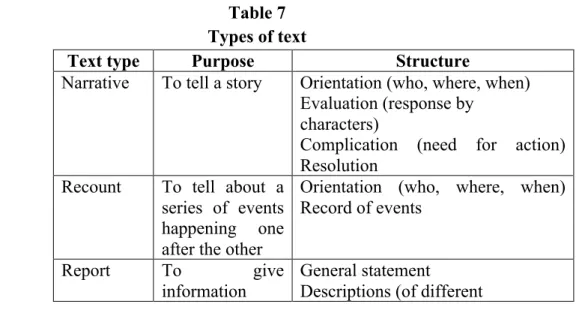
Kate Grenville explained that, there are 8 types of texts at glance, as follow:41
Table 7 Types of text
Text type Purpose Structure
Narrative
To tell a story Orientation (who, where, when) Evaluation (response by
characters)
Complication (need for action) Resolution
Recount To tell about a
series of events happening one
after the other
Orientation (who, where, when) Record of events Report To give information General statement Descriptions (of different
40 A S Hornby, Oxford Learner’s., p. 1544.
41 Kate Grenville, Writing from Start to Finish a Six-Step Guide, (Australia: Allen & Unwin, 2001), p. 194.
aspects of the topic) Review To assess the
value of an art
work
Context (background to art work plus a synopsis)
Description (of characters, key events, style).
Judgment (balance of strengths and
weaknesses) Historical recount/ account To write about of
events the past
Background (general information about the period)
Record of events (in sequence) Evaluation (of the significance of the period) Procedural recount To record a procedure
Aim (scientific purpose)
Record of events (what was done) Results (what happened)
Conclusion (what was found, even if nothing)
Exposition
To argue for a
point Thesis Arguments supporting thesis Restatement of thesis of view From 7 types of text above, the researcher will focus deeply the research on narrative text.
E. Narrative Text
1. The Definition of Narrative Text
Narrative text is a kind of text that tells a story. There are some arguments are stated by some experts about narrative text. First, Alice says that narration is story writing; it is a kind of writing which report events chronologically.42 Narrative is conversation or writing telling about action or human experience based on the sequence of time. James A. W. Heffernan wrote in his book Writing A College Handbook, narration or storytelling is writing about a
42 Alice Oshima, and Ann Hogue. Introduction to Academic Writing. New York: Longman, 1997. p 291.
succession of events. The simplest kind of narration follows chronological order: the order in which the narrated events actually occurred or could have occurred.43 Betty Mattix Dietsch says narration is used not only in fiction writing but also to relay news of a neighborhood or news of a nation, to share research data, to write reports and other documents. Histories, biographies, journals, college papers, magazines, and even advertisements include narrative. Narration is a powerful tool that can captivate an audience – stirring the imagination, eliciting empathy, and lending weight to opinion.44
A narrative presents a connected series of events, either imaginary or based on your own experience, in a vivid descriptive style.45 Narrative text is different from recount text; it focuses on the highlight of complication in the sequence of events. On the other hand, recount text only focuses on the series of events. Narrative can become more complex if there is more than one complication included in the story.
In addition, the complication that is resolved usually carries a social message. Sometimes, the message can be quite obvious and obscure. The obscure message can cause the students from different cultures have difficulties find it difficult to see a point to the story. Meanwhile, the final purpose of curriculum is to develop their interpersonal relationship with others.
43 James A. W. Heffernan & John E. Lincoln, Writing a College Handbook, (W. W. Norton & Company, 1982), p 86.
44 Betty Mattix Dietsch, Reasoning & Writing English Well, (New York: Mc Graw Hill,2003), p. 123.
45 Evans, Virginia. Successful Writing Proficiency. Liberty house: express publishing,
Based on discussions above, the writer concludes that narrative writing is a writing which tells about the story of events in a period of time. Narrative writing is not only about fiction writings, but also about scientific writing can be written in a narration. It presents action with variety of purposes.
2. The Purpose of Narration
Every kind of writing has a purpose, narration also has a purpose. According to Barbara Fine Clouse, “obviously, a narration can entertain because a good story can amuse readers and help them forget about themselves for a time.46 This statement is supported by Mark Anderson and Kathy Anderson, they said that “the purpose of narrative that is to present a view of the world that entertains or informs the reader or listener”.47 In addition, Barbara gave three purposes of narration:
a) To express your feeling, you could narrate an account of your final visit with your grandfather for example.
b) To inform your readers, you could narrate an account of a typical day for your grandfather, pointing out the advantages he enjoyed because he lived at the retirement home for example.
c) To persuade your readers, you could narrate an account of one or more of your own experiences, tell the benefits you and the residents enjoyed as a result.48
46 Barbara Fine Clouse, Patterns for a Purpose: A Rhetorical Reader, (New York: McGraw-Hill, 2003), p. 160.
47 Mark Anderson and Kathy Anderson, Text Types in English 3, (South Yarra; Macmillan, 1977), p. 3.
The researcher concluded that the purpose of narration is to amuse and entertain the readers. Make them feel including in the story while they are reading and also to inform and persuade the readers about the story.
3. Generic Structure of Narrative Text
Narrative deals with problematic events which lead to crisis or turning points of some kinds of solution. Generic structures of narrative texts are described as follows:49
a. Orientation
It is the stage where the researcher or narrator introduces to tell the character in the story, their names, and the place where they live, when, their ages, their condition, and their dream.
b. Complication
In the complication stage, the researcher presents unexpected event that happens to the characters. It can be concluded that complication is also the problem of the story.
c. Resolution
In this stage, the researcher tells how the complication is solved or the ending of the story. Here, the earlier complication is solved for best or worse.
4. The Kind of Narrative
According to Depdiknas there are some kinds of narrative text, it is usually factual or imagination. It is like fairy tales, mystery stories, science fiction, roman and horror.50
Barbara states that there are two kinds of narrations:51 a. Present Narration
It is a narrative text which describes what usually happens during an event in the regular time.
b. Past Narration
It describes completed past like historical events, biographies, or past personal experiences. It uses past tense because the events are completed. Common forms of narrative text which are studied in school are:52
• Legend
A legend is a narrative of human actions that are perceived both by teller and listeners to take place within human history. Typically, a legend is a short, traditional and historicized narrative performed in a conversational mode. Some define legend as folktale.
• Fable
A fable is a short allegorical narrative making a moral point, traditionally by means of animal characters who speak and act like human beings. • Science fiction
50 Ibid p 34.
51Leonhard, Barbara Harist. Discoveries in Academic Writing. Cambridge: Cambridge University Press, 1996. p 132.
Science fiction is fiction based upon some imagined development of science, or upon the extrapolation of a tendency in society. Science fiction is that class of prose narrative treating of a situation that could not arise in the world we know.
From that definition above, the researcher tries to conduct the kinds of narrative about past narration. Because it’s related to the personal experience in the past. Here the example:
My unforgettable holiday
I still remembered about my vacation. It was on my last holiday. It was a great holiday. My family and I visited my grandma in Ketep village, Magelang, Central Java. I had gone there once before when I was a child or when I was 5 years old. And now I am still at first grade of Junior High school in Pekalongan. We left Pekalongan to Ketep at 6 am on Sunday. It needed six hours of time to get there. My father drove the car family so that we could enjoy the beautiful scenery along the journey. We arrived to Ketep at 1 p.m. I could the old woman had waited us. That was my lovely grandma. My grandma looked so happy could see us anymore. She still looked so young and healthy for the woman in her age. I love her so much. Without any thinking, I hugged her so tightly.
Grandma had served many meals like hot extract ginger, tempe mendoan (the original food from Indonesia), and I loved it so much especially my dad, he felt like a nostalgic when he was child. Ketep was my Dad’s hometown. We ate them proudly and behind us, you could see the beautiful of Merapi Mount indeed. We always missed this panorama.
From the example above that we can see about the generic structure at first paragraph is tell us about the main character, place, time, ages, etc. that is called orientation. In the second paragraph that explained about complication and
serve some problems about events. Then for resolution in this story endings with happy character that resolved the complication before.
CHAPTER III
RESEARCH METHODOLOGY A. Type and Characteristic of Research
The research is conducted to explore the phenomenon about error that students make in writing. Therefore, the researcher decides to choose qualitative approach to analyze of error especially on using simple past in narrative. Qualitative research begins with assumptions, a worldview, the possible use of a theoretical lens, and the study of research problems inquiring into the meaning individuals or groups ascribe to a social or human problem.53 Its mean that
qualitative is investigating and conceiving purpose of individuals or groups that attributes human problem.
The type this study is a case study. Case study research is a qualitative approach in which the investigator explores a bounded system (a case) or multiple bounded systems (cases) over time, through detailed, in-depth data collection involving multiple sources of information (e.g., observations, interviews, audiovisual material, and documents and reports), and reports a case description and case-based themes.54
In this research, the researcher concerns with the use of simple past tense in language learning. The researcher consider surely using more qualitative approach to investigate and to analysis the student writing narrative error,
53John W. Creswell, Qualitative inquiry & research design: choosing among five approaches, 2nd edition, (USA: Sage Publications, Inc. 2007), p. 37
54 Ibid, p.37
especially in using simple past. In this case, the researcher will analyze the student’s error on using simple past tense in writing narrative text at the eighth grade of Mts GUPPI Pisang Baru.
B. Data Source
To conduct this research, the researcher would like to use two kinds of data source namely primary and secondary data. In this research, the primary source is the students’ writing product. The primary data gets from student’s writing narrative test. To collect this data, the researcher gives a test at the VIII class of Mts GUPPI Pisang Baru. The writer would like to ask the students to write English narrative writing text using simple past tense in a piece of paper, and the topic is about student’s experience holidays. Then the student’s assignment will collect as a data.
The secondary data is the addition data. The secondary source is from books, articles, English dictionary, encyclopedia, and documentation that are related to the research would be gained.
Furthermore, the writer used purposive sample as the participants. Purposive sample is sampling technique of data source based on certain consideration. That is handed over to researcher and based on research objective.55 The researcher is going to choose 20 students at the eighth graders of Mts GUPPI Pisang Baru Way Kanan in the Academic Year 2015/2016 as the participants.
55 Sugiyono, Metode Penelitian Kuantitatif Kualitatif dan R&D,Bandung, Penerbit Alfabeta,2009,P.219
C. Collecting Data Technique
The instruments that are used in conducting research, the researcher will use one of techniques in collecting data as follows:56
1. Observation
The researcher takes field notes on the behavior and activities of individuals at the research site. In these field notes, the researcher records, in an unstructured or semi structured way (using some prior questions that the inquire wants to know), activities at the research site. Typically these observations are open-ended in that the researchers ask general questions of the participants allowing the participants freely provide their views.
2. Interview
The researcher conducts face-to-face interviews with participants, telephone interview, or engages in focus group interviews with five to eight interviewers in each group. These interviews involve unstructured and generally open- ended questions that are few in number and intended to elicit views and opinions from the participants.
3. Documentation
The researcher will collect the students’ test as primary data. In the collecting the data, the researcher will collect authentic writing from the student’s narrative writing product. The writing should be a part of the test,
56John W. Creswell, Research design: Qualitative, Quantitative and Mixed methods approaches, 4th edition (USA: SAGE Publications, Inc. 2014), p. 190
approved by the researcher. Afterwards, the researcher analyses their assignment. So it’s the clear that documentation is note of information in the form of documentation. The writer used this method to get data about the student’s writing narrative test.
D. Data Analysis technique
The analysis and interpretation of the data represent the application of deductive and inductive logic to the research process. The process of data analysis involved sense out of text and image data. Creswell explained the data analysis technique in the following steps:57
1.Gathering the data
Organizing and preparing the data for analysis. This involved transcribing interviews, optically scanning material, typing up field notes, or sorting and arranging the data into different types depending on the sources of information.
2.Grouping the data
Use the coding process to generate a description of the setting or people as well as categories or themes for analysis. Description involves a detailed rendering of information about people, places, or events in a setting. 3.Selecting/ displaying
The researcher should display multiple perspectives from individuals and be supported by diverse quotations and specific evidence.
57 Ibid, p. 197
4.Interpretation
A final step in the data analysis involves interpretation or meaning of the data results.
The technique of data analysis which is used by the writer in this research is qualitative analysis technique which function is to describe and interpret the result of quantitative data. For getting the quantitative data, it will describe in the table of percentage and formula as follows:
P = !
" x 100%,
Notes: P: Percentage F: Frequency
N: Number of cases (total of frequency).58
58Sudjiono Anas, Pengantar Statistik Pendidikan, (Jakarta: PT. Raja GrafindoPersada,
CHAPTER IV
RESULT OF THE RESEARCH AND INTERPRETATION
A. Result Of The Research 1. Research Setting
The Mts GUPPI Pisang Baru Way Kanan was established in 25 may 1989. The school location is on Jl. Protocol Pisang Baru, Bumi Agung, Way Kanan. The school got the operation under licenses from the Islamic Department. In April 14, 1999 Mts GUPPI Pisang Baru Way Kanan got a new SK with number WH/6/PP.00.6/354/1999.
The Mts GUPPI Pisang Baru Way Kanan have guided by four principles. On 1989 until 2000 Suryadi, S.Pd has guided as the principle. After that on 2000 until 2009, Sukardi S.Pd has guided as the principle. After that on 2009 until 2015, Sukimin S.Pd has guided as the principle. And now, the principle of the Mts GUPPI Pisang Baru Way Kanan is Syahroni S.Pd from 2015 until now.
The vision and mission of The Mts GUPPI Pisang Baru Way Kanan are stated as follow:
The vision: “To be an education institute that has IPTEK insight and the nation, region, and global quality.”
The Mission is the first is to increase the organization quality and the school management in growing the excellence spirit. The second is to increase the
quality of teaching learning activity and to reach the students competence that has the national standard. And the third is to increase the human source quality and the student guided quality in realizing IMTAQ and autonomy attitude. All of the vision and mission have the purpose, to increase the developing of the school.
The orientation of the Mts GUPPI Pisang Baru Way Kanan is the official management. The school consists of 9 classes, teacher room, official employee room, computer room, library, laboratory, masque, toilet, and parking area. The school has 22 teachers and 3 official employees.
The principle is a person who have the high status in coordinator all of duty in school activity. To do it, the principal of the Mts GUPPI Pisang Baru Way Kanan is helped by school committee, official employee, and the head vice of curriculum.
2. Error Identification
In this section, the writer identified the errors found in the use of Simple Past Tense in narrative text written by the students. The writer presented the identification of errors in the form of table below:
Table 8
Recapitulation of Types of Errors in Narrative Writing Focused on Simple Past Tense.
Students Omission Addition Misformation Misordering
Student 1 1 - 13 - Student 2 4 - 5 - Student 3 1 - 3 - Student 4 3 3 5 - Student 5 1 - 9 - Student 6 1 - 7 - Student 7 1 - 10 - Student 8 2 - 6 - Student 9 - - 6 - Student 10 1 - 11 - Student 11 2 1 6 1 Student 12 1 - 10 2 Student 13 2 1 6 2 Student 14 3 1 4 1 Student 15 3 - 1 2 Student 16 2 - 4 1 Student 17 1 - 6 1 Student 18 2 - 4 1 Student 19 2 - 7 - Student 20 2 - 7 1 Total 35 6 130 12 Total (N) 183
The chart below presents the highest level to the lowest of errors mostly made by the students:
omission addition misformation misordering 71% 19% 3% 7%
Percentage of Student's Error
Chart 1: The Recapitulation of Students’ Error
The table shows percentage of each error based on classification of Heidy Dulay, and the writer found that error of misformation is the most frequent error made by the eigth grader students of Mts GUPPI Pisang Baru Way Kanan, with 130 of total errors or 71%. The second is omission with 35 of total errors or 19%. The next is misordering with 12 of total errors or 7%. The last is addition with 6 of total errors or 3%.
3. The Analysis Description of the Students’ Error
After presenting the error into types of errors, the writer would like to talk more about the errors of the use of Simple Past Tense in the students’ narrative