Make Data Work
strataconf.com
Presented by O’Reilly and Cloudera,
Strata + Hadoop World is where
cutting-edge data science and new
business fundamentals intersect—
and merge.
n
Learn business applications of
data technologies
n
Develop new skills through
trainings and in-depth tutorials
Cornelia Lévy-Bencheton and Shannon Cutt
978-1-491-92301-6 [LSI]
Women in Data
by Cornelia Lévy-Bencheton and Shannon Cutt
Copyright © 2015 O’Reilly Media, Inc. All rights reserved. Printed in the United States of America.
Published by O’Reilly Media, Inc., 1005 Gravenstein Highway North, Sebastopol, CA 95472.
O’Reilly books may be purchased for educational, business, or sales promotional use. Online editions are also available for most titles (http://safaribooksonline.com). For more information, contact our corporate/institutional sales department: 800-998-9938 or [email protected].
Editor: Shannon Cutt
Production Editor: Nicole Shelby
Copyeditor: Jasmine Kwityn
Interior Designer: David Futato
Cover Designer: Ellie Volckhausen
Illustrator: Rebecca Demarest February 2015: First Edition
Revision History for the First Edition
2015-01-26: First Release 2015-04-10: Second Release
Table of Contents
Women in Data: Cutting-Edge Practitioners and Their Views on
Critical Skills, Background, and Education. . . 1
Women in Data: Cutting-Edge
Practitioners and Their Views on
Critical Skills, Background, and
Education
Introduction
Women in data and technology are no longer outliers or anomalies; they are entering the mainstream and excelling where technical skills, advanced education, and no small amount of personal tenac‐ ity and brilliance are the minimum requirements. That said, women are still an underrepresented minority in the disciplines of science, technology, engineering, and math, known by the acronym STEM.
To investigate and understand how and why some women do extremely well, we interviewed 15 women in data to learn what got them to their current level of success, exactly what motivated them to get there, and their views about opportunities for women in tech. We were very keen on hearing their recommendations about what needs to get “fixed” to close the tech gender gap for others.
We think you will find the stories shared during these interviews both interesting and inspiring. They reveal insights that will widen the path for other women analysts, engineers, mathematicians, and data scientists. These insights include:
• An update on the expanding role of the contemporary data sci‐ entist
• Benefits of the data and STEM fields as a career choice for women
• Much needed and increasingly sought after remedies for closing the gender gap
Wondering what’s new? The gender gap in tech is not news, but here’s what is: it’s shrinking. The underrepresentation of women in tech has garnered tremendous attention and support of late to the point where the continued existence of the numbers disparity has fostered a nation-wide movement to bring more women into techni‐ cal fields. Starting with the feeder pipeline of education (from kin‐ dergarten to university) and continuing through to diversity issues in and beyond the workplace, bridging the gender gap in STEM and tech is now a nation-wide crusade and a very hot topic.
The groundswell of attention comes from every possible sector: public and private companies, national and local governments, asso‐ ciations, educators, parents, teachers, scientific organizations, media publicity, and trade groups. Emphasis is on correcting a range of loss and leakage issues that occur at multiple points along the career continuum. Extending from the type of coursework offered in schools, factors that discourage women from selecting and staying with tech include cultural bias, behavioral psychology, and gender stereotypes. Now through increased publicity, there is a definite assault on the gender gap issue.
Our data practitioners confirm that dispelling myths of women’s inability to do well in math and tech is only a small part of the battle. Other challenges center on advancing the idea that gender diversity fuels creativity, innovation, and economic growth. Much work needs to be done to publicize these truths and change the prevailing mindset.
Perhaps because big data has created a tsunami of new challenges and opportunities, or perhaps because of the well-publicized need to fill over 1.4 million new jobs in computer science by 2020 (jobs that will largely go unfilled), or perhaps because of a national sense of not wanting to fall behind on the world stage, closing the gender gap in tech is finally making it to the national priority list.
Profiles of Cutting-Edge Practitioners
Carme Artigas
President/Co-Founder/Partner, Synergic Partners
MBA, Industrial Management & Administration, University of Ramon Llull
MS, Chemical Engineering, IQS - University of Ramon Llull
For Carme Artigas, a drive for innovation and an insistence on prac‐ tical application are the art and science of professional life. With a diverse background ranging from cancer research in photochemis‐ try and radiation at the Max Planck Institute, to investigating sus‐ tainable employment practices in Costa Rica, and running her own company in the field of big data and data science, Artigas reveals an impressive model for anyone seeking success in the business world, no matter the industry. When asked for a piece of advice for striving entrepreneurs, Artigas put it simply: “Convert your project, your work, into your life project. Don’t run a business because you want to be rich. Your work must be your passion.”
strong emphasis on being able to express your ideas, with much less focus on the importance of math and science. Cultural influence was no match, though, for Artigas’ clear vision of science as a field capa‐ ble of transforming the world; she knew that through science she could make an impact in any field—beginning with medicine.
After completing her Masters degree in Chemical Engineering, Arti‐ gas began a year of cancer research at the Max Planck Institute in Germany in 1991. There, she initiated a new line of research, study‐ ing the photosensitizing properties of cancer radiation treatment. Her goal was to determine how to use radiation to selectively treat cancerous cells, without destroying healthy cells. The results of her work were corroborated by other research teams, and were were published in an article in the Elsevier Journal of Photochemistry and Photobiology in 1997. The article was later cited by four additional research projects related to cancer therapy. Artigas recollects this milestone as a true expression of her passion for science, and her unrelenting desire to make a difference in the world.
Faced with a critical decision in 1992—whether or not to continue her research and pursue a PhD in science, Artigas chose a new path and decided to discover what the world of industry had to offer. She accepted a position with Procter & Gamble, managing several large-scale production teams, and oversaw all aspects of the production pipeline, including marketing, certifying, packaging, and logistics. A “practical study” in management, as she calls it—to Artigas it repre‐ sented a major shift in mindset: “Moving from a research mentality to a real-world business meant a move from taking the time to find the one right answer to a very specific question, to finding the best possible answer for the demands being made today.” During her five years at P&G, she attended business school at night, and received her Masters of Business Administration in Industrial Management, at the University of Ramon Llull in 1995.
lona City Council. In a post-Olympics recession, when the Internet was still new, Artigas combined her managerial and engineering skills to create the Barcelona Virtual Incubator—a virtual learning and collaboration platform based on Lotus software, to help facili‐ tate the review 1,000+ new business proposals she received every year. In 1998, Artigas was invited to present the Incubator project at an annual conference organized by IBM.
Artigas discovered something while at the Barcelona City Council that would propel her career forward—at the time, new tech start‐ ups had no access to special funding and very limited access to small loans. Promoting an initiative for a venture capital fund for tech startups led to her next move—as CEO of the Ericsson Innova Ven‐ ture Capital Fund in 1999. During her time at Ericsson, Artigas acted as an advisor for technology companies throughout Spain; she was often the only woman on these advisory boards and acknowl‐ edges that there is still a gender gap on company boards in Spain, even today. Reflecting on this experience, Artigas believes that for women in business today, she doesn’t feel that there’s a glass ceiling being imposed the way it’s usually thought of, but rather—it’s a ques‐ tion of whether women are ready to pay the cost to break through the “glass.” For Artigas, the question she asked herself was: “Are you willing to pay the price, and when, in order to go as high as possi‐ ble?”
professional lives, and share equal responsibility for childcare, for example, with their partners.
In looking back on the lessons she’s learned over the evolution of her career, Artigas’ advice for other women in business comes down to a clear, distilled vision: “Preserve your idea—persist even in the face of challenges.” She adds:
“Being an entrepreneur and running your own company is the top ceiling. I see more and more women entrepreneurs that chose this path as their evolution path instead of struggling in companies where they never find the right balance. In my particular case, I see this experience as closing the loop—going back to my roots in maths and science, but being able to capitalize all my experience in the business world.”
Francine Bennett
CEO and Co-Founder, Mastodon C
Trustee, DataKind UK
B.A., Maths and Philosophy, University of Oxford
Growing-up, Bennett was inspired by her math teachers, who fueled her interest and excellence in the subject. Her favorite thing about math, even today? The problem-solving aspect. “I love that there are abstract structures, and you can learn something unexpected by understanding these structures,” says Bennett. From the ages of 16-18, she focused her studies on math, english, art, and music, where she studied the saxophone. She explains that math and music are inherently related, in that both deal with conceptual structures. “Math is about creating and making sense of structures. Music is about playing with structures,” says Bennett. At the University of Oxford, she chose to focus her studies on math and philosophy— two fields she sees connected by one bridge: logic.
“Both fields of study are useful to me now because at its core, pro‐ gramming is about thinking through problems, just the same as with math and philosophy. Especially in data science, you have to consider: what are the implications of these facts that we know? And what’s the impact of what I’m doing,” says Bennett.
After completing her Bachelors degree, she took off for Japan and a completely fresh experience—with no background in teaching, and no experience speaking Japanese, Bennett embraced the adventure and spent a year teaching young people English. When she returned the to UK to begin her PhD in math, she was six months in when she faced a life-changing moment—the realization that she wasn’t happy doing research. With a change of direction that would set her on course for her work in data today, Bennett chose the field of local government, where “there were lots of interesting problems to solve,” and “where I could have a positive impact on people’s lives,” she says. Bennett served for three years as an advisor on how to inte‐ grate technology to improve social services.
her work with Off Centre is what led her to DataKind—she attended a DataKind hackathon in London and was so impressed with how they were using data to solve problems that she worked to initiate their first chapter in the UK, which launched in April 2013.
In that same spirit of adventure, Bennett launched and self-invested her company, Mastodon C, with co-founder Bruce Durling. A team of agile big data specialists, Mastodon C builds products that use open source technology and the skills to help organizations realize the power of data they already have. Her inspiration to create the company came from realizing that there was lots of good open source technology available to work with data in the cloud, but it wasn’t being used for development in important fields such as envi‐ ronmental and government data—it was mostly restricted to Inter‐ net companies. Bennett envisions new opportunities for working with data in the physical environment, where the Internet of Things is just the beginning of this type of application. One area she’s exploring at Mastodon C, is the ability to track energy usage and environmental data, such as temperature and humidity, in buildings, to help improve existing work environments and build more effi‐ cient buildings in the future.
With a background centered on service and passion, Bennett offers a single piece of advice that is both timeless and far-reaching, to women and men alike—she says:
Michele Chambers
President/Chief Operating Officer, RapidMiner
MBA, Duke University
BS, Computer Engineering, Nova Southeastern University
The sunny island paradise of Saint Croix, U.S. Virgin Islands, is a place most only dream about as an ideal vacation getaway. For Michele Chambers, this is her hometown—a place where early island experiences imbued her with strong values that have remained for a lifetime; values like transparency, accountability, and self-motivation that have carried over into the corporate ecosystem:
“Island life is a paradigm for the ideal size of a corporate team,” according to Michele, “when you have the opportunity to lock eyes, you have to get along with each other—that’s an environment where results materialize and learning occurs.”
With diverse roles in corporate and tech leadership, and three books on analytics, Chambers knows how to bridge the divide between technology and the marketplace, keep pace with change, and master new skills and tools along the way.
When asked if it is better to be a generalist or a specialist these days, Chambers replied without a flinch—a generalist:
something less demanding time-wise; maybe these new areas are less deep tech-wise, but they keep me close to the field that I know and love, with the flexibility I need for where I am now.”
Chambers considers the data scientist’s role to be one that relies on deep insight and communication. She feels that strong communica‐ tion skills have been essential to her role in helping businesses build unique analytic roadmaps for their enterprise. Chambers points out that today, analytics are very different as compared to 10 years ago; “first generation” analytics were very dependent on descriptive sta‐ tistics—looking at and describing what had already happened. While many more advanced analytic techniques, such as data min‐ ing, machine learning, predictive analytics, artificial intelligence, simulation, and optimization have existed for quite some time, they were rarely adopted in large enterprises, mostly due to lack of skills and computing power. Now, Chambers says “with the advent of new low cost computing technologies, these more advanced techniques are getting deployed to predict outcomes with great precision, at scale which realizes so much more value for the corporation.”
Chambers believes that “now, the key to unleashing value for an enterprise is finding the right talent,” and that women who enter the data space benefit not only from hard skills, like engineering, but additional skills or degrees, such as an MBA.
Camille Fournier
Chief Technology Officer, Rent the Runway
MS, Computer Science, University of Wisconsin at Madison
BS, Computer Science, Carnegie Mellon
According to Camille Fournier: “There are only two hard problems in computer science: cache invalidation and what to wear on Friday. We’re solving both.”
Fournier is CTO and former head of engineering at Rent the Run‐ way—a startup fashion company that gives women access to the lat‐ est in designer fashion, through a rent and return model. She’s responsible for overseeing the technology architecture, strategic development, and engineering operations for the storefront soft‐ ware, mobile technology and apps, warehouse operations, and reverse logistics platforms. Fournier is also an Apache ZooKeeper Committer and Dropwizard framework member of the Apache Software Foundation Project Management Committee.
What intrigues Fournier about her role at Rent the Runway is the opportunity to solve interesting problems and drive business value with data-driven solutions. According to Fournier: “there are plenty of data professionals out there who can tell an interesting story about the data, and even sometimes a very fun and cool story to support a branding story. But, if it doesn’t add value, what’s the point?”
got to add value; adding that there is so much data out there that if you don’t know where to focus, you can simply drown in the endless ocean of data and get totally lost. Fournier believes that you have to know what is useful and practical, and what is not. An expert in applied data engineering, she relies on her solid foundation in com‐ puter science to help her identify what’s important in her work.
When asked about the line between data science and data engineer‐ ing, Fournier notes that there’s a bit of an overlap between the two that can get “fuzzy.” She explains that strictly speaking—being a data scientist can depend on the company where one works and how that company defines it, what it means to them, and how they configure their internal teams. Sometimes, there are cross functional teams that work together to collaboratively and collectively produce the results associated with the term “data science”, whether that be pro‐ grammatically or by analyzing spreadsheets. In addition to a base‐ line knowledge of math, science, and programming skills, Fournier feels that what is crucial for anyone working in data is the domain and product knowledge (i.e., what is intrinsically going to add value to the business).
As a field for women, Fournier comments that admittedly, it’s tough: “I know too many women who have dropped out of the industry due to working conditions—they are bad for everyone, but women are like the ‘canaries in the coal mine.’ The startup world is really broken,” she continues, “women don’t get as much venture capital funding, VCs gravitate to male-dominated startups, so we end up reproducing the same male-dominated structure that existed 50 years ago. However, I believe that our industry is still somewhat immature, so these things may get better over time.”
Additionally, while studying at Carnegie Mellon, Fournier noticed an environment that really supported women in science and engi‐ neering. Entry requirements were not so rigid around coding that they dissuaded those without that experience, and support programs and on-campus peer groups were all very helpful for making con‐ nections with others and getting help when you needed it.
Carla Gentry
Founder and CEO, Analytical Solution
BS, Math and Economics, University of Tennessee
In an impressive tour de force of reverse engineering, Carla Gentry labeled herself the “data nerd”—a designation she wears proudly as a badge of courage. Having been teased in school as “nerdy,” Gentry did what came naturally to her—she turned a negative into a posi‐ tive. Her timely personal rebranding coincided with the advent of big data and the corresponding need to make sense of it all; Gentry loves to ask the question: “Data: what can it do for you today?”
Gentry started her academic career as a “nontraditional” student—at the age of 27, she was a single mother with two small children, as she began her studies at the University of Tennessee at Chattanooga. She followed her natural gravitation toward math, statistics, and economics and persevered by remembering a significant childhood lesson from her parents: “You learn by doing; live your passion; there are no restrictions except those you place on yourself, and although it might be harder to be recognized as a woman, you can do anything … just keep fighting for everything.”
Gentry uses Twitter to promote the value of data science and spread the word about it being a great field for women, citing the many opportunities to get noticed and have influence. “The sky’s the limit in data science,” she says. “The reward is you can move up the cor‐ porate ladder, or open your own business. Have a basic background in math and economics, and it gives you a wide range of options in terms of your profession.”
In her blog Data Science Is Real: What Can Your Data Do for You?, Gentry proclaims that “Data scientists are the super stars of the 21st Century.” In her post “Being a ‘Data Scientist’ Is As Much About IT As It Is Analysis” (January 28, 2013), Gentry talks about the unique skillset of the data scientist:
“My definition of the data scientist includes: knowledge of: large databases and clones, slave, master, nodes, schemas, agile, scrum, data cleansing, ETL, SQL and other programming languages, pre‐ sentation skills, business intelligence and business optimization— plus the ability to glean actionable insight from data. I could go on and on about what the data scientist needs to be familiar with, but the analysis part has to be mastered knowledge, and not just gen‐ eral knowledge …”
Kelly Hoey
Speaker, Strategist, Startup Board Member
JD, University of British Columbia
BA,Political Science, Economics, University of Victoria
Kelly Hoey is a speaker, strategist, and early-stage investor. Her advi‐ sory work with startups has taken her into operational roles. In 2014, Kelly was interim Chief Marketing Officer for Cuurio, a startup based in New York City that guides brands through digital innovation.
Hoey is one of Fast Company’s 25 Smartest Women on Twitter and Forbes’ 40 Women to Watch over 40 and Women Changing the World:
VC/Entrepreneurs. And on the New York City-based Alley Watch,
Hoey’s included on the 20 Awesome People in the New York Tech
Scene You Need To Know About. In addition, she cofounded and was
Managing Director of Women Innovate Mobile (WIM), an Acceler‐ ator whose mission it was to see women entrepreneurs advance in the tech mobile space.
One of Hoey’s top priorities is helping other women, by investing in women-run ventures, and by serving as a mentor to girls who have an interest in the tech field. She was a member of the inaugural class of the Pipeline Fellowship—an angel investing boot camp for women that works to increase diversity in the U.S. angel investing community, and create capital for female entrepreneurs.
“I am focused on investing in women, and investing in women early. If we want to see women founding the types of companies which IPO on the New York Stock Exchange or are included in index funds, we need to invest in women-founded ventures as friends/family/seed investors. We need to invest our money, time, contacts, experience in those companies before they have made it. Encouragement is nice, but a check is a lot nicer.”
According to the Diana Report, Women Entrepreneurs 2014: Bridg‐
ing the Gender Gap in Venture Capital, in 2011–2013, “15% of the
companies receiving venture capital investment had a woman on the executive team; in contrast, a prior Diana Project study in 1999 revealed that businesses with women on the executive team received less than 5% of all venture capital investments.” The study also found that “companies with a woman CEO only received 3% of the total venture capital dollars, or $1.5 billion out of the total of $50.8 billion invested during 2011–2013.” This disparity in investment allocation stands in stark contrast to the disposable income power of American women. Per Hoey and the “She-conomy. A Guy’s Guide to
Marketing to Women”:
• 45 percent of U.S. millionaires are women
• 48 percent of estates worth more than $5 million are controlled by women
• Women age 50+ control net worth of $19 trillion, and own more than three-fourths of the nation’s financial wealth
• Women will receive 70 percent of inherited wealth over the next two generations
• Women control 85 percent of all consumer purchases.
As part of her effort to bring about greater gender diversity, Hoey is passionate about bringing more women into the tech fields through the use of positive role models. She considers role models and men‐ tors to be especially important throughout all life stages:
committed to getting as many role models in technology, in front of the girls participating in their Girls Geek Club.”
In terms of the role that early education can play in getting more girls interested in technology, Hoey suggests a cross-disciplinary method that approaches “technology education as language, creativ‐ ity, and problem solving.… Create an understanding of what tech‐ nology creates and underlies—from websites to architecture to fash‐ ion. Make it relatable to the products and services they [girls] use every day or aspire to have.”
At the higher education level, Hoey again stresses the role of “mean‐ ingful internships which provide skills, career guidance and intro‐ ductions to influencers.” In the workforce—whether women are working for companies or starting their own businesses—Hoey believes that what they need most is “a network of insider relation‐ ships.”
Cindi Howson, Vice President of Research, Gartner, Inc.
MBA, Management Information Systems, Rice University
BA, English, University of Maryland
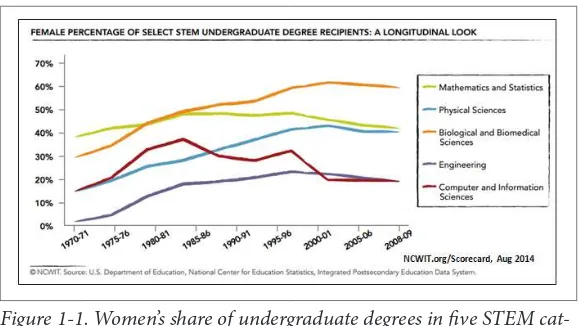
Figure 1-1. Women’s share of undergraduate degrees in five STEM cat‐ egories (1970-2009)
Cindi Howson has completely bucked this trend—she entered the field in the mid-1980s, as things were beginning to take off and has stayed with it ever since. Even more remarkably, Howson didn’t plan on a tech-oriented career in the first place—in college, she was on her way to becoming the next great American writer until a detour led her to explore the functionings of local area networks, databases, file recovery, the intricacies of Lotus 123, and FOCUS. In a fateful move, Howson lost some important documents on her computer and her journey to recover them led her down a path toward an interest in technology. Then, when her first employer started a data warehouse project, she was involved in the selection of BI tools, and her journey into BI and data really began.
Years later, Howson returned to school to round out her grasp of business concepts; she completed her MBA in Management Infor‐ mation Systems at Rice University. This additional education pre‐ pared her for the launch of her business: the BI Scorecard. Accord‐ ing to Howson, “I never had a dream to own my own business—I was simply a new mother at the time trying to juggle work and fam‐ ily and thought being self-employed gave me more control over my time. It’s allowed me to do more and have greater success than if I had stayed with one firm. I’m blessed to have a job that I love, that brings me to fascinating clients, and places around the world.”
on BIScorecard.com; writing for Information Week, and authoring several books including: Successful Business Intelligence, Unlock the Value of BI & Big Data, and SAP Business Objects BI 4.0: The Com‐
plete Reference. She’s been a distinguished faculty member at The
Data Warehousing Institute (TDWI) and joined Gartner in 2015.
Howson has a big-picture vision of data and analytics—she views them as powerful assets that can offer a competitive advantage to those who use them well. Howson thinks about how data can help companies make the best products, stretch public funding dollars further, and even improve education.
Angie Ma
Chief Operating Officer, Co-Founder, The ASI
PhD, Physics, University College London
Graduate Diploma Law, BPP Law School
MSci, Physics, Imperial College
First, identify what’s important to you—whether that be how to make your startup succeed, what career to pursue, how to balance work with family life, or how to improve yourself. Angie Ma is Co-Founder and Chief Operating Officer of The ASI—a London-based startup that runs a carefully structured “finishing school” for science and engineering doctorates. In her role at the ASI, Ma helps guide over 100 PhD graduates a year to find what’s important to them per‐ sonally and professionally, as they transition from higher education to industry. With a background bridging the fields of physics, medi‐ cine, law, and data science—Ma’s career is driven by a sense of adventure, a commitment to quality, and a desire to provide mean‐ ingful service to others.
China in the early 20th century, when girls weren’t expected or encouraged to go to school at all. She and her sisters would take turns going to school—she would go one year, a sister would go the next year, and they would teach each other at the same time. At 18, her grandmother left home with no money and no support, in pur‐ suit of a law degree; Ma remarks, that having achieved it, her grand‐ mother went way beyond her family’s and society’s expectations, and the value of her grandmother’s education is a positive influence that still resonates within her family today.
Rejecting outside influences pushing her to become a pianist or practice law, Ma reveals a history of returning again and again to her passion: science—chosen for its ability to explain how things work, and its capacity to change the world in meaningful ways. Physics, as Ma puts it, is precisely the study of how things work, and she easily relates it to her work in data science, at the ASI today:
“Physics is about understanding the natural world using data. Data science is about understanding the human world with data. The two fields are identical in their goal, which is to develop a deeper mental model of reality. The difference is in the application—what you use the data for.”
After completing her Master of Science degree at the Imperial Col‐ lege, Ma completed her Graduate Diploma of Law at the BPP Law School. While she appreciated the philosophical aspects of studying law, and the perspective it gives her today on any legal issues that come up at the ASI, the most critical thing she learned was that a career in law wasn’t for her.
At the ASI, Ma brings together several key lessons and skills honed during her research experience—one of the most important being the ability to communicate clearly and engage an audience. “Data means nothing unless you have a story that you can tell to explain it,” says Ma. She goes on to explain that a crucial question to ask yourself when working with data is: “How can you relay the story of your data with topics that people care about?” Four years in Toast‐ masters taught Ma an important answer to this question: always find a way to make the story relatable—and capture the audience’s atten‐ tion within 30 seconds or less, or risk losing their attention alto‐ gether.
Another surprising lesson Ma brings from the world of physics to data science today is the importance for women to see what she calls
the real problem. She admits that during her PhD research, a lot of
any gender-related constraints she faced were a result of her own thinking.
“When you see a problem as a gender problem, you’re seeing it through a tinted glass. You’re not seeing the real problem. Instead— if you consider how you can use your own skills to solve the prob‐ lem, that’s empowering and it brings male colleagues closer because you can ask them for help, and you’re not creating an artificial gen‐ der divide,” Ma explains.
Neha Narkhede
Cofounder and Head of Engineering, Confluent
MS, Computer Science, Georgia Institute of Technology
BE, Computer Engineering, University of Pune
Growing up in India, Neha’s parents made sure she clearly under‐ stood that nothing would prevent her from succeeding in any field. This psychological belief in an unlimited future potential, family treatment with complete gender equality and a pro-learning cultural environment in India have all certainly contributed to Neha’s success and career choices in later life. These same factors may also shed light on how Neha has pursued her interests in math, computer sci‐ ence and tech with unbridled enthusiasm. A liberating belief system and an independent spirit have shaped Neha’s identity with a special combination of entrepreneurship, technology and desire to solve real world problems.
When Neha joined LinkedIn a few years ago, the company, in the throes of explosive growth, had started to encounter multiple instances of scaling problems in its core database, social graph sys‐ tem, search engine and data warehouse. The result was that none of the systems that stored data could keep pace with the variety of data generated by its growing user base which has since expanded to 329 million users worldwide and which adds users at a rate of more than two new members per second.
business and activity data as well as operational data like error logs and performance metrics allowed generation of all this as a set of feeds in Kafka. What started as a way of copying high volume real-time data ended up as a different way to think about the data alto‐ gether. Neha became convinced that they were onto something big. And they were. Since its creation by the LinkedIn team, Kafka has seen widespread adoption across thousands of companies like Link‐ edIn, Uber, Netflix, Verizon, Goldman Sachs, Salesforce and many more.
Ultimately, the team donated the Kafka code to the Apache Software Foundation and they wound up starting a brand new venture, Con‐ fluent, to bring Apache Kafka and real-time data to the enterprise. Kafka acts as both a replacement for traditional enterprise message brokers and a way to sync data between different systems and data‐ bases. Neha uses an analogy to explain Kafka’s functionality: “Kafka acts like a company’s central nervous system. If you consider Hadoop like the long term memory or brain that stores huge amounts of data, then Kafka acts as the nervous system that collects billions of sensors in the form of bytes of data for later access.” Now with the team at Confluent, Neha “is solving a very key problem that all large companies face, which is collecting data about everything happening inside a company and allowing applications and systems to react to events in real-time.”
While by profession a distributed systems engineer, Neha has worked with many data scientists and opines about the ideal skill set combination. “Math and statistics are absolutely essential, coding is an either or situation although knowing how to write code grants authority, speed and freedom of expression,” she maintains.
Claudia Perlich
Chief Scientist, Dstillery
PhD, Information Systems, New York University
MS, Management Information Systems, New York University
MS, Computer Science, Technische Universität Darmstadt/Technical
University Darmstadt
BS, Computer Science, University of Colorado
Detecting breast cancer—early. Classifying the genetics of the yeast genome. Solving a myriad of business and societal problems. From computer science and information systems to entrepreneurship, academia, the business sphere, and parenthood: welcome to the world of algorithms, data, and assorted tales of Claudia Perlich.
Perlich is Chief Scientist at Dstillery, where she tackles the complex feat of analyzing billions of web user interactions, and develops algorithms to score and match cohorts of prospective audiences with major marketers. In addition, Perlich teaches in the Stern MBA program at NYU, has published over 50 scientific articles, holds multiple patents in machine learning, and has won awards and com‐ petitions in data mining and related topics. A conscientious and devoted mother, aspiring cellist, and equestrian, Perlich still finds time to give back to the next generation of women.
Perlich spoke candidly about the field of data and its opportunities: “The market is hungry for data scientists. You can even dictate the terms of your engagement. Practices in data science are less formal and rigorous than in the engineering field … you can have flexibil‐ ity, if you need it.”
to the algorithm. Intuition is a vital piece on the data side; you often can tell if something is wrong with your data; more often than not there is something wrong with your data, and there is a notion of intuition needed as you review the data—it can’t be solved techni‐ cally…”
Why is this so? In the evolving field of data science, Perlich sees the following set of challenges: “First, the primary challenge is to under‐ stand the (business) problem. It’s important to have an eye-level … conversation to make sure the problem is being advanced correctly or that the right question is being asked at all. Next, what data is available to solve the problem from a practical usability standpoint or can be had to solve the problem. Thirdly, what algorithms and what sequence of steps need to be taken to tie it all together.” According to Perlich, last but not the least of all of the challenges of a data scientist is convincing business partners of the correct solu‐ tion; she finds that using clear visualizations are most helpful for explaining solutions in a way that makes sense to everyone in the room.
In terms of career advice, Perlich reflects on her own journey: “My career is a direct result of my natural curiosity and a deliberate delay of early commitment to a specific field.” She continues, “I have emphasized flexibility. In my career and professional evolution as a data scientist, I have been agile and have taken advantage of many diverse opportunities and options presented later on in the market‐ place.”
Kira Radinsky
Co-founder and CTO at SalesPredict
PhD, Computer Science, Technion-Machon Technologi Le’ Israel
BS, Computer Science, Technion-Machon Technologi Le’ Israel
Guided by her mother at the age of six, Kira Radinsky wrote her first line of code. Born in the Ukraine, Radinsky immigrated to Israel with her parents as a preschooler. As a child, she delighted in play‐ ing with puzzles and riddles and putting things together—a har‐ binger of future work in conditional probabilities.
In thinking about the inspiration for her work, Radinsky explains: “There are little puzzles you need to solve, and it’s hard to do man‐ ually, so I wondered—is there a way of doing this automatically? I see interesting patterns, and I want to know why. I want to be the Indiana Jones of predictive analytics. Today, I feel that many deci‐ sions in the business world are based on gut feeling, but we have the information we need to make better decisions based on data—this is my focus.”
Early in her career, using knowledge readily available on the Web— historical records, decades’ worth of news stories from The New York
Times, social media posts, and many other large-scale sources of
data—Radinsky has designed a methodology with Eric Horvitz, codirector at Microsoft Research in Redmond, Washington, that determines when and where disease outbreaks might occur. Their system maps historical data—applying computational power that allows for finding patterns and making certain correlations and inferences about the future. Droughts in Angola and Bangladesh, for example, foretold of cholera outbreaks—thereby linking the weather, disease, and death.
previously used for the weather and healthcare challenges. SalesPre‐ dict uses algorithms to help companies find and keep future cus‐ tomers by providing predictive insights into who is most likely to buy, who will buy more, who will churn, and why. Radinsky explains: “If predicting the future can be done, it really would have transformational value for many industries (not only health and healthcare), but for the benefit of mankind and businesses in gen‐ eral.”
According to Radinsky, data science is a multidimensional field where doing well requires many skills. In addition to those usually mentioned—math, statistics, machine learning, coding, etc.—Kira adds business knowledge, “as it allows one to ask the right questions and understand the problem you are trying to solve. Over the long run, coding, and especially being emotionally mature, helps you solve business problems more efficiently.”
Majken Sander
Business Analyst & Data Nerd
Business Developer, T. Hansen Gruppen A/S
Business Degree in Financial Analysis, Project Management and IT, Vejle
Business School; PBa Math and Art, CVU Jelling
For Majken Sander, working with data is an art as well as a science. In data, she finds a creative outlet that leads to better business deci‐ sions. Sander is a Business Developer at T. Hansen Gruppen A/S, a retail supplier of equipment and spare parts for bicycles, scooters, vehicles, computers, and more, in Denmark. She is a self-proclaimed “realist”—interested in what can be measured and proven, and as she puts it: “leaving no path within analytics, visualization of facts, and the language of math unexplored.”
Sander completed business school and one of her first roles was as a business consultant at Dolberg Data. Her role there involved advis‐ ing clients on how to run a business, develop business processes, how to make different departments work well together, and how to determine which questions to ask when making business decisions. She vividly recalls that at first, it felt like she was playing ball on the men’s field: “I felt that I could be feminine, but not too feminine…I felt that I always had to prove my worth.” She later went to work at Hans Tørsleff management systems, and it was at this time that she recalls the first significant milestone in her career: when she felt that a client took her seriously.
“During a project that was off-track, I had to tell an older, male cli‐ ent (and a manager) that he was causing part of the problem by stalling the decision-making process. At the time, I was in my 20s (about half his age), and I was faced with the challenge of telling him his role in the problem. He didn’t like it much, but in the end, he thanked me for helping him realize the issue, and he paid the bill.”
After working several years as a business consultant, analyst, and project manager in a male-dominated field, Sander took some time off to have children, and at the same time, to re-think her career. Well-practiced in asking tough questions, she asked herself what she really wanted. Her next move was to become a math and science teacher at the Skovvang School, where ironically she discovered why she believes so few women pursue careers in math and science:
“One issue is that a lot of examples used in math are geared toward the general interests of boys (for example, ‘How fast does the car drive?’). If we brought in more feminine examples, we could meet girls in their territory, instead of expecting them to get interested in what the boys are interested in, and learn the math.” She adds: “Math is about numbers, but we use words to talk about it—words the kids have never really thought about, so that creates an added layer of challenge. My focus was to work with kids on their lan‐ guage skills, to bring language into math in an understandable way. Helping the kids learn about words that are used in math.”
After two years teaching, she reentered the business world, rejuven‐ ated and ready to use her talent for analyzing data and business pro‐ cesses at T. Hansen Gruppen A/S. Sander’s particular passion is for providing what she calls “data-driven decision support,” so that busi‐ ness leaders use data—facts—to make decisions, rather than gut instincts, which she notes is all too common. For example, in her work analyzing data on the sales of spare car parts, Sander often sees that “…a team might estimate that just because they sold 1,200 items of a certain car part two years ago, and 1,000 a year ago, they’ll project 800 will be sold in the current year. But,if you look at the data for the cars on the road, for example, if fewer people are driving the car that uses that part, you can make a better prediction, using data to know what to expect, and make decisions based on more realistic expectations.”
Today, Sander finds it’s easier than ever to be herself in the business world—she acknowledges that some of this comes with age, and some from perspective. Her advice to other women in business reflects a wisdom clearly gained from experience: “Don’t feel you have to give up your femininity to be in business. At the same time, you have to consider that you’re entering a male-dominated playing field…acknowledge that your male colleagues see the world differ‐ ently than you do.” Sander adds that women bring a diverse perspec‐ tive to the workplace, and it’s important we be aware of its value. She believes that it’s in the combination of both men and women’s attributes that we can excel in business, together.
Gwen Shapira
Software Engineer, Cloudera
BS, Computer Science and Statistics, Tel Aviv University
their advanced programming class. She took all of the exams and embarked on the path to her career in the IT industry.
Equipped with a solid foundation in statistics, programming, and database administration experience (Linux and Oracle), Shapira is today part of the engineering team at Cloudera that is responsible for designing and implementing scalable data processing solutions built on Apache Hadoop. She is a committer of the Apache Sqoop project, active contributor for Apache Kafka, and author of Hadoop
Application Architectures (O’Reilly). Shapira loves troubleshooting
and confesses that when she’s working with computers she is “totally in the flow.”
For Shapira, career management has meant selecting the right jobs for her skill set and expertise, preferring deep technical roles. “Women are often gently directed away from technical roles into positions requiring soft skills like project management. It can be tempting, but I found that I’m happiest when working on technical challenges,” says Shapira. Shapira is an Open Source developer, a former consultant and an expert on designing data pipelines in Cloudera’s data ingest team. The products her team builds enable customers to move data to the Hadoop platform while ensuring accuracy and integrity of the data. In a typical day, Shapira designs and codes new features for Apache Kafka, writes documentation, discusses use cases and solutions with customers, and prospects and perhaps even works on presentations to evangelize her software projects.
Laurie Skelly
Data Scientist, Datascope; Course Designer & Instructor, Metis
PhD, Integrative Neuroscience, University of Chicago
BA, Neuroscience, Trinity College
During graduate school, Skelly began researching the neural pro‐ cesses behind empathy and psychopathy, connecting the dots between behavior and emotions using machine learning algorithms. Now, as a lead course designer for the Data Science Bootcamp at Metis, a newly launched organization offering a 12-week training program for data scientists, Skelly knows firsthand which combina‐ tions of tools, techniques, concepts, and skills are needed by the pro‐ fessional data scientist today. “At Metis, we train for real life condi‐ tions. Our curriculum centers on technology, but since real life includes working with others, reacting quickly, troubleshooting, and communications, we design the projects accordingly,” says Skelly.
Skelly’s students learn from the experience of other professionals, work independently and in teams, adapt quickly to the unexpected, and respect deadlines—all in an effort to mimic the real-world working conditions that await them upon graduation. Presentations and public speaking provide opportunities to practice making con‐ vincing arguments for future employment interviews and for win‐ ning the support of executives on the job. Learning how to commu‐ nicate sophisticated ideas in a digestible and memorable way is another equally vital component of each student’s success.
When asked about her views on early education, Skelly commented that she’d love to see the math and science curriculum de-coupled from goals of bygone days and better tailored to modern use cases and interests. For example, she recommends de-emphasizing geom‐ etry and trigonometry in favor of concepts from statistics or linear algebra.
In the work world, Skelly would also like to see more males advocat‐ ing for and supporting women. In her mind, when male coworkers actively promote their female teammates as equals, they clear away unnecessary debris and help everyone to work at their peak ability.
Kathleen Ting
Technical Account Manager, Cloudera
MS, Computer Engineering, Santa Clara University
BS, Computer Engineering, Santa Clara University
As a Technical Account Manager (TAM), Kathleen Ting helps Clou‐ dera’s strategic customers deploy and use the Apache Hadoop plat‐ form in production. Acting as the customer’s technical advisor, she is a technical expert with a passion for customer management. A key aspect to success in this role is persistence: in managing expecta‐ tions between the customer and Cloudera’s product development teams, in forming a relationship of trust with the customer, in antic‐ ipating customer needs, and in acting with agility in unexpected sit‐ uations.
At SCU, Ting had the opportunity to select Marie Wieck, an indus‐ try stalwart at IBM, as a mentor through MentorNet. Encouraging her to continue on for an advanced degree, Wieck afterwards passed Ting’s resume into IBM, leading to an interview, and Ting’s life-long dream to work at IBM was fulfilled.
After Ting worked at IBM on the mainframe for a few years, it was her former SCU Dean of Engineering, Dan Pitt, who piqued her interest in big data. Although she lacked open source experience at the time, Ting persisted in trying to interview at Cloudera. Eventu‐ ally it was her unconventional offer to work for free that landed her an interview at Cloudera, where she started in early 2011 as their first Hadoop support engineer.
At Cloudera, Ting sought out Apache Software Foundation (ASF) member Arvind Prabhakar, who became her mentor related to all things Apache. In fact, her first conversation with Prabhakar was around the need for an Apache Sqoop mainframe connector by which to easily move data from the mainframe to Hadoop. Ting credits this mentorship with leading her to become an Apache Sqoop Committer and Project Management Committee (PMC) member. Drawing from her work at Cloudera, Ting is a frequent speaker at data-related conferences as well as a published coauthor of the Apache Sqoop Cookbook (O’Reilly).
Appreciative of how mentorship has propelled her career, Ting tries to do her part in shrinking the tech gender gap by volunteering with the Society of Women Engineers as well as by speaking to young women at the She’s Geeky conference and to incoming SCU engi‐ neering freshmen.
Renetta Garrison Tull
Associate Vice Provost, Director of PROMISE, University of Maryland
Baltimore County (UMBC)
PhD, Speech Science, Northwestern University
MS, Electrical Engineering, Northwestern University
BS, Electrical Engineering, Howard University
Dr. Renetta Tull is a recognized expert in women and minorities in education, and in the STEM gender gap—both within and outside the academic environment. Dr. Tull is also an electrical engineer by training and is passionate about bringing more women into the field.
From her vantage point at the University of Maryland Baltimore County (UMBC) as Associate Vice Provost for Graduate Student Development and Postdoctoral Affairs, Dr. Tull concentrates on opportunities for graduate and postdoctoral professional develop‐ ment. As Director of PROMISE: Maryland’s Alliance for Graduate Education and the Professoriate (AGEP) program for the University System of Maryland (USM), Dr. Tull also has a unique perspective on the STEM subjects that students cover prior to attending the uni‐ versity, within academia, and as preparation for the workforce beyond graduation.
Dr. Tull has been writing code since the seventh grade. Fascinated by the Internet, she “learned HTML before there were WYSIWYGs!”,
Dr. Tull has been involved with many strategic initiatives, including the following:
• Liaison for Institutional Collaboration at Universidad Metro‐ politana in San Juan, Puerto Rico
• Co-PI for the ADVANCE Hispanic Women in STEM Network‐ ing Conference
• Co-PI Collaborative Research on diversity programs with the Quality of Life Technology Center (Carnegie Mellon University/ University of Pittsburgh)
• Leader, “Women in STEM” project for the Latin and Caribbean Consortium of Engineering Institutions (LACCEI).
• Invited speaker for programs at MIT, Cornell, University of Maine System, Society for Hispanic Professional Engineers (SHPE), National Society of Black Engineers (NSBE), American Indian Science and Engineering Society (AISES), The National GEM Consortium and others
• Former Board Member of the Northeastern Association of Graduate Schools
• Former Vice President of Operations for an emerging technolo‐ gies firm
Dr. Tull believes that women thrive with support and a network. She recommends organizations such as Latinas in Computing, the ACM Richard Tapia Celebration of Diversity in Computing Conference, and the National Science Foundation’s Louis Stokes Alliance for Minority Participation, a grant-based program that provides student scholarships.
Dr. Tull works to increase the psychological sense of community and professional development opportunities for graduate students in Maryland. Through her involvement with PROMISE, a local pro‐ gram in Maryland that is one of eight National Science Foundation AGEP programs in the United States for underrepresented STEM graduate students and postdocs. Programs include the Summer Suc‐ cess Institute (SSI), Professors-in-Training (PROF-it), Dissertation House, Research Symposium, and others. According to Dr. Tull, these programs have contributed to an increase in applications, enrollments, and graduation rates of underrepresented graduate stu‐ dents in STEM fields in Maryland.
“Women can be more involved with computing fields, and cer‐ tainly, opportunities for ubiquitous computing limit restrictions for engagement. However, women need to know that they are invited to the table; they need to see images that show that they are not excluded and they need regular and continuous access to comput‐ ing environments early, within the K–12 years. Many local, regional, and national groups are doing that. These groups need exposure within the schools, so that girls will take advantage of them. Further, the national media can contribute to a solution by showcasing images of girls working with computers, and women in computing. Some leaders are talking about making computer sci‐ ence a core standard as early as elementary school, in the same way that math and reading are taught at early ages. Building proficiency, and acceptance at a young age, can go a long way. This acceptance must then continue throughout college, graduate school, and the career.”
Hanna Wallach
Researcher, Microsoft; Assistant Professor, University of Massachusetts
Amherst
PhD, Machine Learning, University of Cambridge
MS, Cognitive Science and Machine Learning, University of Edinburgh
BS, Computer Science, University of Cambridge
In speaking with Hanna Wallach, she proudly cites a point of great distinction: “I’m probably the only person on the planet who has appeared in both Linux Format and Glamour magazines.”
act. She collaborates with political scientists, sociologists, and jour‐ nalists to learn how organizations—often those underlying the U.S. political system—work in practice by analyzing publicly available data. Her research contributes to machine learning, Bayesian statis‐ tics, and in collaboration with social scientists, to the field of com‐ putational social science. Her work on infinite belief networks won the best paper award at AISTATS 2010, and she’s organized several workshops on Bayesian latent variable modeling and computational social science.
A Glamour Magazine “35 Women Under 35 Who Are Changing the Tech Industry” honoree, Wallach says “at its core, my work is really all about using fancy math and fast computers to learn about social processes, such as those that underlie the U.S. government.” She adds that what enables her cutting-edge work is the massive quan‐ tity and diversity of data now publicly available. “We’ve had comput‐ ers for a while. We’ve also had some of the math. But now we have massive amounts of data. What were once hypothetical theories about people and society are now being validated (or disproved!) by large-scale, data-driven analyses. This is extremely exciting.”
Is a researcher and computer science professor also a data professio‐ nal? “Yes, absolutely,” says Wallach, “because data science brings together people with a wide variety of skill sets and backgrounds.” Moreover, she believes that in order to succeed in the field, you need to be open-minded, interested, and continually learning—you need to have a “growth mindset.”
Wallach enjoys a strong network of professional women and men, who are at the ready to provide support, suggestions, and advice as role models, friends, and colleagues. Committed to giving back and supporting the cause of helping other women, Wallach has cofoun‐ ded three groups that focus on helping the next generation, includ‐ ing the annual Women in Machine Learning Workshop (which is currently in its ninth year!).
research about how teams with diverse viewpoints end up creating better ideas and products.”
Alice Zheng
Director of Data Science, Dato
Post Doc, Carnegie Mellon, Auton Lab and Parallel Data Lab
PhD, Electrical Engineering, emphasis in Communication, Computation and
Statistics, University of California, Berkeley
BA, Mathematics and Computer Science, University of California, Berkeley
Alice Zheng is Director of Data Science at Dato—the Seattle-based startup that was awarded at the Startup Showcase at the Strata +Hadoop World conference in Fall 2014. At Dato, Zheng demon‐ strates her expertise in machine learning algorithms and applica‐ tions—she loves playing with data and building tools that enable others to play with data.
How did this come about? Alice recalls being in elementary school in her native China, where math studies begin early, and bringing home a math grade that was below expectations. Her parents, both aeronautical engineers, were convinced she could do better. And after some intense tutoring from her father, she did, thereafter to remain at the top of all her math classes.
Zheng explains her feeling that the core of data science is problem solving:
“I love solving problems, and I love solving problems through data. But even more fundamentally, I love gaining fresh perspectives of the world. There are as many perspectives as there are people, and data is as amorphous, as flexible, as mysterious, and as potentially impactful as human beings. … I delight in the process of carefully deriving meaning and actionable information where it was previ‐ ously dominated by chaos and confusion. It’s almost a secondary benefit to then be able to make decisions or produce outputs (like making recommendations of what else someone can buy), based on the understanding I gain. The insights are what I prize.”
Zheng believes that the key to success is removing obstacles, even one’s own inner obstacles: “it’s our perceived limitations that limit us, not our innate abilities. To encourage girls to take up math and science, I think we should be working on getting rid of all of their perceived limitations about themselves. This is subtly different than building confidence. Confidence is the positive booster, whereas perceived limitations means negative self-talk. As we look for posi‐ tive feedback to build confidence, we should also be eliminating the sources of negativity.”
Margit Zwemer
Founder and CEO, LiquidLandscape
MFE, Financial Engineering, University of California, Berkeley
BS, Mathematics, Stanford University
Growing up in a family where both parents and grandparents had advanced degrees, it came naturally to Margit Zwemer to have a strong motivation toward higher education, and even to be comfort‐ able with math and enjoy a challenge. Zwemer’s grandparents emi‐ grated from Hungary; her grandfather arrived with a PhD in chem‐ istry and rebuilt his business here in the United States. The value of a scientific education was instilled in Zwemer at an early age. In fact, it was her father who taught Zwemer how to code when she was still in elementary school.
Zwemer’s early professional experience was as an options trader (a “quant”) at Goldman Sachs, and later with Société Générale. When she joined tech startup Kaggle, she rebranded as a “data scientist.” From having worked with machine learning algorithms and the open data community at Kaggle, Margit later developed these inter‐ ests and techniques further in the financial data visualization space.
Zwemer sees data visualizations “not just as pretty pictures to sum‐ marize the underlying data but as a tool for interacting with and manipulating a live data set and searching for patterns and anoma‐ lies that may not be easy to identify in the raw numbers.” At Liquid‐ Landscape, Zwemer is now “exploring a broad range of visualization environments each of which has pros and cons for understanding certain aspects of the data.We use both traditional two-dimensional visualizations like line charts and heat maps to show the interactions between a small number of variables and three-dimensional screen graphics that allow the overlay of additional streams of data so that users can visualize the overall state of the market.”
The company is currently exploring immersive data environments in virtual reality. Zwemer adds that what’s important for us now is “being able to integrate these visual environments into a single core data pipeline; it’s a huge leap over traditional ways of monitoring and visualizing data and consequently making decisions, optimizing performance and reducing risk.”
About the Authors
Cornelia Lévy-Bencheton is a communications strategy consultant
and writer whose data-driven marketing and decision support work helps companies optimize their performance.
As Principal of CLB Strategic Consulting, LLC., her focus is on the impact of disruptive technologies and their associated cultural chal‐ lenges that open up new opportunities and necessitate refreshed strategies. She concentrates on big data, IT, Women in STEM, social media and collaborative networking.
Ms. Lévy-Bencheton has held senior marketing and strategy posi‐ tions in well-known financial services firms, is currently on the Board of The Data Warehouse Institute, Tri-State Chapter, (TDWI) and the Board of the Financial Women’s Association (FWA). She earned her MA from Stanford University, MBA from Pace Univer‐ sity and holds several advanced certificates from New York University.
Shannon Cutt is an O’Reilly editor focused on content related to