Bv
Jejak Vol 11 (1) (2018): 151-161 DOI: doi.org/10.15294/jejak.v11i1.9643
JEJAK
Jurnal Ekonomi dan Kebijakan http://journal.unnes.ac.id/nju/index.php/jejak
Convergence Analysis of Economic Growth in East Java
Sri Karima Amalia1,Dwi Budi Santoso2, Sasongko3 123Universitas Brawijaya
Permalink/DOI: doi.org/10.15294/jejak.v11i1.9643
Received: October 2017; Accepted: January 2018; Published: March 2018
Abstract
Convergence and divergence of economic growth is a regional economic issue. The concept of convergence occurs when areas with poor economies tend to grow faster than areas with a rich economy whereas divergence occurs otherwise. East Java has a high economic growth but has a high inequality between districts/municipalities as well. Based on the concept of the inverted U-shape of the Kuznets curve, the East Java situation thus indicates that East Java is at the starting point of economic develo pment. Therefore, it is necessary to develop high economic growth with low inequality through acceleration of convergence by knowing the level of convergence of economic growth and acceleration factors of economic growth convergence of East Java. This study uses panel data from 38 districts/municipalities in East Java between 2005 and 2014 by adopting the model Barro & Sala-i-Martin (1992) then the model specification in answering research objectives are sigma convergence, absolute convergence, and conditional convergence. The estimation results show that in East Java economic growth is convergent at a low level so that efforts need to accelerate the convergence that can be reached through 5 (five) development policies, (i) equalization of basic infrastructure such as access equity (ii) equal distribution of energy availability, (iii) equalization of investment, (iv) equal distribution of labor force, and (v) equality of labor productivity.
Key words : Acceleration of convergence, Divergence, Economic growth
How to Cite: Amalia, S., Santoso, D., & Sasongko, S. (2018). Convergence Analysis of Economic Growth in East Java. JEJAK: Jurnal Ekonomi dan Kebijakan, 11(1), 151-161. doi: https://doi.org/10.15294/jejak.v11i1.9643
© 2018 Semarang State University. All rights reserved Corresponding author :
Address: Jalan Veteran, Ketawanggede, Lowokwaru, Malang City, East Java 65145a
E-mail: [email protected]
Sri Karima Amalia, et al., Convergence Analysis of Economic 152
INTRODUCTION
The definition of economic development proposed by Todaro and Smith (2011) is a multidimensional process involving fundamental changes in social structures, attitudes of communities and national institutions aimed at accelerating growth, reducing inequality and alleviating poverty. Spatially, each region or part of the region has diverse potential and conditions. Thus, in regional economic development, the objectives of economic development in general can be imposed in each of the different regions in order to achieve equitable distribution of development across regions reflected through the acceleration of growth, reduction of inequality (convergence), and poverty alleviation in each region.
At the beginning of the industrial era, the average real living standard in the richest countries is no more than three times greater than the poorest countries. Currently, the ratio is close to 100: 1. As Lant Pritchett points out, that developed countries today have enjoyed a much higher average rate of economic growth than developing countries over two centuries, a process known as divergence (Todaro & Smith, 2011). This indicates that the regional economic development objectives have not been achieved because the inequality between regions is widening (divergence).
In the early stages of economic growth there is an inequality caused by the growth process itself. Based Lewis’s theory of development there are two sectors of growth, that is the traditional sector (agriculture) and the modern sector (manufacture). In Lewis's theory of development hypothesized that
underdeveloped occurs due to underutilization of resources from structural
And change factors so that development requires more than the acceleration of capital formation. This theory focuses on the structural transformation of the process of economic transformation so that the contribution of the manufacturing sector exceeds the contribution of the agricultural sector in the national income. The main focus of this model lies in the process of labor transfer as well as the growth of output and employment in the modern sector. The process of self-sustaining growth and the expansion of employment opportunities are assumed to continue until all surplus labor is absorbed into the modern industrial sector. Furthermore, additional labor can only be obtained from the agricultural sector at a higher cost arising from the decline in traditional sector production due to the decline in the labor-to-land ratio which means that rural marginal power is no longer zero. This is known as "Lewis turning point".
In Kuznet's structural model described by the inverted U–shape Curve describing the relationship between growth and inequality. In the early stages of economic development, there is a process whereby the rate of economic growth increases with the level of inequality to the point of steady state which will further increase economic growth with the reduction of inequality.
JEJAK Journal of Economics and Policy Vol 11 (1) (2018) : 151-161 153
(spread effect), while the impact of the backwash effect is negative, that is the absorption of labor and capital from rural areas to urban areas, will cause a gap inter-urban and inland areas are getting bigger. Regional inequalities within a country are rooted on a noneconomic basis. Myrdal argues that if everything is left to market power without being impeded by any policy intervention then all economic activities within a developing economy tend to be profitable, which generally cluster in certain regions or territories. If these developed areas grow by harming other stagnant areas it will exacerbate regional inequality. Economic development in an increasingly developed country leads to a higher impact as well as transportation, communication, better education, and an increasingly dynamic relationship between ideas and values. Therefore, the role of the government in reducing the level of inequality with the aim of weakening the impact backwash effect and strengthening spread effect is very important. Gunnar Myrdal (1957) states that the main causes of regional inequality are strong backwash effects and weak spread effects in underdeveloped countries. Furthermore, according to Mrydal (1957) the non-egalitarian role of government will lead to regional inequality as well. Therefore, the role of the government in reducing the level of inequality with the aim of weakening the backwash effects and strengthening the spread effects is very important.
Barro & Sala-i-Martin (1992) define convergence as a process of economic growth of countries or regions, reducing differences or disparities in income, productivity, wage levels, and other indicators. In other barrwords, poorer regions can catch up with the developed regions because of the decrease
in regional income disparities and inter-region productivity leading to their rapid growth. A spread effect analysis can reduce inequality according to the concept proposed by Barro & Sala-i-Martin (1992) causing convergence while the backwash effect can cause divergence.
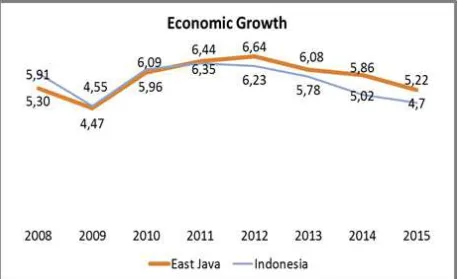
The convergence concept occurs when areas with poor economies tend to grow faster than areas with rich economies so that poorer regions tend to catch up rich regions in terms of per capita income levels or products. The concept of convergence is divided into 3 (three) namely sigma convergence, absolute convergence, and conditional convergence. Sigma convergence occurs when there is a decrease in per capita income dispersion over time. Absolute convergence occurs without considering growth factors whereas conditional convergence occurs by considering growth factors. East Java is one of the provinces in Indonesia that has inequality issue of regional economic growth. According to Regional planning agency of East Java Province (2015) and Central Bureau of Statistics (2012), East Java's economic growth in Java tends to be high even above the national economic growth. In 2011,
Indonesia's economic growth of 6,35 percent while East Java Province of 6,44 percent.
Figure 1. Economic Growth in Indonesia and East Java
Sri Karima Amalia, et al., Convergence Analysis of Economic 154
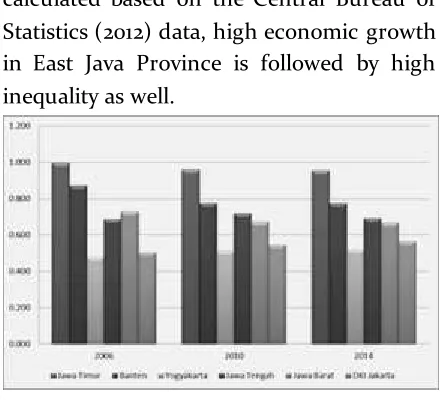
However, based on the index of inequality using the Williamson Index calculated based on the Central Bureau of Statistics (2012) data, high economic growth in East Java Province is followed by high inequality as well.
Figure 2. Economic inequality with Williamson Index in Java Island
Source : Primary Data, Processed
If linked with Kuznet's inverted U– shape curve, East Java's high economic growth is followed by high inequality, East Java is at the start of development (starting point of development) which has not reached the steady state peak of Kuznet's inverted U– shape curve.
Therefore, in order to create high economic growth followed by a decrease in inequality level, strategies are needed in creating and accelerating convergent regional economic growth in East Java through identification of economic growth patterns (convergence rates) and policy factors that accelerate the process of convergence of growth Economy in East Java.
RESEARCH METHODS
This research is quantitative using panel data in the period of 2005 - 2014 in districts/municipalities in East Java with 29 districts and 9 municipalities. By adopting the model Barro & Sala-i-Martin (1992) then
the model specification in answering research objectives are:
...(1)
Absolute Convergence
lnY = β0+ β1ln (yi,t0) + εi...(2)
Conditional Convergence where the policy factors of development affect growth
lnY = β0+ β1ln (yi,t0) + βiXi+εi...(3)
The development of conditional convergence from Barro is influenced by the policy of economic development
β1 = f(Policy) =α0+αiXi...(4)
So the conditional convergence equation in this research is:
lnY = β0+ α0ln(yi,0)+ αiln(yi,0)Xi+
βiXi+ εi...(5)
Is the per capita growth rate, 𝒍𝒏(𝒚𝒊,𝟎) is the initial per capita income, 𝑿𝒊 is a factor affecting regional economic growth, and 𝜷𝟏= 𝜶𝟎 is the convergence rate.
if positive means divergence, and negative means convergence, 𝑹𝑶𝑨𝑫 is a road infrastructure, is the ratio of the length of the road is good and medium per capita, 𝑬𝑳𝑬𝑪 is electrical infrastructure, is per capita electricity sold ratio, 𝑰𝑵𝑽𝑬𝑺𝑻 is a third-party funds, 𝑺𝑴𝑷𝑻 is the percentage of the population who graduated high school and university, 𝑼𝑴𝑲 is the Minimum Wage Value districts / municipalities, 𝑨𝑲 is the labor force level,
𝑷𝑹𝑶𝑫𝑻𝑲 is the ratio of output value per worker,
JEJAK Journal of Economics and Policy Vol 11 (1) (2018) : 151-161 155
𝑛𝑌 = 𝛽0+ [𝛼0+ 𝛼1(𝑅𝑂𝐴𝐷)𝑖𝑡+ 𝛼2(𝐸𝐿𝐸𝐶)𝑖𝑡+ 𝛼3(𝐼𝑁𝑉𝐸𝑆𝑇)𝑖𝑡+ 𝛼4(𝑆𝑀𝑃𝑇)𝑖𝑡+ 𝛼5(𝑈𝑀𝐾)𝑖𝑡
+ 𝛼6(𝐴𝐾)𝑖𝑡+ 𝛼7(𝑃𝑅𝑂𝐷𝑇𝐾)𝑖𝑡+ 𝛼8(𝐺𝑂𝑉𝑆𝑃𝐸𝑁𝐷)𝑖𝑡+ 𝜖𝑖] 𝑙𝑛(𝑦𝑖,𝑡0) + 𝛾1(𝑅𝑂𝐴𝐷)𝑖𝑡
+ 𝛾2(𝐸𝐿𝐸𝐶)𝑖𝑡+ 𝛾3(𝐼𝑁𝑉𝐸𝑆𝑇)𝑖𝑡+ 𝛾4(𝑆𝑀𝑃𝑇)𝑖𝑡+ 𝛾5(𝑈𝑀𝐾)𝑖𝑡+ 𝛾6(𝐴𝐾)𝑖𝑡
+ 𝛾7(𝑃𝑅𝑂𝐷𝑇𝐾)𝑖𝑡 + 𝛾8(𝐺𝑂𝑉𝑆𝑃𝐸𝑁𝐷)𝑖𝑡 + 𝜀𝑖
The policy factor interacted with
𝒍𝒏(𝒚𝒊,𝟎), if a negative value means a policy
factor that can accelerate convergence, and if it is positive means to slow down convergence.
Furthermore, the convergence velocity denoted by 𝒔 can be obtained by the equation
𝒔 = −𝐥𝐧(𝟏 + 𝜷𝟏)/𝚻, where Τ denotes the
number of years beginning and end of the study period. While the time taken to eliminate half of income imbalances at the beginning of the period is half life, 𝝉, with the equation 𝝉 = 𝐥𝐧(𝟐)/𝐥𝐧 (𝟏 + 𝜷𝟏) (Paas et al. 2007). In determining the best model is done chow test and hausman test.
The chow test compares common and fixed characteristic data, while the hausman test compares the fixed and random characteristic data. For fixed character data model (FEM) or LSDV, for random characteristic data used random effect model (REM) or ECM, while for common characteristic data is done least squares method.
RESULTS AND DISCUSSION
This research uses absolute convergence and conditional convergence. Absolute convergence is a natural convergence that occurs without the influence of policies and growth factors whereas conditional convergence occurs because it is influenced by policies and factors that affect growth.
By conducting the model selection test from panel data through chow test and hausman test, the model suitable for absolute convergence and conditional convergence is using fixed effect method (FEM) method in answering the research objectives.
Based on the calculation results that the coefficient of variation in value decreased from 1,656 in 2005 to 1,350 in 2014. The calculation result which can be seen in figure 1 can be concluded that in East Java there is a convergence of sigma that is the decrease of income dispersion per capita between regency / municipalities in East Java during period of 2005-2014.
Figure 1. Sigma Convergence Source : Primary Data, Processed
Sri Karima Amalia, et al., Convergence Analysis of Economic 156
Estimated Results of East Java Absolute Convergence 2005 – 2014 shows in appendix 1. Based on the estimation result, it is known that the coefficient value of 𝛽1=𝛼0 is negative value of -0.09. This means that in East Java there is an absolute convergence with time to eliminate all inequalities for 144.54 years.
The pace of convergence occurs at 1% per year with half time needed for region with least income per capita to be equal with the region with highest income per capita aprroximately 72,27 years. Moreover, the regions with high income per capita tends to have low income per capita growth. While regions with low income per capita have high income per capita growth. Therefore, income per capita convergence is possible in East Java.
There is a difference in per capita income between 2005 and 2014. These differences can affect the speed of the conferences in East Java. In 2005, Regency of Tuban and Bojonegoro were districts with low per capita income but in the year 2014 turned into a district with high per capita income. Bojonegoro regency has high economic growth due to government policy and public welcome in developing natural resources in the form of oil can cause the economy to grow well.
Municipality of Kediri have high GDP per capita, but have lower growth. In fact its growth is below the average growth rate of East Java. While the region with low GDP per capita and above average growth of East Java are Regency of Bojonegoro, Jombang, Lamongan, Lumajang Madiun, Nganjuk, Ngawi, Pacitan, Tuban, as well as Municipality of Batu. Therefore, it is possible to converge per capita income in East Java.
Conditional convergence occurs because it is influenced by policies and factors that affect growth. Low initial per capita income areas may catch up their preoccupation with high initial per capita income areas through policies issued by the government so that inequality may be reduced. Conditional convergence model considers several factor which affect regional economic growth and shows that regional steady state is determined by different structure.
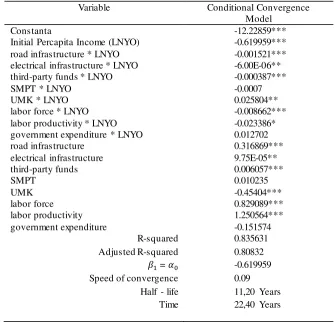
Based on the estimation result, it is known that the coefficient value 𝛽1 = 𝛼0is negative value equal to -0.619959. It means that in East Java there is conditional convergence with time to eliminate all inequality over 22,40 years. Furthermore, it can be concluded that the existence of government policy factors can accelerate the convergence of economic growth in East Java. Policy factors that can accelerate the convergence of economic growth in East Java include per capita road infrastructure, per capita power infrastructure, investment capital, labor force growth, and labor productivity growth.
East Java is a province that has a high rate of economic growth as well as a high level of inequality. Based on the calculation of williamson index among regions in Java Island, East Java has the highest level of inequality. Based on these facts indicate that East Java is in the early stages of economic development.
JEJAK Journal of Economics and Policy Vol 11 (1) (2018) : 151-161 157
policy instruments the time of convergence can be accelerated in East Java.
Results shows several factors influencing income per capita growth, which are road infrastructure per capita, electrical infrastructure per capita, capital investment, regional minimum wages, labour forces, as well as labour productivity. On the other hand factors that aren’t influencing income per capta growth are education level and government expenditure.
Among the policy factors that can accelerate the convergence of economic growth in East Java include per capita road infrastructure, per capita power infrastructure, investment capital, labor force growth, and labor productivity growth. While the factors that aren’t influencing the convergence are education level, labour force, and government expenditure.
Road infrastructure is a transport network that connects the economic activities of various regions into one, and therefore allows rapidly growing areas to encourage the economic growth of the poor regions by the effects of diffusion, thus showing a positive spillover effect. Xueliang (2008) noticed the fact that the development of transport infrastructure can promote the migration of economic activity between regions. It connects the economic activities of the various regions into one, and therefore allows a rapidly growing area to encourage regional economic growth to slow down by the effects of diffusion, thus demonstrating a positive spillover effect.
This variabel positively affect income per capita growth (0.316869) on 1% leve of significance. That is to say this variable accelerate income per kapita growth. For
every 1 unit of road infratucture added, income per capita growth will increase as much as 0.316869 unit. Road services both in quality and quantity in poor areas will tend to accelerate convergence in rich areas as it will facilitate the mobilization of both economic activity, people, and goods and will reduce transportation costs in order to increase the economic growth of poor areas. Likewise with the provision of quality and quantity of electricity infrastructure will accelerate convergence. Maryaningsih, Hermansyah, & Savitri (2014) stating that hard infrastructure, power, roads and port loading and unloading have a positive and significant impact on boosting per capita income.
Investment capital can accelerate growth and accelerate convergence. Based on neoclassical theory, investment capital becomes one of the most important to increase in output growth. Barkley, Henry, & Bao (1996) revealed that for spillover investment is to invest urban funds in rural areas. Increased investment capital in poor areas will have more impact on growth acceleration than in rich areas.
Amongst emprirical research employ physical capital and have positive significant effect on economic growth is Jajri and Ismail (2010) who found that capital reserve and capital per labour ratio have important role in contributing towards economic growth andlabour productivity. WhileResosudarmo and Vidyattama (2006) claims that physical capital accumulation is an important factor in promoting regional growth in Indonesia.
Sri Karima Amalia, et al., Convergence Analysis of Economic 158
Regency / Municipality Minimum Wage slows growth and slows convergence. Obeng (2015) argue that increased spending on wages can reduce investment spending by firms. This is likely to reduce productivity and production.
So growth may be hampered. The attractiveness of educated labor from low-income areas to high-low-income blood. As a result poor areas will lack skilled and educated human resources. This is what causes the backwash effect and slow the convergence.
Minimum wage increase might not be the most efficient way to reduce poverty (Card and Krueger, 1995). This is because the minimum wage increase is followed by higher unemployment rate especially for unskilled labour.
Dube (2013) claims that the moments to increase minimum wage is an important factor due to negative corelation between minimum wage raise and jobs availability. Increasing minimum wage in turn raise price level. Inflation effect of minimu wage raise burden the poor since they spend more portion of their income. Therefore the poors are prone to inflation impact of minimum wage raise.
In neoclassical theory, the labour force can accelerate growth. This is in accordance with the results of research which states that labor force growth can accelerate income per capita and accelerate convergence in East Java. Labor productivity describes the endogenous capability of workers and technical progress in a region. The results show that labor productivity can accelerate per capita income growth and accelerate convergence.
Education level positively influences insignificantly because there are still educated unemployed in East Java. Educated unemployment occurs because the number of registered job seekers is more than the registered job vacancy.
As well as the number of fulfillment of labor that turns out to be less than the vacancy required. This happens because of the inappropriate specifications required by the company so that the fulfillment of labor is not in accordance with the vacancy required.
Districts / municipalities government expenditures negatively affect the insignificant growth of per capita income and acceleration of convergence. This is due to similar variations in government spending that are unable to explain economic growth and acceleration of convergence in East Java. relationship between growth and inequality.
East Java's economic growth is convergent at a low level. This is evidenced by the results of the estimate of absolute convergence or natural convergence where this convergence is not influenced by policy factors. Furthermore, this low level of absolute convergence needs to be accelerated through policy factors issued by the government so that the reduction of inequality can also be accelerated.
JEJAK Journal of Economics and Policy Vol 11 (1) (2018) : 151-161 159
policies that can be pursued through 5 (five) development policies, namely (i) equalization of basic infrastructure such as access equity (ii) equal distribution of energy availability, (iii) equalization of investment, (iv) equal distribution of labor force, and (v) equality of labor productivity.
The policy of Regency / Municipality Minimum Wage in different regions is too far to cause the slowing down of the convergence of economic growth in East Java. Fiscal policy and provision of education in East Java shows the same pattern among regions so that it does not affect the condition of economic growth convergence East Java.
REFERENCES
Adisasmita, Rahardjo. 2013. Theories - Economic Development Theory; Economic Growth and Regional Growth. First. Yogyakarta: Graha Ilmu.
Aschauer, David Alan. 1989. “Is Public Expenditure Productive?” Journal of Monetary Economics 23 (September 1988): 177–200.
Regional Development Planning Board of East Java Province. 2015. Dynamic Data Book of East Java Province in First Semester 2015.
Central Bureau of Statistics. n.d. Gross Domestic Product of Regency / City in Indonesia 2010 - 2014. Jakarta.
Barkley, David L, Mark S Henry, and Shuming Bao. 1996.
“Identifying ‘Spread’ versus ‘Backwash’ Effects in
Regional Economic Areas: A Density Functions
Approach.” Land Economics 72 (3).
doi:10.2307/3147201.
Barro, R.J;, and Xavier Sala-i-Martin. 1995.
“Technologicas Diffusion, Convergence, and Growth.” London: Centre for Economic Policy
Research.
Barro, Robert J., and Xavier Sala-i-Martin. 2004.
Economic Growth. Journal of Macroeconomics.
Vol. 18. doi:10.1016/S0164-0704(96)80041-3. Barro, Robert J, and Xavier Sala-i-Martin. 1992.
“Convergence.” Journal of Political Economy 100 (2): 223–51. doi:10.1086/261816.
Budiono. 1992. Macroeconomy: Introduction to National Income Analysis, Fifth Edition. Yogyakarta: Liberty. Butkus, Mindaugas, and Violeta Pukeliene. 2012.
“Evaluation of Regional β Convergence in EU Countries at NUTS3 Level.” Ekonomika 91 (2): 22–37. Case, Karl E, and Ray C Fair. 2007. Principles Of Economics
Eight Edition. Eights Edi. New Jersey: Pearson
Prentice Hall.
Dao, Minh Quang. 2012. “Government Expenditure and
Growth in Developing Countries.” Progress in
Development Studies 12 (1): 77–82. doi:10.1177/
14649934 1101200105.
Debnath, Avijit, and Niranjan Roy. 2012. “Testing Spillover
Effects of Economic Growth : The Case of India ’ S
Northeastern Region” XI (3): 84–92.
Harvey, armstrong; Taylor, Jim. 2000. Regional Economics
and Policy. Third edit. Malden, Massachusetts:
Blackwell Publishers Inc.
Hong, Junjie, Zhaofang Chu, and Qiang Wang. 2011.
“Transport Infrastructure and Regional Economic Growth: Evidence from China.” Transportation 38 (5): 737–52. doi:10.1007/s11116-011-9349-6.
Jajri, Idris, and Rahmah Ismail. 2010. “Impact of Labour
Quality on Labour Productivity and Economic
Growth.” African Journal of Business Management 4 (4): 486–95.
Jhingan, M.L. 2014. The Economics of Development and Planning. 16thed. Jakarta: PT. RajaGrafindo Persada. Maryaningsih, Novi, Oki Hermansyah, and Myrnawati Savitri. 2014. "The Influence of Infrastructure Against Economic Growth In Indonesia," 61-98.
Obeng, Samuel Kwabena. 2015. “An Empirical Analysis of
the Relationship between Minimum Wage,
Investment and Economic Growth in Ghana” III
(65674).
Paas, Tiiu, Andres Kuusk, Friso Schlitte, and Andres Võrk.
2007. “Econometric Analysis of Income Convergence
in Selected EU Countries and Their Nuts 3 Level
Regions.” Working Papers.
Rahayu, Dewi, Munawar Ismail, Dwi Budi Santoso, and
Devanto Shasta Pratomo. 2015. “Do Natural
Resources And Human Capital Matter To Regional Income Convergence? (A Case Study at Regencies/Municipalities of Kalimantan Area -
Indonesia)” 211: 1112–16. doi:10.1016/j.
sbspro.2015.11.148.
Resosudarmo, Budy P., and Yogi Vidyattama. 2006.
Sri Karima Amalia, et al., Convergence Analysis of Economic 160
Data Analysis.” Asean Economic Bulletin 23 (1): 31–44. doi:10.1355/AE23-1C.
Sala-i-Martin, Xavier. 1994. “Regional Cohesion: Evidence and Theories of Regional Growth and
Convergence.” London: Centre for Economic
Policy Research.
Todaro, Michael P, and Stephen C Smith. 2014.
Economic Development Twelfth Edition. Twelfth.
Vidyattama, Yogi. 2010. “A Search for Indonesia’s
Regional Growth Determinants.” ASEAN
Economic Bulletin 27 (3): 281–94.
doi:10.1355/ae27-3c.
Xueliang, Zhang. 2008. “Transport Infrastructure ,
Spatial Spillover and Economic Growth :
Evidence from China” 3 (4): 585–97.
JEJAK Journal of Economics and Policy Vol 11 (1) (2018) : 151-161 161
APPENDIX
Table 1. Estimated Results of East Java Absolute Convergence 2005 - 2014
Source : Data Processed
Table 2. Estimation Result of East Java Conditional Convergence 2005 - 2014
Source : Data Processed
Variable Absolute Convergence
Model
Constanta 1.551196***
Initial Income Percapita (LNYO) -0.095458***
R-squared 0.219878
Adjusted R-squared 0.130458
𝛽1 = 𝛼0 -0.095458
Speed of convergence 0.010033
Half - life 72,27 Years
Time 144,54 Years
Variable Conditional Convergence
Model
Constanta -12.22859***
Initial Percapita Income (LNYO) -0.619959***
road infrastructure * LNYO -0.001521***
electrical infrastructure * LNYO -6.00E-06**
third-party funds * LNYO -0.000387***
SMPT * LNYO -0.0007
UMK * LNYO 0.025804**
labor force * LNYO -0.008662***
labor productivity * LNYO -0.023386*
government expenditure * LNYO 0.012702
road infrastructure 0.316869***
electrical infrastructure 9.75E-05**
third-party funds 0.006057***
SMPT 0.010235
UMK -0.45404***
labor force 0.829089***
labor productivity 1.250564***
government expenditure -0.151574
R-squared 0.835631
Adjusted R-squared 0.80832
𝛽1 = 𝛼0 -0.619959
Speed of convergence 0.09
Half - life 11,20 Years