Jurnal Studi Kultural Volume I No. 2 Juli 2016 www.an1mage.org 89
Jurnal Jurnal Studi Kultural (2016) Volume I No.2: 89–93
Jurnal Studi Kultural
http://journals.an1mage.net/index.php/ajskLaporan Riset
The Use of Green Turtles in Bali, When Conservation Meets Culture
Rodney Westerlaken*Stenden University, Netherlands
Article Info
Article history: Received 18 April 2016 Revised 27 April 2016 Accepted 6 June 2016
Keywords: Bali Conservation Green turtles Ceremonies Conservation
1.Introduction
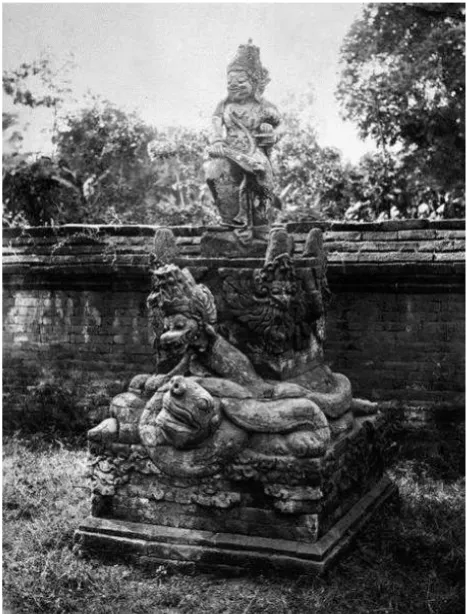
Balinese call their island ‘the navel of the world’. The island is seen as the center of the universe that rests on the back of a turtle named Bedawang Nala.This Bedawang Nala floats on the world ocean [2].
In the catur yoga, an ancient manuscript, the world is seen as strapped to BedawangNala’sback by a pair of crested serpents, or naga. In the description you can read a warning that when the snakes are allowed to lose their grip, for whatever reason, earthquakes will take place with devastating consequences [2].
Bäckström [3] notes that the turtle symbolizes the
foundation supporting the earth and all its life. In the same article she also notes that the world turtle, Bedawang Nala, is believed to dwell in the underworld, where it carries the world on its back.
According to the worldview of the Balinese the sea has demonic qualities whereas the mountains are seen as the seats of the gods. The goal in the life of the Balinese is to create a balance between good and evil. Unbalanced situations need to be corrected by ceremonies.
Figure 1. Bedawang Nala in a temple in Kerobokan (Photo: Collection Tropenmuseum Amsterdam).
In this way you can see the sea as the host of demons. But looking at the sea by itself the sea holds divine and demonic forces at the same time.
The use of green turtles in ceremonies, as delicacy or for the use of the shell has been a vast problem in history and recent years on Bali. The number of turtles living in the waters surrounding Bali is decreasing and the illegal trade is vivid.
Several projects are fighting for conservation of turtles and the Parisada Hindu Dharma Indonesia (the highest Hindu council) issued a decree against the use of turtles in ceremonies, but illegal trade remains. On April 7, 2016 40 green sea turtles (Chelonia mydas) were captured by KAPOLDA (kepolisian daerah, regional police). They were on a ship for 7 days without any water, there flippers tied together prohibiting them to move. On April 14, 2016 31 turtles were released on Kuta beach after given medical care. Four turtles died, three are currently still under medical care and three are kept as evidence.
The green turtle is listed as an endangered species on the IUCN red list [1] and should be protected. Conservation and culture meet each other at the struggle for the green turtle.
© 2016 Komunitas Studi Kultural Indonesia. Published by An1mage. All rights reserved. Abstract
Jurnal Studi Kultural Volume I No. 2 Juli 2016 www.an1mage.org 90 The sea is also seen as the purifier of everything that comes
from the island. A good example is the final phase of the cremation ceremony of a deceased. The ashes will be strewed in the sea in order to purify the soul [4].
To dedicate themselves to reconciliation and harmony between high and low, day and night, good and evil, life and death the Balinese, among other things, give food and flowers to the gods. It’s a sacrifice of special gifts. The most potent and expensive has always been the green turtle [2].
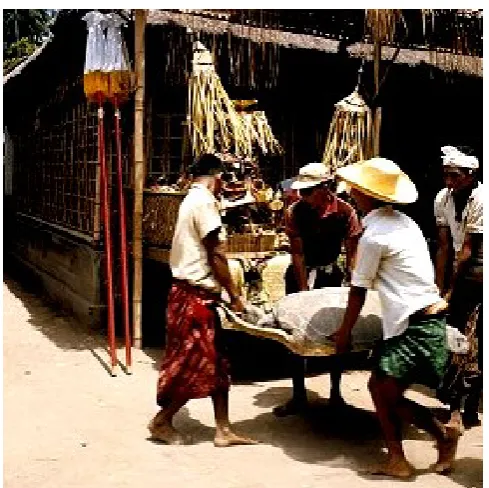
Turtles are used in Manusa Yadnya, the core human rituals. These rites occur in the highlights and lows of life, for example when a child reaches the age of three months, teeth filling, marriage and cremation [2,5,6].
Figure 2. A turtle used as offering in a cremation ceremony (Photo: Boy Lawson, 1971)
Lindsay notes [2] that mass turtle slaughter seems to be an ancient custom in Bali, but this is not the case. The turtle slaughter has developed over the last 100 years. The meat has become a luxury item to guests of honor.
Firgure 3. A Balinese man slaughters a green turtle (photo: occupy for animals)
2.Turtles in Indonesia
Turtles have existed over 100 million years in the oceans of the world. Those reptiles exhibit extraordinary powers of navigation that they use intensely while migrating thousands of kilometers between their feeding and breeding areas [6].
Indonesia is the green turtle’s prehistoric home [2]. Indonesia (with a latitude along 81.000 km and consisting of more than 17.000 islands) is nowadays the residence of six of the eight known sea turtle species in the world.
Species identified to live in Indonesia are: Green turtle (Chelonia mydas)
Hawksbill turtle (Eretmochelys imbricata) Olive turtle (Lepidochelys olivacea) Loggerhead turtles (Caretta caretta)
Leatherback turtle (Dermochelys coriacea)
Flatback turtle (Natator depressus) [7, 8]
3.How Turtles Are Hunted?
While laying eggs:
Turtles are an easy target when they come ashore to lay their eggs. As turtles are slow movers they can easily be caught. Smart hunters wait till the turtle laid her eggs so they can catch the turtle and the eggs [6].
Harpooning:
Harpooning is used for the least of turtle killings. The most turtles are caught by net. While harpooning a sharp tip breaks trough the shell of the turtle lies flat, so the turtle flesh will not damage.
After the impact, the point falls free from the shaft and the harpooner retrieves the turtle with the connected rope. After the turtle is harpooned the hunters will keep them under water. This means the hunters have to bring turtles above the sea level to prevent drowning [2].
Jurnal Studi Kultural Volume I No. 2 Juli 2016 www.an1mage.org 91 By nets:
Most effective is the turtle hunt by net. The hunters use a net strechted between two horizontal ropes. The mazes of the net are big. The turtle swims in to the net and gets entangled in it.
Possibly, the turtle will be harpooned or tied with a rope after this. The nets are set up behind the reefs and must be checked every hour to prevent the drowning of the new catch. During the high tide the nets will be positioned inside the reef [2].
Figure 5. Turtles are brought on land after being cached (photo: charleslindsay.com)
4.The Slaughterhouse
The hunters that bring their turtles to the harbor of Tanjung Benoa are mixed crews from Sulawesi, the Moluccas, Madura, Lombok, Sumbawa, Flores, Timor, Tanimbar and Irian Jaya.
The hunters get an advance promise or telegram to arrange turtle deliveries on important Hindu days [2]. The turtles are killed without any care for the wellbeing of the turtle itself.
Figure 6. Inside the slaughter house (photo: occupy for animals)
5.Finding a Solution
For decades NGO’s are trying to find a solution for the illegal trade and poaching of the green turtle. Well-known NGO’s that make a clenched fist are WWF and Greenpeace, but also local NGO’s like ProFauna, JAAN and soul surf project Bali are fighting for the wellbeing of this magnificent animal.
Greenpeace had a famous campaign in the nineties called ‘slaughter in paradise’ that was more or less the launch of the attention of NGO’s for the green turtle [3,9]
6.Timeline
1953
Lindsay [2]notes that a friend of him, Bapa Kerig, in 1958 witnessed a variation of the nula bulalin ceremony, the ceremony held when a child reaches the age of three months.
The father of the child had read in ‘obscure religious text’ that children should ride live turtles three times around Jaganatha temple in Denpasar.
The man rented the live turtles and returned them. An elderly priest confirmed that in the old days turtles were set free as a part of the ritual [2,5]
Regarding to this matter Backhaus (Backhaus 1988, p
174) notes that a member of a traditional society often has great difficulty breaking with his tradition, regardless whether this society is using natural resources in a sustainable way or not.
1979-1999
WWF has been actively campaigning to stop the turtle trade. Enormous international pressure was put on the Indonesian government during the Conference on the International Trade of Endangered Species of Wild Fauna and Flora (CITES).
Between 1978 and 1996 most turtles were gradually given a protected status under national Indonesian law [3]
In 1990 the governor of Bali set a quota (Governor decree 22/90) for turtle slaughter of 5000 green turtles per year. Hunting at that time was still permitted under national law. Tanjung Benoa (South Bali) was set as the only port for turtles to handle the turtle trade.
Jurnal Studi Kultural Volume I No. 2 Juli 2016 www.an1mage.org 92 people that formerly lived from turtle trade now had no other
source of income.
One year after this decree Greenpeace investigated the situation and did find out the decree only had a little impact.
Turtle meat was still sold in restaurants in the tourist zone (Kuta, Legian) and turtle shell jewelry and stuffed turtles where still for sale, even in the duty free zone of the International Airport. Greenpeace estimated that in 1990 at least 21.000 sea turtles were killed [3,6].
On 12 June 2000 the Governor issued a decree (243/1999) to withdraw the former decree because it was in conflict with the Government Regulation No 7/1999 and the quota for green turtle use stopped.
In 1999 the green turtle became a protected wild life animal under article 21 of Act No.5/1999, which legislates to protect and conserve natural resources and ecosystems.
According to this law the catching, storing, transporting and trading of all turtle species, turtle products and turtle eggs is prohibited. Illegal trade continued because there was still a market [3].
2004-2005
Ida Pedanda Gede Ngurah Kaleran, a high priest of southern
Denpasar said in 2004 that he believes it’s not necessary to
use turtles in religious ceremonies. ‘Nowhere in the holy book of Veda is stated that we should eat turtle’, he said.
He proposes the use of a symbol instead of the real animal to complete the ceremony. Many others disagree with him [3]. It has been estimated that ‘only’ 300 turtles a year are needed for ritual purposes in Bali each year [3].
The problem of the extinction of the green turtle could be solved by a decree from the Hindu Dharma council of Indonesia, a Bhisama.
On 31 august 2005 a Bhisama was issued in Denpasar that says the presence of endangered species, such as turtle, tiger, eagle, or any other near extinct animal in Hindu sacrifices could be substituted with a drawing, cake, or other animal.
Alternatively, the council agreed that endangered species can be used in the ritual provided that it will not be killed and will be released in the wild once the ritual has ended.
With this Bhisama WWF expects that there will be a
People or temples that want to use a turtle in a ceremony can buy them in the Serangan Turtle Conservation Centre. In this legal way those people or temples need an official letter from environmental organizations and religious authority. With those letters they can buy a turtle smaller than 20 cm in diameter for Rp 500.000,- [9,12].
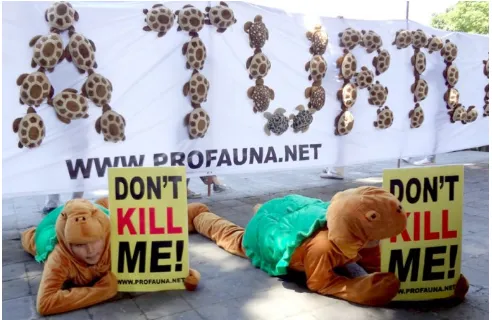
Figure 7. Protests against illegal turtle trade by ProFauna (photo: ProFauna)
WWF thinks that the new law cannot be accepted. But while many questions raise on the effectiveness of the implementation of this Law by Indonesian management authority, at the same time WWF tries to stop people catching productive wild-turtles, to allow these breeding sizes reproduce accordingly.
When the use of turtle for particular purposes cannot be stopped for any reason, and assuming that strict control can be done adequately, sacrificing few turtle nests to be hatched and reared to a certain size, is much better for turtle conservation than allowing people to catch wild and productive turtles for their ceremonial activities [13].
Illegal trade remains, with the last case of 40 green turtles being captured by KAPOLDA on April 7, 2016. Thirty-one turtles could be released on April 14, 2016 on Kuta beach. The flippers of the turtles were punctured and tied together by rope and the turtles were on the ship already for seven days.
Jurnal Studi Kultural Volume I No. 2 Juli 2016 www.an1mage.org 93 The Madurese crew of the ship can face up until five years
in jail for the crimes committed under the UU KSDA
(Indonesian Law on Biological Resources and Ecosystems) according to Irjen KAPOLDA (inspector) Sugeng Priyanto [13].
Figure 8. Turtles being released at Kuta Beach, April 14. 2016 (photo: foundation soul surf project Bali)
References
[1] http://www.iucnredlist.org/details/4615/0
[2] Charles, Lindsay. 1996. Turtle islands, Balinese ritual and the green turtle. Takarajima Books Inc., New York
[3] Bäckström, Jenny H. 2004. “Turtle satay? Attitudes towards turtle consumption are changing in Bali” in: Inside Indonesia (October-December 2004).
[4] Backhaus, Norman. 1998. Globalisation and marine resource use in Bali. in: Environmental challenges in South-East Asia by Victor E. King. University of Oslo
[5] Bakker, Frek. 2001. Balinees Hindoeisme. Uitgeverij Kok, Kampen
[6] Daly, Trevor. 1991. “Seaturtles in trouble in Indonesia”, in: Inside Indonesia (October 1991).
[7] ProFauna report: Hawksbill Trade in Indonesia, 2003
[8] ProFauna report: Sea turtle trade in Java, 2005
[9] I Wayan Wiradnyana in interview
[10] ProFauna. 2008. “Sea Turtle Exploitation in the Name of Conservation in Bali”. ProFauna. 2008.
[11] Acmad, Mubriq. 2005. WWF welcomes ‘Bhisama’ on marine
turtle protection. WWF Indonesia
[12] Staff TCEC (Turtle Conservation and Education Centre) Serangan in interview
[13] Dr. Windia Andyana (WWF) in interview