An Evaluation of the Intended and Implemented Curricula’s Adherence to the
NCTM Standards on the Mathematics Achievement of Third Grade Students: A Case Study
Asha K. Jitendra University of Minnesota
Cynthia C. Griffin University of Florida
Yan Ping Xin Purdue University
Abstract
This paper describes the results of a case study evaluating the influence of the intended
(textbook) and implemented curricula’s (teachers’ instructional practice) adherence to the
National Council of Teachers of Mathematics’ (NCTM) Standards on student outcomes in mathematics. We collected data on 72 third-grade students from four classrooms in one elementary school. Textbook and teacher adherence to the standards were evaluated using content analysis and direct observation procedures, respectively. Student achievement and attitude toward mathematics were measured through open-ended word problem solving tests and an attitude questionnaire. Results regarding the interactions among the intended, implemented, and learned curricula suggested that the textbook used in this school might have primarily influenced student achievement and attitude toward mathematics. Findings suggest that improving student outcomes may include not only changing instructional practices but also addressing changes in textbooks employed within instructional delivery.
The mathematical underachievement of students in the United States is well documented. One potentially critical factor that may explain the relatively poor
performance of U.S. students is the use of prepackaged educational materials that do not foster sufficient opportunities for developing critical mathematical ideas. The influence of mathematics textbooks on what schools teach and what students learn is established and widely accepted. Based on National Assessment of Educational Progress (NAEP) large-scale survey data, elementary school mathematics textbooks have been criticized for being repetitive, ill-defined, and unchallenging (Hiebert, 1999). The need for a coherent curriculum that moves from specific content (e.g., whole
process Standards have begun to shape the scope and sequence of most mathematics curricula programs, including traditional textbooks.
In light of the fact that mathematics textbooks are often the primary resource for teachers and that curricular knowledge presentation in textbooks affects instruction, it becomes critical to evaluate the impact a textbook has on the teaching and learning of mathematics. Preliminary results from mathematics textbook analysis studies suggest that the quality of the curricular content as it adheres to the Standards varies within and across textbooks (Jitendra et al., 2005). Furthermore, numerous empirical studies have examined the impact of curricula on student achievement (e.g., Boaler, 1998, 2002; Senk & Thompson, 2003; Woodward & Brown, 2006; Xin, 2007) or the effects of Standards-based teacher practices on student achievement (e.g., Harwell et al., 2007; Schoen, Cebulla, Finn, & Fi, 2003). These studies suggested a positive relationship between student achievement and either reform-based curricula or teacher use of certain reform practices. Other studies have investigated the effects of curricula on teacher actions (e.g., Collopy, 2003; Freeman & Porter, 1989; Haimes, 1996; Remillard, 2000), the impact of Standards-based curricula on students’ epistemological
conceptions of mathematics (Star & Hoffman, 2005) or the relationship between teacher instructional practices and student motivation (Schweinle, Meyer, & Turner, 2006). However, we found only one study that investigated the interactions among the curriculum, instructional practices, and student achievement (McCaffrey, Hamilton, Stecher, Klein, Bugliari, & Robyn, 2001). This study documented a positive relationship
between teachers’ reported use of Standards-based instructional practices and student achievement for integrated, inquiry-based high school mathematics courses. In contrast, use of Standards-based practices was not related to improved achievement in the more traditional algebra and geometry courses.
Mathematics content, instructional practice, and organization influence student learning (Schmidt, Houang, & Cogan, 2002). What teachers do in the classroom (the implemented or enacted curriculum) may account for student performance (learned curriculum) on standardized tests of mathematics achievement. Research indicates that one critical dimension that distinguishes effective teachers from less effective teachers has to do with their instructional practices rather than individual differences in teaching approaches (Schmidt et al.). With the shift in recent years from teacher emphasis on lecture and seatwork to teacher-student discourse focused on reasoning and making connections among mathematics ideas, it is important to understand how these reform-oriented instructional practices influence student learning. Further, because teachers vary greatly within a school and at the same grade level on their mathematics teaching (Stevenson & Baker, 1991), it is crucial to examine whether teachers who adhere
closely to recent reform practices positively influence students’ mathematics
In this study, we describe the interactions among the intended, implemented, and learned curricula in the context of one elementary school. Given the broad intent of this type of study and the difficulty of treating it in depth, we limited the study to a single topic (story or word problems) at one grade level (third grade) using the process Standards as the sole basis for evaluating the textbook and teachers’ instructional practice. We selected the topics of addition and subtraction problem solving at the third-grade level because it is a critical area in elementary mathematics. In particular, the study addressed the following questions:
To what extent did the textbook and teachers’ pedagogical practices adhere
to the Standards in teaching word problem solving? Further, were there differences in how teachers implemented the Standards? That is, were some teachers more effective at implementing the Standards than others?
What influence does difference in implementation of the Standards by
teachers have on students’ mathematics achievement and attitude toward
mathematics?
Method
Participants and Settings
Teachers. Four female, Caucasian third-grade teachers in a public elementary school in a small urban district participated in this observational study. The teachers were certified in elementary education. With the exception of one teacher (T1) who had a Bachelor’s degree, the remaining three teachers each held a Master’s degree. T1, T2, T3, and T4 had classroom teaching experience of 17, 27, 32, and 31 years,
respectively. The principal assigned T1 and T3 to two low-ability classrooms, whereas T2 and T4 taught in the ability classrooms. Classes were categorized as high-ability and low-high-ability classes on the basis of student scores on a mathematics
achievement test. Mathematics was taught five times a week for 50 minutes using the district-adopted traditional mathematics textbook.
Students. The sample included 72 students (47 boys and 25 girls) from the four third-grade teachers’ classrooms. Of these students, 88% were Caucasian, 4% were African American, and 8% were Hispanic. Five students had identified learning disabilities (LD), with one student also diagnosed with co-morbid attention deficit-hyperactivity disorder (ADHD).
Procedures and Measurement
The analyses of the textbook and teachers’ instructional practice focused on the
five process Standards: problem solving, reasoning, communication, connections, and representation. For the Problem Solving Standard, we coded the number of
problem solving contexts, and the different word problem solving strategies in each section of the lesson. To code for unique contexts, for example, word problems that
involved “cats” or “kittens” would be coded as the same context, whereas a word
problem that discussed “airplanes” would be coded as a different context. In addition, a strategy was coded only once in a lesson. Problem solving strategies were typically described with terminology such as “act it out,” “make a diagram,” “look for patterns,” or
“guess and check.” The presence of the Reasoning Standard was coded when the textbook suggested a practice or teachers required checking the findings (e.g., add more than two numbers and then check the answer by adding up), justifying answers (e.g., determine whether or not estimation could be used to solve the problem and justify the use of estimation), and/or using alternate methods of reasoning (e.g., subtract 3-digit numbers using place-value blocks and then use the “act it out” strategy as an alternate method to solve the problem). The Communication Standard was coded as present when instructions required writing mathematical explanations, explaining
mathematics to others, and using the language of mathematics (e.g., estimate, addend, and sum). For the Connections Standard, all opportunities were coded for making connections among mathematical ideas (e.g., solving a problem using addition followed
by “doubling” [multiplying by 2s] to facilitate problem solution), when applying mathematics in other contexts (e.g., science, social studies), and when connecting problem solving to real world contexts (e.g., solving problems to find how many more students have birthdays in April than in September). Coding of the Representation Standard focused on generating mathematical representations (e.g., draw a picture to solve a problem), selecting among mathematical representations (e.g., table, graph, diagrams), and applying representations (i.e., using a textbook generated
representation to solve the problem).
Textbook evaluation. To evaluate the textbook with regard to meeting the Standards, we examined all 35 lessons related to addition and subtraction of whole numbers. Within the lessons on addition and subtraction, we focused on story or word problems (i.e., problems or questions stated in words) per se, because stories provide the context for applying the mathematical operations of addition and subtraction. Lessons were coded using criteria employed in previous research for evaluating the Standards (see Jitendra et al., 2005). Each lesson was read in its entirety to identify word problems involving addition and subtraction, and the number of problem-solving lessons that were identified as such by the publisher was recorded. Next, the
information on word problems in the lesson (e.g., explanations, practice) as it related to the Standards was noted.
ratings during four problem solving lessons for each teacher. Given that our study emphasized word problem solving, we conducted all observations during problem solving lessons identified as such (e.g., “Science Connection”) by the publisher.
Teachers notified us when these lessons were scheduled so as to sample their teaching practices. In other words, we observed about 57% of the problem solving lessons or about 14% of all lessons on addition and subtraction.
Student learning of word problem solving. In order to document mathematics competence on third-grade word problems, students completed a 25-item word problem solving (WPS) test at the beginning (pretest) and at the end of the 16-week study period (posttest). The WPS test included nine items that were derived from the Test of
Mathematical Abilities (TOMA-2) (Brown, Cronin, & McEntire, 1994) and 16 word problems selected from five third-grade mathematics textbooks. Seven of the items included word problems with distracters. All items required applying simple (e.g., single-digit numbers) to complex computation skills (e.g., three- and four-single-digit numbers, regrouping) to solve one-step and two-step word problems. Students were given 50 minutes to complete the same 25-item test during pretest and posttest administration. Each item was scored such that one point was assigned for the correct number model and one point for the correct answer and label.
Student attitude toward mathematics. At the beginning and end of the study, students completed the TOMA-2’s (Brown, Cronin, & McEntire, 1994) 15-item attitude questionnaire (TOMA-2 Attitude) that documented their attitudes toward math. Sample items in this questionnaire included: “It’s fun to work math problems,” “I’m better at math
than most of my friends,” “Someone who likes math is usually weird,” and “Math tests are usually easy for me.” Students were asked to respond to statements read by the
examiner by choosing the statement that best reflected their feelings: “yes, definitely,” “closer to yes,” “closer to no,” or“no, definitely.” Scoring of the items ranged from 1 to 4 for a total possible score of 60.
Results
NCTM Standards Represented in the Textbook and Implemented by Teachers
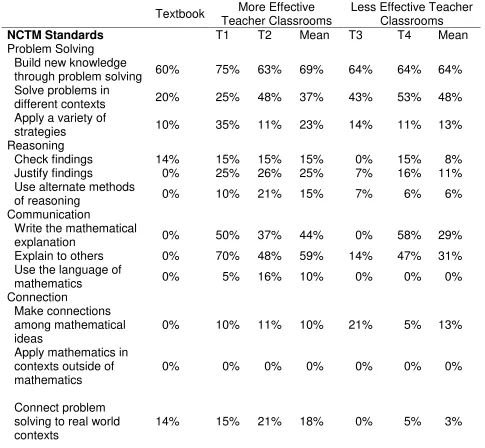
lessons emphasized connecting problem solving to real world contexts (M =14%) to some extent but did not provide opportunities for making connections among
[image:6.612.65.550.250.698.2]mathematical ideas or applying mathematics in contexts outside of mathematics. Although opportunities to apply representations provided in the text were high (M = 71%) for the Representation Standard, the textbook did not require generating or selecting representations. Finally, none of the lessons in the textbook provided opportunities to communicate mathematically during problem solving.
Table 1
Percentage of NCTM Standards Represented in the Textbook and Implemented by the Teachers
Textbook More Effective Teacher Classrooms
Less Effective Teacher Classrooms
NCTM Standards T1 T2 Mean T3 T4 Mean
Problem Solving Build new knowledge
through problem solving 60% 75% 63% 69% 64% 64% 64%
Solve problems in
different contexts 20% 25% 48% 37% 43% 53% 48%
Apply a variety of
strategies 10% 35% 11% 23% 14% 11% 13%
Reasoning
Check findings 14% 15% 15% 15% 0% 15% 8%
Justify findings 0% 25% 26% 25% 7% 16% 11%
Use alternate methods
of reasoning 0% 10% 21% 15% 7% 6% 6%
Communication
Write the mathematical
explanation 0% 50% 37% 44% 0% 58% 29%
Explain to others 0% 70% 48% 59% 14% 47% 31%
Use the language of
mathematics 0% 5% 16% 10% 0% 0% 0%
Connection
Make connections among mathematical ideas
0% 10% 11% 10% 21% 5% 13%
Apply mathematics in contexts outside of mathematics
0% 0% 0% 0% 0% 0% 0%
Connect problem solving to real world contexts
Representation Generate own mathematical representations
0% 35% 54% 45% 57% 5% 31%
Select among mathematical representations
0% 20% 0% 10% 14% 15% 15%
Apply text provided mathematical representations
71% 25% 32% 28% 100% 27% 64%
Mean 8% 23% 23% 23% 18% 17% 18%
Note. Percentage for textbook score was calculated by dividing the number of instances of the criterion (e.g., checking findings, using the language of mathematics) by the total number of addition and subtraction lessons in the textbook multiplied by 100.
Percentage for observed score was calculated by dividing the number of intervals of the criterion by the total number of intervals observed multiplied by 100.
From Table 1, results of teacher observations indicate that, in general, teachers implemented the Problem Solving, Communication, and Representation Standards more often than the Reasoning and Connections Standards. For Problem Solving, the percentages across teachers were quite similar. However, teachers built new
knowledge through problem solving two and three times more frequently than they instructed students to solve problems in different contexts (M = 42%) or apply a variety of strategies during lessons (M = 18%). Most teachers implemented the Communication Standard by having their students write mathematical explanations (M = 36%) and explain their answers (M = 45%). However, students had few, if any, opportunities to use the language of mathematics (M = 5%). Similarly, teachers were observed using the Representation Standard more frequently during mathematics lessons by having
students generate their own representations (M = 38%) and use representations (M = 46%) provided in the text. Yet, these teachers provided few opportunities for students to select among mathematical representations (M = 12%) to enhance problem solving. Teachers implemented the Reasoning Standard relatively less frequently; in particular, they provided students with more opportunities to justify their answers (M = 19%) and fewer to check their findings (M = 11%) or use alternative methods of reasoning (M = 11%). Unfortunately, teachers were observed implementing the Connections Standard infrequently (M = 12% for connecting among mathematical ideas; M = 10% for
connecting to real world contexts), and none of them provided their students with opportunities to apply mathematics to other contexts.
When the relationship between the Standards represented in the textbook and those implemented by the teachers was scrutinized, two noteworthy findings emerged.
First, despite the textbook’s inadequate adherence to the Standards, the four teachers were observed implementing most of the Standards, to greater or lesser degrees,
Based on classroom observation (see Appendices A and B) ratings of mathematics instructional practices (see Table 1), two teachers (T1 and T2) were deemed to be more effective at implementing the Standards. That is, these two
teachers, on average, displayed 10 of the 15 indicators across the five Standards more frequently. The other two teachers (T3 and T4) implemented the Standards less
frequently during problem solving lessons and were categorized as less effective with standard implementation. An evaluation of the mean observation scores indicated that T1 and T2 consistently addressed both the Reasoning (range = 15% to 25%) and Communication Standards (range = 10% to 59%) in their lessons more often than T3 and T4 (range = 6% to 18% for Reasoning and 0% to 31% for Communication). Further, T1 and T2 were better at providing their students with opportunities to connect problem solving to real world problems (M = 18%) and having them generate their own
mathematical representations (M = 45%) during lessons. Conversely, T3 and T4 provided their students with more opportunities to select (M = 15%) and apply the mathematical representations (M = 64%) included in the textbook to solve problems. It is important to note that the categorization of teachers in this study is based solely on the relative ratings of our observations and should, therefore, be viewed as tentative. Finally, a caveat of our categorization is that the more effective teachers would not necessarily be considered reform-based in their teaching practices given that their use of standards-based practices was less than 50% for most observation criteria.
Influence of Teachers’ Implementation of the Standards on Student Achievement
On the basis of results from teacher implementation of the Standards, we categorized the four teachers into two groups, more effective (T1 and T2) and less effective (T3 and T4) teachers. We categorized students in their classrooms accordingly to evaluate the second research question regarding the differential influence of teacher implementation of the Standards on students’ mathematics achievement and attitude toward mathematics. We used students’ scores on the word problem solving test as the primary dependent measure to examine the extent to which more or less effective
teachers influenced students’ mathematical performance over time (i.e., pretest to posttest).
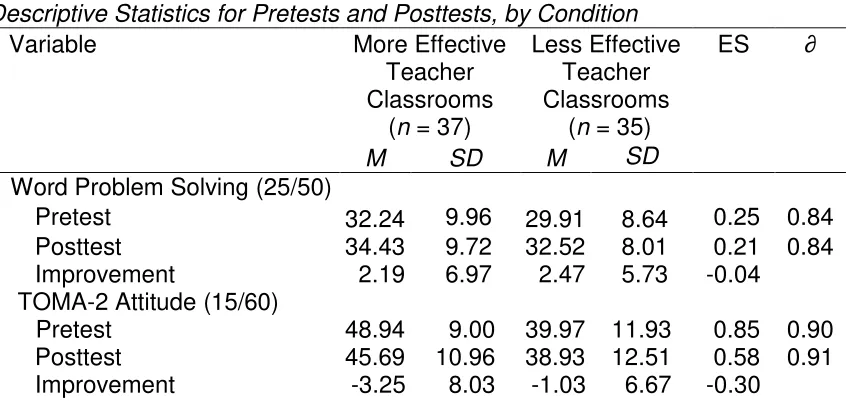
Table 2
Descriptive Statistics for Pretests and Posttests, by Condition
Variable More Effective
Teacher Classrooms
(n = 37)
Less Effective Teacher Classrooms
(n = 35)
ES ∂
M SD M SD
Word Problem Solving (25/50)
Pretest 32.24 9.96 29.91 8.64 0.25 0.84
Posttest 34.43 9.72 32.52 8.01 0.21 0.84
Improvement 2.19 6.97 2.47 5.73 -0.04
TOMA-2 Attitude (15/60)
Pretest 48.94 9.00 39.97 11.93 0.85 0.90
Posttest 45.69 10.96 38.93 12.51 0.58 0.91
Improvement -3.25 8.03 -1.03 6.67 -0.30
Note. ES = effect size. Parenthetical numbers separated by slash are total number of test items and total possible score.
Separate 2 x 2 repeated measures analysis of variance (ANOVA) with group (more or less effective teacher classrooms) as the between-subjects factor and time (pretest and posttest) as the within-subjects factor was used to analyze scores on the WPS and TOMA-2 Attitude test. Results for the WPS test indicated no statistically
significant time by group interaction effect, F(1, 70) = 0.08, p = .78, or the main effect for group, F(1, 70) = 1.10, p = .30. However, there was a statistically significant effect for time, F(1, 70) = 10.16, p = .002. On the TOMA-2 Attitude test, no statistically significant time by condition interaction effect, F(1, 67) = 1.54, p = .22, was found. However, the main effects for time, F(1, 67) = 5.74, p = .02, and group, F(1, 67) = 9.67, p = .003, were statistically significant.
Discussion
This case study evaluated the influence of a traditional mathematics textbook
and teachers’ instructional practices in the context of the Standards for affecting
changes in students’ mathematics achievement and attitudes. Results suggest that the intended curriculum provided few opportunities for students to reason, connect, and represent word problems, and no opportunities to communicate within textbook lessons, indicating a significant lack of alignment with the Standards. Classroom observations
revealed that teachers’ instructional practices in word problem solving, in part, seemed
to reflect the low adherence to the Standards found in the textbook. However, teachers provided additional opportunities for students to reason, communicate, connect, and represent word problems during mathematics lessons that went beyond the textbook. For example, observations revealed that these teachers provided students with
provided students with occasions to justify their answers and use alternative methods of reasoning not provided in the textbook. Further, with the exception of Teacher 3, the remaining teachers were more effective than the textbook in implementing the
Communication Standard (i.e., writing the explanation and explaining to others). This is encouraging, because teachers are expected to implement this standard. In contrast, while textbooks may provide directions for implementation of the Communication Standard, these were lacking in the textbook examined. At the same time, none of the teachers were effective in showing the application of mathematics to other curricular contexts even though these teachers are responsible for teaching all subject areas.
Across the four teachers, adherence to the Standards was quite discrepant, with some teachers implementing the Standards at relatively higher levels than others. This finding seems consistent with research suggesting that there is great variation in
textbook use among teachers, including their use of recommended topics and activities and their sustained use of materials over time (e.g., Freeman & Porter, 1989; Lambdin
& Preston, 1995). Unfortunately, teachers’ efforts to adhere to the Standards in this study were not sufficient to overcome the textbook inadequacies; consequently, student achievement and attitude about mathematics were not affected in this study. At the
same time, the low implementation may simply be a result of teachers’ lack of
knowledge of the Standards and the teaching expectations associated with them that were not addressed in this study.
Student achievement in this study appeared to be moderated by the content in the textbook and teacher practices. Although the problem solving performance of
students in both the more and less effective teachers’ classrooms (ES = 0.22 and 0.31, respectively) improved from pretest to posttest, students’ positive attitudes about
mathematics decreased over time. Items on the attitude questionnaire such as, “I’m
better at math than most of my friends,” are suggestive of students’ self-efficacy, that is, their beliefs that they have the ability to perform mathematics tasks competently. Low self-efficacy has long been recognized as a factor that may contribute to a lack of motivation toward a given task (Brophy, 1999). Reform-based practices in mathematics are characterized by teacher support for student autonomy and goal setting, and by allowing students to work with peers in the classroom (e.g., Schweinle et al., 2006). These practices are known to influence student motivation and attitude, in general, and self-efficacy, in particular (Nix, Ryan, Manly, & Deci, 1999). Given the clear lack of these opportunities in the textbook and in the four classrooms, it is not surprising that
students’ attitude about mathematics did not improve in this study even though their
problem-solving scores improved. Also, consistent with findings of the McCaffrey, et al. (2001) study, the nature of the curriculum influenced teacher practices that, in turn, impacted student achievement. Although teachers in the McCaffrey study reported using reform-based practices in their mathematics classrooms, only those classrooms specifically designed to align with the Standards produced positive outcomes for
students. When teachers attempted to infuse reform-based practices in classrooms that were conducted using more traditional approaches and materials, like the four
16-weeks is not sufficient time to see changes in attitudes or achievement and that
instruction of the more effective teachers was still very traditional and not reform-based enough to impact student outcomes.
Several limitations must be acknowledged when interpreting these results. First, the study was conducted in one school and sampled only four third-grade classrooms. Although the hypothesis generated from this study is that the textbook rather than the teacher would likely influence student outcomes, experimental studies with much larger samples of schools and teachers are needed to explore causality. Another limitation of this study has to do with the use of the observational tool (See Appendix A) that
addressed only the use of Standards-based practices and did not address teachers’ content knowledge. Research in the field of mathematics education has suggested the
importance of teachers’ mathematical content knowledge for implementing the
Standards and the type of mathematical knowledge (i.e., procedural or conceptual) as it affects student learning (Ball & Bass, 2000; Ball, Hill, & Bass, 2005). Further, there is
emerging evidence that teachers’ knowledge of student learning and strategies to improve learning may also have an effect on student achievement (Hill, Rowan, & Ball,
2005). Future research should consider assessing teachers’ knowledge of the content
taught to determine the extent to which outcomes may be attributed to teacher content knowledge.
In sum, findings from this study extend prior research evaluating the content of mathematics textbooks (e.g., Jitendra et al., 2005) by examining pedagogical practices related to the Standards and student achievement and attitude toward mathematics. The study also builds upon the work of McCaffrey et al. (2001) by exploring elementary school student participants and their third grade teachers, and assessing both
achievement and students’ attitude toward mathematics. Taken together, results of the interactions among the intended, implemented, and learned curricula in this study seemed to demonstrate the influence of the textbook on student achievement and
attitude toward mathematics, and that teachers’ inconsistent application of the Standards is unlikely to be effective. Our study and that of McCaffrey et al. (2001) suggest that positive student outcomes may only be realized when both curriculum and instructional practices are considered together. In short, understanding the ways in which reform-based practices and curriculum materials interface appears critical for promoting effective instruction in mathematics classrooms.
Authors’ Note. The research reported here was supported by grant number H324D010024 from the U.S. Department of Education (DOE), Office of Special
References
Ball, D. L., & Bass, H. (2000). Interweaving content and pedagogy in teaching and learning to teach: Knowing and using mathematics. In J. Boaler (Ed.), Multiple perspectives on mathematics teaching and learning (pp. 83-104). Westport, CT: Ablex.
Ball, D. L., Hill, H. C., & Bass, H. (2005). Knowing mathematics for teaching: Who knows mathematics well enough to teach third grade, and how can we decide? American Educator, 29(3), 14-46.
Boaler, J. (1998). Open and closed mathematics: Student experiences and
understandings. Journal for Research in Mathematics Education, 29(1), 41-62.
Boaler, J. (2002). Learning from teaching: Exploring the relationship between reform curriculum and equity. Journal for Research in Mathematics Education, 33(4), 239-258.
Brophy, J. (1999). Toward a model of the value aspects of motivation in education: Developing appreciation for particular learning domains and activities. Educational Psychologist, 34(2), 75-85.
Brown, V., Cronin, M. E., & McEntire, E. (1994). TOMA-2 test of mathematical abilities. Austin, TX: Pro-Ed.
Collopy, R. (2003). Curriculum materials as a professional development tool: How a
mathematics textbook affected two teachers’ learning. The Elementary School Journal, 103(3), 287-311.
Freeman, D. J., & Porter, A. C. (1989). Do textbooks dictate the content of mathematics instruction in elementary schools? American Educational Research, 26(3), 403-421.
Haimes, D. H. (1996). The implementation of a “function” approach to introductory algebra: A case study of teacher cognitions, teacher actions, and the intended curriculum. Journal for Research in Mathematics Education, 27(5), 582-602.
Harwell, M. R., Post, T. R., Maeda, Y., Davis, J. D., Cutler, A. L., Andersen, E., & Kahan, J. A. (2007). "Standards"-based mathematics curricula and secondary students' performance on standardized achievement tests. Journal for Research in Mathematics Education, 38(1), 71-101.
Hill, H. C., Rowan, B., & Ball, D. L. (2005). Effects of teachers' mathematical knowledge for teaching on student achievement. American Educational Research, 42(2), 371-406.
Jitendra, A. K., Griffin, C., Deatline-Buchman, A., DiPipi, C., Sczesniak, E., Sokol, N., & Xin, Y.P. (2005). Adherence to mathematics professional standards and
instructional design criteria for problem-solving in mathematics. Exceptional Children, 71(3), 319-337.
Lambdin, D. V., & Preston, R. V. (1995). Caricatures in innovation: Teacher adaptation to an investigation-oriented mathematics curriculum. Journal of Teacher
Education, 46(2), 130-140.
McCaffrey, D. F., Hamilton, L. S., Stecher, B. M., Klein, S. P. Bugliari, D., & Robyn, A. (2001). Interactions among instructional practices, curriculum, and student
achievement: The case of standards-based high school mathematics. Journal for Research in Mathematics Education, 32(5), 493-517.
National Council of Teachers of Mathematics. (2000). Principles and standards for school mathematics. Reston, VA: Author.
National Mathematics Advisory Panel (2008). Foundations for success: The final report of the National Mathematics Advisory Panel. Washington, DC: U.S. Department of Education.
Nix, G. A., Ryan, R. M., Manly, J. B., & Deci, E. L. (1999). Revitalization through self-regulation: The effects of autonomous and controlled motivation on happiness and vitality. Journal of Experimental Social Psychology, 35(3), 266-284.
Remillard, J. T. (2000). Can curriculum materials support teachers' learning? Two fourth-grade teachers' use of a new mathematics text. The Elementary School Journal, 100(4), 331-350.
Schmidt, W., Houang, R., & Cogan, L. (2002). A coherent curriculum: The case of mathematics. American Educator, 26(2), 10-26, 47.
Schoen, H. L., Cebulla, K. J., Finn, K. F., & Fi, C. (2003). Teacher variables that relate to student achievement when using a standards-based curriculum. Journal for Research in Mathematics Education, 34(3), 228-59.
Schweinle, A., Meyer, D. K., & Turner, J. C. (2006). Striking the right balance: Students' motivation and affect in elementary mathematic. Journal of Educational
Research, 99(5), 271-293.
Star, J. R., & Hoffman, A. J. (2005). Assessing the impact of standards-based curricula:
Investigating students’ epistemological conceptions of mathematics. The Mathematics Educator, 15(2), 25-34.
Stevenson, D. L., & Baker, D. P. (1991). State control of the curriculum and classroom instruction. Sociology of Education, 64(1), 1-10.
Sugai, G. M. & Tindal, G. A. (1993). Effective School Consultation: An Interactive approach (p. 368), Pacific Grove, CA: Brooks/Cole
Woodward, J., & Brown, C. (2006). Meeting the curricular needs of academically low-achieving students in middle grade mathematics. Journal of Special Education, 40(3), 151-159..
Appendix A
Teacher Observation Form
Date: Time Begin: Time End: Page: of:
Observer: Teacher: Class: Interval Length (min):
Interval Task
Momentary Time Sampling
TEACHER Inst. OH/Board
Lecture Demonstrate Lead/Guide Observe Ask Answer Textbook Worksheet
CLASS BEHAVIOR
Media Activity/Lab Listening Asking Answering Read/Write/Copy Test/Quiz Other
GROUPING ARRANGEMENT
Whole Class Indiv Seat Paired Seat Group Seat Partial Interval Recording
STANDARDS Problem Solving Reasoning & Proof Communication Connection Representation
TEACHER
1 2 3 1 2 3 1 2 3 1 2 3 1 2 3
Momentary Time Sampling
TEACHER Inst. OH/Board
Lecture Demonstrate Lead/Guide Observe Ask Answer Textbook Worksheet
CLASS BEHAVIOR
Media Activity/Lab
Listening Asking Answering Read/Write/Copy Test/Quiz Other
GROUPING ARRANGEMENT
Whole Class Indiv Seat Paired Seat Group Seat Partial Interval Recording
STANDARDS Problem Solving Reasoning & Proof Communication Connection Representation
TEACHER
1 2 3 1 2 3 1 2 3 1 2 3 1 2 3
Teacher Observation Code Sheet for the NCTM Process Standards
Problem Solving
1. Teacher offers opportunities to let student use learned skill to solve math word problems.
2. Teacher offers opportunities to solve problems in different contexts (e.g., pets, recreation, money). 3. Teacher offer opportunities to apply and adapt a variety of strategies (e.g., draw a diagram, make a
table, look for patterns). Reasoning and Proof
1. Teacher offers opportunities to use reasoning and proof (e.g., checking the answer) in problem solving.
2. Teacher offers opportunities to make and investigate mathematical hypotheses (e.g., select, set up a math sentence, solve it, and justify choice of action).
3. Teacher offers opportunities to select and use various types of reasoning and methods of proof (e.g., alternate methods for solving the problem).
Communication
1. Teacher offers opportunities to organize and consolidate their mathematical thinking through communication (e.g., acting out, writing)
2. Teacher offers opportunities to articulate their own reasoning and understand the reasoning of others (e.g., explain to peers, teachers).
3. Teacher offers opportunities to use the language of mathematics (e.g., addend, sum) to express mathematical ideas precisely.
Connection
1. Teacher offers opportunities to recognize and use connections among mathematical ideas (e.g., addition & multiplication, subtraction and division).
2. Teacher offers opportunities to recognize and apply mathematics in contexts outside of mathematics (e.g., geography, science, social studies. etc.)
3. Teacher offers opportunities to connect problem solving to real world contexts (e.g., adding books in the classroom, counting number of pets in student’s home) (i.e., have students create problems to personalize them.
Representation
1. Teacher offers opportunities to create and use representations (e.g., diagrams, tables) to organize, record math ideas and to solve problems.
2. Teacher offers opportunities to select among mathematical representations (e.g., diagrams, pictures, manipulatives, etc.) to solve problems
About the Authors
Asha K. Jitendra is the Rodney Wallace Professor for the Advancement of Teaching and Learning in the Department of Educational Psychology
at the University of Minnesota. Jitendra’s research interests focus on
instructional design, particularly mathematics and reading interventions for students at risk for academic learning problems. She can be reached at [email protected]
Cynthia C. Griffin is a Professor in the School of Special Education, School Psychology, and Early Childhood Studies at the University of Florida. Griffin’s research interests focus on teacher education in special
education, particularly teachers’ content knowledge for teaching
mathematics in inclusive elementary classrooms. She can be reached at
Yan Ping Xin is an Associate Professor in the Department of
Educational Studies at Purdue University. Xin’s research interests focus
on effective instructional strategies in mathematics problem solving for students with learning disabilities or difficulties. She can be reached at