www.pharmascholars.com
29
Original Article
CODEN: IJPNL6
BRINE
SHRIMP
LETHALITY
BIOASSAY,
THROMBOLYTIC
AND
ANTIBACTERIAL ACTIVITIES OF METHANOL EXTRACT OF
BOEHMERIA
PLATYPHYLLA
D DON LEAVES
Md. Saif Uddin
1, Mohammad Shah Hafez Kabir
1, Syed Md. Abdul Kader
1*, Mahmudul Hasan
1,
Md. Abu Aiube Ansary
1, Md. Mosarraf Hossen
1, Atiqur Rahman
1, Mohammad Abdul Awal
1,
Mahmud Mostofa Hridoy
1, Abul Hasanat
1, Shaikh Bokhtear Uddin
2, Md. Masudur Rahman
11
Department of Pharmacy, International Islamic University Chittagong, Chittagong-4203,
Bangladesh
2
Department of Botany, University of Chittagong, Chittagong 4331, Bangladesh.
*Corresponding author e-mail: [email protected]
Received on: 30-10-2015; Revised on: 27-12-2015; Accepted on: 01-01-2016
ABSTRACT
Extract from the leaves of Boehmeria platyphylla D Don were screened for their brine shrimp lethality bioassay, thrombolytic and antimicrobial activities. The cytotoxicity was surveyed with the brine shrimp lethality bioassay and thrombolytic impact with human blood. The brine shrimp lethality bioassay was utilized to assess cytotoxicity (LC50
= 75.26 μg/ml) contrasted with Vincristine sulfate (LC50 = 0.74 μg/ml). It was also assessed as thrombolytic activity
when contrasted with streptokinase. It has significant thrombolytic movement (73.17±2.08%) contrasted with standard streptokinase (81.32±1.46%). The extract indicated zone of inhibition against Gram positive bacteria (Bacillus subtilis and Bacillus cereus) and Gram negative bacteria (Salmonella typhi, Salmonella paratyphi, Escherichia coli, Pseudomonas aeruginosa) at 1000 µg/disc. Gram negative bacteria Staphylococcus aureus demonstrated no action against B. platyphylla leaves extract at both doses. Relative percentage inhibition of the extract against each bacterium also calculated. These results indicated that B. platyphylla have favorable thrombolytic, cytotoxic and antibacterial effects and capacities of B. platyphylla extract to be processed for pharmaceutical use.
Key word: Boehmeria platyphylla, Thrombolytic, cytotoxic, antibacterial
INTRODUCTION
Thrombosis is the arrangement of blood coagulation inside a vein, impeding the stream of blood through the circulatory framework. At the point when a vein is harmed, the body utilizes platelets (thrombocytes) and fibrin to shape a blood coagulation to avoid blood misfortune. Notwithstanding when a vein is not harmed, blood clumps may shape in the body under specific conditions [1, 2]. In the patient admitted to doctor's facility, thrombosis is a noteworthy reason for intricacies and once in a while demise. In UK, for occasion, the Parliamentary Health Select Committee
heard in 2005 that the yearly rate of death because of thrombosis was 25,000, with no less than half of these being doctor's facility obtained [3]. Streptokinase (SK) has a place with a gathering of pharmaceuticals known as fibrinolytics, and edifices of streptokinase with human plasminogen can hydrolytically actuate other unbound plasminogen by initiating through bond cleavage to deliver plasmin. SK is utilized as a viable and cheap thrombolysis solution now and again of myocardial dead tissue (heart assault) [4] and pulmonary embolism [5]. Regular items have served as a hotspot for tumor chemotherapy. The brine shrimp lethality bioassay
International Journal of Pharmacy
www.pharmascholars.com 30
has routinely been utilized as a part of the essential screening of the rough concentrates to survey the poisonous quality towards saline solution shrimp. The bioassay has a decent connection with cytotoxic movement in some human strong tumors and in addition pesticidal action [6]. In recent times, there have been increases in antibiotic resistant strains of clinically important pathogens, which have led to the emergence of new bacterial strains that are multi-resistant [7][8, 9]. The non-availability and high cost of new generation antibiotics with limited effective span have resulted in increase in morbidity and mortality [10]. Therefore, there is a need to look for substances from other sources with proven antimicrobial activity. Consequently, this has led to the search for more effective antimicrobial agents among materials of plant origin, with the aim of discovering potentially useful active ingredients that can serve as source and template for the synthesis of new antimicrobial drugs [11, 12].
Boehmeria platyphylla D Don is a monoecious or dioecious, 1-1.5 (-3) m tall, shrub with 4-angled, glabrescent twigs. Leaves mostly opposite, with 2.5-20 cm long petiole; lamina 3-costate, broadly ovate to orbiculate, 6-22 cm long, 5-15 cm broad, sparsely appressed hairy, scabrous, dentate, somewhat cuneate, truncate or subcordate at the base, acuminate; stipules triangular-lanceolate, 8-12 mm long. Cymose clusters of flowers arranged on axillary, drooping, up to 30 cm long spikes. Flowers white, tetramerous; bracts lanceolate, 3-4 mm long. fungal, and nematode parasite diseases [13][14] . The purpose of the present study focuses on the scientific investigation of brine shrimp lethality bioassay, thrombolytic and antibacterial activity of Boehmeria platyphylla (B. platyphylla) leaves.
MATERIAL AND METHOD
Plant material: Fresh leaves of B. platyphylla were collected from Bandarban, Chittagong, Bangladesh in the month of March 2015. It was authenticated by Dr. Shaikh Bokhtear Uddin, Professor, Department of Botany, University of Chittagong, Chittagong-4331, Bangladesh.
Preparation of Extract: The leaves were dried for a period of 10 days under shade and ground. The ground leaves (450 gm) were soaked in sufficient amount of ethanol for one week at room temperature
with occasional shaking and stirring then the whole mixture was filtered and the filtrate thus obtained was concentrated using a water bath to get a viscous mass. The viscous mass was kept at room temperature under a ceiling fan to get a dried extract (yield value, 5.3%). The extract prepared was for pharmacological screening.
Chemicals and equipment: To the commercially available lyophilized streptokinase (SK) vial (Square Pharmaceuticals Ltd. Dimethyl sulfoxide) of 1500000 I.U., 5mL sterile distilled water was added and mixed properly. This suspension was used as a stock from which 100 L (30,000 I.U.) was used for in vitro thrombolysis. Methanol purchased from Merck (Germany). Dimethyl sulfoxide (DMSO) and Vincristine sulfate (2mg/vial; Techno Drugs Limited Bangladesh). Kanamycin (30µg/disc, Oxoid, England) was used as a standard antibiotic disc.
Brine Shrimp Lethality Bioassay: Brine shrimp lethality bioassay was carried out with the method as described by Meyer et al. [15, 16] to investigate the cytotoxicity of methanol extract of B. platyphylla leaves. The dried extract preparations were re-dissolved in DMSO to obtain a solution of 10 mg/ml which was subjected to serial dilution to get the concentrations between 12.5 μg/ml- 400 μg/ml. Standard drug Vincristine Sulphate (VS) was used as
positive control at concentrations of 5 μg/ml - 0.312
μg/ml. A 5.0 ml of artificial sea water was added into
all the test tubes. Simple zoological organism (Artemia salina) was used as a convenient monitor for cytotoxic screening. The eggs of the brine shrimps were collected from local aquarium shop (Dhaka, Bangladesh) and hatched in artificial seawater (Prepared by using sea salt 38 g/L and adjusted to pH 8.5 using 1N NaOH) under constant aeration for 24 h under the light. The hatched shrimps were allowed to grow by 48 h to get shrimp larvae called nauplii. After 48 h, active nauplii were attracted to one side in a glass petri dish by using a micropipette. The nauplii were then separated from the eggs by aliquoting them in another glass petri dish containing artificial sea water and used for the assay. Suspension containing 10 nauplii was added into each test tube and was incubated at room temperature (25±1°C) for 12 h under the light. The tubes were then examined after 24 h and the number of surviving larvae in each tube was counted with the aid of a 3X magnifying glass. Experiments were conducted along with VS in a set of three tubes per dose. The concentration that would kill 50% of the nauplii (LC50) was determined from a linear
www.pharmascholars.com 31
In vitro Thrombolytic activity
Blood specimen: Whole blood (1.5 ml) was drawn from healthy human volunteers (n = 12) without a history of oral contraceptive or anticoagulant therapy. A new consent, approved by Mohammed Abu Sayeed, Assistant professor & Head of Department of Pharmacy, International Islamic University Chittagong, Bangladesh, for collection of blood samples from Human volunteers. Blood collection were conducted by Md. Shariful Islam (Lab technician, Department of Pharmacy, IIUC) and preservation were conducted by Abdul Karim (Lab technician, Department of Pharmacy, IIUC), who stored the clot containing Eppendorf tube in the refrigerator in Microbiology lab, Department of
Pharmacy, IIUC. A 500 μl of blood was transferred
to each of the three previously weighed Eppendorf tube tubes to form clots.
Statement on informed consent of the donors: The volunteer donors were supplied a consent form which informed the title of the research project, name and detail contact of investigators as well as purpose of the research. Description of the research mentioning step-by-step brief of the proposed research, inclusion and exclusion criteria of the donors, whether donors will receive any therapy or not, volume of blood to be taken, possible discomfort of the puncture sites, time required for the blood sampling. Benefits of the volunteer described. It was indicated to the consent form that the volunteers might refuse to donate blood at any time. Donor whether could withdraw his sample data was disclosed. The sample was restricted for that individual study not for future research projects was presented in the consent form. Potential harm, injuries, discomforts or inconvenience associated with donors in this study was added as informed consent statement. If there was known harm to the donors, the potential harm, current knowledge regarding the probability of the occurrence of the harm, clinical importance of the harm; and any relevant knowledge regarding the probability of reversibility. Treatment alternative and possibility of the research was described. Confidentiality statement was included in the consent form in the way that
“confidentiality will be respected and no information that discloses the identity of the participant will be released or published without consent unless required by law of states. Finally identification of investigators was provided in case of further query. The consent form was concluded with major questions on above disclosures in Yes/NO form followed by the signature (with date) of the donor.
In Vitro Thrombolytic Study procedure: Experiments for clot lysis were carried as reported
earlier [17-19]. Briefly, 1.5 ml venous blood drawn from the healthy volunteers was distributed in three different pre weighed sterile Eppendorf tube (0.5 ml/tube) and incubated at 37°C for 45 min. After clot formation, serum was completely removed without disturbing the clot and each tube having clot was positive control, 100 μl of SK and as a negative non
-thrombolytic control, 100 μl of distilled water were
separately added to the control tubes numbered. All the tubes were then incubated at 37°C for 90 min and observed for clot lysis. After incubation, fluid released was removed and tubes were again weighed to observe the difference in weight after clot disruption. Difference obtained in weight taken before and after clot lysis was expressed as percentage of clot lysis. The experiment was repeated with the blood samples of the 12 volunteers.
In vitro Antibacterial activity
Microorganisms: Seven bacterial species, gram-positive Staphylococcus aureus, Bacillus subtilis, Bacillus cereus and gram-negative Salmonella typhi, Salmonella paratyphi, Escherichia coli, Pseudomonas aeruginosa. These microbes were obtained from the department of Pharmacy, International Islamic University Chittagong.
Media preparation and maintenance of bacteria: All of the bacterial strains were grown and maintained on Nutrient agar (Merck, India) media at 37 °C and pH (7.4±0.2). The bacteria were subculture overnight.
Preparation of concentration: In the study of the antibacterial activity, all the extracts were diluted in their solvent. So methanol extract diluted in methanol and other also. The concentrations corresponding to the extracts given in Table 2 are expressed in terms of µg/ disk.
Preparation of discs: The discs of about 5 mm in diameter were cut by punching machine from Whatman No.1 filter paper. The discs were taken in a petri dish and sterilized by autoclaving, dried in oven at 1800C.
www.pharmascholars.com 32
agar plates which had previously been inoculated with the test microorganisms (within 15 min). The Petri dishes were kept at 4 °C for 3 h before incubation at 37 °C for 24 h. The diameters of the inhibition zones were measured in millimeters. All the tests were performed in triplicate. Blank disc impregnated with distilled water was used as negative control and disc of Kanamycin (30 μg / disc) as positive control.
Determination of relative percentage inhibition: The relative percentage inhibition of the test extract with respect to positive control was calculated by using the following formula [23].
Relative percentage inhibition of the test extract:
Where,
x = total area of inhibition of the test extract y = total area of inhibition of the solvent (methanol) z = total area of inhibition of the standard drug The total area of the inhibition was calculated by using area = πr2; where, r = radius of zone of inhibition.
Statistical analysis: The results were expressed as mean±SD from triplicate experiment for zone of inhibition from triplicate experiments for
Antibacterial activity. All other results are expressed as mean ± standard error of the mean (SEM). Data were analyzed using one way factorial ANOVA tests using SPSS Data Editor for Windows, Version 22.0
(SPSS Inc., USA) followed by Dennett’s tests on
each group except negative control for antibacterial activity. The results obtained were compared with the control groups for antithrombotic activity by using Tukey test and P < 0.01, P < 0.001 and P < 0.0001 was considered to be statistically significant in
Dennett’s and Tukey tests. GRAPHPAD PRISM® (version 6.00; GraphPad Software Inc., San Diego, CA, USA) was used for graphical presentation.
RESULTS
In Vitro Thrombolytic activity: In thrombolytic
activity assay, addition of 100μl streptokinase as
positive control (30,000 I.U.) to the clots and subsequent incubation for 90 minutes at 37°C, showed 81.32±1.46 % lysis of clot. On the other hand, distilled water treated as negative control exhibited a negligible percentage of lysis of clot (6.81±0.97%). The mean difference in clot lysis percentage between positive and negative control was found statistically very significant (P<0.0001). In this study, the crude methanol extract of B. platyphylla exhibited thrombolytic activity (73.17±2.08%) (Figure 1).
Wate r
B. pl atyp
hylla
Strep toki
nase
0 20 40 60 80 100
Water
B. platyphylla
Streptokinase
a, b
a
%
o
f c
lo
t
ly
si
s
Figure 1: Thrombolytic activity of methanol extract of B. platyphylla leaves. Values are mean ± SEM ( = 12); a
<0.0001, Tukey test as compared to negative control (Water), b < 0.001, compared to positive control (Streptokinase). Statistical
www.pharmascholars.com 33
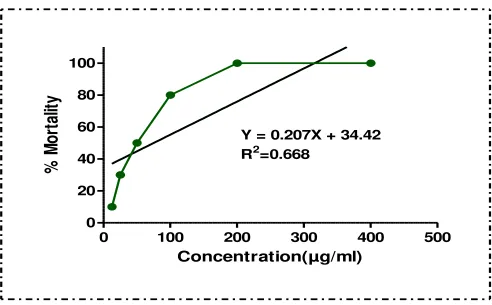
In vitro Brine Shrimp Lethality Bioassay: In brine shrimp lethality bioassay, the methanolic extract of B. platyphylla leaves showed optimistic result in comparison with the positive control vincristine sulphate. By plotting the log of concentration (log C) versus percent (%) of mortality for all test samples showed an approximate linear correlation. From the
graph, the median lethal concentration (LC50)
Cytotoxic effect of the extract is summarized in the Figure 2. The LC50 for ethanol extract of B.
platyphylla leaf were found to be 75.26μg/ml respectively, and that of Vincristine Sulphate was
0.74μg/ml. DMSO was used as negative control to
validate the test method.
0
100
200
300
400
500
0
20
40
60
80
100
Y = 0.207X + 34.42
R
2=0.668
Concentration(µg/ml)
%
M
or
ta
lit
y
Figure 2: Effects of various concentrations of methanol extract of B. platyphylla leaves on the viability of brine shrimp nauplii after 24 hrs incubation. Percent mortality of brine shrimps of methanol extract of B. platyphylla. Data are shown as mean ± SEM of ten shrimps for each concentration.
In vitro Antibacterial activity
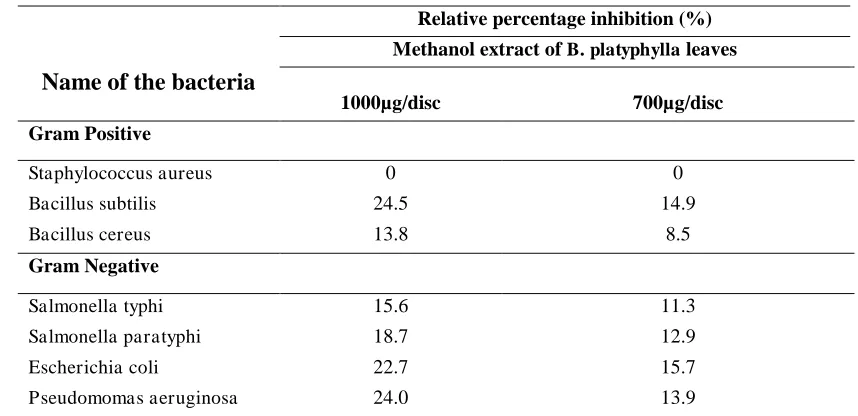
Determination of zone of inhibition: Antibacterial activity results of B. platyphylla leaves extract are given in Table 1. The extract at two different concentrations 1000 µg/disc and 700 µg/disc showed significant (P < 0.01 and P < 0.001) as compared with standard Kanamycin 30µg/disc showed zone of inhibitions against Gram positive Staphylococcus aureus (Nil), Bacillus subtilis (9.0±0.50, 7.0±0.50), Bacillus cereus (9.3±0.58, 7.3±0.58), Salmonella
www.pharmascholars.com 34
Table 1: Results of antibacterial activity testing of B. platyphylla leaves. Negative
control (Methanol)
Methanol extract of B. platyphylla leaves
Kanamycin
Name of the bacteria
30 µl/disc 1000µg/disc 700µg/disc 30µg/disc
Gram Positive
Staphylococcus aureus - - - 22.2±0.76 Bacillus subtilis - 9.0±0.50a 7.0±0.50a 18.2±0.29 Bacillus cereus - 9.3±0.58b 7.3±0.58b 25±0.50 Gram Negative
Salmonella typhi - 10±0.50b 8.5±0.50b 25.3±0.58 Salmonella paratyphi - 8.8±0.29b 7.3±0.58a 20.3±0.29 Escherichia coli - 11.2±1.26a 9.3±0.29a 23.5±0.50
Pseudomonas aeruginosa - 12.5±0.50b 9.5±0.50b 25.5±0.50 Values are mean inhibition zone (mm) ± S.D of three replicates. The different superscripted (a, b) values have significantly different (aP < 0.01 and bP < 0.001) as compared with standard (Kanamycin) in same row in Dunnett’s test by SPSS. - - - = no zone of inhibition.
Table 2: Relative percentage inhibition of Methanol extract of
B. platyphylla
leaves with
their doses
compare to standard antibiotics.
Relative percentage inhibition (%)
Methanol extract of B. platyphylla leaves
Name of the bacteria
1000µg/disc 700µg/disc
Gram Positive
Staphylococcus aureus 0 0 Bacillus subtilis 24.5 14.9 Bacillus cereus 13.8 8.5 Gram Negative
Salmonella typhi 15.6 11.3 Salmonella paratyphi 18.7 12.9 Escherichia coli 22.7 15.7 Pseudomomas aeruginosa 24.0 13.9
Values calculated from their mean values.
DISCUSSION
A few thrombolytic medications acquired from different sources are utilized for the treatment of thrombosis. thrombolytic specialists are utilized to upset effectively shaped blood clusters in clinical settings where ischemia may be lethal (intense
www.pharmascholars.com 35
Due to these activities, thrombolytic medications are likewise called "plasminogen activators" and "fibrinolytic drugs."There are three noteworthy classes of fibrinolytic medications: tissue plaminogen activator (tPA), streptokinase (SK) and urokinase (UK). While drugs in these three classes all can powerful break up blood clusters, they vary in their point by point components in ways that change their selectivity for fibrin clumps. Some are adjusted further with the utilization of recombinant innovation so as to make these thrombolytic medications more site particular and compelling. Cytotoxicity screening models provide important preliminary data to help select plant extracts with potential antineoplastic properties for future work [24]. Brine shrimp lethality test is carried out in order to reveal new anticancer compounds. It was watched that the antimicrobial impact of plant extract fluctuates starting with one plant then onto the next in distinctive inquires about completed in diverse areas of the world. This may be because of numerous components, for example, the impact of atmosphere, soil structure, age and vegetation cycle stage, on the quality, amount and arrangement of extricated item, diverse bacterial strains [25, 26]. Moreover, different studies found that the type of solvent has an important role in the process of extracting [27-30]. Outcomes of this study showed that the gram-negative bacteria indicated more activity to the plant extract than gram-positive bacteria, for example, Pseudomonas aeruginosa displayed more action than Bacillus subtilis when they were tried with B. platyphylla leaves. Since lipopolysaccharide (LPS) layer of gram-negative bacteria in external film have a high hydrophobicity which goes about as an in number porousness
obstruction against hydrophobic atoms [31]. Hydrophobic molecules can pass through cell wall of gram-positive bacteria easier than the gram- negative bacteria because cell wall of the gram- positive bacteria contained only peptidoglycan [32, 33].
CONCLUSION
Crude methanol extract of B. platyphylla leaves indicated thrombolytic, cytotoxic and antibacterial impact, it can be expected that distinctive dynamic auxiliary metabolites were available in this concentrate and maybe some of these mixes may work in a synergistic way. On the other hand, further studies are important to illustrate the component lying with these impacts. On the other hand, this is the first write about this example and it may serve as a stride with respect to the natural and pharmacological exercises of this specimen.
CONFLICT OF INTEREST STATEMENT The authors declare that they have no conflict of interest.
ACKNOWLEDGEMENTS
The authors are grateful to the authority of International Islamic University Chittagong, Bangladesh, for providing the facilities to conduct this research work. The authors thank to GUSTO (A research group) for the financial support. The authors are also thankful to all members of GUSTO (A research group) for their kind help in the experiments.
REFERENCES
1. Furie B, Furie BC. Mechanisms of thrombus formation. New England Journal of Medicine 2008; 359: 938-49. 2. Handin R. Chapter 53: bleeding and thrombosis. Kasper DL, Braunwald E, Fauci AS, et al Harrison's
Principles of Internal Medicine 2005.
3. Hunt BJ. Awareness and politics of venous thromboembolism in the United Kingdom. Arteriosclerosis, thrombosis, and vascular biology 2008; 28: 398-9.
4. Sikri N, Bardia A. A history of streptokinase use in acute myocardial infarction. Texas Heart Institute Journal 2007; 34: 318.
5. Meneveau N, Schiele F, Vuillemenot A et al. Streptokinase vs alteplase in massive pulmonary embolism. Eur Heart J 1997; 18: 1141-8.
6. Mclaughlin JL, Rogers LL, Anderson JE. The use of biological assays to evaluate botanicals. Drug information journal 1998; 32: 513-24.
7. World Health Organization (WHO) (2001). Traditional medicine. Fact sheet number 134. Revised May, 2003. Available on http/www.who.int/media centre fact sheet/fs/134.
8. Aibinu I, Ohaegbulam V, Adenipekun E et al. Extended-spectrum β-lactamase enzymes in clinical isolates of Enterobacter species from Lagos, Nigeria. Journal of Clinical Microbiology 2003; 41: 2197-200.
www.pharmascholars.com 36
10. Williams R. Antimicrobial resistance a global threat. Essential Drug Monitor 2000; 28: 1.
11. Chowdhury KAA, Kabir MSH, Chowdhury TA, Hasan M, Kader SMA, Alam MS, Hossain J, Hossain MS and, Hasanat A. Antibacterial activity on some gram positive and gram negative bacteria and antihelmintic activity on Tubifex tubifex worm of methanol extract of Macaranga denticulata (MUELL. ARG.) bark. International Journal of Pharmacy 2015; 5: 985-90.
12. Moreillon P, Que Y, Glauser M. Staphylococcus aureus. Mandel GL, Bennett JE, Dolin R Principles and practice of infectious disease 2005; 6: 2321-51.
13. The American Phytopathological Society. Common Names of Plant Diseases: Diseases of Foliage Plants (House Plants): Urticaceae".. 26 March 1993. Archived from the original on 30 November 2011.
14. Chase A. Influence of host plant and isolate source on Myrothecium leaf spot of foliage plants. Plant disease 1983; 67: 668-71.
15. Meyer B, Ferrigni N, Putnam J et al. Brine shrimp: a convenient general bioassay for active plant constituents. Planta medica 1982: 31-4.
16. Rahman MA, Sultana R, Bin Emran T et al. Effects of organic extracts of six Bangladeshi plants on in vitro thrombolysis and cytotoxicity. BMC Complement Altern Med 2013; 13: 1472-6882.
17. Prasad S, Kashyap RS, Deopujari JY et al. Effect of Fagonia Arabica (Dhamasa) on in vitro thrombolysis. BMC Complementary and Alternative Medicine 2007; 7: 36.
18. Tarek MI, Hasanat A, Kabir MSH, Chowdhury TA, Rahman MM, Hossain ME. In vitro thrombolytic and cytotoxic activity of methanolic extract of Syzygium operculatum leaves. 2015; 4:87-89.
19. Kabir MSH, Murad MAH, Hasanat A, Hamid MA, Islam MI, Chowdhury TA, Hasan M, Hossain MM, Masum MAA, Uddin MR. Evaluation of total flavonols, total proanthocyanidins content and thrombolytic activity of methanol extracts of three bangladeshi plants. International Journal of Pharmacy 2015; 5: 747-51.
20. Bauer A, Kirby W, Sherris JC et al. Antibiotic susceptibility testing by a standardized single disk method. American journal of clinical pathology 1966; 45: 493.
21. Kabir MSH, Al Noman MA, Rahman MM, Ara J, Hossain MM, Hasanat A, Zaheed F. Antibacterial Activity of Organic and Aqueous Extracts of Hopea odorata Roxb. Leaves and their Total Flavonoid Content. British Microbiology Research Journal 2015; 9: 1-7.
22. Hasanat A, Kabir MSH, Hossain MM, Hasan M, Masum MAA, Chowdhury TA, Bhuiyan DI, Mamur A, Kibria ASMG. Antibacterial activity of methanol extract of Macaranga denticulata leaves and in silico PASS prediction for its six secondary metabolites. World Journal of Pharmaceutical Sciences 2015; 3: 1258-66. 23. Kumar KA, Rai KL, Umesha K. Evaluation of antibacterial activity of 3, 5-dicyano-4,
6-diaryl-4-ethoxycarbonyl-piperid-2-ones. Journal of Pharmaceutical and Biomedical Analysis 2002; 27: 837-40. 24. Cardellina, J.H., Fuller, R.W., Gamble, W.R., Westergaard, C., Boswell, J., Munro, M.H.G., Currens, M. and
Boyd M.P. 1999. Evolving strategies for the selection dereplication and prioritization of antitumor and HIV inhibitory natural products extracts. In: Bohlin, L., Bruhn, J.G. (Eds), Bioassay Methods in Natural Product Research and Development. Kluwer Academic Publishers, Dordrecht, pp. 25-36.
25. Masotti V, Juteau F, Bessière JM, Viano J. Seasonal and phenological variations of the essential oil from the narrow endemic species Artemisia molinieri and its biological activities. Journal of agricultural and food chemistry 2003; 51: 7115-21.
26. Angioni A, Barra A, Coroneo V et al. Chemical composition, seasonal variability, and antifungal activity of Lavandula stoechas L. ssp. stoechas essential oils from stem/leaves and flowers. Journal of agricultural and food chemistry 2006; 54: 4364-70.
27. Al-Zubaydi SR, Al-Hmdany MA, Raesan S. Antibactrial effect of some medicinal plant extracts against some pathogenic bacteria strains. Journal of Duhok University 2009; 12: 244-9.
28. Bakht J, Muhammad T, Ali H et al. Effect of different solvent extracted sample of Allium sativum (Linn) on bacteria and fungi. African Journal of Biotechnology 2013; 10: 5910-5.
29. Bokhari FM. Antifungal activity of some medicinal plants used in Jeddah, Saudi Arabia. Mycopath 2009; 7: 51-7.
30. Bedi N, Bedi P, Bodiwala HS et al. Scientific evaluation of an innovative herbal medicine for relief in respiratory disorders. Canadian journal of pure & applied sciences 2010; 4: 1249-55.
31. Smith-Palmer A, Stewart J, Fyfe L. Antimicrobial properties of plant essential oils and essences against five important food-borne pathogens. Letters in applied microbiology 1998; 26: 118-22.
32. Nikaido H, Vaara M. Molecular basis of bacterial outer membrane permeability. Microbiological reviews 1985; 49: 1.