7
to carry the liquid,control valves,and an output device.The liquid m ust be available from a continuous source, such as the brake fluid reservoir or a sum p.In a hydraulic brake sys-tem , the m aster cylinder serves as the m ain fluid pum p and m oves the liquid through the system . The lines used to carry the liquid m ay be pipes, hoses, or a netw ork of internal bores or passages in a single housing, such as those found in a m aster cylinder. Valves are used to regu-late hydraulic pressure and direct the flow of the liquid.The output device is the unit that uses the pressurized liquid to do w ork. In the case of a brake system , the output devices are brake drum w heel cylinders (Figure 1)and disc brake calipers.
As can be seen, hydraulics involves the use of a liquid or fluid.Hydraulics is the study of liquids in m otion.All m at-ter, everything in the universe, exists in three basic form s: solids, liquids, and gases. A fluid is som ething that does not
___ ___ ___
Introduction
Autom otive brake system s use the force of hydraulic pressure to apply the brakes. Because autom otive brakes use hydraulic pressure, w e need to study som e basic hydraulic principles used in brake system s. These include the principles that fluids cannot be com pressed, fluids can be used to transm it m ovem ent and force,and fluids can be used to increase force.
LAWS OF HYDRAULICS
Autom otive brake system s are com plex hydraulic cir-cuits. To better understand how the system s w ork, a good understanding of how basic hydraulic circuits w ork is needed.A sim ple hydraulic system has liquid,a pum p,lines
59
Chapt er
Basic
Hydraulic
System Theor y
Front
wheel
cylinders
Brake pedal
Hydraulic lines
Apply piston
Master
cylinder
Rear
wheel
cylinders
have a definite shape;therefore,liquids and gases are fluids. A characteristic of all fluids is that they w ill conform to the shape of their container. A m ajor difference betw een a gas and a liquid is that a gas w ill alw ays fill a sealed container, w hereas a liquid m ay not. A gas w ill also readily expand or com press according to the pressure exerted on it (Figure 2). A liquid w ill typically not com press, regardless of the pressure on it. Therefore, liquids are considered noncom -pressible fluids. Liquids w ill, how ever, predictably respond to pressures exerted on them . Their reaction to pressure is the basis of all hydraulic applications. This fact allow s hydraulics to do w ork.
Pascal’s Law
M ore t han 300 years ago a French scient ist , Blaise Pascal,determ ined t hat if you had a liquid-filled cont ainer w it h only one op ening and ap p lied force to t he liquid t hrough t hat op ening, t he force w ould b e evenly dist rib -uted t hroughout t he liquid. This exp lains how p ressur-ized liquid is used to op erate and cont rol t he b rakes on a vehicle. The act ion of t he b rake p edal on t he p istons inside t he m aster cylinder p ressurizes t he b rake fluid and t he fluid is delivered to t he various w heel b rake unit s
(Figure 3).
Pascal constructed the first know n hydraulic device, w hich consisted of tw o sealed containers connected by a tube.The pistons inside the cylinders seal against the w alls of each cylinder and prevent the liquid from leaking out of the cylinder and prevent air from entering into the cylin-der. When the piston in the first cylinder has a force applied to it, the pressure m oves everyw here w ithin the system . The force is transm itted through the connecting
tube to the second cylinder. The pressurized fluid in the second cylinder exerts force on the bottom of the second piston, m oving it upw ard and lifting the load on the top of it. By using this device, Pascal found he could increase the force available to do w ork, just as could be done w ith levers or gears.
Pascal determ ined that force applied to liquid creates pressure or the transm ission of force through the liquid. These experim ents revealed tw o im portant aspects of a liq-uid w hen it is confined and put under pressure. The pres-sure applied to it is transm itted equally in all directions and this pressure acts w ith equal force at every point in the con-tainer.
__ __ __
Pascal’s w ork is know n as Pascal’s Law. Pascal’s Law says that pressure at any one point in a confined liquid is the sam e in every direction and applies equal force on equal areas. One of the m ost im portant results of Pascal’s work was the discovery that fluids m ay be used to increase force. Pascal was the person w ho first dem onstrated the relationships of pressure, force, and m otion and the inverse relationship of m otion and force. In an autom obile, Pascal’s Law s are not applied just to the brake system . These sam e hydraulic principles are at work in the hydraulic system of an autom atic trans-m ission. Pascal’s Law s are even at work in the trans-m ove-m ent of liquid fuel froove-m a tank to the fuel injection system on the engine.
Weight
Gas
Fluid
Weight
Figure 2.
Gases are compressible, but liquids are not.
100-psi
pressure
3-square-inch
output pistons
1-square-inch
input piston
300-pound
force
100-pound
force
Fluid Characteristics
If a liquid is confined and a force applied, pressure is produced.In order to pressurize a liquid, the liquid m ust be in a sealed container.Any leak in the container w ill decrease the pressure.
The basic principles of hydraulics are based on certain characteristics of liquids. Liquids have no shape of their ow n; they acquire the shape of the container they are put in.They also alw ays seek a com m on level.Therefore, oil in a hydraulic system w ill flow in any direction and through any passage, regardless of size or shape. Liquids are basically incom pressible, w hich gives them the ability to transm it force.The pressure applied to a liquid in a sealed container is transm itted equally in all directions and to all areas of the system and acts w ith equal force on all areas.As a result,liq-uids can provide great increases in the force available to do w ork.A liquid under pressure m ay also change from a liquid to a gas in response to tem perature changes.
Fluids Can Transmit Movement
Liquids can be used to transm it m ovem ent. Tw o cylin-ders of the sam e diam eter are filled w ith a liquid and con-nected by a pipe as show n in Figure 4.If you force piston A dow nw ard, the liquid w ill push piston B upw ard. Because piston A starts the m ovem ent, it is called the apply piston. Piston B is called the output piston. If the apply piston m oves 10 inches, the output piston also w ill m ove 10 inches.This principle w orks not only for one output piston, but for any num ber of output pistons.
The principle that m otion can be transm itted by a liq-uid is used in hydraulic brake system s. A m aster cylinder piston is pushed w hen the driver applies the brakes. The m aster cylinder piston is the apply piston.The brake fluid in the m aster cylinder is connected by pipes to pistons in each of the car’s front and rear w heel brake units. Each of the w heel brake pistons is an output piston. They m ove w henever the m aster cylinder input piston m oves.
Mechanical Advantage with
Hydraulics
Hydraulics is used to do w ork in the sam e w ay as a lever or gear does w ork. All of these system s transm it energy or
force.Because energy cannot be created or destroyed,these system s only redirect energy to perform w ork and do not create m ore energy.Workis the am ount of force applied and the distance over w hich it is applied.Forceis pow er w orking against resistance; it is the am ount of push or pull exerted on an object needed to cause m otion. We usually m easure force in the sam e units that w e use to m easure w eight: pounds or kilogram s.Pressure is the am ount of force exerted onto a given surface area.Therefore, pressure equals the applied force (m easured in pounds or kilo-gram s) divided by the surface area (m easured in square inches or square centim eters) that is receiving the force. In custom ary English units, pressure is m easured in pounds per square inch (psi). In the m etric system it can be m ea-sured in kilogram s per square centim eter,but the preferred m etric pressure m easurem ent unit is the pascal.
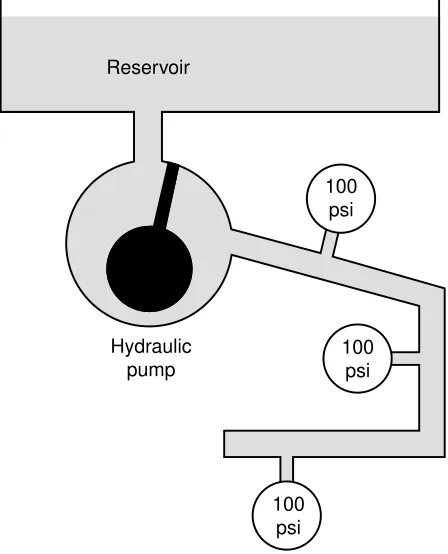
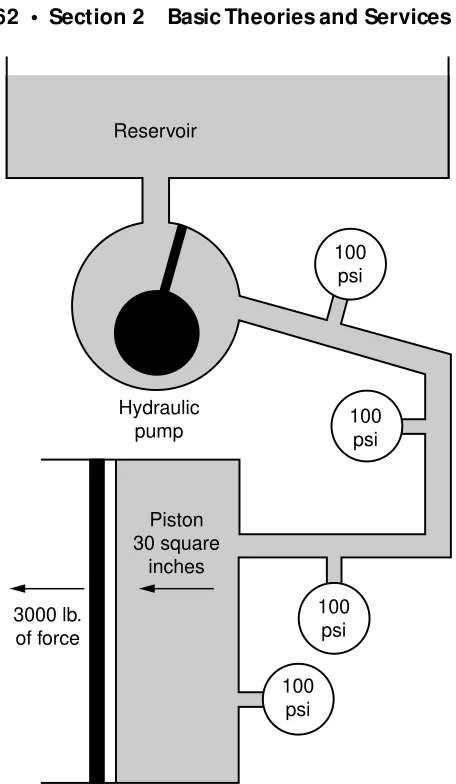
The pressure of a liquid in a closed system such as a brake hydraulic system is the force exerted against the inner surface of its container, w hich is the surface of all the lines, hoses,valves,and pistons in the system .Pressure applied to a liquid exerts force equally in all directions. If the hydraulic pum p provides 100 psi,there w ill be 100 pounds of force on every square inch of the system (Figure 5).When pressure is applied to a m ovable output piston,it creates output force.
If the system included a piston w ith an area of 30 square inches, each square inch w ould receive 100 pounds of force.This m eans there w ould be 3,000 pounds of force applied to that piston (Figure 6).The use of the larger piston w ould give the system a m echanical advantage or increase
___ ___ ___
Pipe
Piston A
(Apply piston)
Piston B
(Output piston)
Fluid
Figure 4.
Fluid can transmit motion through a closed
system.
Reservoir
Hydraulic
pump
100
psi
100
psi
100
psi
in the force available to do w ork.The m ultiplication of force through a hydraulic system is directly proportional to the difference in the piston sizes throughout the system . By changing the sizes of the pistons in a hydraulic system , force is m ultiplied, and as a result, low am ounts of force are needed to m ove heavy objects.The m echanical advantage of a hydraulic system can be further increased by the use of levers to increase the force applied to a piston.
In Figure 7, input piston A is sm aller than output piston B.Pispiston A has an area of 20 square inches;in the exam -ple,w e are applying 200 pounds of force.Therefore,
200 pounds (F)
= 10 psi (P) 20 square inches (A)
w here F is force,A is area,and P is pressure.
If that sam e 200 pounds of force is applied to a piston of 10 square inches,system pressure is 20 psi because
200 pounds (F)
= 20 psi (P) 10 square inches (A)
Therefore, pressure is inversely related to piston area. The sm aller the piston,the greater the pressure that is developed.
Let us apply the 10 psi of pressure in the first exam ple to an output piston w ith an area of 50 square inches.In this case,output force equals pressure tim es the surface area:
P
×
A = FTherefore, 10 psi of pressure on a 50-square-inch piston develops 500 pounds of output force:
10
×
50 = 500Brake system s use hydraulics to increase force for brake application.
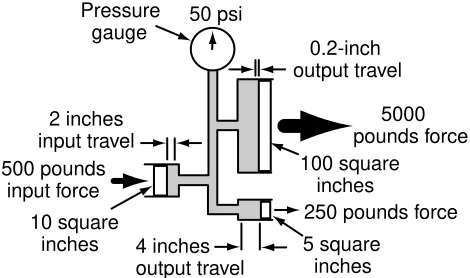
Figure 8 show s a hydraulic system w ith an input piston of 10 square inches.A force of 500 pounds is pushing on the piston.The pressure throughout the system is 50 psi:
500 (F) ÷ 10 (A) = 50 (P).
A pressure gauge in the system show s the 50-psi pressure. There are tw o output pistons in the system . One has 100 square inches of area.The 50-psi pressure in the system is transm itted equally everyw here in the system .This m eans that the large output piston has 50 psi applied to 100 square inches to deliver an output force of 5000 pounds:
100-square-inches
×
50 psi = 5000 pounds The other output piston in Figure 8 is sm aller than the input piston w ith a 5-square-inch area.The 5-square-inch area of this piston has 50-psi pressure acting on it to develop an output force of 250 pounds:5 square inches
×
50 psi = 250 poundsIn a brake system , a sm all m aster cylinder piston is used to apply pressure to larger pistons at the w heel brake units to increase braking force. Im portantly, the pistons in the front brakes have a larger surface area than the pistons in the rear brakes. This creates greater braking force at the
__ __ __
100
psi
100
psi
100
psi
100
psi
Hydraulic
pump
3000 lb.
of force
Piston
30 square
inches
Reservoir
Figure 6.
One hundred psi on a 30-square-inch
pis-ton generates 3000 pounds of force.
Output = 5000 pounds
100 square inches
Output = 250 pounds
5 square inches
500 pounds
Sectional area =
10 square inches
50 psi
Pressure
gauge
Input
Figure 8.
Different-sized output pistons produce
different amounts of output force from the
same hydraulic pressure.
Pipe
Piston A
Piston B
200 Pounds
500 Pounds
20
square
inches
50
square
inches
Input
Output
front w heels to overcom e the w eight transfer created by m om entum during braking.
Hydraulic Pressure, Force, and Motion
Although the force available to do w ork is increased by using a larger piston in one cylinder,the total m ovem ent of the larger piston is less than that of the sm aller one.When output force increases, output m otion decreases. If the 10-square-inch input piston m oves 2 inches as it applies 50 psi to the 100-square-inch output piston, that output pis-ton w ill m ove only 0.2 inch as it applies 5000 pounds of output force (Figure 9).The ratio of input m otion to output m otion is the ratio of the input piston area to the output piston area, and you can use this sim ple equation to calcu-late it:The result from dividing the area of the input piston (A1) by the area of the output piston is m ultiplied by the stroke of the input piston or
(A1 ÷ A2)
×
S (the input stroke) = M (the output stroke) or10 square inches (input piston) 100 square inches (output piston) =
1
10
×
2 inches (input stroke) = 0.2 inch output m otionIf the output piston is larger than the input piston, it exerts m ore force but travels a shorter distance. The oppo-site also is true.If the output piston is sm aller than the input piston,it exerts less force but travels a longer distance.Apply the equation to the 5-square-inch output piston in Figure 9:
10 square inches (input piston) 5 square inches (output piston) =
2
1
×
2 inches (input stroke) = 4.0 inches output m otionIn this case, the sm aller output piston applies only half the force of the input piston, but its stroke (m otion) is tw ice as long.
These relationships of force, pressure, and m otion in a brake system are easily observed w hen you consider the
force applied to the m aster cylinder’s pistons and the resulting brake force and piston m ovem ent at the w heels. Wheel cylinder pistons m ove only a fraction of an inch to apply hundreds of pounds of force to the brake shoes, but the w heel cylinder piston travel is quite a bit less than the m ovem ent of the m aster cylinder piston.Disc brake caliper pistons m ove only a few thousandths of an inch but apply great force to the brake rotors.
This dem onstrates how the use of hydraulics provides a m echanical advantage sim ilar to that provided by the use of levers or gears.Although hydraulic system s,gears,and levers can accom plish the sam e results, hydraulics is preferred w hen the size and shape of the system are of concern. In hydraulics, the force applied to one piston w ill transm it through the fluid,and the opposite piston w ill have the sam e force on it. The distance between the two pistons in a hydraulic system does not affect the force in a static system . Therefore,the force applied to one piston can be transm itted w ithout change to another piston located som ew here else.
A hydraulic system responds to the pressure or force applied to it. The m ere presence of different-sized pistons does not alw ays result in fluid pow er.The force or pressure applied to the pistons m ust be different in order to cause fluid pow er. If an equal am ount of pressure is exerted onto both pistons in a system and both pistons are the sam e size,neither piston w ill m ove;the system is balanced or is at equilibrium . The pressure inside the hydraulic system is called static pressurebecause there is no fluid m otion.
When an unequal am ount of pressure is exerted on the pistons, the piston receiving the least am ount of pres-sure w ill m ove in response to the difference betw een the tw o pressures.Likew ise, the fluid w ill m ove if the size of the tw o pistons is different and an equal am ount of pressure is exerted on the pistons.The pressure of the fluid w hile it is in m otion is called dynamic pressure.
HYDRAULIC BRAKE SYSTEMS
Engineers m ust consider these principles of force, pressure, and m otion w hen designing a brake system for any vehicle. If an engineer chooses a m aster cylinder w ith relatively sm all piston areas, the brake system can develop very high hydraulic pressure, but the pedal travel w ill be extrem ely long. Moreover, if the m aster cylinder piston travel is not long enough,this high-pressure system w ill not m ove enough fluid to apply the large-area caliper pistons regardless of pressure. If, on the other hand, the engineer selects a large-area m aster cylinder piston, it can m ove a large volum e of fluid but m ay not develop enough pres-sure to exert adequate braking force at the w heels.
The overall size relationships of m aster cylinder pis-tons, caliper pispis-tons, and w heel cylinder pistons are bal-anced to achieve m axim um braking force w ithout grabbing or fading. Most brake system s w ith front discs and rear drum s have large-diam eter m aster cylinders (a large piston area) and a pow er booster to increase the input force.
___ ___ ___
2 inches
input travel
4 inches
output travel
0.2-inch
output travel
5000
pounds force
100 square
inches
250 pounds force
5 square
inches
500 pounds
input force
10 square
inches
50 psi
Pressure
gauge
HYDRAULIC BRAKE FLUID
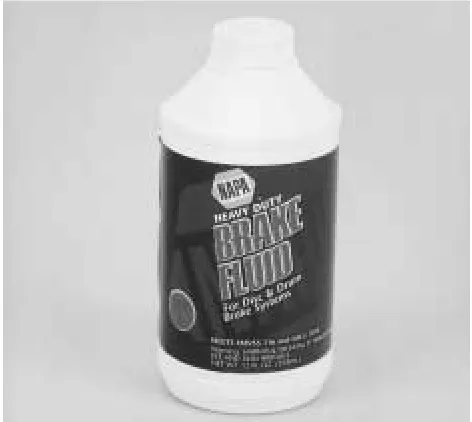
The liquid used in a hydraulic brake system is brake fluid. The specifications for all autom otive brake fluids are defined by Society of Autom otive Engineers (SAE) Standard J1703 and Federal Motor Vehicle Safety Standard (FMVSS) 116. Flu-ids classified according to FMVSS 116 are assigned United States Departm ent of Transportation (DOT) num bers:DOT 3, 4, and 5. Basically, the higher the DOT num ber (Figure 10), the m ore rigorous the specifications for the fluid.These spec-ifications list the qualities that brake fluid m ust have,such as:
● Free flow at low and high tem peratures.
● A high boiling point (over 400°F or 204°C).
● A low freezing point.
● Ability to not deteriorate m etal or rubber brake parts.
● Ability to lubricate m etal and rubber parts.
● Ability to absorb m oisture that enters the hydraulic system .
Choosing the right fluid for a specific vehicle is not based on the sim ple idea that if DOT 3 is good,DOT 4 m ust be bet-ter, and DOT 5 better still.The dom estic carm akers all specify DOT 3 fluid for their vehicles, but Ford calls for a heavy-duty variation that m eets the basic specifications for DOT 3 but has the higher boiling point of DOT 4. Im port m anufacturers are about equally divided between DOT 3 and DOT 4.
DOT 3 and DOT 4 fluids are polyalkylene-glycol-ether m ixtures, called polyglycol. The color of both DOT 3 and DOT 4 fluid ranges from clear to light am ber.DOT 5 fluids are all silicone based because only silicone fluid— so far— can m eet the DOT 5 specifications. No vehicle m anufacturer, how ever, recom m ends DOT 5 fluid for use in its brake sys-tem s.Although all three fluid grades are com patible they do not com bine w ell if m ixed together in a system . Therefore,
the best rules are to use the fluid type recom m ended by the m anufacturer and never m ix fluid types in a system .
Brake Fluid Boiling Point
The m ost apparent differences am ong the three fluid grades are the m inim um boiling points as listed below :
DOT 3 DOT 4 DOT 5
Dry boiling point 401°F 446°F 500°F (205°C) (230°C) (260°C) Wet boiling point 284°F 311°F 356°F (140°C) (155°C) (180°C) The boiling point is im portant because heat generated by braking can be transm itted into the hydraulic system . If the tem perature rises too high,the fluid can boil and form a vapor in the brake lines.The stopping pow er of the system then w ill be reduced. As a result, the brake pedal can go to the floor and the vehicle w ill not stop.
The dry boiling point is the m inim um boiling point of new, uncontam inated fluid.Because brake fluids are hygro-scopic, their boiling points decrease due to w ater contam i-nation after the fluid has been in service for som e tim e. Brake system s are not com pletely sealed, and som e expo-sure of the fluid to air is inevitable.
Other Brake Fluid Requirements
A high-tem perature boiling point is not the only requirem ent brake fluid m ust m eet.Brake fluid m ust rem ain stable throughout a broad range of tem peratures, and it m ust retain a high boiling point after repeated exposure to high tem peratures.Brake fluid m ust also resist freezing and evaporation and m ust pass specific viscosity tests at low tem peratures. If the fluid thickens and flow s poorly w hen cold,brake operation w ill suffer.
Besides tem perature requirem ents, brake fluid m ust pass corrosion tests. It also m ust not contribute to deterio-ration of rubber parts and m ust pass oxidation-resistance tests. Finally, brake fluid m ust lubricate cylinder pistons and bores and other m oving parts of the hydraulic system .
DOT 5 Silicone Fluid
Silicone DOT 5 fluid does not absorb w ater.This purple fluid has a very high boiling point, is noncorrosive to __
__ __
Figure 10.
The DOT number is always clearly stated
on a container of brake fluid.
hydraulic system com ponents, and does not dam age paint like ordinary fluid does. DOT 5 fluid also has som e other characteristics that are not so beneficial.
Silicone fluid com presses slightly under pressure, w hich can cause a slightly spongy brake pedal feel.Silicone fluid also attracts and retains air m ore than polyglycol fluid does, w hich m akes brake bleeding harder; it tends to out-gas slightly just below its boiling point, and it tends to aer-ate from prolonged vibration. DOT 5 fluid has other problem s w ith seal w ear and w ater accum ulation and sepa-ration in the system .All of these factors m ean that DOT 5 sil-icone fluid should never be usedin an ABS.
Hydraulic System M ineral Oil (HSMO)
Fluids
HSMO is the least com m on type of brake fluid, being used by only three carm akers: Citroen, Rolls Royce, and in som e Audi m odels in their brake booster system .HSMO is not a polyglycol or silicone fluid,but rather is m ade from a m ineral oil base.It has a very high boiling point,it is not hygroscopic,it is a very good lubricant,and it actively prevents rust and cor-rosion.HSMO fluid can be identified by its green color.
Because HSMO is petroleum based, system s designed for its use also require seals m ade of special rubber. If poly-glycol or silicone fluid is used in a system designed for HSMO,these fluids w ill destroy the HSMO system seals.
Fluid Compatibility
Although the perform ance requirem ents of DOT 3, 4, and 5 fluids are different, FMVSS 116 requires that DOT 3 and 4 fluids m ust be com patible w ith each other in a system . Mixing DOT 3 and DOT 4 in a syssystem is not recom -m ended, but it can be done w ithout da-m aging the syste-m or creating a dam aging reaction. DOT 5 should never be m ixed w ith DOT 3 or 4 fluids.
If DOT 3 and DOT 4 fluids are m ixed in a system , the boiling point of the DOT 4 fluid w ill be reduced by the sam e percentage as the percentage of DOT 3 fluid in the m ixture. Thus, overall system perform ance can be com prom ised by m ixing fluids.
Reservoir
All hydraulic system s require a reservoir to store fluid and to provide a constant source of fluid for the system .In a
brake system ,the reservoir is attached to the top of the m as-ter cylinder, although som e vehicles m ight use tubing to connect the reservoir to the m aster cylinder. Brake fluid is forced out of the pan by atm ospheric pressure into the m as-ter cylinder and returned to it afas-ter the brake pedal has been let up.
Venting
In order to allow the fluid to flow into the m aster cylin-der, the reservoir has an air vent that allow s atm ospheric pressure to force the fluid into the m aster cylinder w hen a low pressure is created by the m ovem ent of the pistons.The vent is positioned above the norm al brake fluid level in the reservoir and keeps atm ospheric pressure at the top of the fluid.
VACUUM AND AIR PRESSURE
PRINCIPLES
A law of nature defines the role of atmospheric pres-sure on the operation of a brake system . The law sim ply states that w henever a high pressure is introduced to a low er pressure, it m oves to equalize the pressures. In other w ords, som ething that has a high pressure w ill alw ays m ove tow ard som ething that has a low er pressure. The force at w hich the higher pressure m oves tow ard the low er pressure is determ ined by the difference in pressures.When the pressure is slightly low er than atm ospheric, the force is low. When there is a large difference, the higher pressure w ill rush into the low er and the force w ill be great.
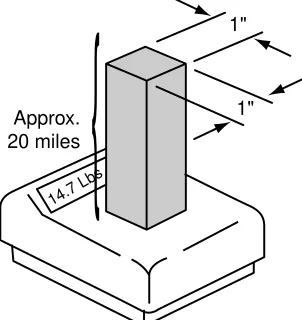
In the w orld of autom otive technology, any pressure that is low er than atm ospheric pressure is called a vacuum. Atm ospheric pressure (Figure 11)is the pressure of the air
___ ___ ___
If HSMO is used in a system designed for polyglycol or silicone fluid,it will destroy the seals of those systems. HSMO is not covered by the DOT classifications of FMVSS 116 and is not com patible w ith DOT fluids.
You Should
Know
1"
1"
14.7 Lbs
{
Approx.
20 miles
around and on us and has a value of approxim ately 14.7 psi at sea level.When w e are at higher elevat ions, t here is less air ab ove and on us and t herefore t he p ressure of t he at -m osp here is less, b ut t hat air is st ill considered at -m o-sp heric p ressure, and any p ressure less t han t hat is a vacuum .
When the pistons inside a m aster cylinder m ove, the volum e of the piston’s cylinder changes.When the volum e decreases, the pressure increases. When the piston m oves back to its original location,the pressure is low er and atm o-spheric pressure pushes fluid from the reservoir into the cylinder.
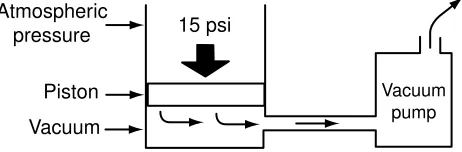
The relationship of vacuum and atm ospheric pressure is used in m ost pow er brake system s to provide a pow er
assist for the driver (Figure 12). The rush of high pressure tow ard an area of vacuum causes an increase in force, m uch like a lever.
__ __ __
Atmospheric
pressure
15 psi
Vacuum pump
Piston
Vacuum
Figure 12.
Vacuum (low pressure) works with
at-mospheric pressure to develop force.
Summary
■ In a hydraulic brake system ,the m aster cylinder m oves brake fluid through the system .The lines used to carry the liquid m ay be pipes,hoses,or a netw ork of internal bores or passages in a single housing,such as those found in a m aster cylinder.Valves are used to regulate hydraulic pressure and direct the flow of the liquid. The output devices are brake drum cylinders and disc brake calipers.
■ Hydraulics is the study of liquids in m otion.
■ Liquids are considered noncom pressible fluids.
■ Pascal’s Law says that pressure at any one point in a confined liquid is the sam e in every direction and applies equal force on equal areas.
■ If a liquid is confined and a force applied, pressure is produced. If the pressure on the fluid is applied to a m ovable output piston,it creates output force.
■ In a brake system , a sm all m aster cylinder piston is used to apply pressure to larger pistons at the w heel brake units to increase braking force.
■ Most brake system s w ith front discs and rear drum s have large-diam eter m aster cylinders (large piston area) and a pow er booster to increase the input force.
■ DOT 3 and DOT 4 fluids are polyglycol m ixtures. The color of both DOT 3 and DOT 4 fluids ranges from clear to light am ber.
■ DOT 5 fluids are all silicone based,and no vehicle m an-ufacturer recom m ends DOT 5 fluid for use in its brake system s.
■ Although the perform ance requirem ents of DOT 3 and 4 fluids are different, FMVSS 116 requires that the grades of fluid be com patible w ith each other in a tem ; how ever, m ixing different types of fluid in a sys-tem is not recom m ended.
■ All hydraulic system s require a reservoir to store fluid and to provide a constant source of fluid for the system .
■ The relationship of vacuum and atm ospheric pressure is used in m ost pow er brake system s.
Review Questions
1. Explain how hydraulic fluid can be used to transm it m otion.
2. Hydraulic system s w ork because fluids cannot be ____________.
3. The pressure in a hydraulic system is the sam e in ________ directions.
4. A hydraulic system w ith a 1-square-inch input piston and a 3-square-inch output piston is being discussed. Technician A says that the output piston w ill have three tim es as m uch force as the input
piston.Techni-cian B says that the output piston w ill m ove one-third as far as the input piston.Who is correct?
A. Technician A only B. Technician B only
C. Both Technician A and Technician B D. Neither Technician A nor Technician B
5. Technician A says that DOT 3 brake fluid has a higher boiling point than DOT 5.Technician B says that DOT 4 brake fluid has a low er boiling point than DOT 5.Who is correct?
A. Technician A only B. Technician B only