Factor Analysis Supporting Implementation SIMDA and Its Effect on Quality of Financial Statements In SKPD (Research on SKPD Local Governments Tegal)
Yeni Priatna Sari, Mohammad Alfian, Bahri Kamal Lecturers in 3rd Diploma of Accounting Study Program
of Polytechnic Harapan Bersama Tegal Jl. Mataram No. 9 Tegal
Telp (0283) 352000, Fax (0283) 353355, Hp. 081932251090 [email protected] ;[email protected]
ABSTRACT
This study aims to identify the factors supporting the implementation SIMDA SKPD and the influence on the quality of implementation SIMDA financial statements at Tegal district governments.This study was conducted based on the condition on SIMDA implementation, it is evidenced by the low quality of accounting information. The low quality of accounting information can be found on the Local Government Finance Report (LKPD) that received an unqualified opinion (WTP) of the results of an audit conducted by the BPK. The population in this study is the Local Government sectors in Tegal regency. The sample in this study were taken by purposive sampling method. The questionnaire can be further processed by 54 pieces. The hypothesis was analyzed using Structural Equation Model (SEM) with SmartPLS 2.0M3.The results of this research is the support of top management, data quality and knowledge level of human resources SIMDA has positive effect on the implementation of the SKPD in Tegal regency. Based on the research conducted is also known that the implementation SIMDA at SKPD in kabupaten Tegal has positive effect on the quality of financial reporting.
Keywords: implementation SIMDA, SKPD, quality of financial statements
INTRODUCTION
Generally the Public sector organizations in Indonesia have lack of the quality of
accounting information.Poor information can not be relied upon as consideration to
make a decision after the reporting period (Bastian, 2010). The low quality of
accounting information generated by local governments proved by the local government
obtain unqualified opinion (WTP) of the results of the audit of the Local Government
Finance Report (LKPD) conducted by BPK. This can be seen from the summary of the
information that is only 12% and 25% kabupaten city or as many as 36 counties and 21
cities of 313 counties and 85 cities in LKPD audited by BPK obtain WTP
opinion.According BPKP not obtaining the WTP opinion beberpa caused by factors,
such factor is the weakness of the internal control system, un organized asset in
countries / regions, financial statements disclosure are not in accordance with
Government Accounting Standards (SAP), the weaknesses in the system of preparation
of financial statements, and inadequate competence of human resources in the financial
management of local governments.LPKD is a combination of the financial statements
produced by SKPD - SKPD that exist in the region, in other words if LKPD less good
quality it is a reflection of the lack of good quality SKPD lapororan kuangan produced
in the area.The government and its related parties are trying to improve the quality of
the resulting financial statements, it is reflected by the issuance of PP 71 in 2010 to
replace PP 24 in 2005 to transform the base into the accrual basis of accounting in order
to improve the quality of accounting information contained in the financial statements.
Accounting information system is a tool used by management in the organization to
provide the added value that generate competitive advantage and as a control device
that generates internal information.Rostami and Mongadam (2010) states that
information technology can be used as an excellent support for the organization in
carrying out the strategy that has been set. At the moment SIA integrated with TI used
by organizations in the existing data processing is not going well can
produce output which can weaken the performance of the organization. Devi (2013)
states that the success of an enterprise information system depends on how the system is
run, the system convenience for the wearer, and the utilization of the technology used.
The application of accounting information system at the local government stipulated
in the Regulation of the Minister of Internal Affairs No. 13 of 2006 on Regional
Financial Management Guidelines.Regulation of the Minister of Internal Affairs No. 13
of 2006 has the objective which is to improve the information generated. BPKP in this
SIMDA (Local Financial Management Information System), which was introduced on
29 August 2006. This application was developed by BPKP to assist financial
management both at SKPKD (as entities reporting) as well as at the level of SKPD
(accounting entities).This application program is expected to provide more benefits to
the local government in implementing the financial management area. However, based
upon initial observations conducted by researchers in the environment SKPD in Tegal
district government found that:
a. SIMDA not fully used optimally, which led to the adoption SIMDA by SKPD can not
help maximal to achieve the goals organization governments.
b. The lack of preparation of SKPD on applicating the integrated financial softwaresuch
as SIMDA to do accounting procedures.
c. There is no certainty about the software that is used as the standard (default
software) in accounting procedures, which led to still diverse forms of financial statements
produced by SKPD, it is obviously difficult for users of the financial statements in decision
making.
d. The ability to master the operation of SIMDA uneven in each SKPD,
this softwarerequires users not only well versed in accounting but also in the use of
computers.
e. There are still many SKPD employees who prefer to use the manual paper work or
with Ms.Excell to complete its work which is considered easier than using SIMDA.
Based on this background, researchers interested in conducting research with the
title “Factors Analysis Supporting Implementation SIMDA and The Effect on
Quality of Financial Statements in SKPD (Research on SKPD in Local Governments Tegal)”
SIMDA implementation of the local government as a public sector organization is
expected to improve the quality of the accounting information contained in the financial
statements in the local government environment. With the increasing quality of financial
reporting is expected that the accounting information can be used as decision making and
as a form of management accountability for the use of the resources available in the
organization.Based on the background of the problem, we propose the following
research problem:
1. How significant is the quality of human resources effecting on the SIMDA
implementation?
2. How significant is the data quality effecting on the implementation SIMDA?
3. How significant is the management support effecting on the implementation
SIMDA?
4. How significant is the implementation SIMDA effecting on the quality of
financial reporting at SKPD?
BENEFITS OF RESEARCH
Researchers conducted this study with the aim to provide the benefits: To determine
the factors supporting the implementation SIMDA SKPD and examine their effect on the
implementation SIMDA Tegal regency administration to the quality of the resulting
financial statement on the local government Tegal.
LITERATURE AND DEVELOPMENT HYPOTHESIS
1. The Effect of Human Resources Toward Quality Implementation SIMDA.
According to Devi (2013) based on its findings stated that the successful use
addition to the training activities could build the confidence of the user so as to
anticipate the onset of anxiety and rejection from the user to the new system.
User understanding of information technology determines the success of an
information system, otherwise ignorance or anxiety new user to the system that could
lead to failures in the use of information technology. Improved understanding of the
users of information systems also affect success in utilizing information technology
(Sunarti and Nur, 1998). Hargo research results (2001) states that the level of
understanding of information technology to significantly affect the implementation
of information technology. Devi (2013) states that the level of user understanding
affect the successful implementation of accounting information systems. Thus the
proposed hypothesis is:
H 1: Human Resources has the Positive Impact Against Implementation SIMDA.
2. The Effect of Data Quality Toward Implementation influence SIMDA.
The whole process of generating data (collection, storage, and use of data) should
be done fine so that the quality of the data used can be properly processed. Lee and
Strong in Al-Hiyari, et al (2013) states that the data production process must run
properly in order to achieve quality results, in line with that Rahayu (2012) states that
quality data can affect the output of the SIA.Xu (2009) stated that the quality of
the output SIA relies on the existing input.Thus the proposed hypothesis is:
H 2: The Quality of Data has the Positive Impact Of Implementation SIMDA.
3. The Effect of Top Management Support Toward The Implementation SIMDA. According to Cooper (2006) a management commitment is the involved and
maintain behavioral management in the achievement of organizational
goals. Improved management commitment to the development of accounting systems
will have a direct impact on the quality of the implementation of the SIA, Thong, et
may not be involved in aspects of the implementation of the SIA as (in response to
the recommendation of consultants, or SIA monitor the development project), they
found that increasing the effectiveness of management's commitment information
system because they provide the resources needed for development projects
SIA.Rahayu (2012) examined the effect of management's commitment to quality
data and SIA, he found that management commitment and quality data together have
a sufficient effect on Accounting Information Systems, although the contribution of
management commitment to quality data that needs to be improved, he also found a
lack of top management support for training and funding for the development of the
resource. Thus the proposed hypothesis is:
H 3: Top Management Support has the Positive Impact Of Implementation
SIMDA.
4. The Effect of Implementation SIMDA Toward the Quality of Financial Statements
According to Grande, et al. (2011) SIA is defined as a tool when put in the field of
information technology and systems (IT) designed to assist in the management and
control topics related to economics-finance companies. In line with this, Salehi et
al. (2010) stated accounting information systems improve individual performance in
producing quality financial statements. Xu (2003) stated that the quality of the
information contained in the financial statements that bad can have adverse effects on
decision-making, such as errors in the information on the inventory may lead to
wrong decision making by managers so that excess inventory or supplies that have a
severe impact on the company profitability and customer satisfaction. Quality of the
information contained in the financial statements can be evaluated by four attributes
accuracy, timeliness, completeness and consistency, in line with Mc Leodet
of relevance, accuracy, timeliness and completeness. Thus the proposed hypothesis
is:
H 4: Implementation SIMDA has the Positive Impact on the Quality of Financial
Statements. RESEARCH METHODS
1. Data Types
Source of data in this study are primary data and secondary data
sources. According to Hartono (2013) states the primary data source is a data source
that directly provide data to data collectors, and secondary data are data sources that
do not directly provide the data to the data collector. Primary data in this study in the
form of opinions and information obtained from the respondents by providing
questionnaires that had been developed to the respondent. Questionnaires will be
given directly to the respondent so that researchers can explain the research to be
done and how to fill out the questionnaire. The bustle of the respondents caused the
respondents require a short time to do filling the questionnaire.
2. Population Research
Population studied in this research is the Local Government SKPD in Tegal
Regency that uses SIMDA in the preparation of financial statements. The
determination of this population is expected to represent a larger population, so the
results of this study can be generalized well. Another factor affecting the
determination of the population in this study is limited time owned by the researcher.
3. Sempel Research
Samples taken by the Judgment purposive sampling method. Criteria - criteria in
selecting sample namely:
2. SKPD in the local government Tegal who have financial or accounting
section.
3. SKPD in the local government Tegal which implementing SIMDA in
the preparation of financial statements.
4. Data Collection Technique
Data collection techniques used in this research is the survey method, the method
of data collection and analysis in the form of opinions from the studied subjects
(respondents) through a question-and-answer (Hartono, 2013).
5. Data Analysis
Latan and Ghozali (2012) stated that the analysis of research data is a part of the
testing process the data after the selection phase and data collection study. Analysis
of the data in this study using Partial Least Square (PLS). PLS can be used on any
kind of scale of data (nominal, ordinal, interval, ratio) and the assumption that a more
flexible terms. PLS is also used to measure the relationship of each indicator with
konstruknya. Additionally, the PLS can test the structural model
of bootstrapping against nature outer and inner models models. Because in this study
using indicators to measure each konstruknya, and also measurement model is
structural, it was decided to use PLS.
RESULTS AND DISCUSSION
1. Return Questionnaire
Questionnaires were returned is as much as 54 questionnaires from 54
questionnaires distributed.From questionnaires that have been returned, the entire
questionnaire can be used as the questionnaire completed by the
2. Data Analyst
a. Designing Model Measurements (Outer Model)
This stage is used to determine the validity and reliability of connecting
indicators with latent variables.Indicators in this study was reflective as
indicators of latent variables affecting the indicator for that use 3-phase
measurement according to Latan and Ghozali (2012), namely:
1. Discriminant Validity
Evaluation in this research was to see at the square root of average
variance extracted (AVE). Model measurements assessed by measurement of
cross loading the constructs. If the correlation constructs with each indicator is
larger than the size of the other constructs, then the latent constructs predict
better indicator than the other constructs.
If the value is higher than the value of correlation between constructs, then
good discriminant validity TERC apai.According to the 2012 Latan and
Ghozali highly recommended if AVE greater than 0.5.
Here is the formula for calculating the AVE:
AVE= Σλi
measurements can be used to measure the reliability and the results are more
conservative than the composite value reliabity (pc).
Based on the results of data processing is done with the help of software
for all constructs of> 0.50. So as to meet the requirements of convergent
validity.
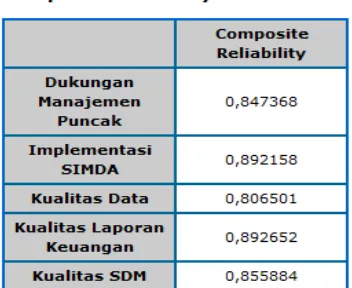
2. Composite Reliability
To determine composite reliability, if the value of composite reliability
pc > 0.8 can be said that the construct has a high reliability or reliable and>
0.6 be quite reliable (Chin in southern and Ghozali 2012).Here's the formula
for calculating the composite reliability ():
ρc=
(
Σλi)
of Composite Reliability for all constructs of > 0.70. It can be concluded that
all indicators of the construct is reliable or in other words meet the reliability
test.
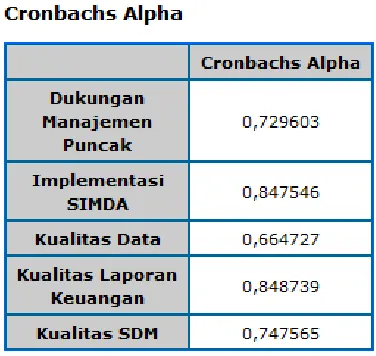
3. Cronbach Alpha
In PLS, reliability testing is reinforced by the Cronbach alpha where every
answer tested consistency, Cronbach's alpha in said well if the 0.5 and 0.3 if
said enough.
Insert Table 3
Cronbach alpha valuesgenerated all very well construct such > 0.7 So that it
can be concluded that all indicators reflective construct is reliable or meet the
reliability test. However, according to the southern and Ghozali
(2012) Cronbach alpha generated by the PLS bit of an underestimate so it is
b. Designing a Structural Model (Iner Model)
Structural models were evaluated using the R-square (R²) to construct the
dependent, Stone-Geisser Q-square test for predictive relevane and t test and
the significance of the coefficient parameters of structural lines. R² can be used
to assess the effect of latent variables independent of the dependent latent
variable does have a substantive effect.
Insert Table 4
From Table 4 it can be seen the value of R-Square for SIMDA variables show
results 0.786115 This means support of top management, data quality, and the
level of human knowledge SIMDA affect the implementation of 78.61 percent, it
shows that 21.39 percent factor or other variables that support the implementation
of SIMPDA at SKPD in TEGAL district government. While the R-square value
for the variable quality of the Financial Statements of .679233 it shows that
SIMDA affect the financial statements amounted to 67.92 percent, so that there
are 32.08 percent of the variables or other factors that affect quality of financial
statements.
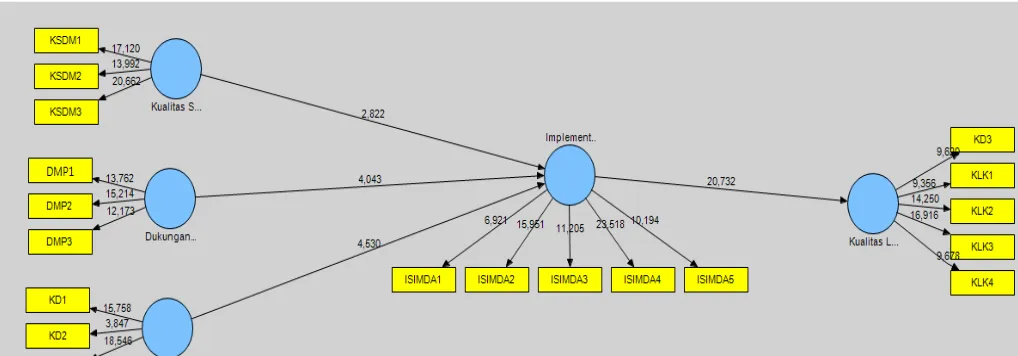
c. Construction Line Diagram
Insert Figure 1
d. Conversion Chart Path to Equation System
a. Iner Model
Inner Model specification specifies the relationship between latent
constructs with other latent constructs.
Inner Equation Model:
η 2 = β 1 η 1 +
ς
2Description:
η: endogenous latent variables.
γ:
Coefficient of influence of exogenous variables on endogenousvariables.
ξ: latent exogenous variables.
β: Coefficient influence endogenous variables on endogenous variables.
ς:
Error models.b. Outer Model
Outer Model specification specifies the relationship between latent constructs
and indicators.
Outer Equation Model:
x=Λxξ+εx
y=Λyξ+εy
Where:
x and y = matrix of manifest variables associated with the latent exogenous
and endogenous.
and =coefficient matrix.
and =matrix of outer models residue.
e. Hypothesis Testing (Resampling bootstrapping)
Based on the goals of the research, the design hypothesis test that can be made is the
design hypothesis testing in this study are presented based on the research
inaccuracies limit of () = 5 per cent = 0.05. And produce t-table value at 1.98
(southern and Ghozali, 2012).
So according to (Latan and Ghozali 2012):
If the value of t-statistic is smaller than t-table [t-statistic <1.98],
soHo accepted andHa rejected.
If the value of t-statistic greater than or equal to the t-table [t-statistic>
1.98], then Ho is rejected and Ha accepted.
Insert Table 5
Based on the above path coefficients can be seen that only the top management
support no significant effect on SIMDA, while the quality of input data and the level
of knowledge menegenai SIMDA positive effect on the implementation SIMDA.
T-statistics from the influence of top management support to the implementation of
SIMDA 4.043497> 1.98 , it means that the management support positive effect on the
implementation of the SKPD in lingkunagan SIMDA Tegal district government. The
results are consistent with Cooper (2006);Rahayu (2012); Al-Hiyari (2013).
T-statistics from the influence of the quality of data on the implementation of SIMDA
4.530046> 1.98, it means that the quality of data input positive effect on the
implementation SIMDA. The results are consistent with Xu (2009);Rahayu
(2012); Al-Hiyari (2013). T-statistics of the effect of the level of knowledge of the
implementation SIMDA users 2.822337> 1.98, it means that the level of knowledge
about the users SIMDA positive effect on the implementation SIMDA. The results are
consistent with Hargo (2001); Devi (2013). T-statistics of influence SIMDA
Implementation of the Quality of Financial Statements 20.731692> 1.98, it means that
the implementation SIMDA positive effect on the quality of financial statements or
LKPD generated by SKPD. The results are consistent with Rahayu (2012);Al-Hiyari
(2013).
1. Conclusion
Good top management support to the implementation of SIMDA is needed
in order to improve the quality of implementation SIMDA due. This study
proves that top management support affect the implementation SIMDA.
Data quality affected to the quality of implementation SIMDA because if
the quality of the data used as input data is less good, it will affect the quality of
implementation SIMDA.This study also proved that data quality has positive
influence on implementation SIMDA.
The quality of human resources greatly affect the implementation SIMDA
because if the quality of human resources that operate SIMDA not qualified then
it will be bad for the implementation SIMDA vice versa.This study proves that
the positive effect on the quality of human resources SIMDA implementation.
Implementation of good SIMDA will produce better quality financial
statements, but if the implementation is not good done SIMDA will produce
quality financial reports that are less well too.This study proves that the
implementation SIMDA affect the quality of financial reporting.
Based on the research results it can be concluded that in order to obtain
good quality reports required keangan good SIMDA dikarenaka implementation
process of preparing financial statements using SIMDA and that the
implementation SIMDA can work well it needs the support of top management,
data quality and good quality of human resources.
2. Limitations Research
Researchers realized that this study has some limitations, which include:
1. The research sample taken by the researcher as a research object only on the
obtained are less able to represent civil servants (PNS), which works on environmental SKPD
other Regional Government , Researchers restricted sampling areas because of the limited
time and energy.
2. Samples taken by the researchers is a public sector organization, so that the
conclusions of this study are not necessarily the same if the research conducted at
organizations in other sectors.
3. Measurement of all variables of this research is based on the perception of
respondents, which can cause problems if the perception of the respondents did not
correspond to the real situation. This can lead to response bias.
1. Suggestion
Suggestions given researchers expected to be used for the development of further research.Future studies are expected to not limit the sampling areas
only on one area only, so as to represent the wider population.In addition, the
sample should not be confined to the public sector organizations alone, but
expanded so as to include organizations in other sectors.
Many factors in the implementation of other information systems that can
affect the quality of the financial statements, but is not used and researched in
this study.Future studies are expected to incorporate these factors to be studied,
such as age, sex, pegaruh working environment, the benefits of information
systems, as well as other factors.
Researchers also suggest not only based on the research variables measuring
perceptions of respondents.Collecting data in future studies are expected not
only limited to the questionnaire alone, but can also be done through
interviews.The presence of investigators at the time of filling the questionnaire
respondents should also be done.This will avoidresponse bias, since
BIBLIOGRAPHY
Al-Hiyari, Ahmad., Al-Mashregy, MHH, Mat, NKN, and Alekam, JM 2013. Factors that Affect Accounting Information System Implementation and Accounting Information Quality: A Survey in Northern University of
Malaysia. American Journal of Economics, 2013, 3 ( 1): 27-31
Cooper, D. 2006. The Impact of Management's Commitment on Employee Behavior: A Field Study. American society of engineers safely.
Devi, Virsia, FP 2013. Effect of Accounting Information System Implementation of the Performance of Local Government Organisation (Research on SKPD Regional Governments Kulon Progo). Thesis. Yogyakarta: Yogyakarta Muhammadiyah University.
Endraswari, Rizki.M. 2006. Factors Affecting Applications Infoemasi Technology and Its Effect on Company Performance (Studies in SMEs Crafts Bantul, Yogyakarta). Thesis.Semarang: Diponegoro University.
Grande, EU, Estébanez, R. P, and Colomina, C. M. 2011. The impact of Accounting Information Systems (AIS) on Performance Measures: Empirical Evidence in Spanish SMEs. The International Journal of Digital Accounting
Research, Vol. 11.
Hargo, Utomo.Exploration Study2001.About Deployment IT For Small and Medium Enterprises. Journal of Economics and Business,
Indonesia Vol.16 No.2 pp.153-163.
Hartono, Jogiyanto.2013. Business Research Methodology misguided and experiences, Fifth Edition. BPFE.Faculty of Economics and Business UGM. Yogyakarta.
Indra Bastian.2010. The Public Sector Accounting An Introduction, Third Edition.Jakarta: publisher.
Southern, Heng and Ghozali, Imam. 2012. Partial Least Squares Concepts, Techniques and
Applications Using Program SmartPLS 2.0 M3, Diponegoro University
Publishers Agency.Semarang.
Mc. Leod, Raymond and Schell, George P. 2007. Management Information Systems, Tenth Edition. Upper Saddle River New Jersey 07458: Pearson / Prentice Hall. Regulation of the Minister of the Interior No. 13 Year 2006 on Regional Financial
Management Guidelines.
Government Regulation No. 58 Year 2005 on Management of Local Government.
Government Regulation No. 71 Year 2010 regarding the Government Accounting Standards. Rahayu, SK, 2012. The Factors That Support The Implementation of Accounting Information
Systems: A Survey in Bandung and Jakarta's Taxpayer Offices. Journal of Global Management.
Sajady, H., Dastgir, M., Nejad, H, H. 2008. Evaluation of effectiveness of accounting information systems. International Journal of Information Science and Technology.
Salehi, Mahdi, Rostami, Vahab, and Abdolkarim Mogadam 2010. Usefulness of Accounting Information System in Emerging Economy: Empirical Evidence of Iran. International Journal of Economics and Finance, Vol.2, No.2; May 2010.
Annual Congress of the European Accounting Association.April 20 to 22, 2011.
Sunarti, Setianingsih and Nur, Indriantoro. 1998. Effect of Top Management Support and Communications User-Developer of the User Satisfaction Relations and Participation in Information Systems Development. Indonesian
Journal of Accounting Research, Vol. 1 No. July 2 pp. 193-207
Thong, JL, Chee-Sing, Y., and Raman, K. S. 1996.Top Management Support, External Expertise and Information Systems Implementation in Small Businesses. Information Systems Research, 7 (2), 248-267. Law No. 17 Year 2003 on State Finance.
Law No. 1 of 2004 concerning State Treasury.
Xu, H., 2003. Critical Success Factors for Accounting Information Systems Data Quality, Dissertation, University of Southern Queensland.
Attachment
Table 1
Table AVE
Results Olah data by SmartPLS 2.0
Table 2
Results Olah data by SmartPLS 2.0 Table 3
Table Cronbachs Alpha
Results Olah data by SmartPLS 2.0
Table 4
Suber: Results Olah data by SmartPLS 2.0
Table 5
Table Path Coefficients (Mean, STDEV, T-Values
Suber: Results Olah data by SmartPLS 2.0
Figure 1