FIBERBOARD
100-111Saptadi Darmawan1,2, Kurnia Sofyan3, Gustan Pari4 and Krisdianto Sugiyanto4,5
ABSTRACT
he manufacturing of medium density iberboard (MDF) using dry forming process for interior purpose requires extensive amount of thermo-setting urea formaldehyde (UF) adhesive. Unfortunately, this adhesive brings about formaldehyde emission from the resulting MDF, which was potentially harmful to human beings. he use of activated charcoal can be efective to reduce such emission. As the relevance, this research aimed to investigate the efect of activated charcoal addition to the MDF pulp on formaldehyde emission from the MDF. he ibers for the MDF-mat forming were the pulp procured from the MDF factory, resulting from the thermo-mechanical pulping (TMP) conducted on the mixed mangium wood (Acacia mangium) and rubber wood (Hevea brasiliensis) in 3:1 (w/w) proportion, respectively. Such mixed TMP pulping was also done in the factory. he bonding between TMP pulp iber during mat forming was assisted by the use of UF adhesive. Prior to the MDF mat forming, was added to the resulting TMP pulp-ibers activated charcoal in various amount, 2%, 4% and 6% based on iber mass as well as based on UF adhesive mass. he activated charcoal was prepared by carbonizing candle nut shell into charcoal followed by activation process using phosphate solution. Meanwhile the forming of MDF mat employed air-dry process. As the control, MDF forming with UF adhesive was performed without addition of activated charcoal. It turned out that the activated charcoal-added MDF exhibited efective reduction in formaldehyde emission and signiicant improvement in physical and mechanical properties, i.e. lower thickness swelling, and greater MOR, MOE and internal bond, compared to the control MDF. he use of activated charcoal at 4% based on the adhesive mass seemed to be the optimum amount. Physical and mechanical properties of the activated charcoal added MDF could mostly meet the JIS speciication.
Keywords:MDF, UF adhesive, candlenut shell, formaldehyde emission, activated charcoal, physical and mechanical properties
I. INTRODUCTION
Fiberboards that include hardboards, insulation boards, medium density iberboards (MDF) belong to the category of engineered wood products, which are formed by at irst breaking down wood into ibers. Aterwards, these ibers are reformed into a mat or the
so-called iberboard using the media of water as well as air (wet and dry forming process, respectively). he bonding between ibers in the iberboard mat can arise from the iber material itself i.e. thermoplastic lignin. In order to improve the iberboard properties (e.g. internal bonding strength, water resistance, decay resistance, ire resistance, etc), other materials can be added during mat forming or iberboard inishing, such as thermosetting resin binder (adhesive), wax emulsion, preservative, and iber retardants. he advantage of iberboard is that it can be manufactured from low grade wood, small size wood, and residues (Walker, 1993). MDF is one of the iberboard types which is commonly used in furniture manufacture and automotive industry to create free-form shapes such as dashboards, rear parcel shelves, and inner door shells.
Urea formaldehyde (UF) resin is predominantly used in MDF industry as it is thermosetting, low in cost, and fast curing characteristic. It is necessary to note that the UF adhesive is applied to reconstituted wood products, including also MDF, for interior use only. However, there is a public pressure on the use of UF resin due to their potential problem associated with the formaldehyde emission. In 2004, the Internal Agency for Research on Cancer (IARC) classiied formaldehyde as harmful chemical for human body. Formaldehyde is classiied into group 1 (carcinogenic to humans) which means a direct contact to formaldehyde can cause cancer to human body. Consequently, the use of formaldehyde on wood panels currently has been reduced to particular levels, previously regarded as not harmful to human health (World Health Organization, 2007).
Recently, to reduce formaldehyde emission in wood panel products, some studies have been carried out, such as the use of phenol-plastic, melamine and isocyanate adhesive (Santoso and Sutigno, 1998). However, most of those adhesives proposed were still high in costs and hence brought about impact on iberboard productivity reduction as well as lowering of its physical and mechanical strength properties (Wang et al., 2004; Dynea, 2005).
Related with such, the use of activated charcoal is one of the possible methods to reduce formaldehyde emission (Pari et al., 2006; Park et al., 2006). Activated charcoal is a form of modiied charcoal that has been further processed through the activation treatment to make it extremely porous thereby afording very large surface area available for adsorption or possibly chemical reaction. Judging from these phenomena, it is possible to incorporate the activated charcoal in the mixture of UF adhesive and iber stuf for the manufacture of MDF with lower formaldehyde emission.
II. MATERIALS AND METHODS
A. Materials
he iber materials for the MDF manufacture were obtained from the MDF factory in Karawang, West Java. he iber resulted merely from the thermo-mechanical pulping (TMP) conducted on the mixed mangium wood (Acacia mangium) and rubber wood (Hevea brasiliensis) in 3:1 proportion, respectively (oven dried weight bases). Such mixed TMP pulping was already conducted in the factory as well.
Meanwhile, activated candlenut shell charcoal was prepared by at irst carbonizing candlenut shells into charcoal, followed by activation by immersing the resulting charcoal in phosphate (H3PO4) solution. he carbonization and activation were carried out in the Laboratory of Chemical Processing at the Center for Research and Development on Forestry Engineering and Forest Products Processing (CRDFEFPR), Bogor.
B. MDF manufacture
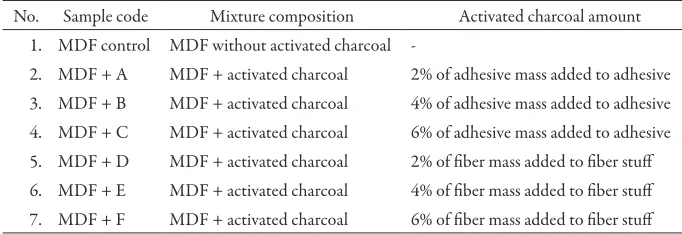
Table 1. Mixture composition of the stufs making up the MDF mat
No. Sample code Mixture composition Activated charcoal amount
1. MDF control MDF without activated charcoal
-2. MDF + A MDF + activated charcoal 2% of adhesive mass added to adhesive
3. MDF + B MDF + activated charcoal 4% of adhesive mass added to adhesive
4. MDF + C MDF + activated charcoal 6% of adhesive mass added to adhesive
5. MDF + D MDF + activated charcoal 2% of iber mass added to iber stuf
6. MDF + E MDF + activated charcoal 4% of iber mass added to iber stuf
7. MDF + F MDF + activated charcoal 6% of iber mass added to iber stuf
C. Formaldehyde Emission Test
In this experiment, formaldehyde emission was tested based on the method developed by Indonesian National Standard (SNI) test No. 01-7140-2005 for MDF (Badan Standardisasi Nasional Indonesia, 2005). he test was carried out using a desiccator method, whereby the MDF test pieces were placed in a desiccator containing a vessel into which was previously poured with distilled water, then let at 20°C for 24 hours. Aterwards, the formaldehyde as released from the test pieces would be absorbed by the distilled water forming formaldehyde solution. Further, formaldehyde concentration in the solution was determined photo-metrically.
D. Physical and Mechanical Properties of MDF
he tests on those MDF specimens were based on the Japanese Industrial Standard ( Japanese Standard Association, 2003). Physical properties as tested included density, moisture content, thickness swelling, and water absorption. Meanwhile, the tested mechanical properties comprised modulus of rupture (MOR), modulus of elasticity (MOE), and internal bond (IB). In addition, scanning electron microscope (SEM) analysis was employed on MDF piece samples to visually examine, identify, and scrutinize the possible diference between surface proiles of the control MDF and of the activated charcoal incorporated MDF.
E. Data Analysis
III. RESULTS AND DISCUSSION
A. Formaldehyde Emission
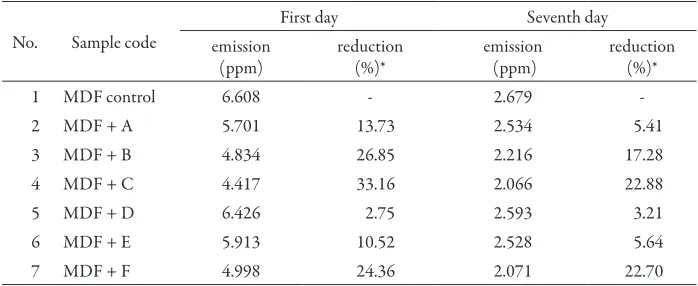
Generally, formaldehyde emission from MDF without activated charcoal (control) was higher than that from the activated charcoal incorporated MDF. On the irst day of observation, the average emission level from the control MDF was 6.608 ppm, while the corresponding value for activated charcoal incorporated MDF varied between 4.417 and 6.426 ppm. Similarly, on the seventh day of observation, the average emission from the control was higher than that from the MDF incorporated (added) with activated charcoal. he results of formaldehyde emission from the MDF were presented in Table 2.
Table 2. Formaldehyde emission from the tested MDF
No. Sample code
Remarks: * percentage of reduction: by dividing the emission at particular level use of activated charcoal with the emission from the control MDF, than multiplied by 100%
Days
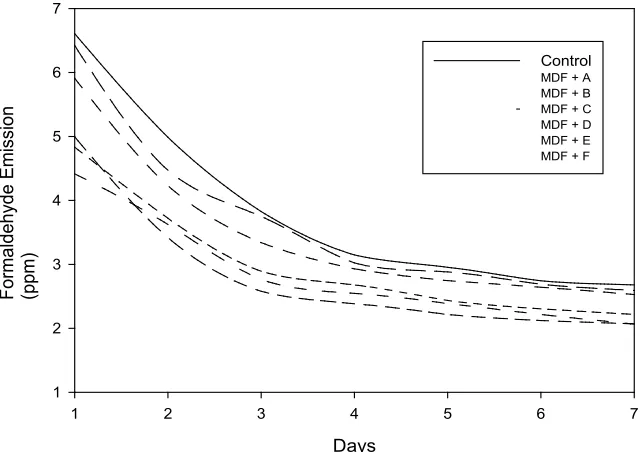
Figure 1. Formaldehyde emission from the tested MDF (For the designation of control, MDF+A, MDF+B, MDF+C, MDF+D, MDF+E, MDF+F, please refer to Table 1)
he percentage of emission reduction decreased exponentially along the observation day. Formaldehyde emission on the irst day varied from 4.417 to 6.608 ppm, while the average emission on the seventh day was 2.35 ppm. he pattern model of emission reduction from the irst day to seventh day was shown in Figure 1.
The initial formaldehyde emission was 6.608 ppm in the control MDF and 5.382 ppm in charcoal added MDF (average value). On the seventh day, the emission exponentially decayed to about 4 ppm and then slightly decreased in the following 5 days. he decay graph of formaldehyde emission happened as MDF irstly was in contact with environment and the emission steadily decreased in exponential trend along the time i.e. days (Figure 1). his resulting phenomenon in fact corresponded to those of the previous researchers (Liteplo et al., 2002; Hawks and Hansen, 2002).
B. Physical Properties
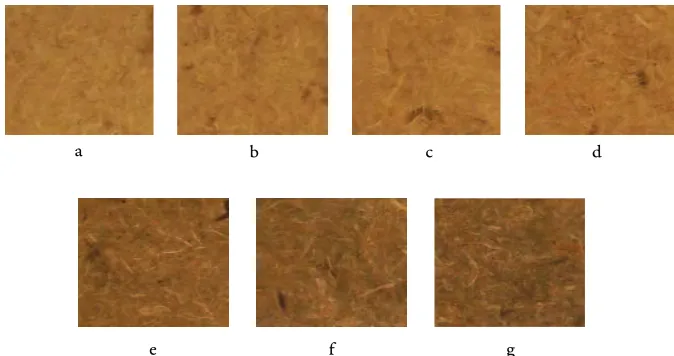
percentage based on iber mass (MDF+D, MDF+E, MDF+F) exhibited darker color than that based on adhesive mass (MDF+A, MDF+B, MDF+C), as shown in Figure 2. his is reasonable since in quantity the amount of activated charcoal in the former MDF was greater than that on the latter MDF.
e
d c
b
f g
a
Remarks : a = Control, b = MDF + A, c = MDF + B, d = MDF + C, e = MDF + D, f = MDF + E, g = MDF + F
Figure 2. Visual observation: the surface of MDF
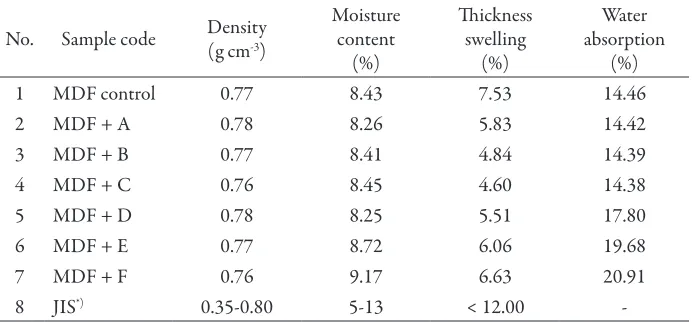
Table 3. Physical properties of the tested MDF
1 MDF control 0.77 8.43 7.53 14.46
2 MDF + A 0.78 8.26 5.83 14.42
(*) Source : Japanese Standard Association (2003)
Addition of activated charcoal to MDF caused signiicant diferences in thickness swelling and water absorption in comparison with those of control MDF. In general, the activated charcoal added MDF exhibited lower thickness swelling than that of control MDF (Table 3). he possible explanation was with the incorporation of activated charcoal to the MDF (MDF+A, MDF+B, MDF+C, MDF+D, MDF+E, MDF+F, as described in Table 1), therefore, the mass portion of ibers in the activated charcoal-added MDF for its particular volume (30 cm x 30 cm x 1 cm) decreased and become lower than that of the control MDF. Consequently, the capability of such MDF to swell its iber following water-immersion decreased, thereby exhibiting lower thickness swelling.
C. Mechanical Properties
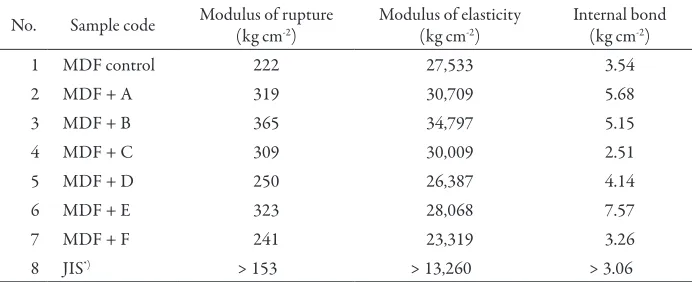
Mechanical properties of the tested MDF are shown in Table 4. Modulus of rupture (MOR) of MDF varied about 241-365 kg cm-2, whereby the MOR of the activated charcoal added MDF was mostly higher than that of the control MDF. he highest MOR was achieved by the MDF added with charcoal at 4% based on adhesive mass (MDF+B), while the lowest exhibited by that at 6% based on iber mass (MDF+F).
Modulus of elasticity (MOE) of activated charcoal added MDF was higher than that of the control MDF except for those designated as MDF+D and MDF+F (Table 4). he highest MOE was achieved by the MDF added with activated charcoal at 4% based on adhesive mass (MDF+B), while the lowest gained by that of 6% based on iber mass (MDF+F). Likewise, internal bond (IB) of activated charcoal added MDF was higher than that of the control MDF, except for those designated as MDF+C and MDF+F.
Table 4. Mechanical properties of the tested MDF
No. Sample code Modulus of rupture
(kg cm-2)
(*) Source : Japanese Standard Association (2003)
added charcoal were lower those with less amount of charcoal. Further, the MOR, MOE, and IB of the experimented MDF (with and without activated charcoal addition) could mostly comply with those required by the JIS (Table 4).
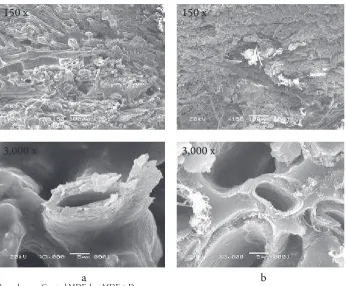
Scanning electron microscopic (SEM) analysis on the surface of activated charcoal added MDF indicated that there were still more frequent void spaces between ibers compare to the MDF with greater amount of added charcoal (Figure 3). Meanwhile, the control MDF exhibited the most frequent void spaces. his hinted that the particles of activated charcoal illed up the gap or empty spaces between ibers in the MDF. his again conirmed that this situation contributed to the strength improvement (MOR, MOE, IB) of charcoal added MDF, particularly for the cases of MDF+A, MDF+B, and MDF+C (Table 4).
150 x
3,000 x
3,000 x
150 x
a
b
Remarks : a = Control MDF; b = MDF + D
IV. CONCLUSION
Formaldehyde emission from the MDF was signiicantly reduced by adding the activated charcoal to the UF (urea formaldehyde) adhesive and iber stuf, prior to the MDF mat forming. he reduction percentage of formaldehyde emission from the activated charcoal added MDF ranged about 2,75–33,16%, compared to that of the control MDF (0%). hat percentage increased by adding the activated charcoal in higher number. Visual observation on the MDF surface revealed that the activated charcoal added MDF was darker in color than that of the control MDF.
he addition of activated charcoal did not bring about signiicant diferences in the moisture content and density among the resulting MDF. However, it afected the thickness swelling and water absorption. As such, thickness swelling of activated charcoal added MDF was lower than that of the control MDF. Meanwhile, signiicant increase in water absorption occurred to the MDF added with activated charcoal particularly at the percentage based on iber mass. Physical properties of the overall MDF (with or without activated charcoal), i.e. density, moisture content, thickness swelling and water absorption could mostly meet the JIS speciication.
Modulus of rupture (MOR) of charcoal added MDF varied about 241–365 kg cm-2, which was higher than that of control MDF. his situation also occurred mostly to modulus of elasticity/MOE (23,319–34,797 kg cm-2) and internal bond/IB (3.26–7.57 kgcm-2) of the charcoal added MDF. Most of mechanical properties of the overall MDF (MOR, MOE, and internal bond/IB) of the overall MDF could comply with the JIS speciication.
Scanning electron microscopic (SEM) analysis on the MDF surface indicated that there were more void spaces between iber in the control MDF than those in the activated charcoal-added MDF. his SEM analysis exhibited that the addition of charcoal brought about the illing-up of such void spaces in the MDF.
REFERENCES
Badan Standarisasi Nasional Indonesia. 2005. Emisi formaldehida pada panel kayu. Standard Nasional Indonesia (SNI) No. 01-7140-2005. Badan Standarisasi Nasional Indonesia. Jakarta.
Dynea. 2005. Resin for ultra low formaldehyde emission according to the Japanese F**** quality. San Diego. Manfred Dunky.
Hawks, L.K., and A.B. Hansen. 2002. Formaldehyde. Utah University Extension. Electronic Publishing. http://www.utah.ac . Downloaded at 27 March 2007. Hendra, D., dan S. Darmawan. 2007. Sifat arang aktif tempurung kemiri. Jurnal
Japanese Standard Association. 2003. Fiberboards, Japan industrial standard No. A 5905. Japanese Standard Association.
Kim, G.E. and H.H. Lee. 2003. Properties of charcoal-iber board by wet forming process. International Conference on Forest Products Better Utilization of Wood for Human, Earth and Future Vol.2. Proceedings of the IAWPS.
Liteplo, R.G., R. Beauchamp, M.E. Meek, and R. Chenier. 2002. Formaldehyde. Concise International Chemical Assessment Document 40. Geneva. WHO. 75p.
Pari G., S. Kurnia, S. Wasrin and Buchari. 2006. Tectona grandis activated charcoal
as catching agent of formaldehyde on plywood glued with urea formaldehyde.
Proceedings of the 8th Paciic Rim Bio-Based Composites Symposium. Kuala
Lumpur. Malaysia.
Park, S.B., K. Su-Won, P. Jong-Young and R. Jung-Kwan. 2006. Physical and mechanical properties and formaldehyde emission of particleboard with bamboo charcoal.
Journal of Forest Science69: 50–59.
Rong, H., Z. Ryu., J. Zheng and Y. Zhang. 2002. Efect of airoxidation of rayon-based
activated carbon ibers on the adsorption behaviour for formaldehyde. Carbon
40: 2291–2300.
Santoso, A and P. Sutigno. 1998. Several factors afecting the formaldehyde emission from wood-based panels. Proceedings the fourth Paciic Rim Bio-Based Composites Symposium. Bogor, Indonesia.
Walker, J.C.F. 1993. Wood panels: particleboards and iberboards. In:Walker, J.C.F.
Primary Wood Processing. Principles and Practice. Chapman and Hall, London. Wang, W., X. Zang and R. Lu. 2004. Low formaldehyde emission from particleboard
bonded by UF-MDI mixture adhesive. Forest Product Journal54(9): 36–39.