Effects of Young Corn Ear Addition on Nutritional Composition and Acceptability
of Malaysian Star Cake (Baulu Cermai)
(Kesan Penambahan Jagung Muda Terhadap Komposisi Pemakanan dan Penerimaan Kek Bintang Malaysia (Baulu Cermai))
W.I. WAN ROSLI* & Y.N. CHOW
ABSTRACT
Sufficient intakes of functional foods containing significant amount of dietary fibre in daily diet are beneficial to human health especially in preventing the prevalence of non-communicable diseases (NCDs). In this study, young corn powder (YCP) was added into Malaysian star cake (Baulu Cermai) to replace wheat flour (WF) partially at the formulations of 5, 10 and 15%. Baulu Cermai with 100% WF and 0% YCP was used as the control. The aim of the present study was to evaluate the effects of YCP addition on the nutritional composition, textural properties and sensory attributes of Baulu
Cermai. The results showed that the mean values of moisture, ash, fat and protein content of Baulu Cermai increased in
line with the levels of YCP incorporation. In addition, the total dietary fibre (TDF) content was increased proportionally with the increasing levels of YCP added into Baulu Cermai. Addition of YCP did not show any predictable trend in all the textural properties of Baulu Cermai. Meanwhile, the aroma, chewiness and tenderness increased in parallel with the increasing percentages of YCP added in the formulated products. Baulu Cermai added with 10% of YCP showed the highest score of overall acceptance. Addition of YCP at 10% into Baulu Cermai increases moisture, ash, fat, protein and total dietary fibre content without significantly affecting the textural properties and the sensory attributes of Baulu
Cermai. Addition of YCP at 5% to replace WF partially in Baulu Cermai resulted in slight improvement of TDF and fat but does not affected moisture, ash, protein content and acceptability of the consumers.
Keywords: Baulu Cermai; nutritional composition; sensory attributes; total dietary fibre; young corn ear powder ABSTRAK
Pengambilan makanan berfungsi yang mengandungi serat dietari yang signifikan dalam diet harian memberi manfaat kepada kesihatan manusia terutama sekali dalam membendung prevalens penyakit tidak berjangkit (NCD). Dalam kajian ini, tepung jagung muda (YCP) telah ditambahkan ke dalam kek bintang Malaysia (Baulu Cermai) menggantikan sebahagian tepung gandum (WF) pada tahap 5, 10 dan 15%. Baulu Cermai yang mengandungi 100% WF dan 0% YCP digunakan sebagai kawalan. Tujuan kajian ini adalah untuk menilai kesan penambahan YCP terhadap komposisi nutrien, ciri tesktur dan atribut sensori Baulu Cermai. Hasil kajian menunjukkan kandungan kelembapan, abu, lemak, protein dan serat Baulu Cermai bertambah seiringan dengan pertambahan peratus YCP. Sebagai tambahan, kandungan jumlah serat dietari (TDF) telah meningkat secara signifikan selari dengan peningkatan paras YCP dalam formulasi Baulu Cermai. Penambahan YCP dalam Baulu Cermai tidak menunjukkan sebarang corak dalam kesemua ciri tesktur. Di samping itu, atribut bau, kekunyahan dan kelembutan bertambah selari dengan peningkatan peratusan YCP dalam formulasi produk. Baulu Cermai yang mengandungi 10% YCP merupakan sampel yang paling disukai oleh para panel sensori. Penambahan YCP sebanyak 10% dalam Baulu Cermai meningkatkan kandungan lembapan, abu, lemak, protein dan TDF serta tidak mempengaruhi ciri tekstur dan atribut sensori Baulu Cermai. Penambahan YCP menggantikan sebahagian WF pada paras 5% meningkatkan sedikit kandungan TDF dan lemak tetapi tidak mempengaruhi kelembapan, abu, protein dan penerimaan pengguna.
Kata kunci: Atribut sensori; Baulu Cermai; jumlah serat dietari; komposisi nutrisi; tepung jagung muda
INTRODUCTION
Non-communicable diseases (NCDs) are global crisis which draw the attention of the world population (Beaglehole et al. 2011). NCDs refer to heart disease, stroke, diabetes, chronic respiratory ailments and cancers (WHO 2010). Parallel with the increasing occurrence of NCDs, people have become more conscious that diet is capable of modifying human health. As a consequence, there is a
mushrooming production of functional foods and increased availability in the market.
Dietary fibre is defined as the storage and structural polysaccharides as well as lignin found in plants which are not digested in both the human stomach and small intestine (Marlett et al. 2002). It can be divided into water-soluble and water-insoluble components (Gorinstein et al. 2001). Soluble fibres can be found mostly in oats products, dried
beans, certain fruits and vegetables. Meanwhile, most plants are good sources of insoluble fibre (Anderson et al. 1994).
Dietary fibre is known as a key component in a healthy diet due to its ability in preventing and mitigating various diseases (Kaczmarczyk et al. 2012). People with a significant amount of fibre intake are at lower risk of developing a variety of diseases and health problems (Lairon et al. 2005; Liu et al. 1999; Montonen et al. 2003; Petruzziello et al. 2006; Steffen et al. 2003; Whelton et al. 2005) compared with those who consumed less dietary fibre (Anderson et al. 2009). The RNI for dietary fibre is 20-30 g/day (NCCFNM 2005) but more than half of the Malaysian adults consumed less than 20 g dietary fibre per day (Ng et al. 2010).
Young corn or baby corn is the ear of the maize plant (Zea mays L.) which is harvested young, especially before or just after the silks have emerged and there is no fertilization occurred (UNDP 2001). It is very rich in dietary fibre in which the dried young corn contains 30.4% of total dietary fi bre (TDF) (Wan Rosli & Che Anis 2012). Usually it is used as vegetable or removed as its nutrient contents and potential functional properties are still not well known (Wan Rosli & Che Anis 2012).
Baulu Cermai is a famous Malaysia traditional local kuih which is served during festivals particularly during Hari Raya celebration and it is easily obtained from stalls
and shops nowadays (Rosniyana et al. 2011). However, it contains high carbohydrates and low minerals as well as vitamins (Khatijah et al. 1992). Furthermore, the milling of wheat kernel during the manufacturing of wheat flour leads to the elimination of the bran and germ and thus the partial removal of the dietary fibre as well as other nutrients (Figoni 2008). Tee at el. (1997) reported that there was no dietary fibre contained in Baulu Cermai.
In the present study, the wheat flour used in the preparation of Baulu Cermai was replaced with four levels (0, 5, 10 and 15%) of young corn ear powder (YCP). The aim of the study was to evaluate the effects of YCP addition on the nutritional composition and acceptability of Baulu
Cermai.
MATERIALS AND METHODS
YOUNG CORN EAR POWDER (YCP) PREPARATION The fresh young corn (Zea mays) ears were purchased from Siti Khadijah wet market in Kelantan, Malaysia. The
young corn ears were detached from the husk, tassel, silk and washed under the distilled water. Next, the fresh young corn ears were julienned, air dried at room temperature for 3 days and oven dried (Mermert, Germany) at 55°C until brownish threads were obtained. After that, the dried young corn ears were ground into powder and kept in the screw cap bottle at 4°C before further analyses (Wan Rosli & Che Anis 2012). The YCP was used in the preparation of Baulu Cermai.
PREPARATION OF BAULU CERMAI
The ingredients used in Baulu Cermai were shown in Table 1. Firstly, the sugar and eggs were beaten into thick smooth form. Then, the wheat flour (WF) and baking powder were sifted in and stirred well. The WF was substituted with YCP partially at the levels of 0% (100%WF:0%YCP) for control, 5% (95%WF:5%YCP), 10% (90%WF:10%YCP) and 15% (85%WF:15%YCP). The amount of YCP used in Baulu Cermai formulations were 0.0 g for control, 1.2 g for 5%,
2.3 g for 10% and 3.5 g for 15%, respectively. The batter was poured into the mould and baked at temperature 170°C until golden colour.
NUTRITIONAL COMPOSITION
The samples of Baulu Cermai were analysed for the moisture (air-oven method), total ash (dry-ashing method), crude fat (Soxhlet method) and protein (semi-micro Kjeldhal method) content based on the methods in Association of Official Analytical Chemists Methodology (AOAC 1990). Meanwhile, TDF content of the samples was determined by enzymatic gravimetric method (AOAC 1990).
TEXTURE PROFILE ANALYSIS (TPA)
The firmness, cohesiveness, springiness, gumminess and chewiness of Baulu Cermai samples were analysed by using a Texture Analyser TA-XT2 (Stable Micro Systems, surrey, UK). Calibration was conducted prior to the tests. The samples were cut into uniform size (25×40 mm diameter) with the crust removed. The probe with 75 mm diameter was used and it was set at pre-test speed (1.0 mm/s), test speed (5.0 mm/s) and post-test speed (10.0 mm/s). The probe compressed the samples twice to the depth of 50% at a 5 g force (Kalinga 2010). Each test was done in triplicate. The textural properties were then evaluated from the graph (Gòmez et al. 2007).
TABLE 1. Types and quantity of ingredients used in Baulu Cermai preparation YCP Levels (%)
Ingredients Control (0%) 5% 10% 15% Sugar (g) Wheat flour (WF) (g) YCP (g) Baking powder (g) Egg (nos) 34.0 23.0 0.0 1.0 1.0 34.0 21.8 1.2 1.0 1.0 34.0 20.7 2.3 1.0 1.0 34.0 19.5 3.5 1.0 1.0
SENSORY EVALUATION
Sensory evaluations were carried out by 50 untrained consumers consisting of students and staff of the School of Health Sciences, Universiti Sains Malaysia Health Campus. All samples of Baulu Cermai were judged by all panelists according to their preferences. The acceptability attributes were evaluated by panelists via seven point hedonic scale and the ratings were done according to the intensity of the panelists’ preferences (0 = dislike extremely and 7 = like extremely) for the attributes of aroma, colour, chewiness, tenderness, flavour and overall acceptance.
DATA ANALYSIS
The data obtained were analysed for significance by using Analysis of Varians (ANOVA) and Tukey test (SPSS Inc., Chicago, IL, USA). The significance level was established at p<0.05.
RESULTS AND DISCUSSION
NUTRITIONAL COMPOSITION AND TDF CONTENT The nutritional composition of Baulu Cermai formulated with four different levels of YCP was shown in Table 2. Addition of YCP at 5% to replace wheat flour (WF) partially does not affect the the mean values of moisture and ash as compared with control. When the levels of YCP were increased up to 15%, the amount of moisture and ash were significantly elevated to 19.43 and 1.42%, respectively, as compared with control (16.12 and 1.27%, respectively). In other nutrient, addition of YCP up to 15% to replace WR partially does not affect the protein content (13.53-14.21%) as compared with control (13.38%). Similar finding was reported by Skuarray et al. (1988) who suggested that increment in moisture content was due to the high fibre content of the ingredient added into Kuih Baulu. The possible mechanism involved was the absorption of water molecules by the free hydroxyl groups found in cellulose and hemicellulose which led to a higher water holding capacity (Sangnark & Noomhorm 2004). Subsequently, the moisture content in the food studied was increased.
Furthermore, the fat content of Baulu Cermai added with YCP at all percentages was significantly higher than the control (0%). In terms of moisture, ash and fat content of Baulu Cermai, these findings were in agreement with the
study conducted by Rosniyana et al. (2011). Meanwhile, the significant increase in ash content of Baulu Cermai with 15% of YCP was also similar with the other baked products such as muffins with the incorporation of Fenugreek seed husk (Srivastava et al. 2012). However, the increment was significantly seen in 5, 10 and 15% of Fenugreek seed husk added into the muffins whereas in the present study, only 10 and 15% of YCP showed a significant increase in the ash content of Baulu Cermai. The difference might be due to difference in the ingredient used in the study.
Apart from that, TDF content of Baulu Cermai increased proportionally with the levels of YCP added into the samples, ranging from 0.40% (control) to 4.48% (15%). The TDF values in the present study were significantly different among all treatments. The increase in TDF content was similarly observed in studies which involved the incorporation of YCP into the cookies (Wan Rosli & Che Anis 2012) and yeast bread (Lim & Wan Rosli 2013).
There are a number of studies which also supported that incorporation of fibre-rich ingredients would lead to an increase in the TDF content of the food products studied. These studies include processed food samples added with matured green banana flour and oat ß-glucan (Chong & Noor Aziah 2009), dietary fibre-rich orange bagasse product (Romero-Lopez et al. 2011), mango peels (Ajila et al. 2008) and soy bean flour (Ndife et al. 2011).
TEXTURAL PROPERTIES
Table 3 shows the textural properties of Baulu Cermai added with different percentages of YCP. According to the results, there was no predictable trend shown in the firmness, cohesiveness, springiness and gumminess attributes of Baulu Cermai. Nonetheless, there was a significant increase in the firmness of Baulu Cermai supplemented with 5% of YCP in comparison with the samples with 0, 10 and 15% of YCP. The present finding was not in line with other similar study. For instance, Srivastava et al. (2012) reported that the firmness of muffins decreased proportionally with the increasing levels of fenugreek seed husk added whereas green tea powder was shown to increase the firmness of sponge cake significantly and proportionally (Lu et al. 2010).
In addition, Baulu Cermai with 5% of YCP was gummier than the control (0%) but the increase was not significant. Further addition of YCP led to an insignificant
TABLE 2. Proximate compositions of Baulu Cermai with YCP addition
YCP Level 0% 5% 10% 15% Moisture Ash Fat Protein TDF 16.12 ± 0.2b 1.27 ± 0.01b 7.24 ± 0.03b 13.38 ± 0.18a 0.40 ± 0.07d 17.84± 0.39ab 1.36 ± 0.05ab 8.31 ± 0.13a 13.53 ± 0.55a 0.44 ± 0.30c 19.12 ± 1.79a 1.42 ± 0.06a 8.50 ± 0.09a 14.02 ± 0.16a 2.94 ± 0.26b 19.43 ± 0.06a 1.42 ± 0.02a 8.51 ± 0.23a 14.21 ± 0.22a 4.48 ± 0.35a
decrease in the gumminess compared with the control (0%). Meanwhile, Baulu Cermai became less chewy as the percentage of YCP increased. The reduction in the chewiness was significantly different between the control (0%) and Baulu Cermai containing 15% of YCP as well as between the samples containing 5 and 15% of YCP. Meanwhile, the springiness of Baulu Cermai was diminished compared with the control (0%) reflecting a denser crumb due to the addition of YCP. The results were similarly observed in the substitution of wheat flour with chickpea flour in the layer cake (Gómez et al. 2008). Chewiness is a secondary texture parameter obtained by multiplying the firmness with cohesiveness and springiness. It is related to the difficulty to chew the food samples and to form a bolus. A decrease in the chewiness was also reported by Martínez-Cervera et al. (2011) after the addition of cocoa fibre into the chocolate muffins. According to these researchers, it was due to the presence of greater moisture bounded by the fibre which led to a denser sample to be chewed.
SENSORY ATTRIBUTES
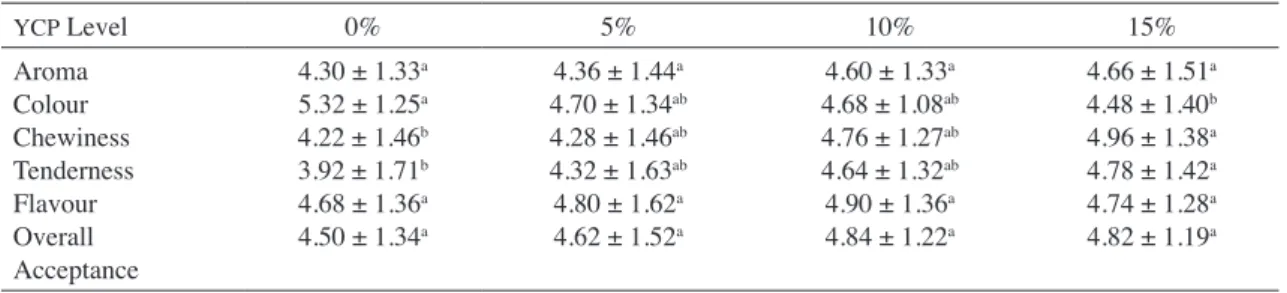
Table 4 shows all the attributes of Baulu Cermai formulated with four different levels of YCP that was perceived by the panels in sensory analysis conducted. The aroma, chewiness and tenderness attributes scores increased in parallel with the levels of YCP. In addition, there was a significant difference observed in Baulu Cermai incorporated with 15% and control (0%) for colour, chewiness and tenderness attributes. As for other attributes, there was no significant difference observed.
The colour of the control (0%) scored the highest (5.32) among all the samples and it decreased beyond 5%
of YCP addition. The reduction was due to the darker colour of Baulu Cermai as the percentage of YCP increased. This situations may be contributed by the Maillard reaction between the fructose which is one of the main sugars found in the dried young corn (Wan Rosli & Che Anis 2012) and the amino acids when thermal process were applied in the preparation of Baulu Cermai (Jaeger et al. 2010). The current finding was in agreement with the incorporation of stabilised rice bran into Kuih Baulu (Rosniyana et al. 2011).
Based on the present results, the increasing preferences of the aroma and flavour in line with the increment of YCP added were due to pleasant flavour and aroma of the young corn in the Baulu Cermai which was more preferred. However, a further increase of YCP at 15% reduced the flavour score suggested that 10% of YCP added into the Baulu Cermai was the highest percentage preferred by sensory evaluation panellists. This can be further convinced by the highest overall acceptance scores (4.84) of Baulu Cermai incorporated with 10% of YCP was the most preferred by the panellists. Nonetheless, the panellists preferred the aroma (4.66), chewiness (4.96) and tenderness (4.78) of Baulu Cermai added with 15% of YCP.
In terms of chewiness and tenderness, the addition of 15% of YCP exhibited a significantly increased preference compared with the control (0%). However, Lim and Wan Rosli (2012) reported that supplementation of 4 and 6% of YCP into the yeast bread decreased the tenderness.
CONCLUSION
In conclusion, 10% addition of YCP into Baulu Cermai increased the moisture, ash, fat, protein and total dietary
TABLE 3. Textural properties of Baulu Cermai with different levels of YCP
YCP Level 0% 5% 10% 15% Firmness (kg) Cohesiveness Springiness Gumminess (kg) Chewiness (kg) 0.87 ± 0.12b 0.97 ± 0.01a 1.69 ± 0.04a 0.85 ± 0.11ab 1.44 ± 0.21a 1.23 ± 0.20a 0.91 ± 0.04a 1.23 ± 0.23a 1.13 ± 0.21a 1.42 ± 0.50a 0.73 ± 0.09b 0.95 ± 0.05a 1.29 ± 0.12a 0.69 ± 0.05b 0.88 ± 0.03ab 0.60 ± 0.02b 0.92 ± 0.05a 1.14 ± 0.36a 0.55 ± 0.01b 0.62 ± 0.18b
a-b Mean values within the same row bearing different superscripts differed significantly (p<0.05)
TABLE 4. Sensory attributes of Baulu Cermai with different levels of YCP
YCP Level 0% 5% 10% 15% Aroma Colour Chewiness Tenderness Flavour Overall Acceptance 4.30 ± 1.33a 5.32 ± 1.25a 4.22 ± 1.46b 3.92 ± 1.71b 4.68 ± 1.36a 4.50 ± 1.34a 4.36 ± 1.44a 4.70 ± 1.34ab 4.28 ± 1.46ab 4.32 ± 1.63ab 4.80 ± 1.62a 4.62 ± 1.52a 4.60 ± 1.33a 4.68 ± 1.08ab 4.76 ± 1.27ab 4.64 ± 1.32ab 4.90 ± 1.36a 4.84 ± 1.22a 4.66 ± 1.51a 4.48 ± 1.40b 4.96 ± 1.38a 4.78 ± 1.42a 4.74 ± 1.28a 4.82 ± 1.19a
fibre content without significantly affecting the textural properties and the sensory attributes of Baulu Cermai. Addition of YCP at 5% to replace WF partially in Baulu Cermai resulted in slight improvement of TDF and fat but does not affected moisture, ash, protein content and acceptability of the consumers. Therefore, further study needs to be conducted with the intention of enhancement of TDF and other essential nutrients while at the same time reducing the fat content.
ACKNOWLEDGEMENTS
The authors would like to thank USM’s grant (1001/ PPSK/813057) and all the staff and postgraduate students in the School of Health Sciences, Health Campus, USM who involved in sensory evaluation.
REFERENCES
Ajila, C.M., Leelavathi, K. & Prasada Rao, U.J.S. 2008. Improvement of dietary fiber content and antioxidant properties in soft dough biscuits with the incorporation of mango peel powder. Journal of Cereal Science 48(2): 319-326.
Anderson, J.W., Baird, P., Ferreri, S., Knudtson, M., Koraym, A., Waters, V. & Williams, C.L. 2009. Health benefits of dietary fiber. Nutrition Reviews 67(4): 188-205.
Anderson, J.W., Smith, B.M. & Gustafson, N.J. 1994. Health benefits and practical aspects of high-fiber diets. American
Journal of Clinical Nutrition 59: 1242S-1247S.
AOAC Method. 1990. Total dietary fibre in foods.
Enzymatic-gravimetric Method. Official Methods of the Analysis of the Association of Official Analytical Chemists. 15th ed.
Arlington, VA: The Association.
Beaglehole, R., Bonita, R., Alleyne, G., Horton, R., Li, L., Lincoln, P., Mbanya, J.C., McKee, M., Moodie, R., Nishtar, S., Piot, P., Reddy, K.S. & Stuckler, D. 2011. UN high-level meeting on non-communicable diseases: Addressing four questions. The Lancet 378(9789): 449- 455.
Chong, L.C. & Noor Aziah, A.A. 2009. Effects of banana flour and β-glucan on the nutritional and sensory evaluation of noodles. Food Chemistry 119: 34-40.
Figoni, P.I. 2008. Wheat flour. In How Baking Works: Exploring
the Fundamentals of Baking Science. Hoboken, New Jersey:
John Wiley & Sons, Inc.
Gómez, M., Oliete, B., Rosell, C.M., Pando, V. & Fernández, E. 2008. Functionality of different hydrocolloids on the quality and shelf-life of yellow layer cakes. Food Hydrocolloids 21(2): 167-173.
Gomez, M., Ronda, F., Caballero, P.A., Blanco, C.A. & Rosell, C.M. 2007. Effect of batter freezing conditions and resting time on cake quality. LWT-Food Science and Technology 44: 911-916.
Gorinstein, S., Zachwieja, Z., Folta, M., Barton, H., Piotrowicz, J., Zember, M., Weisz, M., Trakhtenberg, S. & Martın-Belloso, O. 2001. Comparative content of dietary fiber, total phenolics, and minerals in persimmons and apples. Journal
of Agricultural and Food Chemistry 49: 952-957.
Jaeger, H., Janositz, A. & Knorr, D. 2010. The Maillard reaction and its control during food processing: The potential of emerging technologies. Pathologie Biologie 58(3): 207-213.
Kaczmarczyk, M.M., Miller, M.J. & Freund, G.G. 2012. The health benefits of dietary fiber: Beyond the usual suspects of type 2 diabetes mellitus, cardiovascular disease and colon cancer. Metabolism 61(8): 1058-1066.
Kalinga, D.N. 2010. Delivering ß-glucan via selected bakery systems: Cake. Master Thesis. Victoria University (unpublished).
Khatijah, I., Chia, J.S. & Lim, B.T. 1992. Nutrient composition of Malaysian traditional cakes. (Mardi Report No. 159). Serdang.
Lairon, D., Arnault, N., Bertrais, S., Planells, R., Clero, E., Hercberg, S. & Boutron-Ruault, M.C. 2005. Dietary fiber intake and risk factors for cardiovascular disease in French adults. American Journal of Clinical Nutrition 82: 1185-1194. Lim, J.Y. & Wan Rosli, W.l. 2012. The ability of Zea mays ears
(young corn) powder in enhancing nutritional composition and changing textural properties and sensory acceptability of yeast bread. International Food Research Journal 20(2): 799-804.
Liu, S., Stampfer, M.J., Hu, F.B., Giovannucci, E., Rimm, E., Manson, J.E., Hennekens, C.H. & Willett, W.C. 1999. Whole-grain consumption and risk of coronary heart disease: Results from the nurses’ health study. American Journal of Clinical
Nutrition 70: 412-419.
Lu, T.M., Lee, C.C., Maud, J.L. & Lin, S.D. 2010. Quality and antioxidant property of green tea sponge cake. Food
Chemistry 119: 1090-1095.
Marlett, J.A., McBurney, M.I. & Slavin, J.L. 2002. Position of the American Dietetic Association: Health implications of dietary fiber. Journal of the American Dietetic Association 102(7): 993-1000.
Martínez-Cervera, S., Salvador, A., Muguerza, B., Moulay, L. & Fiszman, S.M. 2011. Cocoa fibre and its application as a fat replacer in chocolate muffins. LWT-Food Science and
Technology 44(3): 729-736.
Montonen, J., Knekt, P., Jarvinen, R., Aromaa, A. & Reunanen, A. 2003. Whole-grain and fiber intake and the incidence of Type 2 Diabetes. American Journal of Clinical Nutrition 77: 622-629.
NCCFNM, National Coordinating Committee on Food and Nutrition Malaysia. 2005. Recommended Nutrient Intakes for
Malaysia. Putrajaya Ministry of Health Malaysia.
Ndife, J., Abdulraheem, L.O. & Zakari, U.M. 2011. Evaluation of the nutritional and sensory quality of functional breads produced from whole wheat and soya bean flour blends.
African Journal of Food Science 5(8): 466-472.
Ng, T.K., Chow, S., Chan, L., Lee, C. & Lim, S. 2010. Recommended nutrient intake for dietary fibre: Bar set too high for Malaysians? Malaysian Journal of Nutrition 16(2): 271-280.
Petruzziello, L., Lcopini, F., Bulajic, M., Shah, S. & Costamagna, G. 2006. Review article: Uncomplicated diverticular disease of the colon. Alimentary Pharmacology and Therapeutics 23: 1379-1391.
Romero-Lopez, M.R., Osorio-Diaz, P., Bello-Perez, L.A., Tovar, J. & Bernardino-Nicanor, A. 2011. Fiber Concentrate from orange (Citrus sinensis L.) bagase: Characterization and application as bakery product ingredient. International
Journal of Molecular Sciences 12: 2174-2186.
Rosniyana, A., Hazila, K.K., Hashifah, M.A., Norin, S.A.S. & Zain, A.M. 2011. Nutritional composition and sensory properties of kuih baulu incorporated stabilised rice bran.
Sangnark, A. & Noomhorm, A. 2004. Chemical, physical and baking properties of dietary fibre prepared from rice straw.
Food Research International 37(1): 66-74.
Skuarray, G.R., Young, D. & Nguyen, M. 1988. Rice bran as a source of dietary fibre in pasta. ASEAN Food Journal 4(2): 69-70.
Srivastava, D., Rajiv, J., Mahadevamma, Naidu, M.M., Puranaik, J. & Srinivas, P. 2012. Effect of fenugreek seed husk on the rheology and quality characteristics of muffins. Food and
Nutrition Sciences 2: 1473-1479.
Steffen, L., Jacobs, D.J., Stevens, J., Shahar, E., Carithers, T. & Folsom, A. 2003. Associations of whole-grain, refined grain, and fruit and vegetable consumption with risks of all-cause mortality and incident coronary artery disease and ischemic stroke: The atherosclerosis risk in communities (ARIC) study.
American Journal of Clinical Nutrition 78: 383-390.
Tee, E.S., Mohd. Ismail, N., Mohd Nasir, A. & Khatijah, I. 1997.
Nutrient Composition of Malaysian Foods. 4th ed. Kuala
Lumpur: Institute for Medical Research.
UNDP. 2001. Special Unit for Technical Cooperation among Developing Countries FAO. Sharing Innovative Experiences.
Volume 5, Examples of Successful Initiatives in Agriculture and Rural Development in the South. UNDP, Special Unit
for Technical Cooperation among Developing Countries.
Wan Rosli, W.I. & Che Anis, J. 2012. The potential of Zea mays ears and it extracts as an alternative food nutritive ingredients.
APCBEE Procedia 2: 141-147.
Whelton, S., Hyre, A., Pedersen, B., Yi, Y., Whelton, P. & He, J. 2005. Effect of dietary fiber intake on blood pressure: A meta analysis of randomized, controlled clinical trials. Journal of
Hypertension 23: 475-481.
WHO. 2010. Global Status Report on Noncommunicable Diseases.
Nutrition Programme, School of Health Sciences Universiti Sains Malaysia
16150 Kubang Kerian, Kelantan Malaysia
*Corresponding author; email: [email protected] Received: 5 September 2013