1
Anti Cancer Pre-Screening for Several Plant Using
Brine Shrimp Lethality Test
Chasanah U1., H. Rachmawati1, V Febriana1, F.T. Wulandari1, S.B. Sikdewa1, R. Amalia1, A.S. Debby1, A.S. Jamil1
Program Studi Farmasi Fakultas Ilmu Kesehatan Universitas Muhammadiyah Malang email contact: [email protected]
Abstract. Indonesia has high biodiversity especially its pharmacologically beneficial flora such as flora with anti cancer activity. The aim of this study is to screen several plant candidate for anti cancer therapy. Brine shrimp lethality test (BST) is the method that used in this study. By measuring the LC50 of the several plant extract to the Artemia salina larvae that analogue with the cancer cells.
The result from the fiftht plant were tested show various responses. With n-Hexane extract of Physalis minima, Allium odoratum, Tabebuia chrysantha has potential biological (anticancancer) activity with LC50 920,92 µg/ml, 805,62 µg/ml, and 652.868 µg/ml. And with methanol extract Chentotecha
longilamina, Impatiens balsamina, Tabebuia chrysantha.shows the activity each with LC50 908,58 µg
/ ml, 744,48 µg/ml and 858 µg/ml.
Key Word: anticancer activity, BST, plants
1.
Background
Cancer is still became most dangerous disease in the world. Based on World Health Organization in 2005; 7,6 million people death by cancer and 84 million people is going to be death 10 years onward (Diananda, 2007). At the advance country the cancer is the second disease that causing death after the cardiovascular diseases (Nafrialdi and Sulistia, 2007). As a development country the cancer diseases in indonesia being the sixth disease with high mortality number.
In the other word, indonesia has many potential in its natural resources, especially its floral biodiversity that has many potential as natural drugs. Mangan (200), from 30.000 .floral species in Indonesia, about 1.260 species has pharmacological activities including anti cancer. Based on the potency of the floral species in Indonesia, the aim of this research are to get several potential plant for anticancer therapy.
The plant candidates were chosen by study its chemotaxonomy with plants that has close relationship in its chemical compound and its morphological taxonomy. Physalis
minima, Allium odoratum, Tabebuia chrysantha, Chentotecha longilamina, Impatiens balsamina are plants that chosen to know its anticancer activity. Its chosen by literally
2
2.
Materials and Methods
2.1.
Plants Material
All plant materials were collected from several area Malang East Java Indonesia.
Physalis minima (all part), Allium odoratum (all part), Tabebuia chrysantha (caulis
cortex), Chentotecha longilamina (all part), Impatiens balsamina (all part). Plant determination conducted in Balai Materia Medica Batu City and Purwodadi National Park.
2.2. Preparation of Plants Extract
Five hundred grams (500 g) of the plant powder were macerated with two solvent each 1,5 liters. First solvent n-hexane, the filtrate and residue from n-hexane maceration separated. The dry residues are macerate once again with methanol and separated to get the filtrate. Both filtrates evaporated with rotary evaporator with 40oC then dried with oven 40oC until gained dry extract.
2.3. Brine Shrimp Lethality Test
Brine shrimp lethality bioassay was carried out to investigate the cytoxicity of plant extracts. Artemia salina (Leach) eggs were added to a hatching chamber containing Ocean/Sea water. The hatching chamber was kept under an inflorescent bulb for 48h for the eggs to hatch into shrimp larvae. Different concentration of plant extract prepared by diluting extract with solvent 10, 50, 100, 500, and 100 µg/ml for both n-hexane extract and methanol extract. Four and a half millilitre (4,5ml) of Ocean/Sea water was added to each vial, and 10 larvae of A. salina Leach (taken 48 – 72h after the initiation of hatching) were added to each vial. The final volume of solution in each vial was adjusted to 5 ml with Ocean/Sea water immediately after adding the shrimps. One drop of dimethyl sulphoxide (DMSO) was added to the test and control vials before adding the shrimps to enhance the solubility of test materials. Each treatment is triplicate. LC50 values were determined at 95% confidence intervals by
analyzing the data with statistical analysis. The LC50 values of the brine shrimps
obtained for extracts of the plants studied were recorded.
2.4. Phytochemical Screening
The Phyto-chemist screening of bioactive compound of the plants including flavonoid, saponin Glycoside, Steroid Triterpenoid, Alkaloid, Tannin and Poliphenol screening.
3. Result and Discussion
The result from the fifth plant were tested show various responses. With n-Hexane extract of Physalis minima, Allium odoratum, Tabebuia chrysantha has potential biological (anticancancer) activity with LC50 920,92 µg/ml, 805,62 µg/ml, and 652,868
µg/ml. And with methanol extract Chentotecha longilamina, Impatiens balsamina,
Tabebuia chrysantha shows the activity each with LC50 908,58 µg / ml, 744,48 µg/ml
and 858 µg/ml (Table 1).
3
The LC50 result from Physalis minima, Allium odoratum, with n-hexane extract shows
that the more potential bioactive compound from this plants are soluble in non polar solvent than polar solvent. But from Chentotecha longilamina, Impatiens balsamina are vice versa. One plant under this research that has potential both in polar and non polar solvent are Tabebuia chrysantha 858 µg/ml
Table 1. Brine Shrimp Test of Cytotoxicity of plant extract under study
Plant Part Used n-Hexane Methanol
LC50 LC50
Physalis minima all part 920,92 1281,39
Allium odoratum all part 805,62 1005,75
Tabebuia chrysantha cortex of stem 652,87 858,63
Chentotheca longilamina all part 2193,26 908,58
Impatiens balsamina all part 1167,75 744,49
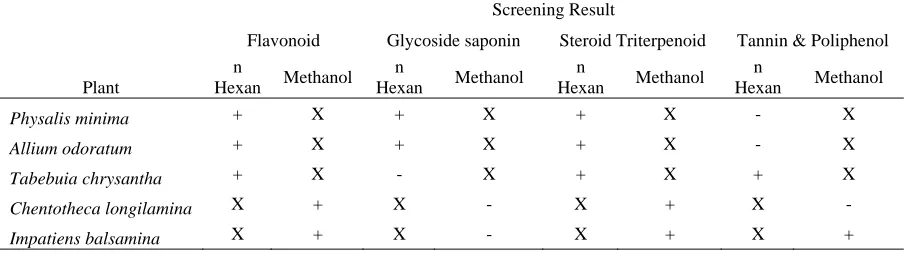
Table 2. Result from phytochemical screening from plant bioactive substances
Plant
Screening Result
Flavonoid Glycoside saponin Steroid Triterpenoid Tannin & Poliphenol n
According to Table 2, there are shows that for Physalis minima and Allium odoratum n-Hexane extract. Its bioactive compound which has cytotoxicity effect has flavonoid, saponin glycoside, and steroid triterpen content. Chentotheca longilamina and Impatiens balsamina both has Saponin Glycoside and Steroid triterpen content but plus Tannin & polyphenol in I.
balsamina. Also in Tabebuia chrysantha look has flavonoid, steroid triterpenoid and tannin &
polyphenol.
All plant above has steroid/triterpenoid substances (Table 2). This maybe the main factor for that plants has cytotoxic activity and potential as anti cancer agents. Thoppil and Bhisayee (2011) mention that terpenoid has potential as chemopreventive and therapeutic for cancer. Former identified terpenoid such as Geraniol and Limonene are stated has anti cancer activity. Geraniol, an acyclic dietary monoterpene, represents the only monoterpene that has been studied in vitro against liver cancer cells. Geraniol was shown to inhibit the growth of HepG2 human hepatic carcinoma cells by decreasing 3-hydroxymethylglutaryl coenzyme A (HMG-CoA) reductase, the major rate-limiting enzyme in cholesterol biosynthesis in mammals (Thoppil and Bhisayee, 2011).
4
resistance or a combination of these mechanisms. Based on these results, flavonoids may be promising anticancer agents.
4. Conclusion
Based on this reseach, it can be conclude that all the plants (Physalis minima, Allium
odoratum, Tabebuia chrysantha, Chentotecha longilamina, Impatiens balsamina) has
cytotoxic activity and potential to become anti cancer agent. From these plant also know triterpenoid and flavonoid can be the main substance which has the cytotoxic activity and potential as anticancer agent. Based on this research there are good chanche for researchers to continue this topic deeper. Analyzing and puryfing the bioactive compound and testing it to human cell line in vitro and propably testing it invivo and step forward with clinical trial if necesarry.
5. Acknowledgement
We thank to Prof. Sukardiman, Apt, MS from Department of Natural Resources, Faculty of Pharmacy, Airlangga University for the guidance and providing several needs for this research.
6. Reference
1. Dalimartha, Setiawan, 2004. Ramuan Tradisional Untuk Pengobatan Kanker, Penebar Swadaya, Jakarta.
2. Mangan, Yellia., 2009. Solusi Sehat Mencegah dan Mengatasi Kanker. Cetakan ke-1, Jakarta : Penerbit Agromedia Pustaka, hal 1-36.
3. Meyer, B.N., Ferrigni, N.R., Putnam, J.E., Jacobsey, L.B., Nichols, D.E. and
McLaughlin, J.L. (1982). Brine Shrimp: A convenient general bioassay for active plant constituents. Planta Medica 45:31 – 34.
4. Mclaughlin, J. L., And L. L. Rogers. 1998, The Use Of Biological Assays To Evaluate Botanicals Drug Information Journal, Vol. 32, pp. 513–524,Nafrialdi dan Sulistia,G., Antikanker, Farmakologi dan Terapi, Edisi 5, Jakarta: Bagian Farmakologi Fakultas Kedokteran Universitas Indonesia, hal. 732-733.
5. Roslin J Thoppil, Anupam Bishayee 2011. Terpenoids as potential chemopreventive and therapeutic agents in liver cancer World J Hepatol 2011 September 27; 3(9): 228- 6. Ren, W., Zhenhua Qiao, Hongwei Wang, Lei Zhu, Li Zhang 2003. Flavonoids: