Digital
Resources
Electronic Working Paper 2018-001
Coordination and
Subordination in Sandawe
Clauses
Coordination and Subordination in Sandawe Clauses
Helen Eaton
SIL International
®2018
SIL Electronic Working Papers 2018-001, September 2018 © 2018 SIL International®
All rights reserved
Data and materials collected by researchers in an era before documentation of permission was standardized may be included in this publication. SIL makes diligent efforts to identify and acknowledge sources and to obtain
2
Abstract
Sandawe (Tanzania) exhibits numerous different clause linkage strategies. Categorising these strategies according to the traditional distinction between coordination and subordination is challenging as Sandawe has an atypical system of marking the subject and TAM of a clause. Furthermore, as discussed in Haiman and Thompson (1984), the concept of ‘subordination’ in clause linkage is itself problematic and needs to be rigorously defined in order to be useful and consistently applicable cross-linguistically.
3
Contents
Abstract 2
Contents 3
Abbreviations 4
1. Introduction 5
2. The structure of the clause in Sandawe 6 3. A formal typology of Sandawe clause linkage 9 3.1 Conjunctions which are marked in agreement with the clausal subject 10 3.2 Narrative connective a 12 3.3 Connective nĩ or -~ 14 3.4 Freestanding conjunctions not marked in agreement with the clausal subject 17 3.5 Temporal subordinate clause hi … i’ 18
3.6 Locative -si’ 19
3.7 Non-embedded subordinate constructions marked by nominalisers 20
3.8 Complement clauses 21
4. Conclusion 22
Appendix: Orthography 24
4
3FSG third person feminine singular
3IPL third person inanimate plural
3MSG third person masculine singular
3PL third person plural
RPC realis pronominal clitic SBJ subject
SC subjunctive conjunction SF subject focus
SG singular SP specific
SPC subjunctive pronominal clitic SUB.CL subordinate clause
5
1. Introduction
In their review of the history of clause typology, Gast and Diessel (2012:4) recognise three major factors in the traditional analysis of clause combining: (i) the relation of dependency holding between the clause and the attachment site; (ii) properties of the attachment site; (iii) properties of the attached clause. The first of these factors concerns the contrast between coordination and subordination. Coordination is marked by the absence of dependency and subordination by its presence. Gast and Diessel (ibid.:5) suggest the notion of ‘dependency’ can be interpreted in different ways. A clause is syntactically
independent if it may ‘stand by itself,’semantically independent if it can be fully interpreted by itself and
prosodically independent if it forms an intonational phrase by itself. A clause is therefore dependent if it lacks one or more of these properties and must depend on another constituent in order to be
syntactically, semantically or prosodically well-formed. Dependent clauses may differ in the type of dependency which they exhibit and also in the extent of that dependency. The distinction between independent and dependent clauses, and thus between coordination and subordination in complex sentences, is therefore not a simple one.
Dixon (2006:3) divides the ways in which clauses can form complex sentences into three basic syntactic types: (i) coordinate and non-embedded subordinate constructions; (ii) relative clauses; and (iii) complement clauses. Type (i) thus includes a range of constructions, both coordinate and
subordinate, whereas types (ii) and (iii) are both embedded subordinate constructions. This approach separates the clearly dependent constructions, namely, relative clauses and complement clauses, from those constructions where the issue of dependency is more complex. As will be seen in §3, applying this three-way distinction to Sandawe leaves a large group of formally and functionally disparate
constructions categorised as type (i).
Parametric approaches to dependency and subordination, such as Haiman and Thompson (1984) and Lehmann (1988), provide a way to view the distinction between coordination and subordination as a gradual one and better capture the complexity of the phenomena. Haiman and Thompson (1984:511) propose seven independent formal properties which are relevant in judging whether a clause is
‘subordinate’:
1. Identity between the two clauses of subject, tense, or mood 2. Reduction of one of the clauses
3. Grammatically signalled incorporation of one of the clauses 4. Intonational linking between the two clauses
5. One clause is within the scope of the other
6. Absence of tense iconicity between the two clauses 7. Identity between the two clauses of speech act perspective
Haiman and Thompson show that although these seven properties correlate to some extent, they can be independently defined in a way which facilitates cross-linguistic application.
A similarly composite approach to clause linkage typology is put forward by Lehmann (1988). He proposes three dimensions along which linked clauses may differ. Each dimension comprises a pair of sub-parameters relating, as shown below:
1. Autonomy vs. integration
(i) The hierarchical downgrading of the subordinate clause (ii) The main clause syntactic level of the subordinate clause
2. Expansion vs. reduction
6 3. Isolation vs. linkage
(i) The interlacing of the two clauses (ii) The explicitness of the linking
There is overlap between the approaches put forward by Haiman and Thompson (1984) and by Lehmann (1988), as will be seen in section 3 when the Sandawe data is viewed in the light of these typologies. A fundamental similarity between the two approaches is that both propose formal rather than functional parameters. The semantic or discourse relationships between clauses are not considered.
One typological approach to clause linkage which does consider semantic criteria is found in Dixon (2009). Here a general set of semantic relations between clauses is proposed for clauses which are combined in ways other than through relative clause and complement clause constructions, i.e. the group of coordinate and non-embedded subordinate constructions, as categorised by Dixon (2006:3). Six main semantic types of clause linkage are proposed: Temporal, Consequence, Possible Consequence, Addition, Alternatives, and Manner (Dixon 2009:2). While this paper does not attempt to categorise all the Sandawe phenomena according to this semantic typology, some reference is made to semantic types of clause linkage where it helps to characterise the formal types identified.
The main data corpus for this study comprises 46 narrative texts written by Sandawe authors and later edited for orthographic accuracy and punctuation.1 In addition some examples from translated texts
are included to demonstrate less common clause linkage types and some simple elicited sentences are used in section 2 to illustrate the properties of the basic clause in Sandawe.2
The genealogical classification of Sandawe remains a question for investigation. Güldemann notes that the language ‘bears typological resemblance to the Khoisan languages of the Kalahari Basin area, more specifically to the Khoe-Kwadi family,’ but considers the language an ‘isolated or at least unclassified language’ (2014:26).
2. The structure of the clause in Sandawe
Unmarked constituent order for the clause in Sandawe is SOV, but all other permutations of these three constituents are possible, given appropriate discourse conditions (Kagaya 1990, Eaton 2010b). This constituent order flexibility means that the subject is usually identified through morphology. The
morphemes which function as identifiers of the subject also mark the mood and polarity properties of the clause. For affirmative realis clauses, the relevant morphemes are the realis pronominal clitic3 (RPC, see
table 1) and the subject focus marker (SF) aa. The RPC indicates the person, gender and number of the clausal subject and may be attached to one or more non-subject clause constituents, whereas the SF marker may be attached to the subject itself.
1 Some of these texts and additional ones can be viewed at www.sandawelanguage.com. All texts are used here with
permission from the authors. A brief description of the Sandawe orthography is contained in the Appendix.
2 Examples from non-translated texts are identified by the name of the text and the sentence number. Examples from translated texts and elicited examples are those without such an identification.
3Elderkin (1989:25) terms this morpheme a ‘suffixed subject PGN [person gender number] morpheme,’ following
7 Table 1. Realis pronominal clitics
Realis pronominal clitic 1SG si
2SG i 3MSG a 3FSG sa 1PL o 2PL e 3PL a’
Examples (1–4) illustrate four of the possible combinations of RPC and SF use in a clause. In (1) the adverb has a RPC, in (2) the subject has a SF marker, in (3) the subject has a SF marker and the adverb has a RPC, and in (4) the verb has a RPC.
(1) Uri=sa4 meenats’i.
very=3FSG.RPC be.happy
‘She is/was very happy.’
(2) Tametchũ-su=aa meenats’i.
woman.SP5-3FSG=SF be.happy
‘The woman is/was happy.’
(4) Tametchũ-su meenats’i=sa.
woman.SP-3FSG be.happy=3FSG.RPC
‘The woman is/was happy.’
The choice of which of these morphemes to employ and in which position, as with the choice of constituent order, depends largely on the information structure of the clause (Elderkin 1994, Eaton 2010b).
Combinations of RPC and SF placement other than those shown in (1) are possible, depending on the constituent order of the clause (Elderkin, 1989:106, Kagaya 1990:3–5, Eaton 2010b:8). The restrictions which are placed on this variation concern the position of the verb in relation to the other clause constituents. Namely, a verb which does not carry a RPC must not precede the first RPC or SF marker of a clause and a verb which does carry a RPC must not be preceded by a constituent bearing a RPC or SF marker within the clause.
Negative realis clauses and both affirmative and negative irrealis clauses require the verb to be suffixed with the appropriate morpheme(s) to signal mood and polarity in agreement with the clausal subject (table 2).
4 Morphemes which are particularly relevant to the discussion are shown in boldface.
5 The specificity morpheme in Sandawe carries a floating low tone and is realised as nasalisation on the word-final
vowel, shown orthographically as -~. This morpheme is obligatorily followed by a suffix indicating the person,
gender and number of the referent (which is zero in the case of third person masculine singular referents).
(3) Tametchũ-su=aa uri=sa meenats’i.
woman.SP-3FSG=SF very=3FSG.RPC be.happy
8 Table 2. Realis and irrealis verb suffixes
Negative realis Affirmative irrealis Negative irrealis 1SG -tchee -si -si-ts’e
2SG -bpoo -bpo -bpo-ts’e 3MSG -tchee -i -i-ts’e 3FSG -tchu -su -su-ts’e 1PL -tchũ -sũ / -sa -sũ-ts’e 2PL -tchĩ -sĩ -sĩ-ts’e 3PL -tchoo -so -so-ts’e
These clause types are exemplified below. The negative realis clause is illustrated in (5), the affirmative realis in (6) and the negative irrealis in (7).
(5) K’o=gki q’oowe-tchũ. fruit=ADD get.3MSG.OBJ-NEG.1PL
‘We did not get fruit at all.’
(6) Qwaa tchia=na ni’-so.
place all=to go.PL.SBJ-IRR.3PL
‘They will go everywhere.’ (7) Tci mana-a-si-ts’e.
I know-3MSG.OBJ-IRR.1SG-NEG
‘I do not know it.’
Subjunctive and imperative clauses contain one or more of a series of pronominal clitics (table 3) with a similar distribution pattern to that of the RPC and may also contain a SF marker (Eaton
2010a:151–154).
Table 3. Subjunctive pronominal clitics
Subjunctive pronominal clitics 1SG e’
2SG gko / gkwaa 3MSG gkwa / khia 3FSG khisa 1PL o’ 2PL gkwe
3PL gkwa’a / khi’a’
Examples (8–9) illustrate two possible placements of this series of clitics in single clauses. In (8) the clitic attaches to the adverb and in (9) it attaches to the object.
(9) Koõ=khisa cheeme.
house.SP=3F.SG.SPC sweep.3MSG.OBJ
‘She should sweep the house.’
(8) Doolo=gko c’inke!
slowly=2SG.SPC chew
9
The variation allowed in the placement of the two sets of pronominal clitics (realis affirmative and imperative/subjunctive) and the SF marker in simple sentences extends also to complex sentences, but with some differences, as will be seen in §3.3. The restrictions on this variation are particularly helpful in determining the clause boundaries in complex sentences.
3. A formal typology of Sandawe clause linkage
The data corpus provides examples of complex sentences which can be grouped into the following nine types according to how to the clauses are linked:
1. Conjunctions which are marked in agreement with the clausal subject 2. Narrative connective a
3. Connective nĩ or -~
4. Freestanding conjunctions not marked in agreement with the clausal subject 5. Temporal subordinate clause hi- -i’
6. Locative -si’
7. Non-embedded subordinate constructions marked by nominalisers 8. Complement clauses
9. Relative clauses
Using the three-way division proposed by Dixon (2006), the first seven types listed all fall into the first category of ‘coordinate and non-embedded subordinate constructions,’ while type 9 corresponds to the second category and type 8 to the third. The following subsections consider the first eight types in turn in the light of Haiman and Thompson (1984) and Lehmann (1988) in order to determine where the clause linkage falls on the continuum between coordination and subordination. Relative clauses are not included in the discussion as they are a means of noun phrase modification rather than one of clause linkage.
In addition to the nine types given above, the text corpus contains some examples of complex sentences created by the juxtaposition of intonationally-linked clauses, with no explicit linking mechanism, as in (10), in which the three clauses (a), (b) and (c) are juxtaposed.
(10) a. Koõ nqoo-we-gkwe-tchoo,
house.SP open-3MSG.OBJ-BEN.3MSG.OBJ-NEG.3PL
‘They didn’t open the house for him,
c. baʼe=a ura.
be.big=3MSG.RPC very.3MSG.RPC it was very big.’ (Dik-dik and Hyena 29)
Examples of this type occur rarely. The clauses involved are always independent and tend to have different subjects and be of different types or modality.
10
3.1 Conjunctions which are marked in agreement with the clausal subject
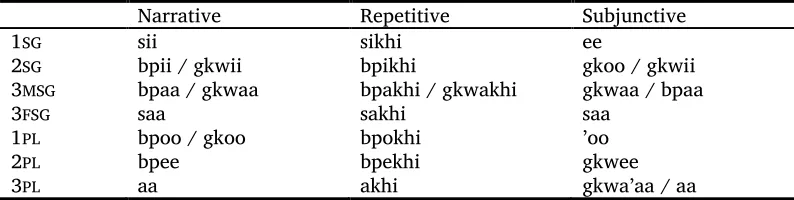
Sandawe clauses can be combined by means of freestanding conjunctions which agree with the subject of the clause. There are three sets: Narrative (glossed as NC), Repetitive (RC) and Subjunctive (SC),
as shown in table 4.
Table 4. Conjunctions marked in agreement with the clausal subject
Narrative Repetitive Subjunctive
1SG sii sikhi ee
Example (11) contains two instances of the Narrative Conjunction. In clause (a), the third person plural Narrative Conjunction aa is sentence-initial and the only means of identifying the subject in this clause. In clause (b) the third person feminine singular Narrative Conjunction saa has the dual function of signalling the switch in subject and linking this clause to the previous one.
(11) a. Aa nee-wa=yoo, 3PL.NC live.PL.SBJ-PLUR=DUR
‘Then they lived for a while
b. saa ncumsũ-su=aa tlʼabisoo=sa qʼoo-we. 3FSG.NC wife.SP-3FSG=SF stomach=3FSG.RPC get-3MSG.OBJ
and the wife became pregnant.’ (Man and Wife 02)
In (b) the subject is also indicated by the RPC on the object tl’abisoo‘stomach’ and by the Subject Focus marker on the subject itself, ncumsũsu‘wife’. In neither clause does the verb carry an RPC and for it to do so would render the clause ungrammatical. As noted in §2, a verb which does not carry a RPC must be preceded by a constituent bearing a RPC or SF marker within the clause. In (b) this rule is clearly followed as the unmarked verb is preceded by both a subject bearing the SF marker and an object bearing a RPC, but as clause (a) contains only the conjunction and the unmarked verb, it follows that the conjunction must be marked with a RPC, even though this is not immediately apparent in the surface form. Elderkin (1989:109–110) posits that each narrative conjunction contains a conjunction morpheme /pu/ and a RPC, plus possibly the SF marker in the form /-ː́/.
Repetitive Conjunctions relate to clause structure and subject marking in realis clauses in the same way as described above for Narrative Conjunctions, but show that the situation described by the clause is either repeated on a specific occasion or happening habitually (Eaton 2015:68, 70).
11
Note that both NCs and SCs may be followed by a bare verb only, as in clause (b), and thus for those conjunctions which can function as either a NC or a SC (see table 4), it may not be clear from the morphology of the clause how it is to be interpreted. However, the tonal properties of the verb differ, depending on which conjunction is contained in the clause (Eaton 2010a:97–98).
When a clause containing a NC or SC has an irrealis verb, the construction as a whole conveys purposive meaning, as in clause (b) of (13).
(13) a. Tci=gki tci - ncemesee haqaa-si,
I=ADD [I - person]6 call.3MSG.OBJ-IRR.1SG
‘And I will call my person b. bpaa ci-i.
3MSG.NC come-IRR.3MSG
so that he can come.’ (Pigeon and Frog 16)
The (b) clauses in (11–13) differ with respect to modality, but share the properties which are relevant to the coordination-subordination continuum, if we consider the parameters suggested by Haiman and Thompson (1984) and Lehmann (1988). Both approaches place clauses in Sandawe linked by subject-marked conjunctions at the coordination end of the continuum. Of Haiman and Thompson’s seven properties of main-subordinate clause combinations, only one, that of intonational linking between the clauses, is attested in the Sandawe examples. If we apply Lehmann’s six parameters, we see that the Sandawe clauses in question involve no hierarchical downgrading and are integrated at the text level (as independent clauses). This locates them at the Autonomy end of the Autonomy vs. Integration
dimension. With respect to the Expansion vs. Reduction dimension, there is no desentialisation associated with subordinate clauses and no grammaticalisation of the main verb associated with main clauses. In terms of Isolation vs. Linkage, the two clauses in Sandawe may be interlaced by identity of subject or modality, but need not be, and are explicitly linked through the presence of the conjunction (and through intonation).
There is one special case of using subject-marked conjunctions to link Sandawe clauses which merits a closer look. In the examples considered so far, the conjunction is clause-initial, but this is not required. The conjunction may instead follow a topicalised subject (Eaton 2010b:22), as seen in (16a). In such a case there is no difference in the clausal relationship from that described above and the semantic relation between the clauses remains one of temporal succession (Dixon 2009:9). However, another possibility is that the conjunction occurs clause-finally and this arrangement of clauses then partly deviates from the properties given above. In (14) and (15) below both (b) clauses contain clause-final subject-marked conjunctions. In (14b) this conjunction is a Narrative Conjunction and in (15b) it is a Subjunctive Conjunction.
b. ware dte – minda’ mantchaa bpoo.
[friend other - field].3PL.RPC eat.3MSG.OBJ 1PL.NC
because they had eaten another friend’s field.’ (Hunting 01)
6 Square brackets in the gloss indicate a genitive relationship between two nouns, which is realised as a tonal process
in speech (Hunziker, Hunziker and Eaton 2008:51–54) and represented in the orthography by hyphenation (here with a space either side of the hyphen to distinguish it from hyphenation used for segmentable morphemes).
(14) a. Nqe tsʼekhe gkeudto - qʼinoo=noo niʼ, day one [pig - hunt].NMLZ=to.1PL.RPC go.PL.SBJ
12 b. ke’e-so gkoo.
hear-IRR.3PL 2SG.SC
otherwise they will hear.’ (Hare and Jackal 16)
The NC used in this way expresses a causal relationship and the SC a relationship of possible consequence (Dixon 2009:23). What is remarkable about both uses is that the subject marking of the conjunction which comes at the end of the second clause is in agreement with the subject of the first clause, rather than with that of the second. Clause (b) in both examples would be a well-formed independent clause if the conjunction were omitted, but the presence of the conjunction necessitates a preceding clause with a subject with appropriate agreement properties.
This special use of subject-marked conjunctions in Sandawe is an instance of Haiman and
Thompson’s third property of subordinate clauses, that of grammatically signalled incorporation. They define this property as ‘incorporation of one clause within another where this incorporation is signalled by material of one clause surrounding another or by grammatical morphology marking one clause as being a grammatical part of another’ (1984:514). In terms of Lehmann (1988), clause (b) in the Sandawe examples is hierarchically downgraded to the status of an adjoined clause which is integrated at the sentence level.
3.2 Narrative connective a
The second clause linkage strategy in Sandawe to be considered here is the Narrative Connective clitic a
(glossed as CONN). This morpheme attaches to a verb and joins two clauses with the same subject.
(16) a. Tekeleẽ bpaa hik’i=yoo=a, Hyena.SP 3MSG.NC go=DUR=CONN
‘Then Hyena went and
b. Chiia - koots’a nxee. [Dik-dik - house]=at.3MSG.RPC arrive
arrived at Dik-dik’s house.’ (Dik-dik and Hyena 64)
The Narrative Connective is restricted in its occurrence to realis clauses containing a Narrative or Repetitive Conjunction or the conjunction heweʼga‘therefore, and so’, which always carries a RPC and therefore is a type of subject-marked conjunction, like the NC and RC.
The clause containing the Narrative Connective and the clause which follows it are not of equal syntactic status in terms of dependency. The clause containing the Narrative Connective must be well-formed in terms of the distribution of subject marking morphemes (RPCs and the SF marker), whereas the following clause need not be. Thus (16a) is a well-formed simple sentence if the Narrative
Connective is removed. (16b) happens also to be well-formed, as the Postpositional Phrase ‘Dik-dik’s
house’ is followed by a RPC. However, it is possible for the second clause to violate the RPC and SF distribution rules, as given in §2, if we apply these rules to the clause in isolation. This can be seen in (17b), which would be ungrammatical if it did not follow clause (a) as the verb in (b) does not carry a RPC and precedes a object marked with a RPC.
13 b. mantcha-gku-’ĩ hesu - nxoogkõ-so=sa.
eat-CAUS-3PL.OBJ [she - children.SP-3PL]=3FSG.RPC
fed her children.’ (Dik-dik and Hyena 20)
This is also clear from examples in which only a single verb follows the Narrative Connective, as in (18).
Thus for the purposes of applying the subject marking rules, the second clause is counted together with the first clause. Subject marking morphemes in the first clause affect what is grammatical in the second clause.
A less literal translation of (18) would be ‘Then he made it for him again.’ In formal terms, (18) can be categorised along with (16) and (17), but semantically it shows parallels with Serial Verb
Constructions, in which ‘the verbs in the construction all refer to sub-parts or aspects of a single overall event’ (Lord 1974:196–7). In a looser sense, a similar description could be applied to (16), in which the going and arriving are distinct, but linked events (see also the discussion of (24) in §3.3). The entering and feeding events of (17) are less closely linked, but the verbs do share the same subject and the events necessarily occur sequentially. In semantic terms therefore, the Narrative Connective covers a range of functions, from conveying temporally successive distinct events (with the same grammatical subject) to expressing the different aspects of a single event. At the former end of this range, there is overlap with clause linkage by Narrative Conjunction alone, as described in §3.1, but the text corpus shows a clear preference for clauses with identity of subject to be linked by the Narrative Connective rather than by the conjunction alone.
In formal terms, the Narrative Connective construction does not resemble the prototypical Serial Verb Construction as it includes an explicit connective in the form of the clitic a. The construction is also not monoclausal and there is no restriction on other constituents intervening between the verbs, as is clear from (16). In terms of the formal properties of Haiman and Thompson (1984), the construction in question is further along the continuum towards subordination in comparison with clauses joined by the Narrative Conjunction alone as there must be identity of subject and modality between the two clauses and the second clause may be reduced, as discussed in relation to (17b) and (18b).
With respect to the Autonomy vs. Integration dimension of Lehmann (1988), clauses joined by the Narrative Connective do not show hierarchical downgrading, but the joining takes place at a lower syntactic level (as evidenced by the requirement that they share a subject and by the way in which the subject marking rules extend across both clauses) in comparison with clauses joined by a Narrative Conjunction. A further difference between the two strategies is that interlacing by identity of subject and modality is obligatory when the Narrative Connective is present rather than optional.
The data corpus shows that the Narrative Connective typically attaches to the first of two linked verbs, but it is possible for it to attach to the second instead.
(19) a. Swe bpaa beeba=a xwa-ts’a, now 3MSG.NC nearby=3MSG.NC hide-REFL.CONN
14 b. dara ie=a heso - ioõ-su=ts’a
wait stay=CONN [they - mother.SP-3FSG]=at.3MSG.RPC
stayed waiting for their mother.’ (Dik-dik and Hyena 12)
(19) contains two Narrative Connective morphemes. The first occurs in the typical position at the end of the clause (a) and links it to what follows. The second morpheme is on the third rather than the
second of the sentence’s three verbs and links it to the preceding verb. This unusual order (A B=CONN) expresses the simultaneity of the situations conveyed by the verbs, in contrast with the sequentiality of the usual order (A=CONN B). Thus in (19) there are two sequential events: hiding and then ‘ waiting-staying.’ When the A B=CONN construction is used with a verb meaning ‘stay,’ as in (19), the resulting verb conjunction conveys progressive aspect and, like example (18), the construction functions in a similar way to a Serial Verb Construction. This verb conjunction in which the second of two verbs carries the linking morpheme is similar to a construction using a different connective morpheme, as will be seen in (25) in §3.3.
The order A B=CONN shows an absence of tense iconicity which Haiman and Thompson (1984:519) posit as one of the composite factors in subordination. That is, the order of the clauses does not
correspond to the order of events. In contrast, the more common order A=CONN B does show tense iconicity.
3.3 Connective nĩ or -~
As noted in §3.2, the Narrative Connective only occurs in realis clauses containing a Narrative or Repetitive Conjunction or the conjunction heweʼga‘therefore, and so’. In other clause types the functions fulfilled by the Narrative Connective are instead achieved through the use of the freestanding
conjunction nĩ or the Connective morpheme -~ (which is realised as a floating high tone and nasalisation on the word-final vowel of the verb to which it attaches and is glossed as &).7 In (20), for example, the
lack of subject-marked conjunction in (a) means that the Narrative Connective cannot be used to link (a) and (b). Instead the conjunction nĩ is employed.
(20) a. Xoo=ts’i ncĩ=si qʼoowe
The conjunction commonly occurs in its reduced form, as in (21).
(21) a. Tlʼeseegkõ
-~, including in joining non-clausal
15
This example can be compared with (18) in §3.2, in which the same two verbs are joined by the Narrative Connective morpheme a. As with that example, a more natural English translation would use only one verb. (21) could be translated ‘Make it again for me!’, as the two verbs refer to the same overall event. It is very common for verbs joined by -~ to convey different semantic components of a single event in this way. Often one of the verbs contributes an aspectual meaning, as in the following elicited examples.
(22) Ta=sã tlemse. run=3FSG.RPC.& finish
‘She has finished running.’ (Lit. ‘She ran and finished.’)
(23) Ie=sã ta stay=3FSG.RPC.& run
‘She is/has been running.’ (Lit. ‘She stayed and ran.’)
In (22) tlemse‘finish’ conveys perfective aspect and in (23) ie‘stay’ conveys imperfective aspect. The semantic reduction of ie‘stay’ in this construction is evident as it clearly no longer conveys the meaning of remaining in a particular place when linked to ta‘run’.8 In formal terms, there is no grammatical
asymmetry between the verb functioning as an auxiliary and the verb providing the lexical content. The formal properties of the construction depend on which verb bears the connective morpheme rather than on the nature of the semantic content contributed by the verbs.
Another common use of this construction is to express motion to or from the deictic centre. This is seen in (24a), in which ni’‘go’ shows that the location of the bush is away from the starting location of the first person narrator.
(24) a. Hi=o niʼĩ nce=dta=noo nxee=iʼ,
when=1PL.RPC go.PL.SBJ.& bush=in=to.1PL.RPC arrive=SUB.CL
‘When we arrived (lit. ‘went and arrived’) in the bush,
b. gkoo gkeudto - mogkondõ=go caʼwaa. 1PL.NC [pig - track.SP]=1PL.RPC see.3IPL.OBJ
we saw pig tracks.’ (Hunting 02)
See also (28) below, in which ncadti‘come’ expresses movement towards the deictic centre. The freestanding conjunction nĩ illustrated in (20) does not tend to occur when the verbs being joined express different facets of a single event, rather than distinct, individual events. However, it is not the case that the freestanding conjunction must be present in order to mark the verbs being joined as expressing distinct events. In (25) the verb habpumse‘think you’ (which is derived from the pronoun
habpu‘you (sg.)’ by the desiderative morpheme -mse) in (c) is joined to nqoowegkwe‘open for him’ in (b) by means of the morpheme -~. These two verbs represent distinct events.
(25) a. Tekelee=aa ci, hyena=SF come
‘Hyena came,
8 Kilian-Hatz (2006) documents some functionally very similar phenomena in Khwe (Central Khoisan), which she
16 b. bpoo koõ=go9 nqoowe-gkwe
1PL.NC house.SP =1PL.RPC open.3MSG.OBJ-BEN.3MSG.OBJ
and we opened the house for him,
c. habpu-msẽ,
and so then he swallowed the brothers.’ (Dik-dik and Hyena 80)
Note also that here we have another example of the linking morpheme for two verbs being found on the second of the two verbs, as was seen in (19) in §3.2. As in that case, this order expresses the
simultaneity of the events, rather than the sequentiality associated with the usual order (as first documented by Elderkin 1989:140).
In functional terms, the Narrative Connective discussed in §3.2 and the Connective morpheme considered in this section cover the same range of uses. The important differences are that the
distribution of the former is restricted to certain clause types and that the latter is more commonly used to join verbs which express the different semantic components of a single event. In formal terms, the two clause linkage strategies are also very similar. For example, one of the linked clauses may be dependent on the other for its subject and modality marking and there is a lack of tense iconicity between the clauses when the connective morpheme attaches to the second rather than the first verb.
An important formal difference beween the Narrative Connective a and the freestanding conjunction
nĩ is that the latter does not require the clauses which it links to have the same subject, whereas the former does. Therefore in terms of the Autonomy vs. Integration dimension of Lehmann (1988), a case can be made for clause conjunction using nĩ occurring at a higher syntactic level than clause conjunction through the Narrative Connective a.
The way in which -~ is used to join verbs perhaps resembles a Serial Verb Construction more closely than the use of the Narrative Connective -a does because the connective morpheme has been reduced to a non-segmental form (floating nasalisation and high tone). The construction can therefore be analysed as being further along a grammaticalisation path towards categorisation as a SVC.
The distribution rules for subject-marking morphemes, as described in §2, apply to constructions in which the verbs are joined by -~, but with the exception that both verbs can be marked with a RPC as long as it is the second which carries the connective morpheme.
(26) Ta=sa ie=sã
(27) represents the pattern we might expect as it mirrors what we have already seen in relation to the Narrative Connective. That is, what follows the connective morpheme need not be well-formed in isolation in terms of subject marking, but is counted together with the preceding clause. Therefore a verb
17
following the connective morpheme does not carry a RPC since one or more constituents preceding the connective must be subject-marked.
The grammaticality of the pattern represented by (26) suggests that there is a clause boundary between the two verbs, or at least a boundary in the domain of the subject-marking morpheme
distribution rules. The first verb plus the RPC is a complete, well-formed clause and is not immediately followed by any form of connective. It is interesting to note that [A-~ B]=RPC is not a grammatical
construction. That is, the connective cannot be analysed as creating a compound verb which is then treated as a single constituent for subject-marking purposes.
Irrealis verbs behave differently in this respect. In irrealis clauses, subject and modality marking is always and only found on the verb. When two or more verbs are joined together by -~, it is the last verb which must carry the inflectional morphemes.
(28) a. Heeso gkiso-sõ-so gkwamẽ
DEM.PROX.3PL two-3PL.SP-3PL drive.out.&
‘These two would drive out and b. habaʼsẽ
make.noise.& make noise and
c. ncadti-so. come-IRR.3PL
come.’ (‘These two would come driving out and making noise.’) (Hunting 05)
An example such as this bears some resemblance to clause chaining, in that only the last verb in a chain of clauses is inflected (Lehmann 1988:5), however the preceding verbs do not carry any special converb suffix to show they are part of a chain.
3.4 Freestanding conjunctions not marked in agreement with the clausal subject
In addition to the Narrative, Repetitive and Subjunctive Conjunction, which are marked in agreement with the clausal subject and cannot occur without this marking, Sandawe has a group of freestanding conjunctions which are either never subject-marked or which may be marked with a pronominal clitic in agreement with the subject according to the usual distribution rules. These conjunctions occur
infrequently in comparison with the subject-marked conjunctions. Three of the more commonly occurring conjunctions will be considered here as examples of this category: hewegkimee‘and so’, haa
‘but’ and khare‘or’.
(29) illustrates the joining of two independent clauses by the first of these conjunctions. (29) a. Swe beeba=na=si hedtegka,
now nearby=to=1SG.RPC marry
‘Now I have recently married,
hewegkimee belongs together with hewe’ga and hewets’i (see 25d) in being derived from the singular masculine referential demonstrative hewe by the addition of the postpositional morphemes gkimee
‘because’ or ts’i‘at’ (Eaton 2010a:106). In the case of hewe’ga, the postpositional morpheme ts’i occurs in
b. hewe=gkimee daa-si-ts’e ci=sa=ts’i.
DEM.REF.3MSG =because be.able-IRR.1SG-NEG come=NMLZ=at
18
a reduced form as a glottal stop and there is also a following declarative evidential ga. All three
conjunctions express a similar meaning, which can be glossed in English as ‘and so’, ‘for this reason’ or ‘therefore’.hewe’ga is a special case as it occurs in narrative clauses and is always marked with a RPC, as noted in §3.2.
In (30) haa‘but’ joins a narrative clause to a copular clause.
(30) a. Saa nxee,
3FSG.NC enter
‘She entered,
b. haa nxoogkõ tchee-’waa. but children.SP absent-3PL
but the children were not there.’ (Dik-dik and Hyena 75)
As in (29), the two clauses being linked by the conjunction are well-formed and independent. Example (31) illustrates disjunction through the use of khare‘or’, which here joins two interrogative
clauses.
(31) a. Haanga=ne=sa leave=INT=3FSG.RPC
‘Has she left
b. khare gkoo=su-su=ne? or present=POSS-3FSG=INT
or is she here?
This conjunction may also link phrases rather than clauses. In its clausal use, the clauses which it joins are independent.
3.5 Temporal subordinate clause hi … i’
Sandawe can show a relative time or conditional relation between two clauses by means of the temporal subordinate clause hi … i’. In this construction the conjunction hi‘when, if, after’ is obligatorily followed by a RPC in agreement with the subject in a realis clause or by the third person masculine RPC if the clause is not realis. The end of the subordinate clause is signalled by the clitic i’. (32a) is an example of a temporal subordinate clause which is marked as realis.
(32) a. Hi=sa hado’=dta=sa nxee=i’, when=3FSG.RPC compound=in=3FSG.RPC arrive=SUB.CL
‘When she (Pigeon) arrived in the compound,
c. bpaa xʼĩ=gaa tchou. 3MSG.NC fire.SP=SF go.out
and the fire went out.’ (Pigeon and Frog 06)
The temporal subordinate clause usually precedes the clause to which it is linked, but may instead follow it.
b. saa malakʼwa=a qʼawe, 3FSG.NC slip=CONN fall.SG.SBJ
19
The verb in a realis temporal subordinate clause never carries a RPC as the conjunction hi which precedes it must carry one. Intervening constituents may be marked with a Subject Focus morpheme or a RPC as appropriate, as the postpositional phrase is in (32a), or may be left unmarked. That is, the temporal subordinate clause follows the expected subject-marking morpheme distribution rules. If the clause is not affirmative realis, the verb must carry the usual inflectional morphemes for subject and modality marking. Thus the temporal subordinate clause is always finite.
It is common for there to be identity of subject and modality between the hi … i’ and the clause to which it is intonationally linked, as in (32a, b), but this is not necessary. In (33), there is a difference in subject between the two clauses and in (34) there is a difference in modality.
(33) a. Hi=a tlaasi=i’,
In terms of the clause linkage parameters of Lehmann (1988), the hi … i’ clause in Sandawe can be clearly identified as an adjoined clause. It contains a subordinative conjunction and must precede or follow a main clause, but is not embedded within that main clause. The hi … i’ clause is therefore adjoined at the sentence level. With respect to the desentialisation parameter, the hi … i’ clause in Sandawe is not reduced in terms of subject or modality marking. That is, it contains all that is necessary for a well-formed clause in these terms. However, it does not necessarily have the illocutionary force (Lehmann 1988:10–11) which the corresponding independent sentence would have and is in that sense subordinate. For example, clause (a) in (34) is not asserted, but if the subordinate clause morphemes are omitted, the clause does contain an assertion, as in (35).
(35) Xoo=ts’i=i mehẽ=gi cãgee. path=at=2SG.RPC something=2SG.RPC arrive
‘You saw something on the way.’
3.6 Locative -si’
A formally and functionally similar construction to the hi … i’ clause employs the locative morpheme -si’
in clause-final position.10 In (36a), the clause to which -si’ attaches comprises a subject and verb. The NP
which precedes this clause is the object of the clause which follows.
(36) a. Hewe lhaã, x’egkwaa tchee-gki=si’,
DEM.REF.3MSG goat.SP dowry=SF absent-VERB=LOC
‘This goat, when the dowry is finished,
10 This morpheme also has several functions which do not involve clause linkage (see Eaton 2010a:107–109).
b. aa tchindowaa. 3PL.NC bury.3MSG.OBJ
20 b. ncĩge-so.
eat.3MSG.OBJ-IRR.3PL
they will eat it.’ (Marriage 26)
On first glance, this appears to fit the criterion Haiman and Thompson (1984:513) put forward as evidence for grammatical incorporation. That is, one clause is surrounded by material from the other. However, there is an intonational break after the sentence-initial NP (shown by the comma) and the material which follows the -si’ clause is a complete, well-formed clause without the object NP.
In formal terms, the -si’ clause can be categorised, like the hi … i’ clause, as an adjoined clause. It is fully inflected for subject and modality, but lacks the illocutionary force which would be associated with the equivalent independent clause. In functional terms, the two clauses show overlap. With respect to semantics, both can be used to express a relative time or conditional relation, but text data suggests that the -si’ clause is more likely to express the former than the latter.
3.7 Non-embedded subordinate constructions marked by nominalisers
Sandawe uses nominalising morphemes to construct both non-embedded and embedded subordinate clauses. In both types, the first step is the nominalisation of the clause by the addition of an appropriate morpheme. Then in the case of non-embedded clauses, a postpositional morpheme is added in order to signal the relationship with the main clause. In the case of embedded clauses, the nominalised
consitituent is treated as a subject or object NP as appropriate, as will be seen in §3.8.
The nominalising morpheme most often used in non-embedded subordinate clauses is sa. In (37) sa
is followed by the postposition na‘to’. The nominalisation in this example is of the VP, comprising the verb mogkolaa‘greet’ and the object NP hewe-maamaã Naanale‘his friend Squirrel’.
(37) a. Hewe - maamaã Naanale [he - friend.SP] squirrel
b. mogkolaa=sa=na=a ci.
greet.3MSG.OBJ=NMLZ=to=3MSG.RPC come.SG.SBJ
‘He came to greet his friend Squirrel.’ (Squirrel and Tortoise 04)
An example of a single verb nominalised by sa and followed by the postposition ts’i‘at’ can be seen in (29b) in §3.4 and an example of a verb and object nominalised by oo and followed by the postposition
na‘to’ is found in (14a) in §3.4.
If the postposition gkimee‘because’ is employed, the choice of nominaliser which precedes it makes a difference to the meaning. (38) illustrates the nominaliser ’õand (39) the nominaliser sa. The situation expressed by the verb in the former is presented as already having taken place, whereas in the latter it is imminent.11
because the sun had gone down.’
11 The combination of sa plus gkimee may also express a desire for an action to take place and does not necessarily
21 b. hewe - nxowẽ tl’itee=sa=gkimee=a.
[he - child.3MSG.SP] slaughter=NMLZ=because=3MSG.RPC
in order to slaughter his son.’
The examples of this section have in common that the subordinate clause is not an argument of the main clause and therefore it is not embedded within it. However, the subordinate clauses are all
followed by the appropriate RPC in agreement with the subject of the main clause and are therefore clearly constituents of the main clause. In (37) the only RPC is found on the subordinate clause and therefore without it the main clause as it stands would simply be a bare verb and not well-formed in terms of subject and modality marking. In (38) and (39) there are other RPCs within the clause and therefore omitting the subordinate clause would leave a well-formed main clause (‘Then he waited there,’‘And so he took a knife’). In all the examples, the attachment of a RPC to the subordinate clause show that it has been grammatically incorporated into the main clause (Haiman and Thompson 1984:513).
An important difference between (38) on the one hand and (37) and (39) on the other is that the subordinate clause in the former example is finite, whereas in the latter examples it is non-finite. Removing the subordinate clause marking (the nominaliser ’õ plus the postposition gkimee) from (38a) leaves a well-formed finite clause with appropriate subject and modality marking (‘The sun went down’).
In (37) and (39) the subordinate clause has undergone reduction. In Haiman and Thompson’s terms, the
clause shows both ellipsis and opposition loss (1984:512). With respect to ellipsis, the subject is missing from the subordinate clause (and is understood to be the same subject as that of the main clause). With respect to opposition loss, there is no modality marking within the clause and therefore the verb is non-finite.
In structural terms, the use of the nominaliser ’õ in marking non-embedded subordinate clauses closely resembles the temporal subordinate clause hi … i’ described in §3.5. That is, it is a fully inflected adjoined clause, whose illocutionary force depends on the main clause.
3.8 Complement clauses
The clause linkage constructions discussed in the previous sections all fall into the category of coordinate and non-embedded subordinate clauses (Dixon 2006:3). In this section we turn to complement clauses, which are a type of embedded subordinate clause. The complement clause in Sandawe may be expressed in a very similar way to the finite subordinate clause discussed in example (38) in §3.7.
In both (40) and (38) a finite clause is nominalised by ’õ and becomes a subordinate part of the main clause. The difference is that here the nominalised clause (b) is not also marked with a
(39) a. Hewe’ga=a roogo=a si-e,
DEM.REF.3MSG=3MSG.RPC knife=3MSG.RPC take=3MSG.OBJ
‘And so he took a knife,
(40) a. Wayahudĩ-so mana=ʼa Jews.SP-IRR.3PL know=3PL.RPC
‘The Jews knew
b. Warangee Masiya kĩse-i=ʼõ.
God Messiah send-IRR.3MSG=NMLZ
22
postpositional morpheme and is therefore interpreted as the complement of the main verb. It is therefore of a different status in terms of the hierarchical downgrading parameter of Lehmann (1988:7) and can be classified as an embedded clause rather than an adjoined one. A further difference is that the subordinate clause of (40b) is on the VP level and therefore on a lower syntactic level than (38b).
An alternative complement clause construction in Sandawe makes use of the hearsay evidential gka’. In (41) and (42) gka’ links the main clause (a) to the complement clause (b).
As with the ’õ strategy, the complement clause is finite and independent, but the linkage marker precedes it rather than follows it. Both morphemes have additional functions. The nominaliser ’õ nominalises non-finite verbs and the hearsay marker gka’ introduces both direct and indirect speech as well a functioning as an evidential (Eaton 2010a:197).
4. Conclusion
The preceding sections have shown that Sandawe has a rich variety of clause types which range along the continuum from coordination to subordination. The composite approaches to characterising this continuum put forward by Haiman and Thompson (1984) and Lehmann (1988) are particularly helpful for Sandawe as it is a language which, due to its unusual subject and modality marking phenomena, does not easily fall into categories posited in more general terms.
Most complex sentences in Sandawe show explicit clause linkage. It is possible, but rare, to form complex sentences of intonationally-linked clauses through juxtaposition. Eight explicit clause linkage strategies were discussed in §3. Of these eight, the two most clearly and consistently found at the coordination end of the coordination-subordination continuum involve conjunctions which are marked in agreement with the clausal subject (§3.1) and freestanding conjunctions not so marked (§3.3). All uses of the latter and most uses of the former combine independent finite clauses. The former category also includes an unusual case in which the conjunction is placed at the end of a second clause to link it to the previous one and indicate a semantic relation of cause or possible consequence. In this case, the second clause is surrounded by material from the first and has in that sense become grammatically incorporated within it.
The conjunction nĩ occurs both as a freestanding conjunction and in a reduced form as the
23
The Narrative Connective a (§3.3) is similar to -~ in that the subject marking rules extend over both clauses. The requirement that the clauses have identity of subject and modality is another indication of subordination and again there is not always tense iconicity between the clause order and event order.
Two clearly subordinate clause types are the temporal subordinate clause hi … i’ (§3.5) and the locative si’ (§3.6). Both are finite clauses which depend syntactically on main clauses and do not necessarily have the illocutionary force which the equivalent main clauses would have. Neither clause type is embedded in the main clause, but is adjoined.
Sandawe makes use of nominalising morphemes in subordinate clause formation. Both non-embedded (§3.7) and non-embedded subordinate clauses (§3.8) employ such morphemes. Non-non-embedded subordinate clauses are then grammatically incorporated into the main clause by means of postpositional morphemes. Such clauses may be finite or non-finite, depending on the nominaliser used.
Complement clauses (§3.8) may be formed in a similar way to non-embedded finite clauses (by means of the nominaliser ’õ), but are then grammatically incorporated into the main clause as arguments rather than by means of postpositional morphemes. Alternatively the hearsay evidential gka’ may link a main clause to a complement clause.
The research presented here has focused on the formal properties of complex sentences in Sandawe. One direction for future research would be to consider the types identified in terms of the semantic relations which they express. Such an approach would perhaps shed light on the differences between constructions which are formally very similar, such as the hi… i’ and si’ clauses (§3.5, §3.6), or between different realisations of the same construction, such as the freestanding conjunction nĩ and the
morpheme -~ (§3.3). An approach which considered complex sentences in their discourse context (such as in Matthiessen and Thompson, 1988) would also help to further understand the variety of
24
Appendix: Orthography
Phoneme Grapheme Phoneme Grapheme Phoneme Grapheme Phoneme Grapheme
b b ʦʼ tsʼ ᶢǀ gc i i
p bp t͡ɫʼ tlʼ ǀ c u u
pʰ p kʼ kʼ ǀʰ ch e e
d d f f ǀʼ cʼ o o
t dt s s ⁿǀ nc a a
tʰ t ɬ lh ᶢǃ gq iː ii
ʤ dz x kh ǃ q uː uu
ʧ tc h h ǃʰ qh eː ee
ʧʰ tch m m ǃʼ qʼ oː oo
d͡ɮ dl n n ⁿǃ nq aː aa
t͡ɫ tl w w ᶢǁ gx ĩ ĩ
ɡ g ɾ r ǁ x ũ ũ
k gk j y ǁʰ xh ẽ ẽ
kʰ k l l ǁʼ xʼ õ õ
25
References
Dixon, R. M. W. 2006. Complement clauses and complementation strategies in typological perspective. In R. M. W. Dixon and Alexandra Y. Aikhenvald (eds), Complementation: A cross-linguistic typology, 1–48. Oxford: Oxford University Press.
Dixon, R. M. W. 2009. The semantics of clause linking in typological perspective. In R. M. W. Dixon and Alexandra Y. Aikhenvald (eds), The semantics of clause linking: A cross-linguistic typology, 1–55. Oxford: Oxford University Press.
Eaton, Helen. 2010a. A Sandawe grammar. SIL e-Books 20. Dallas, TX: SIL International.
Eaton, Helen. 2010b. Information structure marking in Sandawe texts. In Ines Fiedler and Anne Schwarz (eds), The expression of information structure. A documentation of its diversity across Africa, 1–34. Amsterdam: John Benjamins.
Eaton, Helen. 2015. Main event line structure and aspect in Sandawe narratives. In Doris L. Payne and Shahar Shirtz (eds), Beyond aspect. The expression of discourse functions in African lanɡuaɡes, 53–80. Amsterdam: John Benjamins.
Elderkin, Edward D. 1989. The significance and origin of the use of pitch in Sandawe. PhD dissertation. University of York.
Elderkin, Edward D. 1994. Sandawe verbal sentences. Paper presented at the Tutzing Conference on Khoisan Studies, July 11–14 1994.
Gast, Volker, and Holger Diessel. 2012. The typology of clause linkage: Status quo, challenges, prospects. In Volker Gast and Holger Diessel (eds), Clause linkage in cross-linguistic perspective: Data-driven approaches to cross-clausal syntax, 1–36. Berlin: Mouton de Gruyter.
Güldemann, Tom. 2014. ‘Khoisan’ linguistic classification today. In Tom Güldemann and Anna-Maria Fehn (eds), Beyond ‘Khoisan.’ Historical relations in the Kalahari Basin [Current Issues in Linguistic Theory 330], 1–41. Amsterdam: John Benjamins.
Hagman, Roy S. 1977. Nama Hottentot grammar. Bloomington: Research Center for Language and Semiotic Studies, Indiana University.
Haiman, John, and Sandra A. Thompson. 1984. ‘Subordination’ in Universal Grammar. Proceedings of the Tenth Annual Meeting of the Berkeley Linguistics Society: 510–523.
Hunziker, Daniel A., Elisabeth Hunziker, and Helen Eaton. 2008. A description of the phonology of the Sandawe language. SIL Electronic Working Papers 2008–004. Dallas, TX: SIL International.
Kagaya, Ryohei. 1990. Jiyū gojun gengo de no gojun seigen. Sandawe go no baai [Restriction on word order of free word order language – the case of the Sandawe language]. F. Ingham-Nagasawa (tran.), Journal of Asian and African Studies 40:1–12. Institute for the Study of Languages and Culture of Asia and Africa.
Kilian-Hatz, Christa. 2006. Serial verb constructions in Khwe (Central-Khoisan). In R. M. W. Dixon and Alexandra Y. Aikhenvald (eds), Serial verb constructions. A cross-linguistic typology, 108–123. Oxford: Oxford University Press.
Lehmann, Christian. 1988. Towards a typology of clause linkage. In John Haiman and Sandra A. Thompson (eds), Clause combining in grammar and discourse, 181–225. Amsterdam: John Benjamins. Web version, 1–33, http://www.christianlehmann.eu/publ/linkage.pdf. Accessed 5 February 2016. Lord, Carol. 1974. Causative constructions in Yoruba. Studies in African Linguistics (Supplement) 6:195–
26
Matthiessen, Christian, and Sandra A. Thompson. 1988. The structure of discourse and 'subordination’. In John Haiman and Sandra A. Thompson (eds), Clause combining in grammar and discourse, 275–329. Amsterdam: John Benjamins.