53
ICASH-A08
CHANGING COSMETIC BRANDS INCREASE RISK OF FREQUENCY
AND DEGREE OF ACNE VULGARIS IN FEMALE
UNDERGRADUATE STUDENTS
Annida P Maharani*, Witri Pratiwi, Donny Nauphar
Faculty of Medicine, Universitas Swadaya Gunung Jati, Cirebon, Indonesia
*Corresponding author’s email: [email protected]
ABSTRACT
Background: Acne vulgaris is a skin disease caused by chronic inflammation of the follicular
pilosebacea marked by the presence of blackheads, papules, pustules, nodules, and cysts in place of healthy skin. One of the risk factors for Acne vulgaris is changing cosmetic brands which may contain comedogenic and acnegenic ingredients. The aim of this study is to find out the relationship of changing cosmetic brands and the prevalence of Acne vulgaris in female undergraduates.
Methods: This was an observational study with cross sectional design. The subjects were 344 female
undergraduates who used two out of four types of cosmetics, recruited by total sampling. Data were analyzed to see the relationship of changing cosmetic brands with the degree and the frequency of acne.
Results: Based on Spearman correlation test, changing cosmetic brands has a strong positive
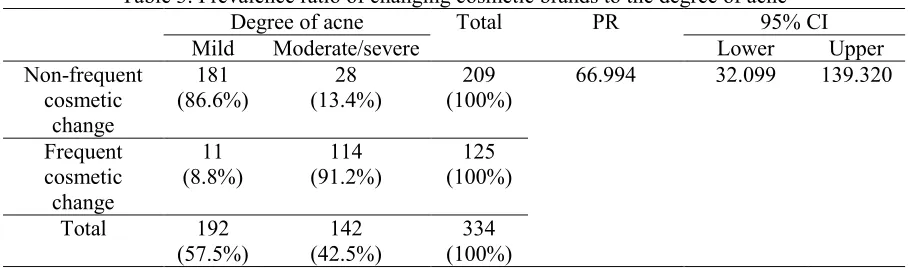
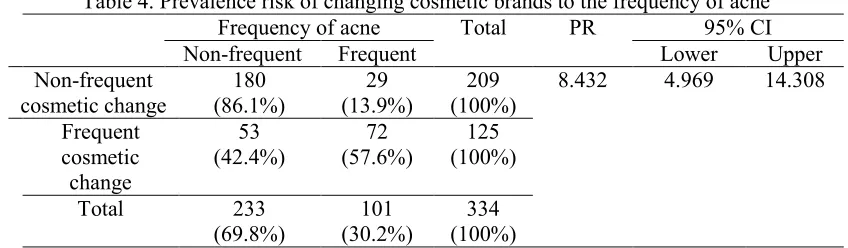
correlation (r2= 0.762) with the degree of acne and a mild positive correlation (r2=0.461) with acne frequency. Chi-square test showed statistical significance (p<0.05) between changing cosmetic brands and the degree and frequency of acne. Subjects who frequently changes cosmetics has a 66 times higher risk of having bad acne (PR= 66.994; CI 95% = 32.099–139.320) and 8 times higher risk of having more frequent acne (PR= 8.432; CI 95% = 4.969-14.308) compared to subjects that do not frequently change cosmetics.
Conclusion: Changing cosmetic brands increased the risk for both the degree of acne and the frequency
of acne.
Keywords: Acne vulgaris, changing cosmetic brands, frequency of acne, degree of acne
INTRODUCTION
Acne vulgaris is a skin disease caused by chronic inflammation of the follicular sebacea marked by the presence of blackheads, papules, pustules, nodules, and cysts in place of healthy skin [1]. Several factors that cause acne includes genetics, endocrine, food, sebaceae activity, stress, infection, cosmetics and other chemicals [2].
54
Excessive use of cosmetics and frequently changing cosmetics is a risk factor for Acne vulgaris [5]. Several cosmetic component may be comedogenic and acnegenic, such as: lanolin, petrolatum, several plant-based oils, butyl stearate, lauryl alcohol, and oleic acid [6]. With many cosmetic brands available in the market along with various chemical composition, changing cosmetics brands may expose skin to these comedogenic and acnegenic chemicals and may cause irritation due to skin incompatibility or skin adaptation to new chemicals. The aim of this research is to find out the relationship of changing cosmetics brands to the frequency and degree of Acne vulgaris.
METHODS
This is a cross-sectional observational study with 334 female undergraduates, recruited by total sampling. Female undergraduates were chosen for this study due to the fact that high school students are prohibited to wear makeup during school hours, while female undergraduates do not have that limitation. Subjects were given questionnaire to document the frequency of changing cosmetic brands and frequency of acne in the last 6 months
Changing of cosmetic brands
Cosmetic is defined as compounds that aremeant to be used superficially on the epidermis, hair, nails, lips, and external genitalia, or teeth and mouth mucosal membrane that cleans, scent, improve aesthetics, improve body odor and maintain good health. In this study, the cosmetics included in this study are powder (facial), foundation/BB cream, sun screen, and make-up remover. Subjects were included in the study if the subject used at least two out of four types of cosmetics mentioned. Changing cosmetic brands of at least one type of cosmetic more than 1 time in the last 6 months is considered frequent.
Acne severity
Acne severity were graded based on American Academy of Dermatology 1991 Consensus Conference on Acne Classification.The degree of acne was classified into mild and moderate/severe. Acne is classified as mild if there is <25 comedo, <10 papule/pustule, and no nodule. While moderate/severe acne have >25 comedo, >10 papule/pustule with nodules.The frequency of acne is classified into frequent and non-frequent. Developing acne more than 1 time in the last 6 months is considered frequent.
The data were then analyzed using Spearman’s correlation, Chi-square test, and prevalence ratio with 95% confidence interval.
RESULTS
Characteristic of respondents
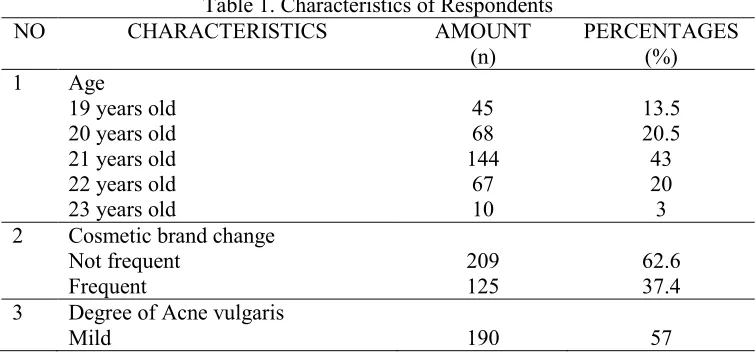
Table 1. Characteristics of Respondents
NO CHARACTERISTICS AMOUNT
(n) 2 Cosmetic brand change
Not frequent 3 Degree of Acne vulgaris
55
NO CHARACTERISTICS AMOUNT
(n)
PERCENTAGES (%)
Moderate/Severe 144 43
4 Frequency of Acne vulgaris Non-frequent 5 Distribution of cosmetic use
Powder
Most of the females in this study were 21 years old (43%) and 37.4% of the subjects changed cosmetic brands frequently. 43% of subjects experienced severe degree of acne and 30.2% experienced frequent acne. Powder were the most used cosmetics (96.4%) followed by foundation/BB cream, sun screen and makeup remover with 74.3%, 22.7%, and 31.1% respectively.
Bivariate analysis
The relationship of changing cosmetic brands to the frequency and degree of acne were analyzed using
Spearman’s correlation and Chi-square test using significance level p<0.05.
Table 2. Effect of changing cosmetic brands to frequency and degree of acne Changing cosmetic brands
Spearman’s correlation analysis showed positive correlation to both the frequency of acne outbreaks and the degree of acne (r=0.462 and 0.762 respectively). The Chi-square analysis showed p=0.000 (p<0.05) for both the frequency and degree of acne, showing that there is a statistically significant effect on changing cosmetic brands to the frequency and degree of acne.
Table 3. Prevalence ratio of changing cosmetic brands to the degree of acne
Degree of acne Total PR 95% CI
Mild Moderate/severe Lower Upper
56
Table 4. Prevalence risk of changing cosmetic brands to the frequency of acne
Frequency of acne Total PR 95% CI
Non-frequent Frequent Lower Upper
Non-frequent experiencing moderate/severe degree of acne compared to those who do not change cosmetic brands often. Females who change cosmetic brands often has 8 times higher probability of experiencing more acne outbreaks compared to those who do not change cosmetic brands often as shown in table 4.
DISCUSSION
Acne vulgaris is one of the most common skin disorders affecting up to 80% of the world population, especially during pubertal years and adolescence. Genetics, stress, poor hygiene, food, bacterial infection, sex and other unhealthy habits have been linked with acne in female adolescence and young adults [2,7,8]. Various causative factors, including cosmetic usage have been linked to acne.
The findings in this study showed that more than 96% of adolescence female use at least one type of cosmetic. A similar finding was also observed in a study in Sri Lankan urban adolescent females aged 15 to 17 years old showed 90% of the population use some form of cosmetic and only 10% are complete non-user.
Components in cosmetics that are comedogenic and acnegenicsuch as acetylated lanolin, benzaldehyde, D&C red, butyl stearate, and oil-based ingredients may be a causative factor for acne. The term, Acne cosmetica, was coined by Kligman and Mills [5] after observation of certain cosmetics were comedogenic when tested on external ear canals of rabbits and human subjects. The findings in this
study are similar to Kligman and Mills’ as there was a significant association between cosmetic use and acne. Due to these comedogenic and acnegenic components, cosmetic use may aggravate acne.
A cross-sectional study in 140 urban adolescent females in Sri Lanka showed a statistically significant moderately strong relationship between frequent usage of cosmetics and severity of acne in adolescent female [7]. This is similar with the findings in this study with positive correlation found between cosmetic brands change and the frequency and degree of acne.
57 CONCLUSION
This study showed that frequently changing cosmetic brands correlates positively with frequency and degree of acne in female undergraduates. Frequently changing cosmetic brands increase the risk of having more severe acne by 66 times higher in females. Females who frequently changing cosmetic brands have 8 times higher risk of experiencing more frequent acne breakouts compared to females who do not change cosmetic brands often. Females of this group age must be made aware that frequently changing cosmetic brands may be a potential aggravating factor for acne.
CONFLICT OF INTEREST
The authors declare no conflict of interest.
REFERENCES
1. Adhi D. Ilmu Penyakit Kulit Kelamin (The Science of Veneral Disease) 6th Edition. Jakarta: Fakultas Kedokteran Universitas Indonesia; 2010.
2. Tjekyan S. Kejadian Dan Faktor Resiko Akne Vulgaris (Prevalence and Risk Factors for Acne Vulgaris). Media Medika Indonesiana; 2009.
3. Badan Pengawas Obat dan Makan (Food and Drug Administration), Republik Indonesia. 2015.
4. Indonesian Trade Ministry. Indonesia Lahan Subur Indsutri Kosmetik (Indonesia Growing Cosmetics Market) .http://kemenperin.go.id/artikel/5897/Indonesia-Lahan-Subur-Industri-Kosmetik. (accessed: 27 Juli 2017)
5. Kligman AM, Mills OHJ. Acne cosmetica. Arch Dermatol. 1972;7:115-119.
6. Layton AM. Disorders of Sebaceous Glands. In: Burns T, Breathnach S, Cox N, Griffiths C, Editor. Rook’s Textbook of Dermatology, 8th. Oxford: Blackwell publishing; 2010.
7. Perera MPN, Peiris WMDM, Pathmanathan D, Mallawaarachchi S, Karunathilake IM. Relationship between acne vulgaris and cosmetic usage in Sri Lankan urban adolescent females. J Cosmet Dermatol. 2018;17:431–436.