Executive Information System
And Data Warehouse
Radiant Vict or Imbar
St af Pengaj ar Jur usan S-1 Si st em Inf or masi Fakul t as Teknol ogi Inf or masi
Uni ver si t as Kr i st en Mar anat ha
Jl . Pr of . Dr g. Sur i a Sumant r i No. 65, BANDUNG 40164 Emai l : radiant . vi@eng. maranat ha. edu
Abst rak
Hal t er pent i ng dal am suat u dat a war ehouse adal ah bahwa dat a war ehouse t er sebut dapat memuat semua i nf or masi bi sni s yang di per l ukan ol eh par a penggunanya dengan akses yang cepat dan dapat di i nt egr asi kan secar a mudah dengan si st em yang l ai nnya. Sebel um mer encanakan pembuat an suat u dat a war ehouse, maka akan sangat di per l ukan suat u konsep yang t epat dal am pembuat annya. Konsep t er sebut akan memuat banyak hal , di ant ar anya adal ah: oper asi onal i sasi dat abase, par a pengguna, pr oses koneksi nya, met adat a, dan l ai n sebagai nya.
Adapun execut i ve i nf or mat i on syst em (EIS) sendi r i adal ah suat u si st em i nf or masi yang ber dasar kan pada penggunaan dat a war ehouse sebagai l andasan dasar unt uk si st em i nf or masi manaj er i al nya. EIS i ni sendi r i dal am pr akt eknya sangat membant u pi hak manaj emen t i ngkat at as dal am penganal i saan dat a mel al ui pengaksesan dat a war ehouse.
Kat a kunci : Dat a war ehouse, i nf or masi , konsep, EIS.
1. Just ifying t he Dat a Warehouse
The dat a warehouse environment invol ves operat ional dat a (it is not real l y part of t he dat a warehouse, but onl y import ant t o it ), at omic dat a, summarized dat a, and answers t o specif ic queries. Al l are import ant in pl anning and designing a dat a warehouse.
An import ant part of dat a warehouse design is choosing an appropriat e dat abase st ruct ure. The st ruct ures used f or t ransact ion processing may not be wel l suit ed t o dat a warehouses because t he requirement s of t he t wo t ypes of comput ing are quit e dif f erent f rom one anot her. Dat a warehouses usual l y use t he rel at ional st ruct ure or t he mul t idimensional st ruct ure.
warehouse, t he kinds of decisions t hat wil l be made wit h t he aid of t hat dat a, t he ways t hose decisions are made wit hout t he dat a warehouse, and how decisions made wit h it (presumabl y bet t er decisions) wil l benef it t he organizat ion.
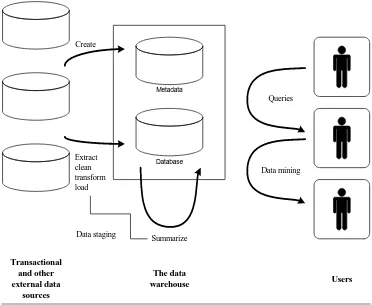
The maj or el ement s of a dat a warehouse and t he maj or ext ernal ent it ies wit h which a dat a warehouse int eract s incl ude :
1. The t ransact ion or ot her operat ional dat abase f rom which t he dat a warehouse is popul at ed. Ext ernal dat a is al so f ed int o some dat a warehouses.
A key point t o remember here is t hat t ransact ion dat a f eeds t he dat a warehouse. The dat a warehouse get s a copy of t he t ransact ion dat a. It does not st ore t ransact ion dat a direct l y.
2. A process t o ext ract dat a f rom t his dat abase, or t hese dat abases, and bring it int o t he dat a warehouse.
This process must of t en t ransf orm t he dat a int o t he dat abase st ruct ure and int ernal f ormat s of t he dat a warehouse.
3. A process t o cl eanse t he dat a, t o make sure it is of suf f icient qual it y f or decision making purposes f or which it wil l be used.
4. A process t o l oad t he cl eansed dat a int o t he dat a warehouse dat abase.
The f our processes f rom ext ract ion t hrough l oading are of t en ref erred t o col l ect ivel y as dat a st aging.
5. A process t o creat e any desired summaries of t he dat a : precal cul at ed t ot al s, averages, and t he l ike, which are expect ed t o be request ed of t en.
These are st ored in t he dat a warehouse al ong wit h t he dat a import ed f rom int ernal and ext ernal sources.
6. Met adat a (equal l y is dat a about dat a).
It is usef ul t o have a cent ral inf ormat ion reposit ory t o t el l users what ’ s in t he dat a warehouse, where it come f rom, who is in charge of it , and more. The met adat a can al so t el l query t ool s what ’ s in t he dat a warehouse, where t o f ind it , who is aut horized t o access it , and what summaries have been precal cul at ed.
7. The dat a warehouse dat abase it sel f .
(Radi ant Vi ct or Imbar )
8. Query t ool s.
These usual l y incl ude an end-user int erf ace f or posing quest ions t o t he dat abase, in a process cal l ed On-Line Anal yt ical Processing (OLAP). They may al so incl ude aut omat ed t ool s f or uncovering pat t erns in t he dat a, of t en ref erred t o as dat a mining. A given dat a warehouse must have at l east one of t his t wo t ypes and may have bot h.
9. The users f or whom t he dat a warehouse exist s and wit hout whom it woul d be usel ess.
The same concept s appl y t o a dat a mart , t hough each individual component woul d be more modest in scope. A dat a mart t ypical l y has f ewer dat a sources because it deal s wit h one subj ect area, meaning f ewer dat a t ransf ormat ion issues t o deal wit h and f ewer conf l ict s among t he sources, dif f erent names f or t he same dat a el ement , dif f erent dat a el ement s using t he same name, dif f erent val ues f or what shoul d be t he same dat a, and so f ort h. Since it is smal l er, it is l ess demanding of comput ing resources, making perf ormance t uning and opt imizat ion l ess crit ical . Since it s user communit y wil l be smal l er, it wil l require l ess t raining and support .
Metadata
Database
Queries
Data mining
Summarize Create
Extract clean transform load
Data staging
Transactional and other external data
sources
The data
warehouse Users
2. Executive Information Systems (EIS) and Dat a Warehouse
Since t he peopl e at t he t op l evel of an organizat ion are known as execut ives, such syst ems came t o be cal l ed Execut i ve Inf or mat i on Syst ems (EIS). A dat a warehouse is an excel l ent f oundat ion f or an EIS. The dat a
warehouse is t ail or-made f or t he needs of t he EIS anal yst . Once t he dat a warehouse has been buil t , t he j ob of t he EIS is inf init el y easier t han bef ore. Wit h a f ul l y popul at ed dat a warehouse in pl ace, t he anal yst can be in a proact ive st ance, not an et ernal l y react ive st ance, wit h regards t o meet ing management ’ s needs.
The reason f or which an execut ive want s t o use an EIS l eads direct l y t o t he capabil it ies t hat t he syst em must provide. Gaining comput er l it eracy might al l ow t he user t o manipul at e dat a direct l y, perhaps by providing a spreadsheet or query capabil it y. Sending a signal may require l it t l e beyond highl y visibl e use of somet hing. Facil it at ing change general l y invol ves communicat ion capabil it y. Boost ing personal work ef f iciency, and sol ving specif ic probl ems, depend on sof t ware t ail ored eit her t o t he execut ive’ s exist ing work bot t l enecks or t he specif ic probl ems in quest ion. This is t he usual reason f or dat a warehouse devel opment .
In t he on-l ine mode of operat ion, t he EIS is essent ial l y an easy t o use query syst em t ied t o a dat abase. The query is coded ahead of t ime by prof essional programmers. Syst ems of t his t ype can be l inked direct l y t o t he l ive corporat e dat abase or t o a st at ic dat a warehouse.
In of f -l ine mode of operat ion, a wide range of possibl e queries is issued t o t he dat abase during a period of l ight syst em l oad such as t he earl y hours of t he morning. Dat a are ext ract ed and screens prepared f or displ ay. When a user asks f or specif ic inf ormat ion, t he corresponding screen is ret rieved immediat el y f rom t he EIS screen dat abase and displ ayed. No comput at ion is required, ot her t han int erpret ing t he condensed f orm in which t he screen is st ored.
Summary
A dat a warehouse is a col l ect ion of a wide variet y of corporat e dat a, organized and made avail abl e t o end users f or decision making purposes. A smal l er col l ect ion, usual l y rel at ing t o one specif ic aspect of an organizat ion, is cal l ed dat a mart .
(Radi ant Vi ct or Imbar )
The dat a warehouses consist s of mul t ipl e el ement s. The operat ional dat abases t hat f eed it are at one side, t he users who access it at t he ot her. In bet ween are t he dat a warehouse dat abase and a met adat a dat abase t hat describes t he cont ent of t he dat a warehouse dat abase. These are connect ed by processes which ext ract dat a f rom t he operat ional dat abases f or t he dat a warehouse dat abase, t ransf orm it and cl ean it as required, creat e any desired summaries, and creat e t he necessary met adat a.
An execut ive inf ormat ion syst em (EIS) is an inf ormat ion syst em t hat provides inf ormat ion t o t op execut ives t o support t heir decision making needs. Reason f or using EIS incl ude sol ving specif ic probl ems in decision making or cont rol , boost ing t he execut ive’ s personal work ef f iciency, f acil it at ing change in t he organizat ion, sending a signal t o subordinat es, and gaining comput er l it eracy.
BIBLIOGRAPHY
Inmon, W. H. (1996). Bui l di ng t he Dat a War ehouse. New York : Wil ey.
Mal l ach, E. G. (2000). Deci si on Suppor t and Dat a War ehouse Syst em.
McGraw-Hil l .
Mart in, E. W. , DeHayes, D. W. , Hof f er, J. A. , & Perkins, W. C. (1991).
Managi ng Inf or mat i on Technol ogy: What Manager s Need t o Know.
New York : Macmil l an.