*corresponding author : [email protected]
Effect of exercise on lipid peroxidation in
student soccer players
Desty Ervira Puspaningtyas1,2*, Yuni Afriani1,2, Silvi Lailatul Mahfida1, Wara Kushartanti3 and Arta Farmawati4
1Public Health Postgraduate Program, Faculty of Medicine, Universitas Gadjah Mada, Yogyakarta, 2Nutrition Science Program, Faculty of Health Sciences, Universitas Respati Yogyakarta, Yogyakarta, 3Faculty of Sport Science, Universitas Negeri Yogyakarta, Yogyakarta, 4Department of Biochemistry, Faculty of Medicine, Universitas Gadjah Mada, Yogyakarta
DOI: http://dx.doi.org/10.19106/JMedSci005001201811
ABSTRACT
Training is conducted to improve physiological functions that can support improvement of cardio-respiratory function (O2max). However, intensive training can lead to oxidative stress, which can contribute to health problems. The purpose of this study was to evaluate the effect of training on serum lipid peroxidation levels in student soccer players. The study was pre-experimental study with a one-shot case design conducted in April 2014. Twelve student soccer players from UGM who chosen by purposive sampling and met the inclusion and exclusion criteria were involved in the study. Each subject received training in the form of O2max measurements using the yo-yo intermittent recovery test. Plasma malondialdehyde (MDA) levels were measured using the thiobarbituric acid method 30 min after O2max measurement. Pearson correlation was used to analyze the correlation between O2max and plasma MDA levels. The mean age of subject was 19.25±1.06 years old. Subjects had normal nutritional status (body mass index 20.99 ± 1.65) with mean body weight of 58.13±3.76 kg and mean height of 166.2±3.40 cm. The mean O2max score was 49.56±0.61 mL/kg/min. The mean plasma MDA level was 4.32±2.09 µmol/L. There was no significant correlation between O2max and plasma MDA levels (p=0.7717). In conclusion, training does not negatively impact oxidative stress conditions in student soccer players.
ABSTRAK
Latihan dilakukan untuk meningkatkan funsi fisiologi yang dapat memperbaiki funsi kardio-respirasi (O2max). Namun demikian, latihan yang berlebihan dapat menyebabkan stres oksidatif yang dapat menimbulkan gangguan kesehatan. Penelitian ini bertujuan untuk mengkaji efek latihan terhadap peroksidasi lipid serum pada pemain sepak bola mahasiswa. Penelitian ini adalah penelitian pendahuluan dengan rancangan kasul bentuk tunggal dilakukan pada April 2014. Dua belas pemain sepak bola mahasiswa dari UGM dipilih dengan teknik purposive sampling sesuai kriteria inklusi dan eksklusi dilibatkan dalam penelitian. Setiap subjek menjalani latihan untuk ditetapkan O2max nya dengan uji
INTRODUCTION
Physical exercise is beneicial to the body, particularly for physical and psychological health and social wellbeing. Additionally, physical exercise can delay the aging process. There is an increase in the sympathetic nerve response at the beginning of physical exercise. Next, the cardiovascular system adaptation is adjusted, resulting in an increase in cardiac rate, cardiac force, and arterial pressure. There is also an increase in metabolism, blood glucose concentrations, and glycolysis in the liver and muscles. Furthermore, the respiratory system adapts. These factors contribute to good athletic performance.1 For example, study
conducted on a male athlete who did a solo ultra-endurance open-water swim showed that heart rate increased by 41.8% and salivary alpha-amylase (sAA) levels increased by 102.6% after athlete completed swim 78.1 km in 23 h 44 min. It conirmed that the autonomic drives depend upon exercise eforts. Indeed, exercise by doing ultra-endurance swim diferently inluenced cardiac function by both adaptive autonomic and non-autonomic patterns.2 An additional study in seven healthy
adult male sport-parachutists demonstrated that exercise done in the form of parachute jumping led to a strong response of salivary cortisol, α-amylase, and heart rate. There was an increase of salivary cortisol and α-amylase levels and heart rate at 12 h before jumping (basal) and within 60 s (jump).3
Soccer is a sport that requires strength and cardiorespiratory endurance, because the distances covered during a game range from 9,800 to 11,500 m.4-5 Soccer is accompanied
by strong and explosive activities, such as jogging, sprinting, jumping, tackling, and heading and kicking the ball.4,6 Therefore,
exercise is important to increasing the cardiorespiratory response of soccer players. One study indicated that to signiicantly improve achievement, athletes must increase their performance, because performance is one of the primary determinants of a win. Athletes receive training and exercise to improve their performance. Not only do athletes receive training focused on techniques and tactics but also to improve physical itness.4
Cardio-respiratory function (O2max) measurements can represent physical itness.
O2max is an upper limit measurement of the
ability of the body to consume, distribute, and use oxygen. O2max is deined as the integrated physiological function of the lungs, heart, blood, and muscles.7 The average
endurance score of soccer players belonging to Gelora Remaja Football Club, Division I Football of Football Association of Pasuruan District (Persekabas) illustrated by O2max measurement using the multistage shuttle run test was 38.13 mL/kg/minute.8 The average
endurance score of soccer players belonging to Football Association of Kudus District, Central Java, Indonesia measured by O2max using the cooper test was 50 mL/kg/minute.9
20.99 ± 1.65) dengan rerata berat badan 58.13 ± 3.76 kg dan tinggi badan 166.20 ± 3.40 cm. Rerata skor O2max adalah 49.56 ± 0.61 mL/kg/menit. Rerata kadar MDA plasma adalah 4.32 ± 2.09 µmol/L. Tidak ada korelasi nyata antara O2max dan kadar MDA plasma. Dapat disimpulkan, pelatihan tidak menyebabkan stress oksidatif yang merugikan pada pemaian sepak bola mahasiswa.
Study conducted by Luhtanen et al.10 reported
that the cardiorespiratory function of young soccer player measured by O2max test on a treadmill starting at a speed of 9 km/h and increasing speed by 1 km/h after every three minutes was 53.5 mL/kg/min. Another study
reported that mean values for an oxygen consumption of non-elite university-level Gaelic footballers ranged from 54.77 to 65.31 mL/kg/min for soloing with the ball and 52 to
63.63 mL/kg/minute for running without the
ball.11 Hence, training and exercise are needed
to increase the cardiorespiratory response (O2max) from soccer players. Previous study demonstrated that weekly 30 min session of intermittent high-intensity drills could increase physical performance of high-level soccer players in the competitive season measured
by O2max using an incremental treadmill test. The O
2max after training and exercise period
(62.2 mL/kg/min) was higher than O2max
before training and exercise period (59 mL/
kg/min).12
Although exercise confers numerous beneits, rigorous physical exercise can cause oxidative stress.1,13-15 Oxidative stress
is a condition in which there is an imbalance between free radicals and antioxidants.16 Study
conducted on nine futsal athletes showed that signiicantly 15 min after exercise there was an increasing of MDA levels―an indicator of oxidative stress.1 Study conducted by
Souza et al.14 reported that exercise with
treadmill running increased plasmatic MDA concentration during and after its performance. Another study in 24 physical education students indicated that concentration of MDA as oxidative stress indices signiicantly increased at immediately and 24 h after aerobic exercise.15 One study determined that aerobic
exercise with moderate intensity caused an increase in oxygen consumption that triggered free radical formation by mitochondria. Free
radical formation can harm cells, proteins, DNA, and other cellular components through the oxidation process.17
Exercise can produce an imbalance between reactive oxygen species (ROS) and antioxidants, commonly known as oxidative stress. Physical exercise increases free radical production through multiple pathways. Of the oxygen used in the mitochondria, 2–5% produces free radicals. Increased oxidative phosphorylation results in increased free radical production. If the rise in free radicals is greater than the ability of the body to neutralize it, the free radicals will attack cell components and particularly body fat. An attack on body fat is commonly known as lipid peroxidation, which can further increase free radicals.16
A frequently used indicator of lipid peroxidation is MDA.13,16 Serum MDA levels
can signiicantly increase under high oxidative stress conditions.16 Thus, it is critical to better
understand the correlation between exercise, as assessed by O2max measurements, and MDA levels. Several studies investigating professional athletes have demonstrated that rigorous physical exercise can cause oxidative stress, although these indings are controversial. In this study, we assessed the efect of exercise, using yo-yo intermittent recovery test, on serum lipid peroxidation levels in student soccer players.
MATERIALS AND METHODS
Subjects
UGM who lived in Yogyakarta Special Region and chosen by purposive sampling as well as met the inclusion and exclusion criteria were involved in the study. The inclusion criteria for subjects were willingness to participate in the study, male, age ≥ 18 years, non-smokers, not taking supplements during the study, and having lived in the study area for at least 6 months. Exclusion criteria included injury, fracture, or treatment during the study.
Protocol of the study
Prior to the study subjects received an explanation concerning the background, objectives and beneit of the study. Subjects were given an informed consent to be signed. Characteristics of subjects including age, weight, height, body mass index (BMI), educational level, and position on the team were recorded. Each subject then received training in the form of O2max measurements at the Stadium of Universitas Negeri Yogyakarta (UNY) using the yo-yo intermittent recovery test followed by exercise until the subject reached 80% of their maximum heart rate. In yo-yo intermittent recovery test, subjects must start on or behind the line, and began running 20 m when instructed by the recorder. Then, subject turned and returned to the starting point when signaled by the recorded beep. A warning was given when the subject did not complete a successful out and back shuttle in the allocated time. Subject was removed the next time when subject did not complete a successful shuttle. The type of exercise performed by the subjects was anaerobic endurance with fartlek training, which included walking, jogging, and sprinting. Subjects then cooled down for ive min. The equation used to calculate the O2max.18 O
2max
(mL/min/kg) = [yo-yo intermittent recovery test distance (m) × 0.0136] + 45.3.
Thirty min after O2max measurements followed by exercise (anaerobic endurance with fartlek type), blood samples were collected and plasma MDA levels were measure spectrophotometrically using the thiobarbituric acid method at Laboratory of Biochemistry, Faculty of Medicine, Universitas Gadjah Mada, Yogyakarta. The
day prior to analysis, study subjects received instructions through a short messages service. Speciically, the subjects were instructed not to do heavy activities, such as running or other exercise, to sleep at least 6–8 h, and to not drink cafeinated drinks, alcohol, or vitamin-mineral drinks. A 24-h food recall form, food record form, and questionnaire of sleep quality index were used to correct for the subject’s condition and the subject’s restraint. The protocol of the study has been approved by the Medical and Health Research Ethics Committee (MHREC), Faculty of Medicine, Universitas Gadjah Mada, Yogyakarta (KE/ FK/257/EC).
Statistical analysis
RESULTS
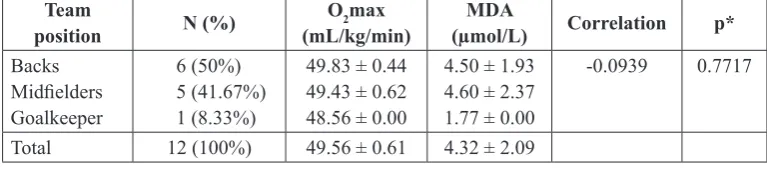
The characteristics of subjects are presented in TABLE 1, whereas the O2max scores and plasma MDA levels are presented in TABLE 2.
TABLE 1. Characteristics of subjects Characteristics Mean ± SD/ N (%) Age (years)
Weight (kg) Height (cm) BMI (kg/m2)
19.25 ± 1.06 58.13 ± 3.76 166.52 ± 3.40 20.99 ± 1.65 Educational level
Diploma degree
Bachelor degree 5 (41.67%)7 (58.33%) Position on the team
Backs Midielders Goal Keeper
6 (50%) 5 (41.67%) 1 (8.33%)
TABLE 2. O2max and plasma MDA levels (mean ± SD) by team position and its correlation
Team
position N (%)
O2max (mL/kg/min)
MDA
(µmol/L) Correlation p* Backs
Midielders Goalkeeper
6 (50%) 5 (41.67%) 1 (8.33%)
49.83 ± 0.44 49.43 ± 0.62 48.56 ± 0.00
4.50 ± 1.93 4.60 ± 2.37 1.77 ± 0.00
-0.0939 0.7717
Total 12 (100%) 49.56 ± 0.61 4.32 ± 2.09
O2max: Cardio-respiratory function; MDA:Malondialdehyde; *Pearson correlation
The backs and the midielders showed comparable O2max scores and plasma MDA levels, while the goalkeeper showed the lowest O2max score and plasma MDA level (TABLE 2). Moreover, the mean O2max score was 49.56 mL/kg/min, and the mean plsma MDA level was 4.32 µmol/L. No signiicant correlation between O2max and plasma MDA levels was observed (p=0.7717) (TABLE 2).
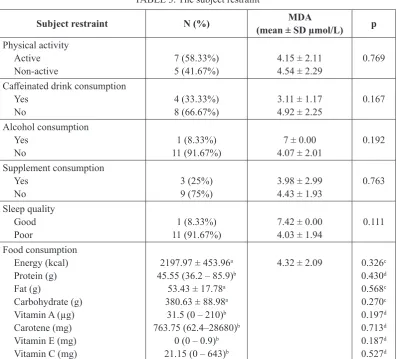
Other variables can also afect plasma MDA levels in student soccer players. Based on the subject questionnaires, seven subjects performed strenuous exercise, four subjects consumed cafeinated drinks, one subject consumed alcoholic drinks, and three subjects consumed supplements the day prior to the study. Additionally, four subjects did not sleep
TABLE 3. The subject restraint
Subject restraint N (%) MDA
(mean ± SD µmol/L) p Physical activity
Active
Non-active 7 (58.33%) 5 (41.67%) 4.15 ± 2.11 4.54 ± 2.29 0.769 Cafeinated drink consumption
Yes
No 4 (33.33%) 8 (66.67%) 3.11 ± 1.17 4.92 ± 2.25 0.167 Alcohol consumption
Yes
No 11 (91.67%)1 (8.33%) 4.07 ± 2.017 ± 0.00 0.192 Supplement consumption
Yes
No 3 (25%) 9 (75%) 3.98 ± 2.99 4.43 ± 1.93 0.763 Sleep quality
Good
Poor 11 (91.67%)1 (8.33%) 7.42 ± 0.00 4.03 ± 1.94 0.111 Food consumption
Energy (kcal) Protein (g) Fat (g)
Carbohydrate (g) Vitamin A (µg) Carotene (mg) Vitamin E (mg) Vitamin C (mg)
2197.97 ± 453.96a
45.55 (36.2 – 85.9)b
53.43 ± 17.78a
380.63 ± 88.98a
31.5 (0 – 210)b
763.75 (62.4–28680)b
0 (0 – 0.9)b
21.15 (0 – 643)b
4.32 ± 2.09 0.326c
0.430d
0.568c
0.270c
0.197d 0.713d 0.187d 0.527d
MDA: malondialdehyde; amean ± SD; bmedian (min-max); cPearson correlation; dSpearman correlation
DISCUSSION
We demonstrated that the backs and the midielders had comparable O2max scores and MDA levels, while the goalkeeper had the lowest O2max score and MDA level (TABLE 2). Previous studies reported the little diference between positions in the distances covered by soccer players. However, it was reported that fullbacks sprinted more than twice as much as central-defenders (2.5 times longer), while midielders and attackers sprinted signiicantly more than central-defenders (1.6–1.7 times longer). Moreover, fullbacks and attackers sprinted signiicantly longer than central-backs and midielders.4
Diferent distances covered by athletes result in diferent O2max scores and plasma MDA levels. This study investigated O2max score and plasma MDA level diferences in the backs as a group; however, an investigation of more speciic positions, such as full back or central-back, may reveal additional diferences.
No signiicant correlation between
O2max scores and plasma MDA levels was
observed in this study (TABLE 3). This results difered from those of a previous study that reported the increase of plasma MDA levels 15 min after exercise in nine futsal athletes signiicantly.1 Previous study
increase plasma MDA levels during and after
its performance.14 Another study conducted in
24 physical education students reported that plasm MDA levels increase immediately and 24 h after aerobic exercise.15 Athletes receive
training not only to improve performance of technical skills, tactical skills, and athletic experience, but also to improve physiological functions, psychological functions, and social wellbeing.6,19 Moreover, physical exercise can
delay the aging process.1
Although exercise increases athletic performance, rigorous physical exercise can cause oxidative stress, which is associated with fatigue and cell damage.1,13-15,20
Oxidative stress is a condition in which there is an imbalance between free radicals and antioxidants.16 There is an alteration in heart
function and blood volume during aerobic exercise, which results in higher oxygen consumption. Exercise causes blood capillary proliferation and increased mitochondrial enzymes, alternating muscle metabolism. This results in increased lipid peroxidation.6
One study demonstrated that aerobic exercise with moderate intensity leads to increased oxygen consumption, impacting free radical formation by the mitochondria. Free radical formation can endanger lipid cells, proteins, DNA, and other cells through the oxidation process.17 During physical exercise,
oxygen plays an important role. It is necessary during physical exercise, however it can also be a dangerous substance due to it can increase oxidative stress. Increased oxygen volume will increase skeletal muscle metabolism, which can increase the production of ROS, a free radical with negative consequences. Additionally, NADPH oxidase activity, PLA2-dependent processes, xanthine oxidase activity, and phagocyte cells can increase ROS production.21
Malondihaldehyde is an indirect measurement of free radical activity.16 Some
studies reported that oxidative stress from lipid peroxidation can be measured by MDA levels.1,14 Malondihaldehyde (C
3H4O2) is a
compound with a three carbon chain and results from lipid oxidation, particularly from arachidonate, eicosapentaenoate, and docosahexaenoate fatty acids.14 Several studies
have used MDA as an indicator of oxidative stress caused by exercise. When a free radical is formed, it can attack polyunsaturated fatty acids in the cell membrane, causing the formation of other chemical reactions, commonly called lipid peroxidation. The fatty acids are then broken down and produce carbon gases (ethane or pentane) as well as aldehyde formation.16
This results difered from previous study indicating that excessive physical activity can increase oxidative stress, characterized by elevated plasma MDA levels. There are several possible explanations as to why this study difered from others. Under high oxidative stress conditions, plasma MDA levels signiicantly increase. When oxidative stress is resolved, plasma MDA levels normally decrease.14 Athletes may be able
to better compensate for the free radical elevation, which can cause lipid peroxidation and consequently increased plasma MDA levels.
Several factors contribute to overcoming oxidative stress. Subjects with increased physical activity displayed lower MDA levels than subjects with non-active physical activity, although it was not statistically signiicant (TABLE 4). Metin et al.13 suggested that
variable that may contribute to plasma MDA levels was alcohol consumption. A previous study by Deshpande et al.22 demonstrated a
correlation between plasma MDA levels and alcohol consumption. In this study, a subject who consumed alcohol displayed higher plasma MDA levels than those of subjects who did not. Additionally, subjects taking vitamin supplements displayed lower plasma MDA levels than those of subjects who did not. Based on subject interviews, the most common supplement consumed was vitamin C. Free radicals, as part of the oxidative stress process, can be neutralized by the antioxidant defense system. The antioxidant defense system consists of enzymatic antioxidants, such as catalase, superoxide dismutase, glutathione peroxidase, and non-enzymatic antioxidants, including vitamin A, E, C, glutathione, ubiquinone, and lavonoids.16
Antioxidant supplementation can neutralize ROS and reactive nitrogen species and reduce the risk of muscle damage. Supplementation with 1000 mg vitamin C and 300 mg α-tocopherol acetate can prevent exercise-induced lipid peroxidation.23
Vitamin C serves as an antioxidant by reacting with free radicals, thus reducing the ability of free radicals to attack polyunsaturated fatty acids and improving plasma MDA levels. One study demonstrated that vitamin C supplementation prevented endurance exercise-induced lipid peroxidation.24
Additionally, vitamin C can overcome ROS, including superoxide or hydroxyl radicals.25 Supplementation with vitamin
C and vitamin E helps to reduce markers of exercise-induced muscle damage. This was illustrated by the signiicant reduction in oxidative stress markers (creatine kinase and malondialdehyde) in a group receiving 250 mg of vitamin C or both vitamin C and vitamin E supplementation.26
Vitamin E also plays a role as an antioxidant. Vitamin E supplementation for two weeks can signiicantly decrease MDA levels before and after an ergometric test, which measures performance.27 A study
investigating β carotene, vitamin E, A, C, zinc, and selenium supplementation demonstrated that serum MDA levels were remarkably reduced after two weeks of supplementation. Furthermore, hemoglobin levels, packed cell volume (PCV), and red blood cells (RBC) in Indian athletes were also improved.28
One weakness of this study is that we did not measure other variables that can be used as oxidative stress indicators, such as lipid hydroperoxide, creatine kinase, superoxide radicals, and other radicals. Additionally, this study did not measure the antioxidant capacity of the body, including measurements of catalase, superoxide dismutase, and glutathione peroxidase levels. This study was pre-experimental with a one-shot case study design or a one-group post only design. Thus, the researcher did not know the diferences before and after exercise or training. Another weakness is that the subjects only received restraint instructions through a short message service. The results should be validated following subject quarantine prior to the study to control the restraints.
CONCLUSION
other radicals. In addition, further research is also needed to investigate the antioxidant capacity of the body, including measurements of catalase, superoxide dismutase, and glutathione peroxidase levels.
ACKNOWLEDGMENTS
The authors would like to thank Mr. Komarudin, M.A., Mr. Geovany Akbar, and Mr. Benny Criya Permana for their valuable assistances during data collection. The authors would also like to thank the athletes who participated in this study.
REFERENCES
1. Valado A, Pereira L, Tavares PC, Ribeiro CF. Efect of the intense anaerobic exercise on nitric oxide and malondialdehyde in studies of oxidative stress. Int J Biol Biomed Engin 2007;1(1):32-6.
2. Valenzano A, Moscatelli F, Triggiani AI, Capranica L, De Ioannon G, Piacentini MF, et al. Heart rate changes after ultra-endurance swim from Italy to Albania: a case report. Int J Sports Physiol Perform 2015; 11(3):407-9. http://dx.doi.org/10.1123/ijspp.2015-0035 3. Giovani M, Valenzano A, Moscatelli F,
Triggiani AI, Capranica L, Messina A, et al.
Efects of emotional stress on neuroendocrine and autonomic functions in skydiving. J Psychiatry 2015; 18(4):1-7.
http://dx.doi.org/10.4172/Psychiatry.1000280 4. Stolen T, Chamari K, Castagna C, Wislof U.
Physiology of soccer: an update. Sports Med 2005; 35(6):501-36.
http://dx.doi.org/10.2165/00007256-200535060-00004
5. Irawan MA. Cairan, karbohidrat dan performa sepak bola. Sports Science Brief 2007; 01(05). 6. Bangsbo Jens. Physiology of training. In:
Thomas Reilly (ed) Science and Soccer. UK: Spon Press Taylor & Francis Group. 2003.
7. Reilly T. Fitness assessment. In: Thomas Reilly (ed) Science and Soccer. UK: Spon Press Taylor & Francis Group. 2003
8. Penggalih MHST, Huriyati E. Gaya hidup,
status gizi dan stamina atlet pada sebuah klub sepak bola. Berita Kedokteran Masyarakat 2007; 23(4):192-9.
9. Aliyana L, Murbawani EA. Pengaruh pemberian air kelapa terhadap kebugaran atlet sepak bola. JNutr Coll 2012; 1(1):336-49. 10. Luhtanen P. Nummela A, Lipponen K.
Physical loading, stress, and recovery in a youth soccer tournament. In: Thomas Reilly and Feza Korkusuz (ed) Science and Football VI, The Proceedings of the Sixth World Congress on Science and Football. New York: Routledge. 2009.
11. Hulton A, Ford T, Reilly T. The energy cost of soloing a gaelic football. In: Thomas Reilly and Feza Korkusuz (ed) Science and Football VI, The Proceedings of the Sixth World Congress on Science and Football. New York: Routledge. 2009.
12. Jensen, Jack Majgaard, Morten Bredsgaard Randers, Peter Krustrup, Jens Bangsbo. Intermittent high-intensity drills improve in-seasonal performance of elite soccer players. In: Thomas Reilly and Feza Korkusuz (ed) Science and Football VI, The Proceedings of the Sixth World Congress on Science and Football. New York: Routledge. 2009.
13. Metin G, Atureken P, Alturfan AA, Gulyasar T, Kaya M, Gumustas MK. Lipid peroxidation, erythrocyte superoxide-dismutase activity and trace metals in young male fotballers. Yonsei Med J 2003; 44(6):979-86.
http://dx.doi.org/10.3349/ymj.2003.44.6.979 14. de Souza TP Jr, de Oliveira PR, Pereira
http://dx.doi.org/ 10.1590/S1517-86922005000100010
15. Atashak S, Sarai H. Plasma malondialdehyde response to aerobic exercise after T. polium
supplementation. Eur J Exp Biol 2013; 3(2):499-502.
16. Urso ML, Clarkson PM. Oxidative stress, exercise, and antioxidant supplementation. Toxicology 2003; 189(1-2):41-54.
h t t p : / / d x . d o i . o r g / 1 0 . 1 0 1 6 / S 0 3 0 0 -483X(03)00151-3
17. Victor KL, McArdle WD, Katch FL. Essentials of exercise physiology, 4th Ed.
China: Lippincott Williams & Wilkins. 2011. 18. Bangsbo J, Iaia FM, Krustrup P. The
Yo-Yo intermittent recovery test a useful tool for evaluation of physical performance in intermittent sports. Sports Med 2008; 38(1):37-51.
http://dx.doi.org/10.2165/00007256-200838010-00004
19. William Clyde. Metabolic aspects of exercise. In: Reilly T, Secher N, Snell P, Williams C. (ed) Physiology of Sports. UK: Spon Press. 2005.
20. Eroglu Y, Daglioglu O. The efect of submaximal exercise on oxidant and antioxidant mechanisms in judokas and sedentary. Int J Sport Std 2013; 3(5):480-6. 21. Powers SK, Nelson WB, Hudson MB.
Exercise-induced oxidative stress in humans: cause and consequences. Free Radic Biol Med 2011; 51(5):942-50.
h t t p : / / d x . d o i . o r g / 1 0 . 1 0 1 6 / j . freeradbiomed.2010.12.009
22. Deshpande N, Kandi S, Kumar PVB, Ramana KV, Muddeshwar M. Efect of alcohol consumption on oxidative stress markers and its role in the pathogenesis and progression
of liver cirrhosis. Am J Med Biol Res 2013; 1(4):99-102.
http://dx.doi.org/10.12691/ajmbr-1-4-3 23. Mastaloudis A, Morrow JD, Hopkins
DW, Devaraj S, Traber MG. Antioxidant supplementation prevents exercise-induced lipid peroxidation, but not inlammation, in ultramarathon runners. Free Radic Biol Med 2004; 36(10):1329-41.
h t t p : / / d x . d o i . o r g / 1 0 . 1 0 1 6 / j . freeradbiomed.2004.02.069
24. Nakhostin-Roohi B, Babaei P, Rahmania-Nia F, Bohlooli S. Efect of vitamin C supplementation on lipid peroxidation, muscle damage and inlammation after 30-min exercise at 75% Ѵo2max. J Sports Med Phys Fitness 2008; 48(2):217-24.
25. Gallagher, Margie Lee. The nutrients and their metabolism. In: Krause’s Food & Nutrition Therapy Edition 12. Canada: Elsevier. 2008. 26. Taghiyar M, Darvishi L, Askari G, Feizi A,
Hariri M, Mashhadi NS, et al. The efect of
vitamin C and E supplementation on muscle damage and oxidative stress in female athletes: a clinical trial. Int J Prev Med 2013; 4(Suppl 1):16-23.
27. Roshan VD, Najafabadi EM. The efect of short-term vitamin E supplementation on some indexes of sport performance and lipid per-oxidation in healthy men. World J Sport Sci 2009; 2(2):75-81.
28. Kelkar G, Subhadra K, Chengappa RK. Efect of antioxidant supplementation on hematological parameters, oxidative stress and performance of Indian athletes. J Hum Ecol 2008; 24(3):209-13.